My husband did not answer the investigator immediately.
For most of our marriage, I had watched him answer difficult questions by changing their shape.
If his mother insulted me, she had been stressed.
If she crossed a boundary, she was trying to help.
If I objected, I was taking things personally.
But there was no softer version of the question sitting between us that evening.
“When your mother proposed that story, did you know it was false?”
He looked at the investigator.
Then he looked at me.
Finally, he said, “I knew she didn’t just bump the chair.”
His mother turned toward him so quickly that her chair scraped the floor.
It was the first completely honest sentence I had heard from him since the cookout.
The investigator wrote something down.
My mother-in-law started talking.
“She spilled food all over my table. I reacted. I shouldn’t have reacted that way, but everyone is acting like I attacked her.”
I felt my arms tighten around my daughter.
Even after the ER, even after the mark on her cheek had been examined, even after watching herself strike a two-year-old on VIDEO, she was still bargaining over the size of what she had done.
The investigator did not bargain with her.
“Did you slap the child?”
My mother-in-law stared at the table.
“Yes.”
“Did you then tell the family to say she hit the chair?”
A long silence followed.
“Yes.”
That was the first answer.
The withheld question had never really been whether my daughter had been hit.
The recording had settled that.
The real question was why several adults who knew what happened had immediately begun treating the truth like the problem.
The investigator separated everyone.
My cousin was contacted first.
She had been sitting far enough from my mother-in-law that nobody had noticed her phone was already pointed toward the table.
She had started recording before the slap because relatives had been joking around near the grill and she wanted a short family clip.
That ordinary decision changed everything.
Her VIDEO did not begin with an accusation.
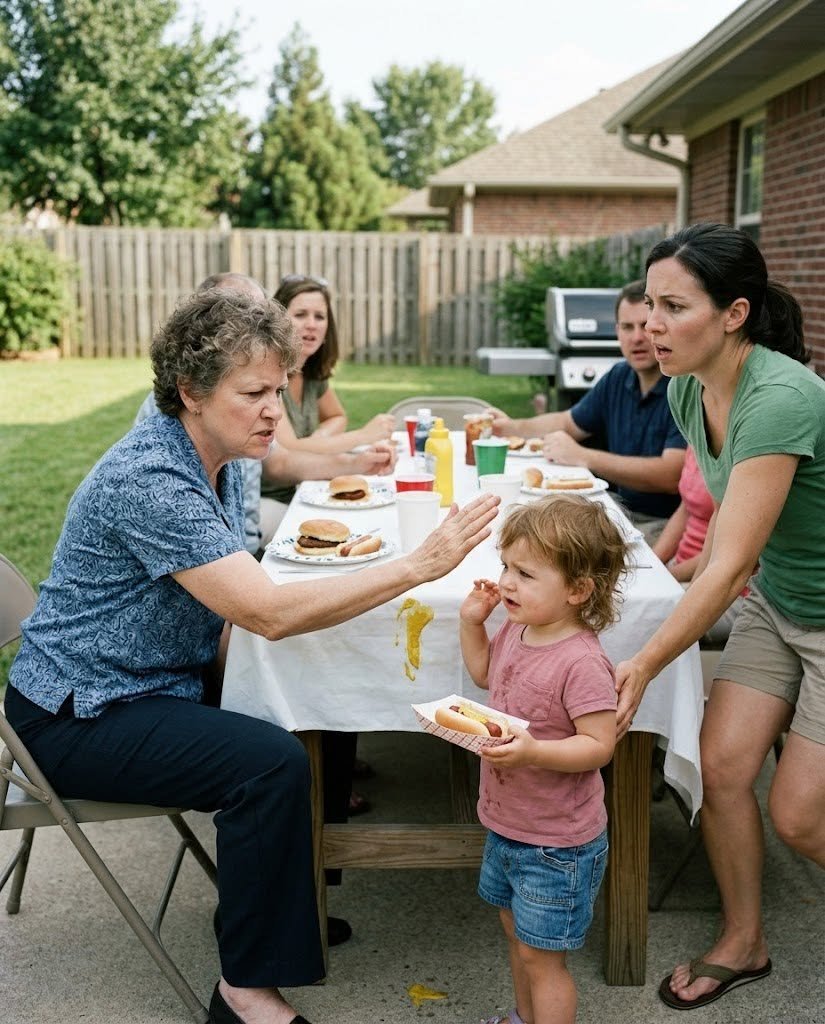
It began with hot dogs, paper plates, adults talking over one another, and my daughter trying to hold food with two small hands.
Then mustard dropped.
My mother-in-law turned.
Her hand moved.
My daughter’s head snapped sideways.
The chair scraped.
And afterward came the part my mother-in-law had apparently forgotten a camera could preserve.
“We’ll say she hit the chair.”
The investigator asked my cousin what happened next.
My cousin said nobody held a vote.
Nobody gathered around and formally agreed.
It happened in the more familiar, uglier way families sometimes protect the person with the most power.
My mother-in-law announced the version she wanted.
My husband told everyone not to make things worse.
My father-in-law said nothing and kept eating.
Two other relatives avoided the argument completely.
By the time I picked up my daughter, the table had divided itself without anyone needing instructions.
There was me and my child.
And there was everyone trying to get back to lunch.
That distinction mattered.
The investigator did not accuse every silent person of inventing the lie.
She asked each adult separately what they had actually seen and what they had actually heard.
My father-in-law admitted he had seen his wife slap my daughter.
He also admitted hearing her say they should blame the chair.
“Why didn’t you correct it?” he was asked.
He said he did not want a family fight.
I remember hearing that later and feeling something in me go cold.
A family fight.
My two-year-old daughter had been struck hard enough to leave a visible mark, and his concern had been preventing an argument.
My husband’s interview lasted longer.
He first said he had been trying to calm everyone down.
Then he said taking my keys had been an attempt to keep me from driving while upset.
I was glad I was not in the room when he said it.
Because the VIDEO did not show a man worried about an emotional driver.
It showed him taking the keys after I said I was leaving with our injured child and telling me I could not go until I apologized to his mother.
That distinction was not subtle.
When he came back out, he looked smaller somehow.
His shoulders had dropped.
He sat several chairs away from his mother.
She noticed.
So did I.
For years I had mistaken his avoidance for neutrality.
That evening I finally understood that refusing to choose can still be a choice when one person is being hurt.
At the hospital, I had been frightened by how quiet my daughter became.
She had cried hard at first.
Later she touched my cheek again and again, almost as though she needed to confirm that I was still beside her.
That small hand was what I remembered while my husband tried to explain himself.
Not his intentions.
Not his mother’s tablecloth.
Her hand.
The pediatrician had documented the mark and watched the recording twice.
When she asked how many people witnessed the incident, I told her nearly everyone at the cookout.
Her expression changed.
At first I had not understood why.
Now I did.
One adult losing control was horrifying.
A table full of adults reorganizing themselves around that behavior was something else.
My husband eventually came to sit beside me.
His mother was still speaking with the investigator.
“I didn’t think Mom would actually hit her,” he whispered.
“That isn’t what I’m asking.”
He rubbed both hands over his face.
“I know.”
“Why did you take my keys?”
He looked at the floor.
“I thought if you left, everything would explode.”
I almost laughed.
Not because it was funny.
Because it finally exposed the logic underneath everything he had done.
His mother striking our daughter was not the explosion.
Me refusing to accept it was.
The ER was making it bigger.
The VIDEO was making it bigger.
The investigator was making it bigger.
Truth, apparently, had a terrible habit of making things bigger.
“I needed you to protect her,” I said.
“I know.”
“No. You know that now because there’s a recording.”
He flinched.
I had spent hours asking myself what I would have done if my cousin had not recorded anything.
Would my husband eventually have admitted the truth?
Would his mother have continued insisting my daughter stumbled?
Would the family have repeated it often enough that even I started defending details instead of trusting what I saw?
That was the part I could not forgive.
The VIDEO had not created reality.
It had simply prevented them from replacing it.
My mother-in-law came out next.
The irritation was gone.
So was the expression she had worn at the cookout when she smoothed the tablecloth and talked about respect.
She stopped in front of me.
“I made a mistake.”
I looked at her.
“You slapped a two-year-old.”
“I said I made a mistake.”
“And then you tried to make everyone lie about it.”
Her mouth tightened.
“Families survive things by not destroying each other.”
There it was again.
Family as a shield.
Family as a reason nobody should call something by its real name.
Family as a place where the person harmed is expected to absorb the cost of keeping everyone comfortable.
I shifted my daughter higher against my shoulder.
“No,” I said. “Families survive when children are safe inside them.”
My husband closed his eyes.
His mother stared at me.
For once, nobody corrected my tone.
Over the following days, the investigator continued speaking separately with the adults who had been present.
The answer became clearer with every conversation.
There had not been a complicated misunderstanding.
My mother-in-law had struck my daughter.
She knew she had struck her.
My husband knew she had struck her.
My father-in-law knew she had struck her.
Then my mother-in-law proposed the chair story because she wanted the slap converted into an accident before anyone outside the family saw the mark.
My husband had not invented the lie.
But he had helped protect it.
He had told people to calm down.
He had taken my keys.
Later, he had texted me the chair story himself.
That was why the family had called it an accident.
Not because anyone was confused.
Because the truth required somebody to confront my mother-in-law, and everyone had spent years learning that it was easier to manage the person she hurt instead.
Once I understood that, my decision became surprisingly simple.
My daughter would not be alone with her grandmother again.
Not next week.
Not after an apology.
Not after everyone “cooled down.”
My husband told me that sounded permanent.
“It is.”
He stared at me.
“What about us?”
I remembered him standing beside the grill.
I remembered my daughter crying.
I remembered his hand disappearing into my purse and coming back with my keys.
Then I remembered the message he sent while we sat in the ER.
She bumped the chair.
“You chose us second,” I said.
He started to object.
I stopped him.
“No. You chose keeping your mother comfortable first. Then you chose protecting the story. Our daughter came after that.”
He cried.
I did too.
But tears did not change the order in which those choices had happened.
I told him our daughter and I would not return to family gatherings where his mother was present, and I would not pretend the marriage could continue unchanged.
If he wanted any relationship with us, it would have to begin with the truth, not another request for me to smooth things over.
His mother called twice that week.
I did not answer.
My father-in-law sent a message saying the family had been torn apart.
I stared at those words for a long time.
Then I deleted the message.
The family had not been torn apart by a VIDEO.
It had not been torn apart by a pediatrician or an investigator.
And it had not been torn apart because I refused to apologize.
It had cracked at a backyard table when a grown woman slapped a two-year-old over mustard and the adults around her decided preserving lunch was easier than protecting a child.
The investigator’s question had sounded simple that evening.
“Why did the family agree to call this an accident?”
By the end, I knew the answer.
Because calling it an accident allowed everyone to remain exactly who they had been before the slap.
My mother-in-law could remain the authority nobody challenged.
My father-in-law could remain silent.
My husband could remain the son who kept his mother calm instead of the father who made her answer for what she had done.
And I could be pressured back into the role they preferred for me: the woman who swallowed the insult so everyone else could finish eating.
I refused that role.
The immediate aftermath was not dramatic.
There was no triumphant speech.
There was my daughter asleep against me, the faint mark on her cheek fading day by day, and a house that suddenly felt much quieter without my phone constantly lighting up with demands that I forgive faster.
My husband eventually stopped calling the incident an accident.
That mattered.
It did not undo it.
I kept thinking about the white tablecloth.
My mother-in-law had treated a mustard stain as though it were the emergency and my daughter’s tears as though they were an inconvenience.
For a few terrible minutes, an entire table followed her lead.
My daughter was not born to carry that contempt.
And I finally understood that protecting her meant refusing to carry it for the family, too.
The stain washed out.
What happened around that table did not.
But my daughter will grow up knowing that when the adults around her looked away, one person picked her up and left.