My 32-year-old wife had been pregnant and in a coma for eight months. The head doctor told me to prepare to raise our baby alone. Then the night janitor’s granddaughter sneaked into Room 312 carrying a jar of soil from her hometown. When the nurses tried to remove her, my wife’s heart monitor suddenly went wild, and her fingers tightly grabbed the little girl’s hand.
“DON’T LET THEM TAKE MY BABY! THE PEOPLE WHO DID THIS TO ME… ARE STILL INSIDE THIS HOSPITAL!”
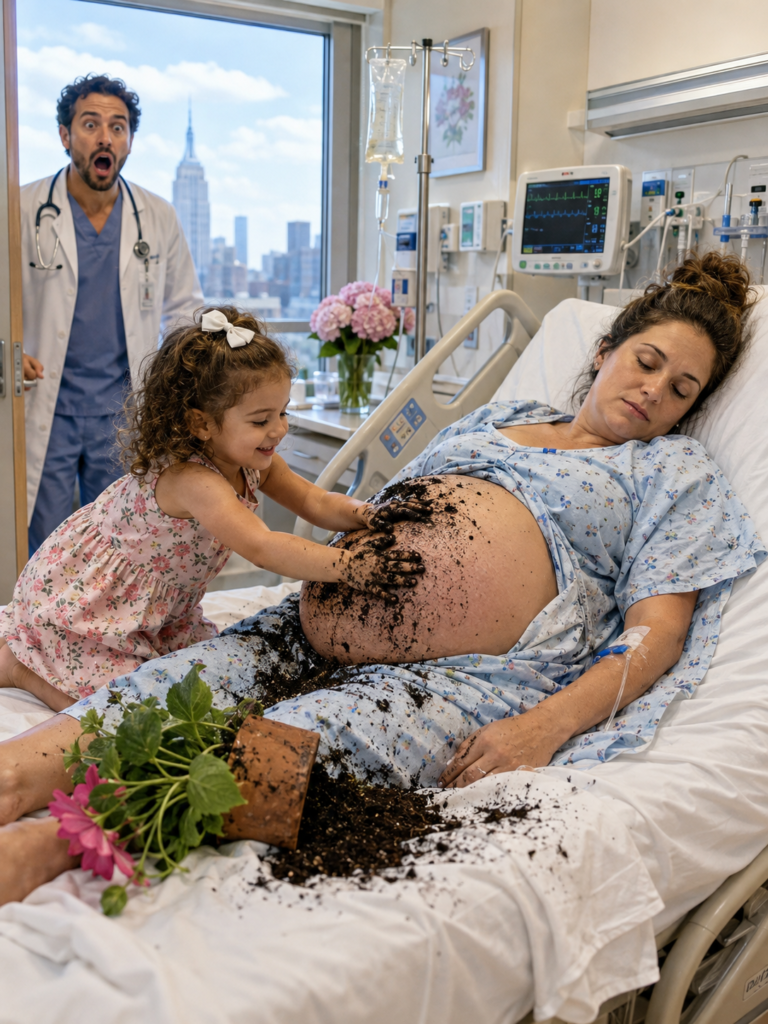
Those were the first words Rachel Whitfield spoke after EIGHT MONTHS IN A COMA, just as a seven-year-old girl placed a handful of mysterious soil on her pregnant belly.
Rachel was only thirty-two. She had been unconscious for almost eight months at St. Mary’s Medical Center in Columbus, Ohio, while her son kept growing inside her.
The doctors had warned her husband, Owen:
“It’s possible the baby will be born before his mother wakes up.”
But Owen never lost hope.
Every day he sat beside her bed, held her hand, read her favorite books aloud, and told her about the white crib waiting for their little boy at home.
Until one rainy afternoon in March…
A seven-year-old girl named Inez Rivera quietly walked into Room 312, carrying a small glass jar filled with dark, damp soil.
Inez was the granddaughter of the hospital’s night janitor.
“What are you doing here, sweetheart?” Owen asked.
The girl held up the jar.
“My grandma says this can help her. It’s special dirt from the town where my great-grandma grew up.”
Owen stared at her, bewildered.
“How could dirt help her?”
Inez answered seriously:
“My great-grandma always said the earth remembers how to heal… especially mothers.”
After eight months of despair, Owen no longer knew what to believe.
Finally, he let the girl come closer.
Inez opened the jar, scooped out a small handful of soil, and gently laid it on Rachel’s belly.
Then she leaned in and whispered:
“Wake up, Miss Rachel. Your little boy is waiting for you.”
One second.
Two seconds.
Three seconds…
SUDDENLY, RACHEL’S FINGERS MOVED!
Owen froze.
The monitors began blaring unexpected alarms. Doctors and nurses rushed in.
“CHECK HER VITALS! NOW!”
Then something happened that nobody expected.
AFTER EIGHT MONTHS, RACHEL OPENED HER EYES!
But she didn’t look at her husband. She didn’t ask about the baby she was carrying.
She stared straight at Inez.
Her face went pale with terror.
Suddenly she seized Owen’s wrist and whispered:
“Don’t let them take our baby…”
Owen looked at her, stunned.
“Who? Who are you talking about?”
Tears began to stream down Rachel’s cheeks. She looked toward the door and, trembling, said words that chilled him:
“THE PEOPLE WHO DID THIS TO ME… ARE STILL INSIDE THIS HOSPITAL!”
MY WIFE WOKE FROM A COMA AFTER EIGHT MONTHS, BUT THE GIRL WHO SAVED HER DIDN’T EXIST IN ANY HOSPITAL RECORD
The next forty-eight hours were an endless blur of medical tests, bright lights, and a happiness I could barely comprehend. After eight months of waiting for a miracle, Rachel had finally regained consciousness. The specialists called it spontaneous neurological recovery, an event so extraordinary that none of them could offer a definitive explanation.
The doctors gradually weaned her off the ventilator and ran test after test to check her cognitive function. Dr. Halloran stood at her bedside, going over the reports again and again as if the results contradicted everything he knew about medicine.
“Owen, I can’t give you a complete scientific explanation,” he finally admitted. “The swelling in her brain has gone down considerably, her vitals are stabilizing, and Rachel can communicate coherently. The tests also show the baby is still developing well.”
I watched my wife as those words took on meaning. For eight months I had been afraid of losing her. Now she was awake, she could talk to me, and soon she would hold the son we had waited so long for.
Three weeks later, in that same hospital, Rachel gave birth to a beautiful boy with rosy cheeks and remarkably strong lungs. His cry filled the delivery room while the doctors finished caring for them both.
When the nurse laid Theo on his mother’s chest, I felt the world stop. Rachel gazed at his tiny face with an expression I will never forget. After so many months trapped in silence, she could finally hear her baby cry.
Tears began to roll down her cheeks. She carefully pressed her face to Theo’s little head and stroked his tiny fingers. “He’s real,” she whispered, her voice shaking. “Owen, our baby is real.”
I laughed as I tried to hold back my own tears. “Of course he’s real, sweetheart. He’s been kicking inside you for months. Trust me, this kid has a ton of energy.”
That night, after so much emotion, the hospital settled back into its usual calm. Theo slept in a small clear bassinet beside Rachel’s bed. A spring storm was building over the city, and the first drops tapped softly against the window.
My wife watched the rain for a long time. Her smile slowly faded, replaced by a thoughtful look that began to worry me.
“Owen,” she murmured, her voice still weak, “I need to ask you something about the months I was in the coma.”
I pulled my chair closer and laced my fingers through hers. “You can ask me anything, Rachel.”
She swallowed before continuing. “The doctors said I had a severe brain injury and probably wasn’t aware of anything. But I remember something different. I wasn’t just asleep.”
A strange chill ran through me. “What do you mean?”
Rachel squeezed my hand. “It was like being locked in a completely dark room. I couldn’t move or open my eyes. I didn’t know where I was, and I was so afraid. I thought I had died and all that was left was to wait. But someone was with me.”
I leaned toward her, listening closely.
“It was a little girl,” she went on. “She came to visit me in that darkness. She held my hand, sang me songs, and told me stories about a river, wildflowers, and how babies can feel love even before they’re born.”
Rachel began to cry again. “She always said the same thing: ‘Don’t give up, Miss Rachel. Your husband is crying. You have to come back to him.’”
I felt the air leave my lungs.
I instantly remembered the little girl in the faded yellow dress who had appeared in Rachel’s room right before she woke. I remembered the small jar in her hands, full of damp soil, and the remarkable calm with which she had approached my wife.
“Rachel,” I whispered, “I saw that girl.”
My wife’s eyes went wide. “You saw her? Then I didn’t just imagine her while I was unconscious?”
“I saw her myself,” I insisted. “Her name was Inez. She told me her grandmother worked as a janitor on the night shift. She wore a yellow dress and put some soil on your belly. Right after that, you started to respond.”
Rachel covered her mouth, overcome. I stood up at once. “I have to find them. I need to talk to Inez and her grandmother. I want to thank them for what they did for us.”
Without waiting for an answer, I hurried out of the room. I took the elevator down to the second floor and headed for Room 204, where I had seen the cleaning staff gather during those endless nights at the hospital.
I opened the door expecting the usual coats on hooks, a coffee maker, and the smell of cleaning supplies. But the room was completely empty. There was no furniture, no mugs, no sign that anyone had used the space recently.
Confused, I went back to the main lobby. Gloria, the night receptionist who knew me well after so many months, was going through files behind the counter.
“Gloria, I need a favor. I’m looking for a cleaning lady named Mrs. Rivera. She works nights, and sometimes she brings her granddaughter Inez, a little girl who usually wears yellow.”
Gloria stopped typing and looked at me with genuine confusion.
“Rivera? Mr. Whitfield, we don’t have any employee with that last name.”
I frowned. “She’s an older woman, Hispanic. I’m sure I saw her. Her granddaughter was in my wife’s room.”
Gloria slowly shook her head. “Our night custodian is named Walt. He’s worked here twelve years. And according to the records, we haven’t had a night janitor assigned to maternity since the late nineties.”
I felt the floor vanish beneath my feet.
“That’s impossible. I talked to Inez. I saw her walk up to Rachel.”
The receptionist checked the system again. “Owen, I’m looking at the entire payroll. There’s no Rivera. Besides, the hospital doesn’t allow employees to bring children on night shifts.”
I stepped away from the counter without knowing what to say. My mind searched for reasonable explanations, but none of them fit what I had witnessed.
I rushed up the stairs to maternity. When I walked into our room, Rachel was awake, holding Theo against her chest. She greeted me with a hopeful smile.
“Did you find Inez?” she asked.
I slowly closed the door.
“Rachel, there’s no record of her or her grandmother. Gloria says no janitor named Rivera has ever worked here.”
My wife’s smile vanished. Her face lost its color as she looked down at our son.
Then her eyes drifted to the window.
I followed her gaze.
On the rain-fogged glass was a small handprint, smeared with mud.
What was truly terrifying was where it was.
The handprint was on the outside of the window.
And we were on the third floor of the hospital.
THE GIRL IN THE YELLOW DRESS DIDN’T EXIST AT THE HOSPITAL, BUT SHE LEFT ONE LAST SIGN BESIDE OUR BABY
I walked slowly to the window. The little handprint was still there, perfectly formed on the wet glass. On the other side was nothing but a three-story drop to the hospital garden.
“Owen, step away,” Rachel whispered, hugging Theo close.
I called security right away. Two officers arrived with a nurse, examined the window, and confirmed there were no balconies or ledges outside.
“We’ll check the cameras,” one of them promised.
After they left, Rachel began to tremble.
“The girl told me something else while I was in that dark room,” she confessed. “She asked me never to forget the river of white flowers.”
Those words stirred a memory.
Inez had mentioned a river when I saw her beside Rachel’s bed.
The next morning I went back to the front desk and asked whether the hospital kept historical staff files.
Gloria walked me to a small administrative office. After sorting through several old documents, she found a photograph dated 1997.
It showed an older woman in a cleaning uniform.
Beneath it was written: Rosa Rivera.
My blood ran cold.
“That’s her,” I murmured. “That’s Inez’s grandmother.”
Gloria examined the file.
“Owen, this woman died almost thirty years ago.”
I stood motionless.
“And her granddaughter?”
The receptionist found a note clipped to the file. Rosa had raised a girl named Inez after the child’s parents died. The two of them used to walk along a river near the hospital.
Then Gloria opened another document.
Inez had died during a serious illness when she was only eight years old.
My legs gave out beneath me, and I had to grab the desk.
That afternoon I returned to Rachel’s room with a copy of the photograph.
My wife began to cry when she saw it.
“Owen, it’s her. She’s the woman who stood behind Inez when I was in the dark.”
I held her, unable to find any words.
Then Theo began to cry in his bassinet.
Rachel reached over to pick him up, but suddenly stopped.
Beside the pillow lay a small white flower, still damp.
Neither of us had put it there.
Beneath it we found a folded piece of paper.
It held a single sentence written in a child’s handwriting:
“Now you can hold him, Miss Rachel.”
My wife covered her face and wept.
But when I turned the paper over, I found something even stranger.
On the back was a date.
It was the exact day Rachel had woken up.
And beneath it, in different handwriting, was a message:
“Owen, the girl kept her promise. Now you must keep yours.”
I went rigid.
Because those last words were identical to what my mother had said before she died.
And I had never told them to Rachel.
I didn’t sleep that night. I sat beside Rachel’s bed with the folded note in my hand while Theo breathed softly in his bassinet. Around three in the morning, Rachel spoke into the dark.
“Owen, I remember something else.”
I turned to her.
“Before the girl came, there were voices in the room. A man and a woman. They thought I couldn’t hear.” She swallowed. “The man said, ‘Keep her under until the baby’s born. After that, it won’t matter what she remembers.’”
“Who was it?”
“I know the woman’s voice. It was Dale Pruitt, the charge nurse on this floor.” Her eyes filled. “And the man was Dr. Pryor.”
Gerald Pryor was the chief of medicine, the same man who had stood in the hallway months earlier and told me, in a kind voice, to prepare myself to raise our son alone.
“Why would he do this?” I whispered.
Rachel closed her eyes. “Because I found out what he was doing.”
Rachel had worked at St. Mary’s for six years as a pharmacy auditor. Last summer she noticed that controlled substances were disappearing from the dispensing records. Doses were logged for patients who had never received them, and the billing for those patients was inflated to match. She took her findings to Dr. Pryor first, believing he would want to know.
“He thanked me,” she said. “He said he’d handle it. Two days later, I collapsed in the parking garage, and I woke up here eight months later.”
“The hospital told me you fell from the stairwell.”
“I didn’t fall. I remember a needle in my neck.”
I felt a cold, steady anger settle over me. It wasn’t the hot kind that makes you shout. It was the kind that makes you plan.
“Do you have proof?” I asked. “Anything?”
“I made copies before I went to him. I put them on a flash drive.” She frowned. “I hid it somewhere in the hospital, because I didn’t trust my locker. But I can’t remember where. The girl kept telling me about a river of white flowers…”
She stopped. We looked at each other.
“The memorial garden,” I said.
Behind the east wing of St. Mary’s was a small garden with a dry creek bed lined with white hydrangeas. The staff called it the River Walk. Rachel used to eat her lunch there.
At six that morning, I walked through the wet grass with Gloria, who had agreed to come after I told her everything. I expected nothing. I was afraid of finding nothing.
Halfway along the creek bed stood a weathered wooden bench. I had passed it a dozen times in eight months without reading the little brass plaque on its back.
I read it now.
In loving memory of Rosa Rivera, who cleaned these halls, and her granddaughter Inez, who loved the river. Rest easy.
Gloria put a hand over her mouth.
I knelt and ran my fingers underneath the seat. Taped to the underside, wrapped in a sandwich bag gone cloudy with age, was a small black flash drive.
I couldn’t breathe.
“She hid it here,” I said. “Rachel hid it under their bench.”
“Maybe she didn’t choose it by accident,” Gloria whispered.
I didn’t answer. I wasn’t sure I wanted to.
I didn’t take the drive to hospital administration. Rachel had been clear about that, and so was my own gut. Instead I called a detective I had met during the early weeks, a patient, tired woman named Detective Okonkwo from the county sheriff’s office who had taken my report about the parking garage and told me gently that it looked like an accident.
She came that afternoon. She listened to Rachel for an hour. Then she plugged in the drive.
The spreadsheets were exactly what Rachel described: dispensing logs, fake patient entries, a thread of billing codes that led straight back to Dr. Pryor’s authorization number. There was a second folder, too. Rachel had recorded herself reading a short statement, dated two days before the garage, saying that if anything happened to her, this was why.
Detective Okonkwo looked up slowly.
“Mr. Whitfield, I’m bringing in the state attorney general’s health care fraud unit. And I’m going to need your wife’s full statement.”
“She’s ready.”
“One more thing.” She hesitated. “The camera footage from the night she was found. Our first review said the garage cameras were down for maintenance. I’m going to find out who signed that work order.”
It was Dale Pruitt’s husband, who worked in the hospital’s facilities department.
They moved fast once they started. Within nine days, agents from the attorney general’s office had pulled the dispensing records, interviewed pharmacy staff, and put together a timeline. Dale Pruitt cracked first. She admitted, in tears, that Dr. Pryor had told her Rachel was “a liability” and asked her to adjust her sedation, quietly and carefully, until things were resolved.
“I thought he meant a few days,” she told them. “Then it became weeks. Then it was too late to stop without everyone finding out.”
Dr. Gerald Pryor was arrested at his home on a Friday morning, in front of his neighbors. He was charged with insurance fraud, drug diversion, conspiracy, and attempted murder. Dale Pruitt was charged as an accomplice and agreed to testify. The board of St. Mary’s removed three administrators who had ignored warnings, and the hospital announced an independent review of its pharmacy and nursing oversight.
Rachel gave her statement from a wheelchair, with Theo asleep in a carrier on her lap. When the detective asked how she wanted her name used in the press, she said, “Use it. I’m not hiding.”
A month after we brought Theo home, we went back to the memorial garden.
It was a warm evening in early May. The hydrangeas were just beginning to show white along the creek bed. Rachel walked slowly, leaning on my arm, and when we reached the bench she lowered herself onto it and set Theo gently in her lap.
She ran her thumb over the brass plaque.
“I think I always knew where to hide it,” she said quietly. “Even in the dark.”
“The girl knew.”
“Or I knew, and she helped me remember.” She smiled at the plaque. “I don’t need to decide which.”
I sat beside her and took out something I had been carrying for weeks: the folded note, with its two different handwritings.
“I never told you about my mother’s last words,” I said.
“Tell me now.”
“When she was dying, she made me promise something. She said, ‘When someone you love is in danger, don’t wait for permission to fight for them. Keep your promise.’” I laughed unsteadily. “I thought I understood it. For eight months I sat beside you and waited for a doctor to tell me what to do. I let Pryor tell me what to expect. I let him tell me to give up.”
“You never gave up.”
“I almost signed the papers he put in front of me, Rachel. Twice.”
She took my hand and held it.
“But you didn’t,” she said. “And when that little girl showed up with her jar of dirt, you let her in. Most people would have called security.”
“I almost did.”
“Almost isn’t what happened.”
I looked at the note again. I still can’t explain how those words reached it, and I’ve stopped trying. Rachel says it was my mother, passing along the message through a girl who knew what it was to be left behind. I don’t know. I only know that when I read it, I felt something loosen in my chest that had been tight for a very long time.
We stayed on the bench until the sun slipped behind the east wing and the windows of St. Mary’s lit up one by one. Theo woke, blinked at the evening light, and let out a small, satisfied sigh. Rachel kissed the top of his head.
“Should we leave something?” she asked.
I had brought it without telling her. From my jacket pocket I took the small glass jar Inez had left behind that day, empty now except for a few grains of dark soil clinging to the glass. I set it on the bench beside the plaque and, next to it, a single white hydrangea blossom I had picked from the creek bed.
“Thank you,” Rachel whispered. “Both of you.”
A breeze moved through the garden. The hydrangeas swayed, and for a moment the whole creek bed seemed to ripple, like water.
Then it was still.
We walked back toward the parking lot together, the three of us, past the east wing where a window on the third floor still glowed. Somewhere behind us, I could have sworn I heard a child laugh.
I didn’t turn around.
Some things you don’t need to see to know they are real.