The Dock
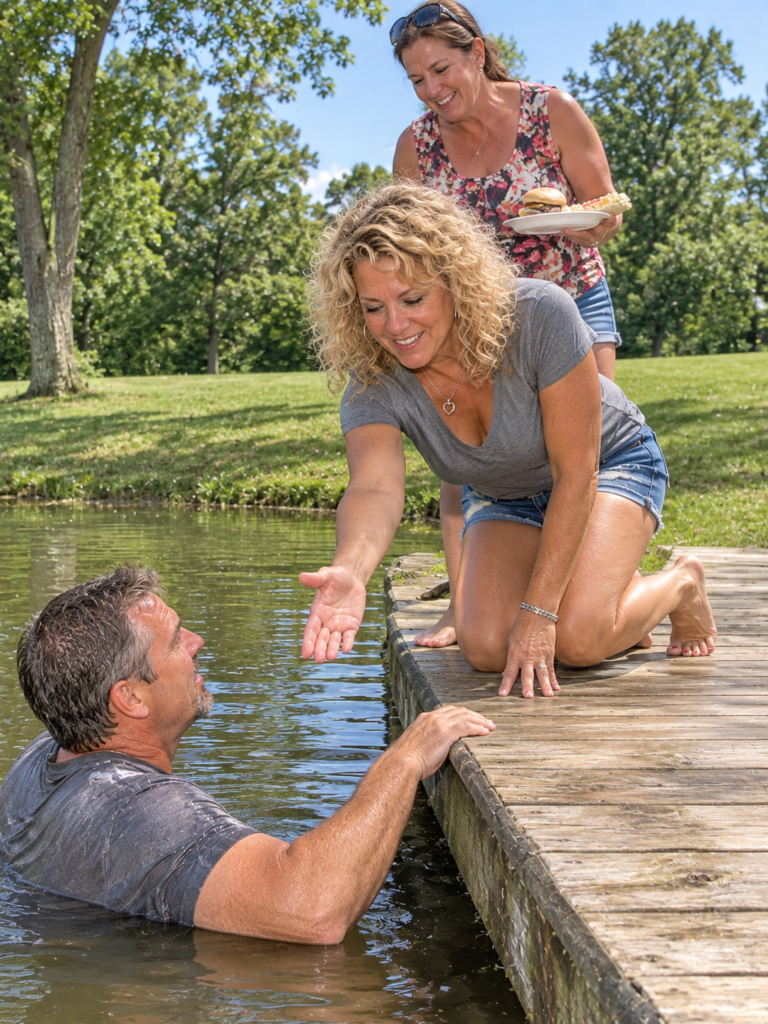
Halfway through the Meeks family reunion, my mother-in-law pushed my sixty-eight-year-old father off the dock.
She said later it was a joke. She said it about a hundred times.
I was standing three feet away when it happened. I saw her hands go flat against his back. I saw her lean into it. I saw Dad’s arms go out, the way a man’s arms go out when the ground isn’t where he left it.
Then he was in the water.
Dad came up sputtering, waist-deep in the brown water beside the dock.
Uncle Wade’s farm pond is maybe an acre and a half, out past Buffalo, Missouri, in a dip between two hayfields. Cattle drink from it. It’s the color of chocolate milk in July, with a slick of green along the edges and a bottom of soft mud that swallows your feet to the ankle.
His light blue button-up shirt was wet up to the chest. The one he wore to church. He’d worn it because it was a family thing and he wanted to look nice. The water came up past his belt buckle.
He stood there blinking, with pond water running out of his gray hair and down his face.
His hand went to his left ear.
Then his right.
Nothing there.
Forty people at the reunion went quiet at once.
All the Meeks cousins and aunts and uncles and kids, spread out across Uncle Wade’s yard on lawn chairs and blankets and the tailgates of pickups. A few seconds earlier there’d been music playing on somebody’s Bluetooth speaker and kids shrieking on the slip-and-slide and the smell of brisket smoking on the hill.
Now there was nothing. Just the speaker playing Alan Jackson to nobody, and the cicadas, and my father standing in the pond with both hands pressed to his empty ears.
Cindy stood on the dock behind me, holding her paper plate.
Potato salad and a deviled egg and a slice of watermelon. She hadn’t even set it down to do it.
She was smiling.
“Oh, Leon, lighten up,” she said. Loud, so everybody could hear. “It’s July. You needed cooling off. You should’ve taken them out.”
Somebody on the bank laughed. One of the teenage cousins. Then stopped.
Dad looked up at her from the water. He saw her mouth moving. He couldn’t hear a word of it.
I didn’t think. I got down on my knees on that dock in my yellow sundress. The one I’d bought at Dillard’s for the reunion, because I wanted to look nice too. The boards were rough and wet and I felt them scrape my knees.
I reached down for his hand.
“Dad,” I said. “Dad, here. Take my hand.”
He looked at my face. He couldn’t hear me, but he could read my lips. He’s been reading my lips since I was a baby. He took my hand.
His hand was shaking. My father’s hands don’t shake.
He’s sixty-eight. His name is Leon Pruitt. He climbed poles for the Southwest Electric Cooperative for thirty-eight years. Through ice storms and tornadoes and summer heat that would cook you inside your rubber gloves. He’s been up a pole in a lightning storm with forty thousand volts three feet from his face, and he’s never once lost his footing.
He doesn’t fall in ponds.
He doesn’t stand in the water with his hands over his ears looking lost.
I pulled. He got one foot on the bottom rung of the old wooden ladder Uncle Wade nailed to the side of the dock. Then the other. Water poured off him. His good church shoes squelched.
I got him up onto the dock. He stood there dripping. He looked down at me, and then he looked at the water, at the spot where he went in.
“They’re gone, sis,” he said. Too loud. Way too loud. Everybody heard it. “They fell out. They’re gone.”
Chapter Two: Walking the Bottom
Josh was up the hill helping his uncle with the brisket when it happened.
He’d been up there for an hour, him and Uncle Wade and a big black offset smoker Wade built out of an old propane tank. Josh is good with a smoker. He was slicing the first brisket when he heard everybody go quiet, and he looked down the hill and saw my dad standing on the dock, soaking wet.
By the time he ran down, I already had Dad out of the water.
He came across the yard at a dead run, still holding the brisket knife. He stopped at the end of the dock, breathing hard.
“What happened?”
I didn’t answer. I looked at his mother.
Cindy was still standing there with her paper plate. Some of the cousins had come down to the dock. One of the aunts handed Dad a beach towel with a cartoon shark on it.
“It was a joke, Joshie,” Cindy said. “For heaven’s sake. Everybody’s acting like I shot him.”
Josh looked at his mother. Then at my dad, wrapped in a shark towel, with his hands still going up to his ears every few seconds. Like he couldn’t believe they were really empty.
“His hearing aids,” I said quietly. “They were in.”
Josh closed his eyes.
He knew what they meant. He’s known my dad almost as long as he’s known me.
Dad lost most of his hearing on the job. Thirty-eight years around transformers and bucket trucks and chainsaws and generators will do that. The co-op made them wear earplugs after about 1995. By then it was too late. By the time he retired, he couldn’t hear the phone ring. He couldn’t hear the TV unless it was so loud the neighbors complained.
For three years after he retired, he just quit hearing things. He quit going to church because he couldn’t hear the sermon. He quit going to the café in the morning because he couldn’t hear the other men at the table. He sat in his house in Buffalo by himself.
Then, three and a half years ago, I made him go to an audiologist. I drove him myself.
The day they fitted his first pair, he cried in the parking lot. He said he could hear his own footsteps. He hadn’t heard his own footsteps in fifteen years.
Josh and two cousins walked the pond bottom with their bare feet until dark.
Josh, and his cousins Travis and Cody. They stripped down to their swim trunks and waded out to where Dad went in. They walked in a grid, slow, side by side, feeling the bottom with their toes. The mud came up to their shins. The water came up to their chests.
They found a fishing lure. A green plastic worm on a hook, probably lost by Uncle Wade in about 1994.
They found a beer can. A flip-flop. A rock that Cody swore felt exactly like a hearing aid until he pulled it up.
Not the hearing aids.
I knew they wouldn’t find them. I knew it from the first minute.
I work in a dental office. Dr. Heller’s office, on Main Street in Bolivar. I’m the office manager. I handle the insurance, the billing, the scheduling, the patients’ complaints. Part of the job is knowing what equipment costs and what kills it.
I know what water does to anything with a battery. Even if they found them, they’d be done. Pond water, mud, bacteria. The little microphones and the circuits would be ruined in minutes.
Dad had paid four thousand, one hundred dollars for that pair. Three and a half years ago.
I knew that because I helped him write the check. He’d been saving for two years. Out of his co-op pension and his Social Security. Fifty dollars here, a hundred there, in a coffee can in his kitchen. He brought the coffee can with him to the audiologist and counted it out on the counter.
They came with a loss and damage warranty. Three years. If you lost them or broke them, the manufacturer would replace them for a deductible.
The warranty ran out at three.
Six months ago.
And Medicare doesn’t pay a dime for hearing aids.
People don’t believe that when I tell them. They think Medicare covers everything for old people. It doesn’t. Original Medicare doesn’t cover hearing aids. Or the exams to fit them. Dad has a supplement plan through the co-op retirees’ group, and it doesn’t cover them either.
You can buy over-the-counter ones now, at Walmart or the pharmacy. A few hundred dollars. But those are for mild hearing loss. Dad’s is severe. The audiologist told us that the first day. He needed real ones. Prescription ones, fitted to his ears.
Four thousand dollars, or he goes back to not hearing anything.
On the bank, as it was getting dark, Dad sat in a lawn chair wrapped in the shark towel. He was watching the boys walk the pond. He hadn’t said much in two hours. When people talked to him, he just nodded.
I sat down in the grass next to his chair. He leaned over toward me.
“Don’t make trouble with her on my account, sis,” he said.
Too loud. Way too loud. Half the reunion heard him.
Cindy, sitting at the picnic table with her sisters, heard him too. She looked over at us. Then she looked away and laughed at something her sister said.
I didn’t say one word to Cindy that day.
Not one. Not when she came over to say goodbye at the cars and told my dad, “No hard feelings, Leon, okay? You know me.” Not when she hugged Josh and said, “Your father-in-law needs a sense of humor.”
I just smiled. I’m good at smiling. Ask anybody at Dr. Heller’s office.
Then I drove my father home to Buffalo. He sat in the passenger seat with his wet church shirt drying stiff and stared out the window at the hayfields going by in the dark.
He didn’t say anything the whole way. He couldn’t hear the radio, so I turned it off.
Chapter Three: Who Cindy Is
I need to tell you about my mother-in-law. So you understand.
Cindy Meeks is fifty-nine. She runs the cash register at the Dollar General in Buffalo four days a week and gets her hair done every Thursday at the Shear Elegance on Ash Street. She’s loud and funny and the life of every party. She’s also the kind of person who thinks the funniest thing in the world is somebody else being embarrassed.
She’s always been that way. Josh says she’s always been that way.
At our wedding rehearsal dinner, she told forty people I was pregnant. I wasn’t. She thought it was hilarious. My grandmother cried.
At Thanksgiving two years ago, she put a whoopee cushion on Josh’s ninety-year-old great-aunt’s chair. Aunt Opal sat on it. Everybody laughed. Aunt Opal went red to her hairline and left before pie.
At Josh’s cousin’s baby shower, she wrapped an empty box in pretty paper, with a bow. When Brittany opened it, Cindy said, “That’s what you’ll have left of your social life!” And laughed so hard she had to sit down.
She’s not cruel, exactly. Josh always says that. “She’s not mean, Kayla. She just doesn’t know when to stop.”
I’m not sure there’s a difference.
Josh’s dad died when Josh was eleven.
His name was Ray Meeks. He was a lineman too. Same co-op as my dad. He died in the ice storm of January 2007, the big one that took down power lines from Joplin to St. Louis. He was working a night shift north of Buffalo, restoring power to a farmhouse with an old man on oxygen inside. A tree limb came down on the line he was working on.
Josh doesn’t talk about it much. Neither does Cindy.
I know Josh grew up without a father from eleven on. Cindy raised him and his sister alone on a cashier’s paycheck and Ray’s co-op life insurance. I know it was hard.
And I know that when Josh was sixteen and started dating me, my dad was the first grown man who took any real interest in him.
Dad taught Josh to fish. He took him to Cardinals games in St. Louis. When Josh’s truck broke down, Dad was the one who got under it with him. When Josh asked me to marry him, he asked my dad first, sitting on Dad’s front porch, and Dad told me later he cried after Josh left.
Josh calls him Leon. But he looks at him the way some men look at their fathers.
Cindy noticed. Of course she noticed.
Here’s what I hadn’t told anybody. Not even my dad.
Josh and I had been putting back two hundred and fifty dollars a month for eighteen months. Into a separate savings account at Mid-Missouri Bank, with a little tag on it in the online banking app. MOM’S CRUISE.
Four thousand, five hundred dollars.
A cruise for Cindy’s sixtieth birthday next spring. Out of Galveston. Five nights. Cozumel and Costa Maya. A balcony cabin. She’d never been on a cruise. She’d never been anywhere, really. Branson, once. Eureka Springs.
It was Josh’s idea. He felt like his mom had given up everything for him and his sister. He wanted to give her something big.
We were going to surprise her at Christmas. Wrap up a little plastic boat in a box.
But she found out. Josh’s sister Brittany let it slip at Easter. And Cindy had been telling the whole Shear Elegance about it ever since. Every Thursday. Her son was taking her on a cruise. A balcony cabin. She’d already bought two new swimsuits at the JCPenney in Springfield and a big floppy hat.
She’d been telling everybody at the reunion about it too. Right before she pushed my dad off the dock.
Chapter Four: The Back Steps
Sunday evening, I sat with Josh on our back steps.
We live in a little brick ranch house in Bolivar, about thirty minutes from Buffalo. Three bedrooms, a chain-link fence, a maple tree in the backyard with a tire swing Josh hung for the nieces and nephews.
It was hot and still. The fireflies were coming up out of the grass. Josh had two beers. He handed me one. I didn’t drink it.
I’d spent most of Sunday on the phone. And on my laptop. Doing what I do at work every day. Figuring out who pays for what.
“I called the audiologist,” I said. “In Springfield. The one who fitted Dad’s first pair.”
Josh nodded.
“The warranty’s gone. Expired in January. There’s nothing they can do on the old ones.” I took a breath. “A new pair of the same model is four thousand, three hundred. Prices went up.”
“Okay.”
“Medicare won’t pay. His supplement won’t pay. I called them both.”
Josh didn’t say anything. He looked out at the tire swing.
“I looked into one other thing,” I said. “Your mom’s homeowner’s insurance.”
Josh turned and looked at me.
“Most homeowner’s policies have personal liability coverage,” I said carefully. “If you damage somebody else’s property by accident, it pays. Like if you hit a baseball through the neighbor’s window. Or if you push somebody into a pond and ruin their hearing aids.”
“Kayla…”
“I’m not saying we should,” I said. “I’m just saying it exists. Somebody would have to file a claim against her policy. Dad would have to file it. Or she would.”
Josh was quiet for a long time.
“Dad would never,” I said. “You heard him. Don’t make trouble with her on my account.”
“And Mom would never admit she did anything wrong,” Josh said.
“No.”
We sat there with that for a while. A whip-poor-will started up somewhere down the road.
Then I said it.
“I want to spend it on Dad.”
Josh didn’t move.
“The cruise money,” I said. “I want to take it out tomorrow and buy him new hearing aids. I’ll take a personal day. I’ll drive him to Springfield myself.”
I waited.
“I know it’s your mom’s birthday present,” I said. “I know she’s been telling everybody. I know it’ll be a mess. But Josh, he can’t hear. He’s sitting in his house in Buffalo right now, alone, and he can’t hear the TV or the phone or anything. And he’s not going to ask anybody for help. He never has.”
Josh looked at the yard a long time.
He looked at the tire swing. At the maple tree. At the fireflies coming up out of the grass.
I thought he was going to say no. I thought he was going to say, it’s my mom, Kayla. It’s her birthday. We promised.
“It was ours to give,” he said finally. “Do it.”
I let out a breath I didn’t know I’d been holding.
Then he said something else.
“And I’ll tell Mom myself.”
“Josh, you don’t have to…”
“Yes, I do,” he said. He set his beer down on the step. “She pushed your dad off a dock, Kayla. In front of forty people. A sixty-eight-year-old man who climbed poles with my dad.” His voice got tight. “And then she told him to lighten up.”
He stood up.
“I’m not going to let you be the one who tells her,” he said. “She’ll make it about you. She’ll make you the bad guy. I know how she works.” He looked down at me. “It’s my money too. It’s my mom. I’ll tell her.”
Chapter Five: Springfield
Monday morning I took a personal day and drove Dad to the audiologist in Springfield.
I called Dr. Heller at seven and told her I had a family emergency. She didn’t ask questions. She’s been my boss for nine years.
Then I drove to Buffalo and picked up Dad. He was waiting on his front porch in a clean shirt. A plaid one, not the blue. I think the blue one was still drying on the line out back.
He didn’t know where we were going. I’d just texted him: Picking you up at 8. Wear shoes.
He got in the car and looked at me.
“Where to, sis?” Too loud.
I held up the legal pad I’d brought. I’d written it on the first page in big black letters.
SPRINGFIELD. HEARING AIDS.
He read it. He looked at me.
“Kayla,” he said. “No.”
I flipped the page. I’d already written the next one.
ALREADY MADE THE APPOINTMENT.
“I can’t afford it,” he said. “You know I can’t. I’ll get the cheap ones. At the Walmart.”
I flipped the page.
AUDIOLOGIST SAID NO. TOO WEAK FOR YOU.
He looked out the windshield. His jaw worked.
“I’ll save up,” he said. “Like last time.”
I flipped the page. I didn’t have anything written on it. I grabbed the pen from the cup holder and wrote fast.
IT’LL TAKE 2 YEARS. YOU’LL BE ALONE IN THAT HOUSE FOR 2 YEARS.
He read it. He didn’t say anything else.
I put the car in drive.
The audiologist’s office was in a medical building on Battlefield Road. Ozarks Hearing Center. The same place as before.
Dr. Anjali Patel came out to the waiting room herself. She’s maybe forty, with dark hair in a bun and kind eyes. She remembered Dad.
“Mr. Pruitt,” she said, loud and slow, facing him so he could see her lips. “I’m so sorry about what happened.”
Dad nodded. He looked embarrassed.
“Come on back,” she said.
She tested him again. Forty-five minutes in a little soundproof booth, with headphones on, pressing a button every time he heard a beep.
His hearing had gotten worse. Not a lot. But some. Dr. Patel showed me the chart afterward. A line that dipped down and down, like a ski slope.
“Severe to profound in the high frequencies,” she said. “Moderately severe in the lows. He needs power. The over-the-counter devices top out at mild to moderate loss. They’d be like putting a Band-Aid on a broken leg.”
“So the same model?”
“The newer version,” she said. “Better feedback control. Bluetooth, so he can stream phone calls straight into his ears.” She paused. “And a rechargeable battery. No more little batteries to fiddle with. His hands were having a hard time with those last time.”
“How much?”
She looked at her computer.
“Four thousand, three hundred,” she said. “That includes the fitting, the follow-ups for three years, and a three-year loss and damage warranty.” She hesitated. “I’ll be honest, Mrs. Meeks. I’d recommend getting him a waterproof case and a clip. After this.”
I wrote the check at the front desk. Out of the account with the little tag that said MOM’S CRUISE.
Four thousand, three hundred dollars. That left two hundred in the account.
The receptionist gave me a receipt. I folded it and put it in my purse.
Dad was standing next to me at the counter. He watched me write the check. He didn’t say anything. His face was very red.
Out at the car, Dad was still shaking his head.
He stood by the passenger door in the hot parking lot with his hands in his pockets. He wouldn’t get in.
“That’s your money, Kayla,” he said. Too loud. A woman walking into the building turned around and looked at us. “That’s your and Josh’s money. I saw the account. I saw what it said on there.”
I didn’t know he’d seen it. I’d tried to hide the checkbook register.
“That’s Cindy’s cruise,” he said. “I can’t take Cindy’s cruise. Not after… not after all this. She’ll never forgive you. She’ll never forgive Josh.”
I opened my legal pad on the hood of the car. It was so hot I could feel it through the cardboard backing. I wrote slowly, in big letters, so he could read every word.
Then I held it up.
IT’S FAMILY MONEY. YOU’RE FAMILY.
He read it. His face did something. His chin started to shake.
I flipped to a new page and wrote one more line. I held it up.
AND JOSH SAID YES BEFORE I EVEN FINISHED ASKING.
Dad looked at that for a long time. Then he looked away. Out at the traffic on Battlefield Road.
“That boy,” he said quietly. Too loud still. But quieter.
He got in the car.
Chapter Six: The Mockingbird
They fitted them Thursday.
I took another half day. Dr. Heller just raised an eyebrow and said, “Go.”
The fitting took an hour. Dr. Patel put them in his ears and plugged them into her computer with a little cable and adjusted the settings. She’d say words to him. Baseball. Sidewalk. Hot dog. And he’d repeat them back. Every few minutes she’d turn something up or down on her screen.
At the end, she sat back in her chair.
“Mr. Pruitt,” she said. In a normal voice. Not loud. Not slow.
He turned his head. Fast. Like somebody had touched him.
“How does that sound?” she asked.
Dad didn’t answer right away. He just sat there in the chair with his mouth a little bit open.
“I can hear you,” he said. And he said it at a normal volume. For the first time since the reunion.
Dr. Patel gave him a little black case, the charging case, and showed him how to use it. And a waterproof clip with a lanyard, so he could pin them to his collar when he took them out. And a little card with her phone number on it, in case anything went wrong.
“If anybody pushes you in a pond again,” she said, “take them out first.”
Dad laughed. Then he looked at me.
I knew he was hearing his own laugh. I could see it on his face.
Out in the parking lot, he stopped under the trees.
There’s a row of pear trees along the edge of the lot at Ozarks Hearing Center. Bradford pears, the kind the city plants everywhere. It was hot and still, and the air smelled like asphalt and cut grass.
Dad stopped dead in the middle of the sidewalk. He tilted his head.
“What kind of bird is that?” he asked.
I listened. I hadn’t even noticed it.
A mockingbird. Up in one of the pear trees. Running through every song it knew. A cardinal. Then a blue jay. Then a robin. Then something that sounded like a car alarm, which mockingbirds in town do now. Then a whistle, three notes, up and down.
“It’s a mockingbird, Dad,” I said. “It’s copying other birds.”
He didn’t answer. He stood there under the pear tree with his head tilted up and his hands at his sides.
He stood there listening like it was the first bird God ever made.
I had to look at the pavement for a minute.
The thing is, I knew he’d heard birds before. He’d had hearing aids for three and a half years. He’d heard mockingbirds.
But I think, for five days, he thought he’d never hear one again. I think he’d sat alone in his house in Buffalo for five days, with the TV on mute, and decided this was the rest of his life.
And now here was a mockingbird in a pear tree in a parking lot in Springfield, singing like it was putting on a show just for him.
“Your mother used to say they sing all night in May,” Dad said. His voice was thick. “Kept her up. She’d poke me in the ribs. Leon, make it stop. And I’d say, what do you want me to do, climb up there and ask it nicely?”
Mom died six years ago. Pancreatic cancer. She was sixty-one.
I’d never heard that story before.
“She’d have liked this one,” Dad said. He wiped his eyes with the back of his hand. “This one’s a real show-off.”
On the drive home, he talked the whole way. Forty-five minutes. He talked about the co-op. About Mom. About the ice storm in 2007, and the time he got stuck in a bucket truck for six hours in a blizzard outside Fair Grove. About the Cardinals’ bullpen.
He kept stopping in the middle of sentences. To listen to the turn signal clicking. To the tires on the road. To my radio, which I’d turned on low, playing a George Strait song.
“I can hear the fiddle,” he said. “Kayla. Listen. You can hear the fiddle.”
I could hear it too. I’d never noticed it before either.
I dropped him off in Buffalo at four o’clock. He stood on his front porch and waved as I backed out of the driveway.
Then, as I was pulling away, he called out something. I rolled down the window.
“What, Dad?”
“I said thank you,” he said. At a normal volume. From his porch. Twenty feet away. “I heard myself say it.”
Chapter Seven: Cindy’s Porch
Saturday, Josh drove out to his mother’s place.
I rode along. He didn’t want me to at first. He said he’d handle it. But I told him I wasn’t going to let him walk into that alone either.
Cindy lives in the house Josh grew up in. A little white two-bedroom on the edge of Buffalo, on Hickory Street, with a carport and a porch swing and about forty wind chimes. She collects them. You can hear her house from a block away when the wind blows.
It was blowing that morning. The wind chimes were going crazy.
Cindy came down her porch steps to meet us in the front yard.
She was wearing capris and a T-shirt that said LIFE IS BETTER AT THE LAKE. Her hair was done. It was Saturday, so she’d been to Shear Elegance on Thursday. She had a big smile on her face.
“There’s my boy,” she said.
She held out her arms.
Josh didn’t hug her.
She stopped. Her arms came down slowly. She looked at him. Then at me, standing behind him by the truck.
“Well,” she said. “What’s wrong with you two? You look like somebody died.”
Josh took a breath. I could see his hands shaking a little at his sides.
“Mom,” he said. “There’s no cruise.”
She laughed.
The same laugh. The one from the dock. Light and high and a little bit too loud.
“Very funny,” she said.
“It’s not a joke, Mom,” Josh said. “Kayla spent it Monday. On Leon’s ears.”
Cindy looked at me.
Then at her son.
Then she opened her mouth.
And what came out was not what I expected.
“On Leon’s ears,” she repeated.
Quietly. Flatly. Like she was saying it to herself.
“Four thousand, three hundred dollars,” I said. “That’s what they cost. We had four thousand, five hundred saved.”
She stared at me. The wind chimes were going behind her, a hundred little bells all at once.
“You spent my sixtieth birthday,” she said slowly, “on that old man.”
“Mom…”
“On that deaf old man,” she said, louder. “Who isn’t even yours, Josh. He’s not your father. He’s her father. And you gave him my birthday.”
Josh went white.
“Mom,” he said. “You pushed him in a pond.”
“It was a joke!”
“He’s sixty-eight! He couldn’t hear for six days!”
“Then he should have taken them out!” Cindy was yelling now. Her face was red. “Everybody knows you take your hearing aids out around water! That’s on him! Not me!”
The neighbor across the street, an old man in a lawn chair, stood up and went inside.
“You told everybody,” Josh said. His voice was very quiet. “Didn’t you? At the beauty shop. About the cruise.”
“Of course I told them! I was excited! My son was taking me on a cruise!”
“So now you’re upset because you have to tell them it’s not happening.”
Cindy stopped.
“That’s what this is about,” Josh said. “Isn’t it? Not Leon. Not his ears. You’re embarrassed.”
She didn’t answer. She turned around. She marched back up her porch steps and stopped at the door.
Then she turned back.
“He’s always been the one,” she said. Her voice was shaking. “Since you were sixteen. Leon this, Leon that. Leon took you to the Cardinals. Leon taught you to fish. Leon helped you fix your truck.” She was crying now. Angry crying. “And I’m the one who raised you, Joshua. By myself. On a cashier’s paycheck. After your father…”
She stopped.
“I’m the one who stayed,” she said. “And he gets my birthday.”
She went inside and slammed the door. The wind chimes all rang at once.
Josh stood in the front yard for a long time.
I came up beside him and took his hand. It was cold, even in July.
“She’s never said that before,” he said quietly. “About Leon. Not once.”
“I know.”
“I didn’t know she felt like that.”
“I know.”
He looked up at the house. At the forty wind chimes. At the porch swing his father hung in 1998, still hanging.
“Let’s go home,” he said.
Chapter Eight: The Beauty Shop
By Thursday, the whole town knew.
That’s how it works in Buffalo, Missouri. Population three thousand. Cindy went to Shear Elegance on Thursday afternoon like always. And she told everybody.
Except it wasn’t the story that happened.
My coworker Tammy told me. Her sister-in-law gets her hair done at Shear Elegance on Thursdays too.
“She says you stole her cruise,” Tammy said, at the front desk at Dr. Heller’s. She said it quietly, so the patients in the waiting room wouldn’t hear. “She says you convinced Josh to take back her birthday present to pay for your dad’s hearing aids. She says your dad faked being upset to get money out of you.”
I set down the phone I was holding.
“She says it was just a little joke at the reunion,” Tammy went on. “And he made a big deal out of it. And now she’s not going on her cruise, and everybody’s supposed to feel sorry for him.”
“Is that what people think?” I asked.
Tammy hesitated. “Some of them.”
I didn’t say anything.
I want to be honest about that. I wanted to. I wanted to call every woman at Shear Elegance and tell them exactly what happened. I wanted to tell them about the shark towel and the empty ears and the boys walking the pond until dark.
But I thought about Dad, on the bank, leaning over to me. Too loud.
Don’t make trouble with her on my account, sis.
So I didn’t.
Josh heard it at the feed store. His cousin Cody told him at the gas station. Somebody posted something on the Buffalo Community Facebook group about “people who use their elderly parents to guilt-trip family members out of money.” No names. But everybody knew.
Josh read it on his phone at the kitchen table that night. He put his phone face down and didn’t say anything for a long time.
“Should I say something?” he asked. “Post something? Tell people what really happened?”
“I don’t know,” I said. “Would it help?”
“No,” he said. “It’d just make two sides. And then everybody’d have to pick one.”
Dad heard it at the café.
That was the thing I didn’t think about. Dad went back to the Buffalo Café the Tuesday after he got his new hearing aids. For the first time in a week. He sat at the long table in the back with the retired men, the way he used to every morning before his hearing got bad.
And he heard everything. Every word. Clear as a bell. Better than he had in fifteen years.
Including what Walt Hensley’s wife said at the booth behind him to Lois Kemper.
“That Kayla Meeks took Cindy’s cruise money and spent it on her own daddy. Can you believe that? After Cindy raised that boy all by herself.”
Dad didn’t say anything to them. He finished his coffee. He paid his bill. He left a dollar for the waitress.
Then he went home and called me. On his phone. Which he could hear now, through the Bluetooth, straight into his ears.
“Sis,” he said. “I need to ask you something.”
“Okay, Dad.”
“Does Cindy know about Ray?”
I didn’t understand.
“Josh’s dad,” Dad said. “Does she know what happened that night? In the ice storm?”
“She knows he died, Dad. On the job. Everybody knows.”
He was quiet on the line for a long time.
“That’s not what I asked,” he said.
Chapter Nine: The Ice Storm
He told me that night. He drove over to Bolivar after supper and sat at our kitchen table and told both of us. Josh and me.
He’d never told anybody. Not in eighteen years. Not even my mother.
January 13th, 2007. The ice storm.
Dad was a crew foreman by then. He’d been with the co-op twenty years. Ray Meeks was on his crew. Ray was thirty-four. He’d been a lineman for nine years. Dad trained him himself, when Ray came on as an apprentice in 1998.
“He was good,” Dad said. “Real good. Careful. Smart. He’d have been a foreman himself in a few years.”
They’d been working for thirty-one hours straight. Half of Dallas County had no power. The ice was two inches thick on every line. Trees were coming down everywhere like gunshots.
Around two in the morning, they got a call about a farmhouse on Route 32 north of town. An old man on home oxygen. His backup generator had failed. His daughter was on the phone with dispatch, crying.
“I sent Ray up,” Dad said. “I sent him up the pole. I was on the ground holding the light. It was my call.”
He stopped. He looked down at the kitchen table.
“I didn’t see the limb,” he said. “A big red oak. Coated in ice. Hanging over the line. I should have seen it. It was my job to see it. I was the foreman.”
Josh was sitting very still across the table.
“The limb came down on the line,” Dad said. “Right where Ray was working. It took the line and the crossarm and Ray with it.”
Nobody in my kitchen breathed.
“I climbed up,” Dad said. “To get him down. The pole was still standing. I don’t know how. I climbed up in the ice with my spikes and I got him down. He was still alive when I got him to the ground.”
He looked at Josh.
“He asked about you,” he said quietly. “And your sister. And your mom. He said, tell Cindy I’m sorry I missed supper.”
Josh made a sound I’d never heard him make.
“He died in the ambulance,” Dad said. “Halfway to Springfield. I rode with him. I held his hand.”
He wiped his eyes with the heel of his hand.
“The co-op investigated,” he said. “They said it was an accident. Nobody’s fault. The storm. The ice.” He shook his head. “But I was the foreman. I sent him up. I didn’t see the limb. And I never told your mother. I went to the funeral and I stood in the back and I never once told her I was the one who sent him up there.”
“Is that why?” Josh asked. His voice was thick. “Is that why you… when I was sixteen? The fishing? The Cardinals games?”
Dad nodded slowly.
“I owed him,” he said. “I couldn’t give him back to you. But I figured I could at least show up.”
He looked at Josh.
“And then you turned out to be a good man,” he said. “Like him. And I didn’t owe anybody anything anymore. I just loved you.”
Josh put his face in his hands.
I reached across the table and took my father’s hand. It was shaking again.
“Dad,” I said. “Why are you telling us now?”
He looked at me for a long time.
“Because I heard what they’re saying at the café,” he said. “About Cindy raising that boy all by herself. About me stealing her birthday.” He took a breath. “And she’s right, Kayla. She did raise him by herself. Because of me.”
He stood up.
“I’m going to go see her,” he said. “Tomorrow. And I’m going to tell her.”
Chapter Ten: What Leon Told Her
He went on a Sunday afternoon. After church.
He asked us to come with him. Not to talk. Just to be there. “In case she throws something,” he said. He almost smiled.
We drove out to Hickory Street in two cars. Dad in his old Silverado. Josh and me in ours. When we pulled up, Cindy was sitting on her porch swing with a glass of iced tea. The wind chimes were going.
She saw Dad’s truck and stood up.
She saw Josh’s truck behind it and sat back down.
Dad walked up her front walk. Slowly. He’d put on his blue button-up shirt. The one from the reunion. Washed and ironed. I don’t know if he did that on purpose.
He stopped at the bottom of her porch steps.
“Cindy,” he said.
“Leon.”
“Can I sit?”
She looked at him for a long moment. Then she nodded at the porch chair across from the swing.
He came up the steps and sat down. Josh and I stayed at the bottom of the steps, by the carport. She didn’t tell us to leave.
Dad reached up and touched his right ear. The new hearing aid. Then his left.
“I can hear you now,” he said. “Real good. These are better than the old ones.”
“I heard,” Cindy said. Her voice was flat.
“I want to tell you something,” Dad said. “Something I should’ve told you eighteen years ago. And I want you to hear the whole thing before you say anything. Can you do that?”
She didn’t answer. But she didn’t get up either.
He told her.
All of it. The thirty-one hours. The farmhouse on Route 32 and the old man on oxygen. Sending Ray up the pole. The red oak limb he didn’t see. Climbing up in the ice to get him down.
Tell Cindy I’m sorry I missed supper.
The ambulance. Halfway to Springfield. Holding Ray’s hand.
Cindy didn’t move the whole time. She sat on her porch swing with her glass of iced tea in both hands, and the wind chimes going, and her face went from red to white to something I’d never seen on her before.
When Dad got to the part about the ambulance, the glass slipped out of her hands. It fell on the porch boards and broke. Iced tea everywhere.
She didn’t even look at it.
“I was the foreman,” Dad said. “It was my call. I’ve carried that every day for eighteen years. I never told you because I was a coward. I thought you’d hate me. I thought you’d have every right to.”
He leaned forward in the porch chair.
“And when Josh started coming around,” he said, “I thought, maybe I can do something. Maybe I can be there for this boy, because I took his daddy from him. I never meant to take your place, Cindy. I never wanted to. I just wanted to give back a little of what I took.”
Cindy stared at him.
“You were there,” she whispered. “When he died.”
“I held his hand.”
“He said…” Her voice broke. “He said he was sorry he missed supper.”
“Yes, ma’am.”
She put both hands over her face.
“I made meatloaf,” she said through her fingers. “That night. I kept it warm in the oven. Until four in the morning. I kept thinking he’d come home. And then the co-op called.”
She sobbed. Big, gasping, ugly sobs. On her porch swing with forty wind chimes ringing over her head.
Josh went up the steps. He sat down on the swing next to his mother. He put his arm around her.
She turned and put her face against his shoulder and cried.
Dad sat in the porch chair across from them. He didn’t say anything. He just sat there, with tears running down his face too.
After a long time, Cindy lifted her head.
She looked at Dad. Her face was wrecked. Mascara everywhere. She looked older than I’d ever seen her.
“I pushed you,” she said. “Off the dock. In front of everybody.”
“I know.”
“It wasn’t a joke,” she said. “Not really. I was mad at you. You were standing there on the dock, and Josh was up the hill, and he’d just told me that morning that he was going to Cardinals opening day next April with you. Just you two. Like every year.” She shook her head. “And I thought, he’s taking my son. He’s always been taking my son. And I just…” She stopped. “I put my hands on your back.”
“I know,” Dad said again.
“You knew?”
“I felt you lean into it,” he said quietly. “A joke’s a little shove. You leaned.”
Chapter Eleven: The Claim
Cindy came to our house on Tuesday night.
She’d never been to our house without calling first. She’d never been to our house without Josh inviting her. She stood on our front porch in Bolivar at seven o’clock in the evening, holding a manila envelope.
“Kayla,” she said. “Can I come in?”
I let her in.
She sat at our kitchen table. The same table where Dad told us about the ice storm. Josh came in from the garage and stopped in the doorway when he saw her.
She opened the envelope. She pulled out a stack of papers.
“I called my insurance agent,” she said. “Gary Pfeiffer. At Farm Bureau. Yesterday.” She looked at me. “You knew, didn’t you? About the liability coverage?”
“I knew,” I said. “I didn’t want to make you do it.”
“I know you didn’t.” She pushed the papers across the table. “So I did it myself.”
It was a claim form. Filled out in her loopy handwriting.
Under Description of Incident, she’d written:
On July 12, at a family reunion at my brother-in-law’s farm pond, I intentionally pushed Leon Pruitt off a dock into the water. It was not an accident. His hearing aids were lost. I am responsible.
“Gary said I shouldn’t write intentionally,” she said. “He said they might not pay if it was on purpose. He said write that I bumped him by accident.”
“What did you say?” Josh asked.
“I said I’m done lying about it,” Cindy said.
She pulled out another paper. A letter from Farm Bureau. Dated that afternoon.
They’d paid it anyway. Gary Pfeiffer had driven out to see the adjuster himself and argued that a fifty-nine-year-old woman shoving a family member off a dock at a reunion as a prank was horseplay, not an intentional act to cause harm. The adjuster agreed. Personal liability coverage. No deductible.
A check for four thousand, one hundred dollars. The value of the original hearing aids. Made out to Leon Pruitt.
“I took it to him this morning,” Cindy said. “Leon signed it over. To you two.” She slid it across the table. “He said to tell you it’s family money.”
I looked at the check. Then at my mother-in-law.
“Cindy,” I said. “Your premium’s going to go up. For three years, probably. Because of this claim.”
“I know,” she said. “Gary told me. About two hundred a year.” She almost laughed. “I figure that’s cheaper than a cruise.”
Then she pulled out one more thing from the envelope.
A brochure. Carnival Cruise Line. Galveston to Cozumel. Five nights.
“I’m not going,” she said. “Not on that money. That money’s for Leon’s ears. It always was.”
“Mom…”
“But,” she said, and she looked at Josh, “I’d like to go. Someday. For my sixtieth. If you’ll still take me.” She turned the brochure over. “I’ll pay my half. I’ve got a little put back. And I’ll need a cabin mate.”
“Who?” Josh asked.
Cindy looked at the table for a long time.
“I was thinking,” she said slowly, “I’d ask your sister. And Kayla.” She looked up at me. “If you’d want to come. A girls’ trip. Me and my girls.”
I didn’t know what to say. I sat there at my kitchen table and looked at the woman who had told forty people at my rehearsal dinner I was pregnant. Who put a whoopee cushion on Aunt Opal. Who pushed my father off a dock.
Who kept a meatloaf warm in the oven until four in the morning, waiting for a man who never came home.
“I’d like that, Cindy,” I said.
She nodded. She couldn’t speak.
The next Thursday, at Shear Elegance, Cindy told everybody the truth.
Tammy’s sister-in-law was there. She told Tammy, who told me. Cindy sat in the chair with foils in her hair and told the whole beauty shop. The reunion. The dock. Leaning into it. The hearing aids. The cruise money. Leon.
She didn’t tell them about the ice storm. That was hers. And Dad’s.
But she told them she was wrong. That Kayla didn’t steal anything. That it was the right thing to do.
“And then she said,” Tammy told me, at the front desk at Dr. Heller’s, “that if anybody ever says a bad word about Leon Pruitt in that beauty shop again, she’ll put a whoopee cushion in their chair.”
Chapter Twelve: Next July
The Meeks family reunion was the second Saturday in July again. At Uncle Wade’s farm pond.
Forty-some people. The slip-and-slide. The Bluetooth speaker playing Alan Jackson. Uncle Wade and Josh up the hill at the smoker with the brisket.
Dad came. He wore a T-shirt this time. A gray one from the co-op retirees’ fish fry. And swim trunks.
“Figured I’d dress for it this year,” he said.
We went on the cruise in April.
Cindy and Brittany and me. Five nights out of Galveston on the Carnival Breeze. Balcony cabin. Cozumel and Costa Maya. Cindy wore her big floppy hat and both of her new swimsuits. She got sunburned on the second day and peeled for a week.
On the last night, we sat on the balcony with our feet up on the railing, drinking piña coladas out of plastic pineapples, watching the moon come up over the Gulf.
“Ray always said we’d go on a cruise someday,” Cindy said. “When the kids were grown.” She looked out at the water. “I think he’d like this. The three of us.”
Brittany put her head on her mother’s shoulder. I reached over and took Cindy’s hand. She held on.
Opening day, Josh and Dad went to the Cardinals game in St. Louis, like every year.
They had three tickets this time.
Cindy wore a red Cardinals T-shirt she bought at the Walmart in Bolivar. She’d never been to a game. She didn’t know the rules. She cheered for the wrong team twice.
Dad sat between her and Josh and explained every single pitch. She could hear him. He could hear her. They argued about the designated hitter for three innings.
Josh texted me a picture from the seventh-inning stretch. All three of them standing up, singing “Take Me Out to the Ballgame.” Cindy had her arm through Dad’s.
Now it was July again. At the pond.
Halfway through the reunion, the kids started jumping off the dock. Josh’s nieces and nephews, the cousins’ kids, a whole crowd of them in swimsuits and life jackets. Cannonballs. Belly flops. Screaming.
“Grandpa Leon!” one of them yelled. Cody’s little boy, Bentley. Six years old. “Grandpa Leon, jump with us!”
He’s not anybody’s grandpa. Not yet. But they all call him that.
Dad looked at the dock. Then he looked at me.
I watched him reach up to his ears. One, then the other. He took out his hearing aids.
Then he walked out onto the dock.
And he stopped in front of Cindy.
She was standing at the end of the dock, where she’d stood last year. Holding a paper plate. Potato salad and a deviled egg and a slice of watermelon.
Dad held out his hand. The two little hearing aids were sitting in his palm.
Cindy looked at them. Then at him.
He didn’t say anything. He couldn’t hear her anyway. He just held them out.
Slowly, she set down her paper plate on the dock. She held out both of her hands, cupped together.
He tipped the hearing aids into them.
Cindy closed her hands around them. Carefully. Like she was holding a baby bird. She held them against her chest.
“I’ve got them, Leon,” she said.
He couldn’t hear it. But he read her lips. He’s been reading lips for fifteen years.
He nodded.
Then my sixty-eight-year-old father, who climbed poles for thirty-eight years, who held a dying man’s hand in an ambulance in an ice storm, who never once in his whole life asked anybody for help, turned around and ran down that dock in his swim trunks.
And jumped.
Cannonball. The biggest splash of the day. Brown pond water went everywhere. Bentley screamed with joy. All the kids cheered.
Dad came up sputtering, waist-deep in the water beside the dock. Grinning like a kid.
Cindy stood at the end of the dock with her hands pressed against her chest. Holding his hearing aids. She was laughing.
Not the laugh from the dock last year. Not the laugh from her front yard.
A different one. Softer. The kind you laugh when something is actually funny, and nobody’s getting hurt.
She looked down at him in the water. Then up the bank at me, standing in the grass in my yellow sundress.
She raised her cupped hands a little. Like she was showing me.
See? I’ve got them.
I didn’t say anything. I just nodded.
Up the hill, the brisket was ready. Uncle Wade rang the old dinner bell on the porch. The kids scrambled out of the pond and ran for the tables.
Dad climbed up the ladder on the side of the dock. He stood there dripping, in the sun.
Cindy opened her hands.
He took his hearing aids back, one at a time, and put them in. Left, then right.
Then he tilted his head.
Up in the big oak by the pond, something was singing. Running through every song it knew. A cardinal. A blue jay. A robin. A whistle, three notes, up and down.
“Listen,” Dad said. “Cindy. Listen to that.”
And they stood there together at the end of the dock, a widow and a widower, soaking wet and dry, and listened to a mockingbird show off.