Between the Roast and the Pie
Mom told me at Sunday dinner, between the roast and the pie.
“We sold Grandpa’s ground to Vern Akers.”
She said it the way you’d say the weather was turning. Like it was something that had already happened somewhere else, to somebody else. She was cutting the roast while she said it. She didn’t stop cutting.
I had come straight off a night shift at the care center in Creston. Twelve hours. I hadn’t slept. I still had my name badge clipped to my scrub top, and I still smelled like hand sanitizer and the lotion we use on the residents’ heels.
I set my fork down.
“What?” I said.
“The eighty,” Mom said. “Grandpa’s eighty. Vern made a good offer. We closed on Friday.”
Across the table, my sister Brittany looked down at her plate. She was twenty-six. She had her blonde hair pulled back with a clip, and she was wearing the engagement ring her fiancé, Tanner, had given her at Christmas. It caught the light from the dining room window every time she moved her hand.
She didn’t look at me.
“Brittany’s getting married at Okoboji,” Mom said. “A real wedding. Right on the lake. At the Inn. With a tent on the lawn and a band from Des Moines.”
She said it like it was the best news in the world. Then she passed me the mashed potatoes.
Grandpa Earl had been gone four months.
He died in October, in the hospice room at Greater Regional in Creston, with the window open so he could hear the combines. He was eighty-seven. He’d farmed that ground since 1956. He’d been born in the farmhouse on it.
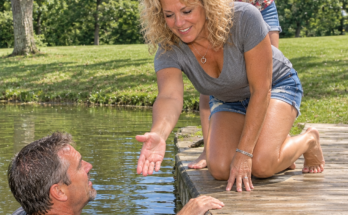
Every summer of my life, he walked my sister and me down to the pond on the back corner of that eighty with two cane poles.
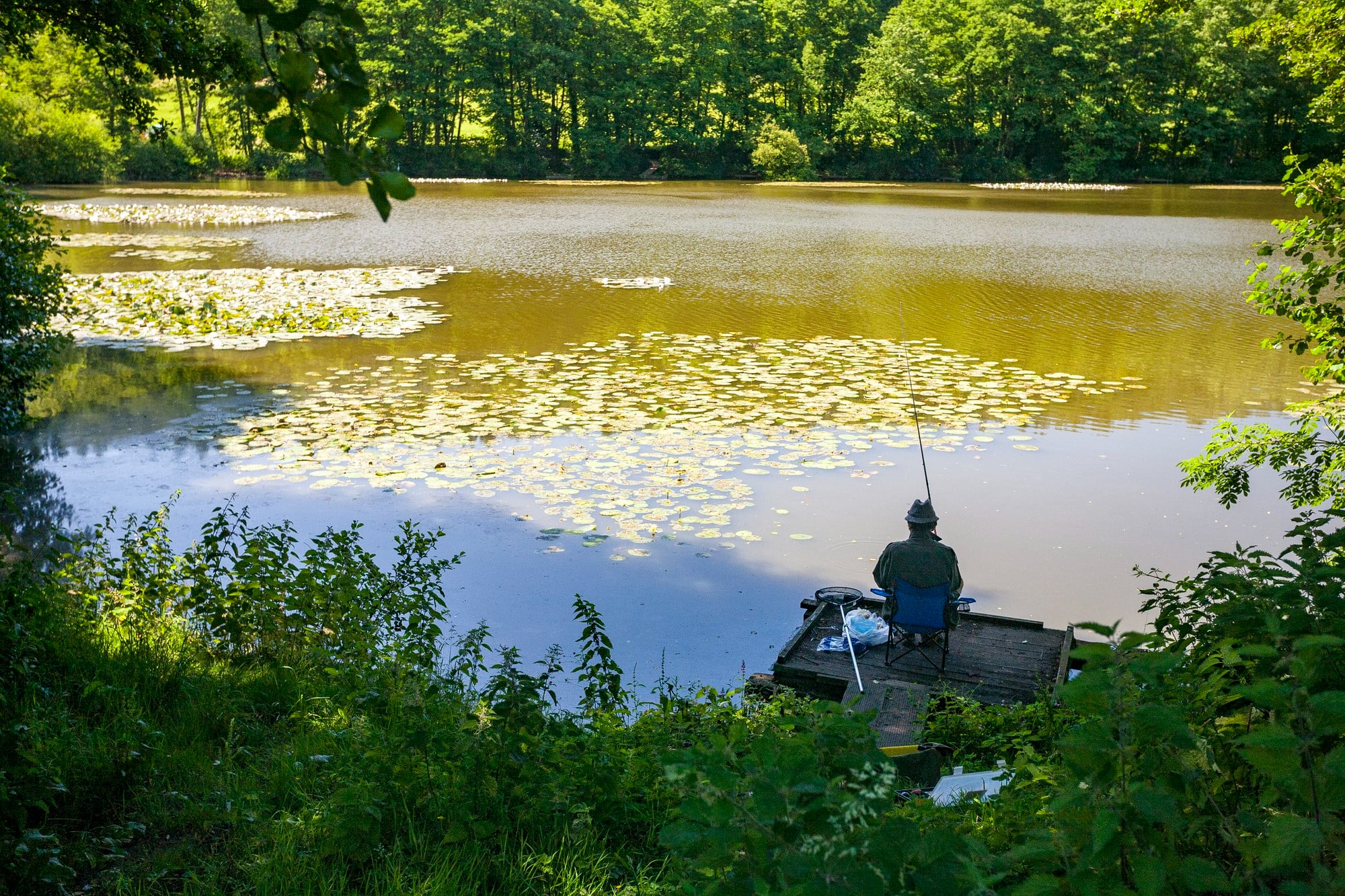
The pond was nothing special to anybody else. Maybe an acre of water, in a low spot between two hills, with a dam at one end that Grandpa built with a borrowed dozer in 1971. Cattails along the dam. A big cottonwood on the north bank. Bluegill and bullheads and a few largemouth bass that Grandpa stocked himself from a bucket.
He’d bait our hooks with nightcrawlers from the coffee can. He’d set us on the bank on overturned five-gallon buckets. He’d sit between us on his own bucket with his seed cap pushed back, and he’d wait.
“This is for you girls,” he’d say. “Both of you. Someday.”
I believed him. Brittany believed him. We’d grown up believing him.
But it turned out the will left the eighty to Mom and Dad outright. Not to us. To them. I found out at the lawyer’s office in Creston in November, sitting in a plastic chair while a man in a gray suit read it out loud.
To my daughter, Sheryl Kessler Morgan, and her husband, Roger Morgan, all my real estate.
Grandpa Earl was Mom’s father. So that was that. The sale was legal. There was nobody to call.
Dad wouldn’t look at me.
He sat at the end of the table in his good Sunday shirt and kept buttering the same roll. Over and over. He’d buttered it three times already. It was falling apart in his hands.
“Your sister only gets one wedding, Jess,” he said to the roll.
I looked at Brittany. She was still looking at her plate.
“Brit?” I said.
She didn’t answer.
Mom reached across the table and patted my hand. She smiled at me. The smile she gave me my whole life, whenever something went wrong and she needed it to be okay.
“You were always fine, Jessie,” she said. “You’ll be fine.”
Then she got up and went to get the pie.
Chapter Two: Always Fine
I was twenty-nine that winter.
I want you to understand where I was in my life, so you understand what “always fine” meant.
I was working three jobs to get through nursing school at Southwestern Community College in Creston.
Nights as an aide at the care center. Ten p.m. to six a.m., four nights a week. Seventeen dollars an hour, turning residents, changing briefs, sitting with the ones who couldn’t sleep.
Saturdays at the Corner Café on Main Street. Six in the morning to two in the afternoon. Biscuits and gravy and refills for farmers who tipped in quarters.
Sunday mornings, cleaning the Iowa State Bank in town. Vacuuming, emptying wastebaskets, wiping fingerprints off the glass doors. Two hours, forty dollars, cash.
I was going to class in between. I was sleeping maybe five hours a night. I had a 2009 Chevy Malibu with two hundred and eleven thousand miles on it and a heater that only worked on high.
I didn’t live at home. I hadn’t since I was nineteen. I rented a one-bedroom apartment above the hardware store in Creston for five hundred and twenty a month.
I’d been paying my own way since I was nineteen. My own tuition. My own car insurance. My own everything.
Nobody ever asked me how I was doing. Not really. Because I was always fine.
Brittany was different. Brittany was the baby.
She went to Iowa State. Mom and Dad paid. She had a sorority and a meal plan and a car they bought her for graduation. When she moved to Des Moines after college and got a job in marketing at an insurance company, Dad co-signed her apartment lease.
I’m not saying that to be bitter. I’m saying it because it’s true. She was the baby, and I was the one who was fine.
That’s just how it was in our family. Some people are the ones who need things. Some people are the ones who are fine.
The wedding cost sixty thousand dollars.
I found that out later. Brittany told me. Sixty thousand dollars for one Saturday in June at the Inn at Okoboji. The tent on the lawn. The band from Des Moines. Two hundred guests. Prime rib and salmon. An open bar. A florist from Spirit Lake who did the whole tent in white hydrangeas.
The rest of the money went to a new truck for Dad. A 2024 Ram 2500, black, with leather seats.
And a pontoon. A twenty-two-foot Bennington, tan and silver, that Dad kept on a lift at a marina on West Okoboji.
I stood up at that wedding in a dress I paid for myself.
A sage green bridesmaid dress from a bridal shop in Des Moines. One hundred and eighty-nine dollars. I paid for it out of my café tips. I drove up to the fitting on my one day off and drove back the same night for my shift.
I stood at the front of the tent on the lawn with the other four bridesmaids and held a bouquet of white hydrangeas. I watched my little sister walk down the aisle on our dad’s arm in a dress that cost more than my car.
I smiled in every picture.
I want you to know that. Every single one. If you look at Brittany’s wedding album, you’ll see me smiling in all of them.
I know how to smile.
Then I drove home. Four hours, in the dark, in my Malibu with the heater on high in June because the air conditioner was broken too.
I got back to my apartment above the hardware store at two in the morning. I hung up my sage green dress in the closet.
And I sat down at my kitchen table and studied for a pharmacology test.
Beta blockers. ACE inhibitors. Calcium channel blockers. I made flash cards until the sun came up.
I got a ninety-four.
Chapter Three: The Boards
I passed my boards a year and a half later.
The NCLEX. Seventy-five questions, and if you get them right enough, the computer shuts off early. Mine shut off at seventy-five. I sat there in the testing center in Des Moines staring at a blank screen, sure I’d failed.
I hadn’t. I got the email two days later. I was in the parking lot of the care center, about to start my last night shift. I read it four times.
Then I sat in my Malibu and cried for twenty minutes.
Then I went inside and worked my shift.
Nobody from my family came to my pinning ceremony.
That’s the nursing school graduation. They give you a pin and you say the Nightingale Pledge with a little candle. It was on a Thursday night in May in the Southwestern auditorium.
Mom said she had a church thing. Dad said he had to get the pontoon ready for Memorial Day. Brittany was in Des Moines. She texted me a string of heart emojis and a picture of a cake.
Grandpa Earl would have come. He’d have sat in the front row in his good seed cap. He’d have clapped too loud.
I said the Nightingale Pledge by myself. Then I went to the Pizza Ranch with three girls from my class and their families.
I took a job on the medical floor at the hospital in Corning. Rosary Hospital. Twenty-two beds, twelve-hour shifts, three days a week.
Twenty-nine dollars an hour to start.
I quit the café. I quit the bank. I quit the care center. For the first time since I was nineteen, I had one job.
I didn’t buy one thing that first year.
No new car. The Malibu was still running, mostly. No trip. No new furniture. No new clothes except scrubs.
I put every dollar I didn’t need for rent and food into a savings account at the Iowa State Bank. The same bank I used to clean on Sunday mornings.
By the end of that first year, I’d saved fourteen thousand dollars.
People asked me what it was for. Coworkers. My friend Kayla from nursing school.
“A down payment?” Kayla asked. “On a house?”
“Something like that,” I said.
I didn’t tell anybody. Not even Kayla.
Because every time I drove past Grandpa’s old eighty on the gravel road to Corning, I looked at it. And every time, I saw the pond on the back corner. And the cottonwood. And the dam he built with a borrowed dozer.
And I thought about two girls on overturned buckets, with cane poles.
This is for you girls. Both of you. Someday.
Vern Akers hadn’t done anything with it.
That’s what I noticed. Two years after he bought it, and he hadn’t plowed it up or built anything. He’d fenced it in with his own pasture and turned his Angus cows out on it. That was all.
The cows had found the pond, of course. They’d tramped the banks bare. Mud all the way around. The cattails along the dam were half gone. The water was brown.
But the cottonwood was still there. And the dam was still there.
And the pond was still there.
Chapter Four: Vern’s Place
I drove out the gravel to Vern’s place on a Tuesday in February. My day off.
He lives about a mile south of Grandpa’s old eighty, in a white farmhouse with a red barn and a windbreak of cedars on the north side. He’s lived there his whole life. He farmed next to Grandpa Earl for forty years.
He was seventy. A widower. His wife, Ardis, died of cancer the same year as Grandpa. They never had children.
I’d known Vern my whole life. He came to every one of Grandpa’s birthday parties. He sat in the second row at Grandpa’s funeral. He had a white beard and wore bib overalls and a seed cap, and he had a way of saying very little that made you feel like he’d said a lot.
He answered the door in his stocking feet. He had a cup of coffee in one hand and his reading glasses pushed up on his forehead.
“Jessie Morgan,” he said. He looked surprised. “Come in. It’s cold.”
He sat me down at his kitchen table. He poured me a cup of coffee without asking. It was strong enough to stand a spoon in.
“How’s nursing?” he asked.
“Good. Hard. Good.”
“Earl would be proud,” Vern said. “He used to tell me you’d be a nurse someday. Since you were about eight. Said you were the only one in the family who could stand the sight of blood.”
I laughed. It came out shaky.
I didn’t know how to start. So I just said it.
“Vern,” I said. “I want to buy the pond.”
He set his coffee cup down.
“The two acres around it,” I said. “With the pond and the cottonwood and the dam. That’s all. I don’t want the rest. Just the pond.”
I took a folded piece of paper out of my coat pocket. A cashier’s check from the Iowa State Bank. I’d gotten it that morning. I slid it across the table to him.
“I have fourteen thousand dollars,” I said. “I know that’s probably not enough. I know what ground’s going for. But I can make payments on the rest. Whatever you want.”
Vern didn’t touch the check.
He was quiet a long time. He looked out the kitchen window at his barn. A clock was ticking somewhere in the living room. His old dog, a black lab with a gray face, came over and put its head on my knee.
“I told your dad that price was low,” Vern said finally.
I looked at him.
“When he sold me the eighty,” Vern said. “I told him. Roger, I said, ground’s going for more than this. You could get six, seven thousand an acre if you list it. But he didn’t want to list it. He wanted it done fast.” He rubbed his beard. “He wanted it done before the deposit was due.”
“The deposit?”
“On the wedding,” Vern said. “The place at Okoboji. He told me they needed thirty thousand by the end of February, or they’d lose the date.”
I sat there with my coffee getting cold.
I’d always thought they sold the land and then decided on the wedding. That it was a windfall. A gift.
But that’s not what happened. They’d booked the wedding first. They’d put down a deposit they didn’t have. And then they’d sold Grandpa’s eighty, at a discount, to pay for it.
Four months after he died.
“How much did you pay?” I asked. “Per acre?”
Vern looked at me for a long time.
“Four thousand, three hundred and seventy-five,” he said.
Then he picked up a pencil from the cup on the table. He took a seed company notepad off the counter. He wrote a number on it and turned it around so I could see.
$4,375.
“That’s my number,” Vern said. “Per acre. What I paid. Not what it’s worth now. What I paid.”
“Vern…”
“Two acres is eight thousand, seven hundred and fifty,” he said. “You pay the survey. Should be about twelve hundred, from Dale Wiese’s outfit in Creston. And the filing fees at the courthouse.” He slid the cashier’s check back across the table to me. “You keep the rest of that. You’ll need it.”
I couldn’t speak.
“And I’ll help with the dock,” Vern said.
“Why?” I finally managed.
Vern picked up his coffee cup again. He held it in both hands and looked into it.
“Earl and me used to fish that pond,” he said. “On Sunday afternoons. After church. For forty years. Before you girls were born, and after.” He paused. “He’d sit on one side and I’d sit on the other, and we wouldn’t say ten words between us. Best afternoons of my life.”
He looked up at me.
“He told me about the cane poles,” Vern said. “About you girls. He said, Vern, that pond is the only thing I’ve got that’s worth anything. The rest is just dirt.” He set the cup down. “I figure I owe him.”
Chapter Five: The Dock
The survey took three weeks. Dale Wiese came out with his son and a GPS unit on a pole and walked the pond in the snow, planting little orange flags.
Two point zero one acres. One acre of water, one acre of bank. The dam, the cottonwood, and a little strip of hillside on the north side where the grass was tall.
The closing was at the abstract office in Bedford on a Friday morning in March. Vern signed the warranty deed. I signed a check for eight thousand, seven hundred and fifty dollars. The lady at the abstract office stamped it and smiled at us.
“Congratulations,” she said. “You’re a landowner.”
I drove out to the pond that afternoon. I parked my Malibu on Vern’s field road and walked down through his pasture, through the snow, to the edge of the water.
It was still half frozen. Gray ice in the middle, black water around the edges. The cottonwood was bare. The cattails along the dam were brown and broken.
I stood there in my Carhartt coat and my boots for a long time.
I didn’t cry. I thought I would. But I just stood there, breathing, and looked at it.
Mine.
We drove four treated posts into the muck the last week of March.
Vern brought a post driver on the back of his skid loader. A big steel weight on a slide. He set it on top of each post, and I held the post steady, and he dropped the weight. Bang. Bang. Bang. Each post went six feet into the mud at the edge of the pond.
He cut the boards in his shop. Treated two-by-sixes. He measured everything twice. He brought them down in the bed of his truck.
I nailed them.
Every single one. With Grandpa’s old hammer, the one with the wooden handle worn smooth from fifty years of his hand. Vern had found it in the shed when he bought the eighty. He gave it to me the day we closed.
It took us three Saturdays. When it was done, it was a dock. Not a fancy one. Twelve feet long, four feet wide, sticking out into the water from the north bank, under the cottonwood.
Vern stood at the end of it and stomped his boot.
“She’ll hold,” he said.
“She’ll hold,” I said.
His cows had tramped most of the bank bare. Two years of Angus walking down to drink had turned it into a mudhole. The cattails Grandpa planted along the dam in 1972 were mostly gone. Just a little stand left at the dam end, maybe twenty stalks.
Vern ran a new fence around my two acres, so his cows couldn’t get back in. He didn’t charge me for it. He said he had wire left over.
Then I started on the cattails.
I dug them from Grandpa’s old stand at the dam end. With a garden spade and a five-gallon bucket. You dig down around the root, which is thick and white and goes sideways under the mud. You lift out a clump. You carry it to the new spot.
I set them along the bank one at a time.
On my knees in the mud.
It took me seven evenings after work. I’d drive out from Corning at seven-thirty, still in my scrubs, change into rubber boots in the Malibu, and dig until dark. By the end, I had cattails along the whole east bank, maybe forty feet, planted every eighteen inches.
My knees were black with mud for a week. My hands were cracked. One of the nurses at work asked if I’d been gardening.
“Sort of,” I said.
Then I went home to my apartment above the hardware store. I sat down at the kitchen table. I picked up my phone.
I opened my messages and scrolled down to Brittany.
The last thing she’d texted me was a string of heart emojis. For my pinning. A year and a half ago.
I typed for a long time. Deleted it. Typed again. Deleted it.
Finally, I just wrote:
Grandpa’s pond. Saturday evening. Bring nothing.
I hit send before I could stop myself.
We hadn’t really talked since the wedding.
Not really. A text on birthdays. A phone call at Christmas that lasted four minutes. A photo of her new house in Ankeny that she sent to the family group chat, which I hearted and didn’t comment on.
It wasn’t that we’d had a fight. We’d never fought. That was the thing.
We just didn’t know how to talk to each other anymore.
She wrote back that night. One word.
Okay.
Chapter Six: The Tackle Box
Saturday was a spring evening. The second week of April.
Golden light on the water. Not a breath of wind. The pond was perfectly still, like a mirror, with the cottonwood leafing out on the north bank and its reflection hanging upside down in the water.
The cattails I’d planted were coming up green. Little spears poking out of the mud. A redwing blackbird was sitting on one of the old stalks at the dam end, singing.
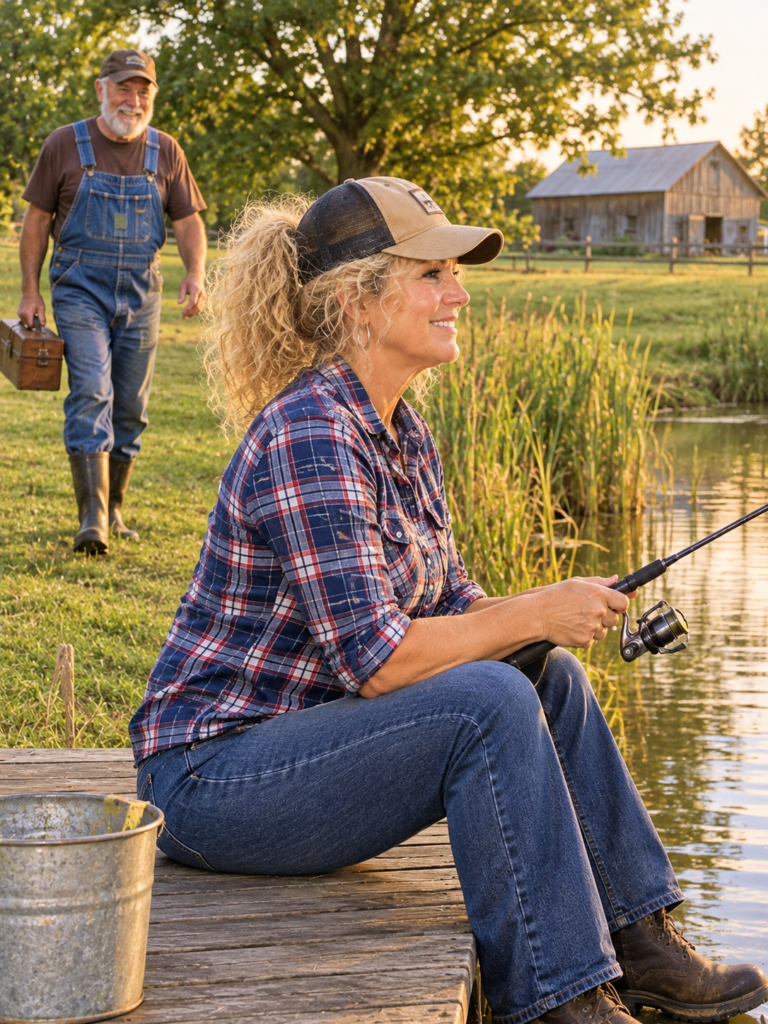
I sat at the end of the new dock in my green flannel and a ball cap. My boots hanging over the edge. Grandpa’s cane pole across my lap.
I’d found the cane poles in the corner of the machine shed when Vern bought the eighty. He’d saved them. Two of them, twelve feet long, with the line wrapped around the end and a little red and white bobber still clipped on each one.
One had a strip of white tape around the bottom with JESS written on it in Grandpa’s handwriting. The other said BRIT.
I was holding mine.
Hers was lying on the dock beside me.
I heard a truck on the field road. Then a door. Then footsteps coming down through Vern’s pasture. Slow, heavy steps.
Vern came down the hill in his overalls and his seed cap. He was carrying something in one hand. An old metal tackle box, green, with rust around the hinges.
He came out onto the dock. It held. He stopped beside me.
“Found this in the shed,” he said. “Back on a shelf behind the grease guns. Took me a while to get the lid loose.” He set it down on the dock next to me. “It was Earl’s.”
I looked at it. I knew it. I’d seen it a hundred times. Every summer. Grandpa would set it between his bucket and mine, and open it, and take out the nightcrawlers and the extra hooks and the little lead sinkers.
My hand moved toward the latch.
Then I stopped.
“Not yet,” I said. “I want to wait for Brit.”
Vern nodded. Like that was the right answer.
“I’ll get on back up the hill,” he said. “Give you girls some room.”
He went back up through the pasture. Slowly. I watched him go. At the top of the hill he stopped by his truck and stood there, looking down at the pond, with his hands in the pockets of his overalls.
Then he got in and drove away.
I sat there alone at the end of the dock.
The light was getting lower. Gold turning to orange. The redwing blackbird kept singing. A frog started up somewhere in the cattails.
I didn’t know if she’d come. Okay could mean anything. Okay could mean I’ll come. Okay could mean I got your message.
I checked my phone. Six-forty.
Then I heard a car on the gravel.
A few minutes later, my sister walked down through the grass.
She came slowly. She was wearing jeans and a light jacket and white sneakers that she probably bought just for this, because Brittany never owned a pair of shoes she could get muddy. Her blonde hair was down. No makeup.
She looked older than she did at the wedding. Tired.
She stopped at the edge of the dock.
She didn’t come out on it. She didn’t sit.
She looked at the cattails a long time. At the new ones I’d planted along the east bank, coming up green in the mud. At the old stand at the dam end. At the cottonwood. At the cane pole lying on the dock with her name on the tape.
Then she said, “Jess, I need to tell you what Mom told me the week before my wedding.”
Chapter Seven: What Mom Said
I set my cane pole down across my knees.
“Okay,” I said.
Brittany didn’t move. She stood at the edge of the dock with her arms wrapped around herself, even though it wasn’t cold.
“Can I sit?” she asked.
“It’s your dock too.”
She looked at me sharply. Then she walked out to the end, carefully, like she wasn’t sure it would hold her. She sat down next to me. Not close. A foot of space between us.
She looked at the water.
“The Saturday before the wedding,” she said, “Mom and I drove up to Okoboji to check on the tent. Just the two of us. Dad stayed home.”
I didn’t say anything.
“And we were sitting on the dock at the Inn, after,” she said. “Drinking wine. Looking at the lake. And Mom got kind of drunk. You know how she gets on two glasses.”
“I know.”
“And she started talking about Grandpa.” Brittany’s voice was very quiet. “About the will.”
The frog in the cattails stopped.
“She said Grandpa had a will,” Brittany said. “An old one. From 2015. After Grandma died. She said it left the eighty to us. To you and me. Fifty-fifty.”
I went very still.
“She said she found it in his desk drawer,” Brittany said. “Last summer. When he was on hospice. When he was on the morphine.” She swallowed. “And she said she and Dad took him to the lawyer in Creston in August. To make a new one.”
“August,” I said.
“Two months before he died,” Brittany said. “When he couldn’t remember what day it was. When he called you Sheryl half the time and asked for Grandma.”
I put my hand flat on the boards of the dock. I needed to touch something solid.
“She said he signed it,” Brittany said. “She said the lawyer asked him if he understood, and he said yes. She said it was all legal.” Her voice cracked. “She said she had to do it. She said she never got a real wedding, and she wasn’t going to let me miss mine.”
I closed my eyes.
Mom and Dad got married at the Taylor County Courthouse in 1993. On a Tuesday. Mom was pregnant with me. Grandpa Earl was so angry he didn’t come. They didn’t speak for a year.
I knew that story. Everybody in our family knew it. Nobody ever talked about it.
“And then,” Brittany said. She stopped. She wiped her eyes with her sleeve.
“And then what, Brit?”
“And then she said, ‘Don’t tell Jess. Jess will be fine. Jess is always fine.’”
We sat there on the dock for a long time without saying anything.
The sun was almost down now. The light on the water was red. The redwing blackbird had stopped singing. Somewhere far off, one of Vern’s cows bawled.
“I almost called it off,” Brittany said. “The wedding. That night. I lay in bed at the Inn and I couldn’t breathe. I almost called you. I had my phone in my hand. I had your name up.”
“Why didn’t you?”
She shook her head.
“Because there were two hundred people coming,” she said. “Because Tanner’s whole family drove from Nebraska. Because the deposit was paid and the band was booked and the flowers were ordered. Because Mom was so happy.” She was crying now. “Because I was a coward, Jess. That’s why.”
“And then you stood up there,” Brittany said. “In that sage dress. And you smiled. In every single picture. And I kept looking at you and thinking, she doesn’t know. She doesn’t know I’m standing here in a dress that was paid for with her half of Grandpa’s land.”
She put her face in her hands.
“I couldn’t look at you,” she said. “For two years. Every time I saw your name on my phone, I felt sick. Every time Mom said ‘Jess is fine,’ I wanted to throw up.”
I didn’t say anything for a long time.
I wanted to be angry. I want to be honest about that. Part of me was. Part of me wanted to stand up and walk off that dock and drive away and never come back.
But I looked at my little sister. Twenty-eight years old. Crying into her hands on Grandpa’s pond in her brand-new white sneakers.
And I remembered her at six. Sitting on an overturned bucket on that bank, crying because a bluegill swallowed her hook. Grandpa kneeling down beside her to get it out. Me holding her hand.
“Brit,” I said. “Look at me.”
She lifted her face.
“You were twenty-six,” I said. “Mom got you drunk on a dock a week before your wedding and dumped all of that on you. That’s not on you. That’s on her.”
“I could have told you.”
“Yeah,” I said. “You could have.”
She flinched.
“But you’re telling me now,” I said.
Chapter Eight: The Lawyer
I called a lawyer on Monday.
I knew what she was going to say before I even dialed. But I needed to hear it.
Her name was Margaret Pohl. She did estate law in Creston. Not the same lawyer Mom and Dad took Grandpa to. A different one. A gray-haired woman in her sixties who’d been doing wills and probate in Union County for thirty-five years.
I met her in her office above the bank on a Wednesday afternoon. I brought Brittany. She drove down from Ankeny and took a personal day.
We told her everything.
Margaret listened without interrupting. When we were done, she took off her reading glasses and set them on her desk.
“I’m going to be honest with you girls,” she said. “Because I think you’d want me to be.”
“Please,” I said.
“What you’re describing sounds like it could be undue influence,” she said. “A parent with a terminal diagnosis, on hospice, on morphine. Children who benefit from the change, driving him to the lawyer’s office. A prior will that went the other way. If you’d come to me two years ago, I’d have said you had something worth looking at.”
“But,” I said.
“But,” Margaret said. “In Iowa, you have a limited time to contest a will. Generally, the later of four months after the second publication of the notice to creditors, or one month after the notice is mailed to you. Did you get a notice in the mail? From the estate?”
I thought about it. I remembered a letter. November. From the lawyer in Creston. I’d opened it at the care center on a break and read it and put it in my locker.
“Yes,” I said.
“Then the deadline passed a long time ago,” Margaret said gently. “Probably before the wedding.”
Brittany made a small sound.
“And even if you could contest it,” Margaret said, “the land’s been sold. To a good-faith buyer. Mr. Akers paid a fair, if low, price, and had no knowledge of any of this. A court isn’t going to take the land back from him.”
“I wouldn’t want them to,” I said.
Margaret looked at me for a long moment.
“Then what do you want?” she asked.
I didn’t know how to answer.
I’d been thinking about it since Saturday night. Lying awake in my apartment above the hardware store.
What did I want? The money? The land? Most of it was gone. The wedding was spent. The truck was being driven. The pontoon was floating on West Okoboji.
I didn’t want to sue my parents. I didn’t want to sit in a courtroom in Creston across a table from my mother.
“I want them to know,” I said finally. “That we know. Both of us.”
Margaret nodded slowly.
“That’s not something the law can give you,” she said. “That’s something you’ll have to do yourselves.”
On the way out, she stopped us at the door.
“There’s one more thing,” she said. “The prior will. The 2015 one. You said your mother found it in your grandfather’s desk.”
“That’s what she told Brit.”
“If it was properly executed,” Margaret said, “the lawyer who drew it up may still have a copy in his files. Lawyers are supposed to keep them. It won’t change anything legally now. But you might want to see it.” She paused. “Sometimes it helps to see it in writing. What someone actually wanted.”
“Who would’ve drawn it up?” Brittany asked.
Margaret almost smiled.
“Earl Kessler,” she said. “Came in here in March 2015, about a month after his wife’s funeral. Sat in that chair right there. Wanted to make sure his granddaughters got the pond.” She went to her filing cabinet. “I’ll have to check. But I believe that was me.”
Chapter Nine: In Writing
She found it the next day. She called me at work.
A copy of Grandpa’s 2015 will, in a manila folder in her files. Signed by Earl Kessler. Witnessed by her secretary and the Iowa State Bank teller who came up to notarize it.
She mailed us each a copy. With a letter on her stationery saying she was sorry for our loss, and that she was sorry the copy came too late to matter.
I opened mine in my apartment, sitting at the kitchen table.
It was simple. Four pages. Most of it was about his savings account and his pickup and who got his guns.
But on page two, it said:
I give my farm real estate, consisting of eighty acres in Section 14, Lenox Township, Taylor County, Iowa, to my granddaughters, Jessica Ann Morgan and Brittany Lynn Morgan, in equal shares, as tenants in common.
And then, right under that, in Grandpa’s own handwriting, in the margin, in blue ink, with an arrow pointing to the paragraph:
The pond is the part that counts. Fish together.
I sat there at my kitchen table and read that line twenty times.
Then I called Brittany.
She answered on the first ring. She was crying already. She’d gotten hers too.
“Did you see it?” she said. “The note? In the margin?”
“I saw it.”
“Fish together,” she said. “Jess. He wrote fish together.”
We didn’t say anything for a long time. Just breathed on the phone, a hundred miles apart.
“Sunday,” I said finally. “Mom and Dad’s. Dinner. Both of us.”
“Both of us,” Brittany said.
That Sunday, we drove up to the house together. In my Malibu. Brittany had driven down from Ankeny the night before and slept on my couch above the hardware store.
Mom and Dad live in a split-level on the edge of Lenox. The black Ram 2500 was in the driveway. The pontoon was on a trailer next to the garage, covered with a gray tarp for the season.
We sat in the car for a minute.
“You okay?” I asked.
“No,” Brittany said. “You?”
“No.”
We got out anyway.
Mom was thrilled to see us. Both girls home on the same Sunday. She hugged us in the doorway. She’d made a roast. She’d made a pie. Cherry, Brittany’s favorite.
Dad was in his recliner with the Twins game on. He got up and hugged us too. He smelled like Old Spice and the cab of a new truck.
We sat down at the dining room table. The same table. Mom carved the roast. Dad buttered a roll.
Then I took the copy of the 2015 will out of my purse. I unfolded it. I laid it on the table, next to the mashed potatoes, turned so they could both read it.
Brittany laid hers down right next to mine.
Chapter Ten: Between the Roast and the Pie
Mom stopped carving.
She looked at the papers. Then at me. Then at Brittany.
Her face went white. Not pale. White. The knife was still in her hand.
Dad leaned forward and read the first page. Then the second. He stopped at the line in the margin. The handwriting in blue ink.
He set down his roll.
“Where did you get this?” Mom said. Her voice was very quiet.
“Margaret Pohl,” I said. “In Creston. She drew it up. In 2015. A month after Grandma died.”
“Jessie…”
“Brit told me, Mom,” I said. “What you told her. On the dock at Okoboji. The week before the wedding.”
Mom looked at Brittany. Brittany looked back at her. She didn’t look away.
“You promised,” Mom said.
“I know I did,” Brittany said. “I shouldn’t have.”
The Twins game was still on in the living room. Somebody hit a double. The crowd cheered. Nobody at the table moved.
“It was legal,” Mom said finally. “The new will. The lawyer asked him if he understood. He said yes.”
“He thought I was you, Mom,” I said. “In August. Every time I came in to sit with him on my break, he called me Sheryl. He asked me if I’d brought the potato salad for the threshers. He thought it was 1962.”
Mom didn’t answer.
“I worked nights at the care center,” I said. “I sat with people on morphine for three years. I know what it looks like. You know he didn’t understand.”
Dad hadn’t said a word. He was staring at the margin of the will. At the blue ink.
The pond is the part that counts. Fish together.
“Roger,” Mom said sharply. “Say something.”
Dad looked up. Not at Mom. At me.
“I told her not to,” he said.
Everybody turned and looked at him.
“In August,” Dad said. His voice was rough. “I told her it wasn’t right. Taking him in like that. I said, Sheryl, he’s not himself. Let it go. The girls should have it.” He swallowed. “She said if I didn’t drive him, she’d drive him herself.”
“Roger!”
“And I drove him,” Dad said. “God help me. I drove him.”
He put his face in his hands. His big farmer’s hands, with the knuckles cracked from forty years of winter.
“And then the place at Okoboji wanted thirty thousand,” he said into his hands. “And we’d already signed. And I didn’t have thirty thousand. I had the operating note at the bank, a hundred and seventy thousand behind on it, three bad years in a row.” He shook his head. “So I called Vern. And Vern said it was too low, and I said I don’t care, Vern. Just write the check.”
“Dad,” Brittany whispered.
“I paid off the operating note,” Dad said. “I paid for the wedding. And I bought a truck and a pontoon, because I told myself I deserved one thing after forty years of eating dirt.” He looked up at me. His eyes were red. “And every time I drive that truck past Earl’s eighty, I want to drive it into the ditch.”
Mom stood up. She put the carving knife down on the platter with a clatter.
“You don’t understand,” she said. “Either of you.”
“Then tell us,” I said.
She stood there by the table in her Sunday apron. Her hands were shaking.
“I was twenty-one,” she said. “Pregnant with you. And my father wouldn’t come to my wedding. He wouldn’t come. To the courthouse. On a Tuesday. He said I’d shamed him.” Her voice cracked. “I didn’t have a dress. I wore my church skirt. Roger’s mother took one picture with a disposable camera. That’s my wedding. One picture.”
She looked at Brittany.
“And then he spent twenty-five years walking you girls down to that pond with cane poles,” she said. “Telling you it was all for you someday. His granddaughters. Never me. Never once in my life did he tell me anything was for me.”
Nobody said anything.
“So when you got engaged, Brit,” Mom said, crying now, “I thought, she’s going to have what I didn’t. She’s going to have a dress and a tent and a band and two hundred people. And I didn’t care where the money came from.” She wiped her eyes with her apron. “I didn’t care. I wanted my baby to have a real wedding.”
“And Jess?” Brittany said quietly. “What did you want for Jess?”
Mom looked at me.
I watched her face. I watched her try to find the answer.
“Jess was always fine,” she said finally. Very softly. Like she was just hearing it for the first time.
“No, Mom,” I said.
I stood up.
“I wasn’t fine,” I said. “I was working three jobs. I slept five hours a night for three years. I drove a car with no heat. I paid for my own bridesmaid dress out of café tips.” My voice was shaking. “I wasn’t fine. I just never asked you for anything. Because I learned a long time ago that in this family, there’s one kind of girl who needs things and one kind who doesn’t.”
Mom’s face crumpled.
“I was fine because I had to be,” I said. “That’s not the same thing.”
Chapter Eleven: The Part That Counts
We didn’t eat the roast. Or the pie.
Brittany and I left about an hour later. Mom was crying at the kitchen sink. Dad walked us out to the car. He stood in the driveway next to his black Ram with his hands in his pockets.
“I’m going to make it right,” he said. “I don’t know how yet. But I’m going to.”
“Dad,” I said. “I don’t want money.”
“I know you don’t.” He looked at the pontoon on its trailer under the gray tarp. “That’s what makes it worse.”
He sold the pontoon in May.
Thirty-one thousand dollars. To a man from Sioux City. He drove it up to Okoboji himself and handed over the keys.
Then he drove down to Corning and found me on my lunch break at the hospital. He handed me an envelope. Inside was a cashier’s check for fifteen thousand, five hundred dollars.
And another one, made out to Brittany, for the same amount.
“Half the pontoon,” he said. “Each. It’s not much.”
“Dad…”
“It’s not half the eighty,” he said. “I can’t ever give you that. But it’s something.” He looked at the hospital parking lot. “And I’m going to keep trying.”
I didn’t cash it for a month. I didn’t know what to do with it.
Then I knew.
I drove out to Vern’s place on a Saturday. Brittany came down from Ankeny and met me there. We sat at Vern’s kitchen table and drank his terrible strong coffee.
“Vern,” I said. “Brit wants to buy in. Half the pond.”
Vern looked at Brittany.
“Is that right?” he said.
“If Jess will have me,” Brittany said.
So we did it right.
Margaret Pohl drew up a new deed. Jessica Ann Morgan and Brittany Lynn Morgan, as tenants in common. Equal shares. The same words Grandpa used in 2015.
Brittany paid me half of what I’d paid for it. Four thousand, three hundred and seventy-five dollars. Plus half the survey. Out of her half of the pontoon money.
She signed the deed in Margaret’s office above the bank in Creston. Then I signed it. Then we took it to the Taylor County Recorder’s office in Bedford and they stamped it.
The lady behind the counter read our names.
“Sisters?” she asked.
“Sisters,” we said at the same time.
Mom didn’t call for three months.
Then, in August, she showed up at the pond.
Brittany and I were at the end of the dock. It was a Sunday evening. We’d started coming every Sunday that summer. Brit drove down from Ankeny. Tanner came sometimes. Kayla from work came once. Vern came down most weeks and sat on an overturned bucket on the bank, and didn’t say ten words, and seemed perfectly happy.
That Sunday, we heard a car on Vern’s field road. A door. Then somebody coming down through the pasture.
Mom stopped at the fence.
She was wearing jeans and her old gardening sneakers. She was holding a covered dish. She stood at the gate in Vern’s new fence for a long time, looking at the pond.
At the cattails along the east bank, tall and green now, with brown heads starting to form. At the cottonwood. At the dock. At her two daughters at the end of it, holding cane poles.
Brittany looked at me.
I got up. I walked down the dock and up the bank to the gate.
“Hi, Mom,” I said.
“Hi, Jessie.” Her voice was small. She held out the dish. “I made potato salad. I didn’t know if you’d want it.”
I took it.
“Can I come in?” she asked.
I looked at her. My mother. Fifty-five years old. In her old gardening sneakers, standing at a gate in a cow pasture, holding her breath.
I thought about one picture from a disposable camera. A church skirt at the Taylor County Courthouse. A father who wouldn’t come.
I opened the gate.
Chapter Twelve: Fish Together
She didn’t come out on the dock that first time. She sat on the bank, on the overturned bucket Vern usually used. Vern took one look at her and went to get another bucket from his truck.
She didn’t say much. Neither did we. We fished. The bobbers sat on the still water, red and white.
Around sunset, Brittany’s bobber went under.
“Brit!” I said. “Brit, you’ve got one!”
She yanked the cane pole up. A bluegill came flying out of the water. Fat and flapping, gold and green in the evening light. It swung in a big arc over the dock and landed in my lap.
Brittany screamed. I screamed. Vern laughed so hard he almost fell off his bucket.
And on the bank, my mother laughed. A real laugh. I hadn’t heard it in two years.
Then I remembered the tackle box.
It was still sitting on the dock, where Vern set it down that first Saturday in April. I’d brought it back every Sunday since. I hadn’t opened it. Neither had Brittany.
We’d both been waiting. I don’t know for what.
I looked at Brittany. She looked at me. Then she looked up at the bank, at Mom.
“Mom,” Brittany said. “Come here. Please.”
Mom came out on the dock. Slowly. Like she wasn’t sure it would hold her.
She sat down between us. Not close. A little space on each side.
I pulled the tackle box over. Old green metal, rust around the hinges. I put my hand on the latch.
“It was Grandpa’s,” I told her. “Vern found it in the shed.”
Mom looked at it. Her mouth trembled.
“I know whose it is,” she said. “He had it when I was a girl.”
I opened the lid.
The top tray was full of what you’d expect. Hooks. Sinkers. A spool of line. A rusty pair of needle-nose pliers. A jar of salmon eggs from about 1998.
I lifted out the tray.
Underneath, in the bottom of the box, there were three bobbers. Red and white. The old-fashioned kind, with the little spring clip on top.
Each one had a strip of white tape wrapped around it. With a name on it in Grandpa’s handwriting.
JESS.
BRIT.
And the third one.
SHERYL.
Mom made a sound I’d never heard her make.
She picked up the third bobber. She held it in her palm. Her hand was shaking so hard the little spring clip rattled.
Underneath the bobbers, folded in quarters, there was a piece of paper. Yellowed. Soft as cloth.
I unfolded it. I held it so all three of us could read it.
It was a note. In blue ink. In Grandpa’s square, slanted farmer’s handwriting. Dated at the top: June 1993.
Sheryl,
I should have been at the courthouse. I was a stubborn old fool and I’ll be sorry for it the rest of my life.
I don’t know how to say it to your face so I’m putting it here, in the box, where I’ll see it every time I go fishing. Maybe someday I’ll get up the nerve to give it to you.
I made this bobber for you. Same as I’ll make one for the baby. If it’s a girl, I’ll teach her to fish. If it’s a boy, same thing.
The pond’s for you too. It always was. I just never knew how to tell you.
Your dad
Nobody said anything.
The sun was down now. The sky over Vern’s pasture was orange and pink. The frogs were starting up in the cattails. The ones I’d planted on my knees in the mud.
Mom held the bobber with her name on it. She held the note. She sat on the end of the dock between her two daughters and cried. Not the way she’d cried at the kitchen sink. Different. Quieter. Like something that had been frozen for thirty years was finally starting to thaw.
“He never gave it to me,” she whispered. “He never said a word.”
“He couldn’t,” Brittany said softly. “He kept it in the box. For thirty years.”
“Every time he went fishing,” I said.
After a long time, Mom wiped her eyes.
She looked at the bobber in her hand. Then at the cane poles lying on the dock. Mine and Brit’s. JESS and BRIT on the tape.
“Is there a third pole?” she asked.
Brittany and I looked at each other.
From up on the bank, Vern cleared his throat. He stood up off his bucket. He walked back up the pasture toward his truck in the dusk without saying a word.
He came back five minutes later with a cane pole. Twelve feet long. Old. The line wrapped around the end.
“Found it in the shed,” he said. “Behind the grease guns. Next to the tackle box.” He handed it to Mom. “Figured somebody’d want it someday.”
There was a strip of white tape around the bottom. The ink was faded almost to nothing. But you could still read it.
SHERYL.
I baited her hook. With a nightcrawler from the coffee can, the way Grandpa taught me. Mom clipped on her bobber. Her hands were still shaking.
Then the three of us sat at the end of the dock. Mom in the middle. Brit on one side, me on the other. Three cane poles out over the water. Three red and white bobbers sitting on the still, dark pond.
Nobody said anything. We didn’t need to.
It’s been four years now.
Brittany had a baby girl in March. Tanner’s parents wanted to name her after his grandmother. Brittany named her Earla. Tanner didn’t argue.
Dad paid off the rest of the operating note last fall. He still drives the black Ram. But he drives it out to the pond every Sunday, and parks it on Vern’s field road, and sits on a bucket on the bank. He brings the nightcrawlers.
Vern is seventy-four. He still sits on the other side of the pond, on his own bucket, and doesn’t say ten words. Last spring, he told me he’d changed his will. He said he was leaving the rest of the eighty to Taylor County Conservation. With one condition. Nobody ever builds on the hill above the pond.
“So you girls always have the view,” he said.
I’m thirty-four now. Charge nurse on the medical floor at Rosary Hospital. I bought a little house in Corning two years ago, with a porch. I drive a car with a heater that works.
Last Sunday was the second Sunday in April. A spring evening. Golden light on the water.
The cattails along the east bank are as thick as a hedge now. Six feet tall. The redwing blackbirds nest in them every year. The cottonwood is leafing out.
I sat at the end of the dock in my green flannel and a ball cap. Brittany sat on one side of me with Earla in her lap, three weeks old, wrapped in a quilt Mom made. Mom sat on my other side.
Dad was on the bank with the coffee can. Vern was on his bucket across the water.
Earla was asleep. Brittany was holding her cane pole one-handed, the way Grandpa used to hold his while he poured coffee from a thermos.
Mom reached into the old green tackle box. Under the top tray. She took out something small and held it out to Brittany.
A new bobber. Red and white. With a strip of white tape wrapped around it.
On the tape, in Mom’s handwriting, in blue ink, it said:
EARLA.
Brittany looked at it for a long time. Then she clipped it on the end of the line of her cane pole. Next to her own.
“For someday,” Mom said.
The sun went down over Vern’s pasture. The frogs started up in the cattails. Out on the dark water, four red and white bobbers sat perfectly still.
Nobody caught anything that night.
It didn’t matter. That was never the part that counted.