The first time Arthur asked for a photograph of my face without makeup, I thought it was romantic.
By the fourth time, I’d started to wonder.
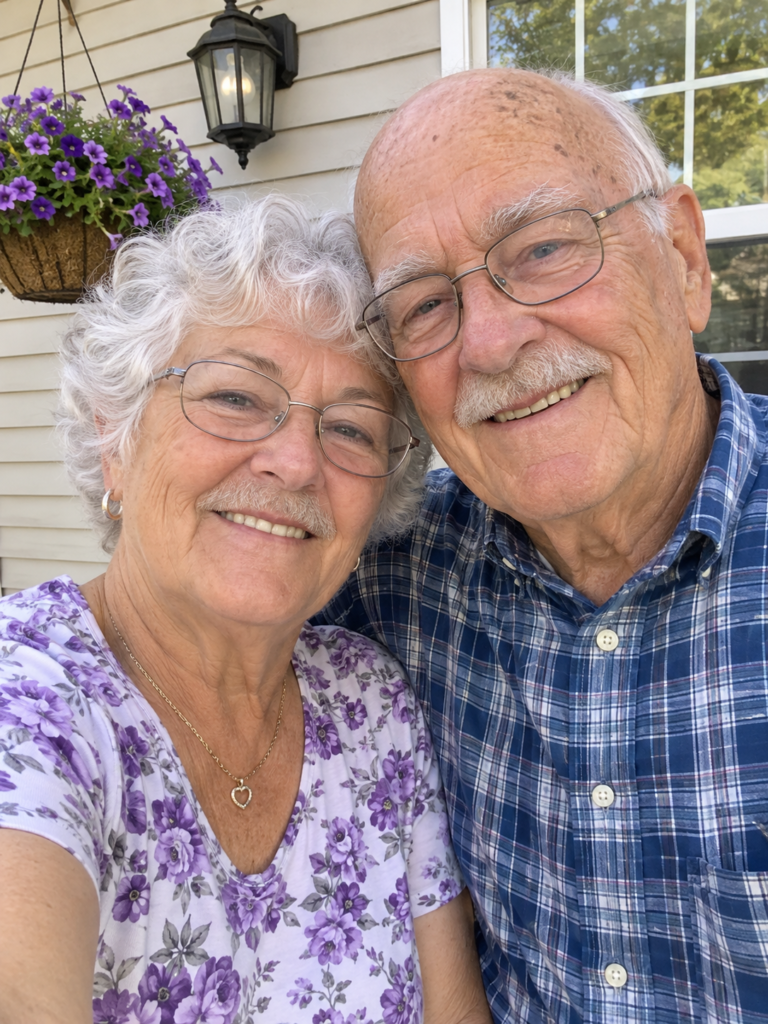
“Another picture?” I teased him over the phone. I was sitting in my kitchen with a cup of tea going cold beside me and my reading glasses pushed up on my head. “Arthur, you’ve already seen me three times this week.”
“Please, Holly,” he said. His voice was warm and a little rough, the voice of a man who’d smoked a pipe once and quit a long time ago. “I love seeing you as you are.”
I laughed.
“You’ve seen me as I am at our coffee date. And at the botanical garden. And in that awful photo by the rosebush where I’m squinting.”
“Not nearly enough,” he said.
I should have asked him why right then.
I didn’t. I was seventy-eight years old, and a man was telling me he wanted to see my face. I didn’t want to ask questions. I wanted to believe him.
I should explain about my face.
When I was a girl, I had a soft, thin little shadow on my upper lip, the kind lots of girls have. Nobody noticed. Then, somewhere in my late teens, it started to darken. By the time I was twenty-two, it was a mustache.
Not a faint one. A real one. Dark and noticeable, the kind people saw from across a room.
Doctors told me it was hormones. They gave me long words and pamphlets and pills that made me sick to my stomach. None of them made it go away.
I spent more than fifty years learning ways to hide it.
I bleached it. I waxed it until the skin bled. I tried electrolysis three times, and each time it hurt so badly I cried in the parking lot. I shaved it every morning in the bathroom with the door locked, even after I was married, because I couldn’t stand for anyone to see me do it. I wore heavy powder. I learned to tilt my head down a little when I smiled. I learned to hold a coffee cup or a napkin near my mouth when I laughed.
Strangers stared. Some of them remembered their manners and looked away. Some of them didn’t. Once, in a grocery store, a little boy pointed at me and said loudly, “Mommy, why does that lady have a mustache like Grandpa?”
His mother pulled him away by the arm. She didn’t apologize. She just looked at me with this mix of pity and embarrassment, which was worse than if she’d laughed.
What hurt most, all those years, wasn’t the staring.
It was knowing that people noticed my mustache before they noticed me.
My husband, Walter, never once complained.
We met at a church picnic when I was twenty-six. He was a quiet, gangly man with big ears and a terrible singing voice. He worked as a pharmacist. He sat down next to me at the potato salad table and asked whether I thought the deviled eggs were safe to eat in that heat.
“I wouldn’t risk it,” I said. I had a napkin pressed against my mouth.
“Then I won’t,” he said. He looked at me. “You can put that down, you know. The napkin. I don’t mind.”
I’d been holding that napkin for two hours.
I put it down.
Walter kissed me good morning every single day for forty-three years. Whether I’d shaved or not. Whether I’d put on powder or not. He’d come into the kitchen in his bathrobe and kiss me right on the mouth, mustache and all, and say, “Good morning, Holly Jean.”
Once, years into our marriage, my cousin invited us to her daughter’s wedding. That morning, my upper lip looked particularly dark. I’d shaved it twice and it still showed through the powder. I sat on the edge of the bed in my good blue dress and told Walter I wasn’t going.
He didn’t argue.
He just went to the closet, got my coat, and held it out to me.
“Holly,” he said, “the bride invited you because she loves you. Nobody’s hiring you to model lipstick.”
I laughed in spite of myself.
I went to the wedding. I still checked my face in my compact six times during the ceremony. But I went.
Walter died nine years ago. A stroke, in his garden, among his tomato plants.
Afterward, I stopped thinking about romance completely. I was sixty-nine. I had my house, my roses, my church friends, and my granddaughter, Maddie, who came every Sunday. That was enough.
I could manage loneliness. I’d learned how.
What I couldn’t stand was the thought of another man studying my face and deciding whether I was acceptable.
I’d already had one man who didn’t care. I didn’t think I’d ever be lucky enough to find a second one.
Then my granddaughter signed me up for a dating app.
Maddie is twenty-eight. She’s a nurse, like her mother, and she has Walter’s ears and Walter’s stubbornness. She came over for Sunday dinner in March, sat down at my kitchen table, and held out her hand.
“Give me your phone, Grandma.”
“What for?”
“Just give it to me.”
I gave it to her. She tapped at it for ten minutes with her tongue sticking out of the corner of her mouth.
“There,” she said. She turned the screen around. “You’re on SilverHearts. It’s for people over sixty-five.”
“Madeline Rose,” I said. “Take that off right now.”
“No.”
“I’m seventy-eight years old!”
“So?” Maddie said. “Grandpa’s been gone nine years. You deserve company. You deserve somebody to go to the movies with. You deserve somebody to argue with about crossword puzzles.”
“I don’t want a man looking at my face and…”
I stopped.
Maddie looked at me for a long moment. She knew. She’d always known. When she was six, she’d asked me why I shaved like Daddy, and I’d been so embarrassed I’d changed the subject.
“Grandma,” she said gently, “anybody who doesn’t like your face isn’t worth your time. Okay?”
She uploaded a photograph of me she’d taken at Easter. I was laughing at something her husband had said. No napkin. No hand over my mouth. My mustache was right there, plain as anything.
“Not that one,” I said. “Maddie, please. Not that one.”
“That one,” she said. She pressed the button.
Three days later, Arthur appeared.
He was eighty, a widower, a retired commercial photographer. His profile picture showed a tall, thin man with white hair, a neatly trimmed white beard, and kind gray eyes behind wire glasses. He was standing on a dock somewhere, squinting into the sun, holding a fishing rod.
His first message asked whether I preferred doing crossword puzzles in pen or pencil.
I stared at it for a long time. It wasn’t hello, beautiful. It wasn’t I like your smile. It wasn’t about my face at all.
I typed back: Pen. I’m old enough to live dangerously.
His reply came in four minutes.
Then we’d get along.
We messaged every evening after that.
At first just a few lines. Then whole paragraphs. He told me about his late wife, Margaret, who’d died two years earlier after a long illness. He told me about his garden, which he admitted was mostly weeds. He told me he’d worked as a photographer for fifty years, mostly catalogs and advertisements, “nothing anyone would hang on a wall.”
He remembered everything I told him. He remembered that I grew roses, and he asked about them by name. My Peace roses, my Mister Lincolns, the climbing Eden on the trellis by the back door. He remembered that Maddie had just started a new job in the cardiac unit at St. Luke’s, and he asked how her first week went.
Walter used to remember things like that.
After two weeks, I decided to tell him.
I sat at my kitchen table one evening with my phone in my hand for almost an hour. I typed it out and deleted it four times.
Finally, I just wrote it plainly.
Arthur, I should tell you something before this goes any further. I have facial hair. A mustache. I’ve had it since I was young. You may have noticed in my photograph. If that bothers you, I understand completely, and I won’t be hurt.
That last part was a lie. I’d be very hurt.
I pressed send. I put the phone face-down on the table. I made a cup of tea I didn’t drink. I held my breath.
Twenty minutes later, the phone buzzed.
Please don’t ever shave it, Arthur wrote. I think you’re beautiful exactly as you are.
I read those words three times.
Then I cried. Right there at my kitchen table, at seventy-eight years old.
Not because Walter had failed to love me. He never failed. Not once in forty-three years.
I cried because I’d spent all those years refusing to believe him.
Our first date was at a little coffee shop downtown called The Daily Grind.
I almost didn’t go. I stood in front of my bathroom mirror for forty-five minutes. I shaved. Then I wished I hadn’t. Then I put on powder. Then I wiped it off. Then I put it back on again.
In the end, I wore a light layer of powder and my good lavender cardigan, and I went.
Arthur was already there when I walked in, sitting at a corner table by the window. He stood up when he saw me. He was even taller than I’d expected. He had a small white bakery box on the table in front of him.
“Holly,” he said. He held out his hand. “I hope you don’t mind. I brought lemon cookies.”
I stared at the box.
“How did you know I like lemon cookies?”
“You told me,” he said. “Last Tuesday. You said the lemon cookies at Hoffman’s Bakery were the only reason you ever went downtown.”
I had said that. I’d forgotten.
He’d remembered.
We talked for almost three hours.
At some point, I realized he was looking at my face. Really looking. Studying it. My hand went up automatically and covered my upper lip. Fifty years of habit.
Arthur noticed.
“You don’t have to do that around me, Holly,” he said gently. “Darling.”
I lowered my hand slowly.
I left it in my lap for the rest of the afternoon.
On our second date, we went to the botanical garden.
It was April. The tulips were out, thousands of them, red and yellow and pink. We walked slowly along the paths, because Arthur’s knee was bad and mine wasn’t much better.
In the rose garden, which wasn’t blooming yet, just green leaves and thorns, he stopped.
“Stand there,” he said. “By that bush.”
“Arthur, it doesn’t even have flowers.”
“I don’t need the flowers,” he said. He took out his phone. “Just you.”
I stood there by a rosebush with no roses on it, squinting into the sun. He took four pictures.
That evening, he sent me a message.
Would you send me another picture? Without makeup? I’d love to see your face the way it really is.
I thought about it for a long time.
Then I went into the bathroom, washed off my powder, stood by the window where the light was good, and took a picture of myself with my phone.
It took me eleven tries. My hands were shaking.
I sent it.
On our third date, we had lunch at a little Italian place.
Arthur asked a lot of questions that day. About my life. Where I’d grown up. What my parents had been like.
“Have you always lived here?” he asked.
“Not always,” I said. “My family moved around when I was young. My father sold farm equipment. We lived in four states before I was eighteen.”
He seemed very interested in that.
Maybe a little too interested.
“Which states?” he asked.
“Oh, all over,” I said. “Iowa. Ohio. Illinois for a few years. Then here.”
He nodded slowly. He didn’t ask anything else about it. But I noticed him write something down on a napkin when he thought I wasn’t looking, and fold it into his shirt pocket.
A few days later, Arthur invited me to dinner at his house.
“Helen will cook,” he said on the phone. “My housekeeper. She makes the best roast chicken in the state. Saturday at six?”
“I’d love that.”
“Wonderful.” He paused. “And Holly? Would you send me one more picture before then?”
I laughed.
“Arthur, at this rate you’ll have enough photographs to open a museum!”
“Just your face, darling. No makeup.”
I didn’t laugh this time.
“Why are you so interested?” I said. “Truly?”
There was a short pause on the line.
“Because I love your natural beauty,” he said.
I wanted that answer to be enough.
So I sent the picture.
But that night, lying in bed, I noticed something odd.
Arthur had never asked for a photograph of my roses. He talked about them all the time. He asked about my Peace roses and my Mister Lincolns. But he’d never once asked to see them.
He’d never asked for a picture of my house. Or my kitchen. Or my garden. Or me holding Maddie’s new puppy, which I’d mentioned three times.
Only my face.
Always my face. Always without makeup. Always close up.
I lay there in the dark for a long time.
Then I told myself I was being a foolish, suspicious old woman, and I went to sleep.
Arthur’s house was a big old brick Colonial on a quiet street on the north side of town, with tall trees in front and a slate path leading to the door.
He greeted me at the door with a bouquet of pink roses.
“For the lady who grows better ones,” he said.
“Flattery will get you everywhere,” I said.
He smiled. Then he looked at my face. He studied it for so long that I touched my upper lip without meaning to.
“Come in, Holly,” he said.
The house was beautiful and a little dusty. Old bookshelves lined the hallway, floor to ceiling, packed with books. There were photographs everywhere, on the walls, on the tables, on the mantel. Most of them were of a woman with short silver hair and a gentle face. Margaret, I assumed. Margaret on a beach. Margaret in a garden. Margaret laughing at a birthday party.
In every picture, Margaret was holding her hand near her face. Covering her cheek, or her chin. I noticed that right away. I know that gesture. I’ve made it a million times.
Arthur led me into the living room. There was a fire going in the fireplace.
A woman came in from the hallway carrying two crystal wine glasses on a little silver tray.
She was about sixty, short and round, with gray hair pulled back in a bun and a plain blue apron over her dress.
“Holly, this is Helen,” Arthur said. “Helen, this is Holly.”
Helen looked at me.
And she went completely white.
One glass slipped off the tray. Then the other.
They shattered on the hardwood floor.
“Oh, goodness!” I said.
I jumped back. There was broken crystal everywhere, glittering in the firelight.
Helen didn’t move. She didn’t even look down at the glass. She just stood there with the empty tray in her hands, staring at my face.
“Are you all right?” I asked her.
Her lips moved.
“Holly?” she said.
It came out like a gasp.
I blinked.
“Yes?”
Arthur stepped between us.
He moved faster than I’d seen him move all week.
“Helen,” he said. “Please take care of the glasses.”
Helen looked at him.
“Arthur…”
“Now, please.”
His voice was firmer than I’d ever heard it. Not loud. But hard.
Helen bent down slowly and began picking up the pieces of glass, one by one, and putting them on the silver tray.
I knelt down to help her.
“No, ma’am,” she said quickly. She wouldn’t look at me now. “Please don’t. You’ll cut yourself.”
Arthur put his hand on my elbow and guided me gently toward the dining room.
“She’s been having a difficult week,” he said quietly. “Her sister’s in the hospital.”
I glanced back over my shoulder.
Helen was still kneeling on the floor among the broken glass. And she was still watching me.
I had the uncomfortable feeling she’d just recognized somebody she wasn’t supposed to see.
The dining room was dark wood, with a long table set for two and candles in silver holders.
Helen brought out dinner a few minutes later. Roast chicken, potatoes, green beans with almonds. She set the plates down in front of us without saying a word. She didn’t look at me. Her hands were shaking.
It was the best roast chicken I’d ever eaten.
I barely tasted it.
Over dinner, Arthur started asking questions about my childhood.
Then my parents.
Then whether I’d ever had a sister.
“No,” I said. “I was an only child. Why?”
“Just curious,” Arthur said.
He cut his chicken into very small pieces. He wasn’t eating any of it.
I set down my water glass.
“You’re asking a lot of family questions tonight, Arthur.”
He smiled.
“I’m just getting to know you, darling.”
I tried to relax. I really tried.
Then he asked something that made my fork stop halfway to my mouth.
“Did your mother live in Chicago in 1965?”
I stared at him across the candles.
“How do you know that?”
Arthur reached for his wine glass. His hand wasn’t quite steady.
“Lucky guess,” he said.
“Arthur,” I said slowly, “that’s a very specific guess.”
He gave a small, uneasy laugh.
“You mentioned you lived in Illinois for a while.”
“I said Illinois,” I said. “I never said Chicago. And I never said 1965.”
His smile faded.
He put the wine glass down without drinking any of it.
For the first time, I wondered whether our meeting had been an accident.
Before I could ask him anything else, his phone rang.
He took it out of his pocket and looked at the screen. Something moved across his face.
“Excuse me,” he said. He stood up. “I’m sorry. I need to take this.”
He walked out of the dining room. I heard his footsteps go down the long hallway. A door opened and closed somewhere at the far end of the house.
I sat there alone with my half-eaten dinner and the candles flickering.
The house was very quiet. I could hear the old grandfather clock ticking in the hallway.
Then I heard footsteps. Fast and light. Hurrying.
Helen appeared in the dining room doorway.
She wasn’t carrying anything. She’d taken off her apron.
“Ma’am,” she whispered. “You need to leave.”
I stared at her.
“What?”
“Please,” Helen said. She glanced back over her shoulder toward the hallway. “Before he comes back.”
“Helen, what’s going on?”
She came into the room. She stood very close to my chair. Her eyes were wet.
“There’s something you should know,” she said. “Something he should have told you a long time ago.”
She took my hand. Her fingers were cold.
She pulled me gently up out of my chair and led me toward the hallway.
“Arthur’s been looking for you,” she whispered. “For years.”
My heart started pounding.
“Looking for me? Why?”
Before she could answer, a voice came from the end of the hallway.
“Helen. What are you doing?”
Arthur was standing at the end of the long hallway, by the door of a room I hadn’t seen yet. His phone was still in his hand.
Helen didn’t let go of my hand.
“I’m telling her,” she said.
“Not like this,” Arthur said.
“Then how, Arthur?” Helen said. Her voice shook, but she didn’t back down. “You’ve had three dates. You’ve had an entire dinner. You’ve had weeks of phone calls. When were you going to tell her?”
I looked from one of them to the other.
“Somebody,” I said, “had better explain to me what’s happening. Right now.”
Arthur walked toward us slowly down the hallway. He stopped about six feet away.
“Holly,” he said. “Please don’t be frightened.”
“That,” I said, “is not a reassuring thing to say.”
He stopped.
Helen turned toward me. She was still holding my hand.
“There’s something in his study you need to see,” she said.
“Helen…” Arthur said. He sounded panicked.
“No,” I said. I pulled my hand gently out of Helen’s. I looked straight at Arthur. “Show me.”
His study was at the end of the hallway. It smelled like old paper and furniture polish and pipe tobacco, even though he told me he’d quit years ago.
There were filing cabinets along one wall. A big wooden desk. Framed photographs on the walls. Not of Margaret. Old black-and-white photographs. Advertisements. Women in pearls holding up bottles of face cream. A girl in a sundress smiling next to a box of hair removal cream. SMOOTH. FEMININE. FLAWLESS.
In the middle of the desk sat a small cardboard box.
Arthur looked at that box as if he’d been hoping I’d never notice it.
I looked at Arthur. Then at the box. Then at Helen.
Helen stepped forward and opened the lid.
Inside were yellowed envelopes, old newspaper clippings, and photographs.
On top of everything else, there were printouts. I recognized them right away. They were the pictures I’d sent Arthur. My face. Close up. Without makeup. Printed out on glossy photo paper.
All of them.
And next to them, in a clear plastic protective sleeve, was an old black-and-white photograph.
Helen lifted it out of the box very carefully, by the edges.
She handed it to me.
It showed a teenage girl sitting under a bright salon lamp.
Her hair was pinned back off her face with bobby pins. Her hands were clasped tightly in her lap. She was wearing a dress with a little white collar. She was looking down at her hands. Not at the camera.
There was a dark shadow on her upper lip.
I knew her before I recognized the dress.
It was me.
Me, at seventeen. In Chicago.
I sat down in the leather chair next to the desk. My legs just gave out.
I ran my thumb along the photograph’s worn edge.
I remembered that day. I’d spent sixty-one years trying not to remember it.
It was the spring of 1965. We’d been living in Chicago for two years, in a little brick apartment on the North Side. My father was traveling all the time for work. It was just my mother and me most of the time.
My mother loved me. I want to say that. She loved me fiercely. But she was terrified for me. She’d grown up in a small town in Iowa where girls got married at nineteen, and she couldn’t imagine what would happen to a girl who looked the way I was starting to look.
One Saturday, she took me downtown to Marshall Field’s, the big department store on State Street. She said we were going shopping for a dress for my junior prom.
Instead, she took me up to the eighth floor, to the cosmetics department, where a company was holding what they called a beauty consultation.
There was a sign. I still remember it. LET US HELP YOUR DAUGHTER BLOSSOM.
A woman in a pink smock took me into a little room with a big mirror and a bright lamp.
She promised my mother they could make my face look more feminine.
She sat me in a chair under the lamp. She tilted my chin up with two fingers. She looked at my upper lip for a long time, like a doctor looking at a rash.
There were other adults in the room. Another woman with a clipboard, writing things down. My mother, sitting in a chair by the door, twisting her handkerchief.
And a young man with a camera. Skinny. Dark-haired. Barely older than me. He was standing by a tripod in the corner.
They talked about my face like I wasn’t there.
“That much hair will be difficult to conceal,” the woman in the pink smock said.
“She’ll need regular treatment,” the woman with the clipboard said. “Weekly, at first. Then perhaps twice a month.”
“Girls are terribly sensitive at this age,” the first woman told my mother, in a low voice, like I couldn’t hear her from three feet away. “We find it’s best to address these things early. Before boys start to notice.”
My mother nodded and twisted her handkerchief.
Then the woman in the pink smock nodded at the young man with the camera.
“Before photo,” she said.
He stepped up to the tripod. He looked at me through the lens.
I looked up at him. He was the only person in that room close to my age. The only one who wasn’t talking about me.
“Do I look terrible?” I asked him.
My voice came out very small.
He didn’t answer.
He just looked down at his camera. He wouldn’t meet my eyes. His face went red.
The woman in the pink smock laughed.
“Well,” she said, “that’s why we’re here, dear.”
The camera flashed.
I’d stared down at my hands until the appointment ended. They put cream on my lip that burned like fire. They sold my mother three jars of it and a booklet and a schedule of appointments.
Then I went into the ladies’ room on the eighth floor of Marshall Field’s, locked myself in a stall, and cried until my mother came looking for me.
I’d never gone back for the appointments. My mother never made me. I think she saw my face in the car on the way home and understood she’d made a mistake. She never brought it up again. Not once.
But I’d carried that afternoon around with me for sixty-one years.
That much hair will be difficult to conceal.
Well, that’s why we’re here, dear.
I’d never forgotten that boy’s silence.
I looked up from the photograph.
Arthur was standing by the desk. He looked very old suddenly. Older than eighty.
“Where did you get this?” I said.
My voice didn’t sound like mine.
Arthur sat down slowly in the chair across from me.
“I worked for the company that produced those consultation photographs,” he said. “Belle Visage Cosmetics. Out of Chicago. They did consultations at department stores all over the Midwest.”
I stared at him.
“You?”
“I was nineteen,” Arthur said. “It was one of my first jobs. I’d just gotten out of photography school. They paid me two dollars an hour to take before-and-after pictures.”
I looked down at the photograph again.
The bright lamp. The pinned-back hair. My hands in my lap.
And in my memory: the camera on the tripod in the corner. The young man behind it. A skinny boy with dark hair who wouldn’t meet my eyes.
I looked up at Arthur. At his kind gray eyes behind his wire glasses. At his white beard.
Sixty-one years.
“You were there,” I said.
He nodded.
“Yes.”
“I remember asking you,” I said slowly, “whether I looked terrible.”
Arthur closed his eyes.
“And I didn’t answer,” he said.
“No,” I said. “You didn’t.”
I remembered his silence perfectly. Even now, sitting in that leather chair, I could feel it. That hot, red silence. The way he’d looked down at his camera instead of at me.
The woman in the pink smock laughing. Well, that’s why we’re here.
I had wanted somebody in that room to tell her to stop. Anybody. My mother. The woman with the clipboard. The boy with the camera.
Nobody did.
“Why do you still have this photograph?” I asked.
Arthur rubbed his hands together slowly, like they were cold.
“Belle Visage went out of business in 1978,” he said. “Years later, maybe twenty years ago, a man I used to work with called me. Stanley. He was clearing out an old storage unit his father had rented. He found boxes of the company’s old records. Consultation cards. Photographs. Things that should have been destroyed decades ago.”
He looked at the photograph in my hands.
“He asked if I wanted any of them. For my portfolio, maybe. As a joke. I went through the boxes in his garage.” Arthur swallowed. “I found this one. Your name was written on the back. And I remembered the appointment. The minute I read it, I remembered you. So I asked to keep it.”
I turned the photograph over.
There it was. My name. In faded blue ink, in somebody’s neat, slanted handwriting.
Holly J. Brennan, age 17. Consult #2241. Severe hirsutism.
Severe.
He’d kept that afternoon in a box for decades. For all those same years, I’d been trying to forget it.
“I should have told you I had it, Holly,” Arthur said quietly. “From the beginning. And I should have asked if you wanted it back.”
He reached into the box and took out a small, faded index card. It was yellowed and soft at the edges. He laid it on the desk in front of me.
It was a consultation card.
My mother’s name was on it. Mrs. Dorothy Brennan. Our old address on Lawrence Avenue in Chicago. The date. April 17, 1965. A list of “recommended treatments.” A total price.
My mother’s signature at the bottom.
I put my hand over my mouth.
“I recognized the appointment,” Arthur said. “When I found the card. I remembered you. The girl who asked me if she looked terrible.”
“You remembered me,” I said. “For sixty-one years?”
“Not every day,” he said. “I won’t pretend that. I got married. I had a career. I lived my life. But I never forgot what happened in that room. Or what I didn’t say.”
I studied his face for a long time.
“Then how did you find me?” I asked.
“Your full name was on the card,” he said. “And your mother’s. I looked for you now and then over the years. Not seriously. Just once in a while, when I thought about it. In phone books. Later on the internet. But Brennan’s a common name, and I knew you’d probably married. I never found anyone I could be sure was you.”
He looked down at the photograph in my lap.
“After Margaret died,” he said, “I started looking again. Seriously, this time. Every day. I found your name in an old community newsletter online, from your church. Holly Brennan Hartley. There was a little article about the rose show. It mentioned your granddaughter, Madeline, and your Peace roses. And there was a photograph of you holding a blue ribbon.”
He swallowed.
“I looked at that photograph for a long time,” he said. “I wasn’t sure. Sixty years is a long time. Then, a few months later, I saw a profile on SilverHearts. Holly, seventy-eight. Loves roses and crossword puzzles. A granddaughter who’s a nurse. And the photo…” He stopped. “I thought it might be you. That’s why I kept asking about your childhood. About Chicago.”
I set the photograph down on the desk before my hands could bend it.
“So you didn’t match with me by chance,” I said.
“No,” Arthur said.
I looked down at the box. At my seventeen-year-old face under that bright lamp. At the glossy printouts of my seventy-eight-year-old face next to it.
Then I looked at Arthur.
“Why?” I said. “Why on earth would you do this?”
Arthur was quiet for a long time.
“My wife,” he said finally. “Margaret. She struggled with her appearance. Her whole life. She had a birthmark on her cheek. Here.” He touched the left side of his own face. “A port-wine stain. Dark red. About the size of a playing card.”
I thought about all those photographs in the hallway. Margaret on the beach, Margaret in the garden, Margaret at the birthday party. Always holding her hand near her face.
“She told me about the beauty advertisements,” Arthur said. “From when she was young. Concealing creams and correcting creams. Women in magazines with perfect skin. She said every single one of them made her feel like a mistake.” His voice cracked. “And I’d spent forty years of my life taking those pictures. The before-and-afters. The smooth, feminine, flawless ones.” He gestured at the old advertisements on the walls. “I made those. That’s my work up there.”
He smoothed one curled corner of the consultation card with his finger.
“After she died,” he said, “I started thinking about all of it. The work I’d done. The things I’d said to girls under those lamps. The things I hadn’t said.” He looked at me. “And I kept thinking about you. The girl who asked me if she looked terrible. And I didn’t answer her.”
“So you decided to find me,” I said.
“I wanted to apologize,” Arthur said. “That’s all I wanted. At first. I thought I’d tell you right away. On the first date. I had it all planned. What I’d say.” He shook his head. “But then I met you. At the coffee shop. And you laughed about the lemon cookies. And you put your hand over your mouth, and I told you you didn’t have to, and you put it down.” His eyes filled. “And I enjoyed talking to you so much, Holly. I was afraid if I told you, you’d never speak to me again.”
“So you dated me instead,” I said.
His face went red. Just like it had sixty-one years ago, behind that camera.
“I didn’t mean to hurt you,” he said.
“Arthur,” I said. “You asked me for photographs of my face. Over and over. Close up. Without makeup.”
“I thought you were becoming more comfortable with yourself,” he said. “I thought every time you sent one, it meant you were a little less afraid. I thought…”
“Was that your decision to make?” I said.
He looked down at the desk.
He didn’t answer.
Helen was standing quietly by the study door. She’d been there the whole time.
“I saw him take that box out this afternoon,” she said. “He’s been working for me six years, and I’ve never seen that box. He spread everything out on the desk. The old picture and the new ones, side by side. He was holding them up to the light, comparing them.” She looked at Arthur. “That’s how I knew you, ma’am. When I walked in with the glasses. I’d been looking at your face all afternoon. Seventeen and seventy-eight. Side by side.”
“That’s why you dropped them,” I said.
“Yes, ma’am.”
“He was rehearsing,” Helen went on. “What he’d say to you. Out loud. In here. I could hear him from the kitchen.” She shook her head. “I told him. I said, ‘Arthur, you can’t spring this on her after dinner, with the box sitting right there on the desk. That’s cruel. She’ll feel ambushed.’”
Arthur looked at her.
“I was going to explain,” he said.
“You’d already had three dates to explain,” Helen said. “And a whole dinner. And then the phone rang, and you went running off to talk to your son for twenty minutes, and she was sitting there all alone wondering why you knew about Chicago.” She looked at me. “I couldn’t stand it. I’m sorry I frightened you, ma’am. I just didn’t want you walking in here without knowing.”
I turned back to Arthur.
“Did you ask for those pictures,” I said slowly, “to make sure I was the girl in this photograph?”
He didn’t answer right away.
“At first,” he said finally. “Yes. I wanted to be certain. Sixty-one years is a long time. Faces change.”
“And afterward?”
He swallowed.
“I liked seeing you happy,” he said. “In the pictures. You looked a little happier every time. Less afraid. I thought…” His voice cracked. “I thought maybe I could help undo some of what happened in that room.”
I looked down at the desk.
At the seventeen-year-old girl who’d been told under a bright lamp that her face needed correcting.
Then at the printouts of my seventy-eight-year-old face. The ones I’d taken in my bathroom by the window, eleven tries each, with my hands shaking.
The same man had been there for both. The boy behind the camera who’d said nothing. The old man who’d told me, sixty-one years later, that I should never change.
“You could have just told me the truth,” I said.
“I know.”
“You let me think,” I said, “that you loved the way I looked. Without any history attached to it. Without any guilt. I thought somebody finally just… saw me. The way Walter did.” My voice broke. “And it was an apology the whole time. A sixty-one-year-old apology.”
“I do think you’re beautiful, Holly,” Arthur said quietly. “That part was always true. That part was never a lie.”
I stood up.
“Then you should have trusted me enough,” I said, “to tell me why you recognized my face.”
Arthur stood up too.
“Please,” he said. “Holly. I only wanted a chance to make things right.”
“You had a chance,” I said. “You could have been honest on our first date. With the lemon cookies. You could have said, ‘Holly, I need to tell you something.’ And I’d have listened. I would have.”
He reached toward the photograph on the desk.
I moved it away from him.
“Don’t,” I said.
His hand dropped back to his side.
Helen came over and stood beside me.
“Would you like me to call you a car, ma’am?” she asked gently.
“Yes, please,” I said.
She went out into the hallway to call.
Arthur stood beside his desk with one hand resting on top of that cardboard box. He looked lost.
“Holly,” he said. “I’m sorry. I’m so sorry.”
I didn’t answer.
Not because I wanted to punish him.
Because I honestly couldn’t tell yet whether he was apologizing for what he did sixty-one years ago or for what he’d done to me in the last six weeks.
I picked up the old photograph. I looked at it one more time. The pinned-back hair. The white collar. The hands clasped in my lap.
Then I put it back down on the desk. Next to the box.
And I walked out with Helen.
The car came in eleven minutes. Helen waited with me on the front porch the whole time. She brought me my coat and held it while I put it on.
Neither of us said anything for a while.
“I worked for a woman once,” Helen said finally, looking out at the dark street. “Before Arthur. Mrs. Pemberton. She told me I’d be pretty if I lost forty pounds. Every single day for three years. ‘You’d be so pretty, Helen, if you just made an effort.’”
I looked at her.
“I’m sorry,” I said.
“I’m not telling you so you’ll feel sorry for me,” Helen said. “I’m telling you because I know what it’s like. To have somebody look at you and see what they want to fix.” She shook her head. “Arthur’s a good man, mostly. He’s kind to me. He pays me fair. He’s never once said a word about my weight. But he’s been sitting in that study with that box for two years. Ever since Mrs. Margaret passed. I think it got all mixed up in his head. His guilt and his grief and you.”
The car pulled up at the curb.
Helen squeezed my arm.
“You take care of yourself, ma’am,” she said.
I didn’t sleep that night.
I sat up in bed with the lamp on and thought about that room on the eighth floor of Marshall Field’s. The bright lamp. The pink smock. My mother twisting her handkerchief by the door.
I thought about Arthur at nineteen, behind his camera, red-faced and silent.
I thought about Arthur at eighty, with his kind gray eyes, bringing me lemon cookies. You don’t have to do that around me, Holly.
I thought about the printouts of my face in his box, next to the old photograph. Side by side. Held up to the light.
I didn’t know what to feel. I felt everything.
Maddie came over the next morning. Sunday. She took one look at me and put down her bag.
“Grandma,” she said. “What happened? Did he do something?”
So I told her.
All of it. Marshall Field’s. The boy behind the camera. The box in Arthur’s study. The printouts.
When I finished, Maddie was quiet for a long time. Then she stood up and walked to the window and stood there with her arms crossed.
“I signed you up for that app,” she said finally. Her voice was tight. “This is my fault.”
“No, sweetheart,” I said. “It isn’t.”
“I made you put that picture up. You told me not to. You said ‘not that one.’ And I did it anyway.” She turned around. Her eyes were wet. “And some guy saw it and recognized you from a box in his garage.”
“Maddie.” I got up and went over to her. I took her hands. “Listen to me. You signed me up because you wanted me to be happy. That’s all. And I was happy. For six weeks, I was happier than I’ve been since your grandfather died. That part was real.”
“But it was a lie.”
“Some of it was a lie,” I said. “Not all of it.”
She looked at me for a long time.
“Are you going to see him again?” she said.
“I don’t know, baby,” I said. “I honestly don’t know.”
Arthur’s letter came four days later.
It came in a thick cream-colored envelope, with my address written in careful, old-fashioned handwriting. I recognized it from the cards he’d brought with the flowers.
I sat down at my kitchen table and opened it.
It was four pages long. Handwritten. In fountain pen.
He apologized. For Marshall Field’s. For not answering me under that lamp. For the work he’d done for forty years, all those smooth, feminine, flawless photographs. For the pictures he’d asked me for. For hiding our history. For letting me believe something that was only half true.
I told myself I was finding you to make things right, he wrote. But I think I was finding you to make myself feel better. Those aren’t the same thing, and you deserved to know the difference. I’m sorry I didn’t give you that.
He didn’t ask for forgiveness. Not once in four pages.
At the end, he wrote: I’ve destroyed the photographs you sent me. All of them. They were yours, and I had no right to keep them. I’ve enclosed the two things that were always yours, which I should have returned to you the first day.
I looked inside the envelope.
There was the old black-and-white photograph. The one I’d left on his desk.
And the faded index card with my mother’s name on it. Mrs. Dorothy Brennan. April 17, 1965.
I took the photograph out of its plastic sleeve and held it under the kitchen light.
I stared at it for a long time.
And then I noticed something I’d forgotten. Something I’d never let myself see, all these years. Because I’d never once looked at that girl long enough to see anything but her upper lip.
The girl under that lamp wasn’t ugly.
She was frightened.
Her shoulders were up by her ears. Her hands were clenched so tight in her lap that her knuckles were white. Her eyes were cast down at the floor, and you could tell, even in an old black-and-white photo, that she was trying very hard not to cry.
She was a scared seventeen-year-old girl in a room full of adults talking about her like she was a problem to fix.
And nobody had comforted her.
Not her mother. Not the woman in the pink smock. Not the boy behind the camera.
Nobody had put a hand on her shoulder and said, You’re fine, sweetheart. You look just fine.
That’s how Maddie found me when she came by on her lunch break. Sitting at the kitchen table, holding that photograph, crying.
“Grandma?”
I handed her the photograph without saying anything.
She looked at it for a long time.
“That’s me,” I said. “At seventeen. In Chicago.”
Maddie sat down next to me. She studied the photograph carefully. She turned it toward the window.
“You had beautiful eyes,” she said.
I wiped my cheek with my sleeve.
“That’s what your grandfather always said.”
Maddie put her arm around my shoulders and squeezed.
“Well,” she said, “Grandpa was always right about everything except the Cubs.”
I laughed through my tears.
Then I looked at the photograph again.
And for once in my life, I didn’t turn it over.
A week later, I called Arthur.
I’d thought about it every day. I’d picked up the phone four times and put it down again.
He answered on the second ring.
“Holly.” He sounded surprised. And careful. “Thank you for calling.”
“I got your letter,” I said.
“I’m glad.”
There was a long silence.
“Arthur,” I said. “Can I ask you something?”
“Anything.”
“Did you ever wonder,” I said, “what happened to me? After that appointment? After I walked out of that room?”
He was quiet for a long time.
“Not until years later,” he admitted. “I’m sorry. That’s the truth. I was nineteen. I took pictures of six or seven girls a day. I went home and didn’t think about any of them. It wasn’t until Stanley called me about the boxes that I really thought about you.” He paused. “About what that afternoon might have done to you.”
“Do you want to know?” I said.
“Only if you want to tell me.”
So I told him.
I told him about the bleach that burned my skin. The wax that made it bleed. The electrolysis that made me cry in parking lots. The razor every morning in the bathroom with the door locked, even after I was married.
I told him about the napkin I held over my mouth at the church picnic for two hours, until Walter told me I could put it down.
I told him about the little boy in the grocery store. Why does that lady have a mustache like Grandpa?
I told him about the wedding I almost didn’t go to. And the six times I checked my compact during the ceremony.
“I spent decades,” I said, “trying to fix something that wasn’t wrong. Sixty-one years. Because a woman in a pink smock told me it was severe. And a boy behind a camera didn’t say anything.”
There was a long silence on the line.
When Arthur spoke, his voice was thick.
“I’m sorry, Holly,” he said. “I’m so sorry. For every single one of those years.”
“I believe you,” I said. “I really do.”
I took a breath.
“But I don’t know whether I can trust you again.”
“I understand,” he said quietly.
We agreed to leave things there. For now.
That spring, I did something I hadn’t done in more than fifty years.
I stopped shaving every morning.
Not all at once. I’m seventy-eight. I don’t do anything all at once. The first week, I only skipped Tuesday. Then Tuesday and Thursday. Then most days.
The first Sunday I went to church without shaving, I sat in the back pew and held my hymnal up near my face for the whole service. Afterward, at coffee hour, Mrs. Abernathy from the altar guild came over and asked me about my Peace roses for ten minutes and never once looked at my upper lip.
Or if she did, she didn’t say anything.
Maybe she’d never cared. Maybe nobody had ever cared as much as I did.
In May, Maddie took me out to lunch for my birthday.
We sat on the patio of a little café by the river. It was warm and sunny. The trees were green. Maddie’s husband, Josh, told a story about their new puppy eating an entire box of tissues, and I laughed so hard I had to put my fork down.
I didn’t cover my mouth.
Maddie took a picture with her phone.
“Let me see,” I said.
She showed me.
There I was, laughing, with my head tipped back, in my lavender cardigan, in the sunshine. My eyes were squeezed shut. My mustache was right there, plain as anything, dark against my lip.
I looked at that picture for a long time.
“Send me that one,” I said.
In June, I met Arthur for coffee.
I chose the place. Not The Daily Grind. A bench in the rose garden at the botanical garden, the same rose garden where he’d taken my picture in April next to a bush with no flowers on it.
This time, everything was blooming.
He was already there when I arrived, sitting on the bench with his cane across his knees. He stood up when he saw me. He didn’t try to hug me. He didn’t try to hold my hand.
He just said, “Hello, Holly.”
“Hello, Arthur.”
We sat down on the bench. Not too close.
He’d brought a small white bakery box.
“Lemon cookies,” he said. “From Hoffman’s. I hope that’s all right.”
“It’s all right,” I said.
We talked for an hour. About ordinary things, mostly. Roses. His terrible garden. Helen, who’d threatened to quit if he didn’t start eating more vegetables. Maddie’s puppy and the tissues.
Then, near the end, he said, “I’d like to see you again. If you’ll let me. Not the way it was before. However you want.”
I looked out at the roses. A Peace rose was blooming right in front of us, yellow edged in pink.
“I’d like to be friends, Arthur,” I said. “I think I can do that. I think I’d like that.”
He nodded slowly.
“Friends,” he said.
“For now,” I said. “And no more photographs. Not unless I offer.”
He smiled. It was a sad smile, but a real one.
“No more photographs,” he said.
Before I left, he reached into his coat pocket and took out a small envelope.
“This is the last thing,” he said. “I promise. Then the box is empty.”
I opened it.
Inside was a newspaper clipping, yellowed and brittle. It was a small advertisement from the Chicago Tribune, April 1965. BELLE VISAGE CONSULTATIONS — Let Us Help Your Daughter Blossom! Marshall Field’s, 8th Floor, This Saturday Only.
“Stanley found it in the boxes,” Arthur said. “With your card. I thought you should have it. So you’d know it was a real place. A real day. That you didn’t make it up.”
I folded the clipping in half and put it back in the envelope.
“I never thought I made it up,” I said.
Then I stood up, picked up my bakery box, and walked home through the roses.
That evening, I went into the living room and took down a small silver frame from the shelf above the television.
It held a photograph of Walter, the summer before he died, standing in his garden among his tomato plants. I moved it over a few inches to make room.
Then I put the old black-and-white photograph from Marshall Field’s into a frame of its own. A plain wooden one I’d bought at the drugstore.
I set it on the shelf.
Right beside it, I put the picture Maddie had taken on my birthday. Me on the patio by the river, laughing with my head tipped back in the sunshine, my mustache plain as day.
I stood back and looked at them. Walter in his tomatoes. The girl under the lamp. The old woman laughing.
I looked from one face to the other. Seventeen and seventy-eight. Sixty-one years apart.
The girl under the lamp was looking down at her hands, trying not to cry.
The woman on the patio wasn’t covering her mouth.
I didn’t reach for my makeup. I didn’t reach for my compact.
Instead, I straightened both frames on the shelf so they stood side by side, close enough to touch.
Then I went into the kitchen and put the kettle on for tea.