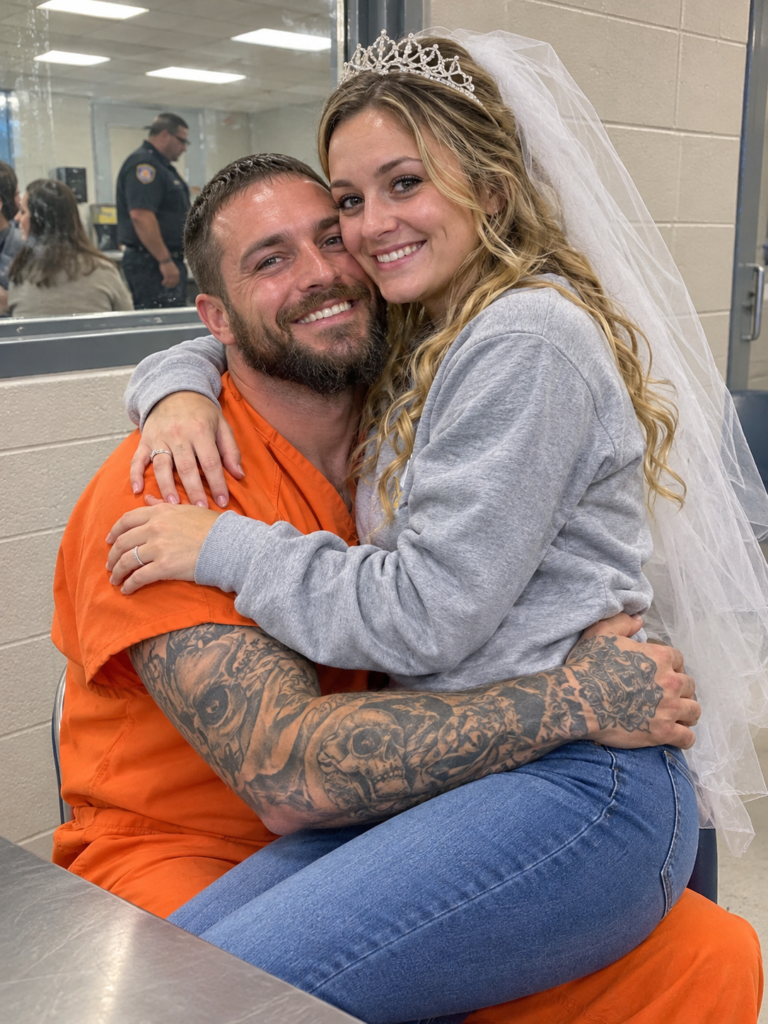
I married Jonah for two thousand dollars a month while he was serving twelve years in prison.
I told myself it was survival, not love.
I was twenty-seven years old. I was raising my little brother, Owen, by myself. And that morning, there had been a bright orange notice taped to our apartment door.
FINAL NOTICE. PAY OR QUIT.
Three years later, Jonah walked out of prison a free man. On his eighth night in my apartment, he set a black box down on my kitchen table and said, “Now it’s my turn to be honest.”
Inside that box was the real reason his mother had chosen me.
And that was the night I learned that being poor had never made me invisible.
It had made me useful.
Owen saw the rent notice before I could hide it.
I’d come home from the breakfast shift at the diner and found him standing in the hallway outside our door, holding it. He was seventeen. Too tall for his secondhand sneakers, which I’d bought at the Goodwill on Fifth Street and which pinched his toes. Too proud to ask why I’d started putting extra water in the soup.
“Is it bad, Sadie?” he asked.
I took the notice out of his hand. I folded it in half, then in half again, and put it in my apron pocket.
“It’s paper,” I said. “Paper likes to act important.”
Owen didn’t smile.
He just looked at me. He had our mother’s eyes, gray-green, and when he looked at you like that, it was hard to lie.
“How much do we owe?”
“Go do your homework.”
“Sadie.”
“Eleven hundred,” I said. “Plus late fees. I’ll figure it out.”
He nodded slowly. Then he went inside and sat down at the kitchen table with his chemistry book, and he didn’t open it. He just sat there staring at the cover.
Let me tell you how we got there.
Our dad died when I was nineteen and Owen was nine. A heart attack, at the plumbing supply warehouse where he’d worked for twenty years. He was forty-six. He left us a used Ford Taurus and four hundred dollars in a checking account.
Our mom fell apart after that. She’d always been fragile. Sad in a way that came and went like weather. After Dad died, the sadness came and didn’t go. Then she found pills that helped, and then she found pills that helped more. When Owen was eleven, she left for a weekend in Tampa with a man named Rick and never came back.
She calls sometimes. On Christmas, usually. Not every Christmas.
So it was just me and Owen.
I dropped out of community college. I’d been studying to be a paralegal. I’d liked it. I was good at it. I liked reading contracts and finding the little sentence on page eleven that changed everything. But you can’t take night classes when you’re working two jobs and raising an eleven-year-old.
I got temporary guardianship of Owen when he was twelve. Every year, I had to go back to family court and file papers to renew it. Every year, I was terrified they’d look at our apartment and our bank account and decide I couldn’t do it.
They never did.
But I was always waiting for it.
By the time Owen was seventeen, I was working the breakfast shift at a diner called Lou’s and the night shift cleaning offices downtown. Twelve hours a day, six days a week. And it still wasn’t enough.
The rent had gone up twice that year. Owen needed shoes. Owen needed a calculator for his math class that cost a hundred and twenty dollars. Owen needed to take the SAT, and the SAT costs money, and so does sending your scores to colleges.
And Owen was going to college.
That was the one thing I’d decided. The one thing I would not let go of, no matter what. Owen was going to college. He was going to get out. He was going to have a life where nobody ever taped an orange notice to his door.
A few weeks before the rent notice, I’d gone to the legal aid office downtown.
I’d filled out an application. Two of them, actually. One for emergency rent assistance. One for help with Owen’s guardianship renewal, because the court had changed the forms and I couldn’t afford a lawyer to help me fill out the new ones.
I wrote everything down on those applications. Everything they asked for. My income. My jobs. My hours. Our rent. Our bills. That our father was dead and our mother was gone. That I was Owen’s only guardian. That we had nobody else.
I handed the papers to a tired woman at the front desk.
She told me it would take six to eight weeks.
Two hours after Owen found the rent notice, my phone rang.
I was in the kitchen, scrubbing a pot. Owen was still at the table with his unopened chemistry book.
The number was one I didn’t recognize.
“Is this Sadie Clarke?” a woman said. She sounded young and very professional.
“Yes.”
“My name is Brianna. I’m calling on behalf of Celeste Harrow. Mrs. Harrow would like to meet with you about a private financial arrangement.”
I almost laughed.
“Is this a scam?”
“No, ma’am. Mrs. Harrow received your information through a legal aid referral program. She funds several of their community grants. She believes she may be able to help you with your current housing situation. And your brother’s.”
I stopped scrubbing the pot.
That should have made me hang up.
A stranger. A rich woman. Calling me about my rent and my brother, two hours after the orange notice went up on my door. Knowing things I’d only written on a form.
I should have hung up right then.
Instead, I listened.
Because desperate people always listen one second too long.
The landlord wanted his money. Owen needed shoes. And pride had never once paid an electric bill.
“When does she want to meet?” I said.
Celeste Harrow’s office was on the twelfth floor of a glass building downtown. The Harrow Family Foundation. The name was on the wall in gold letters behind the receptionist’s desk.
I knew the name. Everybody in the city knew the name. There was a Harrow wing at the children’s hospital. A Harrow scholarship at the state university. A Harrow fountain in the park downtown, where Owen used to throw pennies when he was little.
I’d come straight from the diner. I was still in my black pants and my black shirt with the little coffee stain on the sleeve. I smelled like bacon grease.
The office smelled like lemon polish and money.
Celeste Harrow was sitting behind a big glass desk. She was in her sixties, slim, with silver hair cut in a perfect bob and pearl earrings and a cream-colored suit that probably cost more than my car. She had very pale blue eyes. They didn’t blink much.
She didn’t stand up when I came in.
“Sit down, please, Sadie,” she said.
I sat down in a white leather chair. It was so soft I sank into it.
“I have a shift in an hour,” I said. “At my other job.”
“Then I’ll be brief,” Celeste said.
She folded her hands on the glass desk.
“I’m offering you two thousand dollars a month,” she said.
I stared at her.
“For what?”
“Your name,” she said.
For a second, I didn’t understand. I thought maybe she meant she wanted me to sign something. Be a witness. Something like that.
“My son, Jonah, is serving a twelve-year sentence,” Celeste said. “At Hollis Correctional Facility. For financial crimes. He’s been there for two years.” She said it the way you’d say my son is studying in Europe. Completely calm. “He needs a wife.”
“A wife,” I said.
“On paper,” she said. “You would marry him. Visit him twice a month. Write him letters. Show the parole board, and the appeals court, that he still has family. That he has roots in the community. Courts like roots, Sadie. A wife gives a man roots.”
“You want me,” I said slowly, “to marry a prisoner.”
“I want you to make a practical decision,” Celeste said.
I sat there in her soft white chair.
“Is he dangerous?” I said.
“No,” Celeste said. “Entitled, yes. Careless, yes. Foolish, very much so. Dangerous, no. He’s never hurt anyone in his life. Except himself. And me.”
“Why me?” I said.
She smiled. It was a soft smile. Soft enough to cut with.
“Because you understand responsibility,” she said. “I read your file. You’ve raised your brother since he was eleven years old. Alone. You’ve worked two jobs for eight years. You’ve never once been arrested. You’ve never been in trouble. You’ve never missed a guardianship hearing.” She tilted her head. “You’re exactly the kind of woman a parole board trusts.”
She slid a piece of paper across the glass desk.
It was a contract. Four pages. Typed.
Two thousand dollars a month. Paid on the first. For the length of Jonah’s sentence, or until he was released, whichever came first. In exchange for marriage, two visits a month, and regular letters. No physical relationship expected. Strict confidentiality.
I should have walked out.
I knew that. I knew it while I was sitting there. I knew it with every part of me.
But I thought about Owen.
Owen, coming home from school and saying he wasn’t hungry. Saying he’d eaten a big lunch. When I knew his free lunch card had run out in March, and he hadn’t eaten since breakfast.
Owen, walking with a limp because his sneakers were too small, and telling me they were fine. Telling me they were broken in.
Owen, at seventeen, sitting at our kitchen table with a chemistry book he was too worried to open.
I picked up the contract. I read it. All four pages. Slowly. Like I used to read contracts in my paralegal class.
I didn’t see anything wrong with it. Not on those four pages.
I’d learn later that the important things are never on the pages they show you.
“I want the first payment,” I said, “before the wedding. In my account. Before I sign anything at the prison.”
Celeste smiled.
“Of course,” she said.
When I told Owen, he stared at me like I’d turned into someone else.
We were in the kitchen. I’d made spaghetti. Real spaghetti, with real meat sauce, with ground beef I’d bought with the first payment. It had cleared that afternoon. Two thousand dollars. Just sitting in my checking account like it had always been there.
Owen put his fork down.
“You’re getting married?”
“On paper,” I said. “That’s all. It’s just paperwork.”
“To a man in prison?”
“Yes.”
He pushed his plate away.
“You sold yourself,” he said, “to keep me in school.”
“I did it to keep a roof over our heads, Owen.”
“That’s not an answer.”
“It’s the only one I have,” I said.
His anger went out of him all at once. And what was left behind was worse.
He looked like a little kid again. Like the eleven-year-old who’d stood at the window for a week waiting for our mother’s car.
“I can get a job,” he said quietly. “Sadie. I can work. I’ll get a job at the grocery store. Or the car wash. Tony’s cousin works at the car wash, he said they’re hiring. I’ll quit the math team. I’ll…”
“You are finishing school, Owen,” I said. “That’s what matters.”
“Sadie, please.”
“No,” I said.
I put my hand on the table, flat, the way Dad used to when he was done arguing.
“You graduate,” I said. “You go to college. You get out. And you become somebody no rich woman will ever be able to put a price on.”
He looked at me for a long time.
Then he looked away first.
That’s how I knew he understood.
He picked his fork back up and ate his spaghetti. He ate two helpings. Then he did the dishes without being asked, which he had never once done in his entire life.
The wedding happened behind scratched glass.
Hollis Correctional Facility was two hours away, out in the country, surrounded by cornfields and razor wire. I drove there in the Taurus on a gray Tuesday morning in March. Celeste had arranged everything. The paperwork. The chaplain. The visiting room.
I wore my one nice dress. Navy blue. From my high school graduation. It still fit.
I didn’t bring flowers. It didn’t seem right.
They took me into a small room with plastic chairs and a long counter divided by thick glass. There were phones on the wall on both sides. The glass was scratched and smudged with fingerprints. Somebody had carved a heart into it on the other side, a long time ago, and somebody else had tried to scratch it out.
A guard brought Jonah in.
He sat down across from me on the other side of the glass.
He was thirty-one. Thin. Too thin. He was wearing a beige prison uniform that was too big for him. His hair was dark and cut very short. He had tired eyes. Brown, with dark circles under them, like he hadn’t slept well in a very long time.
He picked up the phone on his side. I picked up mine.
For a long moment, neither of us said anything.
“You don’t have to pretend I’m a good man,” he said.
His voice was quieter than I expected. Lower.
“Good,” I said. “Because I’m not that generous.”
I’d expected him to be angry. Or cold. Or arrogant. I’d met his mother. I’d expected a younger, meaner version of her. A rich boy who thought the world owed him something.
Instead, he looked ashamed.
He looked down at the counter in front of him.
“I want you to know what you’re marrying,” he said. “Before you sign anything. You deserve that.”
I waited.
“I did take money,” he said. “Eighteen thousand dollars. From a restricted account at my family’s foundation. My father had gotten sick, and my trust was frozen while his lawyers sorted things out, and I had…” He stopped. “I had bills. Stupid bills. Gambling, mostly. I told myself I was borrowing from my own future. That I’d pay it back when the trust unfroze. I called it borrowing.”
“That’s a fancy way to say stealing,” I said.
“Yes,” Jonah said. “It is.”
He looked up at me through the scratched glass.
“But I didn’t take the six hundred thousand dollars they convicted me for,” he said. “Dean did that.”
“Who’s Dean?”
“My cousin,” Jonah said. “My mother’s nephew. He’s the chief financial officer of the foundation. He moved the larger funds. Over two years. He forged my name on the transfers. And when they found my eighteen thousand, he let my small mistake make me easy to blame for his big one.”
“Then why didn’t you fight it?” I said. “Why did you let them bury you?”
Jonah looked toward the guard standing by the door.
He was quiet for a long time.
“Because I already hated myself enough,” he said finally, “to believe I deserved it.”
So I signed the papers.
So did he.
The chaplain read some words out of a little book. We said I do into two phones, through a piece of scratched glass, while a guard looked at his watch.
There was no kiss. There was no ring. Celeste had said a ring wasn’t necessary.
Just like that, I had a husband.
And rent money.
At first, I performed.
That’s the only honest word for it.
I visited twice a month, because Celeste’s checks cleared on the first of every month. I drove the two hours out to Hollis on my days off. I sat across from Jonah behind the glass for one hour. I talked about the weather. About the diner. About nothing.
I wrote him letters. Once a week. I wrote them at the kitchen table at night after my office cleaning shift, when I was so tired the words swam on the paper. They were warm enough to be useful. If anyone ever read them, a parole board or a judge, they’d sound like a wife’s letters.
And vague enough not to be real.
Dear Jonah, the weather has been cold this week. Work is busy. Owen is doing well in school. I hope you are staying warm. Take care. Sadie.
Jonah always wrote back.
Every single time. His letters arrived like clockwork, every Thursday, in plain white envelopes with the prison return address stamped in the corner.
His handwriting was neat. Small and careful, like an architect’s.
And in the margins of every letter, there were drawings.
Little sketches in pencil. A coffee cup with steam coming off it, after I wrote that work was busy. A tired waitress with her feet up on a chair, rubbing her ankles. A pile of snow with a frowning face on it.
Once, I mentioned in a letter that Owen had failed a math quiz. Just one line. Owen failed his algebra quiz and he’s in a mood.
In Jonah’s next letter, there was a drawing of a tall, skinny teenage boy in a superhero cape and a mask. He was standing on top of a giant pile of math textbooks with his fist in the air. Across his chest, in big letters, it said CAPTAIN ALGEBRA.
I showed it to Owen.
He tried very hard not to laugh. He failed. He took the drawing and stuck it on his bedroom door with tape.
At the next visit, Jonah picked up the phone on his side of the glass and said, “Did Owen retake the test?”
I blinked.
“You remembered that?”
“You wrote it down,” he said.
“I write a lot of things down.”
“And I read them,” Jonah said. “All of them. More than once.”
That annoyed me more than it should have.
I didn’t want him to remember things. I didn’t want him to read my letters more than once. I didn’t want him to draw Owen in a superhero cape.
I wanted this to stay what it was. A job. A business arrangement. Paperwork.
But kindness is a lot harder to ignore than cruelty.
Cruelty, you can put up a wall against. I’d been doing that my whole life. Landlords. Bosses. Caseworkers. Men at the diner who called me sweetheart and didn’t tip.
Kindness gets in through the cracks.
“He retook it,” I said finally. “He got a B-minus.”
Jonah smiled.
It was the first time I’d seen him smile. It changed his whole face. He looked younger. He looked like somebody I might have liked, if we’d met somewhere else. Somewhere without glass.
“Tell Captain Algebra I’m proud of him,” he said.
After that, my letters got a little longer.
I didn’t mean for them to. It just happened.
I told him about the diner. About Lou, the owner, who was seventy-two and yelled at everybody and secretly gave free coffee to the homeless guy who sat outside every morning. About the regulars. About the woman who came in every Tuesday and ordered dry toast and a glass of hot water and left a ten-dollar tip.
I told him about Owen. About the math team. About how Owen had started talking about wanting to be an engineer. About the girl named Priya in his chemistry class he wouldn’t admit he liked.
Jonah wrote back about the prison library, where he’d gotten a job shelving books. About an old man in his unit named Earl who’d been in prison for thirty-one years and was teaching him to play chess. About how he was reading every book in the library, starting with A. He was on the C’s. Charles Dickens. He hated Charles Dickens.
He takes forty pages to describe a chair, Jonah wrote. I’ve seen better chairs in the visiting room.
There was a drawing of a very sad chair next to that line.
I laughed out loud at my kitchen table at one in the morning.
About seven months after the wedding, I came home from a double shift at the diner and couldn’t sleep.
Jonah had sent me something in his last letter. Not a drawing. A list. Case numbers, court dates, the names of documents from his trial. He’d written at the bottom, I don’t know why I’m sending you this. I guess I just wanted somebody to know the truth, even if nobody can do anything about it.
I’d gone to the courthouse on my day off and asked for copies of his case file. It’s public record. It cost me thirty-eight dollars in copying fees.
It was three inches thick.
So that night, at one in the morning, I sat on the kitchen floor in my pajamas with the whole case file spread out around me. Bank statements. Transfer orders. Witness statements. Court transcripts.
I hadn’t read a legal document since I dropped out of my paralegal program eight years earlier.
It came back faster than I thought it would.
Owen came out of his bedroom in his boxers and an old T-shirt, holding a bowl of cereal.
He stepped very carefully over the papers on the floor.
“Please tell me,” he said, “that this is something fun. And not prison husband stuff.”
“Prison husband stuff,” I said. “Come here. Look at this date.”
He sighed. He crouched down next to me with his cereal bowl.
I pointed at a transfer order. A bank document authorizing the movement of eighty-five thousand dollars from a foundation account to an account at a different bank. Jonah’s signature was at the bottom.
“October fourth,” Owen read.
“Now look at this,” I said.
I pulled out another document from a different pile. Jonah’s arrest record.
“Jonah was arrested on September twenty-ninth,” I said. “He was in county jail on October fourth. He didn’t make bail. He was in a cell.”
Owen looked from one paper to the other.
“So he couldn’t have signed this transfer order,” he said slowly.
“Exactly.”
Owen leaned closer. He put his cereal bowl down on the floor.
“Dean?” he said.
I’d told him about Dean. About the whole story.
“I think Dean copied his signature,” I said. “I think he kept moving money after Jonah was arrested. And put Jonah’s name on it.”
“Can you prove it?”
“Not yet,” I said.
Owen looked at all the papers spread across our kitchen floor. Three inches of paper.
He pushed his cereal bowl out of the way.
“What do you need?” he said.
For the first time in a very long time, I didn’t feel alone.
“A timeline,” I said.
Poor women notice dates.
We have to. Our whole lives are dates. The day the rent is due. The day the electricity gets shut off if you don’t pay. The day the court hearing is. The day the school fee doubles. The day the paycheck clears, and the day the check you wrote bounces.
You learn to keep every date in your head, because if you miss one, everything falls apart.
So I built Jonah’s case on dates.
Owen and I taped butcher paper across the whole wall of our living room. Twenty feet of it. I bought the roll at the craft store for six dollars.
We drew a long line across it with a black marker. A timeline. Two years before Jonah’s arrest, all the way to his conviction.
Then we went through the case file, every single page, and we wrote down every date.
Every transfer. Every signature. Every bank statement. Every witness statement and what the witness said and when they said it. Every day Jonah was locked up when somebody claimed he’d signed something.
We used different colored markers. Red for transfers with Jonah’s name on them. Blue for things we could prove Jonah actually did. Green for every day Jonah was in custody.
It took us two months. Every night, after my shifts, after Owen’s homework.
When we were done, the wall looked like a crazy person’s apartment in a movie.
And in the middle of all that green, all those days Jonah was in a cell, there were eleven red marks.
Eleven transfers. With Jonah’s signature. While Jonah was in jail.
Two hundred and forty thousand dollars.
I took a picture of the wall with my phone. Then I took the timeline down, rolled it up, and took it to the legal aid office.
I waited three hours in the lobby. Then they took me back to see an attorney named Gloria Reyes. She was in her fifties, with reading glasses on a chain and a coffee cup that said WORLD’S OKAYEST LAWYER. She looked tired before I even opened my mouth.
I unrolled the timeline across her desk. It hung off both ends.
She looked at it for a long time.
“He admitted he took money,” she said finally. “Your husband. It’s in the transcript. He confessed to the eighteen thousand.”
“I know what he did,” I said. “I’m not asking you to make him clean. He’s not clean. I know that.”
I put my finger on one of the red marks in the middle of the green.
“I’m asking you to prove who made him dirtier,” I said.
Gloria looked at me then. Really looked at me. For the first time.
She took off her reading glasses.
“Families like the Harrows,” she said quietly, “bury their mistakes very neatly, Mrs. Clarke.”
“Then bring a shovel,” I said.
It took three years.
Three years of visits behind scratched glass. Three years of court hallways and waiting rooms with plastic chairs. Gloria found a law professor at the state university who ran an innocence project. The professor found a pro bono appellate lawyer, a young man named Marcus Webb, who’d just left a big law firm because he said he was tired of defending people who could afford it.
Marcus read the timeline in one night. He called me at six in the morning.
“Who made this?” he said.
“Me,” I said. “And my brother.”
“Is your brother a lawyer?”
“He’s eighteen. He wants to be an engineer.”
There was a long pause.
“Well,” Marcus said. “He’s going to be a very good one.”
Three years of missed shifts. Lou yelled at me every time I asked for a day off to go to court. He gave me the days off anyway.
Three years of vending machine dinners in courthouse basements. Cheese crackers and a Diet Coke, eaten standing up.
Three years of begging people to read one more page. Bank officials. Handwriting experts. A retired detective who’d worked financial crimes. A former foundation accountant named Mrs. Ferris who’d been fired a month after Jonah’s conviction and hadn’t known why.
“Please,” I’d say. “Just one more page. That’s all I’m asking. One more page.”
Owen graduated from high school during the second year.
He got into the state university. Engineering. With a scholarship that covered half his tuition. He worked at the campus library to pay for the rest.
On the day he graduated, I sat in the bleachers of the high school gym in my navy blue dress from my own graduation. When they called his name, I stood up and screamed so loud that the people around me turned and stared.
I didn’t care.
That night, I wrote Jonah a letter. Six pages. I told him everything. What Owen’s face looked like when he walked across the stage. How he’d looked up into the bleachers and found me.
Jonah’s letter came back the next Thursday.
There was only one drawing in it.
It was a tall, skinny young man in a graduation cap and gown, standing on a stage. And in the bleachers, very small, in the corner, a woman in a navy blue dress, standing up, with her arms in the air.
At the bottom of the drawing, Jonah had written: You did this.
I didn’t tell Owen I cried.
Celeste warned me twice.
The first time was about a year in. She called me into her office on the twelfth floor. She didn’t offer me a chair.
“I understand you’ve been making inquiries,” she said. “About my son’s case. Talking to lawyers. Talking to former employees.”
“I’m his wife,” I said. “Isn’t that what you wanted? A wife who cares?”
Her pale eyes didn’t blink.
“You’re confusing loyalty with intelligence, Sadie,” she said.
“No,” I said. “I’m finally learning the difference.”
The second time was in the courthouse hallway, during the second year. After a hearing where Marcus had gotten a judge to agree to look at the bank records.
Celeste was waiting by the elevators. She was wearing a gray coat with a fur collar. She put her hand on my arm as I walked by. Her grip was very tight.
“Whatever you think you’re doing,” she said quietly, “stop. You’re being paid to visit. Not to dig.”
“Then stop paying me,” I said.
She looked at me for a long moment.
She didn’t stop paying me.
At the time, I didn’t understand why.
Jonah told me to stop once.
It was the third winter. Snow on the cornfields outside the prison. I’d driven two hours on icy roads to get there. I’d almost slid into a ditch outside of a town called Milford.
I picked up the phone on my side of the glass.
He looked thinner than ever. Older. There was gray at his temples now.
“You’re wasting your life, Sadie,” he said.
“Excuse me?”
“You’re twenty-nine years old. You’ve spent two years doing this. Driving out here. Missing work. Missing your whole life. For me.” He shook his head. “If you need more money, I’ll talk to my mother. I’ll get her to pay you more. But you need to stop. You need to go live your life.”
I stared at him through the scratched glass.
“It’s my life,” I said. “I choose what I do with it.”
His eyes filled up.
He put his hand flat on the glass. On his side.
He didn’t say anything. He just held it there.
And I put my hand on the glass on my side. Right against his. With the scratched glass between us.
That was the day I realized I loved him.
Not because he was innocent. He wasn’t. He’d stolen eighteen thousand dollars. He’d told me so himself, on the very first day.
I loved him because he was trying, every single day, to be honest. Even when it cost him. Even when lying would have been easier.
I’d known a lot of people in my life. Hardly any of them had ever tried that hard.
The appeal hearing was in May. The third spring.
Marcus presented everything. The timeline. The eleven transfers signed while Jonah was in jail. A handwriting expert who testified that the signatures on those transfers had been traced. Bank records showing the money had ended up, after passing through four different accounts, in an investment account controlled by Dean Harrow.
And Mrs. Ferris, the fired accountant. She testified that she’d raised questions about the transfers with Dean in October, after Jonah’s arrest. That Dean had told her to mind her own business. That she’d been fired three weeks later.
The judge took the case under review.
Two weeks later, she issued her decision.
The judge vacated the conviction tied to the larger theft.
The six hundred thousand dollars. The part that wasn’t his.
Jonah still had to answer for the eighteen thousand he did take. He’d already pleaded to it. The judge resentenced him for that part alone, to time served, and ordered him to pay restitution to the foundation. Every penny, plus interest.
But he wasn’t the thief they’d made him into.
Dean’s forged documents and the missing bank records had been exposed. The district attorney’s office announced they were opening an investigation.
Jonah walked out of the courthouse on a sunny Thursday in June.
He was wearing a gray suit. Marcus had bought it for him at a thrift store. It hung loose on his frame, because he’d lost so much weight. The sleeves were a little too long.
I was waiting outside on the courthouse steps.
I’d expected him to be happy. To smile. To throw his arms in the air like people do in the movies.
Instead, he stood at the top of the steps and looked terrified.
He looked up at the sky. He looked at the street, at the cars going by, at the people walking on the sidewalk. He looked like a man who’d been in a dark room for five years and had just been pushed out into the sun.
He looked at me.
I walked up the steps to him.
It was the first time I’d ever been close to him without glass between us.
He was taller than I expected. He smelled like cheap soap.
“Come home with me,” I said. “It’s small. And Owen leaves cereal bowls everywhere. He’s home from college for the summer. But it’s ours. Tonight, it’s ours.”
Jonah looked down at me.
“Are you sure?” he said. His voice was shaking.
“You’re my husband,” I said.
For a week, we practiced being normal.
Jonah slept on the couch. He slept badly. He’d wake up at five in the morning, every morning, because that was when they did the count at Hollis. He’d sit straight up on the couch, breathing hard, until he remembered where he was.
Sometimes I’d hear him in the middle of the night. Walking around the living room. Opening the front door. Closing it. Opening it again. Just because he could.
Owen asked careful questions. Like he was walking across a frozen pond.
“Do you want eggs?”
“How do you like your coffee?”
“Do you want to watch a movie? Or is that too much? We don’t have to.”
Jonah answered every question carefully, like he was afraid of getting it wrong.
And I bought groceries without counting twice.
That was the strangest part. For the first time in my adult life, I went to the grocery store and put things in the cart without doing math in my head. Strawberries. Real coffee. The good bread.
I stood in the checkout line and cried a little. The cashier, a teenage girl with pink hair, pretended not to notice.
On the eighth night, I was in the kitchen washing dishes after dinner.
Owen was in the living room watching TV. Jonah had gone into Owen’s room, where he’d been keeping his things. The cardboard box the prison gave him when he left, and a backpack Marcus had brought him.
He came back out holding something.
A black box.
It was about the size of a shoebox. Made of some kind of dark wood, shiny, with brass hinges and a little brass latch on the front.
I’d never seen it before.
“What’s that?” I asked.
Jonah set it down on the kitchen table. Very carefully. Like it was something that might go off.
He looked at me.
“Now,” he said, “it’s my turn to be honest.”
My hand froze around the dishcloth.
I had a bad feeling. A cold feeling, in the bottom of my stomach. The same feeling I’d had when I saw that orange notice on my door.
“Unless that box,” I said, “is full of back rent and a working nervous system, I don’t want it.”
He didn’t smile.
“Sadie,” he said, “when you married me, you agreed to something bigger than my name.”
I put the dishcloth down.
“I married you because Owen needed shoes and the rent was due,” I said. “Don’t make it sound better than it was.”
“I’m not trying to make it sound better,” Jonah said. “I’m trying to tell you it was worse.”
He took a breath.
“My mother,” he said, “didn’t choose you by accident.”
My stomach tightened into a knot.
“What did she do?” I said.
“Open it.”
“No,” I said. “You tell me first. Tell me what’s in it.”
Jonah looked down at the black box on the table.
“Inside that box,” he said, “is the reason she picked you. And the reason I was too much of a coward to tell you, once I found out.”
In the living room, the TV went quiet. Owen had muted it.
I wiped my hands on my jeans.
I walked over to the table.
My hands were shaking when I opened the little brass latch.
Inside, on top, there was a cream-colored notebook. Leather cover. Expensive. The kind you buy at a stationery store downtown where everything costs too much.
I opened it.
Celeste’s handwriting curled across the first page. I’d seen it before. On the checks. On the contract. Big, looping, elegant cursive.
At the top of the page, it said:
Candidate 4: Sadie Clarke.
And underneath:
Age 27. No active parents. Father deceased. Mother whereabouts unknown.
Minor brother dependent (Owen, 17). Temporary guardianship, renewed annually. Vulnerable.
Behind on rent. Two jobs, low wage. No savings. No family support.
No legal representation. Some paralegal coursework, did not complete.
Likely compliant if payments remain consistent.
And at the very bottom, underlined twice:
Would not be able to afford to fight.
For a moment, I couldn’t breathe.
I read it again.
Candidate 4.
There had been three others. Three other women, before me. I turned back a page. There they were. Three other names. Three other women. Each one with a little list underneath.
Candidate 1. Has supportive family. Too independent. Rejected.
Candidate 2. Owns home. Not sufficiently dependent. Rejected.
Candidate 3. Asked too many questions in preliminary call. Rejected.
“She studied me,” I whispered.
Jonah lowered his eyes.
“Yes,” he said.
I kept staring at the page.
“She studied my empty refrigerator,” I said. “My shifts. My brother’s shoes. My guardianship papers.” I could hear my own voice getting louder. “She got my file from legal aid. The file I gave them because I needed help. And she looked at my whole life and she saw a handle. Something she could pick up and carry.”
Underneath the notebook, in the bottom of the black box, there was a stack of papers. Stapled. Thick.
A legal document. A trust document.
I picked it up. I read the first page.
My name was on it.
Sadie Clarke Harrow.
My married name. I’d never once used it.
I read the paragraph three times before it made any sense.
“Co-trustee?” I said.
“My father built a safeguard,” Jonah said quietly. “Into the family trust. Before he died.”
He sat down at the kitchen table. He put his hands flat on the wood.
“When my father got sick, he started to suspect what was happening at the foundation,” he said. “With the money. With Dean. He didn’t have proof. But he suspected. He didn’t trust Dean. And I don’t think, in the end, he completely trusted my mother either.”
“So what did he do?”
“He had his lawyer add a clause to the trust,” Jonah said. “If I was ever incarcerated, and my conviction was later overturned, my lawful spouse would receive emergency co-trustee authority over the Harrow Family Trust. And the foundation. With power to review every account and every transaction. Every decision my mother and Dean had ever made.”
He swallowed.
“He wanted someone outside the family,” Jonah said. “Someone who’d stand next to me. Someone who wasn’t afraid of my mother. I think he knew more than he ever let on, when he was dying.”
I stared at him.
“Because he didn’t trust Celeste,” I said. “Or Dean.”
“Yes.”
“And Celeste knew about this clause?”
“Yes.”
I looked down at the notebook. At Candidate 4. At Likely compliant.
And suddenly, everything made sense.
Celeste hadn’t wanted me to give Jonah roots for a parole board.
She’d known that Jonah might win an appeal someday. She’d known that if he won, and he was married, his wife would get the power to look at every single account in the foundation.
So she’d made sure, before any of that could ever happen, that the wife was someone she’d already bought. Someone poor. Someone desperate. Someone who’d sign whatever paper Celeste put in front of her, when the time came, because Celeste was the one paying her rent.
Would not be able to afford to fight.
“So she picked someone poor enough to control,” I said.
“Yes,” Jonah said.
“That’s why she kept paying me,” I said. “Even when I started digging. Even when I told her to stop. She didn’t stop the checks, because she needed me to keep needing her.”
“Yes.”
I looked at him across the table.
“And you knew?”
Jonah flinched like I’d hit him.
“Not at first,” he said. “I swear to you, Sadie. Not at first. When I married you, I thought it was exactly what she told you. Roots. For the parole board. I didn’t know about the clause.”
“But eventually,” I said.
He was quiet.
“Eventually, Jonah. When?”
“Six months before the appeal hearing,” he said.
His voice was barely a whisper.
“My father’s old lawyer came to see me at Hollis. A man named Mr. Albright. He’s eighty years old. He drove out there by himself. He brought this box. My father had left it with him, with instructions to give it to me if I was ever in a position to use it.” He looked at the notebook. “The trust documents were from my father. The notebook… Mr. Albright got that from my mother’s old assistant. After she quit. She’d kept it. She said she couldn’t stand it anymore.”
In the hallway, I saw Owen.
He was standing in the doorway to the living room. Very still. He’d heard all of it.
“Six months,” I said.
“Yes.”
“You knew for six months,” I said. “You sat across from me behind that glass. Twelve times. Twelve visits. I told you about Owen’s scholarship. I told you about Lou’s heart surgery. I told you about the snow on the road outside Milford when I almost ended up in a ditch. And the whole time, you knew. You knew I was part of your family’s war. You knew your mother had picked me like a horse at an auction. And you didn’t say a word.”
“I told myself I was protecting you,” Jonah said.
“No,” I said. “Say it right.”
He looked up at me.
“I was protecting you,” he said again. Weaker this time.
“Say it right, Jonah.”
He swallowed.
He was quiet for a very long time.
“I lied,” he said finally. “By letting you stay in the dark. Because I was afraid if you knew, you’d stop coming. And you were the only thing I had.”
“There,” I said. “That’s the first honest thing you’ve said tonight.”
“Sadie, please…”
“I married you for money,” I said. “I can admit that. I’ve always admitted that. I’ve never once pretended it was anything else.”
My voice was shaking.
“But I loved you,” I said, “out of my own free will. Nobody paid me for that. Nobody bought that. That was mine. That was the one thing in this whole mess that was mine.” I took a breath. “And you betrayed it.”
I picked up the notebook. I picked up the trust papers. I held them both against my chest.
“Sadie,” Jonah said. “Where are you going?”
“Nowhere,” I said. “You are.”
Owen walked into the kitchen. He came and stood beside me. Right next to me. Shoulder to shoulder.
He was twenty now. Taller than me by a foot.
He didn’t say anything. He didn’t need to.
Jonah looked at both of us. At me, holding the notebook against my chest. At Owen, standing next to me like a wall.
Then he lowered his head.
He went into Owen’s room and got his backpack. He came back out. He stopped at the front door.
“Marcus said I can stay at his place,” he said quietly. “If you… If you ever want to…”
“Go, Jonah,” I said.
He went.
After Jonah left, Owen sat down at the kitchen table and read Celeste’s notebook. Twice.
He read every page. Candidates one through four. Every note. Every little observation.
When he was done, he closed it very carefully and put it down.
“She wrote about us,” he said, “like we were stains on a couch.”
“She has money, Owen,” I said. “She has lawyers. Board members. Friends. People who’ve been trained their whole lives to believe whatever she tells them. She has her name on a hospital.”
Owen tapped the trust document with one finger.
“And you have her signature,” he said. “Right here. On page four. Where she acknowledges the clause. She signed it, Sadie. She knew.”
“That doesn’t mean I know how to fight her.”
Owen looked at me across the table.
“No,” he said. “But it means she knows you can. That’s why she wrote all this down. She was scared of exactly this.”
That stayed with me all night.
I didn’t sleep. I sat at the kitchen table until the sun came up, reading the trust document. All forty pages. Like I used to read contracts in my paralegal class. Looking for the little sentence on page eleven that changed everything.
I found three of them.
At nine o’clock the next morning, my phone rang.
Celeste.
“Sadie, dear,” she said. Her voice was warm. Like honey. “We have some business to conclude. Could you come by the office this afternoon?”
Her office looked exactly the same. The glass desk. The white leather chair. The lemon polish.
But everything had changed.
This time, I didn’t sit down in the soft chair. I stood.
Celeste didn’t seem to notice. Or she pretended not to.
She opened a folder on her desk.
“Well,” she said. “You’ve done more than anyone ever expected, Sadie. I must say. Truly. Jonah’s free. That’s… remarkable.”
“I know,” I said.
Her eyebrow went up just slightly. She hadn’t expected that.
Then she reached into the folder and took out a check. She slid it across the glass desk to me.
I looked down at it.
One hundred thousand dollars.
For one second, just one, I saw everything that check could be.
Owen’s whole college tuition. No more library job. No more loans.
A car that actually started in the winter.
Six months of rent. A year. Two years. Never seeing an orange notice on my door again.
Lou’s diner, which was losing money, and which I’d been secretly worrying would close.
All of it. Right there. On a piece of paper on a glass desk.
“What do you want me to sign?” I asked.
Celeste smiled. She slid another paper across the desk. Next to the check.
“A trustee resignation,” she said. “Very simple. One page. You resign your co-trustee position, effective immediately. You were compensated fairly, Sadie. Two thousand dollars a month for three years. Seventy-two thousand. Plus this.” She tapped the check. “You’ve been very generously paid. Let’s not rewrite survival as romance, dear.”
I looked down at the resignation form.
One page. A line at the bottom for my signature.
Then I looked at the check.
Then I reached out, very slowly, and pushed the check back across the glass desk to her.
Celeste’s smile got thinner.
“Women like you,” she said softly, “survive by knowing when to step aside, Sadie.”
I stood up straight.
“No,” I said. “Women like me survive by remembering every single person who thought we’d disappear.”
Her smile vanished.
All at once. Like someone had wiped it off with a cloth.
“Be careful,” she said.
“I was careful for three years,” I said. “Now I’m awake.”
I turned around and walked out of her office.
I didn’t take the elevator. I took the stairs. All twelve floors. Because I needed to move. Because my whole body was shaking.
When I got to the bottom, I sat down on the last step and put my head between my knees and breathed.
Then I called Marcus.
“I need a lawyer,” I said. “Not for Jonah. For me.”
“What happened?”
I told him everything. The black box. The notebook. Candidate 4. The trust clause. The check.
He was quiet for a long time.
“Sadie,” he said finally. “Do you understand what you have?”
“A notebook.”
“You have the legal authority,” Marcus said, “to walk into that foundation tomorrow and demand every single financial record they have. And they can’t say no. Your father-in-law made sure of that.”
“Where would I even start?”
“With Dean,” Marcus said. “Then work up.”
So I did.
Marcus filed the paperwork to confirm my co-trustee authority with the court. It took two weeks. Celeste’s lawyers fought it. They lost. Mr. Albright, Jonah’s father’s old lawyer, came to the hearing in a wheelchair and testified about exactly what his client had wanted.
“Martin Harrow knew his family,” Mr. Albright told the judge in a shaky voice. “He knew exactly what they were capable of. He built that clause like a lock. He just never imagined the key would end up in the hands of a waitress.” He looked over at me. “I think he would have been delighted.”
With my authority confirmed, I requested the foundation’s records. All of them. Ten years.
Celeste’s assistant delivered them to Marcus’s office in fourteen boxes.
Owen came home from his summer job at the library every night and went through them with me at Marcus’s conference table. Jonah came too.
I’d said he could. Marcus had asked me if it was okay, and I’d thought about it for two days, and then I’d said yes.
He sat at the far end of the table. He didn’t talk to me unless I talked to him first. He read every page I handed him. He took notes in his small, neat architect’s handwriting.
He never once tried to explain himself again. He never asked me to forgive him.
He just worked.
What we found in those fourteen boxes was worse than the six hundred thousand.
Dean hadn’t just stolen from the foundation. He’d been doing it for almost seven years. Small amounts, then bigger ones. Over two million dollars in all.
And Celeste had known.
There was a memo. An internal memo, from Dean to Celeste, dated four years earlier. Before Jonah was even arrested. About “the reconciliation problem.” About how the auditors were starting to ask questions.
And at the bottom of that memo, in Celeste’s looping handwriting:
Handle it quietly. If necessary, J’s account can absorb some of the discrepancy. He’s already a liability. — C.
I sat at Marcus’s conference table and read that line.
He’s already a liability.
She’d been talking about her own son.
I looked down the table at Jonah.
He’d read it too. He was sitting very still. His face had gone completely white.
He stood up. He walked out of the conference room.
I found him ten minutes later in the stairwell, sitting on the steps with his head in his hands.
I sat down a few steps above him. I didn’t touch him.
“I always knew she didn’t love me the way I wanted her to,” he said after a long time, without looking up. “I just didn’t know she’d already decided what I was worth.”
I didn’t say anything.
But I stayed.
The Harrow Family Foundation held its annual donor luncheon every September. In the grand ballroom of the Fairmont Hotel downtown. Four hundred guests. Every important person in the city. The mayor. Bank presidents. Hospital directors. People who’d been giving money to the Harrows for thirty years.
This year, it was supposed to be Celeste’s chance to repair the family name. After Jonah’s case. After the newspaper articles about the appeal.
The program said she’d be giving a speech titled A Legacy of Integrity.
It became my speech instead.
I wore a dark green dress that Owen helped me pick out at a department store. I paid for it with my own money. I’d gone back to school in July. Night classes. Paralegal certification. Marcus had hired me part-time to help with case files, and he paid me real money.
Owen came with me. Jonah came too. They sat at a table in the very back of the ballroom.
Marcus came, and Gloria from legal aid, and Mr. Albright in his wheelchair.
And so did two members of the foundation’s board of directors. I’d sent them copies of the memo the week before. As co-trustee, I had the right to.
Celeste stood at the podium at the front of the ballroom in a cream-colored suit. The same color as her notebook. A string of pearls. A spotlight on her silver hair.
Dean was sitting at the table right in front of her. He was a big man, red-faced, in an expensive suit. He was sweating.
Celeste talked for ten minutes about integrity. About her late husband, Martin. About the foundation’s thirty-year history of giving back to the community. About how families face hardship, and how true families come through it stronger.
She said Jonah’s name once. She called his conviction “a painful chapter that our family has courageously moved past.”
People clapped politely.
Then she said, “And now, before we serve lunch…”
That was when I stood up.
At the back of the ballroom, Jonah started to stand up too.
I looked at him across the room.
I shook my head.
This part was mine.
I walked all the way down the center aisle. Between the round tables with their white tablecloths and their flower arrangements. Four hundred people turned in their chairs to watch me.
I was carrying the black box.
Celeste saw me coming. Her smile got very tight.
When I got to the front of the room, I walked up the three little steps onto the stage. I stood next to her at the podium.
“Sadie, dear,” Celeste said quietly. Her hand was over the microphone. “This isn’t the moment.”
“That’s exactly what you counted on,” I said. “You counted on me never knowing when to speak.”
Dean half stood up from his table.
“Sit down,” he hissed at me.
“No,” I said.
I set the black box down on the podium. Right in front of the microphone.
I moved Celeste’s hand off the microphone. She was so surprised she let me.
“My name is Sadie Clarke Harrow,” I said.
My voice was shaking. It echoed through the whole ballroom.
“Three years ago, Celeste Harrow paid me two thousand dollars a month to marry her son, Jonah, while he was in prison,” I said. “That’s true. I’m not going to pretend it isn’t. I was twenty-seven. I was behind on rent. My little brother needed shoes. I took the money.”
The whole room erupted in whispers. Like a wave going across a lake.
“But she didn’t choose me because I was loyal,” I said. “Or kind. Or responsible. She chose me because I had nothing.”
I opened the black box.
I lifted out her cream-colored notebook. I held it up, so everyone could see it.
Then I opened it to the page. Candidate 4.
And I read it out loud. Into the microphone. To four hundred people.
“No active parents. Minor brother dependent. Vulnerable. Behind on rent. No savings. No family support. Likely compliant if payments remain consistent. Would not be able to afford to fight.”
Celeste reached for the notebook.
“That’s private,” she said. Her voice was very sharp.
I pulled it out of her reach.
“No,” I said. “That’s proof.”
I looked out at the ballroom. At four hundred stunned faces.
“Celeste Harrow used a trust, a charity, and me,” I said, “to hold on to power she was never supposed to have. Her husband built a safeguard to protect the foundation from exactly this. And she tried to buy the safeguard.”
I took out another piece of paper from the box.
The memo.
“And four years ago,” I said, “before her son was ever arrested, she wrote this. On a memo from Dean Harrow about money missing from your foundation. Money you donated.”
I read it out loud.
“Handle it quietly. If necessary, J’s account can absorb some of the discrepancy. He’s already a liability.”
The ballroom went completely silent.
Not whispers anymore. Nothing. Four hundred people, and you could have heard a fork drop.
At the back table, Jonah had his face in his hands. Owen had his hand on Jonah’s shoulder.
Dean stood all the way up.
“She’s lying!” he said. His face was bright red. “She’s a gold digger! She’s a waitress! She married my cousin for money! She admitted it!”
I turned and looked at him.
“I did marry him for money,” I said. “I already told everyone that. And you know what? That’s the only crime in this room that everybody already knows about.”
I held up the memo.
“You moved money under Jonah’s name,” I said, “after he was already in a jail cell. Eleven times. Two hundred and forty thousand dollars. On days he couldn’t have touched a pen. You let his eighteen thousand dollars hide your six hundred thousand. And then your two million.”
Dean looked around the room. At all the faces staring at him.
He picked up his jacket from the back of his chair.
He started walking toward the side exit.
A gray-haired man stood up at a table near the front. It was Harold Lin, the chairman of the foundation’s board. One of the two board members I’d sent the memo to.
“Dean,” he said, in a voice that carried through the whole room. “Don’t leave.”
Dean stopped.
Two hotel security guards had quietly moved over to stand by the side exit. Marcus had made a phone call that morning.
I looked back at Celeste.
She was standing beside the podium in her cream suit and her pearls, completely frozen. Her pale blue eyes were fixed on me.
“You thought I was poor enough to rent,” I said quietly. I wasn’t talking into the microphone anymore. Just to her. “And tired enough to erase.”
I closed the notebook.
“You were wrong about both,” I said.
Harold Lin walked up to the stage. Another board member, a woman named Dr. Patricia Owens, came with him.
“Celeste,” Harold said. “Please step away from the podium.”
Celeste looked at him.
“Harold,” she said. “You can’t possibly believe this… this waitress…”
“Step away, Celeste,” he said again. Firmly.
Then he turned to the foundation’s lawyer, who was sitting at the front table looking like he wanted to crawl under it.
“Counsel,” Harold said. “Call an emergency vote of the board. Today. To suspend Mrs. Harrow and Mr. Dean Harrow from all positions with this foundation, pending a full review. And notify the attorney general’s charity division.”
Celeste stood there for a long moment.
Then she picked up her small cream purse from the shelf under the podium. She walked down the three steps off the stage.
She walked down the center aisle of the ballroom, past all the round tables, past four hundred people who’d known her for thirty years.
Nobody stood up for her.
Nobody said a word.
At the very back of the room, she passed the table where Jonah was sitting.
She didn’t look at him.
He watched her go all the way out the door.
Months later, Dean was facing criminal charges. Embezzlement. Forgery. Fraud. Eleven counts.
Celeste was gone from the foundation for good. The board voted unanimously to remove her. The attorney general’s office opened its own investigation into what she’d known and when. Her lawyers were still fighting it. They’d be fighting it for a long time.
She moved to a house she owned in Palm Beach. She never called.
And Jonah paid back every penny of his eighteen thousand. Plus interest. He did it in eleven months, working two jobs. He got a job at a print shop during the day, designing signs and flyers. And at night, he drew. He sold his drawings at a little art market downtown on weekends. People loved them. Little sketches of the city. Coffee cups. Tired waitresses. A diner called Lou’s.
When the last restitution payment cleared, he brought me the receipt and put it on the kitchen table in front of me. He didn’t say anything. He just put it there.
The board asked me to stay on as co-trustee.
I said yes. On one condition. That the foundation’s scholarship program would start accepting applications from students who’d been raised by siblings. Or grandparents. Or by nobody. Students with no active parents.
Harold Lin read my proposal. Then he took off his glasses and looked at me.
“You know,” he said, “Martin would have loved you.”
So that’s what I was doing, the night Jonah came to the doorway of my kitchen.
It was a Tuesday in March. Almost exactly three years since the wedding behind the glass.
I was sitting at the kitchen table with a stack of scholarship applications. Two hundred and sixty of them. I was reading every single one. Every essay. Every story.
My grandmother raised me after my parents died.
My older sister took care of me and my two brothers from the time I was nine.
I’ve been living with my aunt since my mom went to prison.
I’d been crying on and off for an hour.
Jonah had been staying at Marcus’s apartment. For eight months. He came over for dinner on Sundays. Owen had invited him the first time, without asking me. I’d been angry. Then I’d let it go.
He’d never stayed past nine o’clock. He’d never once asked to.
But that Tuesday, he knocked on my door at seven. He was holding a bag of groceries. Strawberries. Real coffee. The good bread.
I let him in.
He put the groceries away in the kitchen. He knew where everything went. Then he stopped in the kitchen doorway and watched me reading.
“You belong here,” he said quietly.
I didn’t look up from the application I was reading.
“I know,” I said.
He was quiet for a moment.
“I should have trusted you,” he said. “With the box. With the truth. From the moment Mr. Albright gave it to me. I should have trusted you.”
“Yes,” I said. “You should have.”
“I’m sorry, Sadie.”
“I know,” I said.
He stood there in the doorway. He was wearing a sweater I’d never seen before. Blue. He’d gained back some of the weight he lost. He didn’t look so tired anymore.
“I’ll never manage you again,” he said. “I’ll never decide what you can and can’t handle. I’ll never keep something from you because I’m afraid of what you’ll do with it.”
I put the application down.
I looked up at him.
“You don’t get to promise that once, Jonah,” I said. “You don’t get to say it one time and be done. You have to prove it. Every day. For the rest of your life.”
He nodded slowly.
“Then I’ll prove it,” he said. “Every day.”
Behind him, Owen appeared in the doorway.
He was home for spring break. He had a bowl of cereal in his hand, of course. He looked at Jonah. Then at me. Then at the stack of scholarship applications on the table.
“Are we having dinner?” Owen said. “Or are we doing emotional accountability all night? Because I’m starving, and I can only eat so much cereal.”
For the first time in months, I laughed.
A real laugh. The kind that comes up out of your stomach.
Jonah laughed too.
Owen rolled his eyes and went to start the pasta water.
I didn’t forgive Jonah all at once.
I want to be honest about that, because I promised myself a long time ago that I’d be honest about everything.
It didn’t happen in one night. It didn’t happen in one month.
It happened slowly. On Sundays. At dinner. One more page at a time.
It happened when he brought me the receipt for his last restitution payment and didn’t say a word.
It happened when he spent six weekends helping Owen build a robot for his engineering competition, and never once told Owen how to do it. He just asked questions until Owen figured it out himself.
It happened when he came to my paralegal certification ceremony in June and sat in the very back row. When they called my name, I heard him yell. Louder than anybody.
It happened when I finally read the last letter he ever wrote me from Hollis. One I’d never opened. It had come the week before his release, and I’d been too busy to read it. On the back, there was a drawing of a woman standing on courthouse steps in the sun.
Underneath, it said, Whatever happens, you already saved me. Not from prison. From believing I was worth nothing.
On a Saturday morning in October, Jonah and I went back to the courthouse downtown.
Not to a courtroom. To a little office on the second floor, with a clerk and a justice of the peace and a window that looked out over the park.
Owen came, wearing a tie for the first time in his life. He was our witness. Marcus came too. And Gloria from legal aid, with her WORLD’S OKAYEST LAWYER mug, because she said she wasn’t missing this for anything. And Lou from the diner, seventy-five now, in a suit that smelled like mothballs.
We were already married. We’d been married for three and a half years.
But we’d never been married like this.
There was no glass.
That was the first thing I noticed. Standing across from him in that little office, in the sunlight from the window. Nothing between us. No phones. No guards. No scratches in the glass where someone had carved a heart and someone else had tried to scratch it out.
Just Jonah, in his blue sweater. Holding my hands.
I could feel that his hands were shaking. Mine were too.
He’d bought me a ring. A simple one. Silver. He’d paid for it with money from selling his drawings. He’d engraved something on the inside.
Captain Algebra approves.
Owen laughed so hard he had to sit down.
The justice of the peace read some words from a little book.
When she got to the part where she asked if I took this man, I looked at Jonah for a long time before I answered.
The first time I married him, fear had backed me into a corner. An orange notice on my door. An empty refrigerator. A brother with shoes that pinched his toes. A rich woman with pale eyes who’d studied my whole life and decided I couldn’t afford to say no.
I’d married him through scratched glass because I had no other choice.
This time was different.
This time, I’d paid my own rent. I had my own job. My own certification. My own name on the door of the foundation office, and my own voice, which four hundred people had heard.
This time, nobody had picked me.
This time, I was the one choosing.
The second time I chose him, I did it standing in the middle of my own life.
“I do,” I said.