Settling on names for the triplets and the family.
“What the hell did you do?!”
Curtis was on his feet before I’d even set the box down.
I placed it gently in the middle of the dining table, between the gravy boat and what was left of the chocolate cake. It was a clear acrylic display case, the kind people use for signed baseballs. A small brass padlock hung from the front.
Inside was his controller.
The limited-edition one. Matte black with gold trim, number 212 of 500. It came in a velvet-lined case with a certificate. He’d stood in line outside a store at four in the morning to get it. He’d told me once, completely serious, that if the house caught fire, he’d grab it right after the dog. We don’t have a dog.
“Relax, darling,” I said. “It’s perfectly safe.”
“Then why is it locked up? Give me the key!”
I smiled at him.
“I’ll decide when you’re allowed to have it,” I said. “Isn’t that how we’re doing things now?”
Nobody laughed.
My mother had her napkin pressed to her mouth. My father had gone very still. Curtis’s parents looked at each other. Our neighbor Jessica was staring at the box like it might explode. Curtis’s friend Drew had stopped with a forkful of cake halfway to his mouth.
Curtis’s face was turning a deep, blotchy red. It started at his neck and climbed.
“Leah,” he said through his teeth. “This isn’t funny.”
“No,” I said. “It isn’t.”
To understand why my husband was standing at the head of our table, red-faced and furious, while twelve people watched him, you’d need to know what happened after our daughters were born.
And to understand that, you’d need to know how much I loved him.
Curtis and I met at a friend’s Fourth of July barbecue five years ago. He was manning the grill. He burned every single hot dog and acted like it was on purpose.
“They’re blackened,” he told me, holding up something that looked like a charcoal briquette. “It’s a Cajun thing.”
“That’s not what blackened means.”
“It is now.”
He made me laugh all afternoon. He was big and warm and goofy, a project coordinator at an engineering firm, with a booming laugh you could hear across a parking lot. He called his mother every Sunday. He coached his nephew’s Little League team. He told me on our third date that he wanted to be a dad more than he wanted almost anything.
“Like, a lot of kids,” he said. “A whole house full. Loud. Chaos. Everybody fighting over the bathroom.”
“How many is a lot?”
“Four? Five?”
“Let’s start with one,” I said.
He grinned. “Deal.”
We got married two years later in my parents’ backyard. My father cried more than I did.
We bought a house on Maple Ridge Court the next spring. Three bedrooms. A basement. A big back yard. A neighborhood full of strollers and minivans and kids on scooters.
The third bedroom, at the end of the hall, became Curtis’s game room.
I didn’t mind. I really didn’t. He’d been building his setup since college, piece by piece. A huge curved monitor. A gaming chair that cost more than my first car. Speakers. Headsets. Glass shelves full of little figurines and collector’s editions, all lit up with blue LED strips.
He called it his sanctuary.
On Friday nights, his friends came over and they played until two in the morning, yelling into headsets. I’d fall asleep to the sound of them. I thought it was sweet. I liked that he had something that was his.
I had things that were mine too, back then. Book club. Spin class on Tuesdays. Long baths with the door locked.
I didn’t know yet how quickly all of that can disappear.
We tried for a baby for almost a year.
Then we tried with help. Pills, at first. Then shots. A fertility clinic with beige walls and a fish tank in the waiting room.
On the second round, it worked.
At the seven-week ultrasound, the technician got very quiet. She moved the wand around. She moved it some more. Then she said, “Hold on, I’m going to get the doctor.”
My heart stopped. I thought something was wrong.
The doctor came in, looked at the screen, and smiled.
“Well,” she said. “Congratulations. Times three.”
I’ll never forget Curtis’s face.
He didn’t say anything at first. He just stared at the screen, at the three little flickering dots. Then his chin started to wobble.
Then my big, loud, goofy husband put his face in his hands and cried.
“Three,” he kept saying. “Three, Leah. Three.”
He cried in the car. He cried calling his mother. He cried at dinner that night when he raised his glass of sparkling water and said, “To the girls. Or boys. Or whatever. To all three of them.”
When we found out at sixteen weeks that they were all girls, he cried again.
I believed those tears meant we were ready to face anything together.
That night, lying in bed, I brought up the game room.
“We’ll need it,” I said. “For the nursery. Eventually they’ll need their own room, but even before that, we’ll need somewhere for everything. Three cribs. Three of everything.”
“Totally,” Curtis said. He kissed my forehead. “I’ll clear it out. I’ll start next month.”
“Promise?”
“Babe. Of course. They’re my daughters. It’s their room.”
The pregnancy was hard.
Triplet pregnancies are always hard. Everybody warned us. But knowing it and living it are two different things.
By twenty weeks, I looked full-term. By twenty-six weeks, I couldn’t see my own feet. My blood pressure kept creeping up. At twenty-nine weeks, my doctor, Dr. Patel, put me on modified bed rest.
At thirty-one weeks, my blood pressure spiked to 170 over 110, and my face swelled up like a balloon. Preeclampsia. They admitted me that afternoon.
At thirty-two weeks and two days, at 3:14 in the morning, they told me it was time.
I don’t remember all of it. I remember the cold of the operating room. The bright lights. Dr. Patel’s calm voice. Curtis in a paper gown and mask, holding my hand so tight it hurt.
I remember the first cry. Then the second.
Then a long, terrible silence.
“Baby C,” somebody said. “Come on, sweetheart. Come on.”
Then a tiny, thin sound. Like a kitten.
Curtis made a noise I’d never heard before.
Maisie was first. Four pounds, one ounce. Loud from the second she arrived.
Clara was second. Three pounds, eleven ounces. Furious about the whole thing.
Hazel was last. Two pounds, nine ounces. Smaller than a bag of sugar.
They took all three to the NICU right away.
And then something went wrong with me.
I started bleeding. A lot. I remember the anesthesiologist’s voice changing. I remember people moving faster. I remember feeling very cold and very sleepy and thinking, clearly, Oh. This is how it happens.
I woke up hours later in the ICU with two units of someone else’s blood in me and Curtis asleep in a chair with his head against the wall.
He woke up when I moved.
“Hey,” he whispered. His eyes were swollen. “Hey. You scared me.”
“The girls?”
“They’re okay. They’re all okay. Hazel’s on a little breathing machine, but they said she’s tough. They said she’s a fighter.”
He laid his head down on the bed next to my hand.
“I thought I was going to lose you,” he said.
I believed him. I still think, at that moment, he meant every word.
I spent six days in the hospital.
Maisie and Clara came home after three weeks.
Hazel stayed in the NICU for seven.
When we finally brought all three girls home, on a gray Tuesday in March, I thought the worst was behind us.
I was wrong.
There’s no way to describe three newborns to someone who hasn’t done it.
They eat every three hours. All three of them. Which sounds manageable until you realize it takes almost an hour to feed and burp and change three babies. So you have two hours. Then it starts again. All day. All night.
And they don’t take turns. They don’t care that you only have two arms.
Maisie screamed when she was hungry. Clara screamed when Maisie screamed. Hazel had reflux and spit up half of every bottle and had to be held upright for twenty minutes after each feeding.
I was pumping, too, because the NICU nurses had told me breast milk was important for preemies, especially Hazel. Eight times a day, twenty minutes each time, hooked up to a machine that sounded like a tiny tractor.
The laundry never stopped. Burp cloths, onesies, sheets, my own shirts soaked with spit-up and milk. The washing machine ran four times a day.
Some mornings, I couldn’t remember when I’d last showered.
Some mornings, I couldn’t remember if I’d eaten.
Curtis had two weeks of paternity leave. He used it while Hazel was still in the NICU, so by the time all three were home, he was back at work.
“I’ll help at night,” he said. “And weekends. We’ll figure it out.”
The first week, he got up a few times.
The second week, he got up once.
The third week, he bought foam earplugs.
“I have a big presentation Thursday,” he said, when I nudged him at two in the morning. “I can’t do it on no sleep, babe. You get it, right?”
I got it.
I got up.
And the celebrating didn’t stop.
That’s the part I still don’t fully understand. The guys at his office took him out for drinks the week the girls came home. Then his college friends took him out. Then his cousin. Then his Little League dads.
“Wetting the babies’ heads,” he called it. Some old British thing his grandfather used to say.
“How many times do their heads need to be wet?” I asked once.
He laughed and kissed me and went out anyway.
He came home at one in the morning smelling like beer and fries. I was on the couch with Hazel upright on my chest and Maisie in the bouncer and Clara screaming in the bassinet.
“How’s my girls?” he said happily from the doorway.
Then he went upstairs to sleep.
When he was home, he disappeared into the game room.
He’d come home from work, kiss each baby on the head like he was blessing them, eat whatever I’d managed to make or order, and then go down the hall. The door would close. A minute later, I’d hear the hum of the computer starting up. Then the headset voices. Then, sometimes, his big booming laugh.
“Just an hour,” he’d say. “I need to decompress.”
An hour became two. Two became four.
The game room was still the game room.
In May, the girls were almost three months old. The nursery furniture we’d ordered in my second trimester was still in its boxes in the basement. Three white cribs. A changing table. A dresser. A glider chair. Shelves.
All of the girls’ things were stacked everywhere. Diapers in the dining room. Wipes in the hallway. Onesies sorted into laundry baskets in our bedroom, in a line along the wall, labeled with masking tape. NEWBORN. 0-3. 3-6. The changing station was a towel on top of our dresser.
I brought it up again.
“Curtis. The room.”
He was eating cereal at the counter. “What about it?”
“You said you’d clear it. Before they came home.”
“They came home early.”
“That was ten weeks ago.”
He sighed. That long, patient sigh. Like I was a customer being unreasonable.
“Babe, they’re sleeping in our room anyway,” he said. “In the bassinets. They don’t need their own bedroom yet. They’re too young. The pediatrician literally said they should sleep in our room for six months.”
Technically, he was right.
“I don’t need it for them to sleep in,” I said. “I need it for their stuff. I need somewhere to change them that isn’t our dresser. I need somewhere to put the diapers that isn’t the dining room table. I need—”
“I’ll get to it,” he said.
He rinsed out his bowl.
“I promise. This weekend.”
That weekend, he went to a bachelor party in Nashville.
I stopped arguing.
Not because I agreed. Because I was too tired.
When you’re running on two hours of broken sleep, you only have so many words in you each day. I started saving mine for the girls.
Then Curtis began commenting on my weight.
It started small. So small that at first I wasn’t sure I’d heard it right.
I was eating a bagel standing up at the counter, with Hazel on my shoulder. My first food of the day. It was eleven in the morning.
Curtis came in for coffee. He looked at the bagel.
“Carbs, huh?” he said.
That was all. He poured his coffee and left.
A week later, he said, “You know, they say breastfeeding burns, like, five hundred calories a day. You should be dropping it pretty fast.”
“I’m pumping,” I said. “And I’m not dropping it fast.”
“Yeah. I noticed.”
Then, one Saturday morning in June, he was standing at our front window drinking his coffee. I was on the floor of the living room changing Clara’s diaper. Maisie was on the play mat. Hazel was in the swing.
“Look at Jessica,” he said.
I looked up.
Across the street, our neighbor Jessica Moreno was jogging down her driveway in leggings and a tank top, pushing a jogging stroller with her three-year-old son in it. Her six-year-old daughter was riding a bike beside them with training wheels. Jessica’s ponytail was swinging. She looked like a commercial for vitamins.
“She’s raising two kids,” Curtis said, “and she still manages to keep everything together.”
I stared at him.
I was wearing his old college sweatshirt with spit-up on the shoulder. My hair hadn’t been washed in four days. I had a C-section scar that still pulled when I bent over. I had leaked milk through my shirt twice that morning.
“Curtis,” I said. “Her kids are three years apart.”
“So?”
“So she didn’t have them at the same time. And she didn’t nearly bleed to death on an operating table.”
“That was four months ago.”
“It was three months ago. And I’m barely sleeping. Dr. Patel says I need time to recover. She said it could take a year to—”
“There’s always an excuse,” he said.
He finished his coffee and went down the hall.
The game room door closed.
I sat on the living room floor with Clara’s dirty diaper in my hand.
I didn’t cry. That’s what I remember. I didn’t cry, because I’d been crying so much already that it felt like a waste of water.
I just sat there and looked out the window at Jessica, jogging down the street.
And for the first time, I wondered what was wrong with me.
His comments became more frequent.
He’d look at my plate at dinner. “That’s a lot of pasta.”
He’d see the granola bar wrappers in the trash. “How many of those are you eating?”
He’d find me asleep on the couch when the babies were asleep. “You know, you could do a workout during nap time. Instead of just lying there. There’s all those YouTube videos.”
“I’m sleeping, Curtis. When the babies sleep, I sleep. That’s the advice. Everybody says it.”
“I’m just saying. You’d feel better.”
“I’d feel better if I slept.”
“That’s not what I mean.”
One night in July, I came out of the shower and he was sitting on the bed, scrolling his phone. He looked up at me in my towel.
He didn’t say anything.
He just looked. Up and down. Then back at his phone.
I put on my pajamas in the bathroom with the door closed after that.
My mother noticed.
She came over every Wednesday to help. She’d bring a casserole and do laundry while I napped. One afternoon, she found me in the kitchen eating a spoonful of peanut butter straight from the jar, fast, standing up, looking over my shoulder at the hallway.
“Leah,” she said slowly. “Why are you eating like you’re going to get caught?”
I put the spoon in the sink.
“I’m not,” I said.
She looked at me for a long time.
“Is Curtis being kind to you?” she asked.
I almost told her.
Then Maisie woke up screaming, and Clara joined in, and the moment passed.
“He’s tired,” I said. “We’re all tired.”
And then, last Monday, I went to my six-month check-up.
The girls were almost six months old. Curtis’s mother, Linda, came to watch them for two hours. It was the first time I’d been out of the house alone since March, except to the pediatrician.
I sat in Dr. Patel’s waiting room and almost fell asleep in the chair.
Dr. Patel checked my scar. My blood pressure. She asked how I was sleeping.
I laughed.
She ran some blood work. Then she sat down across from me with my chart.
“Your iron’s low,” she said. “Your hemoglobin’s still not where I want it after the hemorrhage. And you’ve lost twenty-two pounds since delivery.”
“Is that bad?”
“It’s fast. Especially for someone who’s pumping for three babies.” She closed the folder. “Leah, are you eating?”
“I try.”
“Try harder. I’m serious. You need protein. You need iron. Red meat, eggs, spinach, beans. You need real meals, not crackers over the sink. Your body is still healing from major surgery and a serious blood loss, and it’s producing milk on top of that. You need more food right now, not less.”
I stared at her.
“My husband thinks I need to lose weight,” I said. I don’t know why I said it. It just came out.
Dr. Patel’s face didn’t change. But her voice did.
“Your husband,” she said carefully, “is not your doctor. I am. And I’m telling you to eat.”
She wrote it down. On an actual prescription pad. Like it was medicine.
EAT THREE MEALS A DAY. PROTEIN AT EVERY MEAL. IRON SUPPLEMENT 65MG DAILY. REST.
She tore it off and handed it to me.
“Put that on your refrigerator,” she said.
I drove home thinking about lunch.
I was starving. I’d had half a granola bar at six that morning. I was thinking about the leftover chicken in the fridge. About the eggs. About making myself a real sandwich with real bread and sitting down at the table to eat it while Linda was still there to watch the girls.
I walked in through the garage door into the kitchen.
And I stopped.
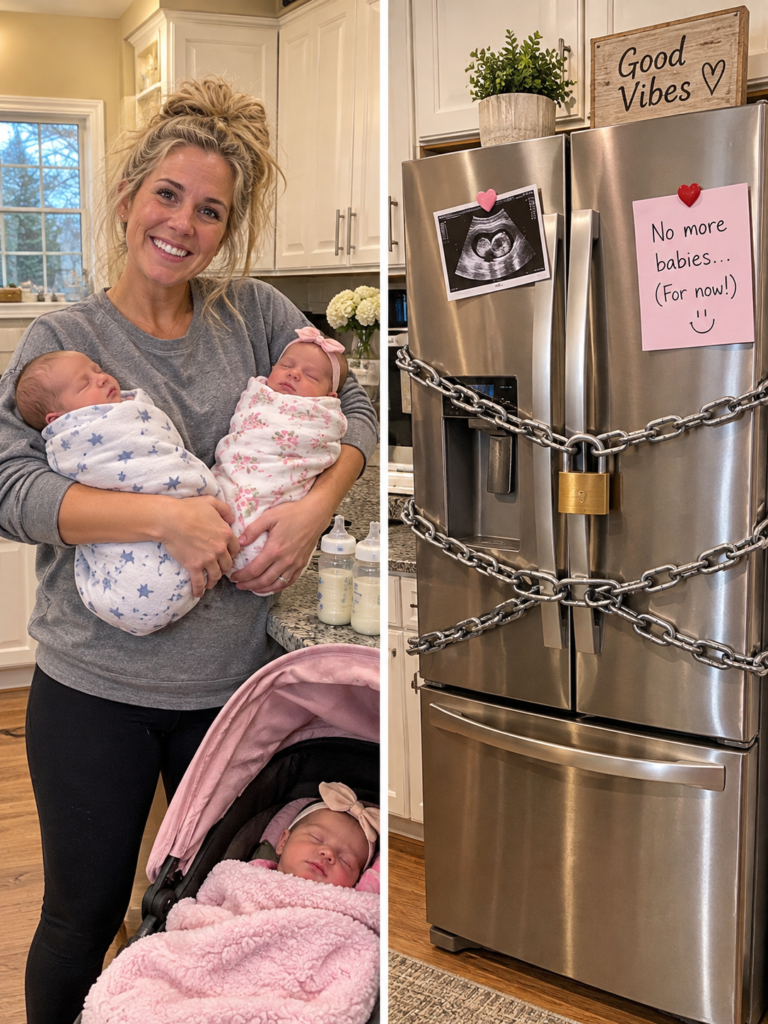
There was a chain wrapped around our refrigerator.
A thick one. Steel. The kind people use to lock bikes to poles. It went around the whole fridge, through both door handles, and around the back. A heavy combination padlock hung from the front, right at eye level.
Linda was in the living room with the girls. She looked up at me with a strange, nervous face.
“He said you knew about it,” she said.
“CURTIS!” I shouted. “What on earth is this?”
He came out of the hallway, from the direction of the game room. He’d taken a half day. He was smiling. Proud. Like a kid with a science fair project.
“Surprise!” he said. “I’ve come up with a new plan for us!”
“A plan?”
“For your health. I’ve been reading about it. It’s all about environment. If the food isn’t easy to get to, you don’t snack. So.” He patted the lock. “Only I know the combination. I’ll open it at mealtimes. Breakfast, lunch, dinner. Portion-controlled. I’ll make the plates.”
I waited for him to laugh.
He didn’t.
“Come on, honey,” I said. “You’ve had your joke. Take it off.”
“I’m serious,” Curtis said. “Trust me, this is for your own good. You’ll thank me when you look like Jessica again.”
The prescription from Dr. Patel was in my coat pocket. I could feel the edge of the paper against my fingers.
Tears burned my eyes.
I’d nearly broken my body bringing our daughters into the world. I’d lain on an operating table while strangers pumped someone else’s blood into me. And he was standing in our kitchen treating me like a disobedient child.
I didn’t say anything.
I walked to the refrigerator. I picked up the padlock. It was heavy and cold. I tried pulling the chain. I tried sliding it off the handles. I tried yanking the door open, hard, so the whole fridge rocked and the bottles inside rattled.
It didn’t budge.
I tried 0000. I tried our anniversary. I tried his birthday. The girls’ birthday.
Nothing.
Curtis watched.
He leaned against the doorframe with his arms crossed and watched me fight his chain. And he looked pleased. Genuinely pleased. Like he’d built something that worked.
“See?” he said. “It’s solid. I got the heavy-duty one.”
In the living room, Linda had gone very quiet. She was holding Hazel and looking down at her.
I let go of the padlock.
Something changed inside me then. I felt it happen. Like a door closing somewhere deep in my chest. Quietly. Firmly.
I stopped crying.
I took a breath. I wiped my face with my sleeve.
And I turned around and smiled at my husband.
“You’re right, darling,” I said quietly. “I understand now.”
He blinked.
“You do?”
“You’re right. I’ve been making excuses. This will help.” I took another breath. “Why don’t we invite everyone over on Saturday? Your parents. My parents. Drew and Kenny and their wives. Jessica and Ben. Let’s have a dinner. Celebrate our new life.”
Curtis practically glowed.
He crossed the kitchen in three steps and hugged me. Hard. He kissed the top of my head.
“That’s my girl!” he said. “See, Mom? I told you she’d get it.”
Linda didn’t answer.
That night, at dinner, he unlocked the fridge and made me a plate. Four ounces of chicken. A half-cup of rice. Steamed broccoli. He’d measured it with a food scale he’d bought from Amazon.
He watched me eat it.
At midnight, while he slept in his earplugs and I fed Hazel her bottle in the dark, my stomach growled so loudly that she startled.
I went to the nursery closet, to the box of diapers in the dining room, and dug down to the bottom where I’d hidden a box of granola bars in April. Just in case. I’d been hiding food in my own house for two months, and I’d never even admitted it to myself.
I ate three of them sitting on the dining room floor in the dark.
He had no idea what I’d already decided.
The following morning, after Curtis left for work, I called my father.
“Dad,” I said. “I need your help.”
My father, Frank Hollister, is sixty-four. He was a high school shop teacher for thirty years. He has big rough hands, a bad knee, and the patience of a man who spent three decades teaching sixteen-year-olds not to cut their fingers off. He does not raise his voice. In my whole life, I’ve heard him yell exactly twice.
He was in my driveway in nineteen minutes.
I opened the front door with Clara on my hip. He took one look at my face and stopped smiling.
“What happened?”
“Come see.”
I walked him into the kitchen.
He stared at the chain.
He stared at it for a long time. Then he walked closer. He picked up the padlock in his big hand and turned it over. He looked at the chain where it went around the back of the fridge.
“Leah,” he said quietly. “Did Curtis do this?”
I nodded.
My father said nothing for several seconds.
I watched his jaw move. I watched his hand tighten around the lock.
Then he set it down. Carefully. Like it was something dirty.
He walked out to his truck without a word.
He came back with his red toolbox and a pair of bolt cutters as long as my arm.
“Wait,” I said. “Let me take pictures first.”
“Already did?”
“Last night. But let me get a few more. With the date.”
I photographed it from every angle. The chain. The padlock. The note Curtis had taped to the freezer door that I hadn’t even noticed the day before. A printed meal plan. 1,200 CALORIES. NO SNACKS. Underneath it, in his handwriting: You got this, babe! 💪
My father read the note.
His face did something I’d never seen it do.
Then he picked up the bolt cutters.
It took him one cut.
The chain fell to the kitchen floor with a crash so loud that Maisie woke up and started crying upstairs.
My father coiled the chain up and laid it on the counter, next to the padlock and the note.
Then he opened the refrigerator door.
“Sit down,” he said.
“Dad—”
“Sit down, kiddo.”
I sat down at the kitchen table.
My father made me eggs. Four of them, scrambled with cheese, and two pieces of toast with butter, and a glass of orange juice. He made it the way he used to make it on Saturday mornings when I was ten, while my mother slept in.
He set it in front of me.
“Eat,” he said.
I ate.
And while I ate, I told him everything.
The sleepless nights. The earplugs. The drinking. The four-hour gaming sessions. The bagel. Jessica in her ponytail, jogging down the street. There’s always an excuse. The granola bars hidden at the bottom of the diaper box. The way Curtis looked at me in my towel.
Dr. Patel’s prescription. I took it out of my coat pocket and slid it across the table to him.
EAT THREE MEALS A DAY.
My father read it twice.
Then he folded it and set it down very gently.
He was quiet for a long time.
“Do you want to bring the girls to our house?” he said finally. “Your mother and I have the guest room. And the den. We can set up cribs. You can stay as long as you need. A week. A year. However long.”
I considered it.
I really did. I thought about my childhood bedroom. My mother’s cooking. Sleeping eight hours while someone else did the night feeds. It sounded like heaven.
But then I thought about packing. Three babies. Three of everything. The bottles. The pump. Hazel’s reflux medicine. Leaving my house, the house I’d painted and decorated and paid half of the mortgage for, so Curtis could stay in it with his game room.
I’d already been the one who sacrificed everything. My body. My sleep. My job. I’d taken unpaid leave from the bank in February and hadn’t been back.
I was tired of being the person who always had to leave, rearrange things, and make sacrifices.
“No,” I said. “I want my home back.”
My father looked at me for a long moment.
Then he nodded slowly.
“Okay,” he said. “Then let’s get it back.”
That afternoon, my mother came over.
Diane Hollister is a retired elementary school principal. She is five-foot-one. She has run a school of six hundred children and forty staff members, and she can organize a fire drill, a bake sale, and a parent-teacher conference at the same time without breaking a sweat.
She walked into the kitchen. She looked at the coiled chain on the counter.
She took off her reading glasses.
“Well,” she said. “All right then.”
She sat down at the table. She took a legal pad out of her purse.
“Tell me what we’re doing,” she said.
Together, we made a plan.
The nursery furniture was still boxed in the basement. Three cribs, a changing table, a dresser, the glider, the shelves. My father could assemble all of it in a day. My mother would organize everything. The diapers. The clothes. The bottles. The hundred little things that had been scattered across our house for six months.
But first, the game room had to be emptied.
I hired movers. A small local company called Two Guys and a Truck. The owner, a man named Luis, came by on Tuesday evening while Curtis was at the gym. I showed him the room.
He whistled when he saw the setup. The curved monitor. The chair. The glass shelves of figurines.
“This stuff’s expensive,” he said.
“I know. I want every piece of it wrapped and packed like it’s going to a museum. Nothing damaged. Nothing thrown away.”
“Where’s it going?”
“A climate-controlled storage unit on Route 30. I rented it this afternoon.”
Luis looked at me.
“Can I ask what’s going on?”
“I’m turning this room into a nursery,” I said. “For my daughters. Like we agreed to do last October.”
Luis looked at the room. Then at me. Then at the three bassinets he could see through our bedroom door across the hall.
“Saturday afternoon?” he said.
“Saturday afternoon. He’ll be out.”
“We’ll be fast,” Luis said. “And careful.”
Nothing would be damaged or discarded.
That was important to me. I wanted to be very clear about it, even to myself.
I wasn’t trying to destroy anything Curtis loved.
I just wanted my daughters to have a room.
On Wednesday, Curtis noticed the refrigerator was unlocked.
He came home from work, went to the fridge for a beer, and stopped.
The chain wasn’t there. The padlock wasn’t there. The meal plan note was gone from the freezer door.
In its place, held up by a magnet shaped like a strawberry, was Dr. Patel’s prescription.
EAT THREE MEALS A DAY. PROTEIN AT EVERY MEAL. REST.
“What happened to my chain?” he said.
I was at the kitchen table feeding Clara a bottle. My mother’s lasagna was in the oven. I’d eaten a real lunch. I’d eaten a real breakfast. I’d had a snack at three o’clock, sitting down, in the open, and nobody had watched me.
“Dad removed it,” I said.
“Your dad?”
“With bolt cutters.”
He frowned.
He pulled the prescription off the fridge and read it.
“What’s this?”
“My doctor’s orders. From Monday. From the appointment I came home from. Right before I found your chain.”
He read it again. He put it back on the fridge, a little crooked.
“Doctors always say stuff like that,” he said. “We agreed you needed discipline.”
“No,” I said. “You decided that.”
He opened his mouth.
I could see the argument coming. The patient sigh. The there’s always an excuse.
I didn’t let it start.
“Don’t forget about Saturday,” I said pleasantly. “Six o’clock. Everybody’s coming. Your parents. Drew and Becca. Kenny and Tasha. Jessica and Ben. My parents. I’m making roast beef.”
He closed his mouth.
“Let’s not spoil the celebration,” I said.
He studied me for a second.
Then something in his face relaxed. Like he’d decided something.
“Fine,” he said. “We’ll talk about the chain after the dinner. But I’m still in charge of the plan. Deal?”
“We’ll talk after dinner,” I agreed.
He kissed my cheek. He took his beer. He went down the hall.
The game room door closed.
He apparently mistook my calmness for surrender.
On Thursday, a box arrived on our front porch.
Huge. Flat. Heavy. I had to drag it inside with one hand while I held Hazel with the other.
The shipping label said GAMING CHAIR – PRO SERIES – BLACK/RED.
The packing slip was taped on the side. I looked at the price.
Four hundred and eighty-nine dollars.
That same week, I’d decided not to buy the second breast pump that Dr. Patel had suggested, because it cost a hundred and fifty, and I was on unpaid leave.
I left the box in the front hall.
When Curtis came home, he walked right past it.
“What’s that?” I said.
He glanced at it. “Oh. Chair.”
“You have a chair.”
“It’s for the guys. For game night.”
“What game night?”
He hesitated. Just for a second.
“I’m gonna start doing Thursdays again,” he said. “Drew and Kenny and Marcus. Weekly. It’ll be good for me. I need something to look forward to. You know?”
“In the game room.”
“Where else?”
“Every Thursday.”
“Babe. It’s a few hours. I’ll put my headset on. You won’t even hear us.”
“And who’s going to help me with the girls on Thursday nights?”
He looked at me like I’d asked him something in another language.
“You’ve got it handled,” he said. “You always do.”
He carried the box down the hall himself.
I stood in the kitchen and listened to him rip it open.
Then I picked up my phone and texted Luis.
Still on for Saturday. Can you bring a second guy?
He texted back a thumbs up.
There was one more thing.
On Thursday night, after Curtis went to bed, I went online and ordered a small clear acrylic display case. The kind people use for signed baseballs. With a lock and two little brass keys.
Overnight shipping.
I’d thought about it for a long time. Whether it was petty. Whether it was cruel.
I decided it wasn’t either one.
I wanted him to understand what it felt like when someone else decided what he was allowed to enjoy.
Just for one evening.
Saturday arrived.
Curtis left at eleven in the morning to play golf with Drew and Kenny. Eighteen holes and lunch at the clubhouse. He’d been talking about it all week.
“Back by five,” he said, kissing my cheek. “Don’t let your mom take over the kitchen.”
“I won’t.”
He went out to his car whistling.
Eleven minutes later, Luis’s truck pulled into our driveway.
They worked fast.
Luis and his nephew, a quiet kid named Eddie, wrapped every single item in that room like it was made of glass. They used blankets and bubble wrap and special boxes for the monitor. They photographed the shelves before they took the figurines down, so Curtis would be able to put them back exactly where they’d been. They labeled every box.
The new chair went back into its shipping box.
The old chair went out to the truck.
By one-thirty, the game room was empty.
Just carpet. Four walls. The marks on the drywall where the shelves had been. And the strange, faint blue outline on the ceiling from the LED strips.
Then my father went to the basement.
He carried up the boxes one by one. He wouldn’t let me lift anything. “Doctor’s orders,” he said, every time I tried.
He set up the cribs. Three white cribs in a row along the long wall. He set up the changing table under the window. The dresser. The glider in the corner. Shelves on the wall above the changing table, perfectly level.
My mother followed behind him like a general.
She sorted. She folded. She labeled. She put diapers in the drawer of the changing table, sorted by size. Wipes in a basket. Onesies in the dresser, by size and by baby, in neat little stacks. Bottles on the shelf. Burp cloths in a bin. Hazel’s reflux medicine in a little plastic organizer.
She hung three wooden letters over the cribs.
M. C. H.
Curtis’s mother, Linda, came at two to watch the girls so I could cook.
She stood in the doorway of the nursery and looked at it for a long time.
I’d told her everything on Thursday. On the phone. I’d been nervous to do it. She’s Curtis’s mother. I wasn’t sure whose side she’d be on.
She’d been quiet for so long that I thought the call had dropped.
Then she’d said, “When he was a little boy, he used to hide in his closet when things got hard. I always let him. I thought he’d grow out of it.”
And then, “What do you need me to do?”
Now she stood in the nursery doorway and wiped her eyes.
“It’s beautiful,” she said. “It’s what it should have been all along.”
My mother helped me cook.
Roast beef. Mashed potatoes. Green beans with almonds. Dinner rolls. And Curtis’s favorite chocolate cake. Three layers. Fudge frosting. His grandmother’s recipe, which Linda had given me the year we got married.
I ate lunch while we cooked. A real sandwich. Sitting down.
My father helped watch the girls while I finished getting ready. I took a shower. A long one. I washed my hair and dried it and put on mascara for the first time since March. I put on a blue dress that fit my body as it was now, not as it used to be.
I looked in the mirror.
I didn’t look like Jessica.
I looked like me.
By late afternoon, the game room had changed completely.
His gaming chair was gone. The television and equipment were safely packed away.
In their place stood three cribs, a changing table, a dresser, and shelves filled with baby supplies.
On top of the dresser, my mother had arranged three framed photographs.
The first was the three girls together on the day Hazel finally came home. Lying side by side on a white blanket. Maisie screaming. Clara asleep. Hazel looking straight at the camera with huge dark eyes, tiny as a doll.
The second was me in the hospital, two days after the C-section, holding Maisie and Clara, one on each arm. Pale. Exhausted. Smiling so hard it hurt.
The third was me at home, in April. Sitting on the couch, holding all three girls at once. One on each arm and one on my chest. My hair was a mess. There was spit-up on my shoulder. My eyes were swollen.
I was smiling.
When I saw the finished room, I nearly cried.
I stood in the doorway and held on to the frame.
For the first time since bringing the girls home, something in our house had been arranged around their needs.
Not his. Not mine.
Theirs.
My father came and stood beside me. He put his arm around my shoulders.
“Good room,” he said.
“Good room,” I agreed.
Curtis came home at five-twenty. Earlier than I expected.
I heard his car in the driveway and rushed down the hall. I closed the nursery door just as the front door opened. I had barely enough time to get back to the kitchen.
He came in sunburned and happy.
“Shot an eighty-nine!” he announced. “Personal best! Drew owes me twenty bucks.”
“That’s great, honey.”
He smelled the roast. He came into the kitchen and kissed my cheek. He looked at me in my blue dress.
“You look nice,” he said. Then, “Did you have lunch?”
“I did.”
He frowned slightly. He opened his mouth.
The doorbell rang.
Soon our parents, friends, and Jessica arrived.
My parents, who’d gone home to shower and change and came back like they’d never been there. Curtis’s father, Roger, who’d come separately from Linda. Drew and his wife, Becca. Kenny and his girlfriend, Tasha. Jessica and her husband, Ben, carrying a bottle of wine and a bouquet of grocery store tulips.
Jessica hugged me in the hall.
“You look great,” she said. “How are you holding up? Seriously.”
It was such a simple question.
Nobody had asked me that in months.
Twelve people around our dining table. I’d pulled the extra leaf out of the closet and borrowed four folding chairs from my parents.
The girls were in their bouncers in the corner of the living room, where everyone could see them. Linda checked on them every five minutes.
Curtis took his usual place at the head of the table.
He was in wonderful spirits.
He carved the roast. He poured the wine. He told the story of his eighty-nine twice. He made Drew pay him the twenty dollars in front of everybody.
When I started filling my plate, Curtis watched me.
I took roast beef. Two slices. Mashed potatoes. Green beans. A roll with butter.
I saw his eyes go to my plate. I saw his jaw tighten.
He didn’t say anything. Not yet.
I ate every bite.
Halfway through dinner, he began boasting.
He’d had three glasses of wine by then. He tapped his fork against his glass.
“So,” he said, grinning. “Big news in the Bishop house this week. Leah and I started a new health plan.”
Jessica looked up.
“It was my idea,” Curtis said proudly. “Basically, after the babies, she’s been struggling with the weight, right? Totally normal. But she just needed some structure. So I came up with this system. It’s all about environment. You control the environment, you control the habits.”
My mother put down her fork.
“What kind of system?” Becca asked politely.
“Oh, it’s simple,” Curtis said. “I just took control of the kitchen. Portions. Meal times. No mindless snacking. It’s working great already, right, babe?”
He winked at me down the length of the table.
“You have to encourage healthy habits,” he told everyone. “That’s what partners do. Right? You help each other get back to your best selves.”
Jessica looked uncomfortable. She glanced at me, then at her husband.
Ben was staring at his plate.
Roger, Curtis’s father, was frowning at his son.
My father hadn’t moved at all. He was holding his water glass so tightly that his knuckles were white.
My mother looked at me.
I smiled at her. A small smile. Wait.
I got up and served dessert.
The chocolate cake. Three layers. Fudge frosting. I cut a slice for everyone. I cut a big one for Curtis.
I cut a big one for myself.
Curtis watched me set it down at my place.
“Babe,” he said lightly. “Maybe half of that?”
The whole table heard him.
I sat down. I picked up my fork. I ate a bite of cake.
It was delicious.
When everyone had finished, I stood up and raised my glass.
The room went quiet.
“To my wonderful husband,” I said.
Curtis grinned and raised his glass. “Aw, babe.”
“Who taught me so much this week,” I said. “About trust. And about control. And about who gets to decide things in a family.”
A few people laughed politely, not sure if it was a joke.
Curtis was still grinning. He hadn’t heard it yet.
“And now, darling,” I said, “it’s time for your surprise.”
“What’s this, sweetheart?” he chuckled. He looked around the table at everyone, delighted. “She’s been planning something. I knew it.”
I went into the pantry.
I came back with the locked display box.
And that’s when Curtis exploded.
Now he was glaring at me across the dining table. His chair was pushed back. His napkin was on the floor. Everybody was frozen.
“Leah, open that thing!”
“Why?” I said.
“Because it’s mine!”
“And the food in our refrigerator belonged to our family.”
“That’s completely different!”
“Is it?”
He stared at me. Everybody stared at him.
I turned toward our guests.
“On Monday,” I said, “I came home from my six-month checkup. My doctor told me my iron was dangerously low. She told me I’d lost too much weight too fast. She wrote me a prescription. To eat.”
I took the paper off the fridge and set it on the table where everyone could see.
“And when I walked into my kitchen, Curtis had wrapped a chain around our refrigerator with a padlock. Because he decided I couldn’t be trusted to make my own choices.”
Jessica’s mouth fell open.
Becca put her hand over her mouth.
Kenny said, “Dude.”
I took out my phone. I turned it around. The photograph. The chain. The padlock. The meal plan taped to the freezer. 1,200 CALORIES. NO SNACKS. You got this, babe! 💪
I passed it around the table.
Nobody said anything as it went from hand to hand.
My mother looked directly at Curtis.
When my mother looks directly at you, you feel it in your spine. Six hundred elementary school students learned that over the years.
“You locked food away,” she said, “from a woman recovering from childbirth?”
Curtis shifted in his chair.
“I was helping her,” he said.
“By making her ask permission to eat?” my father asked quietly.
Curtis turned toward me.
“You’re embarrassing me,” he said.
“You didn’t seem embarrassed when you told everyone about your brilliant plan.”
He reached for the box.
I moved it away.
“Don’t worry,” I said. “You’ll get your controller back tonight.”
He exhaled sharply.
“Then what’s the point?”
I took my phone back from Tasha, who had it last.
“Actually,” I said, “the controller isn’t your only surprise.”
I opened the photos. I found the one I wanted. I turned the screen toward him.
It was the nursery. Three white cribs. The wooden letters. M. C. H. The changing table. The glider. The three photographs on the dresser.
For several seconds, he didn’t speak.
He just looked at the phone.
I watched him figure out where the picture was taken. I watched him recognize the window. The carpet. The faint blue outline on the ceiling where his LED strips used to be.
Then he stood so abruptly that his chair scraped the floor.
“Where’s my stuff?”
“Safe in storage.”
“You emptied my game room?”
“Yes. It’s our daughters’ nursery now.”
“You had no right!”
He was shouting now. In the living room, Maisie started crying. Linda got up to go to her.
“We agreed to make that room a nursery before the babies were born,” I said. I didn’t raise my voice. “You agreed. Last October. In our bed. You said, ‘They’re my daughters. It’s their room.’”
“I told you I’d get around to it!”
“When, Curtis? After they started school?”
A few guests exchanged glances.
Drew was looking down at the tablecloth. Kenny was looking at Curtis like he’d never seen him before.
Curtis folded his arms.
“I work all day,” he said. “That room is the only place I can relax.”
I looked at him for a long moment.
“When was the last time you got up with one of our daughters during the night?” I said.
He hesitated.
“That’s not fair.”
“Just answer.”
“I have to work in the morning.”
“And I have three babies to care for in the morning.”
He looked away.
I picked up the notebook I’d placed beside my chair.
A green spiral notebook from the drugstore. The pages were soft and wrinkled. Some of them had formula stains.
I’d been keeping it since the girls came home. The NICU nurses had told me to. Feeding times. How many ounces. Diaper changes. Which baby. Medicine doses. Pediatrician appointments. Weight checks.
For the last week, I’d started adding something else in the margins.
I’d started writing down when Curtis was available to help.
I opened it.
“Last Saturday, you were out with your college friends until one-thirty,” I read. “Sunday, you watched football from noon to seven. Monday, you came home from your half-day and played games until dinner. Tuesday, you went gaming after dinner. Wednesday, you met your friends at the bar for trivia. Thursday, you spent nearly four hours in your room.”
I turned the page.
“Number of night feedings this week: thirty-one. Number you did: zero.”
“Are you keeping track of everything I do now?” Curtis said.
His voice was different. Less loud.
“I started keeping track,” I said, “because I needed to know when I could count on another adult.”
I closed the notebook.
“And I found out I couldn’t.”
Then Roger spoke.
Curtis’s father hadn’t said a word all night. He’s a quiet man. A retired electrician. He has the same big frame as his son, but slower, softer.
“Curtis,” he said quietly. “Have you really been leaving Leah to do all this herself?”
Curtis turned to him.
“Dad. She never asked me to handle every little thing.”
I stared at him.
“Did someone have to ask you to become a father?” I said.
He had no answer.
Then, unexpectedly, Jessica spoke.
“Curtis,” she said. “There’s something I need to clear up.”
He turned toward her. Surprised.
Jessica set down her wine glass. She’s a pediatric dental hygienist. She has a calm, careful way of talking, like she’s explaining to a nervous kid that the drill won’t hurt.
“You keep comparing Leah to me,” she said.
Curtis blinked. “I was just saying you take care of yourself.”
“I know what you were saying. Leah mentioned it to me once. In August. On the sidewalk. She asked me how I got back in shape so fast. She looked like she was going to cry. I didn’t understand why until tonight.”
Jessica shook her head.
“My children weren’t newborns at the same time,” she said. “Sofia and Mateo are three years apart. And I had them both vaginally. No complications. I was home in two days both times.”
She looked at her husband.
“And Ben helped with almost everything. After both deliveries. He took a month off. He did every night feeding he could. He did all the laundry. He cooked. My mother moved in for six weeks after Mateo.”
Ben nodded, quietly.
Curtis frowned.
“You told me you exercised after having your second.”
“Eventually. Not while I was recovering and barely sleeping. I started running when Mateo was a year old. Not before.”
She looked at me.
“And I didn’t magically get my old body back,” she said. “I still haven’t, honestly. It took time. I had support.”
Curtis tried to interrupt.
Jessica continued.
“When you asked me how I stayed in shape, at the block party in June, I thought you wanted advice on helping Leah feel better,” she said. “I thought you were being a good husband. I told you about sleep and support and eating enough. I didn’t know you were using me to make her feel ashamed.”
The table was dead silent.
For months, I’d looked at Jessica and wondered what was wrong with me.
Every time I’d seen her jogging past our window with her ponytail swinging, I’d felt my stomach drop. I’d looked down at my own body in Curtis’s old sweatshirt and thought, What’s wrong with you? Why can’t you do this?
Now I realized Curtis had been comparing two completely different situations and judging only the results.
I looked at Jessica across the table.
“Thank you,” I said.
She reached over and squeezed my hand.
“I’m sorry I didn’t see it,” she said.
I turned back to my husband.
“Do you know what I wanted when I came home from that doctor’s appointment on Monday?” I asked.
He remained silent.
“A shower,” I said. “A proper meal. Maybe an hour of sleep.”
My voice cracked. I swallowed.
“That’s all. A sandwich. I’d been thinking about it the whole drive home. And I walked into my kitchen and found a chain.”
My mother wiped her eyes.
Curtis looked toward the doorway. Toward the hall. Toward the room that wasn’t his anymore.
“Can we discuss this privately?” he said.
“We could have,” I said. “But you chose to announce my weight-loss plan in front of everyone.”
He sat down slowly.
He rubbed his face with both hands.
“Fine,” he said. “Fine. I should have handled the refrigerator differently. Okay? I get it. Maybe the chain was too much. But moving my things was unnecessary.”
“Do you know what I found out while arranging the nursery?” I said.
He glanced at me suspiciously.
“You’d been planning weekly gaming nights.”
His expression changed.
“Who told you that?”
“You did. On Thursday. When I asked why you’d ordered another chair.”
I looked at Drew. Drew looked at his plate.
“A four-hundred-and-eighty-nine-dollar chair,” I said. “The same week I decided we couldn’t afford the second breast pump my doctor recommended.”
Becca turned slowly to look at her husband.
“Did you know about this?” she said.
“He said Leah was cool with it,” Drew mumbled.
“You had plans for that room, Curtis,” I said. “You just didn’t have any that involved our daughters.”
“I needed somewhere to escape!”
The words came out of him like something breaking. Louder than he’d intended. They rang across the dining room.
In the living room, Linda stopped rocking Maisie.
The table went silent.
“Escape from what?” I asked quietly. “You’ve barely participated.”
He sank into his chair.
For the first time that evening, he didn’t look angry.
He looked cornered.
He was quiet for a long time. He picked at the edge of the tablecloth. Nobody spoke. Nobody moved. Even the girls had gone quiet in the living room.
“I didn’t think it would be like this,” he admitted.
“Like what?”
“Having kids.”
He stared at the tablecloth.
“I thought we’d still have time for ourselves,” he said.
Nobody interrupted.
“When you were pregnant,” he said slowly, “I imagined all this stuff. Taking them to parks. Teaching them to ride bikes. Watching them play softball. Teaching them to play video games, even. I had it all planned out. I was so excited, Leah. You know I was.”
“I know you were.”
“But then they came home.” He swallowed. “And everything was crying. And bottles. And no sleep. And every conversation was about the babies. How much did Hazel eat. Did Clara poop. Is Maisie’s rash worse. Every single conversation.”
He stared at his hands.
“And you were always exhausted,” he said. “We never went anywhere. We never did anything. You didn’t laugh anymore. Nothing felt normal anymore.”
I waited.
He finally looked at me. His eyes were red.
“I thought if you started taking care of yourself again,” he said, “maybe things would feel like they used to.”
There it was.
The explanation I’d been searching for. For months. In the middle of the night with Hazel on my chest. On the dining room floor with a granola bar. Standing in the kitchen in front of that chain.
He wasn’t simply unhappy with my weight.
He was unhappy that our lives had changed. And he’d decided my body was the problem.
“You wanted me to look like I did before the pregnancy,” I said slowly, “because you wanted everything to go back to how it was.”
He didn’t deny it.
I shook my head.
“You got scared and hid in your game room,” I said. “I got scared and still had three babies to feed.”
Across the table, Linda had come back from the living room with Maisie on her shoulder. She sat down in her chair. She began crying quietly.
“I was scared in the hospital, Curtis,” I said. “I was scared when I woke up in the ICU with somebody else’s blood in me. I was scared when Hazel couldn’t come home. Every night for seven weeks, I was scared the phone would ring. I was scared every night I wondered whether I could manage another day.”
My voice trembled. I let it.
“But you never asked how I was coping,” I said. “Not once. In six months. You just asked why I wasn’t thinner.”
He covered his face with his hands.
His shoulders shook.
“I’m sorry,” he said into his hands. “Leah. I’m sorry.”
I wanted those words to fix everything.
I really did. I wanted to walk around the table and put my arms around him and say it’s okay, we’ll figure it out, and go back to the way things were.
A few months earlier, I might have.
But I remembered standing in front of that chained refrigerator. Hungry. Humiliated. With my doctor’s prescription in my pocket. Pulling on that padlock while my husband leaned in the doorway and smiled.
“An apology isn’t enough,” I told him.
He lowered his hands.
“What do you want me to do?” he said.
“Be their father,” I said. “Be my partner. Stop acting like our children interrupted your real life. They are your real life.”
He glanced at the locked controller in its little clear box.
“So I’m supposed to give up everything I enjoy?”
“No,” I said. “Your equipment is safe. Every piece. Wrapped and labeled. I’ll give you the storage information tonight. You can figure out somewhere else to use it. The basement, maybe. Eventually. When you’ve earned it.”
“And my room?”
“It’s our daughters’ nursery.”
He stared at me.
“You’re making all these decisions without me,” he said.
“I spent months asking you to help make them.”
He had nothing to say to that.
So I told him the rest. Right there. In front of everybody. Because I’d decided I was done saying important things only in private, where they could be sighed away.
My mother would be coming three days a week to help with the girls. Monday, Wednesday, Friday. We’d already arranged it.
I would go to all my appointments. I would eat proper meals. Three a day. Sitting down. I would get two hours, every single day, to rest. To shower. To sleep. To sit in the backyard and do nothing.
And Curtis would have responsibilities.
Real ones. The 10 p.m. feeding every night. The 2 a.m. feeding on Fridays and Saturdays. Bath time on Tuesdays and Thursdays. Every other pediatrician appointment.
Responsibilities that didn’t disappear when he wanted to play games or go out with his friends.
He looked frightened.
He looked down the table at me with his face red and wet and blotchy. Like a little boy hiding in a closet.
“Are you leaving me?” he said.
The whole table held its breath.
“I haven’t decided,” I said.
“Leah. Please.”
“I don’t want promises you make because people are watching,” I said. “I want to see what happens when nobody is here.”
The guests left early.
Nobody really knew what to say on their way out. Drew shook Curtis’s hand without looking at him. Becca hugged me at the door and whispered, “Good for you.” Kenny paused on the porch, came back, and said quietly to Curtis, “Thursday’s off, man. Go home to your kids.”
Curtis said, “I am home.”
Kenny said, “Yeah. Exactly.”
Jessica hugged me for a long time.
“Come over Tuesday,” she said. “I’ll make you lunch. A big one. With dessert.”
My father was the last to leave.
He stood on the porch with his hands in his pockets. He looked at Curtis, who was standing in the front hall behind me.
“Curtis,” he said.
Curtis looked up.
My father didn’t yell. He didn’t threaten. He just said, very quietly:
“I put that chain in the back of my truck. It’s still there. I kept it so I’d remember the day my son-in-law made my daughter ask permission to eat.”
He paused.
“I’d like to throw it away someday,” he said. “That’s up to you.”
He walked down the steps to his truck.
After the guests left, I gave Curtis the display box key and a printout with the storage unit address and the gate code.
He took them without a word.
He unlocked his controller.
He held it for a second. Turned it over in his hands. Ran his thumb along the gold trim.
Then he set it down on the kitchen counter. He didn’t take it anywhere. He just left it there.
He went upstairs.
I put the girls to bed. One at a time. In their bassinets, in our room. They’d stay there a few more weeks, until they were six months. Then the cribs.
I did the dishes. I wrapped up the leftover roast beef. I put the rest of the chocolate cake in the fridge.
The refrigerator door opened easily.
I stood there for a moment with the door open and the cold air on my face.
Then I ate a second piece of cake. Standing up. Out of the container. With a fork.
Not because I was hiding.
Because I wanted to.
A little later, I went looking for him.
He wasn’t in our bedroom.
I found him standing in the nursery doorway.
He hadn’t turned the overhead light on. Just the little lamp on the dresser, which my mother had set on a timer. The room was soft and gold. Three white cribs. The glider. The letters on the wall. M. C. H.
He was looking at the photographs on the dresser.
He picked up the first one. The three girls on the white blanket, the day Hazel came home.
He looked at it for a long time.
Then he put it down and picked up the third one. Me on the couch in April. Holding all three of them at once. One on each arm and one on my chest. Spit-up on my shoulder. Hair a mess. Smiling.
“Where was I when this one was taken?” he asked.
I came up behind him.
I looked at the photo.
“Your friends had invited you out,” I said. “It was Kenny’s birthday. My mom took it. She’d come over to help because I called her crying.”
He studied it.
Then he put it down. He picked up another one. One I hadn’t even noticed my mother had added. Tucked in the corner of the dresser mirror.
Me in the NICU. Sitting in a vinyl recliner. Hazel on my bare chest, under a blanket, with wires and tubes coming out from under it. Kangaroo care. The nurses had told me it would help her grow. I’d done it every day for seven weeks. Two hours at a time.
“I don’t remember this,” he said.
“I know.”
He looked at that one for a long time.
That seemed to hurt him more than anything I’d said at dinner.
“How many times did you do that?” he said quietly.
“Every day. Except the two days I had a fever.”
“Every day.”
“She needed it.”
He put the photo back very carefully.
“I went twice,” he said. “To the NICU. After you got out of the hospital. I went twice in seven weeks.”
“Three times,” I said. “But who’s counting.”
He let out a small, broken laugh.
Then he sat down in the glider. In the dark. With his face in his hands.
I didn’t comfort him.
I wanted to. Part of me desperately wanted to.
But I stood in the doorway and let him sit there and feel it. All of it. The way I’d felt it for six months with nobody sitting beside me.
After a while, I said, “Hazel’s due for a bottle at ten.”
He looked up.
“I’ll do it,” he said.
“Do you know how much she gets?”
He hesitated.
“No,” he said.
“Three and a half ounces. With the thickener. One scoop. Hold her upright for twenty minutes after, or she’ll spit up everything. And she likes it if you hum.”
“Hum what?”
“Anything. She’s not picky.”
At ten o’clock, I lay in bed with my eyes closed and listened.
I heard him get up. I heard him go to the kitchen. I heard him mix the bottle. Measuring, very slowly. I heard him come back and lift Hazel out of the bassinet, and I heard her fuss.
Then I heard him hum.
Off-key. Badly. A song I didn’t recognize at first.
Then I did. It was the theme music from one of his video games.
Hazel stopped fussing.
I fell asleep before he was done.
The following weeks weren’t magical.
I want to be honest about that, because I think people expect a story like this to end with a big apology and everything being fixed.
It didn’t work like that.
Curtis made mistakes. A lot of them.
The first Tuesday, he forgot bath time completely and went to the gym. He came home and found me with all three girls in the tub and said, “Oh crap. Oh crap, I’m sorry.” Then he stood there in the bathroom doorway, not sure what to do.
“Grab a towel,” I said.
He grabbed a towel.
He complained about being tired. Constantly. “I don’t know how you did this for six months,” he said one morning, gray-faced, after his first full Friday night shift.
“I didn’t have a choice,” I said.
He didn’t complain as much after that.
Sometimes I had to remind him that changing diapers wasn’t doing me a favor.
“I changed Clara,” he announced one afternoon, coming into the kitchen like he was expecting applause.
“Great. She’s your daughter.”
He stopped.
He thought about it.
“Yeah,” he said slowly. “Yeah, she is.”
But he started getting up for the scheduled nighttime feedings.
The first week, I had to wake him up twice. I’d shake his shoulder and he’d groan and roll over and I’d say, “Curtis. Ten o’clock. Hazel.” And he’d get up.
The second week, he set an alarm.
The third week, he threw away the earplugs.
I found them in the bathroom trash can. Both of them. I stood there looking at them for a long time.
He learned the feeding routines. He learned that Maisie eats fast and needs to be burped halfway, or she’ll scream. That Clara likes her bottle a little warmer than the other two. That Hazel needs the thickener and the twenty minutes upright, and that she’s the one who smiles first in the morning.
He started going to the pediatrician appointments. Every other one, like we’d agreed. The first time, the nurse asked him how much Maisie was eating, and he answered without looking at me.
“Five ounces, every three and a half hours,” he said. “Except at night, she’s going four hours now.”
I looked at him.
He shrugged. “I’ve been writing it down,” he said. “In the notebook.”
He had. In the green spiral notebook. In his blocky handwriting, under mine.
He also stopped commenting on my body.
Completely.
Not a word about my plate. Not a word about the snacks. Not a word about Jessica.
One night, I came out of the shower in my towel, and he was sitting on the bed. He looked up.
Then he said, “Hey. You look like you got some sleep.”
“I did. Two hours. Mom took the girls for a walk.”
“Good,” he said. “That’s good.”
That was all.
I didn’t close the bathroom door to change after that.
We started seeing a counselor in October.
It was his idea. That surprised me.
A woman named Dr. Reyes, in an office with too many throw pillows, every other Thursday evening. My mother watched the girls. Curtis drove.
The first session, he barely spoke. The second, he talked about his father. Not Roger. His biological father, who left when Curtis was three. He’d never told me much about him. I knew the name. That was about it.
“He just left,” Curtis said, looking at his hands. “One day. My mom said he told her he didn’t sign up for all this. Diapers and crying. That’s what he said. ‘I didn’t sign up for all this.’”
He was quiet for a long time.
“And then I had three babies,” he said. “And they were crying all the time. And I went into my room and closed the door. And I was so angry at Leah, and I didn’t even know why.”
He looked at me.
“I think I was turning into him,” he said. “And I couldn’t stand it. So I made it about you. Because that was easier than looking at me.”
Dr. Reyes didn’t say anything for a while.
Then she handed him the tissue box.
He took two.
One afternoon in November, I woke up from a nap.
A real nap. Two hours. In our bed. In the middle of a Saturday.
I lay there for a minute, listening.
The house was quiet. Not the empty, scary quiet of something being wrong. A busy quiet. Dishes clinking. A dryer running. A voice talking low.
I got up and walked down the hall.
My mother was at the kitchen table folding laundry. She looked up and smiled and put a finger to her lips.
She pointed to the living room.
Curtis was on the couch.
He had Hazel in the crook of one arm, feeding her a bottle. Maisie and Clara were on the play mat in front of him, kicking and cooing at the dangling toys. He was watching them, talking to them in a low, silly voice.
“Okay, Clara, I see you. You’re going for the elephant. Bold choice. Very bold. Maisie, you’re gonna let her get the elephant? You’re just gonna let that happen?”
Maisie squealed.
“That’s what I thought. Defend your territory.”
I stood in the hallway and watched.
For once, nobody needed me immediately.
Nobody was crying. Nobody was hungry. Nobody was waiting for me to fix anything.
I didn’t know what to do with myself.
My mother came up beside me. She handed me a cup of tea. Hot. With honey.
“Go sit on the porch,” she whispered. “Nobody needs you for an hour.”
I went and sat on the porch.
Across the street, Jessica was raking leaves. She waved.
I waved back.
I didn’t feel anything in my stomach when I saw her.
Later that week, Curtis asked if we could talk.
We were in the kitchen after the girls went down. He was drying dishes. I was washing.
“So,” he said carefully. “I was thinking. Down the road. Not now. But maybe, in the spring or something, we could set up a little gaming corner? In the basement? Just a small one. A desk. One monitor. Nothing crazy.”
He looked nervous. Like he was asking permission.
I hated that a little.
I put the plate down.
“Of course,” I said. “You deserve time for yourself.”
His face lit up.
“So do I,” I said.
He stopped.
He nodded slowly.
“I understand,” he said.
“I’m still waiting to see that,” I said.
He didn’t argue.
He didn’t sigh. He didn’t tell me there was always an excuse.
He just nodded again, and picked up the next plate, and dried it.
He accepted my answer.
The following Tuesday, I came home from spin class.
My first one in a year and a half. Not to lose weight. Because I’d missed it. Because I’d missed sweating and loud music and a room full of women yelling along to a song.
Curtis had all three girls in the high chairs, feeding them mashed sweet potato, and there was sweet potato on the wall, on the ceiling somehow, and in his hair.
“They had a lot of opinions,” he said.
I laughed so hard I had to sit down on the kitchen floor.
He laughed too.
It was the first time we’d laughed together, really laughed, in almost a year.
We weren’t suddenly the perfect couple.
I still needed time to trust him. Some nights, I’d lie awake and remember the chain, and the smile, and the way he’d leaned in the doorway watching me fight it. I’d remember You’ll thank me when you look like Jessica again. And I’d feel that cold, closed door inside my chest again.
I don’t know if it will ever fully open.
Dr. Reyes says it might take a long time. She says that’s okay. She says trust that comes back slowly is usually stronger than trust that never got tested.
And Curtis had plenty of work ahead. He knew it. He said so, in counseling, more than once.
In December, my father called me.
“Ask Curtis to come out to the truck for a minute,” he said.
I didn’t know what he meant. I went and got Curtis. He went out to my father’s truck in the driveway. I watched them through the front window.
My father opened the back of the truck. He took out the chain. The thick steel one, coiled up. He’d kept it there for three months.
He held it out to Curtis.
Curtis looked at it for a long time.
Then he took it. He carried it to the big garbage bin at the end of our driveway. He dropped it in. It made a loud, heavy clang.
My father nodded once.
Then he shook Curtis’s hand.
One evening in January, I sat down to eat.
The girls were ten months old. They were sleeping in their cribs now, in the nursery, under the wooden letters. M. C. H. Maisie had learned to crawl. Clara had two teeth. Hazel had caught up on the growth charts, finally, and the pediatrician had looked at her numbers and said, “Well, look at this little fighter.”
I’d made chicken and rice and roasted vegetables. A real dinner. A big plate. I’d just picked up my fork.
Upstairs, on the baby monitor, one of our daughters began crying.
Hazel. I can always tell. Her cry is a little higher than the other two.
I started to push back my chair.
Curtis immediately stood up.
“I’ve got her,” he said. “Finish your dinner.”
I watched him go.
I heard him on the stairs. Then through the baby monitor, I heard the nursery door open. I heard his voice, low and soft.
“Hey, Hazelnut. Hey. What’s wrong? Bad dream? Daddy’s here. Daddy’s got you.”
I heard the creak of the glider as he sat down with her.
I heard him start to hum.
Off-key. Badly. That same video game song.
Hazel stopped crying.
I turned back to my plate.
The kitchen was warm. The dishwasher was running. Dr. Patel’s prescription was still on the refrigerator, held up by the strawberry magnet. Curling at the corners now. I’d never taken it down.
The refrigerator was unlocked.
Nobody was counting my bites.
And for the first time in months, I could eat without feeling that I had to earn the right.