Before You Renovate My Kitchen
Part One: 6:30 A.M.
My sister called at 6:30 a.m. and said, “Dad died last night.”
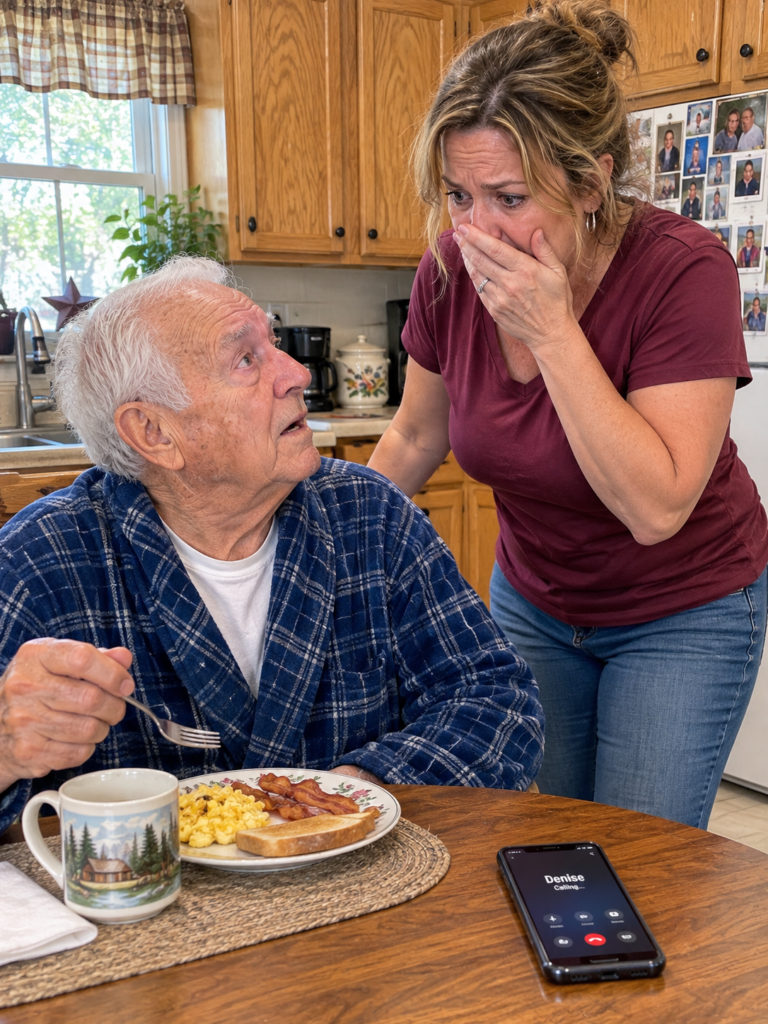
I looked across the kitchen.
Dad was sitting three feet away, drinking my coffee and eating my bacon.
It was a Thursday in early December. Still dark outside. Frost on the windows of my little brick house in Pittsburgh. I’d gotten up at six to make breakfast because Dad likes his bacon crisp and his coffee black and his eggs over medium, and he likes them all at the same time, which is harder than it sounds.
He was wearing my late husband’s navy bathrobe. It was the only one in the house that fit him. He had his reading glasses pushed up on his forehead and the sports page spread out next to his plate.
My phone buzzed on the counter.
I stared at the glowing name on the screen.
Vanessa Cole.
My older sister almost never called before noon. She never called at all, really. Once a month, maybe. On my birthday, if Grant reminded her. On Christmas.
So I immediately assumed something terrible had happened.
I had no idea she was about to invent it.
Dad reached across the kitchen table for another strip of bacon as I answered.
“Vanessa?”
For two seconds, all I could hear was the hum of a car engine and the steady clicking of a turn signal.
Then she said it.
“Natalie,” she said. “Dad died last night.”
Part Two: Speaker
My hand froze around my coffee mug.
Across from me, Dad stopped chewing.
I looked at him.
He looked at me.
Then I pressed speaker and placed the phone beside the sugar bowl.
“When?” I asked.
“Sometime during the night,” Vanessa said. “Harold found him.”
That got Dad’s attention.
His eyebrows went up. He set down his bacon.
Harold Pike had been his closest friend for more than forty years.
They’d fished together on Kentucky Lake every spring since 1981. They’d gone to every Tennessee Volunteers home game together for thirty years, sitting in the same two seats in the upper deck of Neyland Stadium. They’d carried each other through two marriages, one divorce, four heart procedures, and decades of questionable decisions involving bass boats.
Harold had also owned the town’s funeral home before retiring. Pike & Sons Funeral Home, on Wood Street in Paris, Tennessee. Three generations.
For one uncomfortable second, Vanessa’s lie almost sounded believable.
“What happened?” I asked.
Vanessa sighed.
She didn’t cry. She didn’t sniffle. Her voice didn’t crack.
She sighed like I was wasting her time.
“Does it matter?” she said. “He’s gone.”
Dad slowly lowered his fork.
“Grant and I are handling everything,” Vanessa said. “There’s really no reason for you to come to the house.”
Dad’s eyes narrowed.
“The locks are being changed this morning,” she added.
In the background, I heard Grant laughing.
Her husband. Grant Ellison. A big, loud man who sells commercial insurance in Paris and drives a black Ram truck with a lift kit and calls my father Pops to his face and the old man behind his back.
Part Three: Excluded
“Why are you changing the locks?” I asked.
“Because Grant and I found Dad’s papers,” Vanessa said. “He left the house to us. The truck, too. The accounts. Everything else.”
Dad and I stared at one another.
Then Vanessa delivered the sentence she had clearly been waiting to say.
I could tell. She’d practiced it. Probably in the car. Probably with Grant.
“You were specifically excluded,” she said.
Grant’s laughter grew louder.
A second later, his voice moved closer to the phone. Like he’d leaned over from the driver’s seat.
“You’re finally out of the family, Nat,” he said.
Dad’s fingers tightened around his coffee mug.
Grant kept talking.
“No more showing up every few months,” he said, “pretending you’re the devoted daughter.”
Part Four: The Daughter Who Ran Away
For years, Vanessa had called me the daughter who ran away.
Because I moved three states away. For work.
Twelve years ago, I got a job as a respiratory therapist at UPMC Presbyterian in Pittsburgh. It was a good job. Better pay than anything in Paris, Tennessee. Benefits. A pension.
My husband, Danny, got a teaching job in the city schools. We bought a little brick house on a hill in Brookline. We were happy.
Then Danny died of a brain aneurysm four years ago. I stayed. I had my job. My friends. My life.
Vanessa stayed in Paris.
She lives fifteen minutes from Dad. In a big house in a subdivision off Highway 79 with Grant and their two teenage boys.
She told everybody at church that she was the one who took care of Dad. That I abandoned the family. That I only showed up at Christmas.
Apparently, the phone calls didn’t count.
I called Dad every single night. For twelve years. At nine o’clock Central time, after Wheel of Fortune. We talked about the Vols and the weather and what he had for supper. Sometimes we talked for five minutes. Sometimes for an hour.
Every night.
The plane tickets didn’t count.
I flew down every other month. Twelve years. Southwest from Pittsburgh to Nashville, then a two-hour drive to Paris in a rental car. I took him to his cardiologist in Jackson. I took him to the VA in Memphis. I sat with him in the hospital after his bypass in 2019 for nine days straight.
Vanessa visited twice. She brought a balloon.
Everything I’d quietly done for Dad didn’t count either.
I paid for his hearing aids when Medicare wouldn’t. I set up his online banking. I added myself as an authorized viewer on his checking account, so I could make sure his bills got paid. I set up text alerts for any withdrawal over five hundred dollars.
I hired a lawn service so he didn’t have to mow. I hired a cleaning lady who came every other Tuesday. I paid for both.
He thought Vanessa had arranged them.
I never told him otherwise.
Especially what I’d done during the last forty-eight hours.
Part Five: Forty-Eight Hours
Here’s what happened during the last forty-eight hours.
Tuesday morning, at 10:14 a.m., my phone buzzed at work.
I was in the ICU at Presby, suctioning a patient on a ventilator. I didn’t look at it until my break.
It was a text alert. From First Citizens Bank in Paris, Tennessee.
ALERT: A withdrawal of $8,500.00 has been made from checking account ending in 4471.
Dad’s account.
I called the bank from the break room.
The teller was a woman named Brenda, who’d known Dad for thirty years. She told me a check had cleared that morning. Made out to G. Ellison. Signed by Howard Cole.
“Brenda,” I said. “Can you send me a picture of the signature?”
She did.
I’ve seen my father’s signature my whole life. On my report cards. On my permission slips. On every birthday card he ever sent me.
He signs Howard Cole in big, loopy cursive. The H is enormous. The C curls back on itself like a fishhook.
The signature on that check was small. Tight. Careful.
Somebody had tried very hard to copy it.
They’d done a bad job.
“Brenda,” I said. “Has anything else come through?”
She was quiet for a moment.
“Natalie,” she said slowly. “There have been five checks to G. Ellison since September.”
Thirty-eight thousand dollars.
Part Six: The Drive
I called Dad.
He answered on the fourth ring. He sounded confused.
“Natalie? It’s not nine o’clock yet.”
“Dad,” I said. “Did you write a check to Grant for eight thousand five hundred dollars?”
There was a long pause.
“No,” Dad said. “Why would I do that?”
Then he told me something that made my blood run cold.
“Grant came by last week,” he said. “With some papers. He said they were for the insurance on the house. He said I needed to sign them so the policy would renew.”
Dad paused.
“I didn’t have my reading glasses,” he said. “Grant said not to worry about it. He said it was just paperwork.”
“How many papers, Dad?”
“I don’t know,” he said. “Three or four. He took them with him.”
My father is seventy-eight.
He’s sharp. Sharper than most people I know. He did the New York Times crossword in pen until last year. He can tell you the score of every Vols bowl game since 1965.
But his eyes are going. Macular degeneration. And he trusts people. Especially family.
I left work at noon.
I told my supervisor it was a family emergency. I drove to the airport. There were no flights to Nashville until the next morning.
So I drove.
Nine and a half hours. Pittsburgh to Paris, Tennessee. Through West Virginia and Kentucky in the dark.
I got there at ten-thirty Tuesday night.
Dad was sitting in his recliner in the living room. With the TV on and the sound off.
He looked small. Smaller than I’d ever seen him.
“Natalie,” he said when I came in. “You drove all this way?”
“Dad,” I said. “Where are the papers Grant had you sign?”
Part Seven: Harold
We found out the next morning.
I called Harold Pike at seven a.m. Wednesday.
Harold’s seventy-nine. He’s tall and thin and stooped, with a white mustache and the gentlest voice you’ve ever heard. Forty years of talking to grieving families will do that to a man.
He came over in fifteen minutes. In his old Buick. In a cardigan and slippers.
He sat at Dad’s kitchen table with a cup of coffee and listened to me explain everything.
The checks. The signature. The papers Grant brought over.
When I was done, Harold set down his cup.
“Howard,” he said quietly. “What do you remember about those papers?”
Dad thought about it.
“There was one that had a lot of lines on it,” he said. “And one that said Durable at the top. In big letters.”
Harold and I looked at each other.
Durable Power of Attorney.
“Howard,” Harold said gently. “I think Grant had you sign a power of attorney.”
Dad stared at him.
“What does that mean?” he asked.
“It means,” Harold said, “that Grant can sign your name. On anything. Checks. Contracts. Deeds.”
He paused.
“Your house,” he said.
Dad put his face in his hands.
Part Eight: The Lawyer
We spent all of Wednesday fixing it.
At nine a.m., we went to First Citizens Bank. Brenda froze Dad’s account. She flagged every check written to G. Ellison. She filed a fraud report.
At ten-thirty, we went to see Dad’s lawyer. An old man named Walter Brandon, with an office above the hardware store on Court Square. He’d done Dad and Mom’s wills in 1998.
Walter looked at the bank records. He listened to Dad’s story about the papers.
Then he called the Henry County Register of Deeds.
He talked for ten minutes. He wrote something down.
He hung up.
“Howard,” he said. “Grant filed a quitclaim deed on Monday.”
Dad stared at him.
“Transferring your house,” Walter said, “to Grant and Vanessa Ellison. Signed by you. As grantor.”
Dad’s face went white.
“I never signed a deed,” he said.
“You signed four papers without your reading glasses,” Walter said quietly. “One of them was a deed.”
The house on Hickory Street.
The one Dad and Mom bought in 1974. Where Mom planted the azaleas along the front walk. Where Vanessa and I grew up. Where Mom died of breast cancer in 2016, in the downstairs bedroom, with Dad holding her hand.
“Can we undo it?” I asked.
Walter took off his glasses.
“Yes,” he said. “Fraud in the inducement. Your father didn’t know what he was signing. He was told it was insurance paperwork. That’s not a valid conveyance.”
He looked at Dad.
“But it’ll take time,” he said. “A lawsuit. Months, maybe. And in the meantime, Grant has a recorded deed and a power of attorney. He can change the locks. He can sell your truck. He can drain whatever’s left.”
Dad sat in Walter’s office with his hands folded on his knees for a long time.
“Walter,” he said finally. “What can I do today? Right now?”
Walter thought about it.
“Revoke the power of attorney,” he said. “Today. In writing. Notarized. And file the revocation with the register of deeds and the bank.”
He picked up a pen.
“Then put the house in a trust,” he said. “An irrevocable one. With a trustee who isn’t Grant.”
“Can we do that?” I asked. “If Grant’s name is on the deed now?”
“We file the trust deed and a lis pendens at the same time,” Walter said. “A notice of pending litigation. It’ll cloud Grant’s title. Nobody will buy that house or lend a dime against it until a judge sorts it out.”
He looked at Dad.
“And when the judge sorts it out,” Walter said, “the house goes into the trust. Not back to you. Not to Grant. Into the trust.”
Part Nine: The Trust
Dad thought about it for a long time.
“Who’s the trustee?” he asked.
Walter looked at me.
Dad followed his eyes.
Then he shook his head.
“No,” Dad said.
I stared at him.
“Not Natalie,” Dad said. “If I make Natalie the trustee, Vanessa will say Natalie took it. Vanessa will say Natalie came down here and turned me against her.”
He looked at me.
“And she’ll never forgive you,” he said. “And I won’t have that. I won’t have my girls hating each other over a house.”
He turned to Harold.
Harold was sitting in the corner of Walter’s office in his cardigan. He hadn’t said a word in an hour.
“Harold,” Dad said. “Will you do it?”
Harold looked at him.
“Me?” he said.
“Forty years,” Dad said. “You buried my wife. You buried my parents. You carried me out of Kentucky Lake in 1994 when I fell out of the boat.”
He smiled a little.
“You’re the only man in this county I’d trust with my house,” he said.
Harold didn’t say anything for a long moment.
Then he nodded.
“I’ll do it, Howard,” he said.
Part Ten: What the Trust Said
Walter drew it up that afternoon.
The Howard and Margaret Cole Family Trust.
Dad dictated it. Sitting in Walter’s office. While Walter typed.
The house on Hickory Street would go into the trust.
Dad would have the right to live in it for the rest of his life. Or to sell it, if he chose, with the proceeds going back into the trust.
Harold Pike would be trustee.
When Dad died, the house would be sold. And the money split.
Equally.
Fifty percent to Vanessa. Fifty percent to Natalie.
“Equally?” I said. “Dad. After what Grant did?”
Dad looked at me.
“Grant did it,” he said. “Not Vanessa.”
He paused.
“Maybe Vanessa knew,” he said. “Maybe she didn’t. Either way, she’s my daughter. Same as you.”
He looked at Walter.
“Put it in writing,” he said. “Equally.”
Then he added one more thing.
“Any beneficiary,” Dad dictated, “whose spouse is convicted of a crime against me, forfeits the right to have that spouse share in any distribution. Their share shall be held in a separate trust for their children’s education.”
Walter stopped typing.
He looked at Dad over his glasses.
“Howard,” he said. “That’s very specific.”
“I know,” Dad said.
He signed it at four-fifteen Wednesday afternoon.
Walter notarized it. Harold signed as trustee.
Walter filed the revocation of the power of attorney with the bank and the register of deeds before five o’clock. He filed the lis pendens. He mailed a copy of everything to Grant and Vanessa. Certified mail. Return receipt requested.
Part Eleven: Leaving
Dad didn’t want to stay in Paris.
“Not with Grant fifteen minutes away,” he said. “Not right now.”
So that night, Wednesday, I packed him a bag.
Three days of clothes. His heart medications. His reading glasses. His Vols cap.
We loaded it into his truck. His 2011 Ford F-150. Dark blue. A hundred and forty thousand miles. The truck Grant wanted to sell.
Before we left, Harold came over.
He stood in Dad’s driveway in the dark, in his cardigan, with his hands in his pockets.
“I’ll change the locks tomorrow morning,” Harold said. “First thing. My grandson’s a locksmith.”
He looked at the house.
“Grant won’t get in,” he said.
Dad hugged him.
They’re not huggers. Two old Tennessee men who’ve known each other forty years. I’d never seen them hug. Not at Mom’s funeral. Not at Harold’s wife’s funeral.
They hugged in the driveway for a long time.
“Where are you going?” Harold asked.
“Pittsburgh,” Dad said. “With Natalie. For a while.”
He looked at me.
“I’ll call you,” he said to Harold.
“Howard,” Harold said. “What do I tell Vanessa? When she comes looking?”
Dad thought about it.
“Tell her the truth,” Dad said. “Tell her I’m gone.”
Part Twelve: Gone
We drove all night.
Nine and a half hours. Dad slept most of the way, with his Vols cap pulled down over his eyes.
We got to Pittsburgh at seven-thirty Thursday morning. Twenty-four hours ago.
He slept until noon. I called in to work. I made him lunch.
That evening, Harold called.
“Vanessa came by the house,” Harold said. “This afternoon. With Grant. She used her key. It didn’t work.”
He paused.
“She came over to my place,” he said. “She was furious. She wanted to know where Howard was.”
“What did you tell her?” I asked.
Harold was quiet for a long moment.
“I told her what Howard told me to tell her,” he said. “I said, He’s gone, Vanessa.”
“And?” I said.
“I’ve been a funeral director for forty-three years,” Harold said quietly. “I’ve said he’s gone to a thousand families.”
He paused.
“Every single one of them asked the same thing next,” Harold said. “Gone where? Or Is he okay? Or What happened?”
“Vanessa didn’t ask any of that,” Harold said.
“She asked me where his papers were,” he said.
Part Thirteen: The Lie
So that’s where we were.
Thursday morning. Six-thirty. My kitchen in Pittsburgh. Dad in Danny’s navy bathrobe, with his bacon and his coffee.
And Vanessa on speakerphone. Telling me our father died last night.
She’d taken Harold’s two words and built a death out of them.
She hadn’t called a hospital. She hadn’t called the coroner. She hadn’t called Harold back to ask a single question.
She’d just decided.
I could have defended myself.
When Grant said pretending you’re the devoted daughter. When Vanessa said specifically excluded.
I could have told them about the phone calls and the plane tickets and the hearing aids and the lawn service and the nine days in the hospital in 2019.
I could have told them about the bank alert and the nine-and-a-half-hour drive and the lawyer’s office and the trust.
I didn’t.
Because Dad very carefully set his mug down on the table.
That worried me more than if he’d shouted.
My father became quieter when he was truly furious.
Part Fourteen: The Kitchen
Vanessa continued as though nothing unusual was happening.
“Grant already has someone coming to evaluate the truck,” she said.
I looked out my kitchen window.
Dad’s dark blue F-150 was parked in my driveway. With Tennessee plates. Frost on the windshield.
“We contacted the bank,” Vanessa said. “And we’re going through Dad’s office today.”
Dad raised one eyebrow at the word office.
Dad’s office is the little back bedroom on Hickory Street. Where he keeps his filing cabinet and his desk and Mom’s old sewing machine.
Every important paper Dad owns was in a metal lockbox on the top shelf of the closet in that room.
The lockbox was in the back seat of his truck. In my driveway.
“And the house?” I asked.
“Obviously we’re keeping it,” Vanessa said.
From the background, Grant shouted.
“Might renovate the kitchen!”
They both laughed.
Dad didn’t.
Mom’s kitchen. The yellow kitchen with the white cabinets Dad built himself in 1976. With the little window over the sink where Mom grew African violets. With the pencil marks on the pantry doorframe where Dad measured Vanessa and me every birthday until we were eighteen.
Might renovate the kitchen.
Part Fifteen: The Boxes
Vanessa told me she’d pack whatever remained in my old bedroom into boxes.
“Grant will leave them beside the garage,” she said. “You can pick them up whenever. Or not. Doesn’t matter to us.”
Then Grant took over again.
His voice got serious. The insurance-salesman voice. The one he uses at closings.
“Natalie,” he said. “Don’t make this difficult.”
I didn’t say anything.
“Don’t challenge the will,” Grant said. “Don’t start demanding things that aren’t yours. Vanessa stayed close to home.”
He paused.
“She deserves this,” he said.
I stared through the kitchen window at the frost covering my backyard.
“You made your choice years ago,” Grant said.
Then he said the one thing that completely changed Dad’s expression.
“Your father,” Grant said, “obviously knew who really loved him.”
Part Sixteen: Pointing
Dad went perfectly still.
I’ve seen my father angry maybe five times in my life.
When a neighbor kid threw a rock through our front window in 1988. When a used car salesman in Jackson tried to cheat Mom in 1995. When the oncologist told us Mom’s cancer had spread, in 2015, and he walked out of the hospital and stood in the parking lot in the rain for an hour.
He never yells. He never curses.
He just goes very, very still.
I reached toward the phone. Ready to end the call.
He stopped me with one raised hand.
Then he pointed toward himself.
I hesitated.
He pointed again.
Vanessa’s voice sharpened through the speaker.
“Natalie? Are you still there?”
“Oh, I’m here,” I said.
“Good,” Vanessa said. “Then understand this clearly. Dad made his decision. Everything belongs to Grant and me now.”
Grant laughed again.
“Finally,” he said.
Part Seventeen: Dad Stands
Dad stood up.
He tightened the belt of Danny’s navy robe.
He slowly walked around the kitchen table. In his reading glasses and his bare feet. With a piece of bacon still on his plate.
Vanessa was still talking.
About funeral arrangements. About Harold’s funeral home. About the property and the bank accounts and the truck and everything she believed she’d inherited from the man who was now standing three feet from my phone.
Dad bent toward the speaker.
Grant was still laughing.
Then my supposedly dead father opened his mouth.
“Vanessa,” he said.
Part Eighteen: Silence
Silence.
Complete silence.
I heard something drop on the other end.
A phone. Or a coffee cup. Something hit the floor of Grant’s truck and rattled.
The turn signal kept clicking.
Click. Click. Click.
Dad’s voice remained calm.
“Before you renovate my kitchen, sweetheart,” he said, “I think you and Grant should hear what I did with the house yesterday.”
And just like that, nobody was laughing anymore.
Part Nineteen: What Dad Said
For a long moment, nobody on the other end said anything.
Then Vanessa’s voice came back. Small. Shaking.
“Daddy?”
“I’m here, Vanessa,” Dad said.
“But Harold said—” Vanessa started.
“Harold said I was gone,” Dad said. “I was. I’m in Pittsburgh. With your sister.”
He paused.
“Harold’s been a funeral director for forty-three years,” Dad said. “He told me what you asked him yesterday.”
Vanessa didn’t say anything.
“He said gone,” Dad said. “And you didn’t ask if I was okay. You didn’t ask where I was. You didn’t ask what happened.”
His voice was very quiet.
“You asked where my papers were,” he said.
I heard Vanessa start to cry.
“Pops,” Grant said. His voice had changed completely. No more laughing. No more insurance-salesman. “Pops, this is a misunderstanding. We thought—Harold said—”
“Grant,” Dad said. “Pull the truck over.”
There was a pause.
Then the turn signal stopped clicking. The engine noise dropped. Gravel crunched under tires.
“Now listen to me,” Dad said. “Both of you.”
Part Twenty: The House
“On Monday,” Dad said, “Grant filed a quitclaim deed with the Henry County Register of Deeds. Transferring my house to the two of you.”
He paused.
“Signed by me,” he said. “On a paper Grant told me was for the insurance renewal. When I didn’t have my reading glasses.”
Silence on the other end.
“On Tuesday,” Dad said, “First Citizens Bank sent your sister a text alert. Because she set up alerts on my account three years ago. To make sure my bills got paid.”
He looked at me.
“The alert said a check for eight thousand five hundred dollars had cleared,” Dad said. “Made out to G. Ellison.”
“Pops—” Grant said.
“There have been five of them, Grant,” Dad said. “Since September. Thirty-eight thousand dollars.”
He paused.
“Brenda at the bank sent Natalie a picture of the signature,” Dad said. “You made the C too small.”
Grant didn’t say anything.
“On Tuesday,” Dad said, “Natalie left work in the middle of her shift. She drove nine and a half hours. Through the night. To my house.”
His voice cracked a little.
“She got there at ten-thirty,” Dad said. “I was sitting in my recliner in the dark.”
“On Wednesday,” Dad said, “we went to see Walter Brandon.”
Part Twenty-One: The Trust
“Walter revoked the power of attorney,” Dad said. “In writing. Notarized. Filed with the bank and the register of deeds before five o’clock yesterday.”
He paused.
“Grant,” he said. “You can’t sign my name to anything anymore.”
“Walter filed a lis pendens on the house,” Dad said. “A notice of pending litigation. On the deed you filed Monday.”
He paused.
“That house,” Dad said, “can’t be sold. Can’t be mortgaged. Can’t be renovated. Not one cabinet. Not until a judge rules on the fraud.”
“And when the judge rules,” Dad said, “the house goes into a trust.”
Vanessa’s voice came through the speaker. Barely a whisper.
“A trust?”
“The Howard and Margaret Cole Family Trust,” Dad said. “I signed it yesterday at four-fifteen.”
He paused.
“The trustee is Harold Pike,” he said.
“Harold?” Vanessa said. “Not Natalie?”
Dad looked at me across my kitchen table.
“Not Natalie,” he said. “Because I knew you’d say Natalie took it. That she came down here and turned me against you.”
He shook his head.
“I’m not doing that to my girls,” he said. “I’m not having you two hate each other over a house.”
“When I die,” Dad said, “the house gets sold. And the money gets split.”
He paused.
“Equally,” he said. “Half to you, Vanessa. Half to Natalie.”
There was a long silence on the other end.
“Equally?” Vanessa said. Her voice broke. “Daddy. After—after what—”
“You’re my daughter,” Dad said. “Same as Natalie. I don’t love either one of you more than the other. I never have.”
He paused.
“But I’ll tell you one more thing that’s in that trust,” he said.
“If the spouse of either of my daughters is convicted of a crime against me,” Dad said, “that spouse doesn’t see a penny. The share goes into a separate trust. For the grandchildren’s college.”
He paused.
“Jake and Tyler,” he said. “Your boys, Vanessa. They’ll go to college on that house. Not Grant.”
Part Twenty-Two: Grant
There was a long, long silence on the other end of the line.
Then Grant spoke.
His voice was different. Quiet. Almost scared.
“Pops,” he said. “Are you going to press charges?”
Dad didn’t answer right away.
He looked out my kitchen window. At the frost on the backyard. At his blue truck in my driveway.
“Brenda at the bank filed a fraud report on Wednesday,” Dad said. “That’s not up to me. That’s the bank’s policy.”
He paused.
“The Henry County Sheriff’s Office called Walter this morning,” Dad said. “At six. Before Vanessa called Natalie.”
He paused again.
“There’s a deputy sitting in my driveway on Hickory Street right now, Grant,” Dad said. “Harold’s grandson changed the locks yesterday morning. Your key won’t work.”
Grant didn’t say anything.
“I’d suggest you don’t go to my house,” Dad said. “I’d suggest you go see a lawyer.”
He paused.
“A good one,” he said.
Part Twenty-Three: Vanessa
Then Dad said something else.
Quieter. Gentler.
“Vanessa,” he said. “Did you know?”
There was a long silence on the line.
I could hear my sister crying. Not the polite crying. The ugly kind. The kind you can’t stop.
“I knew about the money,” Vanessa said finally. “Grant said you gave it to him. He said it was a loan. He said you offered.”
She was sobbing now.
“I didn’t know about the deed,” she said. “I swear to God, Daddy, I didn’t know about the deed until Monday night. Grant showed me the paper. He said you signed it. He said you wanted us to have it now. So we wouldn’t have to pay estate taxes later.”
“And this morning?” Dad asked quietly. “When you called Natalie and told her I was dead?”
Vanessa didn’t answer for a long time.
“Harold said you were gone,” she said. “And I—”
She stopped.
“I wanted it to be true,” she whispered.
Dad closed his eyes.
“Not that you were dead,” Vanessa said quickly. “I didn’t—Daddy, I didn’t want you dead. I swear.”
She took a shaky breath.
“I wanted it to be over,” she said. “The money stuff. Grant’s debts. The house we can’t afford. The credit cards. The lies. I wanted somebody to tell me it was all fixed.”
She was crying so hard I could barely understand her.
“And Harold said gone,” she said. “And Grant said, That’s it. It’s over. The house is ours. We’re saved.”
“And I believed him,” Vanessa said. “Because I needed to.”
Part Twenty-Four: What I Said
Dad didn’t say anything.
He stood there in my kitchen in Danny’s navy robe with his hand on the edge of the table.
So I said something.
“Vanessa,” I said. “It’s Natalie.”
She was still crying.
“I’m not going to say anything about the last twelve years,” I said. “About running away. About pretending to be devoted.”
I paused.
“But I want you to know something,” I said.
“Every night at nine o’clock,” I said, “for twelve years, I call Dad. After Wheel of Fortune.”
Vanessa didn’t say anything.
“Every other month, I fly to Nashville,” I said. “And drive two hours to Paris. And take him to the cardiologist in Jackson.”
“The hearing aids,” I said. “The lawn service. The cleaning lady who comes every other Tuesday.”
I paused.
“Dad thought you arranged those,” I said. “I never told him otherwise.”
Dad turned and looked at me.
He hadn’t known.
“I didn’t do it to make you look bad,” I said to Vanessa. “I didn’t do it so somebody would give me a house.”
I looked at Dad.
“I did it because he’s our father,” I said. “And he was alone. And Mom would have wanted somebody to make sure he was okay.”
Vanessa was quiet on the other end.
“You were fifteen minutes away,” I said quietly. “I was nine and a half hours.”
I paused.
“Distance isn’t how you measure it, Vanessa,” I said. “Attention is.”
Part Twenty-Five: Hanging Up
Nobody said anything for a long time.
Then Dad leaned toward the phone again.
“Vanessa,” he said. “I’m going to hang up now. And I’m going to finish my breakfast.”
He paused.
“When you’re ready to talk,” he said, “without Grant, you call me. At nine o’clock. After Wheel of Fortune.”
Vanessa was crying.
“Okay, Daddy,” she said.
Dad pressed the red button.
He stood there in my kitchen for a long moment. Looking at the phone.
Then he sat back down.
He picked up his cold bacon.
He took a bite.
“Natalie,” he said. “This bacon’s cold.”
I laughed.
I couldn’t help it. I laughed so hard I had to put my head down on the table.
Then I started crying.
Dad reached across the table. He put his hand on my head. The way he used to when I was little and scraped my knee.
“The lawn service,” he said quietly. “And the cleaning lady.”
“Yeah,” I said into the table.
“And the hearing aids.”
“Yeah.”
He was quiet for a long time.
“Your mother would be so proud of you,” he said.
Part Twenty-Six: Grant’s Case
Grant was charged two weeks later.
Forgery. Theft from a vulnerable adult. Fraudulent conveyance.
He hired a lawyer from Nashville. An expensive one.
It didn’t matter.
The bank had the checks. The register of deeds had the quitclaim. Walter Brandon had Dad’s testimony about the reading glasses.
And Brenda at First Citizens had something else.
Security camera footage. From the drive-through. Of Grant depositing every one of the five checks.
He pleaded guilty in April.
Three years’ probation. Full restitution of the thirty-eight thousand dollars. A permanent order barring him from serving as power of attorney or executor for anyone, ever.
The judge also voided the quitclaim deed.
The house on Hickory Street went into the Howard and Margaret Cole Family Trust.
Harold Pike, trustee.
Part Twenty-Seven: Vanessa Calls
Vanessa called in January.
At nine o’clock Central time. After Wheel of Fortune.
Dad was still in Pittsburgh. He’d stayed through Christmas. Through New Year’s. He said my house was quieter. He said the coffee was better.
He’d started going to the senior center down the street. Playing cards. He’d made a friend. An old Navy man named Sal who’d also lost his wife and also loved the Steelers, which Dad was learning to tolerate.
His phone rang at nine o’clock.
He looked at the screen. He looked at me.
Vanessa.
He answered.
He took it into the guest room and closed the door.
They talked for two hours.
I don’t know what they said. I didn’t ask.
When he came out, his eyes were red.
“She left Grant,” he said. “In December. She’s living with the boys in an apartment in Paris. She’s working at the hospital. In billing.”
He sat down at the kitchen table.
“She’s going to counseling,” he said. “Twice a week.”
“How do you feel?” I asked.
Dad thought about it for a long time.
“Sad,” he said. “And proud. And worried.”
He looked at me.
“She asked if she could call again,” he said. “Next week. Same time.”
“What did you say?” I asked.
“I said every night,” Dad said. “At nine o’clock. After Wheel of Fortune.”
He smiled.
“I said that time slot was already taken,” he said. “But I’d make room.”
Part Twenty-Eight: Hickory Street
Dad went home in March.
He said he missed his house. His recliner. His azaleas. Harold.
I drove him back. Nine and a half hours. In his blue F-150.
We pulled into the driveway on Hickory Street at eight o’clock at night.
Harold was sitting on the front porch in his cardigan. Waiting.
He stood up when he saw the truck.
He held up a new key.
“Locks are changed, Howard,” he said. “Only three keys. Yours. Mine. Natalie’s.”
Dad took the key.
He looked at it for a long time.
Then he handed it back.
“Make one more,” he said. “For Vanessa.”
Harold looked at him.
“Howard,” he said. “Are you sure?”
Dad looked at his house. At the azaleas Mom planted in 1974. At the porch light. At the front door.
“She’s my daughter,” he said.
Part Twenty-Nine: The Kitchen
Vanessa came over the next Sunday.
She drove up in an old Honda Civic. Not Grant’s big black Ram. She was wearing jeans and a sweatshirt. No makeup. Her hair pulled back.
She looked tired. Older.
She stood at the bottom of the porch steps for a long time.
Dad opened the front door.
He looked at her.
He held out the key. The new one Harold made.
Vanessa stared at it.
“Daddy,” she said. “I don’t deserve that.”
“Nobody deserves anything,” Dad said. “You just get it. Or you don’t.”
He held it out further.
“Take the key, Vanessa,” he said.
She took it.
She walked up the porch steps. She put her arms around her father.
He held her for a long time.
Then she went into the kitchen.
Mom’s kitchen. The yellow one. With the white cabinets Dad built in 1976. The African violets in the window over the sink. The pencil marks on the pantry doorframe.
Vanessa stood in the middle of it.
She looked at the pantry doorframe. At the marks.
Vanessa, age 6. Natalie, age 4.
Vanessa, age 12. Natalie, age 10.
Vanessa, age 18. Natalie, age 16.
She put her hand on them.
“Grant wanted to tear these out,” she said quietly. “He said we’d paint over them. Put in new cabinets. Granite countertops.”
She shook her head.
“I let him say it,” she said. “I laughed.”
She turned around.
She looked at Dad.
“I’m sorry, Daddy,” she said. “For the kitchen. For the phone call. For thirty-eight thousand dollars. For not asking Harold if you were okay.”
Dad didn’t say anything.
He walked to the stove.
He took out Mom’s old cast-iron skillet. The one she cooked bacon in every Sunday for forty years.
He turned on the burner.
He laid out six strips of bacon.
“Sit down, Vanessa,” he said. “I’ll make breakfast.”
Part Thirty: Every Night
It’s December again now.
One year since Vanessa called at six-thirty in the morning.
Dad’s back on Hickory Street. He’s seventy-nine. His eyes are worse. He doesn’t drive at night anymore.
But he does the crossword. In pen. With a magnifying glass Harold bought him.
I still call him every night.
At nine o’clock Central time. After Wheel of Fortune.
But now, Vanessa calls him too.
At eight-thirty. Before Wheel of Fortune.
Some nights, she stops by. With the boys. Jake and Tyler. They’re fifteen and seventeen now. Tyler’s applying to college. To UT Knoxville.
He’ll go on Grandpa’s house. Someday. Half of it.
Harold comes over every Saturday morning. They drink coffee on the porch and argue about the Vols.
Last month, Dad flew to Pittsburgh for Thanksgiving.
By himself. On Southwest. He was so proud of himself.
Vanessa drove him to the airport in Nashville. Two hours. She walked him to the security line. She hugged him.
Then she called me.
“Natalie,” she said. “He’s through security. He’s on his way.”
She paused.
“Take care of him,” she said.
“I always do,” I said.
“I know,” Vanessa said. “I know you do.”
Part Thirty-One: Bacon
On Thanksgiving morning, I got up at six to make breakfast.
Dad likes his bacon crisp and his coffee black and his eggs over medium. All at the same time.
He was sitting at my kitchen table. In Danny’s navy bathrobe. With his reading glasses on his forehead and the sports page spread out next to his plate.
At six-thirty, my phone buzzed on the counter.
I looked at the screen.
Vanessa Cole.
I froze.
Dad looked up from the sports page.
I answered.
“Vanessa?”
For two seconds, all I could hear was a kitchen. Pans clanking. A radio playing. A teenage boy asking where the butter was.
Then my sister spoke.
“Natalie,” she said. “Happy Thanksgiving. Is Dad awake?”
I let out a breath I didn’t know I was holding.
I looked at Dad.
He was smiling.
I pressed speaker.
I set the phone down beside the sugar bowl.
“Morning, sweetheart,” Dad said.
“Morning, Daddy,” Vanessa said. “I’m making Mom’s sweet potato casserole. The boys and I are going to Harold’s for dinner. Did Natalie make you bacon?”
Dad looked at his plate.
“She did,” he said. “It’s crisp.”
Vanessa laughed.
A real laugh. The one I remembered from when we were little girls, measuring ourselves against the pantry doorframe.
“Good,” she said. “Eat it while it’s hot.”
Dad picked up a strip of bacon.
He took a bite.
“Girls,” he said, with his mouth full. “Can I tell you something?”
“What, Daddy?” Vanessa said.
“What, Dad?” I said.
Dad looked at the phone beside the sugar bowl.
He looked at me across the table.
“I’m not dead yet,” he said.
Vanessa burst out laughing on the other end of the phone.
I laughed so hard I spilled my coffee.
Dad just sat there in Danny’s navy bathrobe, eating his bacon. Grinning.
Three feet from the phone.
Exactly where he belonged.