Table Nine
Part One: Double Shifts
I was twenty-seven that spring, working double shifts as a waiter at a restaurant called the Harbor Grill in Elizabeth, New Jersey, and barely keeping my family above water.
The Harbor Grill sits on a corner of Elizabeth Avenue, a few blocks from the train station. It’s the kind of place that does a big lunch crowd from the county courthouse and the offices downtown, and a dinner crowd of families and couples on Friday and Saturday nights. Steaks, seafood, a decent bar. White tablecloths at dinner, paper at lunch. I’d worked there for three years.
I worked eleven-to-ten most days. Lunch and dinner, back to back, with a half-hour break in the alley out back where I’d eat whatever the kitchen messed up. Six days a week when they’d give them to me. My feet hurt all the time. My back hurt most of the time. I didn’t complain, because I couldn’t afford to.
My name is Tony Russo. My wife, Emily, was seven months pregnant with our second child that spring. A girl. We’d found out at the twenty-week ultrasound, and Emily had cried in the parking lot of the clinic because she’d always wanted a daughter.
Our son, Kevin, was four. He’d just outgrown the only good pair of sneakers he owned. Blue ones with a dinosaur on the side that lit up when he stomped. His toes were pushing against the front, and he’d started limping a little at the end of the day, and he didn’t complain either. He’s like me that way.
We lived in a two-bedroom apartment on the second floor of a three-family house on Spring Street, with a landlord downstairs who was fair but strict about the first of the month. Rent was fourteen hundred. Emily had been working as a receptionist at a dental office until her doctor put her on light duty in March because of her blood pressure. Now it was just me.
So losing my job wasn’t an option. Not that spring. Not with a baby coming in eight weeks and a little boy whose shoes didn’t fit.
Part Two: “Fire!”
It happened on a Tuesday afternoon in April, a little after one o’clock.
The lunch rush was in full swing. Every table full. Two parties waiting by the hostess stand. I was carrying two plates toward table nine, a crab cake sandwich and a Caesar salad with grilled chicken, for two lawyers from the courthouse who tipped well and complained about everything.
Then somebody near the front window yelled.
“Fire!”
Everybody in the restaurant turned toward the big front windows.
Across Elizabeth Avenue, there’s a four-story brick apartment building. Old, from the 1920s, with fire escapes zigzagging down the front and a corner bodega on the ground floor. Black smoke was pouring out of a window on the third floor. Thick, rolling, oily smoke. You could see orange behind it.
People were gathering on the sidewalk in front of the building. Pointing up. Some of them were running out the front door. A woman was screaming.
I stood there in the middle of the dining room holding two plates.
Then somebody on the sidewalk, a man in a construction vest, shouted something. I couldn’t hear it through the glass. But I saw a woman next to him put her hands over her mouth and point up at the third floor.
One of the busboys, a kid named Luis who’d been watching from the window, turned around. His face was white.
“He said there’s a kid,” Luis said. “Up there. Still inside.”
Part Three: The Plates
I don’t remember deciding. I just remember the plates hitting the floor.
The crab cake sandwich and the Caesar salad, all over the hardwood by table nine. A fork bouncing. Somebody gasping.
I was already moving toward the front door.
“Russo!” a voice yelled behind me. “Where the hell are you going?”
It was Greg. My manager.
Greg Harmon was forty-six, heavyset, with a shaved head and a goatee and a way of standing with his hands on his hips like a football coach. He’d been managing the Harbor Grill for two years. Before that, he’d owned a restaurant of his own in Union, which closed during the pandemic. He never talked about it. He talked about money. Covers. Turnover. Margins. Comps.
He was standing by the hostess stand, staring at me.
“There are people inside,” I said. “There’s a kid.”
“That’s not my concern!” Greg shouted. “The fire department’s coming! You work here! You have a full section! You walk out that door, you’re fired! You hear me? Fired! And you won’t get a single cent for today!”
The lawyers at table nine were staring at me. The whole dining room was staring.
I looked at Greg.
Then I turned around and pushed through the front door.
Part Four: The Building
The street was chaos.
Maybe forty people on the sidewalk in front of the apartment building. Cars stopped in the middle of Elizabeth Avenue. A bus driver standing on the steps of his bus, staring up. Somebody on a phone, shouting the address to a 911 dispatcher. Far away, I could hear sirens. Still far.
Black smoke was pouring out of two windows on the third floor now. And gray smoke was coming out of the front door of the building, drifting into the street.
A man in a construction vest was standing at the bottom of the front steps. He grabbed my arm.
“Third floor,” he said. “In the back. A lady and a little kid. Her neighbor says she’s got a bad leg. She can’t do stairs fast.”
“Is anybody going in?” I asked.
He looked at the smoke pouring out of the front door. He didn’t answer.
I pulled the white dish towel off my shoulder. The one I carried every shift to wipe tables. I ran over to the bodega on the ground floor, where the owner was standing in his doorway, and I shoved the towel under the cold-water tap he had running to fill buckets. I soaked it.
Then I tied it over my nose and mouth.
And I went in.
Part Five: The Stairs
The front hallway was full of gray smoke, thick but not black yet. I could see maybe ten feet. The air was hot and smelled like burning plastic and something chemical.
I found the stairs. I went up, keeping low, holding the railing.
On the second-floor landing, I almost tripped over somebody.
An old man. In his eighties, maybe. Thin, in a cardigan sweater and slippers, sitting on the top step with his back against the wall, coughing so hard he couldn’t breathe. His eyes were streaming.
“Sir,” I said. I knelt down. “Sir, can you walk?”
He looked up at me. He shook his head. He kept coughing.
“I’m going to help you,” I said.
I got his arm over my shoulder. I lifted him up. He weighed almost nothing. Like a bundle of sticks in a sweater.
I half carried, half dragged him back down the stairs, one step at a time. He kept trying to say something. I couldn’t understand it through the coughing.
We came out the front door into the sunlight. People on the sidewalk rushed forward. The man in the construction vest caught the old man’s other arm. They laid him down on the sidewalk on somebody’s jacket.
The old man grabbed my wrist. His grip was surprisingly strong.
“Third floor,” he rasped. “Nadia. And the boy. In 3C. In the back. She can’t…”
He started coughing again.
“I know,” I said. “I’m going back.”
Part Six: 3C
The smoke was worse the second time. Darker. Heavier. By the second-floor landing, it was black, and I couldn’t see the stairs in front of me anymore. I had to feel for them.
The heat on the third floor was like opening an oven. I got down on my hands and knees. I crawled down the hallway, feeling along the wall, counting doors.
3A. 3B.
3C.
The door was open. I crawled inside.
I couldn’t see anything. Just black smoke and, somewhere at the far end of the apartment, an orange glow. The fire was in the kitchen, I think. I could hear it. A roar and a crackle.
“Hello!” I shouted through the wet towel. “Is anybody here?”
Nothing.
Then a voice. A woman. Somewhere to my left. Coughing.
“Here,” she said. “We’re here. Please.”
I crawled toward the sound.
I found them in the bathroom. A small bathroom at the back of the apartment, with the door half closed. A woman was sitting in the empty bathtub, with a little boy clutched against her chest. She’d soaked towels in the sink and wrapped them around both of them. Smart. That’s probably what kept them alive.
She was maybe thirty. Dark hair. Wearing a long cotton dress. One of her legs, the left one, was in a brace from the knee down. A big black plastic boot.
The little boy was maybe five. He was crying, but quietly. Too scared to cry loud.
The woman saw me. She grabbed my sleeve.
“Please,” she said. “Please, just get my baby out. Just him. Take him. Please.”
“I’m taking both of you,” I said.
“I can’t walk,” she said. “My leg. I broke it last month. I can’t do the stairs.”
“I know,” I said. “That’s okay.”
Part Seven: Carrying Them
I still don’t know how I did it.
I’m five-foot-ten. I weighed about a hundred and sixty pounds that spring. I’m not strong. I carry plates for a living.
But I picked her up. The woman, with the little boy still clutched against her chest, both of them wrapped in wet towels. I lifted them both out of that bathtub. One arm under her knees, one behind her back.
And I carried them.
Out of the bathroom. Down the hallway, through the black smoke, feeling for the wall with my shoulder. I couldn’t crawl, not carrying them. I had to walk, bent over, as low as I could get, holding my breath.
The stairs were the worst. I couldn’t see them. I couldn’t hold the railing. I felt for each step with my foot. One. Then the next. Then the next. The woman’s arms were around my neck. The little boy’s face was pressed into her chest.
Somewhere on the second-floor landing, my foot slipped. I went down on one knee. Hard. I felt something tear. I didn’t drop them.
I got back up.
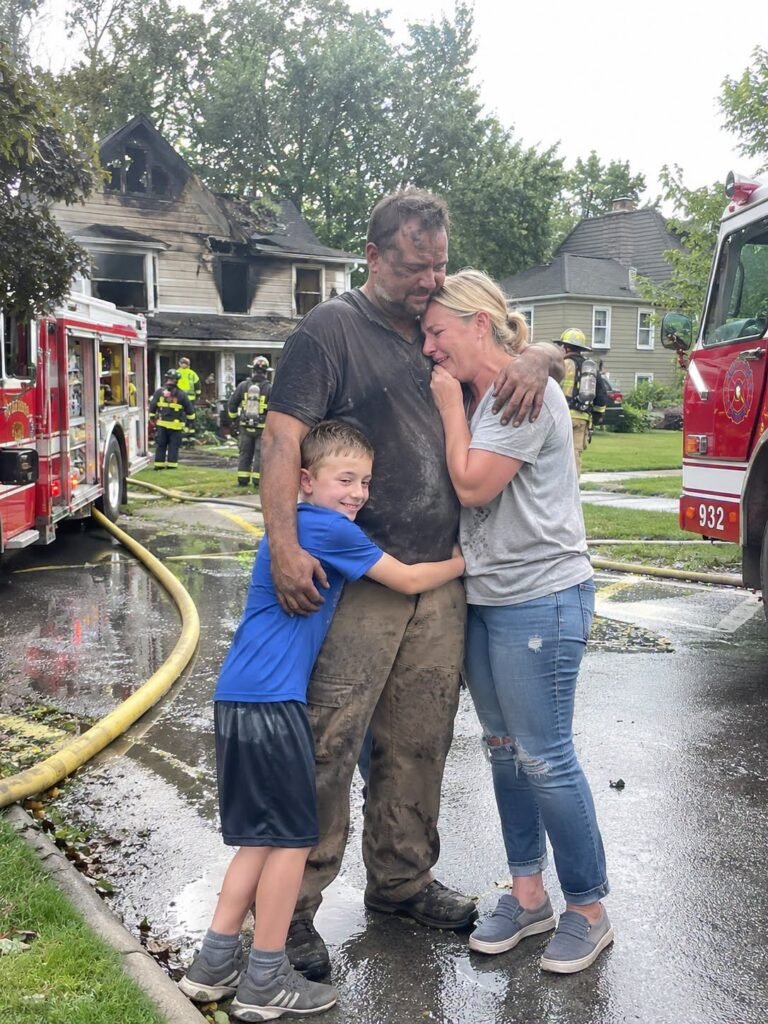
We came out the front door into the sunlight at the exact moment the first fire truck from the Elizabeth Fire Department came screaming around the corner from Broad Street.
People rushed forward. Hands everywhere. Somebody took the little boy. Somebody else took the woman’s legs. They laid her down on the sidewalk beside the old man.
I sat down hard on the bottom step of the building. I pulled the towel off my face. I couldn’t stop coughing. I couldn’t see straight.
Part Eight: “I Don’t Know Your Name”
The little boy was in the woman’s arms again. She was sitting on the sidewalk in her long dress with her broken leg in its black boot stretched out in front of her, holding him so tight I thought she’d crush him.
She was crying. He was crying. They were both covered in black soot.
Then she looked up at me. Sitting on the step, coughing.
“Thank you,” she said. “Oh, God. Thank you. Thank you.”
She reached out and grabbed my hand.
“I don’t even know your name,” she said.
I smiled at her. I don’t know why. It was the only thing I could think of to do.
“You don’t need to,” I said.
Then the firefighters were all around us, and the paramedics. An EMT put an oxygen mask over my face and told me to breathe slow. Another one looked at my knee and said I needed to go to the hospital. I said no. I said I was fine. I said I had to get back to work.
They put the woman and the little boy and the old man in an ambulance. I watched it pull away down Elizabeth Avenue toward Trinitas Hospital.
I never found out their names. Not that day.
Part Nine: The Apron
I walked back across Elizabeth Avenue at two-fifteen. Limping. My left knee was swelling. My shirt was black with soot. My hands were burned in a few places, red and blistered, from the stair railing. My throat felt like I’d swallowed sand.
I pushed open the door of the Harbor Grill.
The lunch rush was over. Half the tables were empty. The lawyers at table nine were gone. Somebody had cleaned up the crab cake sandwich and the Caesar salad.
Greg was standing behind the bar.
On the counter in front of him was my apron. Black, with HARBOR GRILL stitched on the pocket in white. Folded neatly into a square.
He looked at me. At my shirt. At my hands. At my knee.
He didn’t ask if I was okay.
“You’re fired,” he said.
I stared at him.
“Greg,” I said. My voice came out as a rasp. “I just got three people out of that building. An old man. A woman with a broken leg. A five-year-old kid. They’d have died.”
“And I lost three tables,” Greg said. “Because you decided to play hero. Two parties walked out when you dropped those plates. The lawyers at table nine left without paying. I had to comp a whole section.” He tapped the folded apron. “Do you have any idea how much money I lost this afternoon?”
“Greg,” I said. “Please. My wife is pregnant. Seven months. We’ve got a baby coming in June. I need this job.”
He looked at me for a long moment.
Then he laughed. A short, cold laugh.
“Should’ve thought about that,” he said, “before you walked out the door.”
He turned his back on me and started counting the register.
I stood there for a moment. Then I picked up my apron off the counter.
I don’t know why. It wasn’t mine anymore. But I picked it up and carried it out the door and limped down Elizabeth Avenue toward the bus stop.
Part Ten: Emily
I got home at four o’clock. Kevin was napping. Emily was on the couch with her feet up, the way the doctor told her, reading a book about baby names.
She saw me in the doorway. My black shirt. My burned hands. My limp.
She got up so fast she almost fell.
“Tony,” she said. “Oh my God. What happened?”
I told her everything.
The fire. The old man on the stairs. The woman in the bathtub with the broken leg and the little boy. Carrying them down. Slipping on the landing.
Greg. The folded apron. You’re fired.
Do you have any idea how much money I lost?
I waited for her to yell. I’d have understood if she did. We had fourteen hundred dollars due on the first of May. We had a baby coming in eight weeks. We had a little boy whose shoes didn’t fit.
And I’d just walked away from the only job we had.
Emily didn’t yell.
She put her arms around me. She pulled my face down against her shoulder, against the soft cotton of her maternity shirt, with our daughter between us. She held me.
“We’ll figure it out,” she whispered. “We always do.”
Then she pulled back and looked at me. Her eyes were wet.
“Tony,” she said. “If Kevin had been in that building. If it had been our son in that bathtub.” She put her hand on my soot-black cheek. “You’d want somebody to run in. Wouldn’t you?”
“Yes,” I said.
“Then you did the right thing,” Emily said. “And we’ll figure out the rest.”
Part Eleven: The Night
She cleaned my burns at the kitchen table with antibiotic ointment and gauze from the first aid kit. She wrapped my knee in an Ace bandage and made me put ice on it. She made me drink about a gallon of water.
Kevin woke up from his nap and came into the kitchen and stared at me.
“Daddy,” he said. “Why are you dirty?”
“I helped some people,” I said. “There was a fire.”
Kevin thought about that very seriously.
“Like a fireman?” he asked.
“Kind of,” I said.
He climbed into my lap. He looked at my bandaged hands.
“Did it hurt?” he asked.
“A little,” I said.
“Was the kid okay?” he asked. “The one in the fire?”
“He was okay,” I said.
Kevin nodded, satisfied. Then he leaned against my chest and put his thumb in his mouth, which he hadn’t done in a year.
That night, I lay in bed beside Emily and stared at the ceiling.
Fourteen hundred dollars on the first of the month. Eleven days away. We had about six hundred in checking. Maybe two hundred in savings. A baby coming in June. Emily’s hospital bills. Kevin’s shoes.
I couldn’t stop doing the math. Over and over. Adding it up. Coming up short.
I didn’t sleep. Not really.
Around four in the morning, I finally drifted off.
Part Twelve: “Get Up”
At seven-fifteen, Emily shook me awake.
Hard. With both hands.
“Tony,” she said. “Tony. Get up.”
I sat up fast. My knee screamed. “What? Is it the baby? Are you okay?”
She was crying. But she was smiling too. Both at the same time. She had one hand pressed over her mouth.
“What happened?” I said.
She pointed toward our bedroom window. The one that looks out on Spring Street.
“Honey,” she said, through her fingers. “You are not going to believe what’s outside.”
Part Thirteen: Spring Street
I got up. I limped to the window. I pulled back the curtain.
And I stood there in my T-shirt and boxers, staring down at the street.
There were people.
On the sidewalk in front of our house. On the steps. In the little patch of front yard where our landlord grows tomatoes in the summer. Up and down Spring Street, on both sides.
Dozens of them. Maybe fifty. Maybe more.
And parked at the curb, right in front of our house, with its lights off, was a big red fire engine. ELIZABETH FIRE DEPARTMENT — ENGINE 4 painted on the side in gold letters.
Firefighters were standing beside it in their navy T-shirts. Six of them.
And on the front steps of our house, the three-family house on Spring Street with the fourteen-hundred-dollar rent, there were things.
Bags. Boxes. A stack of grocery bags from ShopRite, maybe ten of them, overflowing with food. A car seat, still in its box. A baby stroller, still in its box. A pile of diapers so big it was taller than Kevin.
And on the top step, by itself, a small white shoebox with a red bow on it.
I couldn’t move.
Emily came up beside me at the window. She put her arm around my waist.
“They started coming at six,” she said. “I heard voices. I looked out. There were three people. Then ten. Then the fire truck.” She wiped her eyes. “Then a woman came up and knocked on the door. She asked if Tony Russo lived here.”
“Who?” I said.
“She’s still down there,” Emily said. “She’s been waiting. On the sidewalk. With her little boy. She said she wanted to wait until you woke up.”
She pointed.
On the sidewalk in front of our house, sitting on a folding chair somebody had brought, with her left leg stretched out in a black plastic boot, was the woman from the bathtub.
Her son was sitting in her lap.
She was looking up at our window.
Part Fourteen: Nadia
I went downstairs in a pair of sweatpants and a T-shirt and bare feet. My knee was wrapped. My hands were wrapped. I must have looked terrible.
When I opened the front door, the whole street went quiet.
Then somebody started clapping. A firefighter, I think. Then somebody else. Then the whole street.
I stood on my front steps, beside the pile of diapers and the stroller in its box and the shoebox with the red bow, with fifty strangers clapping for me, and I didn’t know what to do with my hands.
The woman with the broken leg was trying to get up out of her folding chair. A firefighter helped her. She came up the front walk on crutches, slowly, with her son walking beside her holding on to her dress.
She stopped at the bottom of my steps.
She was cleaner than yesterday. No soot. She had dark hair pulled back in a scarf, and dark eyes, and a little gold cross on a chain around her neck.
“You told me I didn’t need to know your name,” she said. “But I found out anyway.”
She smiled.
“My name is Nadia Haddad,” she said. “This is my son, Sami. He’s five.” She put her hand on his head. “You saved our lives.”
Part Fifteen: How They Found Me
They’d found me because of the video.
A teenager on the sidewalk across from the apartment building had filmed the whole thing on his phone. Me running out of the Harbor Grill. Soaking the towel at the bodega. Going in. Coming out with the old man. Going back in. And then, two minutes later, coming out the front door through the smoke, carrying Nadia with Sami in her arms, just as the fire engine came around the corner.
He’d posted it. By eight o’clock that night, it had a hundred thousand views. By midnight, a million.
Somebody recognized my face. A woman who ate lunch at the Harbor Grill every Tuesday. She commented: That’s Tony! He’s my waiter at the Harbor Grill on Elizabeth Ave! He always remembers I don’t want ice in my water.
Then somebody else commented: I was in the Harbor Grill when he ran out. The manager screamed at him that he’d be fired if he left.
And then a busboy named Luis commented, at eleven-thirty at night: He was fired. When he came back. Covered in soot. I saw it. The manager said he lost too much money.
By morning, the whole city of Elizabeth knew.
Part Sixteen: Mr. Price
The old man was there too. From the second-floor landing.
His name was Eugene Price. He was eighty-four. A retired machinist from the Singer sewing machine factory in Elizabeth, where he’d worked for thirty-eight years until it closed in 1982. A Korean War veteran. He’d lived in apartment 2B in that building for fifty-one years.
His granddaughter had driven him over from the hospital, where they’d kept him overnight for smoke inhalation. He was sitting in a wheelchair on the sidewalk in a VFW cap and an oxygen tube under his nose.
When I came down the steps, he held out his hand. The same strong grip from the landing.
“Son,” he said. “I was on that landing ten minutes before you came. Ten minutes. Nobody else came in.” He shook his head. “I was sitting there thinking, Well, Eugene, this is how it ends. Eighty-four years. On a staircase.”
He squeezed my hand.
“Then this skinny kid in a waiter’s shirt with a wet dish towel on his face came up the stairs,” he said. “I thought you were an angel. A very short angel.”
Everybody laughed.
Part Seventeen: The Firefighters
A big man in a navy T-shirt came up the walk. Fifties, gray crew cut, a barrel chest. His T-shirt said ELIZABETH FIRE DEPARTMENT — CAPTAIN on the front.
He held out his hand.
“Captain Frank Delvecchio,” he said. “Engine 4. We were the first truck there yesterday. You came out the door with Ms. Haddad and her son right as we pulled up.”
“I remember,” I said.
“I want to tell you something,” Captain Delvecchio said. “And I want you to hear it right.”
He looked at me for a long moment.
“What you did was dangerous,” he said. “Stupid, honestly. You didn’t have gear. You didn’t have air. You went into a building with an active fire on the third floor with a wet dish towel on your face. Twice.” He shook his head. “I’ve been doing this twenty-six years. I’ve pulled guys out of buildings who did exactly what you did. Some of them didn’t make it.”
I didn’t say anything.
“Fire investigators were in there this morning,” he said. “The kitchen in 3C. A grease fire that got into the walls. By the time we got the hose on it, the back half of that apartment was fully involved.” He paused. “The bathroom where you found Ms. Haddad and her son? It flashed over about four minutes after you got them out.”
He let that sink in.
“Four minutes,” he said. “That’s what you gave them.”
Part Eighteen: The Offer
Then Captain Delvecchio reached into his back pocket. He took out a folded piece of paper.
“The Elizabeth Fire Department is hiring,” he said. “Firefighter recruits. The application window closes in two weeks. The civil service exam is in June.” He held out the paper. “Recruits are paid during the academy. Sixteen weeks. Starting salary’s fifty-four thousand. With full benefits. Health insurance for your wife and kids. A pension.”
I stared at the paper.
“I can’t make you any promises,” Captain Delvecchio said. “You’ve got to pass the written exam. The physical. The background check. The academy’s hard. Harder than you think.” He looked at my wrapped knee. “And you’d have to get that knee looked at.”
He put the paper in my hand.
“But I’ll write you a letter of recommendation,” he said. “Personally. And so will every guy on Engine 4.”
Behind him, the five other firefighters nodded.
One of them, a young guy with a buzz cut, called out, “We already voted, Captain. Unanimous.”
Part Nineteen: The Shoebox
Then Sami came up the steps.
He’s five. Small for his age, with big dark eyes and curly hair and a gap where his front tooth had just come out. He was holding the white shoebox with the red bow. The one from the top step.
He held it up to me with both hands.
“This is for your little boy,” he said. “My mom said he needed shoes.”
I looked at Nadia. She was standing at the bottom of the steps on her crutches, wiping her eyes.
“Your wife told me,” she said. “This morning. When I knocked on the door. I asked if there was anything you needed. She said everything was fine.” Nadia smiled. “Then she said, Well, Kevin needs new sneakers. But that’s nothing.”
I opened the shoebox.
Inside was a pair of little blue sneakers. Size 11 toddler. With a dinosaur on the side.
The kind that light up when you stomp.
That’s when I broke.
I sat down on my own front steps, in my sweatpants and my bandages, beside the pile of diapers taller than my son, and I put my face in my hands and cried. In front of fifty strangers and six firefighters and an old man in a VFW cap and a five-year-old boy holding a shoebox.
I cried for a long time.
Nobody said anything. Nadia came up the steps on her crutches and sat down beside me. Sami climbed into my lap. Emily came out the front door and sat down on my other side and put her arms around me.
Upstairs, I heard Kevin’s footsteps. He’d woken up. He came to the front door in his pajamas, rubbing his eyes, and looked out at all the people.
“Daddy,” he said. “Why is there a fire truck?”
Part Twenty: The Others
The rest of the morning was a blur.
People kept coming up the steps. Shaking my hand. Hugging Emily. Leaving things.
A woman from the ShopRite on Elmora Avenue, the store manager, had brought the groceries. She said her staff had taken up a collection overnight. Ten bags. Enough food for a month.
A man from the Baby Depot in Union had brought the stroller and the car seat. He’d seen the video at midnight. He said his own daughter was born at Trinitas Hospital six years ago, and he’d been sitting in the waiting room when a firefighter brought in a little girl from a house fire on Morris Avenue. She hadn’t made it. He said he’d thought about that girl every day since.
The diapers came from a church. St. Mary of the Assumption, on Washington Avenue. The parish women’s group had driven to Costco at six in the morning.
And at eight-thirty, a black Lexus pulled up behind the fire engine.
A woman got out. Sixties, elegant, silver-haired, in a camel coat. She walked up the front walk.
I didn’t recognize her. Emily did.
“Tony,” Emily whispered. “That’s Mrs. Castellano.”
Part Twenty-One: Mrs. Castellano
Rosemary Castellano owns the Harbor Grill. She’s owned it for thirty-four years. She and her late husband, Sal, opened it in 1990, when Elizabeth Avenue was mostly boarded-up storefronts. Sal ran the kitchen. Rosemary ran the dining room. When Sal died in 2019, Rosemary kept it going. She lives in Westfield now. She comes in on Sunday nights and sits at the corner table by the window and has the veal.
She hired Greg Harmon two years ago to run the place day to day. I’d met her maybe a dozen times.
She stopped at the bottom of my front steps. She looked at me sitting there, with Sami in my lap and Emily beside me. At my bandages. At the fire engine.
“Tony,” she said. “I owe you an apology.”
“I didn’t know,” she said. “Until this morning. My granddaughter showed me the video at six a.m. On her phone. In my kitchen.” Her voice was shaking. “I watched you run out of my restaurant. And I watched you carry that woman out of that building. And then I read the comments. About what Greg did when you came back.”
She closed her eyes.
“Sal would be ashamed,” she said. “Of me. For hiring a man like that to run the place he built.”
Part Twenty-Two: Back Pay
She held out an envelope.
“Your pay,” she said. “For yesterday. The whole double shift. And your tips, which Luis says were about ninety dollars before you left.” She paused. “And two weeks of severance. And something extra. From me. Not from the restaurant.”
I didn’t take it.
“Mrs. Castellano,” I said. “You don’t have to…”
“Yes, I do,” she said. “Take it.”
I took it.
“Greg Harmon,” Rosemary Castellano said, “doesn’t work at the Harbor Grill anymore. As of seven o’clock this morning.”
I stared at her.
“And Tony,” she said. “If you want your job back, it’s yours. Not as a waiter.” She looked at me. “As the dining room manager. Greg’s job.”
I didn’t know what to say.
Behind her, Captain Delvecchio was standing by the fire engine, with his arms folded, watching. I still had the folded paper in my hand. The fire department application.
I looked at Rosemary Castellano. Then at Captain Delvecchio. Then at Emily.
Emily was smiling at me. The same way she smiled the night before, when I came home covered in soot. You did the right thing.
“Can I think about it?” I asked.
“Take all the time you need,” Rosemary said.
Part Twenty-Three: Greg
Greg Harmon came to my house three days later.
On a Friday evening. Alone. I almost didn’t open the door. Emily saw him through the window and told me who it was.
He stood on my front steps in a windbreaker and jeans, with his hands in his pockets. He looked smaller than he did behind the bar at the Harbor Grill. Older. Tired.
“Tony,” he said. “Can I talk to you? Just for a minute?”
I didn’t invite him in. I stepped out onto the porch and closed the door behind me.
“Mrs. Castellano fired me,” he said. “Tuesday morning. She called me into her car in the parking lot. She didn’t even come inside.”
I didn’t say anything.
“I deserved it,” Greg said. “I’m not here to argue about that.”
He looked at the street. At the place where the fire engine had parked.
“I want to tell you something,” he said. “And then I’ll go.”
“I owned a restaurant,” Greg said. “In Union. Harmon’s. For fourteen years. A steakhouse. I put everything into it. My savings. My wife’s savings. My kids’ college money.” He swallowed. “And in 2020, the pandemic shut us down. For five months. And when we reopened, nobody came back. We closed in 2021. I lost everything. My wife left in 2022.”
He looked at the ground.
“When Mrs. Castellano hired me,” he said, “I promised myself it would never happen again. Never. I’d watch every penny. Every cover. Every comp. Every table.” He shook his head. “I counted money in my sleep, Tony. I still do.”
“When you dropped those plates,” Greg said, “all I could see was money walking out the door. Table nine. The two parties by the hostess stand. The comps.” He laughed bitterly. “I didn’t even look out the window. I didn’t even look at the fire. I was looking at the register.”
He looked up at me.
“I saw the video,” he said. “Like everybody. Wednesday morning. I watched you come out with that little boy.” His eyes were wet. “And I thought about my own kids. They’re eleven and fourteen. They live with their mother in Cranford.”
He was quiet for a long time.
“I fired a man for saving a child’s life,” Greg said. “Because of three tables. I don’t even know what kind of person does that.”
I looked at him for a long time.
“A scared one,” I said finally.
Greg stared at me.
“I’m scared too, Greg,” I said. “All the time. About money. About rent. About the baby. I counted it all night on Tuesday. Over and over.” I looked at him. “But when I saw that smoke, I wasn’t scared of being fired. I was scared of somebody’s kid being in there.”
Greg nodded slowly.
“I’m sorry, Tony,” he said. “That’s all. I’m sorry.”
He walked down the steps and down Spring Street. I never saw him again.
Part Twenty-Four: The Choice
I thought about it for a week. The manager job at the Harbor Grill. And the paper from Captain Delvecchio.
The manager job was safe. Steady. Forty-eight thousand a year, Mrs. Castellano said. I’d be home most nights. I knew the restaurant. I knew the staff. I knew the regulars and which ones didn’t want ice in their water.
The fire department was hard. A written exam. A physical test where you drag a hundred-and-sixty-pound dummy and climb a ladder with a hose and carry a chainsaw up stairs. Sixteen weeks of academy. Twenty-four-hour shifts. Danger.
I talked to Emily about it every night that week. At the kitchen table, after Kevin was asleep.
“What do you want?” she asked me, on the sixth night.
I thought about it for a long time.
“When I went into that building,” I said slowly, “and I was crawling down that hallway on the third floor, with the smoke and the heat and the fire roaring in the kitchen. I was terrified.” I looked at her. “But I also felt like I was exactly where I was supposed to be. For the first time in my life. Like I’d been carrying plates for three years waiting to find out what my hands were for.”
Emily reached across the table and took my bandaged hand.
“Then you know,” she said.
“But the baby,” I said. “And Kevin. What if something happens to me?”
“Something could happen to you crossing Elizabeth Avenue,” Emily said. “Something could happen to you carrying plates.” She squeezed my hand. “Tony, I married a man who drops everything and runs toward people who need help. I knew that when I married you. I didn’t fall in love with a waiter. I fell in love with that.”
Part Twenty-Five: Mrs. Castellano Again
I went to see Mrs. Castellano at the Harbor Grill on Sunday night. She was at her corner table by the window, with her veal.
I told her I was turning down the manager job. I told her why.
She put down her fork. She looked at me for a long time.
“Sal,” she said, “wanted to be a firefighter. Did you know that? When he was young. He took the exam for the Newark Fire Department in 1972.” She smiled. “He failed the physical. Flat feet. So he became a cook instead.” She shook her head. “He used to say every chef is a frustrated fireman. You stand next to fire all day, and you’re never allowed to put it out.”
She picked her fork back up.
“Go,” she said. “Be what Sal couldn’t. And Tony,” she said, as I stood up. “Until the academy starts, I want you back here. On the floor. Waiting tables. Same section. At double what Greg was paying you.” She looked at me. “A man studying for a fire exam needs to eat.”
Part Twenty-Six: The Exam
I took the New Jersey civil service exam for firefighters on a Saturday in June, at a high school in Newark, with four hundred other people.
I’d studied every night for six weeks. Captain Delvecchio had given me his old study guides. The guys on Engine 4 quizzed me at the firehouse on Tuesday afternoons. Eugene Price, the old man from the stairs, called me twice a week from his granddaughter’s house in Linden to ask how studying was going.
I passed. Ninety-one.
The physical was in July. The candidate physical ability test. Eight events, timed. Stair climb with a forty-pound vest and a hose. Hose drag. Equipment carry. Ladder raise. Forcible entry. Search through a dark maze on your hands and knees. Rescue drag, with a hundred-and-sixty-five-pound dummy. Ceiling breach and pull.
My knee had healed by then. A torn meniscus, the orthopedist said. Physical therapy for eight weeks. I’d done every exercise twice.
I passed. Barely. On the rescue drag, I thought my lungs were going to explode.
When I crossed the finish line, I looked up, and the whole crew of Engine 4 was standing behind the fence. In their navy T-shirts. Cheering.
Part Twenty-Seven: Joy
Our daughter was born on June 19th, at Trinitas Regional Medical Center. Six pounds, eleven ounces. A full head of black hair, like Emily’s. A tiny, furious face.
Emily had a hard labor. Nineteen hours. Her blood pressure spiked twice. But she came through it, and so did our girl.
We named her Joy. Joy Nadia Russo.
Nadia came to the hospital the next day. On crutches still. With Sami, carrying a stuffed fire truck almost as big as he was.
She stood beside the bassinet and looked down at our daughter for a long time.
“Nadia,” she read, from the little card on the bassinet. Joy Nadia Russo. She looked up at Emily. Then at me.
“You named her after me?” she whispered.
“After the woman who soaked towels and got in a bathtub to save her son,” Emily said. “So our daughter would know what a brave mother looks like.”
Nadia put her hand over her mouth. She sat down in the chair beside the bed and cried.
Sami put the fire truck in the bassinet beside Joy.
“So she has one,” he said. “Like her daddy.”
Part Twenty-Eight: The Academy
I started at the Elizabeth Fire Department training academy on September 3rd.
Sixteen weeks. Monday through Friday, seven a.m. to five p.m. Classroom and drills. Fire behavior. Building construction. Hazardous materials. Emergency medicine. Search and rescue. Ladder work. Hose work. Self-contained breathing apparatus. Live burns in a concrete training tower in a parking lot in Linden.
It was the hardest thing I’ve ever done. Harder than double shifts. Harder than carrying Nadia and Sami down those stairs.
Some nights I came home so tired I fell asleep at the dinner table with my fork in my hand. Kevin thought that was hilarious.
In week eleven, we did our first live-fire search-and-rescue drill. In the burn tower. Full gear. Full air. Real fire. Real smoke.
I crawled through the black on my hands and knees, feeling along the wall with my glove, counting doors. Just like 3C. Just like that day.
I found the dummy in a bathroom on the third floor. In a bathtub. Somebody on the training staff has a sense of humor. Or maybe Captain Delvecchio told them.
I carried it out.
Part Twenty-Nine: Graduation
I graduated from the academy on December 19th. In the auditorium at Elizabeth High School. Thirty-one recruits in dress blues.
Emily was there, with Joy in a carrier on her chest, six months old, sleeping through the whole thing. Kevin was there, five years old now, in a little clip-on tie, wearing his blue dinosaur sneakers. They didn’t fit anymore. He’d outgrown them in October. He wore them anyway. He wears them to everything important.
Nadia was there, walking without crutches now, with Sami. Eugene Price was there, in his wheelchair and his VFW cap, with his granddaughter. Rosemary Castellano was there, in her camel coat.
And Luis, the busboy, who posted the comment at eleven-thirty at night. He was fired. I saw it.
And the whole crew of Engine 4. In the front row. In their dress uniforms.
When they called my name, Firefighter Anthony Russo, I walked across the stage, and the fire chief pinned my badge on my chest.
Then Captain Delvecchio came up on stage. That’s not usually how it works. He’d asked special permission.
He held out a helmet. Black, with a leather front shield. And on the shield, in gold letters:
ENGINE 4.
“We asked for you,” he said. “The whole crew. We put in a request. You’re ours.”
Part Thirty: First Call
My first real fire was on a Tuesday in February. Two months after graduation.
A kitchen fire in a two-family house on Westfield Avenue. An elderly couple. The husband got out. The wife was on the second floor in a back bedroom, with a bad hip, and couldn’t do the stairs.
I went up with Captain Delvecchio. Full gear. Full air. A charged hose line behind us.
We found her in the bedroom. She’d closed the door and put a wet towel under it. Smart. Just like Nadia.
I carried her down.
When we got outside, I laid her down on the stretcher with the paramedics. She grabbed my glove. She was crying.
“Thank you,” she said. “Oh, thank you. I don’t even know your name.”
I took off my helmet.
I thought about saying You don’t need to. Like I told Nadia, on the sidewalk on Elizabeth Avenue.
But I didn’t.
“It’s Tony,” I said. “Tony Russo. Engine 4.”
She squeezed my hand.
“Tony,” she said. “I’ll remember.”
When I got home that night, after a twenty-four-hour shift, Kevin was waiting for me at the front door in his pajamas.
“Daddy,” he said. “Did you help somebody today?”
“I did,” I said.
“Like a fireman?” he asked.
I knelt down on our front steps. The same steps where, ten months earlier, a stranger had left a shoebox with a red bow.
“Exactly like a fireman,” I said.
Kevin threw his arms around my neck. Then he stomped his feet, and his blue dinosaur sneakers, two sizes too small, lit up red and green on the dark porch.