I caught her at a quarter past nine.
Aunt Verlene. At the back of her Tahoe, out in the gravel lot behind the Shiloh Community Center, where the string lights ran out and the dark started.
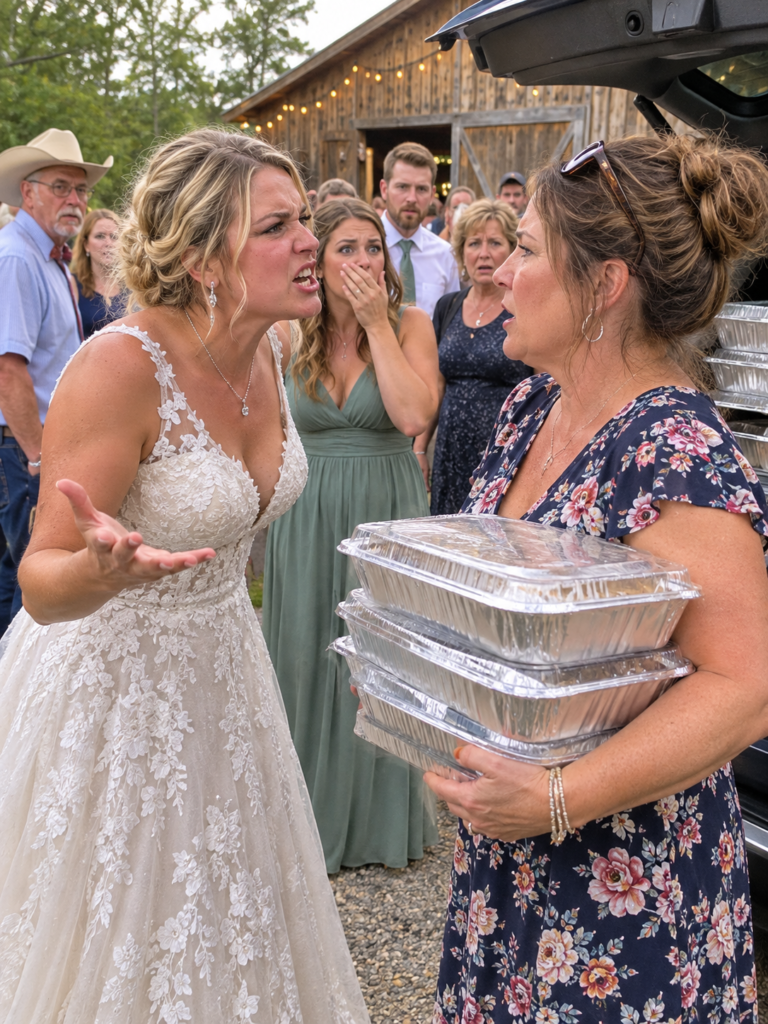
She had a full pan of brisket balanced on both hands.
Holding it close against her chest. Like she was carrying a sleeping baby out to the car.
The hatch was already half loaded.
Foil pans stacked up in the shadows. Two trays of green beans. The ham. The big hotel pan of pulled pork. A plastic tub of coleslaw with the lid taped down.
“Verlene,” I said.
She didn’t jump.
That’s the thing I keep coming back to. She didn’t jump. A person doing something right jumps when you catch them. Out of surprise. You come up behind somebody watering your flowers and they’ll startle and laugh and say, “Lord, you scared me.”
Verlene didn’t jump.
She just turned around. Slow. With the brisket still in her arms.
“I’m getting this out of the heat, honey,” she said. “Before it spoils.”
It was June. It was hot. That part was true.
But the food wasn’t in the heat. It had been sitting inside, in the air conditioning, on the long folding tables along the back wall of the hall, under the paper banner my cousin Shawna painted that said JOSIE & REED in big blue letters.
And it wasn’t spoiling.
It was barely nine o’clock. The reception was supposed to go till eleven. Half the guests were still on the dance floor. The other half were still going back for seconds.
Or they would have been. If the food had still been there.
My mother is a lunch lady.
She’s worked in the cafeteria at Calloway County Middle School for twenty-six years. She’s the one who stands behind the steam table in a hairnet and knows every single kid’s name, and which ones get free lunch, and which ones are going to try to sneak a second chocolate milk, and which ones haven’t eaten since Friday because the weekend is a long time when there’s nothing in the cabinets at home.
She planned my whole wedding supper on a legal pad.
A yellow one. She kept it on the kitchen counter for four months. I’d come over and she’d be sitting at the table in her reading glasses with a calculator, scratching things out and writing things in.
Brisket — 3 (smoke Thurs)
Ham — 2 (Hollis’s mama’s glaze)
Pulled pork — 1 hotel pan
Green beans — 4 #10 cans + bacon
Potato salad — Sister Ruth
Coleslaw — Wanda
Rolls — 400 (ME)
She circled ME three times.
There was no caterer. There was no money for a caterer.
Daddy drives a truck for the county road department. Mama’s a lunch lady. I’m a dental hygienist, two years out of school, still paying on my loans. Reed works at the John Deere dealership in Mayfield, in the parts department.
A caterer wanted four thousand dollars to feed a hundred and fifty people. That was more than the whole wedding.
So Mama said, “We’ll do it ourselves.”
And she did.
She cooked for three days in the kitchen at Shiloh Baptist.
Her sisters helped. Aunt Ruth made potato salad in a bowl the size of a kiddie pool. Aunt Wanda made coleslaw with her secret dressing that has a little bit of pickle juice in it. Half the Homemakers Club showed up Thursday night with their own aprons and their own knives.
Daddy borrowed a smoker from a man at church. He and Mama sat up all Thursday night tending the brisket in the church parking lot. Three of them. Twelve hours. Mama got up every two hours and checked the temperature with a meat thermometer she’d bought special for it.
Two hams. With Daddy’s mama’s brown sugar and mustard glaze, which nobody in the family is allowed to write down.
And four hundred rolls.
The rolls were the thing.
Mama’s rolls are famous in Calloway County. Not famous like on TV. Famous like people ask about them at funerals. Famous like the principal at the middle school comes down to the cafeteria on roll days and stands in line with the sixth graders.
They’re yeast rolls. Soft and tall and a little bit sweet, brushed with butter on top. She makes them from her grandmother’s recipe, by hand, in a big crockery bowl that’s older than my daddy.
She made four hundred of them.
By hand.
I came by the church kitchen on Friday afternoon and she was standing at the counter punching down dough. Both fists. Her glasses all fogged up from the steam coming off the proofing oven. Flour on her cheek. Flour in her hair. Flour all down the front of her apron, the blue one that says WORLD’S OKAYEST COOK that I gave her for Mother’s Day when I was fifteen.
“Mama,” I said. “You could’ve bought rolls. Nobody would have cared.”
She stopped punching. She looked at me over her foggy glasses.
“They’ll taste the difference,” she said.
And she went back to punching.
That was the food in the back of that Tahoe.
Not leftovers. Not scraps. Not what was left after everybody had eaten.
The whole supper.
I stood there in the gravel and counted. Six pans in the dark. Maybe seven. The two hams. Two of the three briskets. The pulled pork. The green beans. The coleslaw.
And Verlene was reaching for the rolls next.
There were three big aluminum trays of them sitting on her open tailgate. Covered in dish towels. Waiting their turn.
My mama’s rolls.
“The band’s still here,” I said.
Verlene set the brisket pan down carefully in the back of the Tahoe. She pushed it in next to the ham.
“The busboys haven’t eaten,” I said. “Nobody’s eaten. Verlene, it’s only nine o’clock.”
“They’ll be fine,” she said. “They get paid.”
She said it like the weather.
Not mean. Not angry. Not even defensive.
Just settled. Like she was telling me it was going to be hot tomorrow.
She reached for the first tray of rolls.
I looked back at the hall.
The double doors were propped open with folding chairs to let some air in. I could see straight through them, across the gravel and the little strip of grass, into the light and the music.
The band was playing a slow one. “Tennessee Waltz.”
And there was my mother.
On the dance floor. In the blue dress she’d bought at Belk, on sale, and hemmed herself. With her head on my daddy’s shoulder.
Swaying. Eyes shut.
Daddy had his big hand flat on her back. He was looking down at the top of her head like he couldn’t believe she was his.
She’d cooked for three days.
She’d been up since four that morning.
And she was dancing. And she didn’t know.
She didn’t know yet.
I wasn’t going to put that on her face.
Not tonight. Not on the one night in my whole life she’d planned for since I was born.
I wasn’t going to go back in there and say, “Mama, Reed’s aunt is stealing your food.” I wasn’t going to watch her eyes open. I wasn’t going to watch her lift her head off Daddy’s shoulder and look out toward the parking lot and see.
And I wasn’t going to make a scene.
You don’t call the law to a wedding. You don’t go get your daddy and let him walk out there and say what he’d say. You don’t stand in a gravel lot screaming at a sixty-eight-year-old woman in her church dress.
Because Verlene was family now.
As of four o’clock that afternoon, when Brother Tim said “man and wife.”
She’d be sitting at my Thanksgiving table for the next forty years. She’d be at my children’s birthday parties. She’d hold my babies. She’d be at my funeral, or I’d be at hers.
So I didn’t go get my father.
I didn’t make a scene.
I reached past her into that truck.
I took hold of the pan of brisket she’d just set down.
I lifted it out.
It was heavy. Warm through the foil. I put it in my own two arms, the way she’d been holding it. Against my chest. Against my wedding dress.
“What are you doing?” Verlene said.
“Feeding the band,” I said.
The band was called Sonny and the Switchgrass.
Four men and a girl on the upright bass. Bluegrass and old country, mostly. A little gospel. Sonny Burkhart played banjo and sang lead. He was sixty, maybe, with a white beard and a voice like gravel in a coffee can.
We’d found them at the county fair the summer before. Reed and I had been walking past the bandstand eating funnel cake, and they were playing “Wildwood Flower,” and Reed stopped walking and stood there with powdered sugar all over his shirt and listened to the whole thing.
“That’s our band,” he said.
“For what?”
“For when we get married.”
He hadn’t asked me yet. He asked me three weeks later. But he already knew.
They weren’t cheap. Six hundred dollars. Which was a lot for us. Reed’s daddy paid half.
The fiddle player, a skinny kid named Wade with a mustache he was trying too hard with, had driven two hours from over past Clarksville to be there.
They’d started at six o’clock sharp.
They’d played through the whole supper. Through the toasts. Through the first dance and the father-daughter dance and the mother-son dance. Through the Cotton-Eyed Joe, twice, because my Uncle Larry requested it again and slipped Sonny a twenty.
Three hours.
Not one of them had put down an instrument to eat.
I’d noticed. Around eight. I’d looked over at the stage in the middle of a song and seen the bass girl licking her lips. And I’d thought, I need to make sure they get a plate. As soon as they take a break.
And then I’d gotten pulled into a picture. And then somebody’s baby needed holding. And then Reed’s grandmother wanted to dance.
And then it was nine o’clock and I’d gone looking for the food.
They were on a break when I came across the gravel. Sitting on the tailgate of Sonny’s old Ford pickup at the edge of the lot, under the last string of lights. Drinking water out of plastic bottles. Wade was smoking a cigarette and trying not to let Sonny see.
I carried that pan of brisket across the gravel in my stocking feet.
I’d taken my shoes off at seven-thirty. They were white satin pumps from Payless, half a size too small, and by the cake cutting I couldn’t feel my toes. I’d left them under the head table.
The gravel hurt. I didn’t care.
I set the brisket down on their tailgate.
I peeled the foil back.
The smell came up into the June night.
Smoke. Brown sugar. Black pepper. That deep dark bark on the outside that takes twelve hours to get and that my mama checked every two hours all Thursday night in a church parking lot.
Smoke and brown sugar and my mother’s hands.
Five grown musicians went quiet.
Sonny set his water bottle down. Wade put out his cigarette on the tailgate.
“Y’all eaten?” I said.
The bass girl shook her head.
Her name was Tessa. She was maybe twenty-five. Blond braid. Freckles. She’d played that big upright bass for three hours straight in a dress and cowboy boots.
“We’re alright, ma’am,” she said. “We’ll grab something on the way home. There’s a Sonic in Murray.”
“The Sonic closes at ten,” I said.
She looked at me.
“I know,” she said. “We’ll make it.”
She said it the way people do when they’ve said it a hundred times. When they’ve played a hundred weddings and watched a hundred suppers go by and nobody ever thought to bring them a plate.
Then I heard boots on the gravel behind me.
Heavy ones. Slow.
I turned around.
My husband of six hours.
Reed stood at the edge of the string lights. In his gray suit with the jacket off and his tie loosened and his sleeves rolled up to the elbow. He’d come out looking for me. I could see it on his face. Where’d she go? Is she okay?
He looked at me. At the brisket on the tailgate.
Then he looked past me.
At the open Tahoe. At the stacked pans in the dark.
At his aunt.
I watched his jaw go tight.
It’s a thing he does. When something hurts him. His jaw goes tight and a little muscle jumps in his cheek and he goes very, very still.
He grew up in that family.
He knew.
I could see it on his face. Whatever this was, it wasn’t the first time. He wasn’t surprised. Not even a little. He looked at that Tahoe like he’d seen it a hundred times before.
Here it was, I thought.
Standing barefoot on the gravel in my wedding dress, with brisket grease on the front of it and my heart going so hard I could feel it in my throat.
Here it was. The thing you can’t know about somebody until it happens.
Either this was a man I could live with.
Or one I was going to have to carry.
Reed walked over to his aunt.
He didn’t look at me. He walked right past me and the band and the brisket, across the gravel, to the back of that Tahoe.
He stood next to Verlene.
He looked in the truck. At the hams. The pulled pork. The green beans. The coleslaw with the lid taped down.
At the three trays of rolls waiting on the tailgate, under their dish towels.
And he said one quiet thing to her.
“Not this time, Aunt Verlene.”
That was all.
He didn’t yell. He didn’t call her a thief. He didn’t say anything about stealing or shame or what kind of person does this.
Just four words. Very quiet. So quiet I almost didn’t hear them over the crickets.
Not this time.
Verlene looked up at him.
I watched her face. In the light from the hatch. And something happened in it that I didn’t understand. Not then.
It wasn’t anger.
It was like he’d slapped her. Like he’d reached across twenty years and pulled something out of the dark she thought was buried.
“Reed,” she said. Her voice cracked. “Honey. I was just—”
“I know what you were just,” Reed said.
“It’ll spoil. Out here in the heat. Somebody has to—”
“It’s not in the heat,” Reed said. “It was inside. On the table. Where people could eat it.”
He reached into the truck.
He took out the ham. The first one. With Daddy’s mama’s glaze.
He held it out to his aunt.
“Help me carry it back,” he said.
She didn’t take it.
She stood there with her hands at her sides.
Reed waited. He didn’t move. He just stood there holding that ham out, with the tight jaw and the jumping muscle in his cheek.
“After everything I’ve done for this family,” Verlene said finally. Very low.
“I know what you’ve done,” Reed said.
Verlene’s face went white.
Not pale. White. Like somebody had pulled a sheet over it.
She looked at him for a long, long moment.
Then she turned around and walked to the driver’s side door of her Tahoe.
She got in. She shut the door.
She sat there. With the engine off. With her hands on the wheel. Staring straight ahead through the windshield into the dark.
Reed didn’t go after her.
He set the ham back down on the tailgate. He reached in the truck and started unloading. Pan by pan. The other ham. The pulled pork. The green beans. The coleslaw.
He stacked them up on the tailgate of Verlene’s Tahoe. Then he turned around and looked at me.
“Where do you want them?” he said.
I didn’t say anything.
I couldn’t.
“Josie,” Reed said. “Where do you want them?”
I pointed at Sonny’s truck.
Reed picked up the ham and the pulled pork, one on top of the other, and carried them across the gravel. He set them down on the band’s tailgate next to the brisket.
He went back for the green beans and the coleslaw.
Then he went back one more time.
And he picked up the three trays of rolls.
He carried them across the parking lot like they were the most important thing in the world. Very careful. Like they might break.
He set them down on Sonny’s tailgate.
He pulled the dish towel off the top tray.
And there they were. A hundred and thirty-some rolls. Tall and golden, brushed with butter. Still a little bit warm.
My mama’s rolls.
Reed looked at the band.
“Y’all go ahead,” he said. “There’s plenty.”
Nobody moved for a second.
Then Sonny Burkhart reached over very slowly and took a roll off the top of the tray.
He held it up. He looked at it. He turned it around in his big rough banjo-player’s hand.
He took a bite.
He closed his eyes.
He chewed for a long time.
“Lord have mercy,” Sonny said quietly. With his eyes still shut. “Who made these?”
“My mama,” I said.
He opened his eyes.
“Your mama,” he said, “is a saint.”
I went back into the hall.
I found a stack of paper plates and a box of plastic forks under the punch table. I got the serving spoons out of the dish tub by the kitchen door.
I found the busboys.
There were two of them. High school boys from the church youth group, Marcus and Dylan. Sixteen and fifteen. Brother Tim had volunteered them. They’d been clearing tables and hauling trash bags and refilling the iced tea and sweeping up spilled punch since five o’clock.
They were standing in the kitchen doorway in their white button-down shirts, which weren’t white anymore. Marcus had barbecue sauce on his collar. Dylan had a tear in his sleeve where he’d caught it on a folding chair.
“Have y’all eaten?” I asked.
Marcus looked at Dylan.
“No, ma’am,” Marcus said. “Brother Tim said we could eat after.”
“After what?”
“After everybody else,” Dylan said. “When it’s over.”
I looked at the clock over the kitchen door.
Nine twenty-two.
“Come with me,” I said.
They followed me outside.
The band had pulled the plates off my stack and was already eating. Wade the fiddle player was on his second roll. Tessa was sitting on the tailgate with a plate of brisket balanced on her knees, eating with her fingers, licking barbecue sauce off her thumb.
“Help yourself,” I told the boys. “As much as you want.”
Marcus looked at the pans. At the brisket. At the ham. At the rolls.
His face did something. Something soft and young.
“For real?” he said.
“For real.”
Dylan filled up two plates. Two. He held one in each hand. Then he looked at me, embarrassed.
“One’s for my little brother,” he said. “He’s at home with my grandma. Is that okay?”
“Take three,” I said. “Take one for your grandma.”
He looked like he might cry.
Then other people started coming.
I don’t know how word got around. It just did.
The photographer came out. A woman named Lisa who’d been taking pictures since two o’clock. She’d brought a protein bar in her camera bag and eaten it in the bathroom at seven.
The two women from the Homemakers Club who’d been washing dishes in the kitchen all night came out. Mrs. Pruitt and Mrs. Dowdy. Seventy-something, both of them. Their hands red from the hot water.
“Josephine Hollis,” Mrs. Pruitt said. “Is that your mama’s brisket out here in the parking lot?”
“Yes, ma’am.”
“What’s it doing out here?”
I looked over at the Tahoe. At Verlene, still sitting in the driver’s seat with the engine off.
Mrs. Pruitt followed my eyes.
She didn’t say anything for a long moment.
“Hm,” she said.
Then she picked up a plate.
The man who’d rented us the chairs and tables came out. He’d been waiting in his truck to load everything up at eleven.
My cousin Shawna came out, who’d painted the banner.
Reed’s best friend, Cody, came out with a beer in his hand and said, “Is this the after-party?”
Then some of the older guests started drifting out. The ones who’d gone back to the food table for seconds and found it empty and been too polite to ask where it went.
Within fifteen minutes, there were thirty people standing around Sonny Burkhart’s tailgate in the dark, eating my mama’s supper off paper plates.
Sonny finished his plate. He wiped his hands on his jeans.
He picked up his banjo off the tailgate.
He looked at the rest of the band.
“Y’all ready?” he said.
Tessa wiped her mouth with a napkin. She stood up. She went and got her upright bass from where it was leaning against the truck.
“Ready,” she said.
They played right there.
In the parking lot. Under the last string of lights. Standing on the gravel by Sonny’s tailgate.
“Will the Circle Be Unbroken.”
Sonny sang lead. Tessa sang harmony. Wade’s fiddle came in on the second verse, high and sweet and a little bit scratchy.
Thirty people stood in the gravel with paper plates in their hands and listened.
Mrs. Pruitt was crying.
Marcus the busboy stood next to me with his mouth full of roll. He leaned over and whispered, “This is the best wedding I’ve ever been to.”
“How many have you been to?” I whispered back.
He thought about it.
“Two,” he said. “But still.”
Halfway through the second verse, I heard somebody coming across the gravel behind me.
Fast. Light steps. High heels.
I turned around.
It was Mama.
She’d heard the music from inside. She’d come out the side door to see what was happening. She was still in her blue dress from Belk. Her hair had come half down from the bobby pins. Her face was pink from dancing.
She stopped at the edge of the crowd.
She looked at the band, playing in the parking lot.
She looked at the tailgate. At the brisket. At the hams. At the rolls.
At thirty people eating her food under the stars.
I froze.
Here it was. She was going to see the Tahoe. She was going to ask. She was going to figure it out.
I held my breath.
Mama put her hand over her mouth.
Her eyes filled up.
“Oh,” she said.
She looked at me.
“Oh, Josie,” she said. “They’re eating.”
She came over and threw her arms around me.
She held on tight. So tight I could smell the flour still in her hair, under the hairspray.
“The band,” she said into my shoulder. “The band and the boys. And Lisa. And Ida and Margaret from the kitchen. I was so worried. I kept looking over at the stage all night and thinking, those poor kids haven’t eaten. I kept meaning to fix them a plate. And then the dancing started. And your daddy wouldn’t let go of me.”
She pulled back. She looked at me. Tears running down her face.
“You fed them,” she said. “You remembered. On your own wedding night. You thought about them.”
I didn’t say anything.
I couldn’t.
Over Mama’s shoulder, I could see the Tahoe. At the dark edge of the lot. With the hatch still open and empty.
And Verlene in the driver’s seat. Watching us through the windshield.
Mama didn’t turn around.
She didn’t see.
“I raised you right,” Mama said. Wiping her face with both hands. “I raised you right.”
Then she went over to Sonny’s tailgate. And she picked up a paper plate.
And she started serving.
She couldn’t help it. Twenty-six years behind a steam table. She stood at the tailgate and put brisket on people’s plates and asked them if they wanted sauce and told them to take another roll, go on, there’s plenty, and called every single person “baby.”
Marcus. Dylan. Tessa. Mrs. Pruitt. The chair rental man.
“You want some ham, baby? Here. Take another roll. You’re too skinny.”
Reed came up next to me.
He’d been standing at the back of the crowd. Watching.
He put his arm around my waist.
“She doesn’t know,” I said quietly.
“No,” Reed said.
“I don’t want her to know. Not tonight.”
“She won’t,” Reed said. “Not from me.”
I looked back at the Tahoe.
The headlights came on.
The engine started.
Verlene backed out of the gravel lot, slowly. The hatch was still open. It bounced as she went over the curb. She didn’t stop to close it.
Her taillights went down the county road and around the bend and were gone.
Our wedding night was at the Murray Holiday Inn.
It was all we could afford. We were going to Gatlinburg in the fall, when Reed had vacation. For now, it was a king room on the third floor with a view of the parking lot and a little bottle of champagne the front desk gave us for free.
We didn’t drink the champagne.
I sat on the edge of the bed in my wedding dress, with brisket grease on the front of it and gravel dust on the hem and my feet so sore I couldn’t stand.
Reed sat in the chair by the window with his tie off and his shirt unbuttoned and his elbows on his knees.
We didn’t say anything for a long time.
“How did you know?” I said finally.
He didn’t answer.
“You weren’t surprised,” I said. “You walked up and looked in that truck and you weren’t surprised at all. Like you’d seen it before.”
Reed looked at the carpet.
“I’ve seen it before,” he said.
He told me.
Sitting in that chair at the Holiday Inn at one in the morning on our wedding night. He told me everything.
Reed’s mama died when he was fourteen.
I knew that much. Darlene Tackett Hollis. Breast cancer. She was thirty-nine.
I’d seen her picture. On the mantel at his daddy’s house. A pretty woman with dark curly hair and a big laugh you could see even in a photograph.
I knew she died. I knew it was hard. I knew Reed still couldn’t hear “Amazing Grace” without walking out of a room.
What I didn’t know was what happened after.
“The funeral was at Shiloh,” Reed said. “Same church. Same kitchen. Brother Tim’s daddy did the service.”
He rubbed his hands together.
“And everybody brought food,” he said. “You know how it is. Casseroles. Hams. Pies. Fried chicken. The whole county came. There was food on every table in that fellowship hall. More food than I’d ever seen in my life.”
“I know how it is.”
“Daddy couldn’t do anything,” Reed said. “After. He just sat there. In a folding chair. In the corner. For three hours. People kept coming up and hugging him and he’d just sit there and let them.”
He swallowed.
“And at the end,” Reed said, “when everybody was leaving, Aunt Verlene took it. All of it. Every casserole. Every pie. The ham from the Pruitts. The fried chicken from the Dowdys. She loaded it all up in her old Buick. Said she was taking it home to keep it safe. Said Daddy and me couldn’t handle it. Said she’d bring us plates.”
He was quiet for a long moment.
“She never brought us plates,” he said.
I stared at him.
“Reed.”
“Daddy didn’t notice. He didn’t notice anything. Not for months.” Reed looked at his hands. “And I was fourteen. I didn’t know how to cook. I didn’t know how to do anything. Mama always did everything.”
“What did you eat?”
He laughed. It wasn’t a laugh.
“Froot Loops,” he said. “For eight days. That’s what was in the cabinet. A big box of Froot Loops Mama bought on sale before she went in the hospital the last time. I ate Froot Loops for breakfast and lunch and supper. Dry, after the milk ran out.”
I didn’t say anything.
I got up off the bed. I walked over to the chair. I knelt down on the floor in front of my husband in my wedding dress and put my hands on his knees.
He didn’t look at me.
“On the ninth day,” Reed said, “Mrs. Pruitt came by. With a pound cake. She saw the Froot Loops box on the counter. And she looked in the refrigerator. And she looked at me. And she didn’t say a word. She just went home and came back an hour later with a pot roast.”
He wiped his eyes with the heel of his hand.
“She brought us supper every night for a month,” he said. “Her and Mrs. Dowdy. They took turns.”
Mrs. Pruitt. Who’d stood in the gravel tonight and said “Hm.” Who’d looked at the Tahoe and then picked up a plate.
She knew too.
She’d known for fourteen years.
“I asked Verlene about it once,” Reed said. “When I was older. Seventeen, maybe. I asked her what happened to all the food from Mama’s funeral.”
“What did she say?”
“She said she put it up,” Reed said. “In her freezer. To keep it safe. She said, ‘You never know when you’ll need it, honey.’”
He shook his head.
“She does it at everything,” he said. “Every funeral. Every reunion. Every Christmas dinner. Every baby shower. Somebody brings food, Verlene takes it home. Everybody knows. Nobody says anything. It’s just Verlene.”
He finally looked at me.
“I’ve watched her do it my whole life,” he said. “And I never said one word. Not once. Not when I was fourteen and eating Froot Loops. Not ever.”
He took my hands.
“I wasn’t going to let her do it to your mama,” he said.
We didn’t tell Mama.
Not that night. Not the next morning, when she called at seven to ask how the hotel was and whether we’d remembered to put the cake topper in the freezer.
Not the next week.
But you can’t keep a thing like that quiet in Calloway County. Not with thirty witnesses and a Homemakers Club.
She found out eight days later.
At the Kroger. In the produce section. From Wanda Dowdy’s sister-in-law, who had heard it from Ida Pruitt, who had been standing in the gravel with a plate in her hand.
Mama drove straight to our apartment. Still in her lunch lady clothes. Hairnet still on.
I opened the door. She walked right past me into the kitchen and sat down at our little table.
“Josephine,” she said. “Sit down.”
I sat down.
“Is it true?”
I looked at her. At the hairnet. At her hands folded on the table. Red and chapped from twenty-six years of hot dishwater.
“Yes, ma’am,” I said.
She didn’t say anything for a long time.
She looked at her hands.
“All of it?” she said finally. “The brisket?”
“Two of the three.”
“The hams?”
“Both of them.”
“The rolls?”
“She was reaching for the rolls,” I said. “When I caught her.”
Mama closed her eyes.
“Why didn’t you tell me?” she said.
“Because you were dancing,” I said. “With your head on Daddy’s shoulder. And your eyes shut.”
My voice broke.
“You cooked for three days, Mama,” I said. “You were up all night with the brisket. You punched four hundred rolls down by hand. And you were dancing. And you were so happy. I wasn’t going to take that away from you. Not that night.”
Mama opened her eyes.
She looked at me for a long, long time.
Then she reached across the table and took my hand.
“You carried it out to the band yourself,” she said.
“Reed helped.”
“Reed told her to put it back.”
“He said, ‘Not this time, Aunt Verlene,’” I said.
Mama was quiet.
“Not this time,” she repeated.
She took off her hairnet. She set it on the table.
She rubbed her forehead.
“Verlene Tackett,” she said. Very slowly. Like she was remembering something.
“You know her?”
“I went to school with her,” Mama said. “Well. Not with her. She’s older than me. Twelve years. But I knew her.”
She looked out the kitchen window.
“My mama was a lunch lady too,” she said. “At Hazel Elementary. Before me. You know that.”
“I know.”
“Mama used to talk about this little Tackett girl,” Mama said. “When I was small. Every night at supper. ‘That little Tackett girl stuffed rolls in her coat again today.’ Every single day. She’d come through the line and take her roll, and then when Mama wasn’t looking, she’d take four more. And stuff them in her coat pockets. In winter, in summer. She wore that coat in August.”
She shook her head.
“Mama never stopped her,” Mama said. “Not once. She said those Tackett kids didn’t have a daddy and their mama drank and there wasn’t anything in that house to eat but what came out of the school cafeteria. She said that little girl was taking rolls home to her brothers and sisters. Six of them.”
I stared at my mother.
“That was Verlene?”
“That was Verlene,” Mama said. “Verlene and Darlene and four little boys, in a tarpaper house out on Tackett Hollow Road with no running water.”
“Darlene,” I said. “Reed’s mama.”
“Reed’s mama,” Mama said. “Verlene was the oldest girl. She raised all of them. Practically. She was twelve years old and she raised six kids. On rolls stuffed in a coat.”
Mama looked down at her hairnet on the table.
“Some people,” she said, “were hungry so long, they never stop.”
She was quiet for a long moment.
“It doesn’t make it right,” she said. “What she did. It doesn’t make it right. She took food out of the mouths of those band kids. Out of Marcus and Dylan’s mouths. She took it from me.”
“I know.”
“But I see it now,” Mama said. “I see that little girl in the coat.”
Verlene didn’t come to church for three Sundays.
Reed’s daddy, Earl, called on the third Sunday night.
Earl’s a quiet man. Quieter than Reed. He’s worked at the Briggs and Stratton plant in Murray for thirty-one years. He married Darlene when they were nineteen. He never remarried. He never even dated. He still wears his wedding ring.
He’d been at the reception. I hadn’t seen him outside. He’d left early, around eight-thirty. He said his back was hurting.
“Josie,” he said on the phone. “Can I talk to you a minute?”
“Of course.”
He was quiet for a long time.
“Reed told me,” he said. “What happened. In the parking lot.”
“I’m sorry, Earl. I know she’s your sister-in-law. I know she’s family.”
“I’m not calling to fuss,” Earl said. “I’m calling to say thank you.”
I didn’t know what to say.
“I never said anything,” Earl said. “In fourteen years. After Darlene. I knew about the food. I found out about it later. Mrs. Pruitt told me, about a year after. About the Froot Loops.”
His voice went rough.
“My boy ate Froot Loops for eight days,” he said. “And I didn’t even notice. I was sitting in a chair.”
“Earl—”
“I never said one word to Verlene about it,” he said. “Not one. Because she was Darlene’s sister. Because she raised Darlene. Because she was all Darlene had, growing up.” He swallowed. “And because after Darlene died, I didn’t have anything left in me to fight with.”
He was quiet.
“My boy said it,” Earl said. “In that parking lot. What I should’ve said fourteen years ago. Not this time.”
Then, in August, Verlene went into the hospital.
Her son Dwayne called Reed at work. Dwayne’s forty, drives a truck, lives in Paducah. He doesn’t come home much.
Verlene had a diabetic episode. Her blood sugar went too high. She’d passed out on her kitchen floor and laid there for most of a day before her neighbor found her.
She was going to be okay. But she’d be in the hospital for a week. And then she’d need some help at home.
“I can’t come down,” Dwayne said. “I’m on a run to Houston. Can you go check on her house? Feed the cats? Make sure everything’s okay?”
Reed was quiet on the phone for a long time.
“Yeah,” he said finally. “We’ll go.”
Verlene lives about six miles from us. In a small brick house out on the Hazel Highway. Tidy yard. A birdbath. Two concrete geese on the front porch that she dresses up for every holiday. In August they were wearing little straw hats.
Reed had the key from Dwayne. We let ourselves in.
It was clean inside. Spotless, actually. Doilies on everything. Pictures of Dwayne and his kids on every wall. Two fat orange cats on the couch who looked at us like we were trespassers.
I went into the kitchen to find the cat food.
I opened the pantry.
And I stopped.
It was full.
Floor to ceiling. Every shelf.
Cans. Hundreds of them. Green beans and corn and creamed corn and tomatoes and Vienna sausages and soup. Boxes of saltine crackers stacked twelve high. Jars of peanut butter. Bags of flour and sugar and cornmeal and rice. Some of them so old the labels were faded white.
“Reed,” I said. “Come look at this.”
He came and stood beside me.
He looked at the pantry.
He didn’t say anything.
There was a door off the kitchen. Into a little utility room. Washer and dryer.
And two chest freezers.
Big ones. White. Humming.
Reed looked at them. I watched his jaw go tight.
He walked over to the first one. He lifted the lid.
It was packed.
Foil pans. Tupperware. Freezer bags. Stacked so tight you couldn’t see the bottom. Every single one labeled with masking tape, in Verlene’s neat old-lady handwriting, in black marker.
I picked one up. A foil pan, frozen solid.
HAM — HOLLIS REUNION — JULY 2019
Another one.
CHICKEN & DUMPLINGS — EDNA PARKER FUNERAL — MARCH 2017
Another.
POTATO SALAD — CHRISTMAS — 2015
Another.
BANANA PUDDING — DWAYNE’S BIRTHDAY — 2012
They went back years.
Every funeral. Every reunion. Every Christmas. Every potluck at Shiloh. Every church homecoming.
Verlene had taken all of it.
And she’d never eaten any of it.
Reed opened the second freezer.
It was older. The white paint was yellowed. The seal around the lid was cracked and taped.
He reached all the way to the bottom. Under everything. Past the stacks of foil and Tupperware.
He pulled something out.
A casserole dish. Glass. The old kind, Corning Ware, with little blue flowers around the side.
Frozen solid. Covered in frost so thick you couldn’t see through it.
There was a piece of masking tape on the lid. Old. Yellowed. Peeling at the corners.
Reed wiped the frost off with his thumb.
The handwriting underneath was faded almost to nothing.
He read it out loud.
“Chicken spaghetti,” he said. “Darlene. March 2009.”
He stood there in Verlene’s utility room, holding that frozen casserole dish in both hands.
His mama’s funeral.
Fourteen years.
“That’s Mrs. Pruitt’s dish,” Reed said. Very quietly. “I remember it. She brought chicken spaghetti. To the funeral. In this dish. It was Mama’s favorite.”
He looked down at it.
“I was so hungry,” he said. “I was so hungry. And it was right here. The whole time.”
He put the dish down on top of the dryer.
And he sat down on the floor of Verlene’s utility room, with his back against the humming freezer.
And he cried.
I’d never seen him cry. Not at our wedding. Not when he proposed. Not ever.
He cried like he was fourteen years old.
I sat down on the floor next to him. I put my arms around him. I held on.
The orange cats came to the doorway and stared at us.
The freezers hummed.
We went to see Verlene at the hospital the next day.
Reed didn’t want to. I made him.
“You need to talk to her,” I said. “Or you’re going to carry that casserole dish around for the rest of your life.”
She was in a room on the third floor at Murray-Calloway County Hospital. In a hospital gown. With an IV in her arm. Her gray hair was flat on one side from the pillow. She looked smaller than I remembered. Old.
She saw us in the doorway.
She didn’t say anything.
We came in. Reed sat down in the chair by the bed. I stood behind him with my hand on his shoulder.
“Aunt Verlene,” Reed said. “We fed your cats.”
She nodded slowly.
“Thank you,” she said.
“We went in the pantry,” Reed said.
Verlene closed her eyes.
“And the freezers,” Reed said.
Nobody said anything for a long time.
The IV pump beeped.
“I found Mama’s chicken spaghetti,” Reed said.
Verlene’s eyes opened.
She looked at him. At her sister’s boy. Twenty-eight years old now. With Darlene’s dark curly hair and Earl’s tight jaw.
“In the bottom of the old freezer,” Reed said. “Mrs. Pruitt’s dish. With the blue flowers.”
Verlene’s chin started to shake.
“You saved it,” Reed said. “For fourteen years. Why?”
She didn’t answer for a long time.
When she did, her voice was very small.
“Because it was the last thing,” she said.
Reed waited.
“Everything else,” Verlene said. “Everything else was gone. Darlene was gone. Her clothes went to Goodwill. Earl gave her jewelry to her friends. Her car got sold. Her house was your daddy’s house. There was nothing left of her.”
She looked at the ceiling.
“And I kept thinking, if I can just keep this,” she said. “The food. From her funeral. If I can just keep it safe. Then she’s not all the way gone. Some part of that day is still here.”
Tears were running down into her gray hair.
“I couldn’t eat it,” she said. “I couldn’t throw it away. I just kept it. I’d go out to the freezer sometimes. At night. And I’d just look at it.”
Reed didn’t say anything.
“I raised her,” Verlene said. “You know that? Darlene. I raised her. From the time she was two. Mama was drunk all the time. Daddy left. It was me. I fed her. I fed all of them. I took rolls home from the school cafeteria in my coat pockets every day for six years.”
She laughed. A wet, broken laugh.
“Mrs. Hollis,” she said. “The lunch lady at Hazel. She saw me every day. Every single day. She never said one word. She’d turn around and wipe down the counter so she wouldn’t have to see me take them.”
I put my hand over my mouth.
Mrs. Hollis. My grandmother.
“Your mama’s mama,” Verlene said, looking at me. “I know who you are, Josie. I knew the minute Reed brought you home. You’ve got her chin.”
“I’m sorry,” Verlene said.
She said it to Reed. Then she turned her head on the pillow and said it to me.
“I’m sorry about your mama’s food,” she said. “At the wedding. I’m so sorry. I know what I did. I knew it when I was doing it.”
“Then why?” I said. Very quietly.
She looked at me.
“Because I’ve been hungry,” Verlene said. “Real hungry. The kind where you go to sleep with your stomach hurting and you wake up and it still hurts. And you find out how fast food disappears. How fast. One day it’s there, and the next day it’s gone, and nobody’s going to bring more.”
She closed her eyes.
“And I see a table full of food,” she said, “and something in me goes right back to that tarpaper house. And I can’t stop it. I can’t stop taking it. I have to put it somewhere safe. Before it’s gone.”
She opened her eyes.
“I know it’s crazy,” she said. “I know I have two freezers and a pantry full of cans and fourteen years of funeral food. I know. I’m not stupid. I just can’t stop.”
Reed sat there for a long time.
Then he reached over and took his aunt’s hand. The one without the IV.
“Aunt Verlene,” he said. “I ate Froot Loops.”
She looked at him.
“After Mama’s funeral,” Reed said. “For eight days. That’s all there was. You took the food home to keep it safe. And there wasn’t anything at our house. And Daddy was sitting in a chair. And I ate Froot Loops for eight days. Dry, after the milk ran out.”
Verlene’s face broke.
I watched it happen. That hard, settled, weather-report face. It just broke apart in that hospital bed.
“No,” she said. “No. Reed. No. I didn’t know. I didn’t know that.”
“I know you didn’t.”
“I thought Earl—I thought you had—oh, God. Oh, honey. Oh, Darlene.”
She was sobbing now. Holding onto his hand with both of hers. The IV line pulling.
“I did to you,” she said, “what was done to me. I took the food away from a hungry child. I took it from Darlene’s baby.”
Reed held her hand.
He didn’t say it was okay. It wasn’t okay.
But he held on.
“I’m not here to fuss at you,” he said. “I’m here because when you get out of this hospital, we’re going to clean out those freezers. Together. You and me and Josie.”
Verlene looked at him.
“I can’t,” she whispered.
“You can,” Reed said. “Because I’m going to be right there. And I’m not going anywhere. And nobody’s going to be hungry. I promise you. Nobody in this family is ever going to be hungry again.”
We cleaned out the freezers on a Saturday in September.
Verlene sat in a kitchen chair in the utility room. Reed and I pulled everything out, one pan at a time. We read each label out loud.
Most of it had to go. It was too old. Freezer-burned, frosted over. Some of it had been in there so long you couldn’t tell what it was anymore.
Verlene cried at every single one.
“Edna Parker’s chicken and dumplings,” she’d say. “Edna made the best dumplings in this county. She died of a stroke. Her daughter brought these to the funeral.”
And Reed would say, “I know, Aunt Verlene. I remember Edna.”
And he’d put it in the trash bag.
And Verlene would cry.
And then he’d pick up the next one.
It took all day.
Forty-seven trash bags.
Mama came at noon. She brought sandwiches. Ham salad, on her rolls.
She walked into Verlene’s utility room and looked at the two empty freezers and the forty-seven trash bags and the old woman sitting in the kitchen chair with her face in a dish towel.
Mama didn’t say anything about the wedding.
She didn’t say anything about the brisket or the hams or the rolls.
She just went over and set the plate of sandwiches on top of the dryer, next to Mrs. Pruitt’s Corning Ware dish with the blue flowers.
Then she pulled up another kitchen chair and sat down next to Verlene.
“Hey, baby,” Mama said. Like she says to every kid in her lunch line. “You want a sandwich?”
Verlene lowered the dish towel.
She looked at my mama.
“Peggy Hollis,” she said.
“Verlene Tackett,” Mama said.
“Your mama let me take her rolls,” Verlene said. “Every day. For six years.”
“I know she did,” Mama said. “She told me about you every night at supper.”
Verlene stared at her.
“She did?”
“She worried about you,” Mama said. “Every single night. She’d say, ‘I hope that little Tackett girl’s brothers and sisters ate tonight.’”
Verlene put her face back in the dish towel.
Mama put her arm around her.
They sat there like that for a long time.
Mrs. Pruitt’s dish was the last thing.
We’d saved it for the end. Reed thawed it out in the sink. The chicken spaghetti inside was gone. Gray and freezer-burned and long past saving. He dumped it in the last trash bag.
Then he washed the dish. By hand. In Verlene’s kitchen sink. With hot water and Dawn and a sponge.
He dried it with a dish towel.
He held it up to the light from the kitchen window. The little blue flowers around the side. Clean for the first time in fourteen years.
“I’m going to take this back to Mrs. Pruitt,” he said.
He took it back that afternoon.
Ida Pruitt answered her door in her house shoes. She was eighty-one. She looked at the dish in Reed’s hands for a long time.
“Lord,” she said. “I haven’t seen that since your mama’s funeral.”
“I know,” Reed said. “I’m sorry it took so long.”
Mrs. Pruitt took the dish. She held it against her chest.
Then she looked up at Reed.
“You were so skinny,” she said. “That ninth day. When I came over with the pound cake. You looked like a scarecrow, baby. With a box of Froot Loops.”
“I remember,” Reed said.
“I’ve thought about you every day since,” Mrs. Pruitt said. “Every day. Whether you were eating.”
She reached up and patted his cheek.
“You look like you’re eating now,” she said.
Verlene came to Thanksgiving.
At our apartment. Our first Thanksgiving as a married couple. A card table pushed up against our kitchen table to make it long enough. Folding chairs borrowed from Shiloh.
Mama and Daddy came. Earl came. Mrs. Pruitt came, with a pound cake. My Aunt Ruth and Aunt Wanda came.
And Verlene.
She came in the door holding a foil pan.
She held it out to me. Her hands were shaking.
“I made rolls,” she said. “Your mama taught me. Last week. In the church kitchen. It took me three tries. The first two were bricks.”
I took the pan.
I peeled back the foil.
They weren’t Mama’s rolls. They were flatter. A little lopsided. One of them was burnt on the bottom.
But they were rolls. And Verlene had made them.
Herself. For somebody else.
“Thank you,” I said.
We ate.
Turkey and dressing and Mama’s green beans and Aunt Ruth’s potato salad and Aunt Wanda’s coleslaw. Daddy’s mama’s ham glaze on a ham Reed and I paid for ourselves.
And two kinds of rolls. Mama’s. And Verlene’s.
Everybody ate Verlene’s first. Nobody said a word about the burnt one. Earl ate it. He said it was the best one.
Then, at the end of the meal, when everybody was pushing back from the table and loosening belts and groaning, I got up.
I got a stack of foil pans out of the cabinet. And a roll of Saran wrap. And some Ziploc bags.
And I started packing up leftovers.
Everybody watched me.
I made a plate for Mrs. Pruitt. Turkey and dressing and a slice of her own pound cake. I wrapped it up and set it by the door.
I made a plate for Aunt Ruth. And one for Aunt Wanda.
I made a plate for Earl. Two plates. One for supper tonight and one for tomorrow.
Then I made a plate for Verlene.
Turkey. Dressing. Green beans. A big piece of ham. Two of Mama’s rolls and two of her own.
I wrapped it up.
I brought it over to her chair.
“Here,” I said. “For you.”
Verlene looked at the plate.
She looked at it for a long time.
Then she looked up at me.
“Just one?” she said.
“Just one,” I said. “There’s more if you want it. But this one’s yours.”
She took it. She held it in her lap. With both hands. Like she’d held that brisket in the parking lot.
Like a sleeping baby.
“It’s enough,” she said quietly. “It’s plenty.”
At the door, when everybody was leaving, Verlene stopped.
She turned around and looked at me.
“Josie,” she said. “That band. At your wedding. Sonny and the—”
“Switchgrass.”
“Sonny and the Switchgrass,” she said. “Where do they play?”
I didn’t understand.
“I don’t know,” I said. “Fairs. Weddings. Why?”
Verlene looked down at the plate in her hands.
“I’d like to fix them supper sometime,” she said. “Those kids. The bass girl. The fiddle boy. I’d like to fix them a real supper. The whole thing. Brisket and ham and everything.”
She looked up at me.
“I owe them a meal,” she said.
She did it in April.
Sonny and the Switchgrass played the Calloway County spring festival. On the bandstand at the courthouse square in Murray. Three hours, same as our wedding.
Verlene set up a folding table behind the bandstand.
She’d cooked for two days. In the Shiloh church kitchen. With Mama. And Aunt Ruth. And half the Homemakers Club.
Brisket. A ham. Green beans with bacon. Potato salad. Coleslaw, with a little pickle juice in it.
And rolls. Two hundred of them. Half Mama’s and half Verlene’s.
She wouldn’t let the band eat until their break. She said it would spoil their singing.
But at the first break, at seven o’clock, she was standing there at that folding table with a serving spoon in her hand and a dish towel over her shoulder.
“Come on, babies,” she said. “Come eat. There’s plenty.”
I was there. Reed and me. Sitting in folding chairs on the courthouse lawn.
I watched Sonny Burkhart come down off the bandstand and walk over to that folding table and look at the food.
He looked at the brisket. At the rolls.
He looked at Verlene.
“Ma’am,” he said. “Is this the same brisket?”
“Same recipe,” Verlene said. “Peggy Hollis showed me.”
Sonny picked up a roll. One of Verlene’s. A little lopsided.
He took a bite.
He closed his eyes.
“Lord have mercy,” he said.
Tessa came over with her plate. She looked at Verlene for a long time.
“Ma’am,” she said. “Were you at that wedding? Last June? Out in Shiloh?”
Verlene didn’t look away.
“I was,” she said.
Tessa looked at her. At the folding table. At the brisket and the ham and the two hundred rolls.
Then she smiled.
“I thought I recognized you,” Tessa said. “Thank you for supper.”
She took her plate and went and sat down on the courthouse steps.
Verlene stood there behind that table for a long time.
Then she looked out across the courthouse lawn. And found me in the crowd.
She lifted the serving spoon. Just a little.
Like a wave.
I lifted my hand back.
Next to me, Reed put his arm around my shoulders.
“Not this time,” he said quietly. Watching his aunt.
“What?” I said.
He smiled. That rare one. The one that makes his jaw go soft.
“I’m just saying,” Reed said. “Not this time. She’s feeding them.”
Mama keeps the legal pad now.
The yellow one. From my wedding. She keeps it in the drawer by the stove, under the dish towels.
The list is still there. In her handwriting.
Brisket — 3 (smoke Thurs)
Ham — 2 (Hollis’s mama’s glaze)
Rolls — 400 (ME)
And underneath, in different ink, she’s added a line.
I saw it last week. When I went over to borrow a cake pan.
It says:
Band — FED.
Busboys — FED.
Verlene — FED.
She circled the last one three times.