For most of my life, I believed I was the one who needed looking after. But shortly before Daniel died, something began happening that neither of us could explain. I dismissed the little things at first. I wish I hadn’t. Because by the time I understood what they’d been hiding, I was terrified of losing the only friend I had left.
My name is Robert. I’m 73 years old, and six weeks ago, I buried my best friend.
Daniel.
We’d known each other since second grade.
There were three of us back then.
Daniel, Michael, and I.
Three boys who learned to ride bicycles together.
Stood beside each other at our weddings.
And somehow grew old without ever learning how to live apart.
Thirty-two years ago, an accident took my sight.
I was 41.
For months afterward, I could barely get out of bed.
But Daniel and Michael refused to let me disappear.
They took me fishing.
Drove me to family gatherings.
Described sunsets I could no longer see.
For 32 years, Sunday afternoons on Daniel’s porch had been our tradition.
Almost without fail.
I’d always been grateful.
But losing my sight had left me with a fear I couldn’t shake.
That I had become a burden.
Sometimes, when I heard Michael pulling into my driveway, I wondered whether he came because he wanted to.
Or because he felt he had to.
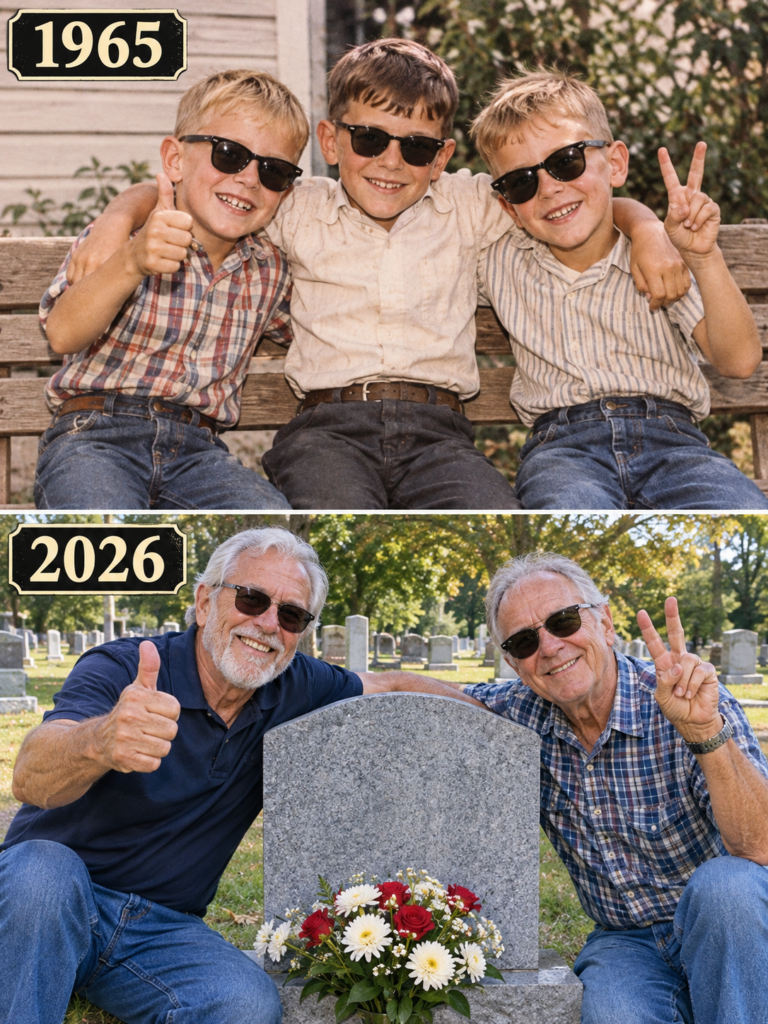
At Daniel’s funeral, Michael brought an old photograph.
It was the three of us sitting on a wooden bench when we were 12.
Daniel in the middle.
Michael on one side.
Me on the other.
“Daniel wanted us to recreate it,” Michael told the mourners, his voice shaking. “We kept putting it off. Thought we had more time.”
So we stood on either side of Daniel’s headstone.
Michael took my hand and placed it against the cold stone.
I traced Daniel’s name with my fingers.
Seventy-three years old.
And this was all I had left to touch.
Beside me, Michael began crying.
I reached for him.
He wrapped his arm around my shoulders, and for a moment, we stood there holding each other.
Just two of us now.
For the first time since we were seven.
When someone offered to take our picture, neither of us could speak.
We simply nodded.
Then Daniel’s wife approached me.
“Robert,” she whispered, pressing something heavy into my hands. “Daniel spent the last 32 years making this for you. He made me promise you’d get it today.”
“Thirty-two years?”
She squeezed my hand.
“He wanted you to know how much you meant to him.”
I tried to thank her, but my voice broke.
She hugged me instead.
Michael drove me home from the cemetery.
While he made coffee, I sat at the kitchen table with the box.
It was small enough to hold on my lap.
Its lid was smooth, but the corners were worn.
I lifted it carefully.
Inside were envelopes.
Dozens of them.
And when my fingertips brushed the first one, I froze.
Raised dots.
Braille.
Daniel had learned it shortly after my accident.
Sometimes he’d leave little messages for me on his kitchen table.
I opened the first envelope and slowly read the words.
“Robert, there’s something Michael has been afraid to tell you.”
I stopped.
Michael?
Why Michael?
My fingers found another card.
“I promised him I wouldn’t say anything until he was ready. He finally agreed that you should know.”
I read it again.
Then turned toward Michael.
“What haven’t you told me?”
He didn’t answer.
I heard him shift in his chair.
And when he finally spoke, his voice was shaking.
“Keep reading, Robert.”
I heard him set down his coffee as I reached for the next Braille card.
“Robert, think about the last few months.”
I frowned.
The last few months?
Daniel had been getting weaker.
We’d spent more time indoors, sitting around his kitchen table instead of on the porch.
But Michael had been acting strangely too.
I remembered one Sunday when he asked whether my granddaughter had started school.
“Michael, she’s 14,” I’d laughed.
He laughed with me.
Then asked the same question the following week.
I remembered that now.
How Daniel sometimes answered questions before Michael could.
How he’d gently reminded him of things we’d discussed only minutes earlier.
I’d assumed they were ordinary signs of aging.
We were 73, after all.
But there had been something else.
A few weeks before Daniel died, Michael forgot our Sunday gathering.
For the first time in years, he didn’t come.
When I called, he sounded confused.
“I thought tomorrow was Sunday.”
I laughed and told him we’d see him next week.
Daniel didn’t laugh.
He’d been strangely quiet for the rest of the afternoon.
Now, sitting at my kitchen table, I remembered every word.
“Michael,” I said.
“Yes?”
“Is Daniel trying to tell me something about your memory?”
The kitchen went silent.
Then Michael whispered.
“There’s something else in the box.”
I reached for the next envelope.
Across its front, Daniel had written four words.
“Remember the wooden bench.”
We were 12.
It was a Saturday afternoon when Michael’s mother took him into town.
They stopped near a small park.
She told him to wait on a wooden bench while she went to buy something.
Michael waited.
An hour.
Then two.
By the time Daniel and I found him, the shops were closing.
He was sitting perfectly still.
“Where’s your mum?” I asked.
“She’s coming.”
We sat beside him.
Another hour passed.
Then Daniel went to fetch his father.
By nightfall, the adults had discovered Michael’s mother had left town.
She wasn’t coming back.
Michael went to stay with his aunt, who lived a few streets away.
But I remember something about the following morning.
Something I’d forgotten until Daniel’s note brought it back.
The three of us had arranged to meet at that same bench.
Michael got there first.
Much too early.
When Daniel and I arrived, he was staring down the road.
He stood so quickly he nearly fell.
“You came,” he said.
“Of course we came,” I answered.
He looked from me to Daniel.
Then he started crying.
Not loudly.
He just stood there, rubbing his face with his sleeves.
I didn’t understand.
Not really.
I was 12.
So I grabbed his hand and made him a promise.
“If one of us ever gets lost, the other two come looking.”
Daniel nodded.
“Even if he tells us to go away.”
Michael laughed through his tears.
We shook hands.
Then Daniel’s father, who’d come to collect us, took our photograph.
Three boys.
One wooden bench.
Daniel in the middle.
For the next 61 years, that picture was my favorite memory of our childhood.
I’d always imagined us smiling because we were happy.
I never understood what Michael was smiling about.
Until I read Daniel’s next words.
“Michael told me something about that morning recently.”
I moved my fingers slowly.
“He said he still remembers the sound of you and me running toward him.”
I smiled.
Of course he remembered.
Michael never forgot the things that mattered.
Then my fingers found the next line.
“But Robert, he’s terrified there will come a day when he can’t remember us at all.”
My smile disappeared.
I turned toward Michael.
“What does that mean?”
He didn’t answer.
I reached for the next card.
But there were only three words.
“Let him explain.”
“Michael?”
“Yes?”
“Please tell me what’s happening.”
I heard him take a breath.
Then another.
“I’ve been seeing a doctor, Robert.”
My stomach tightened.
“What’s wrong?”
“I started forgetting things last year. Little things at first.”
“We all forget things.”
“That’s what I kept telling myself.”
His chair creaked.
“But then I started forgetting conversations. Things I’d done the day before. Once, I drove to the shops and couldn’t remember why I’d gone.”
I reached across the table. “Michael?”
He took my hand.
“They ran some tests.”
I waited.
For a moment, all I could hear was the clock ticking on the kitchen wall.
Then he said it.
“Robert, I have Alzheimer’s.”
I couldn’t speak.
Michael had always been the one who remembered everything.
Our childhood adventures.
The names of teachers I’d forgotten.
Every embarrassing thing I’d done since second grade.
When I lost my sight, he’d described the world to me.
And now he was losing pieces of his own.
“How long have you known?”
“Four months.”
“Four months?”
“I wanted to tell you.”
“Then why didn’t you?”
His voice broke.
“Because Daniel was dying. And I couldn’t bear telling you that you might lose me too.”
I gripped his hand.
“Michael, you’re sitting right here.”
“I know.”
“You’re still here.”
“I know that too.”
He paused.
Then he said something that frightened me more than the diagnosis.
“Robert, I can’t remember what Daniel said to me the day before he died.”
I felt my throat tighten.
“I’ve been trying for weeks. I remember sitting beside his bed. I remember holding his hand.”
His voice broke.
“But I can’t remember what he said. And there’s nobody left to ask.”
“I can still remember us when we were 12. I remember the bench. I remember you running toward me.”
His grip tightened.
“But what happens if one day I don’t?”
I had no answer.
Then Michael reached across the table and guided my hand toward the box.
“Daniel wanted you to have the rest.”
Beneath the envelopes was a small recording player.
And more Braille cards.
Dozens of them.
Each one carried a date.
I picked up the first.
“June 1994. Michael’s birthday.”
I remembered that day.
The three of us had gone fishing.
Michael had fallen into the lake trying to retrieve Daniel’s hat.
I’d laughed so hard I nearly fell in after him.
I pressed the button on the player.
And suddenly, Daniel’s voice filled the kitchen.
“Michael, tell Robert what happened to your trousers.”
Then Michael’s voice.
Much younger.
“I told you, the fish pulled me in!”
Laughter.
All three of us.
Beside me, Michael let out a small laugh.
“I’d forgotten that day,” he whispered.
I turned toward him.
“You remember now?”
“Not all of it. But I remember how happy we were.”
My hands began to shake.
I pressed another button.
A recording from my granddaughter’s seventh birthday.
Then another.
Daniel describing a sunset from his porch.
Another.
Michael laughing at one of my terrible jokes.
Thirty-two years.
Daniel had been recording our ordinary lives.
I’d known he sometimes made recordings after my accident.
He used to say they would help me remember the moments I couldn’t see.
But I hadn’t realized how many he’d kept.
Or how carefully he’d organized them.
Underneath the player, my fingers found one final envelope.
Thicker than the others.
I opened it.
Inside was a letter.
From Daniel.
“Dear Robert,”
“When you lost your sight, you told me you were frightened you’d forget what our faces looked like.”
“So I started writing things down.”
“At first, it was little things.”
“The color of Michael’s new fishing hat.”
“The way your granddaughter smiled when she lost her first tooth.”
“The three of us getting older.”
“I started recording our conversations too.”
“Every year, I added a little more.”
“I wanted you to have something you could return to whenever you missed the world you used to see.”
I stopped reading.
Daniel had never told me how much work he’d put into it.
I wiped my face and continued.
“Then Michael told me about his diagnosis.”
“And I realized something.”
“For 32 years, I’d been saving these memories for you.”
“Now there might be times when Michael wants to hear them too.”
“Robert, I wish I could sit beside you both and tell those stories myself.”
“But I can’t.”
“So I’m leaving them with the person who knows our lives as well as I do.”
“You.”
“Remember what we promised when we were 12?”
“If one of us gets lost, the other two come looking.”
“Michael may need you to come looking now.”
“And I know you’ll be there.”
I lowered the paper.
For a long time, neither of us spoke.
Then Michael whispered, “He told me he was making something for you. I didn’t know how much he’d saved.”
I reached for the recorder again.
Daniel’s laughter filled the room.
Then Michael’s.
Then mine.
Three boys who’d somehow grown into old men without ever learning how to stop being friends.
“Robert?”
“Yes?”
“What if it gets worse?”
I turned toward Michael.
He was still holding my hand.
“What if I forget our Sundays?”
I swallowed.
“What if I start asking you the same questions over and over?”
“Then I’ll answer them.”
“Every time?”
“Every time I can.”
His hand tightened around mine.
“What if I forget Daniel?”
That was the question that nearly broke me.
Because I couldn’t promise he wouldn’t.
I couldn’t promise anything about what this illness might take from him.
But I could promise something about myself.
“Michael, listen to me.”
He went quiet.
“For 32 years, you and Daniel helped me find my way through a world I couldn’t see.”
“Robert—”
“You described things for me. Told me stories. Reminded me of things I’d forgotten.”
My voice shook.
“Now it’s my turn.”
He started crying.
“When I was 12, I was afraid nobody would come back for me.”
His voice broke.
“Now I’m afraid I won’t remember when they do.”
I reached for his hand.
“Then I’ll remind you.”
He let out a broken sob.
“And I’ll tell you about Daniel. About the bench. About all the Sundays we’ve spent together.”
I squeezed his fingers.
“You don’t have to remember everything for me to keep loving you.”
For a long time, Michael said nothing.
Then he leaned forward.
And the two of us held each other.
Just as we had when we were boys.
I couldn’t bring Daniel back.
I couldn’t take away Michael’s illness.
But for 32 years, I’d worried that Michael only came because he felt sorry for me.
Now I understood.
Sometimes you show up because you love someone.
Even when there’s nothing you can do to save them.
Last Sunday, Michael and I sat on Daniel’s porch.
His wife had told us to keep coming.
Daniel’s chair was empty.
Between us sat his wooden box.
Michael had asked me to bring it.
For a while, we listened to the birds.
Then he reached for my hand.
“Robert?”
“Yes?”
“Tell me about that photograph.”
“Which one?”
“The one of us when we were boys.”
I smiled.
So I told him.
About the wooden bench.
About his mother leaving him there.
About how Daniel and I came running toward him the following morning.
And the promise we’d made.
Michael listened quietly.
Then he squeezed my hand.
“I remember that.”
“Good.”
We sat there for a while.
Then he spoke again.
“And if someday I don’t?”
I held his hand a little tighter.
“Then I’ll tell you again.”