My mother turned the furnace invoice over in her hand, as if the blank back of the page might somehow erase the $4,000 printed on the front.
It didn’t.
I stood beside the open box in the driveway while she stared at that sheet of paper, and for once I didn’t rush to rescue her from an uncomfortable moment.
For three years, rescuing people had become my reflex.
A bill showed up, and I figured out how to cover it.
Something broke, and I found someone to repair it.
My parents worried about money, and I told them we would manage.
We always managed.
Mostly because I kept paying.
My mother finally looked up from the invoice.
“What exactly did Sophie tell you?” she asked.
There was something different in her voice now.
Not fear, exactly.
Calculation.
“She looked at the records,” I said.
“That isn’t what I asked.”
“I know.”
Her grip tightened on the paper.
Behind her, the front door was still standing open, and several more boxes waited just inside the hallway.
Boxes she had packed before she ever told me I was supposed to leave.
That detail mattered more to me now than it had at dinner.
The dinner had been staged like a conversation.
The decision had already been made.
The boxes proved it.
The emails proved it.
And the sentence Derek had written—make sure Naomi is out before the kids arrive—had stripped away whatever excuse I might have invented for them later.
My mother hadn’t lost her temper and said something cruel.
She had planned around my removal.
There was a difference.
I reached for the invoice.
She pulled it closer to her chest.
“Why do you need this?” she asked.
“I don’t.”
That surprised her.
I nodded toward the box.
“It’s a copy.”
Her eyes dropped to the page again.
I had spent the week making copies of everything that mattered.
Furnace records.
Tax receipts.
Repair invoices.
Payment confirmations.
The email thread.
Nothing dramatic.
Nothing secretive.
Just three years of numbers finally arranged in a way that made them harder to dismiss.
My mother had always been able to turn money into emotion when she needed to.
If she wanted help, the issue became family loyalty.
If I hesitated, it became selfishness.
If I paid, we never discussed it again.
That system had worked because I kept participating in it.
I wasn’t participating anymore.
“You went through our finances?” she asked.
“My finances.”
“This is our home.”
“I know.”
“And now you’re threatening us over it?”
“No.”
She waited.
I could see her preparing for the version of me she understood—the daughter who would explain too much, soften the sentence, apologize for upsetting her, then somehow end up solving the problem she had created.
That version of me had spent years mistaking guilt for responsibility.
I picked up another box instead.
“I’m moving out,” I said. “You wanted me gone by the weekend. I’m going.”
“Then why involve Sophie?”
“Because I wanted to understand what I had paid for and make sure I had records of it.”
“You’re trying to punish us.”
I carried the box toward my car.
I carried it without arguing.
I carried it without defending myself.
I carried it because, for the first time all week, the next step was actually mine.
My mother followed me.
“You don’t get to act like some victim here,” she said.
I opened the rear door and slid the box inside.
“I’m not acting like anything.”
“You’ve lived here three years.”
“Yes.”
“Do you know what rent costs?”
“Yes.”
“You had a roof over your head.”
“And you had a furnace.”
She stopped.
I hadn’t raised my voice.
That seemed to bother her more.
The old arguments depended on me getting emotional enough for the original issue to disappear.
This time, I didn’t give her anywhere to redirect it.
I went inside for another box.
My father was standing near the kitchen entrance.
He had been almost completely silent at dinner when my mother told me I had until the weekend to leave.
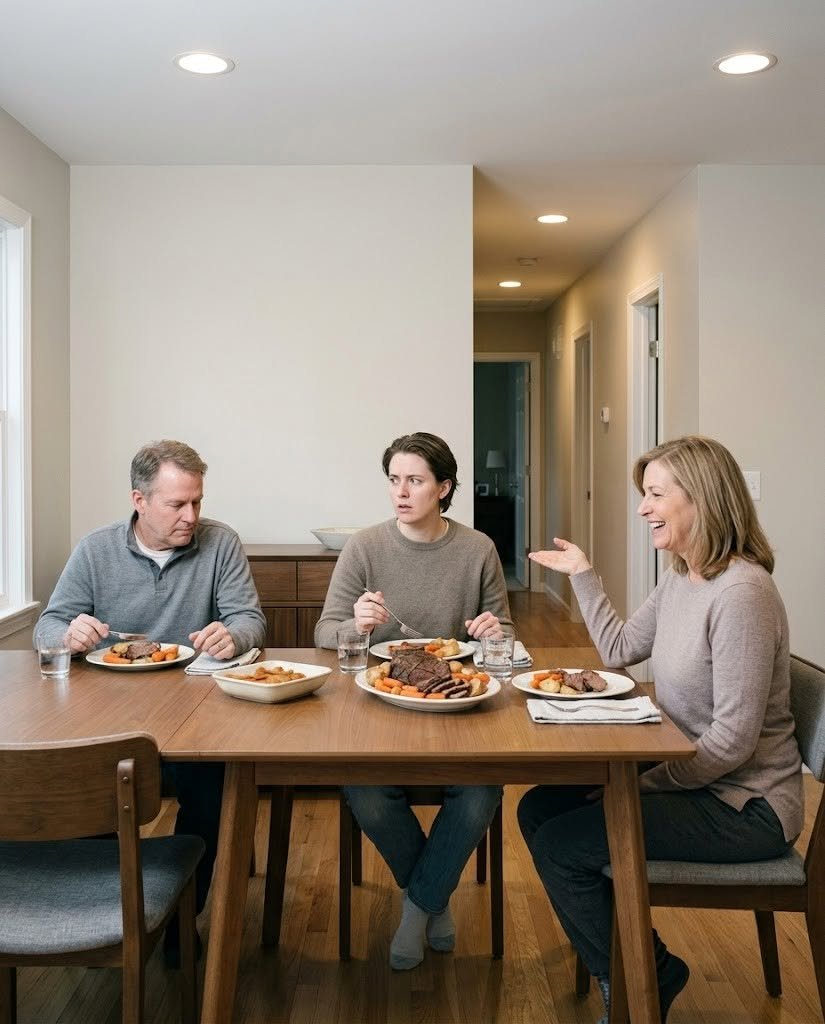
He had kept eating his pot roast while she called me a parasite.
Now he looked from me to the boxes lined against the wall.
“You really found a place already?” he asked.
“I did.”
His eyebrows lifted slightly.
My mother came in behind me.
“She has apparently been planning things behind our backs.”
I almost laughed at the wording.
Behind our backs.
The same woman who had been packing my belongings before dinner was offended that I had signed a lease without announcing it.
My father looked at her.
Then at me.
“When did you sign?” he asked.
“This week.”
“Where?”
“I’m keeping that to myself for now.”
My mother made a sharp sound of disbelief.
“Oh, please. We’re your parents.”
“I know who you are.”
The sentence came out quieter than I expected.
My father looked away first.
I picked up the next box.
My mother stepped between me and the door.
“What did that lawyer tell you you could do to us?”
“Sophie is my friend, and I went to her because she handles property disputes.”
“What did she tell you?”
“She told me to keep my records.”
That was enough.
I wasn’t going to stand in the hallway and make legal threats I didn’t intend to carry out.
I had already told Sophie the truth: I didn’t want the house.
I didn’t want a war.
I didn’t even want revenge.
I wanted my life back.
That sentence had sounded simple in Sophie’s office.
Living by it was harder.
Because getting your life back sometimes looks disappointingly ordinary.
It looks like a lease.
It looks like a cardboard box.
It looks like changing where your paycheck goes before anybody can assume it will cover the next emergency.
It looks like putting your passport, tax documents, and personal records somewhere only you can reach them.
It looks like saying no before somebody has even finished explaining why you should say yes.
My mother moved aside.
Barely.
I passed her with the box.
By the time I returned from the car, she had placed the furnace invoice on the kitchen island.
The same island where she had called me a parasite.
My father picked it up.
He read the amount.
Then he looked at me.
“You paid all of this?”
I stared at him.
He knew I had helped with the furnace.
But hearing him ask the question told me something I should have understood years earlier.
He had never bothered to know how much.
“Yes,” I said.
He looked at my mother.
She folded her arms.
“She offered.”
I nodded.
“I did.”
That was true.
And that truth mattered.
Nobody had held me at a table and forced me to enter my card number.
Nobody had physically taken the money from my account.
I had offered because I believed helping my parents made me part of the household in a way that mattered.
My mistake was assuming they understood the arrangement the same way.
My mother looked at me as if my agreement had proved her entire case.
“Exactly,” she said. “You offered. You don’t get to turn gifts into debts because you’re angry.”
“I’m not doing that.”
“Then what is all this?”
I looked around the kitchen.
At the counter I had helped maintain.
At the hallway full of boxes she had packed.
At my father holding an invoice he had apparently never examined closely.
“This is me leaving.”
She blinked.
Nothing more.
I picked up another box.
For the next half hour, I moved my things while my parents stayed mostly inside.
There were no dramatic speeches.
No one begged me to stay.
No one apologized.
That hurt more than I expected.
Part of me had still been waiting for the moment when my mother would look at the boxes, remember everything I had done, and say she had gone too far.
She didn’t.
Instead, she asked whether I would be finished before Derek arrived.
There it was.
The priority hadn’t changed.
I set a box into the trunk.
“Yes.”
“Because the kids have already been through enough.”
I closed the trunk.
“I hope the move goes smoothly for them.”
She studied my face, suspicious of the lack of resistance.
“And you’re not going to cause trouble?”
“No.”
“With the house?”
“I told you. I don’t want the house.”
She exhaled.
For one brief second, relief crossed her face.
Then I added, “But I’m also done paying for it.”
The relief stopped there.
My mother stared at me.
“What does that mean?”
“It means exactly what it sounds like.”
“You know we have expenses.”
“Yes.”
“You know your father and I can’t just absorb everything overnight.”
I looked toward the house.
The house Derek needed.
The house his children needed.
The house that, according to my mother’s email, would finally feel like family once I was gone.
“Then you should talk to the people who are going to be living here.”
Her mouth tightened.
“Derek is going through a difficult time.”
“I know.”
“He has children.”
“I know.”
“He needs help.”
I looked at her.
There was the old door.
The one I had walked through again and again for three years.
Family needs help.
Your brother needs help.
We need help.
You have a job.
You can rebuild your savings later.
Just this once.
Except once had turned into a furnace.
Then taxes.
Then repairs.
Then expenses nobody discussed once they were paid.
I had spent three years being useful enough to call when something broke and disposable enough to remove when somebody more important needed the bedroom.
“No,” I said.
My mother frowned.
“No what?”
“No, I’m not paying for Derek to live here.”
“I didn’t ask you to.”
“You were about to.”
She opened her mouth.
Then closed it.
I went back inside.
My father was still in the kitchen.
The furnace invoice remained on the island between us.
He touched the edge of it with one finger.
“What about the taxes?” he asked.
“What about them?”
“You said at dinner you helped with those too.”
“I did.”
“How much?”
I told him to look at the records if he wanted the exact history.
I wasn’t going to perform an accounting from memory just so somebody could decide afterward whether my contribution had been large enough to deserve respect.
He nodded slowly.
Then he said something that would have meant much more if he had said it at dinner.
“I didn’t realize.”
I picked up the last small box from beside the stairs.
“You could have asked.”
He looked down.
I left it there.
That was the strange thing about finally setting a boundary.
It didn’t erase what had happened.
It didn’t magically produce the apology you had spent years imagining.
It simply stopped the next repetition.
Outside, my mother was standing beside my car.
“Are you really not telling us where you live?” she asked.
“Not yet.”
“So now we’re strangers?”
“No.”
“Then why would you hide your address from your own mother?”
“Because I want one place that belongs to me before everybody starts having opinions about it.”
She shook her head.
“You’re being dramatic.”
Maybe I would once have argued with that word.
Instead, I unlocked the driver’s door.
My phone was lying on the passenger seat.
The missed calls from earlier in the week were still there in the history.
Fifty-three.
At first, seeing that number had made me feel sick.
I had spent years treating every family call like a possible emergency.
A broken appliance.
A payment problem.
A repair.
A favor.
A crisis.
Fifty-three missed calls should have pulled me straight back into that role.
Instead, they had sent me toward Sophie’s office.
That was the part my mother still didn’t understand.
She thought pressure would bring me home.
It had pushed me out.
My father came onto the driveway while I was getting into the car.
He didn’t try to stop me.
He stood a few feet away with his hands in his pockets and asked, “Do you need help carrying anything upstairs at the new place?”
I looked at him.
It was such a normal question that it almost broke me.
Not because it fixed anything.
It didn’t.
But because it was the first question anyone in that house had asked me all week that was about what I needed.
“I’ve got it,” I said.
He nodded.
My mother stayed near the porch.
“Naomi,” she called.
I waited.
She looked like she wanted to say several things at once.
That I was ungrateful.
That she had done her best.
That Derek needed her.
That I was making a family problem bigger than it needed to be.
Maybe she wanted to apologize.
If she did, she couldn’t get there.
What she finally said was, “You’re still coming for dinner sometimes, aren’t you?”
I held the car door.
A week earlier, I would have heard that as proof she loved me.
Maybe it was.
But love had never really been the question.
Access was.
Obligation was.
Whether love automatically entitled someone to my money, my time, my address, my labor, and my silence was the question I had finally started answering differently.
“Maybe,” I said. “Not right away.”
She looked hurt.
I let her.
That was new.
I got into the car.
My new apartment was small enough that I could stand in the kitchen and see almost the entire living room.
There were boxes against the wall, two mismatched lamps, a bare stretch of counter, and almost nothing in the refrigerator.
It was not impressive.
It was mine.
I carried in the first box.
I carried in the second.
I carried in the folder with the records last.
Then I set it in a drawer and closed it.
For three years, those receipts had represented sacrifice.
For one week, they had become evidence.
Now I wanted them to become something much less dramatic.
Old paperwork.
I sat on the floor because I hadn’t bought a couch yet.
My phone buzzed.
Mom.
I watched it ring until it stopped.
A minute later, a message appeared.
She wanted to know if I had arrived safely.
I answered that I had.
Nothing else.
Another message came later asking when we could talk.
I told her I would reach out when I was ready.
The old Naomi would have added three paragraphs explaining why.
I didn’t.
Over the next several days, I learned how much space there was in a life when every decision didn’t have to pass through the filter of family need.
I bought groceries for one person.
I paid my own bills.
I went to work without wondering whether I would come home to another repair waiting for me.
I made coffee in the morning and left the mug in the sink because nobody was going to turn it into a discussion about what I contributed to the household.
Small things.
That was the point.
Sophie checked in once and asked whether I still had the documents somewhere safe.
I told her yes.
She reminded me that keeping records and starting a fight were not the same thing.
I needed to hear that.
My mother had spent so much time framing preparation as betrayal that I had started to believe protecting myself was automatically an attack on her.
It wasn’t.
I didn’t file anything against my parents.
I didn’t demand the house.
I didn’t show up when Derek arrived and ruin the moment my mother had planned for him and his children.
I simply stopped funding a household that had told me, clearly and deliberately, that I did not belong in it.
That choice had consequences all by itself.
My savings stopped shrinking.
My evenings became mine.
When my phone rang, I stopped assuming I had to answer immediately.
When my mother mentioned an expense during a later conversation, I listened without volunteering to solve it.
That silence felt uncomfortable at first.
Then it felt normal.
The hardest part was accepting that my family did not become completely different people just because I had changed my behavior.
My mother still believed Derek’s situation justified what she had done.
My father still preferred avoiding conflict until avoiding it was no longer possible.
Derek still had his own problems and his own children to think about.
I could understand all of that without moving back into my old role.
Both things could be true.
They could be struggling.
And I could still say no.
Weeks later, I found the copy of the furnace invoice again while organizing the drawer in my apartment.
The paper was creased across the middle from being folded into the box my mother had packed.
For a moment, I saw the whole morning again.
Her fingers closing around it.
Her voice changing when I mentioned Sophie.
My father asking if I had really paid the entire $4,000.
The boxes lined against the hallway wall.
Then I remembered something else.
I had taken the invoice back.
Not from my mother’s hand.
From its old meaning.
It no longer proved that I deserved a place in their house.
I didn’t need it to prove that.
It proved that I had helped when I chose to help.
Nothing more.
Nothing less.
I slid the paper back into the folder and closed the drawer.
Then I picked up my own keys from my own kitchen counter and walked out the door.