The Green Notebook
The Tractor
Grandpa lost most of his hearing in the fall of 2019.
He was working on an old John Deere 4020 in the machine shed, the same tractor his father had bought new in 1966. He’d rebuilt the engine himself, twice. That October afternoon, he was standing beside it with the hood open, listening for a knock, when something inside let go.
The engine blew with a sound I heard from the house, a quarter mile away. It was like a cannon going off inside a tin can.
I was twenty that year, home from community college for the weekend. My grandmother, Bea, was in the kitchen making apple butter. We looked at each other, and then we were both running.
Grandpa was sitting on the floor of the machine shed with his back against a hay bale. There was oil on his face and his shirt. He was blinking slowly, like a man waking from a nap.
He wasn’t hurt anywhere we could see. But when Grandma knelt down and said his name, he didn’t turn his head.
He just watched her lips move.
The doctors in Lincoln said the blast had damaged both of his eardrums and the tiny nerves behind them. Some of it would heal. Most of it wouldn’t.
My grandfather, Henry Larkin, was seventy-seven years old. He had farmed six hundred and forty acres of corn and soybeans outside of Beatrice, Nebraska, for fifty-five years. And now the world had gone quiet.
That part of the story is true.
Everything my family believed about it after that was not.
My name is Katie Larkin. I’m twenty-six now.
My mother was Grandpa’s younger daughter, Susan. She died in a car accident when I was eleven, on an icy stretch of Highway 77 on her way home from a nursing shift. My father wasn’t in the picture. So I moved to the farm, and Grandma and Grandpa raised me.
I learned to drive a grain truck at fourteen. I learned to make pie crust at nine. I learned that you can tell a lot about a person by how they treat someone who can’t do anything for them.
That last one, Grandpa taught me without ever saying it.
The Secret
In February of 2020, Grandpa got hearing aids.
Not the big beige ones that sit on top of your ear like a seashell. These were tiny. Dark gray. A specialist in Omaha fitted them so they tucked completely behind his ears and disappeared under his hair. Unless you were standing right beside him and knew to look, you’d never see them.
I was the one who drove him to that appointment. Grandma came too. She held his hand in the waiting room the whole time.
When the audiologist turned them on, Grandpa sat very still.
The audiologist said something quietly. Grandpa’s eyes filled with tears.
“Bea,” he said, without turning around. “I can hear you breathing.”
Grandma started crying. Then I started crying. The audiologist handed all three of us tissues and pretended to look at her clipboard.
On the drive home, he was quiet for a long time. He kept turning his head toward sounds. The turn signal clicking. The tires on the highway. A radio commercial for a feed store in Wahoo.
Somewhere around Ceresco, he said, “Katie, I want you to promise me something.”
“Anything, Grandpa.”
“Don’t tell anybody about these,” he said. “Not Linda. Not Gary. Not Tom. Not anybody.”
I looked at him in the rearview mirror. Grandma was looking at him too.
“Why not?” I asked.
He reached up and tapped the spot behind his ear where the little device was hidden. He smiled the slow smile he got when he was about to say something he’d thought about for a while.
“Because people say the truest things,” he said, “to a man they think can’t hear.”
Grandma shook her head. “Henry Larkin, that’s sneaky.”
“It’s not sneaky,” Grandpa said. “It’s listening. Lord knows I spent seventy-seven years talking. Maybe it’s time I did some listening.”
Grandma didn’t argue. She just squeezed his hand.
I promised.
So for six years, my grandfather pretended.
He sat at the end of the dining table at every family dinner, nodding slowly. He cupped his hand behind his ear. He said, “What’s that?” and “Speak up, now,” and “You’ll have to say that again.”
People got tired of repeating themselves. So they stopped trying.
And then they forgot he was in the room at all.
Six Years of Dinners
My aunt Linda is Grandpa’s oldest child. She’s fifty-eight. She lives in a big house in a new subdivision outside Lincoln with her husband, Gary, who sells commercial insurance. They have a boat on Branched Oak Lake and a habit of mentioning it.
Their son, Brett, is thirty. He’s had four different jobs in five years and a lot of student loans from a college he didn’t finish. Their daughter, Lacey, is seventeen. She’s quiet and draws in a sketchbook at family dinners.
My uncle Tom is Grandpa’s son. He’s fifty-three, and he farms with Grandpa. He lives in a small house on the east side of the property with his wife, Marcy. Tom doesn’t say much. He shows up at five every morning and fixes whatever’s broken.
Then there were cousins and second cousins and in-laws. On holidays, we usually had twenty or more people at the farmhouse.
That’s a lot of conversation. And for six years, Grandpa heard all of it.
The first time I realized what he was doing, it was Thanksgiving of 2020.
We were small that year because of the pandemic. Just family, with the windows open. Aunt Linda was sitting two chairs down from Grandpa, talking to Gary about the farm.
“The land alone has to be worth four million now,” she said. “Prices are crazy.”
“More, with the equipment,” Gary said.
Grandpa was buttering a roll. He didn’t look up.
Christmas of 2021, Uncle Gary took out his phone at the dinner table and started looking up the value of Grandpa’s machinery. Out loud.
“That combine’s a 2016 S680,” he said. “Low hours. Even used, that’s three-fifty, maybe four hundred grand. The planter’s another hundred.”
Linda laughed. “You’re like a kid at a car dealership.”
“Just doing my homework,” Gary said.
Grandpa asked if somebody could pass the green beans.
Easter of 2022, my cousin Brett said the worst one.
He was sitting maybe two feet from Grandpa’s chair, scrolling on his phone. Linda was complaining about how long the drive was and how the farm smelled like cattle.
“Why do we even keep coming out here?” Brett said. “The old man’s a vegetable. He doesn’t even know we’re here. Let’s just put him somewhere and split it.”
I felt my face go hot. I started to stand up.
Grandpa caught my eye from across the table. He gave me a tiny shake of the head.
Then he turned to Brett with a pleasant smile.
“Could you pass the dinner rolls, son?” he said, a little too loud, the way he’d learned to talk when people thought he couldn’t hear himself.
Brett rolled his eyes and slid the basket toward him without looking up.
After that dinner, I found Grandpa in the machine shed. He was sitting on the same hay bale where we’d found him after the explosion, polishing a wrench that didn’t need polishing.
“Grandpa,” I said. “How can you stand it? How can you sit there and let them say those things?”
He set down the wrench.
“Not yet, Katie,” he said. “I’m learning something.”
“Learning what?”
He looked out through the open shed door at the fields.
“Who people are,” he said, “when they think nobody’s keeping score.”
The Other Things He Heard
It wasn’t all cruel. That’s the part people forget when I tell this story.
Grandpa heard the bad things. But he heard everything else too.
He heard Uncle Tom, on a cold February morning in 2022, talking to the vet in the calving barn while Grandpa sat on a bucket nearby. Tom didn’t think he could hear.
“Dad’s slowing down,” Tom said quietly. “He won’t admit it. But I’m not going to make him stop. This farm is the only thing that makes him feel like himself since the accident. As long as he wants to come out here, I’ll make sure there’s something for him to do.”
Grandpa didn’t say anything. But that night, he wrote it down.
He heard Lacey, Brett’s little sister, the summer she turned fifteen. She’d come out to the porch where Grandpa sat in his rocking chair, and she’d started talking. To him, but really to herself, because she thought he couldn’t hear.
She told him about how she got anxious at school. How she drew in her sketchbook to make the bad feelings quieter. How her parents thought drawing was a waste of time and wanted her to do something useful, like business.
“I wish I could live out here,” she said. “It’s quiet. Nobody’s always telling you what you should be.”
Grandpa kept rocking. He didn’t let on.
But he wrote that down too.
And he heard Grandma.
Of course he heard Grandma. He’d always been able to hear Grandma, even before the hearing aids. She told me once that after fifty-four years of marriage, he could hear her think.
But I think the hearing aids let him hear the small things. Her humming over the stove. The way she talked to the barn cats. The way she sometimes whispered thank you to nobody in particular when the sun came up over the east field.
Grandma got sick in the summer of 2024.
It was her heart. Congestive heart failure, the doctors said. They gave her medicine that helped for a while. Then it stopped helping.
She died in April of this year, in the downstairs bedroom of the farmhouse, with the window open so she could smell the lilacs. Grandpa held one of her hands. I held the other. Uncle Tom stood at the foot of the bed.
Aunt Linda arrived two hours later, after it was over. She said traffic on Highway 77 had been terrible.
At the funeral, Linda gave a beautiful eulogy. She talked about how much she loved her mother and how close they’d been. People cried.
Afterward, at the luncheon in the church basement, I heard her talking to Gary by the coffee urn.
“Well,” she said. “At least now there’s only one of them left.”
Grandpa was sitting at a table ten feet away, holding a paper plate of ham sandwiches he hadn’t touched.
He heard.
Christmas
This Christmas, Grandma had been gone eight months.
It was the first holiday without her. Grandpa insisted on hosting at the farmhouse anyway, like always. He said Grandma would have wanted the house full.
Twenty-two people came. Aunt Linda and Uncle Gary. Brett and his girlfriend. Lacey. Uncle Tom and Aunt Marcy. Cousins from Lincoln and Omaha and Seward. The house smelled like ham and cloves and wood smoke from the stove in the living room.
I spent all of Christmas Eve in the kitchen making Grandma’s pies. Apple and sour cherry, with a lattice top. I used her recipe card, the one in her handwriting with a grease stain in the corner.
They didn’t turn out quite like hers. Nobody’s ever did. But they were close.
Grandpa came into the kitchen while they were cooling on the counter. He stood over them for a long time.
“She’d be proud of you,” he said.
Then he went upstairs, and I heard him on the phone. He talked for a long time with the door closed. When he came down, he asked me to set an extra place at the table.
“Who’s coming?” I asked.
“A friend,” he said. “He’ll wait in his car until I need him.”
Christmas dinner started at two.
Grandpa sat at the very head of the long dining table, in his good brown cardigan with the leather buttons Grandma had sewn on herself. He’d put on a clean white shirt underneath. His hair was combed.
He looked smaller than he used to. But his eyes were bright.
We said grace. Uncle Tom said it, because Grandma always used to. His voice cracked on her name, and Aunt Marcy put her hand on his back.
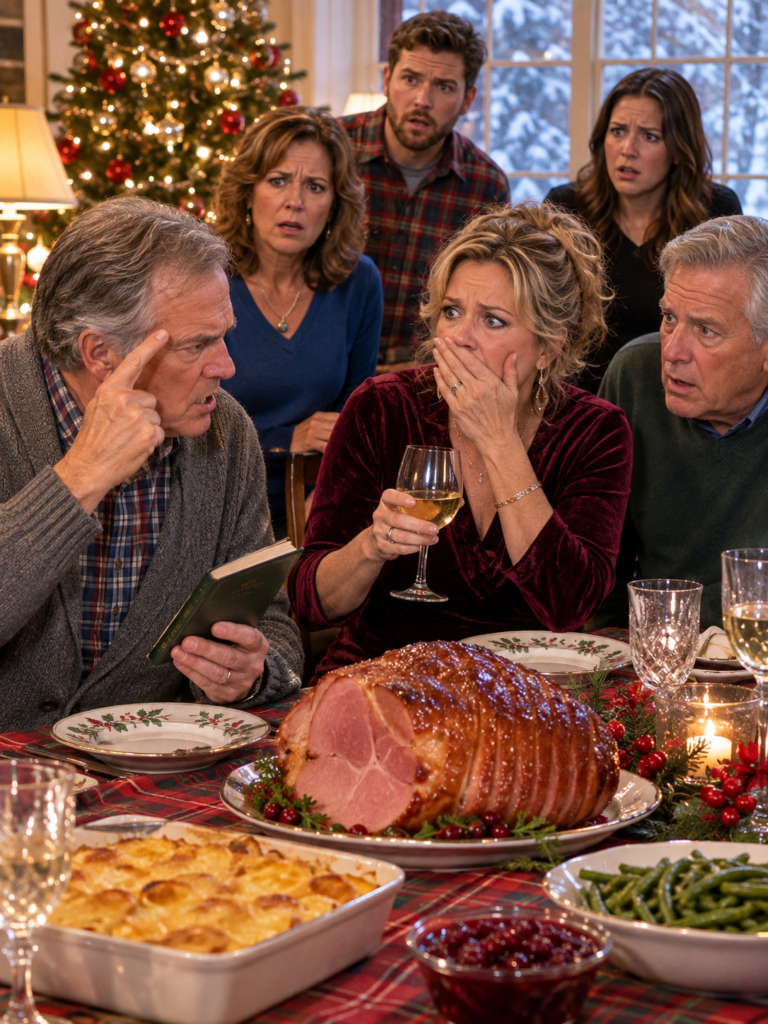
Then the food went around. Ham with brown sugar glaze. Scalloped potatoes. Green beans with bacon. Grandma’s dinner rolls, which Aunt Marcy had made from Grandma’s recipe. Cranberry salad that nobody really liked but everyone ate anyway because Grandma always made it.
For a while, it was nice. People talked. Kids ran through the living room. Somebody’s baby fell asleep in a high chair.
Halfway through the meal, Aunt Linda refilled her wine glass.
She leaned toward Uncle Gary. She lowered her voice a little, but not much. She’d stopped lowering it all the way years ago.
“I talked to a commercial realtor in Lincoln last week,” she said. “He came out and drove the property line.”
“And?” Gary said.
“The south parcel alone is worth one point two,” Linda said. “Developers want it for houses. It’s right off the highway.”
I put down my fork.
At the head of the table, Grandpa was cutting a piece of ham into small, careful squares.
“He won’t last the winter,” Gary said casually. He didn’t even glance toward Grandpa. “Look at him. Since your mom passed, he’s gone downhill fast.”
“I know,” Linda said. She took a long sip of wine.
Then she laughed.
“Honestly,” she said, “when he dies, the farm pays off my mortgage. The boat. And Brett’s loans.”
She swirled her wine.
“It’s the only reason we still come out here,” she said.
Gary laughed.
Across the table, Brett raised his glass.
“To the south parcel,” he said.
A couple of people chuckled awkwardly. Most of the table had gone quiet. Uncle Tom was staring at his plate with his jaw clenched. Lacey had stopped drawing and was looking at her mother with something like horror.
I couldn’t take it anymore.
I pushed my chair back so hard it scraped against the wood floor. I started to stand up. I didn’t know what I was going to say. Something I’d regret, probably.
Then Grandpa set his fork down.
Not hard. Not with a clatter.
He set it down neatly beside his plate, the way he’d done ten thousand times at that table. Tines up. Handle parallel to the knife.
Then he lifted his head.
He looked straight down the long table at his oldest daughter.
Every Word
“Linda,” he said.
His voice was clear as a church bell. Not loud. Not the too-loud voice he’d used for six years. His real voice. The voice I remembered from when I was a kid, calling me in from the fields for supper.
“I’ve heard every word you’ve said,” he said, “since 2020.”
The room didn’t just go quiet.
It was as if all sound in the world stopped at once. The clinking of forks. The crackle of the wood stove. The cousins in the living room. Even the baby in the high chair seemed to stop breathing.
Aunt Linda’s wine glass froze halfway to her mouth.
“Dad,” she said. “What?”
Grandpa reached up. He brushed his gray hair back from his left ear. He tapped the tiny dark device tucked behind it.
“Hearing aids,” he said. “February 2020. A specialist in Omaha. Your mother knew. Katie knew. My doctor knew.”
He looked around the table.
“Nobody else,” he said.
Uncle Gary had gone pale. Brett set his wine glass down so quickly it sloshed onto the tablecloth.
“Every Thanksgiving,” Grandpa said. “Every birthday. Every Christmas. Every Easter.”
He looked at Brett.
“I heard you call me a vegetable, Brett,” he said. “Easter, 2022. You were sitting right there, about two feet from my chair. You said, Let’s just put him somewhere and split it.”
Brett opened his mouth. Nothing came out.
Grandpa turned to Gary.
“I heard you price my combine at Christmas dinner, Gary,” he said. “2021. You said it was a 2016 S680 with low hours. You were right about that, by the way. You’ve got a good eye.”
Gary swallowed hard.
Then Grandpa looked back at Linda.
“And I heard you, Linda,” he said quietly. “In the church basement. After we buried your mother.”
Linda’s face went white.
“You said, At least now there’s only one of them left,” Grandpa said.
He didn’t raise his voice. He didn’t need to.
“I was sitting ten feet away,” he said. “Holding a plate of sandwiches.”
Nobody moved. Nobody spoke.
Aunt Marcy had both hands over her mouth. Uncle Tom was staring at his father like he’d never seen him before. Lacey had tears running down her face.
Linda’s hand was shaking so badly that wine was spilling over the edge of her glass.
“Dad,” she whispered. “I didn’t—I didn’t mean—”
“I kept a notebook,” Grandpa said.
He reached into the deep pocket of his brown cardigan. He took out a small green notebook. The cheap spiral kind you buy at the farm supply store for ninety-nine cents. The cover was worn soft from handling.
He set it on the table in front of him. Perfectly straight. Right beside his fork.
“Six years,” he said. “Everything you said. Dates and all.”
Linda stared at the notebook like it was a snake.
Gary reached for his wife’s arm. “Henry, I think there’s been some kind of misunderstanding—”
“There hasn’t,” Grandpa said. “I wrote it down the same night, every time. Your mother helped me remember when I missed something.”
He let that sit for a moment.
Then he turned his head and looked at me.
“Katie,” he said gently. “Would you please go get Mr. Dawson from the porch? He’s been waiting in his car. Tell him it’s time.”
I stood up.
My legs were shaking. I walked through the dining room, past twenty-one silent faces, through the kitchen with Grandma’s pies cooling on the counter, and out the back door into the cold.
Mr. Dawson
A silver Buick was parked by the machine shed with its engine running. The heater was on. The windows were fogged.
I knocked on the driver’s window.
It rolled down. Mr. Dawson was in his seventies, with white hair, wire glasses, and a red Christmas tie under a gray overcoat. He’d been the Larkin family’s lawyer since before I was born. He’d handled Grandma’s will in April.
“Is it time?” he asked.
“He says it’s time,” I said.
Mr. Dawson nodded. He turned off the engine, picked up a leather briefcase from the passenger seat, and climbed out slowly.
“He told you to wait in the car on Christmas?” I asked as we walked toward the house.
“He did,” Mr. Dawson said. “He offered to bring me a plate of ham. I told him I’d rather wait until the paperwork was done.”
He glanced at me.
“Your grandfather is a very thorough man, Katie,” he said.
“I’m starting to understand that,” I said.
When I opened the back door and walked Mr. Dawson into the dining room, every head turned.
Aunt Linda saw the lawyer. She saw the leather briefcase. She saw the Christmas tie and the overcoat and the snow on his shoes.
And she understood.
Her wine glass slipped from her fingers. It hit the edge of her plate and shattered, and red wine spread across Grandma’s white Christmas tablecloth.
Nobody moved to clean it up.
Mr. Dawson walked to the head of the table. He set his briefcase down beside Grandpa’s chair.
“Merry Christmas, everyone,” he said politely. “I’m sorry to interrupt your dinner. I’m Robert Dawson. I’m Henry’s attorney.”
He looked at Grandpa.
“Would you like me to explain, Henry? Or would you like to?”
Grandpa picked up his water glass and took a slow sip.
“I’ll start,” he said. “You can fill in the legal parts.”
He set down the glass.
“After Bea died,” he said, “I sat in this house by myself for a long time. And I read this notebook. Every page. Every word.”
He tapped the green cover.
“And I made some decisions,” he said.
What He Decided
“On December nineteenth,” Grandpa said, “I signed a new will. And I signed some other papers.”
He nodded to Mr. Dawson.
Mr. Dawson opened his briefcase. He took out a folder.
“Henry has placed the entire farm,” Mr. Dawson said, “all six hundred and forty acres, into a conservation easement with the Nebraska Land Trust. It was recorded with the county last week.”
“A what?” Gary said.
“A conservation easement,” Mr. Dawson said. “It’s a permanent legal agreement. It means the land can never be subdivided or developed. It can only be used for agriculture, forever, no matter who owns it.”
He looked at Linda.
“The south parcel,” he said, “can’t be sold for houses. Not now. Not ever.”
Linda made a small sound, like the air going out of a tire.
“The farm itself,” Mr. Dawson continued, “is now held in a trust. Henry remains the trustee for as long as he lives. When he passes, the farm will be managed by two successor trustees, who will continue farming it.”
He looked down at his paper.
“Thomas Larkin,” he said. “And Katherine Larkin.”
I stared at Grandpa.
Uncle Tom put his fork down very slowly.
“Dad,” he said. “You didn’t tell me.”
“I’m telling you now,” Grandpa said. “You’ve been out in that barn at five in the morning for thirty years. You never once asked me what you were getting. You never once priced my equipment.”
He looked at Tom.
“I heard you, son,” he said quietly. “In the calving barn. February 2022. You told the vet you’d make sure I always had something to do out here. As long as I wanted to come.”
Uncle Tom’s face crumpled. He looked down at the table.
Aunt Marcy put her arm around him.
Grandpa turned to me.
“And you,” he said. “You drove me to Omaha. You kept my secret for six years. You’ve never asked me for a dime.”
“Grandpa,” I said. “I don’t know anything about running a farm.”
“You know more than you think,” he said. “And Tom will teach you the rest.”
“What about us?” Linda said.
Her voice was high and thin. She’d found it again.
“I’m your oldest child,” she said. “I have rights.”
Mr. Dawson cleared his throat.
“Henry has made provisions for all three of his children’s families,” he said. “Including yours, Linda.”
Linda looked up hopefully.
“When Henry passes,” Mr. Dawson said, “you will receive a cash bequest of twenty-five thousand dollars.”
Gary laughed. It wasn’t a happy laugh.
“Twenty-five thousand,” he said. “Out of a four-million-dollar farm.”
“Out of a farm,” Grandpa said, “that’s not for sale. That’s the point, Gary.”
He leaned forward.
“You’ve been sitting at my table for six years,” he said, “talking about this place like it was a winning lottery ticket. Pricing my combine. Measuring my fields. Talking to realtors behind my back.”
He tapped the notebook.
“Twenty-five thousand dollars,” he said, “is what I figure your share is worth to you. Since it’s the only reason you come out here.”
The Notebook
Nobody said anything for a long time.
The wood stove crackled. Outside, the wind blew snow across the yard.
Then Grandpa did something none of us expected.
He opened the green notebook.
“I want to read you some things,” he said. “Not to embarrass anybody. You’ve done that well enough on your own.”
He turned a few pages.
“I want to read you the other things I heard,” he said.
He put on his reading glasses. He found a page.
“July fourth, 2023,” he read. “Lacey, on the porch. She said she gets scared at school sometimes and draws so the bad feelings get quieter. She said she wishes she could live out here because nobody tells you what you should be.”
He looked up.
Lacey was crying openly now. Her sketchbook was clutched against her chest.
“Lacey,” Grandpa said gently. “Those drawings you do. The barn. The cats. The cottonwood tree by the creek.”
Lacey nodded.
“Bea saw them,” Grandpa said. “You left your sketchbook on the porch one Easter. She looked through it. She cried. She told me, Henry, that girl sees this place the way we do.”
He took off his glasses.
“There’s a scholarship fund in the will,” he said. “For art school. Anywhere you want to go. It’s in your name. Your parents can’t touch it.”
Lacey made a sound I’ll never forget. Half sob, half laugh.
Across the table, Linda turned to her daughter.
“Lacey,” she said. “What is he talking about?”
Lacey wiped her face.
“I’ve been telling you for three years I want to go to art school,” she said. “You said it was a waste of money.”
She looked at Grandpa.
“He’s the only one who listened,” she said. “And I didn’t even know he could hear me.”
Grandpa turned another page.
“Thanksgiving, 2023,” he read. “Marcy, in the kitchen with Bea. She said, I married into the best family in Gage County. I’d do anything for those two.”
Aunt Marcy put her hand over her heart.
Grandpa turned another page.
“Christmas, 2022. Katie, in the kitchen, washing dishes. She said to Bea, I’ll never leave. Not as long as they need me.”
I didn’t know he’d heard that. I didn’t even remember saying it.
He turned to a page near the back. The handwriting was different. Rounder. Neater.
“This one isn’t mine,” he said quietly. “Bea wrote this one. In September. After she got too weak to come to the table.”
He held up the notebook so we could see the page.
“She asked me to read it at Christmas,” he said. “If she wasn’t here.”
His voice got thick. He cleared his throat twice.
“To Linda,” he read.
Aunt Linda looked up.
“Linda, my firstborn,” Grandpa read. “I know you’ve been saying things about the farm. Your father told me. I’ve heard some of them myself.”
He paused.
“I want you to know that I’m not angry. I’m sad. Because I remember you at six years old, riding on your daddy’s lap on that old 4020 tractor, steering while he worked the pedals. You told everyone at church you were a farmer.”
Linda put her hand over her mouth.
“I don’t know when the farm stopped being home to you,” Grandpa read, “and started being money. Maybe it was when you moved to the city. Maybe it was when life got expensive. Maybe it was my fault for not noticing sooner.”
He turned the page.
“But I want you to know this. You can come home anytime. Not for the land. For your father. He’s going to be so lonely when I’m gone. He’ll never say it. He’ll sit at the end of that table and nod and pretend he can’t hear. But he can. He always could.”
“Talk to him, Linda,” Grandpa read. “Not about him. To him. That’s all I’m asking.”
He closed the notebook.
“Love always,” he said quietly. “Mom.”
Linda
Aunt Linda put her head down on the table and cried.
Not the polite crying she’d done at the funeral. Real crying. Her whole body shaking. Her face pressed against the wine-stained tablecloth.
Gary stood behind her looking helpless. Brett stared at the floor.
Nobody else moved.
After a long time, Linda lifted her head.
Her mascara had run down her cheeks. She looked older than I’d ever seen her. She looked like a woman who had just heard her mother’s voice from the other side.
“Dad,” she said. “I’m so sorry.”
Grandpa looked at her for a long time.
“For what, exactly?” he asked.
It wasn’t cruel. It was a real question.
Linda wiped her face with her napkin.
“For all of it,” she said. “For the things I said. For pricing the land. For not coming when Mom was dying. For saying what I said in the church basement.”
She took a shaky breath.
“For forgetting you were in the room,” she said.
Grandpa nodded slowly.
“That’s the one that hurt,” he said. “Not the money. Not the land. I don’t care about any of that.”
He looked down the table at her.
“You stopped talking to me, Linda,” he said. “Six years. You talked over me. Around me. About me. But you never once talked to me.”
Linda started crying again.
“I thought you couldn’t hear,” she said. “I thought there was no point.”
Grandpa leaned back in his chair.
“Linda,” he said quietly. “Even when I couldn’t hear, I could see your face. I could see whether you looked at me.”
He shook his head.
“You didn’t,” he said.
Brett finally stood up.
He looked shaky and gray. He walked around the long table until he was standing beside Grandpa’s chair. Two feet away. Exactly where he’d been sitting that Easter.
“Grandpa,” he said. “I called you a vegetable.”
“You did,” Grandpa said.
“I said to put you somewhere,” Brett said. “I said to split it.”
“You did,” Grandpa said.
Brett’s voice broke.
“I was drunk,” he said. “I was angry about my loans. I was mad at everybody. I don’t even remember saying it.”
“I remember,” Grandpa said. “It’s on page twenty-three.”
Brett laughed. Then he started crying.
“I’m sorry,” he said. “I’m really sorry.”
Grandpa looked up at his grandson for a long moment.
“You’ve got a hundred and eighteen thousand dollars in student loans,” Grandpa said. “From a school you didn’t finish.”
Brett blinked. “How do you know that?”
“Your mother said it at Thanksgiving,” Grandpa said. “Page forty-one.”
He folded his hands on the table.
“Here’s what I’ll do,” Grandpa said. “Tom needs help this spring. Planting season. Six days a week, dawn to dark, March through May. Hard work. Dirty work. The kind that doesn’t care who your parents are.”
He looked at Brett.
“You work the whole season,” he said, “and I’ll pay you a fair wage. A good one. Enough to make a dent in those loans. But you have to earn every dollar. And you have to show up.”
Brett stared at him.
“You’d do that?” he said. “After what I said?”
“I’m not doing it because of what you said,” Grandpa said. “I’m doing it because I think you’ve never once been proud of yourself. And I think you might be, if you planted a field.”
After the Dishes
Uncle Gary and Aunt Linda left early that night. Brett went with them. Lacey asked if she could stay at the farmhouse through New Year’s. Grandpa said yes before her mother could answer.
The rest of us cleaned up. Uncle Tom and Mr. Dawson carried dishes to the kitchen. Aunt Marcy scrubbed the wine stain on Grandma’s tablecloth with salt and cold water and muttered that it was ruined. Lacey sat at the kitchen counter and drew.
Mr. Dawson finally ate a plate of ham. He said it was worth the wait.
Later, after everyone had gone home or gone to bed, I found Grandpa on the back porch.
He was sitting in Grandma’s rocking chair, not his own. Wrapped in a quilt she’d made. Looking out at the dark fields covered in snow, lit silver by the moon.
I brought him a cup of decaf. I sat in his rocker beside him.
“You okay, Grandpa?” I asked.
He didn’t answer for a while.
“I’m tired, Katie,” he said finally. “Six years is a long time to pretend.”
“Why did you do it?” I asked. “Really?”
He took a sip of coffee.
“At first,” he said, “I think I wanted to know who loved me. Not the farm. Me. When I was useful, everybody loved me. When I was just an old deaf man at the end of the table, I wanted to see who’d still sit beside me.”
“And?” I asked.
He looked out at the fields.
“Tom did,” he said. “Marcy. Lacey. You.”
He paused.
“And Bea,” he said. “Always Bea.”
“What about Linda?” I asked. “Do you think she’ll change?”
Grandpa thought about it.
“I don’t know,” he said. “I hope so. Bea hoped so. That’s why she wrote the letter.”
He set his cup on the porch railing.
“I’m not trying to punish her, Katie,” he said. “I’m just done pretending I didn’t hear. That’s all.”
He tapped the hearing aid behind his ear.
“Your grandma told me something the day I got these,” he said. “In the car. You were driving. You probably didn’t hear.”
“What did she say?”
He smiled.
“She said, Henry, be careful what you listen for. You’ll find it,” he said.
He looked at me.
“I listened for who loved me,” he said. “And I found them.”
Spring
Brett showed up on March first at five in the morning.
I’ll admit, none of us thought he would. Uncle Tom had bet Aunt Marcy ten dollars he’d last three days. He showed up in brand-new work boots and a Carhartt jacket with the tags still on it.
The first week was rough. He got the tractor stuck in a wet spot in the north field. He backed the grain truck into a fence post. He fell asleep in the cab at lunch and Tom had to knock on the window to wake him.
But he kept showing up.
By April, his boots weren’t new anymore. His hands had calluses. He’d learned how to calibrate a planter and how to check the moisture of the soil by squeezing a handful of it. He’d started eating lunch with Grandpa on the tailgate of the pickup, every day at noon.
I don’t know what they talked about. Brett never told me.
But one afternoon in May, I drove out to the south parcel with a thermos of coffee. I found them sitting on the tailgate together, looking at forty acres of freshly planted corn. Little green rows coming up through the dark soil.
Brett was talking. Grandpa was listening.
Neither of them was pretending anything.
When planting season ended, Grandpa paid Brett twenty-two thousand dollars. Brett put every cent toward his loans.
Then he asked if he could come back for harvest.
Lacey started at the Kansas City Art Institute in August.
Grandpa drove her down himself. I went along to help. We loaded her dorm room with art supplies and a mini-fridge and a framed photo of Grandma standing in the garden.
Before we left, Lacey gave Grandpa a present wrapped in brown paper.
It was a drawing. A pencil sketch of the farmhouse dining table, with twenty-two chairs around it. In the chair at the head of the table sat an old man in a brown cardigan, with his fork set neatly beside his plate.
He was looking up. Listening.
Part Thirteen: Linda Comes Home
Aunt Linda didn’t come to the farm for a long time after Christmas.
She sent a card on Grandpa’s birthday in March. It said Happy Birthday, Dad and nothing else. He kept it on the kitchen windowsill anyway.
In June, she called. Grandpa answered on the third ring. They talked for four minutes about the weather.
In August, she called again. Twenty minutes. About Lacey and art school.
In October, she came to the farm.
She came alone. No Gary. No wine.
She knocked on the back door like a guest. Grandpa was in the kitchen making coffee. He opened the door and looked at her for a long moment.
“Linda,” he said.
“Hi, Dad,” she said. “Can I come in?”
I was in the living room. I didn’t mean to listen. But the farmhouse is small, and the walls are thin.
They sat at the kitchen table. Grandpa poured her a cup of coffee.
For a while, neither of them said anything.
Then Linda said, “I read Mom’s letter again. Mr. Dawson sent me a copy.”
“I know,” Grandpa said. “I asked him to.”
“I’ve been thinking about the tractor,” Linda said. “The old 4020. Steering while you worked the pedals. I’d forgotten about that until Mom wrote it.”
“You told everyone at church you were a farmer,” Grandpa said.
Linda laughed. It was a wet, shaky laugh.
“I did,” she said. “I really thought I was.”
“What happened?” Grandpa asked.
It was quiet for a long time.
“I got embarrassed,” Linda said finally. “When I went to college in Lincoln. Everyone there was from the city. Their parents were doctors and lawyers. They laughed about farm kids. So I stopped telling people where I came from.”
She took a breath.
“And then I married Gary, and he cared about money more than anything, and I started caring about it too. And somewhere along the way, I started seeing this place the way he did. As something worth money. Not as home.”
“I’m sorry, Dad,” she said. “I’ve said it before. But I don’t think I knew what I was apologizing for until now.”
“What are you apologizing for now?” Grandpa asked.
Linda was quiet for a moment.
“For talking about you,” she said. “Instead of to you.”
I heard a chair scrape. Then I heard my grandfather’s voice, softer than I’d heard it in a long time.
“That’s all your mother wanted, honey,” he said.
And then I heard my aunt crying. And I heard my grandfather say, “Come here,” and I didn’t listen anymore. I went out to the porch and gave them the kitchen.
Part Fourteen: The Next Christmas
This Christmas, there were twenty-four people at the farmhouse.
Brett brought his girlfriend again, and she brought a pie that was almost as good as Grandma’s. Lacey came home from art school with a portfolio and a nose ring that made Aunt Marcy gasp and then say it was actually kind of nice. Uncle Tom carved the ham. Mr. Dawson came, and this time he came inside.
Gary came too. He was quieter than usual. He didn’t take out his phone once.
Grandpa sat at the head of the table in his brown cardigan with the leather buttons.
He didn’t pretend anymore. When somebody talked to him, he answered. When somebody made a joke, he laughed. When Lacey showed him pictures from her art class, he asked questions about every one.
People talked to him now. Not around him. To him.
Halfway through dinner, Aunt Linda stood up.
She tapped her water glass with a spoon. The table went quiet.
“I want to say something,” she said. “It’s short.”
She turned toward the head of the table. Toward Grandpa.
She looked him right in the eye.
“Dad,” she said. “I love you. Not the farm. You.”
She paused. Her voice wavered, but she kept going.
“I’m talking to you,” she said. “Not about you. I want everyone to know that.”
She raised her glass.
“To Dad,” she said.
Twenty-four people raised their glasses.
“To Dad,” they said. “To Grandpa. To Henry.”
Grandpa didn’t say anything for a moment. His eyes were shining.
Then he raised his own glass.
“To Bea,” he said quietly.
“To Bea,” we all said.
After dinner, Grandpa asked me to help him with something in the living room.
He took the green notebook out of his cardigan pocket. The cover was even softer now. The pages were full.
He opened it to the last page. There was one blank line left at the bottom.
He handed me a pen.
“You write this one, Katie,” he said.
“What should I write?”
He looked through the doorway into the dining room. At Linda helping Aunt Marcy clear plates. At Brett showing Uncle Tom something on his phone, a photo of the corn they’d planted together. At Lacey sketching the Christmas tree in the corner.
At twenty-four people who were all, for once, actually talking to each other.
“Write the date,” he said. “And then write: Christmas. Everybody talked to each other. Nobody said anything I wouldn’t want to hear.”
I wrote it.
He closed the notebook and held it for a long moment. Then he handed it to me.
“Keep it,” he said. “I don’t need it anymore.”
“Grandpa,” I said. “Why not?”
He reached up and tapped the little device behind his ear.
“Because I’m done listening for who loves me,” he said. “I know now.”
He smiled.
“From here on out,” he said, “I’m just going to enjoy hearing them.”