The Key That Didn’t Turn
My son forgot to pick me up from the hospital.
I called him ten times.
Ten.
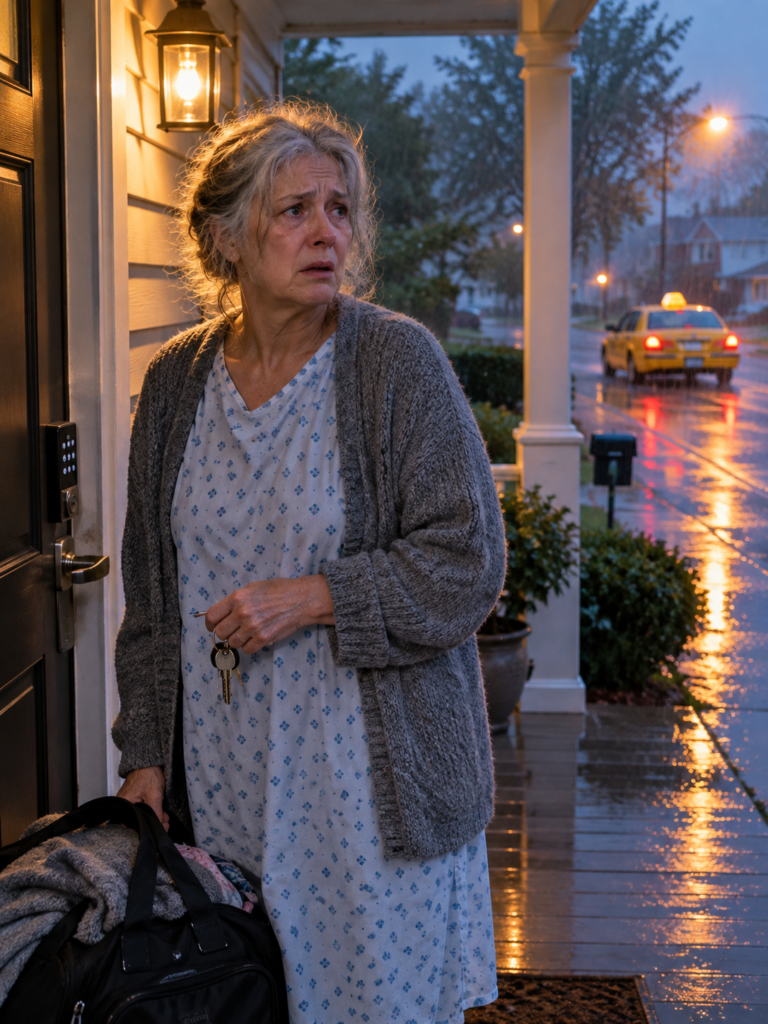
I sat in a wheelchair by the sliding glass doors of St. Luke’s with my discharge papers in my lap and a plastic bag holding everything I’d come in with. A nightgown. Slippers. My reading glasses. A paperback I hadn’t been able to focus on for two weeks.
The first call went to voicemail. So did the second. By the fifth, I’d started making excuses for him. He’s stuck in traffic. His phone died. He’s at work and can’t step away.
By the eighth, I was scared.
Kevin had promised. He’d said it on the phone the night before, in that bored voice he’d started using with me. “Yeah, Mom. Noon. I’ll be there.”
It was two-forty.
A nurse named Rosa came over. She’d taken care of me for most of those two weeks. She was about fifty, with gray streaks in her braids and reading glasses on a beaded chain. She crouched down next to my wheelchair.
“Mrs. Doyle, are you sure there’s nobody else we can call?”
“My son’s coming.”
“It’s been almost three hours, honey.”
“He’s coming,” I said. “Something must have happened. He wouldn’t just…”
I didn’t finish. Rosa looked at me with a kind of sadness I didn’t want to see.
On the tenth call, it rang four times, and then it stopped ringing. Like someone had pushed the button to send me away.
I sat there staring at my phone.
Then I thought, Something’s wrong. Something’s wrong at the house. He’s hurt. He fell. Something happened to him.
My heart started to pound. The heart they’d just spent two weeks fixing.
“Rosa,” I said. “Can you call me a taxi?”
My name is Martha. I was seventy-two years old that day.
Two weeks earlier, I’d had a heart attack in my own kitchen. I was standing at the sink washing Kevin’s dinner plates, and suddenly it felt like someone was sitting on my chest. My left arm went numb. I tried to call out, but nothing came out except a little gasp.
Kevin was in the living room. Twenty feet away. Watching a basketball game.
I knocked a glass off the counter on purpose so he’d hear it break. He yelled, “Mom, what’d you drop now?” without getting up.
It was his wife, Jessica, who finally came into the kitchen. She found me sitting on the floor against the dishwasher. She stood there for a second. Then she said, “Kevin, I think your mom’s having a stroke or something.”
He called 911. I’ll give him that. He called.
But he didn’t ride in the ambulance. He said he’d follow in the car. He showed up at the emergency room two hours later. He’d stopped to get dinner first.
They put two stents in my heart. I was in the hospital for fourteen days. Kevin visited three times. Once to bring me my glasses. Once to ask where I kept the checkbook. And once, on the fourth day, when I was still very sick and very groggy from all the medicine, to have me sign some papers.
“Just insurance stuff, Mom,” he’d said. “So I can handle the bills while you’re in here. Sign right there.”
I signed. I could barely hold the pen. I didn’t read them. I trusted him.
He was my son.
The taxi driver was a young man with a soft voice. He helped me into the back seat like I was made of glass. He carried my plastic bag.
“Where to, ma’am?”
I gave him the address. 41 Linden Street.
The house Harold and I bought in 1979. The house where we raised Kevin. The house where Harold died eight months earlier, in a hospital bed we’d set up in the living room, holding my hand.
The driver kept looking at me in the rearview mirror.
“You okay back there? You look kind of pale.”
“I’m fine,” I said. “I just had a heart attack.”
He nearly drove off the road.
“Ma’am, should I take you back to the—”
“No. Please. Just take me home. I need to see my son.”
The ride took twenty minutes. Every minute, I imagined something worse. Kevin on the floor. Kevin in a car accident. Kevin in the hospital himself and nobody had called me.
When we turned onto Linden Street, my heart was hammering so hard I put my hand on my chest. The scar from the stents ached under my blouse.
Then I saw the house.
Kevin’s car was in the driveway. Jessica’s car was in the driveway. Every light in the living room was on. Through the front window, I could see the flicker of the big TV.
Nothing was wrong.
Nothing at all.
The taxi driver carried my bag to the bottom of the porch steps. He asked twice if I wanted him to wait. I told him no. I paid him. I gave him a twenty-dollar tip because he’d been kind, and kindness felt very rare that afternoon.
He drove away slowly. I could tell he didn’t want to.
I stood on the sidewalk in the cold. It was late October. I was wearing the thin cardigan I’d been wearing the night of my heart attack. My legs were shaking. The doctor had said no stairs for a week, no lifting, no stress.
I walked up the path. There were five porch steps. I took them one at a time, holding the railing, stopping to breathe on every one.
At the top, I got out my key. The same key I’d carried on my keychain for forty-five years. Brass, worn smooth. Harold had a matching one.
I slid it into the lock.
It didn’t turn.
I jiggled it. Pulled it out. Tried again. Nothing. It wouldn’t even go in all the way.
I looked down at the lock.
It was new. Shiny silver. Not the old brass one Harold had put in himself in 1985, after a break-in down the street. This one was sleek and modern, with a little keypad above it.
I stood there with my old key in my hand, staring at a lock I didn’t recognize. On my own front door.
Then I saw the paper.
It was taped to the middle of the big oak door, at eye level. A white sheet of printer paper. The message was typed in big, thick, bold letters. Like someone was shouting.
DO NOT BOTHER KNOCKING. THIS IS MY HOUSE NOW. DAD LEFT IT TO ME. THERE IS NO ROOM HERE FOR FREELOADERS. GO FIND A NURSING HOME. — KEVIN
I read it once.
Then I read it again.
Freeloader.
That word hit me harder than the heart attack.
I’d carried that boy for nine months. I’d been in labor with him for twenty-two hours. I’d sat up with him through croup and chicken pox and a broken arm. I’d worked nights as a hospital switchboard operator for twenty years so Harold and I could pay for his college. I’d paid his car insurance until he was thirty. I’d given him the money for his first apartment. And his second. I’d let him and Jessica move into my house eight months ago, right after Harold died, when they got evicted from their condo, because Kevin said, “We’ll take care of you, Mom. You shouldn’t be alone.”
I’d been buying their groceries. Paying the electric bill. Cooking their dinners. Washing their dishes.
I’d been washing their dishes when my heart stopped.
And now I was a freeloader. On my own doorstep. Locked out of the house I’d lived in for forty-five years.
I didn’t cry.
That surprised me. I’d thought I would. I stood there waiting for it, the way you wait for a sneeze.
It didn’t come.
Instead, something else came. Something cold and clear and quiet. Like the feeling you get right before a thunderstorm.
I didn’t knock. I didn’t argue. I didn’t bang on the door and beg.
Because Harold had left me one final secret.
And I’d been saving it for exactly this.
Here’s what was happening on the other side of that door.
I didn’t know it then. I found out later. From Kevin himself, eventually. And from the police report. And from Jessica, of all people, much later still.
Inside the warm living room, Kevin was stretched out in Harold’s brown leather recliner. The one Harold had sat in every evening for twenty years to read the paper. Kevin had his feet up. He was holding a glass of scotch. Harold’s scotch. A bottle of eighteen-year-old Macallan that Harold had been saving for his eightieth birthday. He never made it to his eightieth birthday.
Jessica was sitting on the couch with a big fan of paint samples spread across her lap. She was holding one up to the wall.
“I hate this wallpaper,” she said. “It smells like old people. We need to gut it. All of it.”
Kevin laughed. A cold sound.
“Do whatever you want, babe. It’s ours now. Finally.”
Jessica looked over at him.
“Are you sure she won’t come back?”
“I changed the locks this morning,” Kevin said. He took a long sip of the scotch. “Let her try. She’ll see the note and go crying to her sister in Maple Grove. I’m done carrying her.”
“Carrying her” was a funny thing to say, considering I’d paid for the groceries that were in his refrigerator.
“Dad’s gone,” Kevin went on. “And the law’s the law. I’m the only son. Everything goes to me. And possession is nine-tenths of the law. She signed the power of attorney. I’ve got the bank accounts. I’ve got the house. By the time she figures it out, it’ll be too late.”
“What about the car?”
“Already sold it. The guy came yesterday. Cash.”
Jessica smiled and went back to her paint samples. “I want the kitchen gray. Like a light gray. And we need to get rid of that awful china cabinet.”
That china cabinet was my mother’s.
I walked back down the five porch steps one at a time.
I sat down on the bottom step, because my legs wouldn’t hold me anymore. I took out my phone. My hands were shaking, but not as badly as I expected.
I didn’t call Kevin. I didn’t call my sister, June.
I scrolled down to a number I hadn’t called in eight months.
Paul Henderson. Attorney.
He answered on the second ring.
“Martha?” he said. “Martha Doyle? I thought you were in the hospital.”
“I was,” I said. “I got out today. Paul, I’m sitting on my front steps. Kevin changed the locks.”
There was a long silence on the other end of the line.
“He did what?”
I read him the note. Every word.
When I got to go find a nursing home, I heard Paul take a sharp breath.
“Stay right where you are,” he said. “Don’t knock. Don’t go to a neighbor’s. Don’t do anything. I’m leaving now. I’m twelve minutes away.”
“Paul, what if he—”
“Martha.” His voice was very calm. “Harold made me promise. If this day ever came, I’d be there. I’m keeping my promise. Twelve minutes.”
He hung up.
I sat on my front step in the cold and waited.
I should tell you about Harold. And about the promise.
Harold Doyle was a quiet man. An electrician, for forty years. He had big rough hands and a laugh you could hear from across a parking lot. He wasn’t a talker. He didn’t say “I love you” very often. He showed it instead. He fixed things. He warmed up my side of the car in winter before I came out of the house. He brought me coffee in bed every Sunday morning for forty-six years.
He loved Kevin. I want to be clear about that. He loved our son with his whole heart.
But Harold saw things I didn’t want to see.
Six years ago, Kevin came over for dinner on a Sunday. Without Jessica. He was jumpy. Sweating. He kept checking his phone.
After dinner, he followed Harold out to the garage. I was doing dishes. I could see them through the kitchen window. Kevin talking fast with his hands. Harold standing very still with his arms crossed.
When Harold came back inside, his face was gray.
“What did he want?” I asked.
“Money,” Harold said.
“How much?”
He didn’t answer right away. He sat down heavily at the kitchen table.
“Thirty-eight thousand dollars,” he said.
I almost dropped the plate I was holding.
“What for?”
Harold looked at me for a long time.
“He’s been betting,” he said. “On sports. On his phone. Football. Basketball. Everything. He’s been doing it for two years. He owes money to some people, Martha. Not good people.”
I sat down across from him. I couldn’t breathe.
“Did you give it to him?”
“I gave him half,” Harold said. “I told him I’d give him the other half if he went to Gamblers Anonymous. He said he would.” Harold rubbed his face with both hands. “He won’t. I could see it in his eyes. He won’t.”
He was right. Kevin didn’t go. He paid off the people he owed, and six months later he was betting again. Harold found out because Kevin came back for more money. Harold said no. They didn’t speak for almost a year.
I kept sending Kevin money behind Harold’s back. Two hundred here. Five hundred there. I never told Harold. I thought I was being a good mother.
I didn’t know Harold already knew.
Five years ago, Harold was diagnosed with lung cancer. Forty years of breathing in dust and insulation in people’s attics. The doctors said maybe two years if he was lucky.
He was lucky. He got four and a half.
A few months after the diagnosis, Harold asked me to come with him to Paul Henderson’s office. Paul had done our wills twenty years earlier. He was a tall, thin man with neat gray hair who always wore a bow tie and never seemed to be in a hurry.
We sat in two leather chairs across from Paul’s big wooden desk.
“I want to change some things,” Harold said. “About the house.”
Paul nodded and took out a yellow legal pad.
“I want to put the house in Martha’s name,” Harold said. “Only Martha’s. Right now. Not when I die. Right now, today.”
I turned and looked at him.
“Harold, why? It’s already in both our names. When you go, it comes to me anyway.”
“I know,” he said. “But I want it done now. While I’m alive. While I can sign my name and prove I knew what I was doing.”
“Why?”
He took my hand. His hand was so rough. Electrician’s hands.
“Because I know our son, Marty,” he said quietly. “And I love him. But I know him.”
I didn’t understand. Not then.
Paul did. I saw him look at Harold over the top of his glasses. He put down his pen.
“Harold,” Paul said. “Are you worried about what Kevin might do after you’re gone?”
Harold didn’t answer for a long time.
“I’m worried that he’ll try to take it from her,” he said finally. “I’m worried he’ll tell her I left it to him. I’m worried he’ll make her feel like she doesn’t belong there. And Martha will believe him, because she always believes him. Because she’s his mother.”
I opened my mouth to argue.
And then I closed it.
Because I knew he was right.
So Paul did it. That same day. Harold signed a deed transferring his half of 41 Linden Street to me. Paul recorded it at the county courthouse the next morning. From that day on, the house belonged to Martha Doyle. Only Martha Doyle.
Harold also changed his will. He left Kevin some things. His tools. His truck. His watch. His fishing gear. And a sealed envelope.
But not the house. Never the house.
“Don’t tell Kevin,” Harold said, as we walked out of Paul’s office. “Not unless you have to. Let him think whatever he wants to think. But if he ever tries anything, you call Paul. You call Paul first. Promise me.”
“I promise,” I said.
“Paul,” Harold said, turning back to him in the doorway. “You promise me too. If she calls, you go. Whatever time it is. Whatever you’re doing.”
Paul nodded.
“I’ll go,” he said. “You have my word.”
Ten minutes after I hung up the phone, I heard cars.
Three of them. A black sedan. A white van with QUICK KEY LOCKSMITH painted on the side. And a police car, with its lights off but its headlights bright.
Paul Henderson got out of the sedan. He was wearing his bow tie, a long camel overcoat, and carrying a thick brown leather briefcase. He came straight to me and knelt down on the sidewalk in his good trousers.
“Martha,” he said. “Are you all right? Are you in any pain?”
“I’m all right,” I said. “Just cold.”
He took off his overcoat and put it around my shoulders. It was warm. It smelled like pipe tobacco and old books.
Two police officers got out of the cruiser. One was a big, broad man in his forties with a shaved head. The other was a young woman with her hair pulled back tight. Her name tag said OFFICER CHEN.
The locksmith was a skinny older man with a toolbox. He looked at the house. Then at me. Then at Paul.
“This the one?” he asked.
“This is the one,” Paul said.
Officer Chen crouched down next to me. “Ma’am, Mr. Henderson says you’re the owner of this home and you’ve been locked out. Is that correct?”
“Yes.”
“And who’s inside?”
“My son,” I said. “And his wife.”
She looked at the note on the door. She read it. Her face got very still.
“Did he write this?”
“He signed it.”
Officer Chen stood up. She looked at the big officer. Something passed between them.
“Mr. Henderson,” she said. “You have the deed?”
Paul opened his briefcase and handed her a document in a clear plastic sleeve. She read it carefully. Then she handed it to her partner. He read it too.
“Okay,” the big officer said. “Ma’am, you’re the sole owner of record. You have every right to enter your home.” He turned to the locksmith. “Go ahead.”
Paul held out his hand to help me up.
“Do you want to wait in the car while they open it?” he asked. “You don’t have to see this.”
“No,” I said. I stood up. My legs were still shaking, but I stood up. “I want to see it.”
The locksmith knelt down in front of the shiny new lock and took out a drill.
It made a loud, grinding, mechanical scream.
Inside the house, I heard Kevin’s voice.
“What the hell? Is she trying to break in?”
Footsteps. Heavy and angry. Coming down the front hall.
The drilling stopped. The locksmith pulled out the core of the lock. The door clicked.
And before anyone could touch it, it flew open from the inside.
Kevin was standing there. He was forty-four years old, but he looked older. Puffy around the eyes. He was wearing Harold’s old flannel shirt. The one I’d washed and folded and put in the cedar chest after the funeral.
He was holding Harold’s scotch glass.
“I told you to leave!” he shouted.
Then he saw who was standing on the porch.
It wasn’t just me.
Two uniformed police officers. A locksmith with a drill. And Paul Henderson, in his bow tie, holding his leather briefcase.
Kevin’s face went red. Then white. Then red again.
Behind him, Jessica appeared in the hallway, still holding a paint sample. She stopped dead.
“What is this?” Kevin shouted. His voice cracked. “You’re trespassing! Get out! All of you! This is my house! Dad left it to me!”
Paul stepped forward.
He looked at Kevin the way you’d look at a stain on a rug. Calmly. With a kind of tired disappointment.
“No, Mr. Doyle,” Paul said. His voice was quiet, but somehow it filled the whole porch. “You’re operating under a significant misunderstanding. Your father did not leave this house to you.”
He opened his briefcase. He took out the deed.
“In fact,” Paul continued, “your father didn’t even own this house when he died.”
Kevin stared at him.
“What are you talking about? That’s… that’s crazy. Of course he owned it. He lived here for forty-five years.”
“He lived here,” Paul said. “He did not own it. Not for the last five years.” He held up the document. “On March eleventh, five years ago, your father transferred his entire interest in 41 Linden Street to your mother. It was recorded at the Hennepin County courthouse the next morning. It’s public record. You could have looked it up any day. It would have taken you about four minutes.”
Kevin snatched the paper out of Paul’s hand. He read it. His hands were shaking.
“This is fake. This is a fake. He wouldn’t—”
“It’s certified by the county recorder,” Paul said. “Look at the stamp.”
Kevin looked at the stamp.
His face went completely white.
“So,” Officer Chen said, stepping forward. “Let me make sure I understand. Mr. Doyle, you changed the locks on a house that belongs to your mother. While she was in the hospital recovering from a heart attack. And you left a note telling her to go to a nursing home.”
“I… It’s not… I thought…”
“Is that your note?” she pointed at the paper still taped to the door.
Kevin looked at it. He didn’t answer.
“Sir, is that your note?”
“Yes,” he said. Very quietly.
Jessica stepped up behind him. Her voice was high and fast.
“We didn’t know! We didn’t know it was hers! Kevin told me his dad left it to him. He told me. I wouldn’t have—” She turned to Kevin. “You told me, Kevin. You said it was in the will!”
“I thought it was!” Kevin shouted at her. “I thought it was! Dad always said, ‘Someday this’ll all be yours!’”
“He meant after I’m gone,” I said.
Everyone turned and looked at me.
I was standing at the top of the porch steps, in Paul’s big camel coat. My cardigan was underneath it. I was holding my plastic bag from the hospital.
“Your father always said that, Kevin,” I said. “‘Someday this’ll all be yours.’ He meant after your mother is gone too. After both of us. He meant someday.” I looked at my son. “Not two weeks after my heart attack.”
Kevin opened his mouth. Nothing came out.
“There’s more,” Paul said.
He reached into his briefcase again. He took out a second document. Several pages, stapled together.
“Mr. Doyle,” he said. “While your mother was in the intensive care unit on her fourth day, you had her sign a durable power of attorney. Is that correct?”
Kevin went very still.
“It was just for the bills,” he said. “So I could pay the bills while she—”
“You told her it was insurance paperwork,” Paul said. “She was on heavy sedation at the time. I spoke with her cardiologist this afternoon, Dr. Reyes. She was quite clear. On that day, your mother was not legally capable of understanding a contract. Dr. Reyes put it in writing.” He held up another sheet of paper. “Which means the power of attorney is void.”
“Void?”
“Invalid. Worthless. It never existed.”
Kevin’s eyes darted back and forth between Paul and the police officers.
“I also spoke with your mother’s bank this afternoon,” Paul went on. Calmly. Like he was reading a grocery list. “Using that power of attorney, you withdrew forty-one thousand dollars from her savings account over the past eight days. In five separate withdrawals. The bank has security footage of each one.”
I put my hand on the porch railing. I hadn’t known that part. Paul hadn’t told me on the phone.
Forty-one thousand dollars. Almost everything I had. Everything Harold and I had saved.
“And yesterday,” Paul said, “you sold your mother’s car. A 2019 Buick that is registered in her name only. For eight thousand dollars cash. To a private buyer.” He looked at Kevin over his glasses. “That buyer called the DMV this morning to transfer the title. He couldn’t, because your mother’s signature wasn’t on it. The DMV called the police. They have his statement.”
Officer Chen took a small notebook out of her pocket.
“Mr. Doyle,” she said quietly. “I’m going to need you to step out onto the porch.”
Kevin didn’t move.
He just stood there in the doorway, in his father’s flannel shirt, holding his father’s scotch glass. He looked at me.
And for a second, just one second, I saw him. My boy. The little boy who used to fall asleep on Harold’s chest watching baseball on Sunday afternoons. The boy who made me a clay ashtray in third grade even though nobody in our house smoked.
“Mom,” he said. His voice was small. “Mom, please. Tell them. Tell them it was a mistake. Tell them I’m your son.”
Everyone looked at me.
The cold wind blew down Linden Street. Somewhere, a dog barked.
I thought about the ten phone calls. I thought about Rosa crouching by my wheelchair. I thought about the note on the door. Freeloader.
I thought about the forty-one thousand dollars.
And I thought about Harold. In Paul’s office. I know our son, Marty. And I love him. But I know him.
“You are my son,” I said. “That’s the problem, Kevin. You’ve always been my son. And I’ve always let that be enough. No matter what you did.”
“Mom—”
“I let you take money from me for six years,” I said. “Behind your father’s back. I let you gamble it away. I let you and Jessica move into my house and I paid for everything. I washed your dishes. I washed your dishes while my heart was stopping, Kevin. You were twenty feet away. And you yelled at me for dropping a glass.”
He flinched like I’d hit him.
“I’m not going to tell them it was a mistake,” I said. “Because it wasn’t. You knew exactly what you were doing. You had me sign that paper when I couldn’t even hold a pen. You took everything you could get. And then you locked me out of my own house and told me to go find a nursing home.”
I took a breath. My chest hurt. The doctor had said no stress.
“So I’m not going to lie for you,” I said. “Not this time. Not ever again.”
Kevin started crying.
Not like a man. Like a little boy. Big, gulping sobs, standing in the doorway. The scotch glass slipped out of his hand and shattered on the hardwood floor.
Jessica stepped away from him.
The big officer put his hand on Kevin’s arm. Not roughly. Just firmly.
“Come on, son,” he said. “Come out onto the porch. Let’s talk about this.”
Kevin came out. He stood on the porch in his socks. Harold’s flannel shirt hanging off his shoulders.
Officer Chen turned to me.
“Mrs. Doyle,” she said gently. “I need to ask you. Do you want to press charges? For the theft? For the car? For the power of attorney?”
That was the question. The one I’d been dreading since Paul told me about the money.
I looked at my son, crying on my porch.
I thought about everything I could do. I could say yes. Send him to jail. Let him find out what it’s like to have nowhere to go.
Or I could say no. Let it go. Like I always had.
“Not tonight,” I said.
Officer Chen nodded slowly. “That’s okay. You don’t have to decide tonight. You have time.” She looked at Kevin. “But Mr. Doyle, you and your wife will need to leave this residence. Tonight. Pack a bag. Mrs. Doyle needs to rest, and she can’t rest with you here.”
“Where am I supposed to go?” Kevin said. His voice cracked.
Jessica was already walking past him down the porch steps. She had her purse over her shoulder and her car keys in her hand. She didn’t look at him.
“I’m going to my mother’s,” she said. “Alone.”
“Jess—”
“Don’t, Kevin.” She stopped at the bottom of the steps and turned around. Her eyes were wet. “You told me it was yours. You told me your mom was a burden. You told me she’d be happier in a home. You told me she wanted to go.” She shook her head. “And she just had a heart attack. And you wouldn’t even pick her up from the hospital. I asked you this morning if you were going to get her. And you said, ‘Let her take a cab. She’s got money.’”
She looked at me.
“I’m sorry, Mrs. Doyle,” she said. “I’m sorry about the wallpaper. And the china cabinet. And everything. I didn’t… I should have asked more questions. I should have asked a lot more questions.”
Then she got in her car and drove away.
Kevin stood on the porch and watched her taillights disappear around the corner.
They let him pack a bag. Officer Chen went in with him and stood in the bedroom doorway while he threw clothes into a duffel bag. It took ten minutes.
When he came back out, he was wearing his own coat. Not Harold’s flannel. He’d left it folded on the end of the bed. I saw it later.
He stopped next to me on the porch.
“Mom,” he said. “I don’t have anywhere to go.”
“You have money,” I said. “Forty-one thousand dollars, I hear.”
He looked down at his shoes.
“It’s gone,” he said.
“What do you mean, gone?”
He didn’t answer for a long time.
“I owed people,” he said finally. Very quietly. “Again. A lot. They were… they said if I didn’t pay by the end of the month…” He swallowed. “I paid them. Most of it. The rest I lost. Trying to win it back.”
I stood there on the porch.
Eight days. Forty-one thousand dollars. Gone.
“The house,” I said slowly. “That’s why you needed the house.”
He nodded. He couldn’t look at me.
“Jessica found a realtor,” he said. “We were going to sell it. In the spring. I was going to pay everybody back and we were going to move to Arizona. Start over.” He laughed. It came out ugly. “That was the plan.”
“And me?”
He didn’t answer.
“And me, Kevin? Where was I going to be? In the spring?”
“In a home,” he whispered. “A nice one. I looked at brochures.”
I closed my eyes.
When I opened them, he was still standing there. Waiting. Like he used to wait when he was little and he’d broken something and he was waiting to see how mad I’d be.
I reached into my purse.
I took out my old brass key. The one that hadn’t turned.
I held it out to him.
“Here,” I said.
He stared at it. Confused.
“That’s my key,” I said. “Your father had one just like it. We used them for forty-five years. They don’t work anymore. You made sure of that.” I put it in his hand. “I want you to keep it. So you remember. You remember what you locked out.”
He closed his fingers around it.
Then he walked down the steps, past the police car, past the locksmith’s van, and down the sidewalk into the dark.
I watched him go until he turned the corner.
He didn’t look back.
Paul helped me inside.
The house smelled like scotch and paint samples. There were dirty dishes stacked in the sink. Kevin and Jessica’s things were everywhere. Jessica’s makeup on the bathroom counter. Kevin’s sneakers by the door. Pizza boxes on the kitchen table.
In the living room, Jessica had already started peeling back a corner of the wallpaper. The yellow roses Harold and I had picked out together in 1984. A long strip was hanging off the wall, curled up like a tongue.
I stood there and looked at it.
Paul brought me a glass of water and made me sit down. Not in Harold’s recliner. I couldn’t sit there yet. On the couch.
The locksmith put in a new lock. A simple brass one, like the old one. He handed me three shiny new keys on a ring. He wouldn’t take any money.
“My mom’s eighty-one,” he said. “If anyone ever did this to her, I’d want somebody to fix it for free.”
The police officers left. Officer Chen gave me her card.
“Whenever you decide,” she said. “About the charges. Call me. And Mrs. Doyle?”
“Yes?”
“You did really well tonight,” she said. “Most people can’t stand up to their own kids. I see it all the time. Grandmothers giving away everything they have. Getting pushed out of their own homes.” She shook her head. “You did really well.”
After she left, Paul sat down across from me in an armchair.
“Martha,” he said. “There’s one more thing.”
He opened his briefcase one last time. He took out a sealed envelope. It was old. A little yellowed. On the front, in Harold’s big blocky handwriting, it said:
For Kevin. Only if he tries.
“Harold gave me this the day he signed the deed,” Paul said. “He told me, ‘If Kevin ever tries to take the house from Martha, you give her this. And she decides whether he gets to read it.’”
I took the envelope. My hands were shaking.
“He knew,” I said. “Harold knew this would happen.”
“He was afraid it would,” Paul said. “He prayed it wouldn’t. He told me that. He said, ‘I hope you never have to use any of this, Paul. I hope I’m wrong about my boy.’”
I held the envelope against my chest.
“Have you read it?”
“No,” Paul said. “It’s not mine to read.”
I looked at it for a long time.
Then I put it in my lap. I didn’t open it. It wasn’t mine to read either.
My sister June came the next morning. She drove in from Maple Grove with a suitcase and a casserole and a look on her face like she was ready to commit murder.
“I’m staying for a month,” she announced in the doorway. “Don’t argue. I already packed my blood pressure pills.”
She’s sixty-eight. Four years younger than me. She’s been a widow for ten years. She never liked Kevin. She never said it out loud, but I always knew.
She spent the first day cleaning. Scrubbing every dish. Throwing out every pizza box. Packing up all of Kevin’s and Jessica’s things into boxes and stacking them in the garage.
She found the realtor’s brochure in a kitchen drawer. A glossy folder with a picture of my house on the front. 41 LINDEN STREET — COMING SOON — CHARMING 1950s COLONIAL WITH POTENTIAL.
Under it, she found the nursing home brochures. Three of them. Each one cheaper than the last.
She stood in the kitchen holding them. Then she ripped them in half. And in half again. And again. Until they were confetti. Then she threw them in the trash and slammed the lid.
“I’m sorry, Marty,” she said. “I know he’s your son. But if I see him, I’m going to hit him with this casserole dish.”
“Please don’t,” I said. “It’s my good Pyrex.”
She laughed. Then she sat down at the kitchen table and cried.
On the second day, June and I put the wallpaper back. We found an old roll of the yellow roses in the basement, left over from 1984. Harold never threw anything away. We matched the pattern and glued it back up where Jessica had torn it. You can still see the seam if you look really close.
On the third day, I sat in Harold’s recliner for the first time.
I put my feet up. I closed my eyes.
It still smelled a little like him. Under the scotch Kevin had spilled on it. Under everything.
“You were right,” I said out loud. “You were right about him. I’m sorry I didn’t listen.”
The house was quiet.
But I felt better.
Kevin didn’t call for three weeks.
I found out from a neighbor, Frank Delaney, who knew a guy who worked at the Shell station on Highway 7, that Kevin had been sleeping in his car. In the back parking lot of the station. Frank said the guy saw him washing his face in the bathroom sink every morning.
I didn’t go to him.
June said I was doing the right thing. I didn’t know if I was. I lay awake every night thinking about my son sleeping in a car in the cold.
Paul came by on a Tuesday to check on me. I asked him about the money.
“I want it back,” I said. “Not to punish him. I need it. I’m seventy-two. My heart medicine is three hundred dollars a month.”
Paul nodded. “We can file a civil claim. Get a judgment. He’ll have to pay you back whatever he earns, a little at a time. Or you can press criminal charges, and the court will order restitution.” He looked at me. “That would mean a record, Martha. Maybe jail time. It would follow him the rest of his life.”
“What would Harold do?”
Paul thought about that.
“Harold,” he said slowly, “would want him to pay it back. Every dollar. With his own two hands. But Harold wouldn’t want him in jail. I don’t think Harold ever wanted him to suffer. He just wanted him to learn.”
“Then that’s what we’ll do,” I said.
Kevin called on a Thursday night. Almost a month after the porch.
I was sitting in Harold’s recliner watching Jeopardy! with June. My phone rang. I looked at the screen. My heart did a little flip. The doctor said I had to watch out for those.
“Don’t answer it,” June said.
I answered it.
“Mom?”
His voice was hoarse. Tired. Older.
“Hello, Kevin.”
“I… I’m sorry to call. I know you probably don’t want to talk to me.” He stopped. Started again. “I went to a meeting. Today. Gamblers Anonymous. In the basement of the Lutheran church on Excelsior.”
I didn’t say anything.
“It was my first one,” he said. “I’ve been driving past it for two weeks. Sitting in the parking lot. Today I went in.” He laughed a little. “There was an old guy there. Like seventy. He’s been going for nineteen years. He lost his house. His wife. His kids wouldn’t talk to him for eight years.” His voice broke. “He told his story, and I sat there and thought, that’s going to be me. That’s going to be me if I don’t stop.”
“Kevin—”
“I’m not calling to ask for anything,” he said quickly. “I swear. I’m not asking for money. I’m not asking to come home. I just… I wanted you to know. I went. That’s all.”
I was quiet for a long time.
On the TV, Alex Trebek’s replacement said, “That is correct.”
“Where are you sleeping?” I asked.
He didn’t answer.
“Kevin. Where are you sleeping?”
“In the car,” he said. “Behind the Shell station.”
I closed my eyes.
“It’s going to be fifteen degrees tonight,” I said.
“I know. I’ve got blankets.”
June was staring at me from across the room. She was shaking her head. Slowly. Don’t you dare.
I looked at her.
“There’s a men’s shelter on Lake Street,” I said into the phone. “The Salvation Army. I called them last week. They have a bed for you if you want it. Ask for Gerald. He knows your name.”
There was a long silence.
“You called them?” Kevin said. “For me?”
“I’m still your mother,” I said. “That part doesn’t change.”
“But you’re not letting me come home.”
“No,” I said. “I’m not.”
Another long silence.
“Okay,” he said. Very quietly. “That’s fair. That’s more than fair.”
He went to the shelter. Gerald called me the next morning to tell me.
“Big guy?” he said. “Sad eyes? Wouldn’t stop saying thank you?”
“That’s him.”
“He’s okay, Mrs. Doyle. He’s got a bed. He ate breakfast. He’s asking about jobs.”
I hung up the phone and sat in the kitchen and cried. June made me tea and didn’t say anything. She just sat with me.
Kevin got a job at a tire shop on Highway 55. Changing tires. Twelve dollars an hour to start. He’d been a regional sales manager for a medical supply company until he got fired for missing too many days. He’d never worked with his hands in his life.
He called me after the first week.
“My back is killing me,” he said. “My hands are all cut up. I smell like rubber. I came home and fell asleep in my clothes.”
“Your father came home like that every day for forty years,” I said.
He was quiet.
“I never thought about it,” he said. “I never once thought about it. I just thought Dad liked being tired.”
“Nobody likes being tired, Kevin. He did it for us.”
“Yeah,” Kevin said. “I’m starting to get that.”
Paul drew up an agreement. Kevin signed it in Paul’s office on a Wednesday afternoon in December. I wasn’t there. I didn’t want to see him yet.
Kevin agreed to pay me back the forty-one thousand dollars. Plus the eight thousand for the car. Forty-nine thousand total. Two hundred dollars a month. It would take him over twenty years.
“He didn’t argue,” Paul told me afterward. “Not about one single number. He just signed it.”
“Did he say anything?”
Paul hesitated.
“He asked how you were,” Paul said. “Your heart. He asked if you were taking your medicine. He asked if June was still there. He asked if you’d put the wallpaper back.”
I didn’t know what to say.
“And Martha,” Paul said. “He asked about the envelope.”
“What envelope?”
“Harold’s. He asked if Harold left him anything. Anything at all. Even just a note.” Paul looked at me. “I told him that was up to you.”
I opened the drawer where I kept the envelope. For Kevin. Only if he tries.
I’d been keeping it for two months. I’d held it a hundred times. I’d never opened it. It wasn’t mine.
I thought about Harold in Paul’s office. She decides whether he gets to read it.
I thought about my son in the basement of a Lutheran church. In a shelter on Lake Street. With cut-up hands that smelled like tires.
Then I called him.
“Can you come to the house on Sunday?” I said. “At two. Just for an hour.”
He was quiet for so long I thought the call had dropped.
“Are you sure?” he said finally.
“I’m sure.”
He came at two o’clock exactly on Sunday. He rang the doorbell. He didn’t try to come in.
I opened the door.
He looked different. Thinner. His face was red from the cold. He was wearing a cheap gray winter coat from the Salvation Army thrift store. His hands were rough and cracked, with black grease in the creases of his knuckles that wouldn’t wash out.
Just like Harold’s used to be.
“Hi, Mom,” he said.
“Hello, Kevin.”
He stood on the porch. He didn’t move. He looked at the new brass lock.
“Can I come in?”
“Yes,” I said. “You can come in.”
He wiped his feet on the mat for a long time. Then he stepped inside.
He stopped in the front hall. He looked around. At the yellow rose wallpaper. At the seam where June and I had glued it back. At my mother’s china cabinet, still standing in the corner of the dining room.
“You fixed it,” he said quietly.
“June and I.”
“It looks good.”
“It looks like it always did.”
“Yeah,” he said. “That’s what I mean.”
June came out of the kitchen. She stopped in the doorway with a dish towel in her hands. She looked at Kevin. Kevin looked at her.
“Aunt June,” he said.
“Kevin.”
She didn’t hit him with the casserole dish. She just nodded, very stiffly, and went back into the kitchen. I heard her banging pots louder than she needed to.
We sat at the kitchen table. I made coffee. He held the mug with both hands like he was trying to get warm.
I put the envelope on the table between us.
He looked at it. He saw his father’s handwriting. For Kevin. Only if he tries.
He went very pale.
“Dad wrote this?”
“Five years ago. The same day he put the house in my name.”
“Only if he tries,” Kevin read. His voice was shaking. “He knew. Didn’t he. He knew I’d try to take it.”
“He was afraid you would,” I said. “He hoped you wouldn’t.”
Kevin picked up the envelope. He turned it over in his cracked hands. He didn’t open it.
“Have you read it?”
“No. It’s yours.”
He looked at it for a long time.
“I don’t know if I can,” he said.
“Then don’t. You can take it with you. Read it when you’re ready.”
He shook his head. “No. I need to… I think I need to read it here. With you.” He swallowed. “Will you stay? While I read it?”
“I’ll stay.”
He slid his thumb under the flap. It was old glue. It came open easily.
There was one sheet of paper inside. Harold’s handwriting. Big and blocky. A little shaky. He was already sick when he wrote it.
Kevin read it. His lips moved a little, the way they used to when he was a boy reading comic books.
Then he put it down on the table. He put his hands over his face.
And he cried.
I’d seen him cry on the porch. That night. But that was different. That was fear. That was a little boy who’d been caught.
This was something else. This was grief. Real grief. For his father. For himself. For everything he’d done.
I didn’t touch him. I didn’t say anything. I just sat across from my son at the kitchen table and let him cry.
After a long time, he slid the letter across the table to me.
“Read it,” he said. “Please. I want you to know what he said.”
I picked it up.
Kevin,
If you’re reading this, it means you tried to take the house from your mother. And she let you read this anyway. Which means she’s a better person than either of us.
I’m not going to yell at you, son. I’m too tired for that. I’m sick and I’m going to die, and I don’t want my last words to you to be angry ones.
I want you to know I love you. I’ve always loved you. From the minute the nurse put you in my arms, you were the best thing I ever did. Even now. Even after this.
But I’ve watched you for a long time. I watched you take from your mother. I watched you lie to her. I watched her lie to me to protect you. I watched you get lost in those phone games, and I watched you get angry at everyone who tried to help you.
I couldn’t fix you. Neither could your mother. Lord knows she tried. She’d give you her own heart if you asked for it.
That’s why I put the house in her name. Not to punish you. To protect her. From you. Because she would never protect herself.
Here’s what I want you to know. There’s only one person who can fix you, Kevin. It isn’t me. It isn’t your mother. It’s you.
You’re going to have to fall all the way down. I’m sorry. I wish there was another way. But I know you, son. You won’t stop until you hit the bottom. So hit it. And then get up.
When you get up, go to your mother. Not to ask for anything. Just to sit with her. Fix something in the house. Mow the lawn. Change the furnace filter, it’s in the basement next to the water heater. She won’t remember to do it.
Be the man I couldn’t make you be.
I’ll be watching. I’m pretty sure I’ll be watching.
Love,
Dad
P.S. Leave my Macallan alone. That’s for your mother. She’s going to need a drink.
I put the letter down.
I was crying too now. Both of us. At the kitchen table. In the house where Harold died.
“I drank it,” Kevin said through his hands. “The Macallan. I drank half of it. That night. Sitting in his chair.”
“I know,” I said. “I smelled it on the recliner.”
He laughed. A broken, wet laugh. And then I laughed too. I couldn’t help it. Both of us sitting there with tears running down our faces, laughing about a bottle of scotch.
June stuck her head in from the kitchen. She looked at us. She looked at the letter.
“Well,” she said. “I guess I’ll make more coffee.”
Before he left that afternoon, Kevin asked if he could go down to the basement.
“What for?”
“The furnace filter,” he said. “Dad said you wouldn’t remember to change it.”
I hadn’t. I hadn’t changed it once since Harold died.
He went down. I heard him banging around. He came back up twenty minutes later with dust on his face and the old filter in his hands. It was gray and clogged and disgusting.
“It’s been eight months,” he said. “You’re lucky the furnace didn’t quit.”
“Your father always did it.”
“I know,” Kevin said. “I’ll do it now. If that’s okay. Every three months. I’ll come over and do it.”
I looked at my son, standing in the kitchen with a dirty furnace filter and grease under his fingernails.
“That’s okay,” I said.
That was a year ago.
Kevin comes every Sunday now. Not for dinner. Not to ask for anything. He comes at two o’clock and he works.
He fixed the leaky faucet in the upstairs bathroom. He cleaned out the gutters. He raked the leaves in October and shoveled the driveway every time it snowed. He fixed the third porch step, the one that always wobbled. He replaced the light in the front hall that had been out since Harold got sick.
He doesn’t know how to do most of it. He watches videos on his phone. He gets it wrong the first time. Sometimes the second time. Last spring, he flooded the basement trying to fix the washing machine hose. He stood in two inches of water with a wrench in his hand, looking up at me at the top of the stairs.
“Dad would’ve known how to do this,” he said.
“Your father flooded that basement twice,” I said. “In 1987 and 1994. You come by it honestly.”
He laughed so hard he slipped and sat down in the water.
He still goes to his meetings. Every Tuesday and Thursday at the Lutheran church on Excelsior. He hasn’t placed a bet in fourteen months. He showed me the little chip they gave him. He keeps it on his keychain.
Right next to my old brass key. The one that didn’t turn.
“Why do you keep that?” I asked him once.
He looked down at his keychain.
“Because you told me to,” he said. “So I remember. What I locked out.” He turned the old key over in his fingers. “Every time I want to place a bet, I look at this key. And I think about you sitting on that porch. In the cold. Two weeks after your heart attack.” He swallowed. “And I don’t do it.”
He got promoted at the tire shop. Assistant manager now. Sixteen-fifty an hour. He moved out of the shelter in March into a tiny studio apartment above a laundromat. He sends me two hundred dollars on the first of every month. He’s never been late.
He and Jessica got divorced in August. It was quiet. Nobody fought. She sent me a card afterward. It said, I’m sorry. I hope you’re doing well. I’m glad he’s getting better. I’m getting better too. I put it on the refrigerator.
June went home after three months. She calls every morning to make sure I’ve taken my pills.
Paul retired in September. He came to see me on his last day of work. He brought a bottle of Macallan eighteen. A new one. With a bow on it.
“From Harold,” he said. “He asked me to make sure you got a drink when this was all over.”
I cried. Paul cried. We each had a very small glass at the kitchen table.
Last month was my seventy-third birthday.
Kevin came over at two o’clock on a Sunday, like always. But this time he brought a cake. A sheet cake from the grocery store, with yellow frosting roses on it. To match the wallpaper.
“I didn’t know what else to get you,” he said. “You don’t need anything. You’ve got everything already.”
“That’s true,” I said.
We ate cake at the kitchen table. Just the two of us.
Afterward, while he was washing the plates, I went into the front hall. I opened the little drawer in the table by the door. The one where I keep the spare keys.
I took out one of the three shiny brass keys the locksmith gave me that night. I’d never given the other two to anyone. One for me. One for June. One just sitting in the drawer for a whole year.
I went back to the kitchen.
Kevin was drying the last plate. I held out the key.
He looked at it. Then at me.
“Mom,” he said. “I can’t—”
“I’m not giving you the house,” I said. “Let me be clear. The house is mine. When I die, it goes to a trust. Paul set it up. You’ll get your share someday. Not before.”
He nodded slowly.
“But I’m seventy-three,” I said. “And I have a bad heart. And if I fall down some night, or my heart stops again while I’m washing dishes, I want somebody who has a key.” I put it in his hand. “Somebody who’ll come. Not twenty feet away watching basketball. Somebody who’ll come.”
He stared at the key in his palm. His cracked, rough, greasy palm. His father’s hands.
“You trust me with this?” he whispered.
I looked at my son.
Forty-five years old. Fourteen months without a bet. Two hundred dollars on the first of every month. A furnace filter changed every three months, right on schedule.
“I’m learning to,” I said. “One Sunday at a time.”
He closed his fingers around the key.
Then he put it on his keychain. Right next to the old one. The one that didn’t turn.
Two keys. One for what he’d locked out. One for what he was being let back into.
He didn’t say anything. He didn’t have to.
He just hugged me. Carefully. Gently. Like I was made of glass. The way the taxi driver had helped me into his back seat that day.
And for the first time in a long time, my son held me like he was afraid of losing me.
Instead of like he was waiting for me to be gone.