“I believe that boy right there knows something.”
Betty Shears was standing straight up at her table near the front of the fellowship hall. She’s seventy-nine years old. She’s buried two husbands. She’s played the organ at Mount Hope Community Church since before I was born.
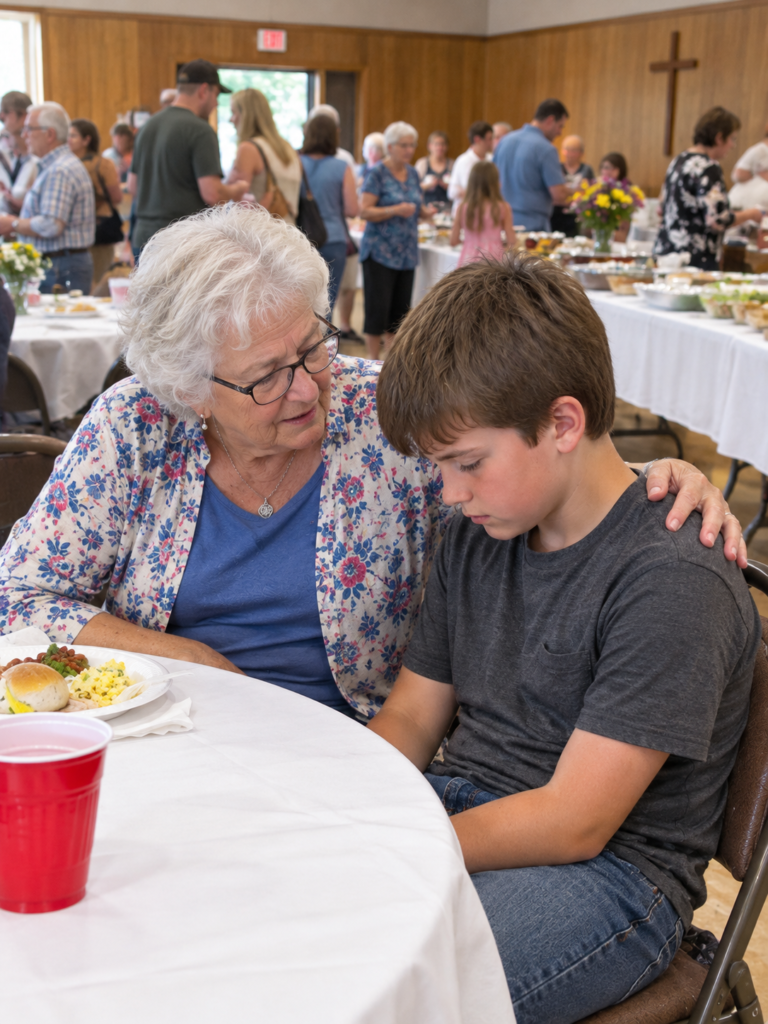
And she was pointing her cane straight across the room at my grandson.
Every head at every table turned.
Wyatt’s ears went the exact color of the cranberry relish on the table in front of him.
I need to back up a little. Because you can’t understand what happened in that hall without understanding the two minutes before it.
It was the Wednesday supper before Thanksgiving. The fellowship hall was so full that night that Pastor Ward had to send the Hendricks boys to carry in extra folding chairs from the Sunday school rooms. Even then, my husband Dale and I ended up at the very end of a table jammed up against the dessert line. I could smell the cinnamon on somebody’s apple crisp the whole supper long.
Wyatt sat between us.
He’s twelve. My son Curtis’s boy. He’d been picking at the same plate of scalloped potatoes for ten minutes without eating one bite.
And I remember thinking, the way you sometimes think a small true thing right before a big one, that my grandson had been acting strange for two months. And I still didn’t know why.
Then Pastor Ward stood up at the front of the hall with his coffee cup in his hand. He said he had one announcement before the pie got cut.
Dana Dermot stood up beside him. Her husband Roy stood up too, and their boy Micah.
The whole hall went quiet. That particular kind of quiet when everybody already half knows what’s coming and wants to hear it said out loud anyway.
“Some of you know our family had a hard fall,” Dana said.
Her voice caught on the word hard.
“The furnace went in September, and we lost near everything upstairs. And so many of you fed us and gave us clothes and prayed for us. I’m never going to stop being grateful to this church.”
She stopped. She pressed her lips together. Roy put his hand flat on her back.
“But something happened a few weeks ago that I have to say in front of everybody. Because I don’t know how else to find out who did it.”
Beside me, Wyatt went very still.
Not fidgeting anymore. Still the way a rabbit goes still when a hawk’s shadow crosses the yard.
“Micah’s school lunch account had gotten so far behind I was sick about it,” Dana said. “I didn’t even know how far behind until the school called me. To tell me somebody had paid it off.”
The room was dead silent.
“All of it. A hundred and ten dollars. Paid in cash. And the woman in the office wouldn’t tell me who, because whoever did it asked her not to.”
She looked down at her son.
Micah was twelve. He was wearing a brand-new canvas work coat. It was still so new and stiff that you could see the fold creases in the sleeves from the store.
“And three days after that,” Dana said, “a box showed up on our porch. A coat. And boots. His size exactly. Nobody rang the bell. Nobody left a name.”
I felt my grandson’s shoulders come up around his ears. Like a turtle pulling into its shell.
And thirty seconds later, when Dana said the words I would have paid every dollar I own for her never to have needed to say, I understood. All at once. Completely.
I knew exactly where two hundred and forty dollars of lawn-mowing money had gone.
“Whoever you are,” Dana said, and her voice broke clean in half, “you kept my son from being the boy at school in the old coat. You kept him from being ashamed. I don’t care if you never tell me your name. I just need you to know what you did.”
Wyatt slid down in his folding chair so far and so fast that his chin nearly hit the edge of the table.
I put my hand on his shoulder.
And that was the moment half the room turned and looked at us. Because a grandmother can’t keep her face still when her heart is doing what mine was doing right then.
And that was when Betty Shears stood up with her cane.
But to understand how a twelve-year-old boy came to be sitting in that folding chair with two hundred and forty dollars of secret on his conscience, you have to go back to June.
To a boy with a push mower and a coffee can.
And a grandmother who thought she already knew everything there was to know about him.
My name is Lois Teague. I’m sixty-eight years old. I’ve lived in Henry County my whole life. Our town is small enough that the bank teller knows your middle name and the man at the feed store knows what your cattle eat.
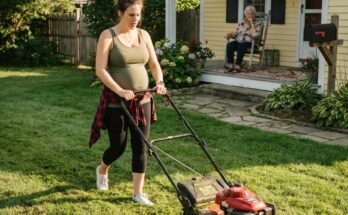
Wyatt started mowing lawns the summer he turned eleven. The summer before this one.
Dale pulled an old Toro push mower out of our pole barn. It hadn’t run in six years. He went over it blade, belt, and spark plug until it ran like something twice its age had no right to run.
Dale is seventy. He was a lineman for the rural electric cooperative for thirty-one years before he retired. There isn’t a small engine in Henry County he can’t get running again.
He taught Wyatt to check the oil before every single job. And to never, ever mow wet grass.
“Wet grass clumps,” he said. “It chokes a mower. And a boy who ruins his equipment in July has no business in August.”
The two of them spent a whole Saturday out in the pole barn with that Toro flipped up on two cinder blocks. Dale talked Wyatt through cleaning the carburetor in the same slow, patient way he used to walk new linemen through a bucket truck inspection.
By the end of that afternoon, Wyatt could name every single part he’d touched.
That’s how Dale does things. He doesn’t hand a boy a mower that runs. He hands him a mower that doesn’t run yet, and the tools to make it run. Then he stands back with his arms crossed and lets the boy get frustrated before he says one word.
That’s how Dale taught our son Curtis. That’s how Dale’s own father taught him. I quit trying years ago to talk any of the Teague men out of doing things that slow, backward way. Because it works.
Word gets around fast in a town our size.
By this second June, Wyatt had eleven steady yards. Strung out along County Road 400, and two more streets into town once you cross the bridge by the grain elevator.
The Hoskins place, with its half acre of fescue.
The Petries, who always had a glass of sweet tea waiting for him on the porch rail, whether he wanted it or not.
And old Mrs. Feagin.
Mrs. Feagin is eighty-three. She’s lived alone since her husband passed four years ago. She paid Wyatt an extra five dollars every single week just to carry her trash cans back up from the road.
Both of us know she could do that herself if she had to.
Some jobs a boy does for the money. Some jobs you let a boy do for the company. And you pay him anyway, so neither one of you has to say that part out loud.
He ran that mower six days a week, rain permitting.
He came home every evening with grass stains on his knees and salt rings on his T-shirt from sweat. He’d drink two glasses of water standing at the kitchen sink without stopping to breathe.
And he kept every dollar he earned in a coffee can on the shelf in his closet.
A red Folgers can with the plastic lid pressed back on.
That’s where his father kept his money at that age, too. Curtis had a Folgers can on the exact same shelf, in the exact same bedroom, thirty years ago. Nobody told Wyatt that. Some things in a family just repeat themselves without anybody deciding they should.
I knew about the can.
I helped him count it in July. We sat on his bedroom floor and sorted the bills into piles. Ones, fives, tens, twenties. The way you’d sort canning jars by size.
It was a hundred and ninety dollars then.
“You’re going to be a rich man by Labor Day,” I told him.
He grinned at me. That big gap-toothed grin, with the space where his molar was still coming in.
“I’ve got plans for it, Grandma,” he said.
I didn’t ask what plans.
What business is it of a grandmother’s what a boy does with money he earned pushing a mower in ninety-degree heat?
Now, I know what somebody reading this is going to ask before I finish. So I’ll say it right now, plainly.
Why didn’t I just ask him?
I did ask him. Once.
The last Saturday in September, I went into his closet to put away some laundry. I noticed the coffee can was light. A lot lighter than it should have been, with three more weeks of mowing still left in the season.
I took it down. I looked inside.
There was maybe thirty dollars in it.
I found Wyatt in the kitchen and asked him straight out where the money had gone.
He looked at his shoes for a long time.
“It’s spent, Grandma,” he said. “And it’s spent right.”
That’s all he’d say. Not one word more.
Dale was out the window, fixing a fence post. He’d heard. He leaned his head in the back door.
“Lois,” he said. “Let the boy have his own business.”
And that was that.
We don’t interrogate kindness in this family. And I had a feeling, somewhere deep down, that it was kindness. If pressing him had meant making him explain somebody else’s shame out loud before he was ready, then I’d rather not know for one more month than make him do that.
It was the hardest thing I’ve ever not asked.
And I don’t regret it one bit.
The furnace at the Dermot place went bad on a Tuesday night in the middle of September.
A crack in the heat exchanger, the fire department said afterward. The kind that lets a slow smolder start up behind a wall where nobody can see it. Until it isn’t slow anymore.
Nobody was hurt. Thank the Lord, and thank the smoke detector Roy Dermot had put fresh batteries in not two weeks before.
But they lost the whole upstairs to smoke and heat. Every bedroom. Every closet. Every stitch of clothing.
The family had to move into Roy’s brother’s basement two towns over for six weeks while the insurance people did whatever it is insurance people do. Which in my experience is slowly.
The church took up what Pastor Ward calls a love offering the very next Sunday. People brought coats and canned goods and blankets and a folding cot. I put twenty dollars in the plate myself.
And I thought that was the end of what I personally had to do with it.
I heard about the fire the ordinary way news travels in a town our size. Standing in line at the diner on Main Street, listening to two women ahead of me talk about it over their coffee.
One of them said the fire department figured the smoke had built up behind the hallway wall for the better part of a week before anybody smelled it.
The other one said thank the Lord nobody was asleep upstairs when the detector finally went off.
I nodded along the way you do. I filed it away under things in town that are sad and none of my business. I went home and mentioned it to Dale at supper.
Neither one of us thought another thing about it.
Here’s what I didn’t know.
I didn’t know Wyatt sat two rows behind Micah Dermot in Mrs. Castellano’s sixth-grade homeroom.
I didn’t know that in late September, Micah started wearing the same thin gray hoodie to school every single day. Because it was the only coat that survived the fire.
I didn’t know the other boys had started calling him Gray Hoodie behind his back.
That’s what twelve-year-old boys do. They find the one true thing about another boy’s situation and turn it into a knife. Without ever once thinking of it as cruelty.
I didn’t know that the lunch register at the middle school flashes a little red number up on the screen when a kid’s account is behind. Right there at the counter, where every single kid in line can see it.
I found all of this out afterward. In pieces.
The way you put together a quilt from scraps people hand you one at a time.
Mrs. Pruitt in the school office told me some of it. Dana told me some of it. Ed Begley at the feed store told me some of it.
And Micah himself, eventually, sitting at my own kitchen table eating banana bread, told me the rest.
Here’s what I know now.
Sometime in early October, Wyatt asked if he could walk home from school a different way. Down Main Street. Past Begley’s Western and Farm Supply.
He went into Begley’s alone three separate afternoons before he ever did anything.
He just stood and looked at the coat rack. And the wall of boots. Like a man pricing a tractor he knows he can’t afford yet.
Ed Begley has run that store for thirty-eight years. He told me later he noticed a boy standing by the Carhartt coats for the better part of twenty minutes on a Thursday afternoon. Not touching anything. Just looking at the size tags.
When the boy finally came up to the counter, he asked a question Ed had never once been asked in thirty-eight years.
He asked whether Mr. Begley could find out a boy’s coat size and boot size. Without that boy ever knowing somebody had asked.
“I told him that was an unusual request for a customer his age,” Ed told me later.
We were standing in his store. He had his thumbs hooked in his belt, the way he stands when he’s telling you something he still can’t quite get over.
“And he looked me dead in the eye,” Ed said, “and he said, ‘It’s not for me, Mr. Begley. It’s for somebody who’d be embarrassed if he knew.’”
Ed shook his head slowly.
“I’ve sold coats in this town for thirty-eight years, Lois. I never once had a customer explain himself like that.”
Ed Begley is a careful man.
He called Mrs. Castellano at the middle school. She checked the size tags in the gym locker room. She didn’t tell a single soul why.
Three days later, Wyatt came back into Begley’s.
He had a hundred and thirty dollars folded up in a plastic sandwich bag inside his jacket pocket.
He bought a canvas work coat, brown, lined with flannel. And a pair of insulated work boots. Size eight.
He counted the money out on the counter twice. Every bill. The way his grandfather taught him to count anything that mattered.
Then he asked Mr. Begley for one more favor.
He asked him to deliver the box himself. On his own time. And leave it on a porch with no name attached.
Because a delivery truck from a feed store showing up at somebody’s house is a different thing in a small town than a stranger’s car pulling up after dark.
“You don’t want the credit,” Ed said to him. It wasn’t really a question.
“No sir,” Wyatt said. “If he knows it was me, he’ll feel like he owes me something. I don’t want him owing me anything. I just want him to have a coat.”
Ed Begley went home that night and told his wife the story twice. He said he couldn’t get over it. A sixth grader who understood debt and shame and pride better than most of the grown men who come through his register arguing over a ten percent discount.
He left the box on the Dermots’ porch at six-thirty the next morning, on his way to open the store.
The next part I found out from Mrs. Pruitt.
She’s worked in the middle school office for twenty-two years. She couldn’t keep it to herself after the supper. Nobody who was part of this story particularly wanted to keep it to themselves, once it was finally safe to tell.
On a Friday during his lunch period, Wyatt walked into her office.
He put a hundred and ten dollars on her desk. Counted twice.
He asked her to put it toward Micah Dermot’s lunch account. And to never, under any circumstances, tell anybody who it came from.
“I asked him if he was sure,” Mrs. Pruitt told me. “Because that is a great deal of money for a boy his age to hand over without blinking. I wanted him to understand there was no taking it back once it posted.”
“What did he say?”
“He said, ‘I’m sure. I earned it mowing. It’s mine to give.’”
She took off her glasses and wiped them on her sweater.
“Mrs. Teague, I’ve had grown men come into my office red-faced, arguing over a two-dollar late fee on a field trip form. I have never once had anybody, child or grown-up, be so certain about giving away that much money all at once.”
She told me she cried a little after he left. She’d told him that sometimes people did pay off accounts anonymously. Grown folks, mostly. Church people.
And Wyatt had said, “I know. That’s why nobody will think it’s me.”
“That might be the most practical sentence I’ve ever heard come out of a sixth grader,” Mrs. Pruitt said.
That was two hundred and forty dollars.
Every single cent he’d made all summer. Standing behind a push mower in heat that put salt rings on his shirts. Gone in eleven days.
And he never told a soul.
Not his best friend, Caleb. Not his grandfather. Not me.
Not even his own daddy.
Curtis drives a grain truck. He was two states over, hauling loads to Ohio, most of October. He didn’t hear one word about any of this until after the supper.
When I finally called him the next morning and told him, Curtis was quiet on the phone for so long I thought the call had dropped.
“Curtis? Are you there?”
Then he said, “That’s my boy.”
And his voice cracked clean through. The same way Dana Dermot’s had the night before.
I want that said plainly. Because a boy ought to have his father in his story, and not just his grandmother.
Curtis was away working the job that keeps this family’s lights on. Same as his own daddy was away doing linework thirty years before him.
And the very first thing Curtis did when he got home two days later was drive straight to the Dermots’ rental. With a chainsaw and a truck bed full of split oak.
Because Roy Dermot had mentioned offhand at the supper that his brother’s basement ran cold.
Curtis Teague doesn’t know how to show up empty-handed. Not once he knows where to show up.
But I’m getting ahead of myself.
The supper itself is the part you want. I was there. So let me tell it the way it really happened. Not the way it sounds all smoothed out afterward.
After Dana said what she said, the hall stayed quiet for what felt like a very long time. It was probably about four seconds.
Pastor Ward is a kind man. But not always a quick one.
He cleared his throat and said something about how generosity like that was exactly what this church ought to be known for. And then he started moving the evening along toward the pie. The way pastors do when they sense a thing has been said and doesn’t need more said on top of it.
That’s when Betty Shears stood up.
“I believe that boy right there knows something.”
And every head turned.
I’ll tell you what I did. Because I’m not proud of hesitating even one second. But I want this honest.
I looked at my grandson’s face.
It had gone that particular white a boy’s face goes when the whole world is about to find out he’s kind. And he had very specifically, very carefully arranged for the world to never find that out.
And part of me wanted to stand up and say, oh, Betty, it’s nothing. Or, I think you’re mistaken. Because some part of me still wanted to protect the secret he’d worked so hard to keep.
Then I thought about Dana Dermot’s voice. Breaking in half not two minutes before. Asking for nothing in this world except to be allowed to say thank you to somebody.
And I understood that my job right then wasn’t to protect Wyatt’s secret.
My job was to let a decent thing finish happening. The way decent things are supposed to finish. Out loud. Where the people it helped could tell him what it meant to them.
So I put my hand on his shoulder. The way you’d steady a ladder.
And I said, not loud, just loud enough for the tables right around us:
“Go on and stand up, Wyatt.”
He didn’t want to.
I’ll tell you that plainly too. He looked at me like I’d asked him to walk barefoot across hot coals.
I squeezed his shoulder once. The squeeze his grandfather and I have used on him his whole life. The one that means, I’m right here. You’re not alone in this.
And he stood up.
Slowly. Like his legs had gone to sleep under the table.
Micah Dermot hadn’t said a single word the entire time his mother was talking.
He looked across that crowded fellowship hall at the boy who sat two rows behind him in homeroom.
The boy who had never once said a friendly word to him. Not in six weeks of the gray hoodie. Not in six weeks of the whispered nicknames.
I watched the exact moment it landed on his face.
The understanding of who had bought his coat. Who had bought his boots. Who had paid down his shame at the lunch counter, where every kid in that school could see the little red number flash up on the screen.
Micah didn’t say anything either.
He walked straight across that fellowship hall. Past the dessert table. Past Betty Shears, still half standing with her cane.
And he put his arms around my grandson.
In front of the whole church.
And Wyatt, who had held that secret through a classmate’s cold shoulder, through his own grandmother’s one direct question, through six full weeks of silence, finally put his face down into Micah’s shoulder.
And cried.
Like the twelve-year-old boy he still was underneath all that careful secret-keeping.
Joyce Pemberton plays piano for the children’s choir. She’s cried at every single baptism this church has had since Reagan was president. She was already dabbing her eyes with a paper napkin before the boys even finished hugging.
She told me afterward it was the best cry she’d had at that church in two years. She meant it as the highest compliment she knew how to give.
Dana Dermot came next. Roy right behind her.
Dana knelt down right there on the fellowship hall linoleum, in her good church dress, and put her arms around a boy half her height.
“You didn’t have to do that, baby,” she said into his hair. “You didn’t have to do any of that.”
And Wyatt, muffled and still crying, said the only thing he said out loud in that whole hall that entire night.
“Nobody should know what their coat costs at school.”
I’ve turned that sentence over in my head more times than I could ever count.
A sixth-grade boy understood something about shame and money, and what a child carries silently into a school cafeteria, that a lot of grown men and women never learn their whole lives.
And he didn’t do it to be thanked.
He went to a great deal of trouble. Three trips to a feed store. A sandwich bag full of cash. Strict instructions to two grown adults.
All so that he never would be.
Pastor Ward did eventually get his pie served.
But by then, half the room had stopped eating so they could come by our table and put a hand on Wyatt’s head, or his shoulder. The way this community does when it decides somebody’s done something worth laying hands on.
Old Mrs. Feagin came by with her walker. She didn’t say anything. She just reached into her purse and pulled out a five-dollar bill and pressed it into his hand.
“For carrying my trash cans,” she said. “I think I underpaid you this summer.”
Wyatt tried to give it back. She wouldn’t take it.
Dale didn’t say much. My husband isn’t a man of many words in a crowded room.
But when Ed Begley came by our table, Dale stood up and shook his hand for a long moment.
“You did right by him too,” Dale said. “Delivering it quiet like that.”
Ed Begley does not embarrass easily. But he had to look up at the ceiling for a second before he could answer.
Mrs. Pruitt found me later by the coffee urn. That’s when she told me the rest of what she knew. The hundred and ten dollars counted twice. The sentence about nobody thinking it was him.
And then Micah came and found me too.
He was holding a paper plate with two pieces of pie on it.
“Mrs. Teague,” he said. “Can I ask you something?”
“Of course, honey.”
“Why did he do it? He doesn’t even know me. He never even talked to me at school.”
I looked across the hall. Wyatt was sitting with Dale now, eating pie, with his ears still red.
“I don’t think he needed to know you,” I said. “I think he just saw something wrong, and he had the money to fix it. And he figured that was enough of a reason.”
Micah thought about that for a long time.
“Nobody ever did anything like that for me before,” he said.
“Well,” I said. “Somebody did now.”
He nodded. He went back across the hall and sat down next to Wyatt with his two pieces of pie. He handed one of them over.
And the two of them sat there eating pie together without saying a single word. The way boys do.
This isn’t a story that ends in a church fellowship hall and then just stops. Not in a real family’s life.
So I’ll tell you what happened in the weeks after.
Micah started riding the bus to our stop twice a week that November.
The two of them would come in from the cold stamping their new boots on my mat. They’d eat whatever I’d just pulled out of the oven. Usually too much of it. Boys that age eat like the food might be rationed come morning.
Then they’d go out to the pole barn so Dale could show them both how to swap a mower blade before winter put the machine away for the season.
Micah would lean in close. The way a boy leans in when a man is finally showing him something, instead of just talking at him.
I watched them out the kitchen window one of those afternoons.
Dale’s big, scarred hand guiding Micah’s smaller one around the socket wrench. And Wyatt standing just behind them with his arms crossed. Exactly the way his grandfather crosses his.
Already halfway to being an old man’s imitation, at twelve years old.
I had to set my dish towel down on the counter for a minute.
I’m not an easy crier. I cried at that window anyway.
Roy Dermot found steady work by Thanksgiving. Finish carpentry for a contractor two counties over. His work had dried up some after the fire, when he lost the better part of three weeks running back and forth to adjusters and contractors.
The insurance finally settled enough that the Dermots moved back into their own repaired house the week before Christmas.
The day they moved back in, Dana brought a casserole dish to our door.
She didn’t owe us one thing. But that’s what you do in our town when somebody’s done something for you, and you’ve finally got your own kitchen back to cook in.
She stood in my doorway in her good wool coat, the one she’d worn to the supper.
“I keep trying to think what I’d have done for a stranger’s grandson,” she said. “And I can’t come up with anything that measures up. So I made you a chicken and rice casserole. And I know that doesn’t measure up either. But it’s what I have today.”
“Dana,” I said. “A casserole measures up just fine.”
And I meant it.
Because the measuring in our town has never been about matching a gift dollar for dollar.
It’s about showing up with whatever you have. On the day you have it.
Curtis made good on that truckload of split oak. And more besides.
He and Roy got to talking the way men do. While they were stacking wood, instead of looking at each other.
By January, the two of them had rigged up Roy’s brother’s old box blade to clear out the ditch line along the Dermots’ driveway. A job Roy had been putting off since before the fire.
Curtis told me once, driving home, that he never said much to Roy about Wyatt and the coat.
“Roy didn’t need me to,” Curtis said. “Some things a man just says thank you for with his hands. Same as Dad always did.”
And I thought, not for the first time, that my son had turned out to be exactly the kind of man his father raised him to be. Even from two states away, most months out of the year.
Wyatt never once asked anybody to make a fuss over what he did. And mostly, nobody has. Past that one night.
He mowed through the last few weeks of the fall season. By Thanksgiving, he was talking about raising his prices by two dollars a yard come spring.
Strictly business. Like the whole thing at the supper had happened to some other boy, and not to him.
But I noticed something.
He started setting a little money aside this time. Separate from the Folgers can.
In a plain white envelope he keeps in his sock drawer.
One afternoon I asked him about it. Careful. Not pushing.
“What’s that envelope for, Wyatt?”
He just looked at me and smiled that gap-toothed smile.
“You never know, Grandma,” he said.
And I didn’t ask him again.
I’ve learned my lesson about what a boy is allowed to keep as his own business. Until he’s ready to let it go.
I think about Betty Shears pointing her cane across that crowded hall more than I probably should.
An old woman who’s buried two husbands and sat through forty years of church potlucks. Deciding, in that one quiet second before Pastor Ward moved the evening along, that a church doesn’t get to let a true thing slide by unsaid. Not just because it’s more comfortable to go ahead and cut the pie.
She was right to make him stand up.
I didn’t want her to be right, in the moment. But she was.
I went and found Betty a few weeks later, after the Sunday service. She was packing up her sheet music at the organ.
“Betty,” I said. “How did you know? That night. How did you know it was Wyatt?”
She looked at me over her reading glasses.
“Lois,” she said. “I’ve sat at this organ for forty-one years. I can see every single face in this church from right here. Every Sunday.”
She snapped her music folder shut.
“Since the middle of October, that boy has been watching Micah Dermot during every sermon. Not staring. Watching. The way you watch something you’re responsible for.”
She stood up and picked up her cane.
“Grown folks never notice what children see,” she said. “But children see everything. And sometimes, if you’re very lucky, one of them decides to do something about it.”
I’ve thought about that a lot too.
My grandson spent every dollar he earned, sweating behind a push mower from June to September, on a boy he barely knew.
So that boy wouldn’t have to sit in a school cafeteria doing the arithmetic of his own family’s hard luck in front of all his friends.
He did it in secret. On purpose. At a great deal of trouble to himself.
And he’d have let it stay a secret forever, if an old woman with a cane, and a family too grateful to stay quiet, hadn’t made that impossible.
Last week, Micah came over for supper again. He and Wyatt sat at my kitchen table doing math homework, arguing about fractions.
Micah was wearing the brown canvas coat. It’s broken in now. Soft at the elbows. Mud on the hem from the pole barn.
He’s already starting to outgrow it.
When he does, I have a pretty good idea where the money in that white envelope in Wyatt’s sock drawer is going to go.
I don’t know many better uses for two hundred and forty dollars.
And I’m not sure I know a better use for a summer.