I followed my 16-year-old to the “soccer practice” I’d been paying for. Twenty minutes later, he stopped somewhere I never expected. The woman came out through a side door just as Ryan locked his bike.
She was maybe 55, with silver hair pulled into a bun and a black sweatshirt tied around her waist.
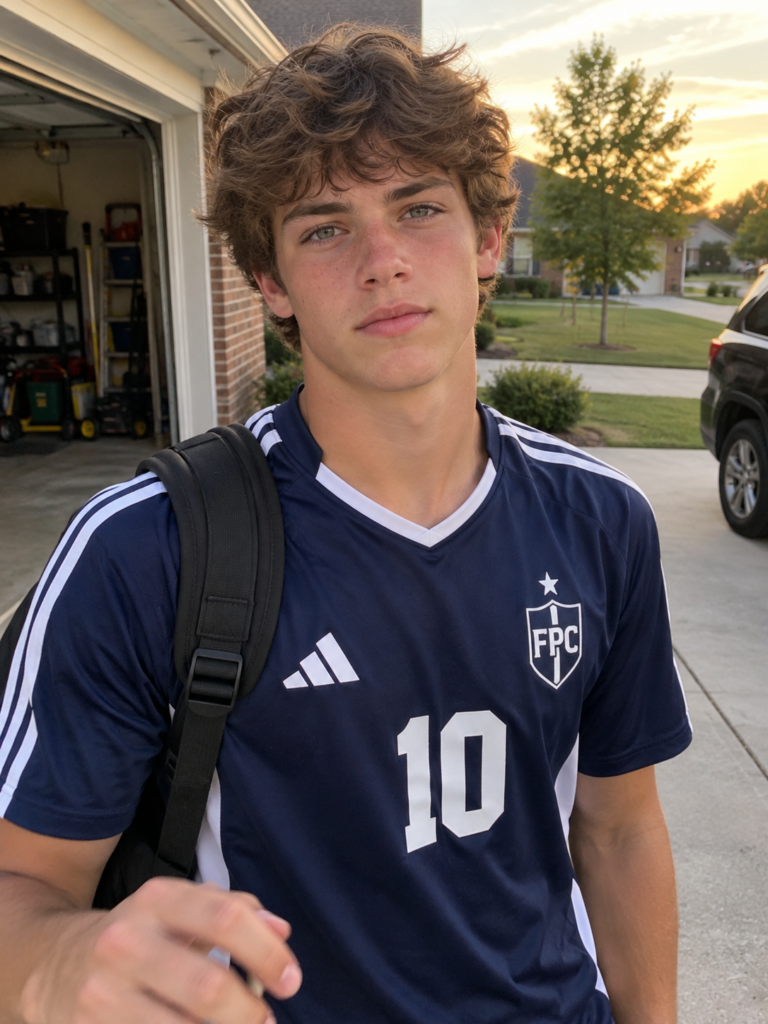
Ryan walked straight toward her.
She smiled.
Then she hugged him.
I gripped the steering wheel.
I had followed my 16-year-old son across town after learning that five months of “soccer practice” had apparently never existed.
Nearly $1,900.
Four evenings a week.
Mud on his uniform.
Complaints about sore legs.
Stories about drills and teammates.
And now Ryan was standing outside a small building behind a strip mall with a woman I had never seen before.
My first thought was drugs.
My second was tutoring.
Then I saw the sign over the side entrance.
MARISOL DANCE STUDIO
I actually leaned toward the windshield. “Dance?”
Ryan followed the woman inside.
I sat there for 30 seconds.
Then I got out.
My name is Karen. I’m 44, and until that evening, I would have told you I knew my son extremely well.
Ryan is my only child.
His father, Michael, died when Ryan was 11.
Sudden heart attack. Forty-two years old.
Michael loved soccer.
Not casually. Obsessively.
He played in high school, coached neighborhood kids, and treated the World Cup like a national emergency.
Ryan grew up kicking a ball before he could spell his last name.
After Michael died, soccer became one of the things we held onto.
I’d sit at Ryan’s games wearing Michael’s old club scarf.
Ryan wore his father’s number whenever he could.
Seven.
Whenever he scored, he’d glance toward me.
For years, I assumed we were preserving something together.
Maybe I had never asked whether Ryan still wanted to preserve it.
I walked toward the studio.
Through the window, I saw a brightly lit room with mirrors along one wall.
About a dozen teenagers were warming up.
And there was my son.
No cleats. No soccer drills.
Ryan had pulled loose black pants over his shorts and changed into a fitted gray shirt.
Music started.
The woman clapped twice. “From the beginning!”
Then Ryan danced.
Not awkwardly. Not like someone trying something new.
He was good. Really good.
He moved across the floor with a confidence I hadn’t seen in years.
Turns.
Jumps.
A slide across one knee that made my joints hurt just watching.
At one point, the woman stopped the music.
“Ryan, you’re anticipating the turn again.”
“Sorry.”
“Don’t be sorry. Fix it.”
She restarted the track.
He did it again.
Better.
I stood outside in the rain, forgotten.
Then somebody behind me said, “Can I help you?”
I turned.
The silver-haired woman stood in the doorway.
“I’m Ryan’s mother.”
Her expression changed.
“Oh.”
That “oh” told me plenty.
“You know who I am.”
“Ryan has talked about you.”
“Has he mentioned that he’s been telling me he’s at soccer practice?”
Her mouth tightened.
“Maybe we should go inside.”
“No. I’d like an answer first.”
She looked uncomfortable.
“My name is Marisol. I own the studio.”
“Have I been paying you $25 four nights a week?”
Her eyebrows rose.
“You’ve been giving him the money?”
“Yes.”
Marisol looked through the window.
“Oh, Ryan.”
My anger returned immediately.
“How long has he been coming here?”
“Since May.”
Five months.
“Four times a week?”
“Usually.”
“And the $280 tournament?”
She winced. “It’s not a tournament.”
I laughed once.
Of course it wasn’t.
“What is it?”
“A regional dance intensive and audition next weekend. Workshops, instructors, scholarship evaluations.”
“Cost?”
“Two hundred eighty dollars.”
At least he hadn’t invented the amount.
“So I’ve been funding dance lessons my son pretended were soccer.”
Marisol folded her arms.
“I didn’t know he was taking money from you under false pretenses.”
“Did you know he was lying about where he was?”
She hesitated.
“Yes.”
I stared at her.
“Why didn’t you call me?”
“Because he told me you knew he danced but didn’t approve.”
That stopped me.
“He said that?”
“He said his family expected him to play soccer.”
“I have never told him he couldn’t dance.”
“I believe you.”
“You don’t know me.”
“No. But I’ve taught teenagers for 30 years.”
She looked through the window.
“They sometimes tell adults the version of a story that makes their choices easier.”
Then Ryan saw us.
His face changed so fast I almost felt sorry for him.
Almost.
He stopped moving.
The other students kept going for a few seconds before noticing.
Ryan walked toward us. “Mom?”
I folded my arms. “Good practice?”
He went pale.
Marisol said, “You two can use my office.”
“I think we’re going home.”
The drive back was silent.
Ryan put his bike in my SUV because I refused to let him ride in the rain.
He sat beside me still wearing dance clothes.
His soccer uniform was stuffed inside his bag.
At a red light, I noticed dirt on one knee of the shorts.
I pointed. “How?”
He looked down.
“What?”
“The mud.”
He didn’t answer.
“Ryan.”
His face reddened.
“There’s a dirt patch behind the grocery store.”
I stared at him.
“You’ve been rubbing dirt onto your soccer clothes?”
“Sometimes.”
For some reason, that broke me.
“Do you know how many times I washed those?”
“I know.”
“I bought stain remover!”
“I know.”
“That stuff is $8 a bottle!”
“Mom.”
“No. You don’t get to ‘Mom’ me right now.”
He stared out the window.
At home, I put his bag on the kitchen table.
“Sit.”
He sat.
I opened my banking app.
“I’ve given you roughly $1,900.”
He nodded.
“Every bit went to dance?”
“Almost.”
“Almost?”
“Sometimes I bought dinner afterward.”
I closed my eyes.
“Ryan.”
“I know.”
“Stop saying you know.”
He went quiet.
“Why?”
Ryan stared at his hands.
“Because I wanted to do it.”
“That’s not what I asked.”
He looked up.
“Because I knew what you’d say.”
“What would I say?”
Nothing.
“What, Ryan?”
He swallowed.
“You’d say Dad would’ve wanted me to keep playing.”
That hit harder than I expected.
“Have I said that?”
“Not exactly.”
“Then what have I said?”
He looked miserable.
“You always talk about him when I play.”
I waited.
“You wear his scarf.”
My throat tightened.
“You tell people soccer was our thing.”
“It was.”
“It was his thing.”
That hurt.
Ryan immediately looked guilty.
“I didn’t mean—”
“No. Keep going.”
He stared at the table.
“I liked soccer when I was little. Really liked it. But after Dad died, it stopped being something I could quit.”
I didn’t move.
“Every time I talked about stopping, people said I had his talent.”
I remembered.
Coaches. Uncles. Friends.
Me.
“Grandpa gave me Dad’s old cleats.”
I remembered that too.
“You cried when I scored on his birthday.”
“I was proud of you.”
“I know.”
“Then why didn’t you tell me you wanted to stop?”
“Because you looked happy.”
That silenced me.
Ryan rubbed his eyes.
“You weren’t happy much after Dad died.”
I couldn’t speak.
“But at games you were.”
“Ryan—”
“So I kept playing.”
I walked to the sink because I suddenly couldn’t sit there.
My 16-year-old son had spent years believing part of his job was keeping his widowed mother connected to his dead father.
I turned around.
“That was never your responsibility.”
“I know that now.”
“No. Hear me. You are not responsible for keeping your father alive for me.”
His eyes filled.
“But if I quit, it felt like we were losing another piece of him.”
“We already lost him.”
He flinched.
I softened my voice.
“And making you keep a sport you don’t love won’t change that.”
He nodded.
Then I pointed toward his bag.
“But none of this excuses five months of lying.”
“I was scared.”
“You were scared five months ago. What were you last Tuesday when you asked me for twenty-five dollars?”
He looked down.
“Still lying.”
“Exactly.”
I could understand why the lie started without pretending it was okay that he kept feeding it.
“How did dance even happen?”
Ryan gave the smallest smile.
His school put on a musical the previous spring.
He wasn’t performing.
He was helping backstage when a boy in the ensemble got injured.
The choreographer asked Ryan to fill a spot temporarily so they could block a scene.
“He said I picked it up fast.”
“So you secretly became a dancer?”
“I watched videos first.”
“Of course you did.”
Then he found Marisol’s beginner class.
He paid for his first session with birthday money.
After a few weeks, she moved him into a more advanced group.
By summer, he was going four evenings a week.
“Do your friends know?”
“Some.”
“Grandma?”
“No.”
“Your soccer teammates?”
He looked at me.
“I haven’t been on the team since spring.”
Another punch.
“What?”
“I quit.”
“You told me the schedule changed.”
“I know.”
I leaned back.
“Ryan, I have apparently been the last person informed about your entire life.”
“I’m sorry.”
This time I let him say it.
Then I asked, “Are you embarrassed to dance?”
“No.”
“Are you embarrassed for me to know?”
His answer took too long. “A little.”
That hurt too.
“Why?”
“Because Dad used to make jokes about dancers.”
I remembered.
Michael wasn’t cruel.
But he was a sports guy in a way that sometimes made him dismissive of things he didn’t understand.
Dance. Theater. Figure skating.
He once watched a musical with us and asked why everyone kept singing instead of solving their problems.
Ryan had laughed harder than anyone.
He’d been nine.
I said, “Your father isn’t here to decide who you become.”
Ryan’s eyes filled.
“I know.”
“And if he were here, he’d have to learn.”
That surprised him.
“You think he’d be okay with it?”
I thought about Michael.
Not the polished version grief had created.
The actual man. Stubborn. Funny. Competitive. Occasionally ridiculous.
And a man who loved his son far more than he loved soccer.
“He might’ve needed a minute.”
Ryan laughed through tears.
“Yeah.”
“But if he saw you tonight, he’d figure it out.”
“Figure what out?”
“That you’re good.”
Ryan looked down, smiling.
Then I ruined the moment. “You’re still paying me back.”
His head shot up. “What?”
“Not all 1900. Those classes were real. But you got the money by lying.”
“How much?”
“We’ll figure it out.”
“Mom.”
“You’re lucky I’m not charging you for stain remover.”
He groaned.
That felt almost normal.
The next day, I called Marisol.
I apologized for being sharp.
She apologized for taking Ryan’s story at face value.
Then I asked, “Is he actually good, or do dance teachers say that to every parent?”
She laughed.
“He’s actually good.”
“Good enough for the intensive?”
“Yes.”
“Good enough for the scholarship evaluation to matter?”
A pause.
“Yes.”
That scared me more than if she’d said no.
Because suddenly this might become something.
I paid the $280.
This time, Ryan sat beside me while I did it.
He showed me the registration.
Schedule. Address. Emergency information.
“The hotel?” I asked.
“There isn’t one. It’s close enough to drive.”
“You invented a hotel too?”
“I never actually said there was one.”
“Do not become a lawyer.”
At the intensive, Ryan received a partial scholarship for a summer program.
He didn’t become an overnight prodigy.
He still had school, homework, and sore knees.
He also got a Saturday job at a grocery store.
Part of each paycheck came back to me until he’d repaid $600.
Why $600?
Because after several arguments, that was the number we settled on as a consequence for the deception without pretending the legitimate classes had been worthless.
Parenting is not always mathematically elegant.
More importantly, Ryan stopped lying.
A month later, he finally told my mother he’d quit soccer.
She stared at him.
Then said, “Thank God.”
Both of us looked at her.
“What?”
“You’ve looked miserable on that field for two years.”
I nearly threw a cushion at her.
“Why didn’t you tell me?”
“You weren’t ready.”
Apparently everyone in my family had become an expert on what I was ready to hear.
Then Ryan showed her a dance video.
By the end, she was crying.
“Grandma.”
She wiped her face.
“Your grandfather cried when you learned to ride a bicycle. We’re emotional people.”
Months later, I found Michael’s old soccer scarf in my closet.
The one I’d worn to Ryan’s games.
For a while, looking at it made me feel stupid.
Then guilty.
Then sad.
Eventually, I folded it and put it in a memory box with Michael’s photographs.
Not because soccer stopped mattering.
It gave Michael and Ryan years together.
It gave us good memories.
But memories aren’t instructions.
Ryan is 17 now.
He still dances.
He also helps younger kids at Marisol’s studio.
Last month, I was waiting outside when a father picked up his little boy from beginner class.
The child ran out saying, “Dad! I learned the turn!”
His father said, “Show me.”
The boy spun in the parking lot.
Not perfectly.
Nearly fell.
His father clapped anyway.
I sat in my car and cried for 30 seconds.
Then Ryan opened the passenger door.
“Why are you crying?”
“I’m not.”
“You are literally crying.”
“Allergies.”
“It’s November.”
“Get in the car.”
He laughed.
On the drive home, he asked, “Do you miss soccer?”
I thought about it.
“Sometimes.”
“Me too.”
That surprised me.
“You do?”
“Yeah. I don’t hate it.”
He looked out the window.
“I just don’t want it to be my whole life.”
That was when I finally understood what I’d gotten wrong.
Ryan hadn’t spent five months secretly running away from his father.
He’d been trying to find out who he was when nobody was asking him to become him.
I still wish he’d told me.
I still hate that he lied.
And if he ever asks me for money for another mysterious tournament, I will call the organizer, the venue, and probably the mayor.
But I don’t regret paying for those five months anymore.
I thought I was paying for soccer.
Ryan thought he was buying time before he had to disappoint me.
We were both wrong.
What I was really paying for was the first thing my son had chosen entirely for himself.
I just wish he’d trusted me enough to tell me its name.