The Ledger of Eleanor Peterson
The Arrest at the Altar
The scent of stargazer lilies will forever make my stomach turn.
My name is Joyce Peterson. I am thirty-eight years old, and for the entirety of my adult life, I have been a registered nurse. Exactly six days before the world as I knew it collapsed, I had stood in a sunlit bedroom, gently washing my dying grandmother’s hair in a basin of warm, lavender-scented water. I remember the fragility of her scalp beneath my fingertips, the way she hummed a tuneless melody as the suds rinsed away.
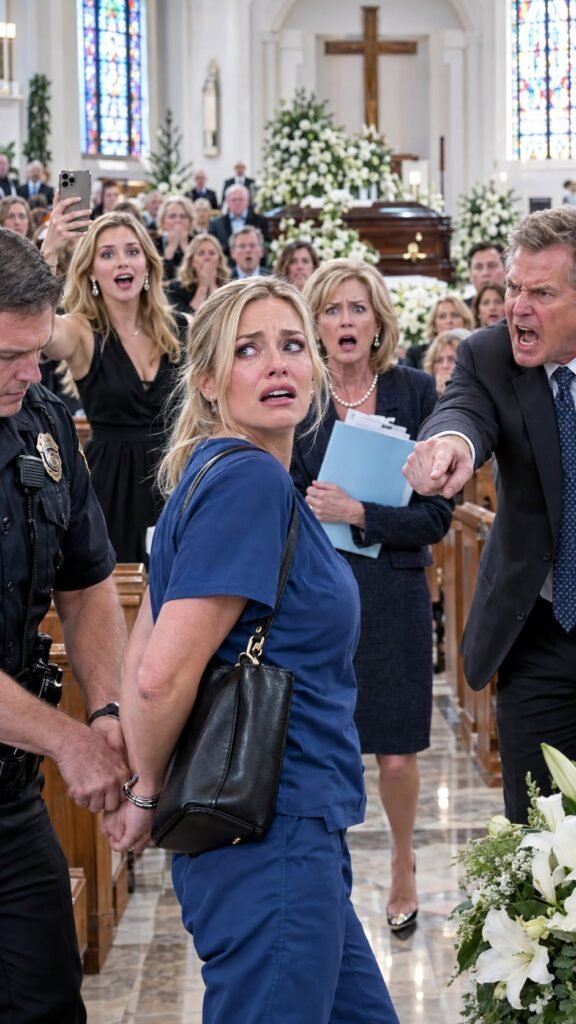
Less than a week later, I stood in the fellowship hall of Grace Lutheran Church in Kettering, Ohio, surrounded by eighty relatives, listening to my mother publicly dismantle my life.
The funeral service had concluded. The luncheon was underway. I had just picked up a heavy cardboard box of my grandmother’s photo albums, adjusting the strap of my black tote bag over my shoulder, intending to slip out the side door. That was when my father, Dale Peterson, marched back into the hall from the parking lot. He wasn’t alone. Flanking him were two uniformed police officers.
The low hum of eighty Voss family members chewing on ham sandwiches and reminiscing ground to an agonizing, immediate halt.
“That’s her,” my father barked, his finger thrusting through the stale church air, pointing directly at my chest. “There has been a sworn complaint on file since yesterday afternoon, and she is attempting to carry my mother’s stolen property out the door right now.”
I froze. The heavy box of memories dug into my ribs. The silence in that room was absolute, a suffocating vacuum that swallowed all the air.
My mother, Caroline, rose slowly from the family table. She held a light blue folder, the tab on the side neatly labeled Joyce in her immaculate, looping cursive. She didn’t look at me. She handed the folder to the older of the two cops, an officer whose silver name tag read Kessler.
Then, she pivoted to face the crowd. Because, in my family, the crowd was always the entire point.
“She stole from a dying woman,” my mother announced, her voice pitched with that perfect, trembling vibrato of a grieving daughter. “She is a nurse. She knew exactly what she was doing. She took the wedding ring right off her hand.”
A collective gasp rippled through the folding chairs. I set the cardboard box down on the linoleum floor. My mind raced, trying to form a defense, but I could only manage the single, most crucial truth I had breath for.
“I hold her power of attorney,” I said, my voice shaking but loud enough to carry.
My father didn’t let the sentence breathe. “Forged!” he shouted, stepping closer. “She is a registered nurse. She knows exactly how to manipulate a confused, vulnerable old woman. She isolated my mother. She was alone with her every single day. Nobody else was allowed in that house.”
That last part was a line he’d stolen directly from my mother, a narrative they’d been workshopping for months.
Officer Kessler flipped open the blue folder. From where I stood, I could see bank statements mutilated by thick strokes of yellow highlighter, alongside a page bearing a notary’s embossed stamp. He scanned the documents for a long, torturous moment. Then, he looked up, his gaze shifting from the papers to me, and finally to the eighty people watching him with bated breath.
“Ma’am,” Kessler sighed, his voice heavy with the weight of the room. “I’m going to need you to come with us.”
“Handcuff her,” my father demanded, stepping into the officer’s space. “Walk her past the casket. I want everyone to see what she is.”
Kessler didn’t verbally reply, but he reached to his belt. The metallic rasp of the cuffs sliding from their pouch echoed off the high vaulted ceiling. The steel was ice-cold against my wrists—wrists that, just days prior, still carried the faint scent of the shampoo I’d used on the woman currently lying in the sanctuary.
As they clicked shut, a scraping sound drew my attention. My older sister, Brittany, the golden child who had never once made my father repeat a command, had climbed onto a metal folding chair. Her smartphone was hoisted high above the crowd, the red recording light blinking like a beacon.
“For everyone asking in the group,” Brittany narrated, her tone bright, performative, and utterly venomous. “Yes, this is my sister. Yes, she is a nurse. Though, not for much longer.” She paused, reading something off her screen. “Thank you, Jessica. Yes, it’s disgusting.” She tilted the lens straight down at my face as I was paraded past her. “Say goodbye to your career, Joyce. Grandma died ashamed of you.”
I didn’t argue. I didn’t scream. Silence was the only defense in that room they could not edit in post-production.
As Kessler steered me toward the double doors leading into the dim sanctuary, my father leaned in close to the officer. The microphone on a phone held high by a woman standing ten feet away is a remarkably sensitive piece of technology.
I heard my father’s hushed, urgent whisper.
“Cuff her before she gets to that lawyer of hers.”
The Void and the Ledger
The Kettering Police Station is a squat, brick fortress that constantly smells of ammonia and cheap floor wax. They deposited me in an interrogation room featuring a steel table bolted directly into the concrete. A young, green officer handed me a paper cup of tepid water that I left untouched.
Nobody uttered the word charged. Nobody uttered the word released.
They pressed my fingertips onto a glass biometric scanner and photographed my tear-streaked face against a height chart. A female officer named Lutz asked if I had any medical conditions.
“I’m a nurse,” I murmured, the reality of my suspended license already choking me. She noted it without a flicker of empathy, logging it the way one might note an allergy to penicillin.
For two hours, I sat in that freezing room in my black funeral dress. My mind drifted back to the kitchen table on Ridgeway Road, to the woman who had graded my math homework there decades ago. My grandmother, Eleanor Peterson, had taught high school algebra for thirty-four years. When I was fourteen—the age when my parents had permanently affixed the label of difficult child to my forehead—Grandma Eleanor had limitless patience for me.
“Anybody can guess the answer, Joyce,” she used to say, tapping her pencil against my worksheet. “Half credit for the right number. Full credit only when you show me the work. Show me how you got there.”
The heavy metal door clicked open, dragging me back to the present. Detective Carol Hensley from the Elder Crimes Unit stepped inside. She was a woman in her mid-fifties, with reading glasses perched atop a messy bun of graying hair, wearing the specific kind of exhaustion that comes from a decade of listening to greedy families lie about inheritance.
She dropped a thin, manila folder onto the steel table. It wasn’t my mother’s light blue trap. This one had a yellow tab, and the edges of the paper inside looked weathered.
She booted up her laptop, typed for a moment, and then stopped. Her eyes scanned the screen, darted to the yellow folder, and then fixed onto me. Her entire posture shifted. The adversarial tension drained from her shoulders, replaced by a sharp, calculating curiosity.
“You are the registered agent on Eleanor Peterson’s durable power of attorney,” she stated, not a question.
“Yes,” I rasped.
“Notarized February 18th of last year. Drafted by an attorney named Nora Whitfield.” She leaned forward, closing the manila folder halfway, shielding its contents. “Your family has absolutely no idea you have this, do they?”
“Have what?”
“A full, legally binding power of attorney that is already on file with this department,” Hensley said softly. “Attached to a protective document your grandmother filed herself, fourteen months ago.”
My pulse hammered behind my eyes. “What did she file?”
Hensley shook her head, a sympathetic but firm refusal. “I cannot show you this file. But I can tell you that the bank transfers your mother so enthusiastically reported as theft were executed by a person your grandmother explicitly authorized in writing. In front of a notary. With a licensed physician’s cognitive evaluation attached to it.” She tapped the folder. “This isn’t criminal theft, Joyce. This is just bulletproof paperwork.”
I stared at the water cup, my hands shaking so violently I had to press them flat against my thighs. “Then why did you arrest me at her funeral?”
“Because your mother filed a sworn, signed affidavit regarding a stolen wedding ring,” the detective explained, standing up. “And because a formal complaint does not magically close itself. I am waiting on the full, unredacted bank records.”
She opened the door. “You are being released pending further investigation. No charges are being filed tonight. Do not leave the county, and do not contact the complainants.” She paused in the doorframe, offering a cryptic smirk. “And if I were you, I would have a very long chat with whoever it was that drove your grandmother to her appointments last February.”
Before I could ask how she knew about a phantom driver, she was gone.
They released me into the humid Ohio evening. While waiting for a rideshare in the precinct parking lot, I powered my phone back on. The screen exploded. Sixty-three text messages. Four missed calls from Denise Albright, the Director of Nursing at Brightwater Home Health, my employer.
Nothing from my mother. Nothing from my father. Nothing from Brittany.
Denise’s final text was ominous: Call me immediately. Not tomorrow morning. Tonight.
I couldn’t face Denise yet. I opened Instagram instead. Brittany’s live stream was pinned to her profile. It was twenty-two minutes long. The view count already possessed a comma. The comments were a firing squad, demanding my nursing license be revoked, branding me a vulture who preyed on the elderly.
I barely slept. Monday morning, I met Denise in the Brightwater lobby. She intercepted me before I could even reach the elevators, guiding me into her office and shutting the blinds.
“Five families called our corporate office over the weekend, Joyce,” Denise said, her voice tight. “Five. Our compliance officer is demanding to know why our lead geriatric care manager is the star of a local crime watch group.”
“Denise, it’s a lie. My parents—”
She held up a hand. “I’ve audited your charting for a decade. I know you didn’t do this. I am not building a case against you. But I am forced to put you on administrative leave, with pay, until the police formally clear your name. Corporate’s hands are tied.”
I unclipped my hospital badge and set it quietly on her desk. My fourteen patients—the elderly men and women I managed, the medications I balanced, the hands I held—were being stripped away.
Driving away from the clinic, a hollow ache settled in my chest. On autopilot, I drove to Ridgeway Road. Grandma’s mail had been accumulating, and I still possessed the house key I had used every morning for the past two years.
I stepped onto the porch and slid the key into the lock. It wouldn’t turn.
I looked closer. The deadbolt was brand new, gleaming brass. Taped to the inside of the glass storm door was a neon index card. My father’s aggressive block lettering stared back at me: PROPERTY OF THE ESTATE OF ELEANOR PETERSON. NO ENTRY WITHOUT AUTHORIZATION. – D. PETERSON.
I backed away from the door, a cold realization washing over me. The blue folder my mother had given the police… the bank statements with the yellow highlighter. Grandma’s physical bank statements were still mailed to this address. My mother had broken in. She had sifted through the old woman’s mail, cherry-picked the pages showing money moving out of the account, and conveniently destroyed the pages showing it moving into a protected care account.
I snapped a photo of the index card and sent it to Nora Whitfield, the elder law attorney I hadn’t spoken to in a year.
Her reply was instantaneous: Do not engage. Document the lockout. We will slaughter them on paper, not on a porch.
I returned to my apartment, exhausted to my marrow. I dropped my tote bag onto the kitchen island. Inside it was the box of photo albums, and resting on top of them was the last object my grandmother had ever handed me: a tattered, green cloth notebook.
I hadn’t opened it since the day she died. I poured a glass of cheap wine, sat at my counter, and finally flipped open the cover.
The first page was dated 1960. Rent: $22. Milk, gas, a church envelope. Her handwriting was impeccable, identical to the script she used to correct my algebra. Sixty-six years of a woman meticulously tracking every cent she was owed, and every cent she owed the world.
I turned the fragile pages for hours, letting her essence wash over me. I found an entry in May 2009. J. Tuition – $6,200. Don’t tell Dale. I wept. She had recorded my college tuition in the same matter-of-fact column as her furnace filters.
Then, I reached January 2022. The neat handwriting remained, but the rhythm of the entries shattered.
D. Card – $2,000
February: D. Card – $2,500
March: D. Card – $2,900
I stopped breathing. I counted the lines. Thirty-six entries spanning three years. Every month, a withdrawal ranging from $1,200 to $2,900. She never wrote a narrative beside them. No exclamation points. No questions. Just the irrefutable data, recorded by a woman who had graded math for three decades and understood exactly what a parasite looked like.
The final D. Card entry was in January 2025. Beneath it, she had drawn a thick, heavy line, tallying the column.
$61,000.
Next to the total, written in a furious, pressing hand that had nearly torn the paper, was a single word underlined twice:
Enough.
My mind flashed to my father’s enraged phone call a year ago, screaming that his supplementary card had been declined at the pharmacy. He had been bleeding her dry for three years. She had caught him. She had calculated the theft to the penny, cut off his access, and never breathed a word of it to me.
I turned the page. February 2025 contained three peculiar entries.
Feb 4: NW – $350 (Nora Whitfield, Attorney)
Feb 11: Dr. H – $40 Copay
Feb 12: L. drove – $0
Aunt Lorraine, her eighty-three-year-old sister, had driven her somewhere. And Grandma had deemed it necessary to document that the trip cost zero dollars.
As I closed the book to process the revelation, my thumb snagged on the back cover. It was unusually thick. I grabbed a butter knife from the drawer and carefully pried back the cloth lining.
Taped to the cardboard spine was a small, flat brass key with the number 218 stamped into the metal. Beneath it was a folded scrap of paper.
Heartland Bank. You are on the box. E. For later.
Cliffhanger: The trap my parents set was loud and vicious, but my grandmother’s trap was silent, buried in ink, and the timer had just hit zero.
The Three Appointments
On Tuesday morning, I didn’t go to the bank. I went back to the police station. This time, I didn’t go alone. I brought Nora Whitfield.
Nora was a formidable woman in her sixties, wearing a sharp blazer and a braided crown of silver hair. She wasn’t a criminal defense attorney, but I needed a witness who understood the architect of this paper fortress.
Detective Hensley met us in the same bleak interrogation room. She eyed the green notebook under my arm.
“She never disclosed the contents of that safe deposit box to me,” Nora told the detective, setting her briefcase down. “She merely instructed me to add Joyce as the co-signer and ordered me not to mention it until Joyce asked. I’ve had many clients hide assets from their greedy children. I have never had a client hide the weapon from the child she was trying to protect.”
“Why the secrecy?” I asked, my voice echoing off the steel.
“Because,” Nora said softly, “if you had known what your father did, you would have confronted him while she was alive. And she would have had to watch her family tear each other apart.”
I slid the green notebook across the table to Hensley, opened to the page that read $61,000. Enough.
The detective adjusted her reading glasses. She traced the numbers with the cap of her pen. “This is a handwritten ledger tallying grand theft by the son,” Hensley murmured. “People suffering from dementia do not cross-reference thirty-six months of credit card fraud.”
“Is the complaint against me closed?” I asked.
“On paper, no. I am waiting on the subpoenaed bank logs from Heartland to confirm you didn’t empty that box last week,” Hensley replied. “But I told you before. You need to speak to whoever drove her in February.”
Xenia, Ohio is an eighteen-mile stretch of highway east of Kettering. Aunt Lorraine’s farm sprawled across one hundred and twenty acres of soybeans and corn. I found her sitting on her wraparound porch, wearing the exact same navy wool coat she had worn to the funeral, her arms crossed like a sentry.
“You took your sweet time,” Lorraine grumbled, though her eyes were soft.
“You told me to sleep first. I slept.”
She led me into her farmhouse kitchen, a room bathed in yellow morning light. She placed a mug of black coffee in front of me, followed by a wall calendar from the previous year, folded open to February. Three dates were circled in thick red marker.
“Your grandmother swore me to secrecy,” Lorraine said, taking the seat across from me. “She said, ‘If Joyce comes asking, tell her everything. If she doesn’t ask, she doesn’t need the burden.’”
I pushed the green notebook toward her, pointing to the three cryptic lines. “What happened on these days, Aunt Lorraine?”
Lorraine didn’t need her glasses to read the ledger. She had lived it.
“February 4th,” she began, her voice steady. “I picked Ellie up at nine in the morning. She had an envelope stuffed with bank statements. We spent an hour at Nora Whitfield’s office. When she got back in the car, she said, ‘The lawyer says I’m not crazy, but I better get a doctor to put it on paper before Dale tries to say I am.’”
I flinched. My mother’s text in the family group chat echoed in my skull: Mom was confused at the end. Grandma had anticipated their slander a full year in advance.
“February 11th,” Lorraine continued, tapping the calendar. “Dr. Susan Halverson down in Centerville. A top-tier geriatric psychiatrist. Ellie sat through a grueling three-hour cognitive evaluation. She passed with flying colors. The doctor signed an affidavit declaring her of completely sound mind.”
“And the twelfth?” I asked, my chest tightening. “The trip that cost zero dollars?”
Lorraine looked away, staring out the window at the swaying cornstalks. “That’s the one your father is going to burn the world down over.”
She turned back to me, her eyes glistening. “We drove to the Montgomery County Job and Family Services building on Edwin C. Moses Boulevard. Second floor. Adult Protective Services.”
The air in the kitchen vanished. “She reported him?”
“She sat in a plastic waiting room chair for two hours,” Lorraine whispered. “She walked up to the counter and handed them copies of his credit card fraud. Sixty-one thousand dollars. But when the social worker asked if she wanted to press criminal charges and have him arrested…”
Lorraine’s voice finally broke. A tear tracked through the deep wrinkles of her cheek. “She said no. She said, ‘He is my son. I will not put him in a cage. But I want it on the official government record that I knew he was stealing from me, so that when I die, nobody can ever blame my granddaughter.’”
I buried my face in my hands. The magnitude of her sacrifice crushed me. She had built an airtight alibi for me, constructed entirely of her own heartbreak.
“She wore her good blue church suit to the county office,” Lorraine added softly. “She said if she was going to formally accuse her own flesh and blood of elder abuse, she was going to be dressed properly for it.”
“Why didn’t she just tell me?” I sobbed, the tears finally flowing freely.
“Because you are a fixer, Joyce,” Lorraine said gently. “You would have demanded answers from Dale. He would have spun a web of lies, turned the whole congregation against you, and Ellie would have been eighty-eight years old, trying to stand between a firing squad and her favorite grandchild. She wanted this evidence to protect you after she was gone. She planned for his lies. She just didn’t plan for him to have you arrested next to her coffin.”
Lorraine reached across the table and gripped my wrist. “The annual Voss Family Memorial Day Reunion is next Saturday. Out in my back field. Eighty people. The exact same crowd from the funeral.”
She leveled a terrifying, unyielding glare at me.
“Your father called me this morning. He asked to borrow the PA system. He is planning to put it to a family vote to excommunicate you and take the house.”
“I wasn’t planning on coming,” I whispered.
“You are coming,” Lorraine commanded, her grip tightening until it hurt. “And you are bringing every single piece of paper that woman left you. It’s time to grade his homework.”
Cliffhanger: The vault was open, the ammunition was loaded, but the final, most devastating weapon was still locked inside a dark box in Kettering.
Box 218
Heartland Savings Bank boasts a subterranean safe deposit vault that feels like a mausoleum. I arrived on a rainy Wednesday afternoon, the brass key burning a hole in my scrub pocket.
Gail Ostrowski, the branch manager who had facilitated the account opening a year prior, greeted me with a solemn nod.
“Your grandmother told me you wouldn’t rush down here,” Gail said softly, pulling the master ledger. “She said you’d only come when the wolves started howling.”
Gail printed out the access log and handed it to me. I scanned the sheet.
Box 218. Access History: Eleanor Peterson – February 18, 2025. One entry.
No one had touched the box in over a year.
Gail escorted me into the claustrophobic viewing room, inserted her master key, and stepped out, pulling the heavy door shut behind her.
Inside the long, steel drawer sat three items: a thick manila envelope, a legal folder clipped shut, and a dark blue velvet jewelry box.
My hands trembled as I reached for the velvet box. I popped the spring hinge. Resting on the plush white satin was the ring. Thin, 14-karat gold, the band worn completely flat on the bottom edge from sixty years of gripping chalk and pencils. It was the ring my mother had sworn to the Kettering Police I had ripped off a dying woman’s hand in March. It had been sitting in this steel tomb since the previous February.
I opened the manila envelope next. Inside was a piece of lined notebook paper covered in her familiar, flawless cursive.
My dearest Joyce,
If you are reading this, Dale has made his move. I knew my son was bleeding my accounts dry. I calculated the sum to be $61,000. I could not bring myself to send my own boy to prison, so I filed an APS report to ensure the truth existed in a place he could not manipulate.
I did this because I have watched your parents and your sister dictate your worth since you were a teenager. I refuse to let them dictate it with my money after I am gone. They will scream that you are a thief. I have ensured that a detective with a badge will prove them liars.
The ring is yours. Not for its monetary value, but because it belongs on a hand that so gently held mine at the end.
You can burn my green ledger. You can hand it over to the police and let Dale burn. You can give the ring to Brittany if it buys you peace. You can do nothing at all.
I trust the girl who showed her work. Being loved by me never required you to be quiet, Joyce. Do not let it require silence from anyone else ever again.
I pressed the letter to my face, inhaling the faint scent of her talcum powder that still lingered on the paper. I slipped the gold ring onto my finger. It fit perfectly.
Then, I took it off and dropped it into my pocket. No one was going to see it until I was ready to blind them with it.
I sat in my car in the bank parking lot and made two phone calls. The first to Nora Whitfield. “Schedule the reading of the will.” The second to Aunt Lorraine. “Save me a seat at the head of the table.”
Friday morning, the air in Nora Whitfield’s glass-walled conference room was suffocatingly tense. Twelve people sat around the mahogany table. My parents, radiating righteous indignation. Brittany and her husband Tyler, scrolling on their phones. Aunt Lorraine, sitting like a stone gargoyle. Two of Grandma’s brothers. And a slickly dressed man named Curtis Blanchard, whom my father proudly introduced as “our litigation attorney.”
Blanchard had already filed an emergency injunction to block my appointment as the estate executor, citing the pending criminal investigation. Attached to his filing was a screenshot of Brittany’s viral video.
Nora did not offer coffee. She opened the folder and began reading Eleanor Peterson’s final testament in a clipped, clinical voice.
The house on Ridgeway Road was to be sold. Half the proceeds to me. A quarter to Brittany. A quarter to establish a scholarship at Fairmont High School for aspiring math teachers, to be named the Show Your Work Scholarship.
My father leaned back in his leather chair, a smug, self-satisfied smile playing on his lips.
Then, Nora turned the page.
“I further stipulate,” Nora read, her eyes flicking up to meet my father’s, “and acknowledge that my son, Dale Peterson, has already received from me, during my lifetime via unauthorized credit withdrawals, the sum of $61,000. It is my strict intention that this stolen sum serves as his full, final, and complete share of my estate. He is to receive nothing else.”
The smugness evaporated from my father’s face, replaced by a violent shade of crimson.
“Sixty-one thousand what?” my father spat, slamming his palm on the table. “What kind of senile garbage is this?”
“I believe your mother expected you to know the exact figure, Dale,” Nora replied, completely unbothered.
My mother jumped in, her voice shrill. “She was confused! Everyone in the family knows she was losing her mind at the end! Joyce manipulated her into writing this!”
Nora didn’t argue. She calmly slid a stapled, two-page document across the polished wood.
“Letterhead from Dr. Susan Halverson, Geriatric Psychiatry,” Nora announced. “A comprehensive cognitive evaluation dated February 11th, 2025. One week before this will was drafted. Every single metric is in the superior normal range. An attached sworn affidavit declares Eleanor Peterson possessed full testamentary capacity and acutely understood the nature of her property and the greed of her heirs.”
Attorney Blanchard paled. He asked for a ten-minute recess.
My father stormed out of the room, knocking his chair over in the process. My mother lingered just long enough to lean over the table, her face inches from mine, the smell of her floral perfume nauseating.
“This isn’t over, you little bitch,” she hissed, abandoning the grieving daughter act. “The police still have an open theft file on you. You’re going to lose your license.”
She was right about the file. She was devastatingly wrong about whose name was sitting at the top of it.
Cliffhanger: The legal skirmish was won, but the social war was about to erupt on the bloodiest battlefield imaginable: a family potluck.
The Gathering Storm
The three weeks leading up to Memorial Day were a masterclass in psychological warfare.
My mother mobilized the prayer chain at Grace Lutheran Church. My name was blasted out in the Wednesday parish email to four hundred households under the passive-aggressive header: Prayers for the Peterson Family in Crisis regarding Elder Exploitation.
Brittany posted a melancholic Instagram story featuring a photo of Grandma’s empty house. The caption read: It shatters my heart that some people would sue their own parents to steal a dead woman’s home. #JusticeForGrandma
Attorney Blanchard’s injunction sat rotting in probate court, weaponizing the Facebook video against me.
I did not respond to a single post. I did not defend myself in the family group chat. Instead, I operated in the shadows, quietly assembling an arsenal of absolute devastation.
First, I emailed Detective Hensley the access logs from Heartland Bank and a PDF of Grandma’s handwritten letter.
Second, I forwarded Dr. Halverson’s cognitive evaluation and the valid Power of Attorney to Denise Albright for Brightwater’s corporate compliance file.
Third, I received an unexpected text message from Renee Dubois, the hospice aide who had cared for Grandma in her final weeks. Nora had tracked her down. Renee had willingly signed a sworn affidavit regarding the events of March 14th.
“I heard Caroline Peterson demand the ring,” Renee’s affidavit read. “Eleanor Peterson opened her eyes and clearly stated, ‘It’s where it belongs.’ She never claimed Joyce took it. I am willing to testify to this under oath.”
I was building a titanium wall, brick by brick. But the final piece of ammunition came from the most unexpected source.
My phone buzzed. It was a text from my cousin Meredith. Meredith ran the scheduling department at Miami Valley Hospital. She was notoriously cynical and possessed a bullshit detector that could pick up a lie from space. She was also the woman who had been standing by the pillar during my arrest, recording on her phone.
Meredith’s text was brief: I have the whole video.
I replied: I saw Brittany’s livestream.
Meredith: No. I wasn’t recording you. I was recording Brittany and your dad. I wanted to capture the look on their faces when they did that to you. I have all 22 minutes. Unedited. And my microphone picked up a lot more audio than Brittany’s did.
My breath hitched. Do you want to post it? Meredith asked.
No, I typed back, my fingers trembling with adrenaline. Not online. I need you to bring it to the reunion. I want to play it for the same eighty people who watched me get cuffed.
On Thursday, May 14th, the Ohio Board of Nursing sent me a letter. The preliminary investigation against my license had been summarily dismissed due to overwhelming exculpatory evidence provided by my attorney.
An hour later, Denise called me into her office at Brightwater. She didn’t look angry anymore. She looked triumphant.
She slid my laminated hospital badge back across the desk. “Corporate reviewed the police findings. You are reinstated, effective immediately. Kevin Brennan has been calling every day. His mother refuses to take her beta-blockers unless you’re the one handing them to her.”
I pinned the badge to my scrubs, feeling the weight of my identity return to my chest.
That evening, Aunt Lorraine finally added me to the massive, 120-person Voss Family group text. I scrolled up to see a message my father had blasted out just an hour prior.
Family Meeting at Lorraine’s farm on Saturday before the barbecue. We are putting this estate mess to a vote. We need to stand united against the theft occurring in this family.
He had absolutely no idea the Kettering Police Department had already closed the case. Detective Hensley had legally been required to notify the complainant—my mother. And my mother, in a desperate bid to maintain the illusion of control, had clearly hidden that fact from my father.
He thought he was walking into a coronation. He was walking into an ambush.
I packed my black tote bag. The police report. The bank access log. The hospice aide’s affidavit. The green notebook. The blue velvet box.
Cliffhanger: The trap was set, the audience was seated, and it was time to teach my family how to show their work.
The Calculus of Truth
The Voss Family Reunion has been a mandatory Memorial Day tradition for four decades. This year, three long rows of wooden picnic tables were arranged end-to-end beneath the sprawling canopy of walnut trees in Aunt Lorraine’s backyard.
I arrived precisely at noon. As I walked across the grass, the low chatter of eighty relatives faltered, replaced by a heavy, suffocating tension. Eyes darted away from me. Whispers hissed behind plastic cups of lemonade.
Uncle Ray, Grandma’s eighty-seven-year-old brother—a retired pipefitter who had turned his face to the wall when I was handcuffed—marched straight up to me. He didn’t smile, but he extended a calloused hand, shaking mine firmly for everyone to see. It was a silent, profound declaration of neutrality.
I took my seat at the head of the first table, right next to Lorraine. I placed my black tote bag on the bench between us. Two seats down, my cousin Meredith sat quietly, her laptop bag resting against her ankles.
At 12:30, my parents arrived. My mother clutched a thick stack of light blue folders to her chest—photocopies of her doctored bank statements. Brittany trailed behind them, her phone already in her hand, though she wasn’t recording yet.
My father bypassed the pleasantries, walking straight to the PA system Lorraine’s son had set up for the opening prayer. He snatched the wireless microphone.
“Before we break bread,” my father’s voice boomed across the field, echoing off the barn, “this family needs to excise a cancer.”
He paced the grass like a televangelist. “Most of you were at the church. You saw what my daughter did. What you don’t know is that there is a massive, ongoing criminal investigation into her theft, and she is using a forged document to hold my mother’s estate hostage. I am asking all of you to stand with Caroline and me today.”
As he spoke, my mother began dealing out the blue folders like toxic playing cards, slapping them onto the picnic tables.
“The police have her file!” my father bellowed, pointing a furious finger at me. “Ask her why she hasn’t been cleared! Ask her why she’s hiding!”
I stood up. The wooden bench scraped loudly against the dirt.
I reached into my tote bag and pulled out a single sheet of paper. I didn’t yell. I didn’t need to. I walked over and placed the official Kettering Police Incident Report directly onto the table in front of Uncle Ray.
“I’ll let the police answer that,” I said, my voice cutting through the humid air.
Uncle Ray put on his thick reading glasses. He picked up the paper, cleared his throat, and read the disposition line in a booming baritone that carried to the very back tables.
“Disposition: Unfounded. All financial transfers executed under valid, durable Power of Attorney on file. Zero evidence of theft. Case closed, May 8th.”
A shockwave rippled through the crowd.
My father whipped his head toward my mother. “You told me the detective was still building a case against her,” he snarled, the microphone catching his genuine confusion.
My mother froze, the remaining blue folders clutched desperately to her chest. She had lied to him. For the first time in thirty years, the united front was fractured.
But my mother was a cornered animal, and she panicked. “That report says nothing about the ring!” she shrieked, her voice cracking. “She stole Mom’s wedding ring! I was in the room! Mom told me she took it!”
I reached into my bag and pulled out the dark blue velvet box. I snapped it open and placed the gold ring onto the center of the picnic table, right next to the police report. The gold caught the midday sun. Dozens of relatives gasped, leaning forward in their seats.
Next to it, I placed the Heartland Bank access log.
“Box 218,” I announced, projecting my voice. “The bank’s timestamped log. Grandma placed this ring in a subterranean steel vault on February 18th of last year. Nobody opened that box until I did last Wednesday.”
Aunt Lorraine stood up next. She unfolded the hospice affidavit.
“This is a sworn, notarized statement from Renee Dubois, Ellie’s hospice nurse,” Lorraine read, her voice dripping with disgust. “She was standing four feet away on March 14th when Caroline demanded the jewelry. Ellie said, ‘It’s where it belongs.’ She never said Joyce had it. Caroline lied to the Kettering Police.”
My mother’s face drained of color. She looked at my father, begging for a lifeline, but he was staring at the bank log in horror.
It was time for the kill shot. I pulled out the green cloth notebook.
I didn’t explain its origins. I just opened it to January 2022 and began reading.
“January 2022. D. Card: $1,200.” I flipped a page. “March 2022. D. Card: $2,100.” I flipped another. “August 2022. D. Card: $1,500.”
The entire field went dead silent, save for the rustling of the walnut leaves. Eighty people were doing the mental arithmetic in real-time.
I turned to the final page. “January 2025. Total sum: $61,000. And one word, written in Grandma’s hand, underlined twice. Enough.”
I passed the ledger to Lorraine. She held it high so the nearest tables could see the pristine handwriting. “I personally drove your mother to Adult Protective Services,” Lorraine told my father, her voice devoid of pity. “She sat for two hours to file an elder abuse report against you, Dale. She made sure it was in the government system fourteen months before you paraded the police into her funeral.”
My father’s face contorted into an ugly, desperate mask. “She was senile!” he shouted, gripping the microphone so hard his knuckles turned white. “She was confused, and Joyce brainwashed her! Joyce was in that house every day!”
At the second table, Meredith flipped open her laptop. She turned the screen to face the crowd, cranked the volume to maximum, and hit play.
The audio of the church fellowship hall blasted across the lawn. My mother’s theatrical weeping. Brittany’s vicious commentary: Say goodbye to your career, Joyce.
And then, at the nineteen-minute mark, the audio spiked. My father’s hushed, frantic whisper cut through the air like a gunshot.
“Cuff her before she gets to that lawyer of hers.”
Meredith paused the video. My father’s face was frozen on the screen, caught in the act of malicious prosecution.
Sixty-odd people stared at the screen, then turned in unison to stare at the man holding the microphone.
I looked my father dead in the eye. “How did you know I had a lawyer, Dad?”
He opened his mouth, but no sound came out.
My mother, unable to endure a vacuum of silence, blurted out the final, fatal truth. “Because your grandmother threatened us with her! She said if we touched one more dollar of her money, the lawyer would…”
She clamped her hands over her mouth, but it was too late. The words hung in the air, radioactive and undeniable. If we touched one more dollar.
Brittany, sitting two seats away, slowly took her phone and placed it face down on the picnic table. She looked at our parents with a mixture of terror and revulsion.
My father, stripped of his narrative, stripped of his audience, resorted to the only truth he had left. His entitlement.
“That money was mine!” he screamed into the microphone, his voice echoing off the trees. “I am her son! She had two hundred thousand in the bank! I took care of my father’s estate! I was owed that sixty grand! You want to talk about thieves? Ask Joyce why she was hovering around a dying woman every day!”
Nobody answered him.
Eighty people had just heard him demand my arrest in a church to stop me from calling a lawyer he knew existed. Now they were listening to him justify stealing sixty-one thousand dollars from his own mother.
Uncle Ray slowly stood up. He walked over to my father and simply held out his weathered palm. My father stared at it for a moment, defeated, and handed over the microphone.
“Dale,” Uncle Ray said quietly. “Sit the hell down.”
Cliffhanger: The explosion was over, but the fallout was about to permanently alter the geography of the Voss family.
Zero Balance
The collapse of my parents’ empire was swift and entirely silent.
People around the picnic tables began to move. A cousin who had previously left a heart emoji on my mother’s Facebook post stood up, walked the length of the grass, and sat down directly across from me. Then another. Then five more.
Aunt Bev, my mother’s lifelong best friend, stood up, walked behind my mother’s chair, and placed a consoling hand on her shoulder. I didn’t begrudge her that. Some people will choose the person over the truth, and I was finally okay with letting them.
I reached into my pocket, retrieved Grandma’s gold ring, and slid it onto my left hand. I held it up, letting the sun catch the flattened gold one last time.
“I am not asking a single person here to pick a side,” I said to the crowd, my voice calm, untethered, and finally free. “Grandma Eleanor already wrote down hers.”
Lorraine took the microphone from Uncle Ray. “Ellie showed her work,” she announced to the silent field. “Now you’ve all seen it. The pork is getting cold. Eat.”
My mother remained frozen in her chair, clutching the fraudulent blue folders to her chest, looking utterly terrified of the irrelevance she had just walked into.
That evening, Meredith posted the full, unedited twenty-two-minute video into the massive Voss Family group chat. Beneath it, she uploaded a high-resolution photo of the Kettering Police report. She didn’t add an emotional diatribe. She simply wrote: For those who only saw the first 40 seconds. Here is the rest. And here is the law.
It didn’t go viral on the internet. It went exactly where it needed to go—into the living rooms of every person who mattered—and then it stopped.
By Tuesday morning, Attorney Curtis Blanchard formally withdrew his objection in probate court. The threat of an undue influence lawsuit evaporated into the ether. My letters of authority as executor were issued, and the house on Ridgeway Road was listed with a premium realty firm.
Brittany was noticeably excluded from the listing. Her boutique brokerage received two massive formal complaints that week from prominent Kettering clients who happened to be Voss cousins in attendance at the reunion. Her agency quietly removed her face from their featured agent roster. I didn’t make a single phone call to facilitate it. Gravity did the work for me.
The scholarship paperwork was finalized on Friday. When I called Fairmont High School to establish the Show Your Work Scholarship, the senior guidance counselor burst into tears. She had been in Grandma’s algebra class in 1991.
Two days later, my phone pinged. A text from Brittany.
I didn’t know about the credit card. I swear to god. I am so sorry about the video.
I stared at the screen. I believed the first sentence. I think she desperately wanted to believe the second. I didn’t reply, and I didn’t block her. I left it on read, letting the silence be the only editing she got.
My mother sent a sprawling, four-paragraph email. The subject line was MOVING FORWARD IN CHRIST AS A FAMILY. It was a masterpiece of narcissistic deflection, claiming we were all “under terrible spiritual warfare” and that “Grandma would want us to forgive.”
I replied with three sentences.
Stand up in front of the exact same eighty people at church. Tell them exactly which parts of your sworn police statement were perjury. Then, and only then, will I read another email from you.
My father never reached out. I didn’t expect him to. Men who believe they are owed the world do not apologize when the check bounces; it upsets their internal ledger.
On a quiet Wednesday afternoon, between checking vitals and charting medications, I blocked my parents’ phone numbers and routed all their emails straight to the trash folder. I informed Nora that any communication regarding the estate would go exclusively through her office. It took less than forty seconds. I expected it to feel like a monumental, earth-shattering event.
Instead, it just felt like closing a completed medical chart.
The following week, Aunt Lorraine mailed me a small, unmarked envelope. Inside was the February page torn directly from her kitchen calendar. The three dates—the lawyer, the doctor, the APS office—were circled in red. I took it into the kitchen, pulled back the cloth lining of the green notebook, and tucked it into the hidden compartment where the brass key used to live.
I returned to my life. I went back to Brightwater Home Health. The first afternoon back, I walked into Ida Brennan’s living room. She was ninety-one, sharp as a tack, sitting in her recliner with the television muted, waiting for me.
As I counted out her blood pressure medication, her eyes caught the flash of gold on my hand.
“That’s new,” Ida noted.
“It was my grandmother’s,” I smiled.
She took her pills, her frail hand brushing mine. “It’s nice that you have it.”
“It’s where it belongs,” I replied, and the ghost of Grandma Eleanor’s voice echoed in my own.
I wear the ring on a silver chain under my scrubs now. The hospital gloves don’t accommodate the gold, but I prefer it resting against my chest anyway. I like knowing it’s there, pulsing with the beat of my heart, without needing to perform it for an audience.
The tattered green notebook sits on the highest shelf in my kitchen, sandwiched between two heavy cookbooks. I don’t look at it often. I don’t need to. Sixty-six years of a woman meticulously tracking the balance of her life.
For the longest time, I thought she had left me an answer in that book. I was wrong. She didn’t leave me an answer; she left me the infallible methodology of survival.
Write it down. Document the date. Keep the receipts. Show your work.
Because when the day comes that someone stands up in a crowded room and tries to tell the world exactly who you are, there must be a ledger waiting in the dark that irrevocably proves otherwise.
On the final Friday of May, I pulled the green notebook down from the shelf. I opened it to the very last page, just beneath the heavy, furious line where she had written Enough. There was a little blank space remaining. She had always left room for me.
I picked up a blue pen, uncapped it, and wrote a single line in my own hand:
May 2026. J. Ring. $0. Show your work.
I snapped the book shut and placed it back on the shelf. My parents had tried to write the final chapter of my life in front of an audience. But my grandmother had provided the ink to rewrite it.
And I am the one who gets to keep writing.