My name’s Eli. I’m 29. And I guess you could say I’ve always been the stable one in the family.
The reliable one. The one who doesn’t cause drama. Who sends birthday cards on time. Who picks up when someone calls at 2 a.m.
It’s a role I didn’t exactly volunteer for. But I learned pretty early on that if I didn’t hold the line, no one would.
My parents, nice enough on the outside, have always had this uncanny ability to decide things for me. Usually under the guise of family unity or what’s best for everyone.
My younger sister, Cassie, on the other hand, was the whirlwind. The kind of person who could fail three college courses, borrow money from everyone in the family, and still get a standing ovation for showing up to dinner with new hair.
That’s not bitterness talking. It’s just how things have always been.
The real turning point started at what should have been an ordinary family brunch.
You know, the kind: bland eggs, too many mimosas, and the same five stories that get recycled like clockwork.
We were all crammed around the patio table at my parents’ place. Me, Cassie, our mom and dad, and at Laya, who never says much, but always seems to know everything.
I had barely touched my plate when mom said with her usual cheery tone, “We’re just so relieved Cassie will be staying with Eli for a while. It’ll give her some breathing room to get back on her feet.”
My fork paused halfway to my mouth.
Cassie chimed in like it was old news.
“Yeah, I’ll just take the spare room. I figure I can start moving my stuff next weekend.”
There wasn’t a question mark at the end of her voice. Not really. Just the kind of entitled assumption I’d heard my whole life.
No one had asked me.
Not once.
They just said it like I wasn’t even sitting there.
“Right,” Dad added, like some kind of punctuation. “She needs a fresh start. And it’s not like you use that space for anything important. Besides, family sticks together.”
I just nodded slowly, chewing a dry piece of toast, trying not to let my face betray anything.
My heart was pounding, not in anger, but in that quiet, heavy way that tells you a line just got crossed.
I didn’t say a word.
I just let them keep talking.
They were so confident, so comfortable assuming my time, my space, my life, that they didn’t even pause to check if I was on board.
They didn’t notice that I didn’t confirm it.
They didn’t ask when I’d be home.
They didn’t even look at me.
Cassie was already pulling up Pinterest boards for how she’d decorate the room.
What they didn’t know was that I’d moved out of that apartment 3 weeks earlier.
Not on a whim, either.
I’d been planning it for months. The lease had ended and I took the chance to grab a smaller place across town closer to work with more light, no roommates, no baggage, and I never told my parents.
Part of me just wanted something for me, a space that was mine alone, that didn’t come with the weight of expectation or family deals.
I still had the old lease in my name for another week since I paid through the month, but I hadn’t stepped foot in there since I carried out the last box.
Sitting there listening to them carve up my life like it was a pie they were entitled to split, I realized something.
They genuinely believe they had the right to decide where my boundaries were.
They thought my silence was agreement.
They thought they could just assign me responsibilities like a side character in their story.
I remember excusing myself from brunch early, saying I had errands to run.
Mom barely looked up.
Cassie waved absently, already texting.
I walked to my car in a days, sat in the driver’s seat for a few long minutes, and let the stillness settle around me.
No music, no calls, just breathing.
That quiet clarity that only shows up when something inside you snaps, not in rage, but in resolve.
That week, I didn’t reach out.
I didn’t remind anyone that I didn’t live there anymore.
I didn’t correct them when mom texted me a grocery list for Cassy’s arrival or when dad sent a thumbs up emoji in response to some article about teaching responsibility to adult children.
I didn’t say anything when Cassie asked if she could bring over a cat just for a few weeks.
I just watched it unfold.
Every message was a reminder that they weren’t asking.
They were informing.
And that made what came next feel inevitable.
The day she was supposed to move in, a Saturday.
I drove by the old apartment around noon just to see.
The street was crowded.
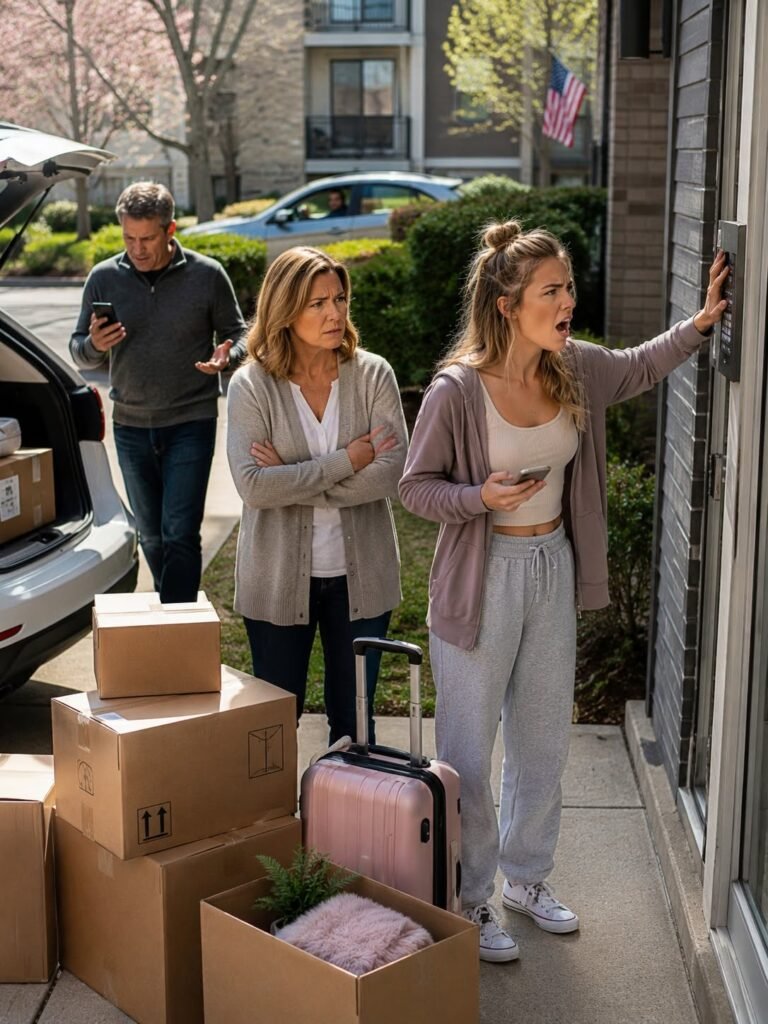
Cassie’s little white car was double parked, its trunk open, boxes stacked on the sidewalk.
She stood there holding a plastic container of what looked like makeup or jewelry, her phone pressed to her ear.
I didn’t stop.
I didn’t wave.
I didn’t even slow down.
I just kept driving.
The scene burned into my mind.
Later, I checked the security camera feed from the building’s shared entrance.
Yes, I still had login access.
The motion sensor had picked her up, ringing the buzzer again and again.
She knocked, she paced, she sat on her suitcase.
She called first me, then mom, then probably half the family.
I didn’t answer.
I turned my phone off and went out for coffee.
That evening, I checked again.
The boxes were gone.
So was Cassie.
The last footage was of her being picked up by someone.
Maybe a friend, maybe dad.
I didn’t care.
I just sat there sipping my drink.
And for the first time in a long while, I felt something that wasn’t guilt.
It wasn’t satisfaction either.
It was quiet.
Like I’d finally stepped out of a role I didn’t audition for.
But that wasn’t the end.
By Monday, my inbox was flooded.
Missed calls, voicemails, texts that started off passive aggressive and quickly became just plain aggressive.
Mom texted, “Eli, this isn’t funny. Cassie is extremely upset and confused. You need to call me back.”
Dad texted, “You made your sister wait in the cold. You better have a good explanation.”
Cassie texted, “What is wrong with you? I stood outside for an hour like a fool. You couldn’t even send a text. What kind of brother does that?”
I didn’t reply.
Not yet.
I was still sitting with it, this strange, quiet storm that had been building inside me for years.
It wasn’t just about Cassie or the spare room.
It was about every time they had made a decision with my name attached to it, like I was some resource they could allocate.
Babysitting duties, loan co-signs, family errands, emergency help, and me always the good soldier.
That week at work, I was unusually calm, productive, even like I had finally unplugged from a current that had been draining me dry.
But every day, the messages kept coming, some demanding, others manipulative.
Tuesday, mom left a voicemail in tears.
“I just don’t understand why you’re doing this. Cassie needed you. You know how hard things have been for her lately.”
Wednesday, Cassie sent a screenshot of her trying to book a hotel.
“Guess I’ll just spend the rent money on this then since some people can’t be bothered to answer their phones.”
Thursday, a long message from Dad, the kind that pretends to be calm but drips with judgment.
“You’ve always been the responsible one. That’s why we trusted you with this. Honestly, I expected more from you.”
That last one hit harder than I wanted it to.
Not because it hurt, but because it confirmed what I already knew.
To them, I wasn’t a person.
I was a utility, a dependable cog in the family machine.
So, I did what any responsible one would do.
I started documenting everything.
Every text, every voicemail, every dollar I had spent in the last 2 years, helping out with family stuff, covering Cassie’s overdraft fees, helping mom and dad with car repairs, chipping in for groceries until payday.
I made a spreadsheet, line by line.
It was exhausting and cathartic because for the first time, I was treating their chaos like a problem to be solved.
That Friday, I sent an email.
One single polite, impossibly formal email.
I CC mom, dad, and Cassie.
The subject line: re Cassy’s living situation.
The body of the email read, “Hello, just to clarify, I moved out of the previous apartment on April 3rd. The lease officially ends on April 30th, but I have no belongings there and no intention of returning. It is not my legal residence, and I am not responsible for guests attempting to access it.
“In the past two years, I’ve contributed financially to various family matters. For full transparency, I’ve included a breakdown of those contributions below.
“Please review at your convenience. Going forward, I will no longer be able to assist with unplanned housing arrangements or emergency funding. I recommend coordinating these matters with more advanced notice.
“Best, Eli.”
And I attached the spreadsheet.
The silence that followed was glorious.
No calls that night, no texts the next day, not even a passive aggressive meme from Aunt Laya.
It was like I had finally spoken a language that didn’t understand boundaries.
Not anger, not sarcasm, just clear unemotional facts.
But then came Sunday.
That morning, I went to the grocery store like I always do.
Same route, same little corner cafe for a cinnamon roll on the way back.
My phone buzzed halfway through the line.
Cassie, again.
I muted it.
Then it buzzed again.
Mom.
Then again, Dad.
I stepped outside and finally opened the group message.
A photo of my old apartment.
Cassie was standing in front of it again.
This time, she wasn’t alone.
Mom was there, too, arms crossed.
And dad, looking annoyed, like he had something better to do.
Below the photo, Cassie had written, “We’re here. Opened the door.”
My heart actually skipped.
They were there again.
Except this time, they didn’t think I was avoiding them.
They thought I was inside.
5 minutes later, another photo came in.
A box on the ground labeled toiletries.
Then a message.
“We’ll wait.”
That’s when I realized they were going to sit there.
All afternoon if they had to, maybe even longer.
So, I got in my car.
I didn’t head toward them.
I didn’t call.
I drove to a quiet parking lot two blocks away, turned off the engine, and sat.
Not because I didn’t know what to say, but because I was deciding whether or not to say anything at all.
The next hour changed everything, and it started when I saw my dad walking back toward the street without Cassie or mom and picking up his phone.
From the distance of my parked car, I watched dad pace along the sidewalk, phone to his ear, his other hand gesturing in those short sharp chops he always used when he was frustrated but pretending not to be.
I rolled the window down just slightly, just enough to hear the murmur of his voice drifting through the spring breeze.
I couldn’t make out the words, but I could tell from his posture that this wasn’t a calm check-in.
This was the beginning of damage control.
After a minute, he turned around and started walking back toward the building.
Cassie was still there, sitting on one of the boxes, legs crossed, phone in her lap.
I scanning the sidewalk like she was expecting some divine intervention to descend from the sky.
Mom stood stiffly beside her, arms folded so tight it looked like she was hugging herself.
No one spoke.
I wondered how long they had been like that.
Waiting, assuming I’d eventually appear to save the day like I always had.
But I didn’t move.
I just sat there, parked behind a row of hedges, a few buildings down, watching the family dynamic unfold from the outside, literally and metaphorically.
And it hit me how theatrical it all was.
Three grown adults staging a sit in outside an apartment that didn’t belong to any of us anymore, demanding I show up to make their problem go away.
Around 2:00 p.m., a neighbor must have come out.
I saw her from my angle, a woman in gym clothes walking her dog, pausing at the sight of the impromptu sidewalk standoff.
She and my mom exchanged a few words.
Cassie stood up quickly, trying to look composed.
My dad, ever the gentleman when someone else was watching, even extended a hand toward the dog, trying to smile.
The neighbor didn’t linger.
She just nodded and walked on.
But 30 seconds later, Cassie was texting again.
“Everyone here thinks we’re crazy. Just let us in already.”
And then, “You’re being cruel, Eli. Seriously, who does this to their family?”
I stared at the screen for a while, then opened a note on my phone.
Not to reply, just to jot something down.
A thought that hit me so clearly.
I didn’t want to lose it.
They don’t think you’re a person.
They think you’re a service they forgot to tip.
I sat with that for a while.
Then, I opened my banking app, scrolled through the last dozen charges, and took note of the remaining auto payments still quietly draining from my account on their behalf.
Subscriptions.
Cassie had asked me to temporarily cover the shared Netflix tied to my email, the grocery card linked to mom’s number, the insurance payment.
Dad swore he’d reimburse me for in February.
It wasn’t about the money.
It was about the pattern, the quiet entitlement, the way they painted themselves as the injured party the second I didn’t fall in line.
At 3:13 p.m., Cassie called again.
I let it ring once before silencing it.
Then another text buzzed in.
“You’re going to regret this.”
That one stuck with me.
It wasn’t dramatic.
It wasn’t in all caps.
It didn’t come with 20 angry emojis, but something about the way she phrased it, not you’re hurting me, but you’re going to regret this, spoke volumes.
It wasn’t about being abandoned.
It was about losing access to a room, a buffer, a backup plan.
They weren’t there because they missed me.
They were there because I’d stopped being useful.
I watched them for another 20 minutes before I saw Dad open the trunk of the car.
One by one, the boxes went back in.
Cassie didn’t help.
She stood on the sidewalk, arms dangling at her sides, face locked in a grimace that would have looked like heartbreak to anyone who didn’t know better.
Mom finally broke first, getting into the front seat without a word.
Dad followed.
Cassie lingered the longest, sending one final glance toward the building before she too climbed in.
The car sat there for a full minute before pulling away.
I didn’t move.
Not yet.
When I finally drove home, my home, the new one, the one no one had ever visited.
I walked in with the strange feeling of having watched my old life from the outside.
The door closed with a soft click behind me, and I stood there in the silence.
The air smelled like basil from the little plant I kept on the window sill.
The light spilled onto the hardwood floor.
No boxes, no drama, no sister in the spare room.
But the messages didn’t stop.
By Monday, I was getting texts from extended family.
Aunt Laya, Uncle Brian, even a cousin I hadn’t spoken to in over a year.
Each one some variation of can we talk or just want to understand what’s going on.
Cassie had clearly gone on a PR tour telling her version of the story, the cold-hearted brother who tricked his poor sister into homelessness.
And then came the message that changed everything from my mother.
“If you don’t fix this, you’re going to split the whole family in two. I hope you’re proud.”
I stared at that message for a long time.
Not we, not let’s talk.
Not even an ounce of curiosity about why I’d gone silent.
Just an accusation straight from the queen herself, dropped like a gavvel.
And the thing that stung wasn’t the message.
It was the realization that she actually believed it.
She really thought the weight of the entire family’s unity rested on me bending again, on me making it all go away.
Just like always.
That night, I didn’t sleep much.
I lay awake thinking about all the times I’d fixed things over the years.
Helping Cassie get out of that bad subleasase when she bailed on rent halfway through the year.
Wiring mom and dad money when their car insurance lapsed and they forgot.
Driving 3 hours in a snowstorm to fix the busted heater in their cabin after they rented it out and didn’t warn the guests.
All the little things, the can you just favors that added up to years of rearranging my life around everyone else’s comfort.
I thought about how no one ever asked if I needed help.
By the time morning came, I was done.
Not angry, not emotional, just done.
I got up, made coffee, and opened my laptop.
I drafted one last message.
No drama, no insults, just facts.
I sent it to my parents, Cassie, and the few relatives who had texted to get my side of things.
It read, “Hi, everyone. I’ve taken some time to think about everything that’s happened in the last few weeks. I want to clarify a few things and set expectations moving forward.
“I moved out of my old apartment in early April. No one consulted me about having Cassie move in. I was informed after the decision had already been made, and when I didn’t comply, I was met with silence, guilt, and eventually public shaming.
“What happened at the apartment, Cassie showing up with boxes and being locked out, was not a prank. It was not punishment. It was the result of a family that has grown too comfortable treating me as a backup plan.
“Over the past 2 years alone, I have financially contributed in various ways that total over $9,000. I’ve never asked for repayment. I’ve never held it over anyone’s head.
“But from this point forward, I am stepping back. This means I will not be covering any more family expenses. I will not be hosting, housing, or financially supporting Cassie. I will not be the emergency contact for issues I had no say in creating.
“This is not done in anger. This is done out of self-respect. I’m 29. I deserve a life of my own.
“You’re welcome to reach out if you’d like to have an honest conversation. Not a guilt trip, not a lecture, but a real dialogue. Otherwise, I wish you well, Eli.”
I turned off my phone after hitting send.
And for the first time in a long, long while, I didn’t feel the weight of my family pressing down on me.
I didn’t worry about how they’d spin it.
I didn’t even brace for the fallout.
I just made breakfast.
I watered my basil plant.
I cleaned the apartment while listening to music.
Full volume.
No interruptions.
That week, the silence was deafening.
No replies, no angry follow-ups, no apologies, just nothing.
It took 5 days before someone cracked.
It was Aunt Laya.
She sent a text that just said, “Saw your message. Proud of you. if they want to martyr, they can build a statue.”
I laughed harder than I expected to.
Then I cried just a little.
Eventually, the responses did come in.
Mom sent a long email full of vague sentimentality and no accountability.
She talked about how family goes through hard times and how I had always been the strong one.
I didn’t reply.
Dad called and left a voicemail that started with, “I just don’t get what you’re trying to prove,” and ended with, “This isn’t how we raised you.”
I deleted it.
Cassie went quiet surprisingly.
No texts, no sub tweets, just silence, and that said more than any tantrum would have.
Weeks passed.
I started sleeping better, eating better.
I went out with friends without that tightness in my chest, waiting for the next favor to derail my weekend.
I stopped checking my phone every 10 minutes like it was a time bomb.
Then one day, something strange happened.
I got a letter in the mail, a real one, handwritten, from Cassie.
It was short, just a few lines.
“Eli, you made your point. Loud and clear. I didn’t see it before, but I do now. I used to. We all did. I think I wanted a soft landing more than I wanted to grow up. That’s not your fault. I don’t expect you to forgive me right away. I just wanted to say I get it and I’m sorry, Cassie.”
I sat with the letter for a long time.
I didn’t frame it.
I didn’t post it anywhere.
I didn’t even reply, but I didn’t throw it out either because maybe, just maybe, something had shifted.
Months have passed now.
I see my parents less.
I’ve stayed no contact with Cassie since the letter.
Not out of spite, just space.
The kind of space I never realized I was allowed to claim.
Last week, I got a call from a number I didn’t recognize.
It was the leasing office at my old building.
Apparently, someone had tried to use my name as a reference to rent a unit.
They flagged it because the application looked suspicious.
I asked who the applicant was.
They told me it was Cassie.
I paused for a second, then told them the truth.
“That’s my sister. I wouldn’t recommend using my name.”
And I hung up.
That night, I made dinner.
I played some jazz.
I lit a candle and cracked open a new book.
The apartment was quiet, still mine.
And for the first time in my adult life, I wasn’t waiting for the other shoe to drop because it already had.
If you came here from Facebook because of this story, go back to the Facebook post, tap Like, and leave exactly “Worth reading” in the comments to support the storyteller. That small gesture means more than it may seem, and it gives the writer real motivation to keep sharing more stories like this with readers who stay all the way to the end.