The shaking shoulders.
The smile.
The pride.
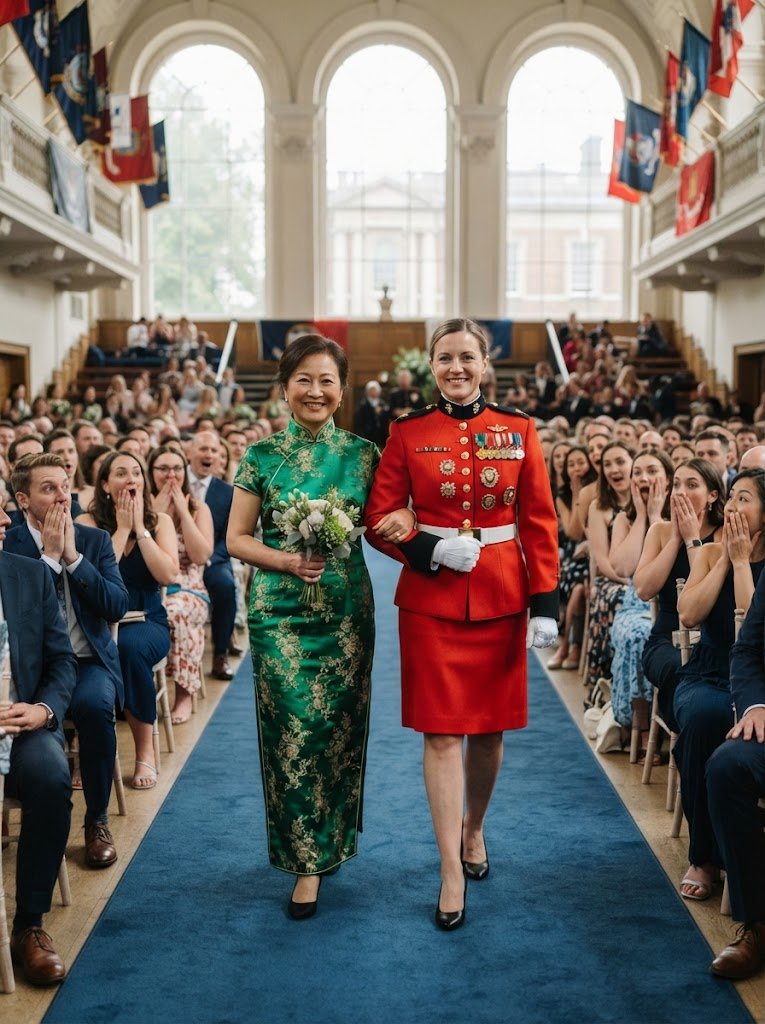
The disbelief that somehow, after all those years, we had actually made it here.
Together.
I walked toward the stage.
Behind me, I heard movement.
Then my biological mother’s voice.
“Hannah.”
I did not turn around.
The commanding general extended his hand when I reached him.
“Congratulations, Lieutenant Morgan.”
“Thank you, sir.”
He handed me the academy’s honor award, a dark wooden plaque engraved with my name.
Lieutenant Hannah Elise Morgan.
First in Class.
Distinguished Graduate.
Leadership Excellence Award.
I stared at it for half a second.
Then I looked toward Rachel.
Her hand covered her mouth.
That woman had once worked twelve-hour hospital shifts and then driven forty minutes home with a sick thirteen-year-old sleeping against the passenger-side window.
She had cleaned vomit from my bedroom carpet at three in the morning.
She had shaved the rest of my hair when clumps began falling out in the shower.
She had sat beside me during spinal procedures.
She had fought insurance companies.
She had attended court hearings.
She had learned how to cook five different meals because chemotherapy had made almost everything taste like metal.
She had never once called me a burden.
Never once calculated my worth.
Never once asked what loving me would cost.
The general leaned toward the microphone.
“Please remain on stage, Lieutenant Morgan.”
That caught me off guard.
I had expected the award.
I had expected the recognition.
But not that.
The applause slowly faded.
I glanced at the commandant seated behind him.
He nodded.
Something was happening.
The general turned toward the audience.
“There is one additional recognition today.”
A quiet ripple moved through the hall.
I looked at Rachel.
She looked just as confused as I was.
The general continued.
“During Officer Candidate Morgan’s final year of training, members of the faculty nominated her for an award that is not presented annually.”
Behind me, I heard chairs shifting.
“This recognition is reserved for a candidate whose conduct demonstrates exceptional courage, resilience, service, and commitment to the welfare of others.”
My throat tightened.
No.
They could not possibly—
The general opened a second folder.
“Some of Lieutenant Morgan’s classmates may know that while completing one of the most demanding training programs in the country, she also spent weekends volunteering with pediatric oncology patients at Walter Reed.”
I closed my eyes for one second.
That had never been something I wanted announced.
I did not volunteer for recognition.
I volunteered because I knew what fluorescent hospital ceilings looked like at two in the morning.
I knew what it felt like when adults discussed your survival as if you were not in the room.
I knew what it meant to need one person to stay.
The general kept speaking.
“Last winter, a seventeen-year-old leukemia patient named Maya Chen was considering abandoning treatment after a relapse.”
I felt my pulse jump.
Rachel sat straighter.
“Maya had refused several procedures and told her medical team she saw no point in continuing.”
The room had gone completely silent.
“Lieutenant Morgan spent nearly six hours with her that evening.”
I remembered every minute.
Maya had thrown a plastic cup against the wall.
She had screamed at everyone.
She had asked me what the point was.
I had not told her everything would be fine.
I had not lied.
I had sat on the floor beside her bed.
And eventually, I told her about Room 314.
About my parents.
About being thirteen.
About hearing that I was average.
About Rachel.
About surviving one terrible night at a time.
Maya had stared at me for almost ten minutes.
Then she had whispered, “You had leukemia too?”
“Yes.”
“And they left?”
“Yes.”
“How did you not hate everybody?”
I had looked at Rachel’s old deck of cards in my hand.
Because I still carried it sometimes.
“I did for a while.”
Then I told her the truth.
“But one person staying can become louder than ten people leaving.”
The general looked toward the side entrance.
“Today, with her physicians’ approval, Maya and her family are here.”
The doors opened.
I stopped breathing.
A thin girl in a blue dress walked into the hall.
Her hair was just beginning to grow back.
Beside her were two adults I recognized immediately.
Her mother.
Her father.
Maya saw me.
And smiled.
The entire room erupted again.
I broke protocol.
I stepped away from the center mark.
Maya walked faster.
Then she ran.
I caught her just before she reached me.
She wrapped both arms around me.
“Guess what?” she whispered.
I could barely speak.
“What?”
“My last bone marrow results were good.”
My eyes burned.
“How good?”
She pulled back.
“Really good.”
I laughed.
Actually laughed.
On stage.
In uniform.
With a commanding general standing three feet away.
“I’m proud of you.”
“No,” she said.
Then she looked straight at me.
“You told me not to quit.”
And that was the moment I realized the Barretts no longer mattered.
Not really.
For fifteen years I had imagined success as something that might someday hurt them.
Some achievement so large it would force them to understand what they had thrown away.
But standing there with Maya in my arms, I understood something else.
The greatest revenge was not making them regret losing me.
It was building a life that had nothing to do with them at all.
The general waited until Maya returned to her seat.
Then he presented me with the academy’s Humanitarian Leadership Medal.
The audience stood again.
Rachel was crying openly now.
And three rows behind her, Linda Barrett was crying too.
But the difference between those tears mattered.
Rachel was crying because she remembered what it had cost me to survive.
Linda was crying because she had just realized other people knew what she had failed to see.
When I finally returned to my seat, Linda leaned into the aisle.
“Hannah.”
I kept walking.
“Hannah, please.”
Rachel stood.
For one terrifying second, I thought she might confront her.
She did not.
Rachel simply stepped into the aisle beside me.
Linda looked at her.
Their eyes met for the first time in fifteen years.
Linda’s expression changed.
Recognition.
Then jealousy.
Then something uglier.
“You’re Rachel.”
Rachel’s voice was calm.
“Yes.”
“You’re the nurse.”
Rachel looked at her for a long moment.
“No.”
Linda blinked.
Rachel continued.
“I’m her mother.”
Richard stood suddenly.
“That’s enough.”
Several people turned.
A uniformed usher immediately approached.
“Sir, please remain seated.”
Richard’s jaw tightened.
“I just need one minute with my daughter.”
I looked at him.
“No.”
The word came out quietly.
He stared at me.
Perhaps he expected anger.
Perhaps he expected tears.
Perhaps somewhere in his mind I was still thirteen.
Still frightened.
Still waiting for him to decide whether I was worth saving.
But I was not thirteen anymore.
And he was no longer the person who got to decide anything about my life.
The ceremony continued.
Commissions were presented.
Oaths were taken.
Families applauded.
Photographs were taken.
And through all of it, I could feel the Barretts behind me.
Waiting.
Planning.
Probably imagining the conversation they would have once the ceremony ended.
They had always believed access to me was something they could reclaim whenever they wanted.
They were about to learn otherwise.
After the final salute, candidates began moving toward the reception hall.
Rachel met me near the stage.
She grabbed my face in both hands.
“You did it.”
“We did it.”
“No.”
She shook her head.
“You did it.”
I smiled.
“You taught me how.”
She pulled me into a hug.
For several seconds, the entire room disappeared.
Then Rachel whispered near my ear.
“They’re coming.”
I did not need to ask who.
I stepped back.
Linda approached first.
Richard followed.
Allison came behind them.
For the first time, my sister looked uncomfortable.
Not smug.
Not proud.
Uncomfortable.
Linda opened her arms as if she intended to hug me.
I stepped back.
She froze.
“Hannah.”
“It’s Lieutenant Morgan.”
Her mouth fell open.
Rachel’s hand touched my back.
Just once.
Not to control me.
To remind me she was there.
Linda lowered her arms.
“All right. Lieutenant Morgan.”
She laughed nervously.
“This is incredible. We always knew you were capable of something like this.”
Rachel actually inhaled sharply.
I looked at my biological mother.
“You did?”
Linda’s smile weakened.
“Of course.”
Richard stepped in.
“Let’s not do this here.”
“Do what?”
“Rewrite history.”
I almost smiled.
That word.
Rewrite.
Coming from him.
“You mean like telling people today that I’m your daughter without mentioning you abandoned me during cancer treatment?”
A couple walking past slowed down.
Richard noticed.
His voice dropped.
“You have no idea what we went through.”
I stared at him.
“What you went through?”
“We had impossible choices to make.”
“No.”
My voice stayed quiet.
“You had an uncomfortable choice to make.”
I stepped closer.
“You chose Allison.”
Allison’s face tightened.
“Don’t drag me into this.”
I turned toward her.
“I didn’t.”
She crossed her arms.
“You’re making it sound like I wanted you abandoned.”
“Did you?”
Her face changed.
That was enough.
I looked at her carefully.
Fifteen years earlier, Allison had been sixteen.
Old enough to understand.
Old enough to hear our parents talking.
Old enough to know what was happening.
I had spent years refusing to blame her because she had been a child too.
But something in her expression told me there was more.
Linda interrupted quickly.
“This is supposed to be a happy day.”
“It is.”
Richard nodded.
“Then why are you behaving like this?”
Rachel moved.
I touched her wrist.
No.
I wanted to answer.
“Because you walked in here telling strangers I was your Hannah.”
Linda’s eyes filled.
“You are our Hannah.”
“No.”
My voice cracked for the first time.
Not from weakness.
From fifteen years of truth finally finding its place.
“I was your Hannah when I was thirteen.”
Silence.
“I was your Hannah in Room 314.”
Linda’s face went white.
“I was your Hannah when Dr. Grant told you my survival odds were good.”
Richard looked away.
“I was your Hannah when you had enough money to help me and still decided Allison’s future was more valuable.”
Allison whispered, “Stop.”
I turned toward her.
“No.”
Tears had begun sliding down Linda’s cheeks.
I continued.
“I was your Hannah when I cried after you left.”
Rachel’s breathing changed beside me.
“I was your Hannah when social services told me I might go into foster care.”
My voice became steadier.
“But when Rachel chose me, something changed.”
I looked at the woman standing beside me.
“She became the person who stayed.”
Then I looked back at Linda.
“And you became the woman who left.”
Nobody spoke.
Then Allison did something I did not expect.
She started crying.
Not dramatically.
Not loudly.
Her face simply crumpled.
“I didn’t know.”
I stared at her.
“What?”
She shook her head.
“I didn’t know they actually left you.”
Richard’s head snapped toward her.
“Allison.”
She ignored him.
“I thought you were in a special treatment program.”
My stomach tightened.
Linda whispered, “This is not the place.”
Allison looked at our mother.
“You told me she was receiving charity treatment.”
Linda’s face went blank.
Allison’s voice rose.
“You told me Hannah had been transferred to a long-term pediatric care center because she needed specialists.”
People were watching now.
Richard moved toward her.
“That was complicated.”
Allison pulled away.
“No.”
She looked at me.
“When you disappeared, they told me your doctor recommended isolation because of infection risk.”
I said nothing.
“I asked why I couldn’t visit.”
Her voice broke.
“Mom said you didn’t want me there.”
My chest tightened.
That hurt in a place I had forgotten existed.
Allison wiped her face.
“I wrote you letters.”
Linda closed her eyes.
I stared at my sister.
“What letters?”
Allison looked at our parents.
Ten seconds passed.
Then twenty.
My heartbeat became thunder.
“What letters?”
“I wrote every week.”
The reception hall seemed to disappear.
“I wrote you for months.”
Rachel slowly turned toward Linda.
Allison continued.
“I gave them to Mom.”
Linda whispered, “Allison—”
“You said the hospital would deliver them.”
I looked at my biological mother.
“Did you?”
Linda’s lips trembled.
She said nothing.
That was the answer.
Something cold moved through me.
Allison laughed once.
A broken sound.
“You never gave them to her.”
Richard stepped forward.
“We were trying to keep the family functioning.”
“What does that mean?” Allison demanded.
“It means you had exams.”
Her eyes widened.
“My sister had cancer!”
“Exactly.”
Richard’s tone sharpened.
“And your mother and I were trying to stop it from consuming everyone’s life.”
I stared at him.
There it was.
Not regret.
Not remorse.
Just the same logic.
Polished now.
Older.
But identical.
Allison stepped backward as if he had struck her.
“You lied to me for fifteen years.”
Linda reached for her.
“Allison, sweetheart—”
“Don’t.”
My sister pulled away.
“You made me think Hannah didn’t want me.”
Linda began crying harder.
“We thought it would be easier.”
“For who?”
No one answered.
Then a voice behind us said, “Lieutenant Morgan?”
I turned.
A colonel stood near the reception doors.
Beside him was an older man with silver hair.
For one second, I did not recognize him.
Then he smiled.
Room 314 came rushing back.
“Dr. Grant?”
Michael Grant looked older.
Fifteen years older.
But his eyes were exactly the same.
Kind.
Tired.
Observant.
He stepped forward.
“I was hoping you’d remember me.”
I crossed the distance before I could think.
I hugged him.
Military protocol disappeared again.
He laughed softly.
“It’s good to see you too.”
When I stepped back, Linda and Richard looked like they had seen a ghost.
Dr. Grant noticed them.
His face changed.
Not dramatically.
But enough.
Richard spoke first.
“Doctor.”
“Mr. Barrett.”
No warmth.
No handshake.
Linda wiped her cheeks.
“What are you doing here?”
Dr. Grant looked at me.
“I was invited.”
I glanced toward the colonel.
The colonel smiled.
“Lieutenant Morgan recommended Dr. Grant to receive this year’s civilian service recognition.”
I stared at him.
“What?”
Dr. Grant looked equally surprised.
The colonel continued.
“Apparently neither of you was informed about the other.”
Rachel laughed through her tears.
“Good.”
I looked at Dr. Grant.
He looked down for a moment.
“Hannah, there is something I should tell you.”
My body went still.
His expression had changed.
This was not about an award.
“After your parents left the hospital that day, I documented everything.”
Richard’s face tightened.
Dr. Grant continued.
“The hospital ethics board reviewed the situation, and social services opened a neglect investigation.”
Linda whispered, “That was closed.”
“Yes.”
Dr. Grant looked directly at her.
“Because Hannah entered safe placement and received treatment.”
He turned back to me.
“But the documentation remained in your medical file.”
I did not understand why that mattered.
Then Dr. Grant said something that made Richard’s face drain of color.
“And several months ago, I received a records request.”
My father’s eyes widened.
“From whom?”
The colonel answered.
“The academy.”
My stomach dropped.
The colonel continued carefully.
“Lieutenant Morgan voluntarily disclosed her childhood medical history and guardianship transition during her security and medical review.”
Richard looked at me.
“Hannah, what did you tell them?”
“The truth.”
His jaw tightened.
“How much truth?”
“All of it.”
For the first time since entering the hall, Richard Barrett looked afraid.
Not ashamed.
Afraid.
And I suddenly understood why.
He had not come merely for photographs.
He had come because of something else.
I studied him.
“You knew they reviewed my records.”
He did not answer.
Linda did.
“We received a phone call.”
Richard glared at her.
Too late.
I looked between them.
“What phone call?”
Linda swallowed.
“A government investigator contacted us three months ago.”
My pulse slowed.
“They asked about your childhood.”
The pieces began moving into place.
The investigator.
The record request.
Their sudden appearance after fifteen years.
I looked at Rachel.
She saw it too.
“You didn’t come because you missed me.”
Linda shook her head quickly.
“No, Hannah, that’s not—”
“You came because someone contacted you.”
Richard spoke sharply.
“We came because you’re our daughter.”
“Then why now?”
Silence.
“Why not fourteen years ago?”
Nothing.
“Ten?”
Nothing.
“Five?”
Linda looked down.
I understood.
And it hurt less than I expected.
Because there was something almost freeing about having the final illusion removed.
They had not come for me.
They had come because my success had finally made me useful.
The colonel spoke.
“There’s another matter.”
Everyone looked toward him.
He hesitated.
“This may be better discussed privately.”
“No.”
I looked at my parents.
“If it concerns them, say it here.”
The colonel studied me.
Then nodded.
“During the background review, investigators found a discrepancy involving a college savings account established in your name when you were a minor.”
Richard’s face went rigid.
Allison turned.
“What account?”
Linda whispered, “Richard.”
The colonel continued.
“The account had originally been funded by Hannah’s maternal grandparents.”
My heart stopped.
I had barely known them.
My mother’s parents had died when I was young.
I remembered birthday cards.
A wooden music box.
My grandmother brushing my hair.
That was all.
The colonel continued.
“The account was not part of the funds allocated for Allison’s education.”
I looked at Richard.
“How much?”
No one answered.
“Dad.”
The word escaped before I could stop it.
The first time I had called him that in fifteen years.
His face changed.
The colonel said quietly, “At the time of Hannah’s diagnosis, approximately seventy-two thousand dollars remained.”
I felt sick.
Seventy-two thousand dollars.
They had told Dr. Grant treatment would destroy the family financially.
They had said helping me meant sacrificing Allison.
But there had been money.
My money.
“For my medical care?”
“No,” the colonel said.
“The account documents indicate it was created for your education or medical expenses.”
I stared at Linda.
“What happened to it?”
She began shaking her head.
“No.”
Allison turned toward our father.
“What happened to it?”
Richard’s face had hardened.
“It was family money.”
The room went dead silent.
My hands went numb.
“What happened to it?”
He looked at me.
And finally said it.
“We moved it.”
“To where?”
No answer.
Allison whispered, “Dad.”
He looked away.
Then she understood first.
Her face went completely white.
“No.”
Linda started crying.
Allison stared at her.
“No.”
I looked between them.
“What?”
My sister covered her mouth.
I knew before anyone said it.
Still, I needed to hear it.
“Allison?”
Her eyes filled.
“My tuition.”
The words barely came out.
I could not breathe.
She started shaking her head violently.
“I didn’t know.”
Richard snapped, “It paid for the family’s priorities.”
Allison spun toward him.
“You used Hannah’s money for me?”
“You got into Princeton.”
“That was her money!”
“You had a future.”
There it was again.
Fifteen years later.
Exactly the same sentence wearing different clothes.
You had a future.
Meaning I did not.
Allison stepped away from him as though he were dangerous.
Richard continued.
“We did what parents do. We made a strategic decision.”
I laughed.
I could not help it.
A single quiet laugh.
“Strategic.”
Linda whispered, “Hannah…”
I looked at her.
“Did you know?”
She cried harder.
“Did you know?”
“Yes.”
The word broke something.
Not inside me.
Inside Allison.
She sat down hard in the nearest chair.
“Oh my God.”
I turned away.
For a second, all I could see was Room 314.
Thirteen-year-old me.
Thin arms.
IV pole.
No hair.
Begging my parents to understand I wanted to live.
And somewhere, while I was doing that, they had already taken seventy-two thousand dollars that belonged to me.
Then abandoned me because I was too expensive.
Rachel stepped beside me.
“Breathe.”
I did.
Once.
Twice.
The colonel spoke quietly.
“Lieutenant Morgan, the financial matter is outside academy jurisdiction. It surfaced only because the documentation conflicted with statements made during the investigation. Appropriate authorities were notified.”
Richard’s head snapped up.
“What authorities?”
The colonel did not answer.
He did not need to.
Two people were standing near the far doors now.
A man and a woman in civilian clothes.
The man approached.
“Richard Barrett?”
Richard’s entire posture changed.
“Who are you?”
The man displayed identification.
“Special Agent Daniel Reeves. Department of Defense Office of Inspector General.”
Richard actually laughed.
“This has nothing to do with the military.”
Agent Reeves remained calm.
“It does when potentially false statements are made during a federal background investigation.”
Linda grabbed Richard’s arm.
He pulled away.
“This is ridiculous.”
Agent Reeves continued.
“We’d like to speak with you regarding information you provided about Lieutenant Morgan’s childhood finances and guardianship.”
Richard looked at me.
And that was when I saw it.
Rage.
Not guilt.
Not grief.
Rage that I had become powerful enough for the truth to matter.
“You did this.”
I shook my head.
“No.”
“You dragged federal investigators into our family.”
“No.”
I stepped closer.
“You did that when you lied to them.”
His jaw clenched.
“You think wearing that uniform makes you better than us?”
“No.”
I looked down at my nameplate.
MORGAN.
Then back at him.
“But it reminds me I survived you.”
Linda covered her mouth.
Richard stared at me.
Then his voice dropped.
“You would have had nothing without us.”
Rachel moved before I did.
“No.”
Everyone turned toward her.
For fifteen years, Rachel Morgan had rarely spoken about my biological parents.
She had always said the same thing.
They gave you life.
What happened after that was their failure, not your identity.
But now she looked Richard directly in the eyes.
“She had cancer without you.”
Her voice shook.
“She survived treatment without you.”
Another step.
“She graduated high school without you.”
Another.
“She went to college without you.”
Another.
“She earned every scholarship without you.”
Linda was openly sobbing.
Rachel continued.
“She trained without you. She failed tests and retook them without you. She ran until her feet bled without you. She sat beside sick children without you.”
Then Rachel pointed toward my academy plaque.
“And she earned that without you.”
Richard said nothing.
Rachel’s voice softened.
“The only thing Hannah got from you was a lesson in what kind of parent never to become.”
That ended it.
Richard looked away.
Agent Reeves gestured toward the exit.
“Mr. Barrett, we need to speak privately.”
Richard did not move at first.
Then he looked at Allison.
“Let’s go.”
She remained seated.
“Allison.”
“No.”
His face hardened.
“We are leaving.”
She looked up at him.
“You are.”
Linda stared at her.
“Allison—”
My sister stood slowly.
“No.”
She looked at me.
“I’m staying.”
Richard’s expression changed.
For the first time, he was losing both daughters in the same room.
And he knew it.
“You have no idea what she’s trying to do.”
Allison’s eyes filled.
“She isn’t doing anything.”
She looked at him.
“You did.”
Agent Reeves stepped closer.
Richard finally walked away.
Linda hesitated.
She looked at me as though waiting for something.
Permission.
Forgiveness.
Rescue.
I gave her none.
She followed him.
The doors closed.
For several seconds, none of us spoke.
Then Allison turned toward me.
“I’m sorry.”
I looked at her.
She shook her head.
“No. That’s not enough.”
Her hands were trembling.
“I spent years being angry at you because I thought you stopped answering me.”
My chest hurt.
“I thought you hated me.”
“I thought you forgot me.”
She closed her eyes.
“I never forgot you.”
Then she said something I had not expected.
“I still have copies.”
“What?”
“The letters.”
She swallowed.
“I was dramatic at sixteen. I wrote everything first in notebooks before copying it onto stationery.”
A strange laugh escaped me.
“That sounds like you.”
She laughed too.
Then cried harder.
“I wrote that I was sorry.”
I froze.
“For what?”
She looked down.
“For not stopping them.”
My body went still.
“You knew?”
“Not everything.”
She shook her head quickly.
“But I knew Mom and Dad were angry about the money.”
She wiped her face.
“I heard them talking one night.”
“What did you hear?”
“That they didn’t want to use my college fund.”
I waited.
“I told them they could.”
Her voice cracked.
“I told them I could go somewhere cheaper.”
Linda and Richard had never told me that.
Never.
“I told Dad to use it for your treatment.”
Tears burned my eyes.
“He told me not to be stupid.”
Allison started crying again.
“He said you had always been weak and that I couldn’t throw my life away because you got unlucky.”
I looked away.
Fifteen years.
Fifteen years I had believed Allison had silently accepted their choice.
She had not.
She had been manipulated too.
Not abandoned.
Not like me.
But manipulated.
Used as justification.
“I’m sorry,” she whispered.
This time I believed she meant it.
“I don’t know what happens now.”
She nodded.
“I know.”
“I don’t know if we can become sisters again.”
Her face tightened.
“I know.”
“But…”
I stopped.
She waited.
“I’d like to read the letters.”
She covered her mouth.
Then nodded.
“Okay.”
Rachel stepped away to give us space.
That was Rachel.
Always knowing when to hold me.
Always knowing when to release me.
Later that afternoon, after photographs and formalities, I found Dr. Grant alone near the academy courtyard.
He was studying a memorial wall.
I walked beside him.
“You saved my life.”
He shook his head.
“Chemotherapy saved your life.”
“You called social services.”
“That was my job.”
“You threw my parents out of the room.”
He smiled faintly.
“That part may have been personal.”
I laughed.
Then he looked at me.
“Hannah, I worried about you for years.”
“I know.”
“I used to ask Rachel for updates when you came for follow-ups.”
“She told me.”
“She told me you wanted to join the military.”
He shook his head.
“I thought, of course she does.”
“Why?”
“Because you were thirteen years old and already fighting battles adults could not handle.”
My eyes burned again.
He pointed toward my uniform.
“But this?”
He smiled.
“This suits you.”
Rachel joined us a moment later.
The three of us stood there in the afternoon sun.
The doctor who refused to treat me like a financial problem.
The nurse who became my mother.
And me.
The child they had both helped keep alive.
I realized something then.
Blood had started my life.
Choice had built it.
Two months later, Richard Barrett was charged with making materially false statements during a federal investigation.
The financial case was referred to state authorities.
Because the original transfer had happened while I was a minor and involved funds established specifically for my benefit, attorneys spent months sorting through old records.
There were documents.
Bank statements.
Signatures.
Tax filings.
And one handwritten letter from my grandmother that Rachel cried when she read.
The letter had been stored with the original account paperwork.
It said:
For Hannah.
For school, illness, or whatever future she chooses.
Make sure she always knows she has options.
I sat at Rachel’s kitchen table holding that letter for almost an hour.
My grandmother had died believing she had protected part of my future.
My parents had taken the money.
But they had not taken the future.
That part was mine.
Allison returned the money she had inherited from our parents’ investment account.
I initially refused.
She insisted.
“It was never mine.”
Eventually, most of it went somewhere neither of our parents could have imagined.
We created the Morgan Grant Fund.
Rachel hated the name at first.
“It sounds like I’m dead.”
“You’re impossible.”
“So were you at fourteen.”
The fund covered emergency living expenses for families with children undergoing cancer treatment.
Not medical bills alone.
Rent.
Gas.
Food.
Childcare.
The quiet costs that break families while everyone focuses on hospital invoices.
Dr. Grant joined the advisory board.
Rachel reviewed every family-support program.
And once a year, I spoke to teenage patients.
I never told them they had to be strong.
I hated that sentence.
Children should not have to be strong for adults.
Instead, I told them something simpler.
You are not a burden.
Your life is not a bad investment.
And anyone who makes you feel otherwise does not get to define your worth.
As for Linda, she wrote me seventeen letters during my first year of active duty.
I read none of them.
Then one day, I received an envelope with no return address.
Inside was a single page.
It was from Allison.
She had found one of her old notebooks.
A copy of the first letter she had written me after I disappeared.
I sat on the edge of my bed and unfolded it.
The handwriting was sixteen-year-old Allison’s.
Messy.
Angry.
Full of crossed-out words.
Hannah,
Mom says you don’t want visitors, but I don’t believe her.
I don’t know where you are.
Dad says I need to focus on school.
I told him I don’t care.
If you’re mad at me, I understand.
But I need you to know I told them to use my college money.
All of it.
I can go somewhere else.
I can get loans.
I don’t care.
I just want you to come home.
Please don’t think I chose school over you.
I didn’t.
I choose you.
I had to stop reading.
For fifteen years, one sentence from my father had lived inside me.
Allison has potential.
You’ve always been average.
And because of that sentence, I had built my life as if I needed to prove I had been worth saving.
I ran harder.
Studied longer.
Expected more from myself.
Needed every achievement to answer one question.
Was I enough?
But sitting alone with Allison’s letter in my hands, I finally understood.
Thirteen-year-old Hannah had never needed to prove anything.
She had not needed to become first in her class.
She had not needed medals.
She had not needed a uniform.
She had not needed an officer’s commission.
She had deserved treatment because she was a child.
She had deserved love because she existed.
Nothing else.
Years later, when people asked about my graduation, they usually remembered the dramatic parts.
The award.
The federal investigators.
My parents being confronted.
The stolen money.
The name Morgan being announced inside that packed auditorium.
But that was not the moment I remembered most.
I remembered the final photograph.
The academy photographer had gathered families near the steps after the ceremony.
Rachel stood on my left.
Dr. Grant stood slightly behind us.
Maya was there too, smiling beneath a graduation cap she had stolen from one of the candidates for the picture.
And then Allison approached slowly.
“Do I belong in this?”
The photographer looked at me.
Everyone did.
For a second, I thought about thirteen-year-old Hannah.
Then I moved aside.
“Come here.”
Allison stood on my right.
The photographer lifted the camera.
“Everybody ready?”
Rachel slipped her arm around my waist.
Allison reached for my hand.
I let her take it.
“Three.”
I looked straight ahead.
“Two.”
Somewhere behind the photographer, American flags moved in the afternoon wind.
“One.”
The camera flashed.
And for the first time in my life, I had a family photograph where nobody in it was standing there because of obligation.
Every person had chosen to be there.
Every person had chosen me.
The photograph still hangs in my office today.
Above my desk.
Below it is my academy plaque.
Lieutenant Hannah Elise Morgan.
First in Class.
Most people who see it think Morgan is simply my last name.
They do not know what it means.
They do not know it came from a thirty-four-year-old nurse who walked into Room 314 after two people walked out.
They do not know she sat beside a frightened child and asked one question nobody else had bothered to ask.
What do you want?
Fifteen years later, I finally had the answer.
I wanted a life no one could measure in dollars.
I wanted a family built by loyalty instead of blood.
I wanted children like Maya to know that being sick did not make them less valuable.
I wanted Allison to understand that neither of us had ever needed to compete for the right to be loved.
And most of all, I wanted thirteen-year-old Hannah to know something.
She was never average.
But even if she had been—
she was still worth saving.