The Back Bedroom
On the first Monday in November, I found Grandma Lorraine in Darla’s back bedroom with the door shut.
It was a little after four in the afternoon. I’d driven out to drop off a bag of the cinnamon bread Grandma likes from the bakery next to my shop. Darla’s car was in the driveway, but nobody answered when I knocked, so I let myself in through the kitchen like I’ve done a hundred times.
The house was quiet except for the television in the living room. A game show. Nobody watching it.
I walked down the hall and tapped on the back bedroom door.
“Grandma? It’s me.”
There was a long pause.
“Don’t come in,” she said.
I opened the door anyway. Just a crack.
She was sitting in the old green recliner by the window, the one Darla had hauled up from the basement when Grandma moved in. Her legs were covered with an afghan. Her left wrist was still in a soft brace from July.
And she was holding one hand flat on top of her head.
Pressing down. Like she was trying to hold her hair in place in a strong wind.
“Don’t look at me, Nicole,” she said.
She hadn’t called me Nicole since my wedding.
Seven years ago, at the reception in the Legion hall, she’d hugged me in the receiving line and said, Welcome to the family, Nicky. She’d called me Nicky ever since. Nicky this. Nicky, come here. Nicky, you’re putting too much product in that child’s hair.
Not Nicole. Never Nicole.
Nicole is what you call somebody you want to keep at arm’s length.
“Grandma,” I said. “What’s wrong?”
She turned her face toward the window.
“Nothing’s wrong,” she said. “I’m tired. Go on home.”
I came all the way into the room. I pulled the little wooden desk chair over and sat down in front of her.
That’s when I saw it.
Her hair.
Grandma Lorraine’s hair is white. Pure white, soft as dandelion fluff. For sixty years, she set it in pin curls every Saturday night and brushed them out on Sunday morning before church. Short and soft and perfectly round, like a cloud sitting on top of her head.
It wasn’t a cloud anymore.
It was flat. Matted. Greasy at the roots and tangled at the ends. There was a knot behind her left ear the size of a walnut. Her scalp was red and flaking around her part line, where she’d been scratching.
I didn’t say anything.
Thirteen years doing hair teaches you one thing above all others. You don’t say anything about a person’s hair until they ask you to.
But my throat closed up.
Because I knew what I was looking at. I’d seen it before, on women at the nursing home in town where I do volunteer hair every other Tuesday.
It’s what hair looks like when nobody’s washed it in a very long time.
Part Two: Lorraine
I need to tell you about Grandma Lorraine.
She’s ninety-one. She’s my husband Joel’s grandmother on his father’s side. She was born in a farmhouse outside Viroqua, Wisconsin, in 1934, and she’s lived within ten miles of that farmhouse her whole life.
She married Joel’s grandfather, Walter, in 1953. They had two sons. One of them is Joel’s dad, Ron.
But that’s not the most important thing about her.
The most important thing about Grandma Lorraine is that for forty years, she ran Lorraine’s Beauty Nook on Main Street in Viroqua.
It was a two-chair shop in a narrow brick building between the hardware store and the bank. Pink walls. Black-and-white checkered floor. Two big hooded hair dryers that looked like spaceships. A wall of mirrors with her license framed in the corner. Lorraine Pederson, Licensed Cosmetologist, State of Wisconsin, 1956.
Every woman in Viroqua went to Lorraine. Brides and widows and girls getting ready for prom. Farm wives who came in once a month for a wash and set and stayed two hours to gossip.
She closed it in 1998, when Walter got sick.
I bought that building in 2016.
I was twenty-two. Fresh out of cosmetology school in La Crosse. I’d grown up in Viroqua and always wanted my own shop. The building had been empty for eighteen years. The pink walls had faded to the color of an old eraser.
I didn’t know it had been Lorraine’s.
On my first day, before I even had my sign up, an old woman walked in.
White hair set in perfect pin curls. A lavender cardigan. A purse hanging from her elbow.
She stood in the doorway and looked around for a long time. At the empty space where the hooded dryers used to be. At the checkered floor I’d decided to keep.
“I set hair in this room for forty years,” she said.
That was Lorraine.
She sat in my chair that afternoon and let me wash and set her hair. She watched every move I made in the mirror. She corrected me six times.
“Too much tension on that roll,” she said. “You’ll give me a headache.”
“Pin it flat. Not crossways. It’ll leave a dent.”
“Honey, you’re using too much setting lotion. You’re not glazing a ham.”
When I was done, she looked at herself in the mirror for a long time.
Then she nodded once.
“You’ll do,” she said.
She paid me twelve dollars and tipped me five. Then she said, “I’ll be back next Saturday. Two o’clock. Don’t be late.”
She came every Saturday for three years.
She taught me everything they don’t teach you in beauty school. How to set a pin curl that lasts a week. How to tell a woman her husband’s having an affair without saying a word. How to keep your hand cupped against a client’s forehead at the sink so not one drop runs into her eyes.
“That’s the whole job, Nicky,” she told me once. “Making somebody feel safe with their eyes closed.”
In the third year, she brought her grandson to the shop.
He needed a haircut. He was home from his job in Madison for Thanksgiving. Tall, quiet, with a farmer’s tan and nervous hands.
Lorraine sat in the waiting chair and watched me cut his hair. When I was done, she said, “Joel, ask her to dinner.”
He did.
We were married two years later.
Part Three: July
In July, Grandma fell.
She was living alone in her little house on Jefferson Street, the same house she and Walter bought in 1961. She’d been fine. Fiercely independent. Driving herself to church and the grocery store in her 1997 Buick, which she called the Duchess.
She was hanging wash on the clothesline in her backyard. She stepped wrong off the back stoop. She put her hand out to catch herself.
She broke her left wrist in two places.
She was in the hospital in La Crosse for four days. Then a rehab facility for three weeks.
When she came out, the doctors said she couldn’t live alone anymore. Not for a while. Maybe not ever. Her wrist wasn’t healing right. Her balance was worse. She needed someone in the house.
Joel and I offered to take her. We have a spare room.
But we live in an upstairs apartment above my shop on Main Street. Steep stairs. No railing on one side. The doctor said absolutely not.
So Darla took her in.
Darla is Joel’s mother. Ron’s wife. She’s sixty-two. She works part-time as a cashier at the Kwik Trip on Highway 14, and she keeps a neat, small ranch house on the edge of town with a big garden and a dog named Biscuit.
She and Lorraine have never gotten along.
I don’t know all of it. Joel doesn’t know all of it either. Some things happened before he was born, and nobody talks about them.
But I know that for forty years, Lorraine made it clear she thought Ron could have done better. She criticized Darla’s cooking. Darla’s housekeeping. Darla’s hair, which Lorraine said looked like a haystack in a windstorm.
She did it at Thanksgiving dinner. At Christmas. At Joel’s high school graduation.
Darla took it. For forty years. Smiling with her teeth clenched.
And now Lorraine lived in her back bedroom.
Part Four: The Payee
In August, Darla became Grandma’s representative payee at the Social Security office in La Crosse.
That means she manages Grandma’s Social Security check. It goes into an account in Darla’s name, for Grandma’s benefit. Darla pays Grandma’s bills. Buys her groceries. Covers her expenses.
It’s legal. It’s common. Families do it all the time when an older person can’t manage their own money anymore.
Grandma’s Social Security is sixteen hundred and forty dollars a month.
Of that, Darla keeps twelve hundred.
For room and board. For her keep, Darla calls it.
Grandma gets the other four hundred and forty for her medications and her phone and her church offering envelope.
I didn’t know that until October.
Grandma told me. On the phone. Almost by accident.
“Darla keeps twelve hundred,” she said. “For my keep. I don’t mind. It’s her house.”
I checked.
I spent an evening on the Social Security website, reading the rules for representative payees. A payee is allowed to charge room and board. They’re allowed to use the money for the person’s food and shelter and care. It has to be reasonable. It has to be for the person’s benefit.
Twelve hundred dollars a month for a room, three meals, utilities, and someone to keep an eye on you?
In Viroqua, Wisconsin, that’s not unreasonable. It might even be fair.
Grandma was fed. She was safe. She had a warm bed and her medications and a roof over her head.
A skipped shampoo is not a call to the sheriff. It’s not something you report to Adult Protective Services.
It was our family’s shame to fix.
Part Five: What Grandma Said
Back in the bedroom, I sat in the little desk chair and didn’t say anything for a long time.
Finally, Grandma took her hand off her head. She folded both hands in her lap. She looked at them.
“My scalp itches,” she said quietly. “It’s itched for weeks.”
“When did you last wash it?” I asked.
She didn’t answer.
“Grandma.”
“I can’t lift my arm high enough,” she said. “Not since the wrist. I tried in the shower. In September. I couldn’t get my hands up to my head.”
She looked at the brace on her left wrist.
“And I can’t bend over the sink,” she said. “I get dizzy. I almost fell.”
“Did you ask Darla to help?”
Grandma’s mouth went tight.
“I’m not asking that woman to wash my hair,” she said.
I didn’t say anything.
“She’d do it rough,” Grandma said. “She’d get soap in my eyes. She’d yank the comb. She’d stand there and sigh the whole time.”
She looked out the window.
“And she’d know,” she said quietly. “She’d know I couldn’t do it myself.”
That was it.
That was the real thing.
Not the soap. Not the comb. Not the sighing.
Lorraine Pederson, who’d washed and set the hair of every woman in Viroqua for forty years, could not stand to have her daughter-in-law see her helpless.
“Grandma,” I said. “How are you getting to church?”
She didn’t answer.
“Grandma.”
“I quit going,” she said. “In September.”
Grandma Lorraine has gone to Viroqua Lutheran Church every Sunday since 1941. She was confirmed there. Married there. Buried her husband from there. She sits in the fourth pew on the left side, the one with the brass plaque that says In Memory of Walter Pederson.
“I told Pastor Dahl’s wife I had a cold,” she said. “Every week. Seven weeks.”
She looked at me.
“I can’t go to church looking like this, Nicky,” she said. “I’d rather die.”
She’d called me Nicky again.
I don’t think she noticed.
Part Six: The Kitchen
I left Grandma in her recliner and walked down the hall to the kitchen.
Darla was standing at the stove, stirring a pot of chili. She was wearing her blue Kwik Trip polo shirt and jeans. Her own hair, gray-blonde and frizzy, was pulled back in a scrunchie.
She looked tired. More tired than I’d ever seen her.
“Oh,” she said when she saw me. “Nicole. I didn’t hear you come in.”
“I brought cinnamon bread,” I said. I set the bag on the counter.
“That was nice of you.”
She went back to stirring.
I stood there for a long moment.
“Darla,” I said carefully. “When was Grandma’s hair last washed?”
Darla’s spoon stopped moving.
She didn’t turn around.
“August, maybe,” she said. “Early August. Right after she got here.”
She went back to stirring.
“She fights me on it,” Darla said. “Every time I bring it up. She says she’ll do it herself. She won’t let me near her head.”
She tapped the spoon on the edge of the pot. Hard.
“And I’m not her maid,” she said.
I didn’t answer her.
I wanted to. I had a whole speech ready. About August being three months ago. About Grandma’s scalp being red and raw. About a woman who hadn’t missed church in eighty-four years sitting alone in a back bedroom on Sunday mornings because she was ashamed of her hair.
I didn’t say any of it.
Because I was looking at the kitchen.
At the pill organizer on the counter, the big kind with seven days and four slots per day, every slot filled. At the calendar on the refrigerator, with doctor’s appointments written in Darla’s handwriting. Orthopedic. Cardiology. Physical therapy, twice a week.
At the stack of laundry on the kitchen chair. Grandma’s nightgowns, washed and folded.
At the case of Ensure on the floor by the pantry.
At the dark circles under Darla’s eyes.
I picked up my purse.
“I’ll see you, Darla,” I said.
She didn’t turn around.
Part Seven: Joel
That night, I told Joel.
We were sitting at our kitchen table in the apartment above the shop. I’d made spaghetti. Neither of us was eating much.
When I finished, Joel set down his fork.
“August,” he said.
“That’s what she said.”
“Three months.”
“Almost.”
He pushed back from the table.
“I’m calling her,” he said. “Right now.”
He picked up his phone.
“Joel, wait,” I said.
“Nicky, she’s keeping twelve hundred dollars a month of Grandma’s money, and she can’t wash her hair once?”
“I know,” I said. “I know. But listen to me.”
He stopped.
“If you call her tonight,” I said, “she’s going to get defensive. She’s going to yell. You’re going to yell. Then she’s going to call your dad in Nebraska and cry, and he’s going to call you and yell, and nothing’s going to change except everybody’s going to be mad at everybody.”
Joel’s dad, Ron, drives a semi for a trucking company out of Tomah. He hauls paper rolls from the mill in Port Edwards to printing plants all over the Midwest. He’d been gone seventeen days on this run. Somewhere around Lincoln, Nebraska, by now.
He calls Darla every night at nine. He’s home maybe four days a month.
“And Grandma’s hair still won’t be washed,” I said.
Joel looked at me for a long moment.
“So what do you want to do?” he asked.
“Let me go first,” I said. “Saturday.”
“Go do what?”
“What I know how to do,” I said.
Part Eight: The Phone Call
The next evening, I called Grandma.
I waited until seven o’clock, when I knew Darla would be at the Kwik Trip for her evening shift.
Grandma answered on the fifth ring. Her voice was thin.
“Hello?”
“Grandma, it’s Nicky.”
“Oh,” she said. “Hello, Nicky.”
“Grandma,” I said. “I’d like to book an appointment.”
There was a pause.
“An appointment for what?”
“For you,” I said. “A wash and set. Saturday. At Darla’s house. I’ll bring my things.”
The line was quiet for a long time.
“I’m not a charity case,” Grandma said finally. Her voice was sharp. The old voice. The Beauty Nook voice.
“No, ma’am,” I said. “You’re my two o’clock.”
A long quiet on the line.
I could hear the game show playing in the background. I could hear her breathing.
I could hear her thinking.
For sixty years, Lorraine Pederson had a two o’clock appointment every Saturday. First in her own chair, setting her own hair. Then in my chair, for three years, before her eyes got too bad to drive to Main Street.
Two o’clock on Saturday was the most sacred hour of her week. More sacred, I think, than Sunday morning.
“Bring the good setting lotion,” she said finally. “Not that cheap stuff from the drugstore.”
“Yes, ma’am.”
“And a real towel,” she said. “Not one of those paper capes.”
“Yes, ma’am.”
There was another pause.
“Two o’clock,” she said. “Don’t be late.”
She hung up.
I sat at my kitchen table with the phone in my hand.
And I cried.
Part Nine: Saturday
On Saturday, I packed my kit.
Not my everyday kit. My good kit. The one I take to weddings and funerals.
Two bottles of gentle shampoo, the kind for sensitive scalps. A bottle of conditioner. The good setting lotion, the kind Grandma taught me to use, in the brown glass bottle with the old-fashioned label. A wide-tooth comb. A fine-tooth comb. A rattail comb for parting.
A box of steel pin curl clips. Two hundred of them. The double-prong kind she liked.
A handheld dryer with a diffuser. A round bristle brush. A can of hairspray.
My black vinyl shampoo cape.
And three white bath towels. Thick. Soft. Brand new. I’d bought them at the Farm & Fleet in La Crosse on Wednesday.
I drove out to Darla’s at one-thirty.
It was a gray November day, cold and still. The maple trees in her front yard had dropped all their leaves. Biscuit the dog was barking at the mailbox.
I carried my kit up the front steps. I knocked.
Darla met me at the door in a red sweatshirt.
She looked at me. She looked at my kit. At the towels over my arm. At the folding chair I’d brought from the shop.
“What is all this?” she said.
“Grandma’s appointment,” I said.
Darla stared at me.
“Her appointment,” she repeated.
“Two o’clock,” I said. “She booked it Tuesday.”
Darla didn’t move out of the doorway for a long moment.
Then she stepped aside.
She didn’t say anything. She just walked into the kitchen and stood by the refrigerator with her arms crossed.
Part Ten: The Lavender Cardigan
At one fifty-five, Grandma came down the hall.
She was using her walker. The one with the tennis balls on the feet. She was moving slowly, carefully, the way she does now.
She was wearing her lavender cardigan.
That cardigan is fifty years old. Walter bought it for her at a department store in La Crosse in 1975, for their twenty-second anniversary. It’s pilled at the elbows. One of the pearl buttons has been replaced with a plain white one.
She wore it every Saturday to the Beauty Nook. And every Saturday to my shop.
She’d put it on for her appointment.
She’d put on lipstick too. Pink. A little crooked, because she couldn’t hold the tube steady with her bad wrist.
And she’d tied a silk scarf over her head. Navy blue with little white flowers. Knotted under her chin. Hiding her hair.
She stopped at the edge of the kitchen. She looked at me.
“You’re early,” she said.
“Five minutes,” I said.
“Good,” she said. “Early is on time.”
I dropped my black cape on the counter.
Grandma looked at it. She frowned.
“Not that,” she said. “A towel.”
“The cape keeps your cardigan dry,” I said.
“I don’t care about my cardigan,” Grandma said. “I want a towel. Around my shoulders. The way my mother did it.”
Her mother, Ingrid, used to wash Lorraine’s hair in the kitchen of their farmhouse when she was a little girl. In a big enamel basin. With water heated on the wood stove and a white flour sack towel around her shoulders.
Grandma told me that story once, on a Saturday in my shop, while she was under the dryer. She said it was the reason she became a beautician.
“My mother’s hands,” she said. “In my hair. In the kitchen. I never felt so safe in my life.”
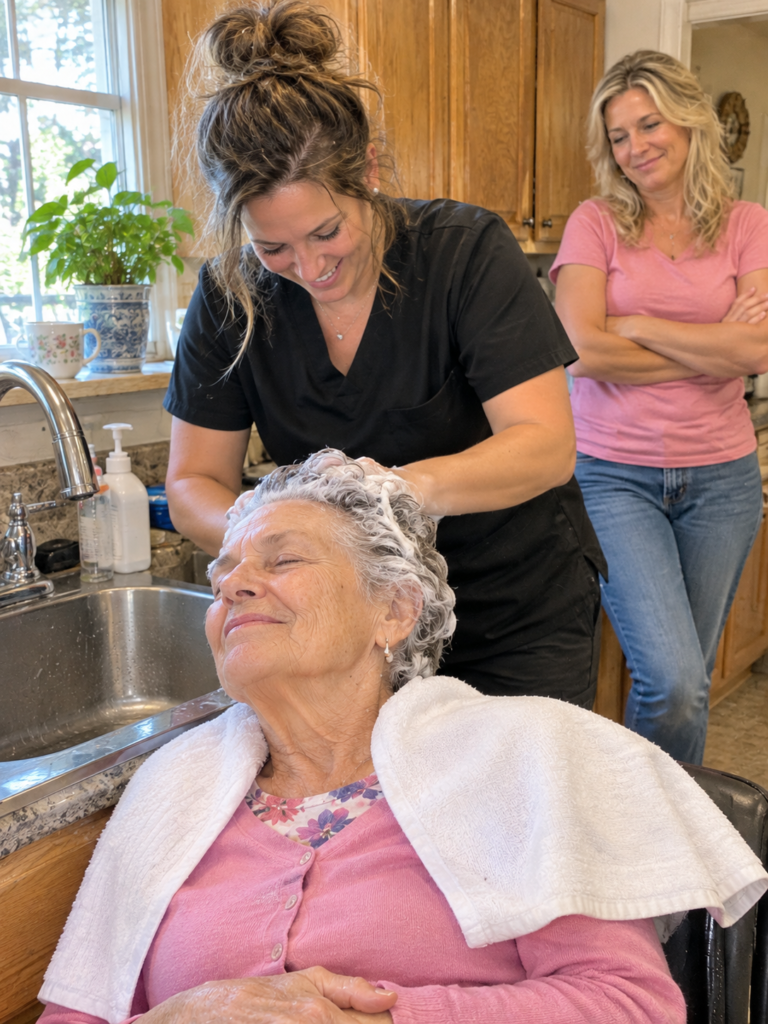
I put the cape away.
I took out one of the new white towels. I unfolded it. I tucked it around Grandma’s shoulders, over her lavender cardigan. Snug around her neck, the way she taught me. Not too tight. Just enough so it wouldn’t slip.
She nodded.
“That’s right,” she said.
Part Eleven: The Sink
Darla’s kitchen sink is a double steel sink under a window that looks out over her vegetable garden. The garden was done for the year. Brown tomato cages. A row of dead cornstalks.
I unfolded my folding chair. I backed it up to the sink. I adjusted the height so the back of the chair would tilt just right.
I put a rolled-up hand towel on the edge of the sink, for her neck.
Darla stood in the doorway to the living room.
She had her arms crossed. She didn’t say anything. She just watched.
“Grandma,” I said. “Can you sit?”
She let go of her walker. I took her good arm. I helped her lower herself into the folding chair.
She sat very straight. Her hands folded in her lap.
Then she reached up with her right hand, the good one, and untied the silk scarf under her chin.
She held it for a moment.
Then she pulled it off.
I didn’t look at Darla. I didn’t look at anything but Grandma’s hair.
Flat and matted. Greasy at the roots. The walnut-sized knot behind her left ear. Her scalp red and flaking.
Grandma closed her eyes.
“Well,” she said quietly. “Go on. Get it over with.”
I helped her lean back. Slowly. One inch at a time. Until her neck rested on the rolled-up towel at the edge of the sink.
Her eyes were still closed. Her hands were gripping the arms of the folding chair.
I turned on the faucet.
I tested the water on my wrist. Too hot. I adjusted it. Tested again. Too cool. Adjusted it again.
Warm. Like a bath. Like the water her mother heated on the wood stove.
I cupped my left hand at her forehead. Right along her hairline. So nothing would run in her eyes.
The way she taught me.
That’s the whole job, Nicky. Making somebody feel safe with their eyes closed.
Then I let the first warm water touch her head.
Grandma’s whole body went still.
Her hands let go of the arms of the chair.
Her shoulders dropped.
She let out a breath I think she’d been holding for three months.
“Oh,” she said. “Oh, honey.”
I had to look at the faucet for a minute.
Part Twelve: Two Shampoos
I washed her hair twice.
The first shampoo didn’t lather at all. Three months of oil and dead skin and the residue of old hairspray. It just slid off her hair like water off a duck.
I rinsed. I worked the shampoo into her scalp with my fingertips. Slow circles. Gentle. Around the red patches where she’d been scratching. Behind her ears. At the nape of her neck.
She kept her eyes closed.
The second shampoo lathered.
White foam, soft and thick, all through her hair. I massaged her scalp for five full minutes. I could feel her relax under my hands. Her jaw unclenching. Her breathing slowing down.
At one point, I thought she’d fallen asleep.
Then I rinsed. Slowly. Thoroughly. Every bit of soap. One hand cupped at her forehead the whole time.
Not one drop ran into her eyes.
Then the conditioner.
Then the knot.
The knot behind her left ear took forty minutes.
I worked it with my fingers first, then the wide-tooth comb, then the rattail comb. One strand at a time. Holding the hair above the knot so the comb wouldn’t pull at her scalp.
Grandma sat with her eyes closed, her neck on the towel, her hands in her lap.
“It pulls,” she said once.
“I’m sorry,” I said. “I’ll go slower.”
“No,” she said. “It pulls the way it ought to pull.”
She opened her eyes and looked up at me. Upside down, from the sink.
“The way it does when somebody’s taking care of it,” she said.
Part Thirteen: Darla
Halfway through the knot, Darla spoke from the doorway.
I’d almost forgotten she was there. She’d been so quiet. Standing with her arms crossed, watching.
“Nobody in this family came out here once,” she said.
Her voice was low. Shaking.
“Not once,” she said. “To see if I was drowning.”
I stopped combing.
I looked up at her.
Darla wasn’t looking at me. She was looking at Grandma, lying back in the folding chair with her eyes closed and her wet hair spread out in the steel sink.
“Ron’s gone three weeks out of every four,” Darla said. “Joel lives in town but he works sixty hours a week. His brother’s in Minneapolis and calls on holidays. Nobody else came. Not once since July.”
Her voice cracked.
“I work at the Kwik Trip four nights a week. I cut my hours from thirty to twenty when she moved in. I get up at six to give her pills. I drive her to La Crosse twice a week for physical therapy. I do her laundry. I cook her meals. I help her to the bathroom at two in the morning.”
She looked at me.
“And every single day,” Darla said, “she tells me I’m doing it wrong.”
The kitchen was very quiet.
Grandma’s eyes were still closed. But I could see her jaw tightening.
“She fights me on everything,” Darla said. “The food. The pills. Getting dressed. And the hair.”
She swallowed.
“I tried, Nicole,” she said. “In September. I filled the bathroom sink and got a towel and asked her if she wanted me to wash her hair. She looked at me like I’d slapped her. She said she’d rather go bald than let me touch her head.”
She wiped her eyes with the back of her hand.
“So I stopped asking,” she said. “Because I was tired. Because I was so, so tired.”
She was right about that.
About all of it.
“We didn’t,” I said quietly. “We didn’t come out. I’m sorry, Darla.”
Darla stared at me.
I don’t think anyone had said that to her before. Not Ron. Not Joel. Not anybody.
She didn’t say anything. She just stood in the doorway with her arms crossed and tears running down her face.
Part Fourteen: The Curls
When the knot was out, I sat Grandma up.
I wrapped her head in a second white towel. I patted her hair until it was damp, not wet. The way you have to for a good pin curl set.
Then I pulled a kitchen chair over and sat down in front of her with the box of pin curl clips.
“Okay, Grandma,” I said. “Tell me how you want it.”
She looked at me for a long moment.
Then she told me.
“Left side one way,” she said. “Clockwise. Toward my face.”
“Yes, ma’am.”
“Right side the other. Counterclockwise. Away from my face.”
“Yes, ma’am.”
“Two rows across the back. Flat curls. Not stand-ups. And don’t you dare put them crossways.”
“No, ma’am.”
She couldn’t reach up yet with her bad wrist.
But she could hold the box.
So she held the box of clips in her lap. And every time I wound a curl around my finger and pressed it flat against her head, she handed me a clip.
One at a time. With her good hand. Holding it out between two fingers, the way she’d held them out for sixty years.
I set the left side.
She handed me twenty-two clips.
I set the right side.
She handed me twenty-four.
Twice, she made me redo one.
“That one’s crooked,” she said. “Take it out.”
I took it out. I wound it again. I pinned it flat.
“Better,” she said.
The second time, she didn’t even look in a mirror. She just reached up with her good hand and touched the curl and said, “No. That’s too tight. You’ll give me a headache.”
She was right. It was too tight.
Halfway through the back rows, something happened.
Darla came in from the doorway.
She walked across the kitchen. She didn’t say anything. She went to the coffee maker on the counter. She filled the pot from the tap. She measured out coffee into the filter.
She started it.
While it brewed, she got three mugs down from the cabinet.
When it was done, she poured three cups of coffee.
One black, for herself.
One with cream and two sugars, for me. I don’t know how she knew. I’d never had coffee at her house.
And one with just a little cream, in a white mug with blue flowers, for Grandma.
She set Grandma’s mug on the counter beside her chair. Close enough to reach with her good hand.
Grandma looked at the mug.
She looked at Darla.
Neither of them said anything.
Then Darla pulled out a kitchen chair. She sat down across from us.
And she watched me set the last row of curls.
Part Fifteen: The Mirror
Grandma’s hair took an hour and a half to dry.
I used the handheld dryer with the diffuser on low. Moving slowly. Back and forth. Never too hot, never too close.
Grandma drank her coffee. Darla drank hers. Nobody talked.
Biscuit came in from the living room and lay down at Grandma’s feet.
When the curls were dry, I took the clips out.
One at a time. Seventy-four of them. Dropping them back in the box. Each curl springing loose, soft and white and round.
Then I brushed them out.
With the round bristle brush. Gently. The way she taught me. Brushing each curl around my finger so it would fall into place. Fluffing the crown. Smoothing the sides.
When I was done, her hair was a cloud again.
Soft and white and round. Sitting on top of her head like it had every Sunday morning for sixty years.
I set the brush down.
I reached into my kit. I took out my hand mirror. The silver one with the long handle. It was the first thing I bought when I opened my shop.
I put it in Grandma’s hands.
Her hands were shaking.
Darla set her coffee down.
Grandma held the mirror in both hands. Her good one and her bad one, in the soft brace. She lifted it slowly.
She looked at herself.
She looked a long time.
Then she touched her own hair with the tips of her fingers.
The left side. The right side. The crown. Feeling each curl. The way she used to feel her clients’ curls, after a set, to check that they were right.
Her lips were moving. I couldn’t hear what she was saying.
“Grandma?” I said.
She lowered the mirror.
She looked at me. Her eyes were full of tears.
“There I am,” she said.
Part Sixteen: What Lorraine Said
Nobody said anything for a long time.
Then Grandma turned in her chair.
She turned away from me. Toward Darla.
Darla was sitting across the kitchen table with both hands around her coffee mug. She was crying too. Quietly. She didn’t wipe her eyes.
Grandma looked at her for a long moment.
“Darla,” she said. “Come here.”
Darla looked surprised. She hesitated.
Then she got up. She walked around the table. She stood beside Grandma’s chair.
Grandma reached up with her good hand. She took Darla’s hand.
“I fought you,” Grandma said. “On the hair. I know I did.”
Darla didn’t say anything.
“I told you I’d rather go bald,” Grandma said. “I’m sorry. That was a terrible thing to say.”
Darla’s face crumpled.
“Why?” she said. “Why wouldn’t you let me help you? I tried, Lorraine. I really tried.”
Grandma looked down at their joined hands.
“Because of 1986,” she said quietly.
Darla went very still.
I didn’t know what that meant. I looked at Grandma. Then at Darla.
“What happened in 1986?” I asked.
Neither of them answered right away.
Then Grandma spoke.
“Darla had Joel’s older brother in the spring of 1986,” Grandma said. “Matthew. And she was very sick afterward. Very sad. The kind of sad they have a name for now, but back then we just called it the baby blues.”
She looked at Darla.
“Ron was on the road,” Grandma said. “Like always. And Darla called me. At the shop. In the middle of a Saturday. She was crying so hard I could barely understand her.”
“She asked me to come over,” Grandma said. “Just for an hour. To hold the baby so she could wash her hair. She said she hadn’t washed it in three weeks. She said she couldn’t remember the last time she’d taken a shower.”
Grandma’s voice cracked.
“And I said no,” she said. “I said I had clients. I said I had a two o’clock. I said she’d have to manage like everybody else did.”
The kitchen was completely silent.
Darla was crying openly now. Holding Grandma’s hand.
“I hung up on her,” Grandma said. “And I went back to my two o’clock. And I set Agnes Torkelson’s hair. And I never once went over there. Not that day. Not that whole spring.”
“You remember that?” Darla whispered. “I didn’t think you remembered.”
“I’ve thought about it every day since July,” Grandma said. “Every single day. Lying in that back bedroom.”
She looked up at her daughter-in-law.
“I didn’t come when you needed me,” she said. “Forty years ago. When you couldn’t wash your own hair. And now I’m the one who can’t.”
She swallowed.
“I couldn’t stand to let you see me like that,” Grandma said. “I couldn’t stand to let you do for me what I wouldn’t do for you.”
Darla knelt down beside the folding chair.
She put her arms around her mother-in-law.
Grandma held on to her. Her good hand on Darla’s back. Her soft white curls against Darla’s frizzy gray-blonde hair.
They stayed like that for a long time.
Part Seventeen: The Ledger
That night, after I’d packed up my kit, Darla walked me out to my car.
It was dark already. Cold. The stars were out over the dead garden.
She stopped by my car door.
“Nicole,” she said. “Wait.”
She held out something. A spiral notebook. Green cover. The kind you buy at Walgreens for a dollar.
“I want you to see this,” she said. “So you know. And so you can tell Joel.”
I opened it under the dome light of my car.
It was a ledger. In Darla’s handwriting. Every page. Every month since August.
Grandma’s SS: $1,640.
Grandma’s meds (co-pays): $187.
Ensure (2 cases): $64.
Adult briefs: $48.
Hospital bed rental: $135.
Gas to La Crosse PT (8 trips): $96.
Groceries (Grandma’s share): $310.
Electric (heated mattress pad, extra heat for back bedroom): $85 increase.
Church envelope: $40.
Phone: $35.
At the bottom of each month, Darla had written a total.
Grandma’s expenses: $1,000.
And then another line underneath.
Lost wages (cut hours at Kwik Trip): $640.
I looked up at her.
“The twelve hundred,” Darla said quietly. “About a thousand goes to her things. The rest I’ve been using to cover the hours I lost. So I can be home with her.”
She looked at the ground.
“I know how it looks,” she said. “Twelve hundred dollars for her keep. I know what people are saying at church. I know what Joel thinks.”
“Why didn’t you tell anyone?” I asked.
Darla laughed. It wasn’t a happy sound.
“Who would I tell?” she said. “Nobody asked.”
Part Eighteen: The Family Meeting
Ron came home on Tuesday.
Seventeen days on the road. He pulled into the driveway at four in the afternoon, still in his trucking company jacket, and found his whole family sitting at his kitchen table.
Joel. Me. His other son, Matthew, who’d driven down from Minneapolis that morning. Darla. And Grandma, in her lavender cardigan, with her hair still in soft white curls from Saturday.
Ron stood in the kitchen doorway with his duffel bag.
He looked at all of us.
“What’s going on?” he said. “Is somebody dead?”
“Sit down, Dad,” Joel said.
We told him everything.
The hair. The church. The back bedroom. The ledger. Darla’s cut hours. Two in the morning trips to the bathroom.
When we were done, Ron sat at the head of his own kitchen table and stared at his hands for a long time.
He’s sixty-five. He’s been driving a truck for thirty-eight years. He has a gray beard and a big belly and hands like catcher’s mitts.
He’s never been much of a talker.
“I didn’t know,” he said finally. “Darla, I didn’t know it was this bad.”
“You didn’t ask,” Darla said quietly.
Ron flinched.
“Every night at nine,” Darla said. “You call. And you ask how’s Mom. And I say fine. And you say good. And you hang up.”
She looked at him.
“You never once asked how I was,” she said.
Ron didn’t say anything for a long time.
Then he looked at his mother.
“Mom,” he said. “Why didn’t you tell me?”
Grandma looked at her son.
“Because I’m stubborn,” she said. “Because I’m proud. Because I’d rather sit in a back bedroom with dirty hair than admit I need help.”
She looked at Darla.
“I learned it from my mother,” Grandma said. “And I taught it to you.”
She looked back at Ron.
“And you married a woman who had to learn it from both of us,” she said.
Part Nineteen: The Schedule
We made a schedule that night.
Darla wrote it on a big sheet of paper and taped it to the refrigerator next to the doctor’s calendar.
Monday — Matthew (FaceTime, 7 p.m.).
Tuesday — Joel (dinner + evening with Grandma, Darla gets night off).
Wednesday — Darla.
Thursday — Nicole (PT drive to La Crosse).
Friday — Darla.
Saturday — 2:00 p.m. Grandma’s appointment. Nicole.
Sunday — Church. Joel drives.
When Ron is home — Ron does EVERYTHING.
Ron laughed when he read the last line. It was the first time I’d heard him laugh in months.
“Fair enough,” he said.
We decided on the money too.
Joel and Matthew would each contribute two hundred dollars a month. Toward Grandma’s care. So Darla could go back up to thirty hours at the Kwik Trip if she wanted. Or not. Her choice.
Darla would keep being the payee. But the ledger would go on the refrigerator. Every month. Where everyone could see it.
“Not because we don’t trust you,” Joel told his mother. “Because nobody should have to keep a ledger alone.”
Part Twenty: Sunday
On Sunday, Grandma went to church.
Joel drove her. I sat in the back seat. Darla sat in the front with her.
Grandma wore her lavender cardigan. Her pink lipstick, straight this time, because I’d put it on for her. And her hair. Soft and white and round. A cloud sitting on top of her head.
She walked into Viroqua Lutheran Church on her walker.
Slowly. Down the center aisle. To the fourth pew on the left side, with the brass plaque that says In Memory of Walter Pederson.
People turned to look.
Agnes Torkelson was sitting in the pew behind her. Ninety-three years old. One of Grandma’s oldest clients from the Beauty Nook.
She leaned forward. She tapped Grandma on the shoulder.
“Lorraine,” she whispered. “Your hair looks lovely.”
Grandma turned around.
“My granddaughter-in-law set it,” she said. “Nicky. She has my old shop.”
She paused.
“And my daughter-in-law helped,” she said.
Darla, sitting beside her in the pew, went very still.
Then she reached over and took Grandma’s hand.
Pastor Dahl’s wife came over after the service.
“Lorraine!” she said. “We’ve missed you so much. How’s your cold?”
Grandma looked at her for a long moment.
“It wasn’t a cold, Ruth,” she said. “It was my hair. I couldn’t wash it. And I was too proud to let anyone help me.”
Ruth Dahl’s mouth fell open.
Grandma patted her arm.
“Don’t make that face,” she said. “It’s fixed now.”
Part Twenty-One: Darla Learns
In December, Darla asked me to teach her.
She came to my shop on a Thursday afternoon, after closing. She stood in the doorway in her red sweatshirt, looking around at the checkered floor and the two chairs and the wall of mirrors.
“I’ve never been in here,” she said. “Not when it was Lorraine’s. Not when it was yours.”
“Never?”
“She never invited me,” Darla said. “And I never asked.”
I sat her in my chair.
I gave her a mannequin head with a wig on it. White, short, curly. I gave her a box of pin curl clips and a bottle of setting lotion.
“Left side clockwise,” I said. “Toward the face.”
Darla was terrible at it.
Her curls were too loose. Then too tight. She pinned them crossways. She dropped half the clips on the floor.
She laughed. Then she swore. Then she laughed again.
She came back the next Thursday. And the Thursday after that.
By January, her curls were passable.
By February, they were good.
In March, Grandma’s wrist brace came off.
She still couldn’t lift her arm all the way above her head. The doctor said she might never be able to.
But she could hold the box of clips.
Part Twenty-Two: Darla’s Kitchen
It’s a Saturday in April now.
Two o’clock.
I’m sitting at Darla’s kitchen table with a cup of coffee. Cream and two sugars.
I’m not setting anybody’s hair.
Grandma is in the folding chair by the double steel sink. A white towel tucked around her shoulders, over her lavender cardigan. Her eyes are closed.
Darla is standing behind her.
She tests the water on her wrist. She adjusts it. Tests again.
She cups her left hand at Grandma’s forehead. Right along her hairline. So nothing will run in her eyes.
She lets the first warm water touch Grandma’s head.
Grandma’s shoulders drop.
“Oh,” she says. “Oh, honey.”
I look at the faucet for a minute.
Darla washes her hair twice. She massages her scalp for five full minutes. Grandma falls asleep for a little while, right there in the folding chair, with her neck on the rolled-up towel.
Darla doesn’t wake her. She just keeps her hand cupped at Grandma’s forehead and lets the warm water run.
When Grandma wakes up, Darla sits her up and towels her hair.
Then she pulls a kitchen chair around and sits down in front of her mother-in-law with the box of pin curl clips.
“Okay, Lorraine,” Darla says. “Tell me how you want it.”
Grandma tells her.
“Left side one way. Clockwise. Toward my face.”
“Right side the other.”
“Two rows across the back. Flat. Don’t you dare put them crossways.”
Grandma holds the box in her lap.
Darla winds a curl around her finger. She presses it flat.
Grandma hands her a clip.
Twice, Grandma makes her redo one.
“That one’s crooked,” she says. “Take it out.”
Darla takes it out. She winds it again. She pins it flat.
“Better,” Grandma says.
When the curls are dry, Darla brushes them out.
Soft and white and round. A cloud.
Darla picks up my silver hand mirror from the counter. She puts it in Grandma’s hands.
Grandma’s hands still shake. They always will now.
She looks a long time.
Then she touches her own hair with the tips of her fingers.
“Well?” Darla asks. Her voice is nervous. “Is it all right?”
Grandma lowers the mirror.
She looks up at her daughter-in-law. Forty years of Thanksgiving dinners. Forty years of your hair looks like a haystack. One phone call in 1986 that she never answered.
She reaches up with her good hand. She touches Darla’s cheek.
“You’ll do,” she says.
Darla laughs. Then she cries. Then she does both at once, standing in her own kitchen with a hairbrush in her hand.
Grandma hands me the mirror.
“Nicky,” she says. “Write it in the book. Saturday. Two o’clock. Darla’s my girl now.”
I take out the appointment book from my bag. The one I keep for the shop. I open it to the page for next Saturday.
I write it in the two o’clock slot.
Lorraine Pederson. Wash and set.
And underneath, in smaller letters:
With Darla.
Grandma used to say that the whole job was making somebody feel safe with their eyes closed.
She was right.
But she left something out. Something I didn’t understand until I watched her daughter-in-law cup a hand at her forehead and let the warm water run.
It’s not just the person in the chair who needs to feel safe.
Sometimes it’s the person at the sink.
The one who’s been standing in the doorway with her arms crossed for forty years. Waiting for somebody to come in. Waiting for somebody to say, We didn’t come. I’m sorry.
Waiting for somebody to hand her a clip.
Compacted conversation