I stood there beside the truck, reading the ticket twice. My hands were shaking, and I was
At the airport, I watched my husband kiss his physical therapist like he was nineteen again. He was supposed to be at his brother’s fishing camp. I heard him tell her, “Two more weeks and I’m out of that house. Then it’s just us.” For nine days I played the good wife. Then I drove to her address, and the door opened.
I had driven my granddaughter Lilly to the airport in St. Louis that Saturday morning. She was nineteen, heading back to college in Texas, and trying to hide how homesick she already felt. Her mama had a double shift at the hospital, so it was just me and Lilly.
Bill said he would have come, but he had promised his brother a weekend at the fishing camp on Kentucky Lake. I didn’t question that. We’d been married forty-one years, and I was used to his fishing weekends. He still brought me the first tomato off the vine every July, holding it out like it was a diamond.
Two springs earlier, he’d had his knee replaced. A physical therapist at a clinic over in Evansville helped him get walking again. Her name was Christa. She was fifty-two, had a nice smile, and was patient with him. I baked her a pound cake to thank her.
After Bill’s therapy ended, he kept “running into her” at Walmart.
“Christa’s a sweet gal, hon,” he said when I teased him. “Don’t be silly.”
I let it go. That was my first mistake, though I didn’t know it yet.
At the curb, I hugged Lilly while she cried a little into my shoulder. I told her to call when she landed, and she promised she would. Then I got back in my car and started to pull into traffic.
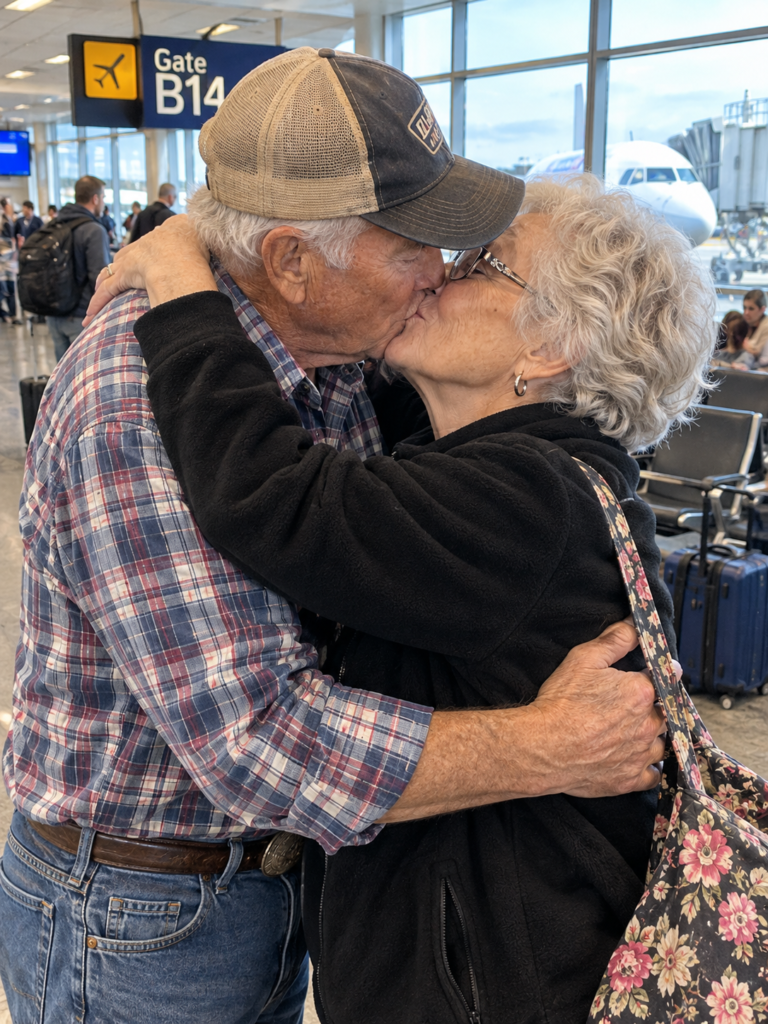
That was when I saw Bill’s tan fishing hat, the one with the lure tucked in the band. I had bought it for him. He stood two doors down from me beside a red rolling suitcase, with his arms around Christa.
Then he kissed her.
I slid down in my seat and rolled the window down an inch. I heard him say, “Two more weeks and I’m out of that house. Then it’s just us.”
Christa laughed and patted his chest. A car honked behind me, and I drove off before Bill could turn around. I cried all the way home, two and a half hours, until my eyes swelled shut. By the time I got there, I had washed my face and put a roast in the oven.
Bill came home Sunday night smelling like his brother’s woodstove. He had a cooler of crappie he’d bought at the bait shop.
“Caught ’em myself,” he said, and kissed me on the cheek.
“Real nice, hon,” I said.
I fried the fish. For nine days I ironed his shirts, asked about his knee, and let him hold my hand at the fish fry. I hate admitting this, but I still laid his work shirts out where he could find them. It was easier than looking at him and asking what he planned to do to me.
Every night after he went to sleep, I took a flashlight out to his truck. On the fourth night, I found a folded delivery ticket in the console. It was from a furniture store in Evansville. One queen bed, one dresser, one rocking chair, delivered to an address on the north side. Paid in full with the card we used for groceries.
furious with myself for needing a piece of paper before I believed what I’d heard.
On the kitchen fridge, Lilly’s school pictures still hung under magnets, every grade from kindergarten up. Beside them was a garden club card in Bill’s handwriting, from our fortieth anniversary.
“To Earlene. Forty years, and I’d do it all again.”
I called my daughter on her break.
“Mom, don’t you go knocking on that door,” she said. “If he finds out you know, he’ll empty the accounts before you blink. Let a lawyer handle it.”
She was probably right. Maybe I was a foolish old woman, chasing something I didn’t want to see. But I needed to look at it with my own eyes before I let a lawyer blow up forty-one years.
On the ninth day, Bill said he had a VFW meeting. I waited ten minutes, then drove to Evansville. The house on the north side was a little yellow ranch with mums on the porch. His truck wasn’t there, but a brand-new rocking chair sat outside with the tags still on the arm.
My legs shook when I rang the bell. A dog barked inside, and somebody shushed it. Christa opened the door in a sweatshirt, her hair pinned up. She didn’t know me. We’d only met once, at the clinic, the day I brought that pound cake.
She wore a gold band on her left hand. Then she smiled and said, “Can I help you? If you’re here for my rocking chair, the delivery man left it on the porch.”
“I’m Earlene,” I said. “Bill’s wife.”
The smile went away. She looked at the ring on her own hand, then back at me.
“His wife?”
“Forty-one years.”
She opened the door wider but didn’t step aside. The dog pushed its nose between her legs, and she held it back with one hand.
“He told me you knew,” she said.
I felt my throat tighten. “Knew what?”
“That he was leaving. He said you were staying in the house and you’d agreed to separate. He said he was just waiting until after the family got used to the idea.”
I looked past her at the rocking chair. The tags were still tied to the arm. I could see the edge of the bed box through the open doorway, leaning against a wall.
“I didn’t agree to anything,” I said. “I heard him tell you at the airport he was leaving in two weeks.”
Her mouth opened, then closed. She finally stepped back and let me in.
I didn’t want to go into her house. I did anyway. The place was still half empty, with a small table and two chairs in the front room. The furniture ticket had listed all three pieces, and seeing them there made my stomach twist.
Christa shut the door. The dog circled my legs, then settled near the rocking chair.
“He said you two had been living separate lives for years,” she said. “He said the marriage was over, just not on paper yet.”
“We still sleep in the same bed.”
She stared at me. “He said you knew he was seeing me.”
I was so angry I almost laughed. Instead, I took the delivery ticket from my purse and held it out.
“He paid for this with the card we use for groceries.”
She read the address. She didn’t take the ticket from me.
“He told me he was using his own money.”
“He’s been saying things like that to both of us, I suppose.”
Christa’s face changed. She wasn’t smiling anymore. “He told me it was his card. He said he was keeping his money separate.”
I told her about the airport, the fishing camp, and the cooler of fish he’d bought at the bait shop. I told her he came home smelling like his brother’s woodstove and kissed me on the cheek.
She sat down at the table. Her hand stayed flat on the wood, and she stared at it.
“I asked him if you knew,” she said. “He said you had made your decision and he had made his.”
“Did you ask him to leave me?”
She looked up. “I told him I wouldn’t move into a house while he was still living with you. He said he was leaving in two weeks.”
There it was. Not an excuse that made me feel better, just another piece of the truth. She’d believed the part that made her comfortable. I had done the same for forty-one years.
I asked for her phone number. She hesitated, then wrote it on the back of a store receipt and handed it to me.
“I don’t want to be part of your fight,” she said.
“It started before I knew about it.”
She looked at the rocking chair. “I know.”
I drove home with the ticket in my purse and Christa’s number tucked behind it. The whole way, I kept seeing the same things: Bill’s hat, the red suitcase, the easy way Christa patted his chest. When I pulled into my driveway, I could see the garden club card through the kitchen window.
I called my daughter again.
“Did you go?” she asked.
“Yes.”
“Mom.”
“She says he told her I knew. He also told her the card was his.”
My daughter let out a breath. “Then you have to get the records and talk to somebody before you confront him.”
“I know.”
I did know. I also knew Bill would be home soon, and I didn’t want to spend another night folding shirts for him while pretending I hadn’t heard his voice at the airport.
I went online and printed the card activity for the furniture charge. I put it on the kitchen table with the delivery ticket. The charge was there, and the address matched. No secret account, no complicated trail. Just a transaction on a card we used for groceries.
I called the number on the back of the card and asked how to keep it from being used again. I also called the lawyer my daughter had mentioned. I made an appointment for the next day. The person who answered didn’t promise me anything. She just told me what papers to bring.
I took the fish-fry dish from the cupboard and set it in the sink. I was standing there with a wet cloth in my hand when Bill came in.
“How was the meeting?” I asked.
“Fine,” he said. He set his keys down. “Why?”
“Just asking.”
He looked at the table and saw the delivery ticket. His hand stopped halfway to his wallet.
“Where’d you get that?”
“Your truck.”
He looked at the card activity underneath it. “You went through my things?”
“I looked in the console of the truck we both use.”
“That isn’t what I asked.”
“It was paid for with our grocery card.”
He picked up the ticket. “It’s a bed and a chair, Earlene. It’s not like I bought a boat.”
I was angry, and I said something I regret. “You should’ve bought a second life with your own money.”
He set the ticket down hard. “I was going to tell you.”
“When?”
“After I had things worked out.”
“What’s worked out? The furniture? The house? Christa?”
He didn’t answer me. He rubbed his knee and looked toward the window, as if the answer might be outside.
“She says you told her I knew.”
“I told her we were having problems.”
“We still share a bed.”
“We’ve been together a long time,” he said. “You know things haven’t been right.”
I couldn’t believe he was asking me to accept that as the same thing as agreement. I felt my face get hot.
“Did you tell her we were separating?”
He rubbed his forehead. “I said I was going to leave.”
“Did you tell her I knew?”
He stared at the floor. “I didn’t want to make it worse.”
“How did you think this was going to go?”
He looked up at me then, with a little smirk that made me angrier than the ticket had.
“You’d make a scene and turn the family against me over a bed?”
The sentence stayed there between us. For a second, I almost did what I’d done so many times before. I wanted to say, “You know I wouldn’t.” I wanted to make it easier for him to take back what he’d said.
Instead, I said, “You used our grocery card to buy furniture for the woman you kissed at the airport.”
His face changed when I said the word kissed. He glanced at the front window.
My daughter had arrived while we were talking. She stood just inside the doorway, still wearing her work badge. She had heard enough to know I wasn’t making it up.
“Dad,” she said, “you told Mom you were at the fishing camp.”
“I was with my brother part of the weekend.”
“That isn’t what she asked.”
He tried to turn toward her, but she stayed by the door. She didn’t move to comfort him.
“She was going to find out,” he said.
“That’s your answer?” I asked.
He lowered himself into a chair. “I needed time.”
“For what?”
“To get settled. To figure out what I could afford.”
The furniture ticket sat between us. I looked at the list again, especially the rocking chair with its tags still on. I had been expecting him to say he was leaving because he had finally fallen in love. Now he was saying he’d planned the move first and expected us both to wait while he arranged it.
“What did you tell Christa about me?” I asked.
“Nothing that concerns you.”
“It concerns me if you used my money to make your new place.”
He looked toward my daughter, then back to me. “I thought I could pay it back.”
“With what?”
He didn’t have an answer ready. For once, I watched him struggle to find a story that fit both women at the same time.
I picked up Christa’s number. “I’m calling her. She can tell us what you told her.”
“Don’t drag her into this.”
“She’s already in it.”
My daughter put her hand on my shoulder. I called Christa and asked if she would speak to us. I told her Bill was here and my daughter was with me. She paused long enough that I thought she might hang up.
Then she said, “All right.”
I put the phone on speaker. Bill sat back in the chair and folded his arms.
Christa’s voice came through clear. “Bill, you told me Earlene knew.”
He leaned toward the phone. “I said we were having problems.”
“No. You said she’d agreed you would move out.”
“That’s not exactly what I said.”
“You said she knew about us.”
He looked at me. “This is ridiculous.”
Christa kept going. “You said you were using your own card for the furniture. You said she knew you were moving.”
Bill reached for the phone, but I moved it closer to me.
“Did you tell her I agreed?” I asked.
He was quiet for a moment. “I didn’t think there was a point in getting into all of it.”
“You told her I knew.”
“I was trying to keep things calm.”
Christa let out a short breath. “You told me what I needed to hear so I’d let you set up a place.”
Bill’s arms came down. “That’s not fair.”
“Then tell us what was fair,” I said. “Tell us why you did it.”
He looked at his hands. “I didn’t want to leave with nowhere to go.”
“Your brother has a house,” my daughter said.
“That’s different.”
“How?”
He didn’t answer her. His jaw worked, and he rubbed his knee again. I used to think that meant he was in pain. Sometimes it did. That night, it looked like he wanted to get away from the questions.
“I thought if I had the place ready, I could explain it to you after,” he said. “I didn’t want to have this conversation until I knew what I was doing.”
“You knew what you were doing at the airport,” I said.
He shook his head. “I made a mess.”
It was the closest thing to an admission I’d heard, but it didn’t undo anything. I was heartbroken, and I was furious. I told him both.
Christa said, “I won’t have the furniture delivered there if you haven’t told her the truth.”
“It already is there,” I said.
“I mean the rest of it. I’m not pretending this is all right.”
I believed she was embarrassed. I didn’t mistake that for loyalty to me. She had still kissed my husband, and I couldn’t make myself feel grateful because she finally understood what he’d done.
Bill stood up. “I’m not doing this over the phone.”
“Then you can say it here,” I told him. “You told her I agreed to this. I didn’t. You used our card. You lied about the fishing camp. What part of that is wrong?”
He turned toward the kitchen, then back to us. My daughter stayed still. She had been warning me not to knock on Christa’s door because she thought Bill would take the money and leave me scrambling. I had thought she was overreacting. Now she could see the ticket, the charge, and the way he kept trying to change the question.
“I’ll pay the card back,” he said.
“From your own money?”
“Yes.”
He pulled out his wallet and sat back down. He wrote a check for the amount on the charge and slid it across the table. I put it beside the delivery ticket. I wasn’t going to treat a check as an apology. It was only the money he owed the household.
Then I told him, “You’re not sleeping here tonight.”
He stood up again. “You can’t throw me out of my own house.”
“I’m not saying the house belongs to me. I’m saying I can’t sleep beside you tonight after what you’ve done. Go to your brother’s.”
He started to say something, then stopped. Maybe he knew I was right about the first part. Maybe he knew he had no business asking me to share a bed after those words at the airport.
He put his wallet away and looked at my daughter. “You think this is what you want?”
She glanced at me before answering. “I think she deserves the truth.”
He went upstairs to pack a bag. I heard drawers opening and shutting. I hated the sound. Forty-one years of a person moving around in the same house, and then a shirt coming off a hanger meant something different.
When he came back downstairs, he had his fishing hat in one hand. The lure was still tucked in the band. He looked at it before putting it on.
“I’m going to stay with my brother,” he said.
“All right.”
He set his keys on the table, but he kept his truck. Then he left with the bag. I watched from the kitchen window as he drove off. I didn’t feel strong. I felt tired and embarrassed that I had waited nine days to make him say out loud what I already knew.
My daughter stayed with me. She didn’t say, “I told you so.” She helped me put the check and the card activity in a folder for the lawyer. The delivery ticket went in there too. On the fridge, the garden club card was still beside Lilly’s school pictures.
I called Christa back the next day. I told her Bill had left the house, and I asked her to have the furniture store cancel whatever hadn’t been delivered. She said she would speak to them. The rocking chair and the bedroom furniture were already inside her house. I didn’t want to see them again.
The lawyer’s office helped me understand what I needed to sort out next. There wasn’t a magic paper that could make forty-one years simple. I had to decide what I wanted and take the steps one at a time. I told Bill through the lawyer that I wanted a separation. I also told him the charge on the card had to be repaid, and he had already written the check.
He didn’t come home to talk me out of it. He called once and asked if we could sit down alone.
I told him, “Not yet.”
That was the last time I let him call it a misunderstanding. I didn’t know what the house or the rest of our marriage would look like after the paperwork was done. I knew I couldn’t keep pretending we were fine just because he’d brought home fish and kissed my cheek.
When July came, the first tomato ripenedon the vine. Bill wasn’t there to bring it in. I picked it myself and set it on the kitchen counter beside the garden club card.
Then I took the card down and put it in the drawer.