Greatest Regret
My mother had walked both of my sisters down the aisle. Twice each.
Four weddings. Four times she held their arms and smiled for the cameras like she was presenting miracles dressed in lace. Four times she cried in the front row and told everyone who would listen that it was the proudest day of her life.
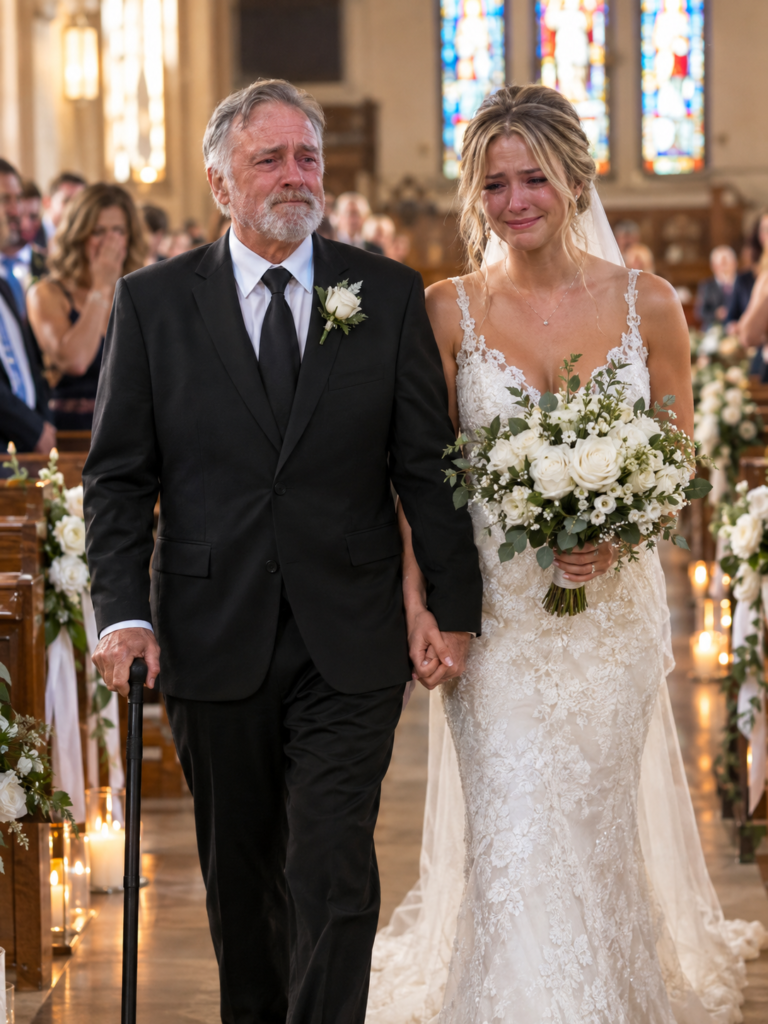
But on the morning of my wedding, she stood in the doorway of the bridal suite, looked at me in my white gown, and said, “I refuse to walk my greatest regret to the altar.”
The room went completely silent.
The hairstylist stopped with a bobby pin halfway to my head. My friend Nadia, who’d been steaming the hem of my dress, slowly set the steamer down on the carpet.
My fingers shook a little around the edge of my veil.
Standing behind Mom, my sisters, Paige and Lauren, traded little smiles. The kind they’d been trading my whole life. They’d always liked watching me get made small.
Paige touched the diamond bracelet on her wrist. Mom loved reminding everyone that she’d “helped” Paige buy it. Lauren tilted her head and whispered, loud enough for everyone to hear, “Don’t cry, Emma. You’ll ruin the cheap mascara.”
I looked at myself in the mirror.
Twenty-nine years old. My face calm. My lips steady.
But to them, I was still the unwanted third daughter. The one who got the attic bedroom while my sisters got the big rooms on the second floor. The one who got a sheet cake at the grocery store on her birthday while they got trips to Paris.
My dad was leaning against the doorframe in his gray tuxedo. He was smiling like this was a show he’d bought tickets for.
“Your mother has a right to her feelings,” he said. “You’ve always been difficult.”
Difficult.
Being difficult meant asking, at eighteen, where my college fund had gone.
Being difficult meant asking, at fifteen, why Grandpa’s letters had stopped coming.
Being difficult meant becoming a forensic accountant instead of marrying someone rich and staying quietly grateful for whatever I was given.
My fiancé, Daniel, had been standing by the window. He wasn’t supposed to be in the bridal suite at all. He’d only come in for two minutes to give me a note he’d written, the old-fashioned kind, folded into a tiny square. Now he stepped forward. I could see the anger under his face, held down hard, the way he holds things down.
I put my hand on his sleeve.
“Don’t,” I whispered. “Not yet.”
Mom laughed softly. “Still dramatic. Even today.”
Then the door opened.
My grandfather walked in slowly, leaning on his black cane.
His white hair was combed neatly back. His navy suit was older than either of my sisters’ marriages, and somehow cleaner than my parents’ consciences. He was eighty-one years old. He’d had a stroke twelve years earlier, and his left foot still dragged a little when he got tired.
But his eyes were the same as they’d always been. Sharp enough to quiet a whole room.
He looked straight at my mother.
“Margaret,” he said. “You said what?”
My mother’s face went hard.
“This is family business, Dad.”
“I am family,” he said.
My father pushed off the doorframe. “Arthur. Don’t make a scene.”
Grandpa didn’t even look at him. He turned to me instead and held out his hand. It was wrinkled and spotted and a little shaky.
“I’ll walk you,” he said.
My throat went tight. “Grandpa…”
“You were never a regret, Emma.” He pressed his thumb into my palm, the way he used to when I was little and scared of thunderstorms. “You were the only one who came back for the truth.”
My mother’s smile slipped.
Just for a second. Less than a second.
But I saw it.
And so did Grandpa.
Out in the hallway, the organ started to play.
The church was packed. Relatives. Neighbors. My father’s business partners. Donors from my parents’ charity, the Stone Family Foundation, which had put my parents’ faces in the local paper every Christmas for ten years. Three hundred people who believed the picture-perfect Stone family had nothing to hide.
Mom lifted her chin. She thought she’d already won.
What she didn’t know was that I had spent the last eighteen months following every dollar they’d ever taken.
And what I didn’t know was that my grandfather had plans of his own.
Let me back up a little. Because you need to know what kind of house I grew up in.
We lived in a big white colonial outside of Hartford, Connecticut. Five bedrooms. Three on the second floor, one for my parents, one for Paige, one for Lauren. A guest room downstairs.
And the attic.
That was mine.
It had a slanted ceiling and one small window, and in the summer it got so hot I slept with wet washcloths on my neck. In the winter, I could see my breath in the mornings. There was no heating vent up there. Dad said it would cost too much to put one in.
“You like it up there,” Mom would say whenever anyone asked. “Emma’s our little bookworm. She likes being alone.”
I didn’t like being alone. I just didn’t have a choice.
Paige was five years older than me. Lauren was three years older. They were blond and pretty and easy, the kind of girls who knew how to laugh at the right moment at a dinner party. I was dark-haired and serious and asked too many questions.
“Why does Lauren get to go to Paris?” I asked once, when I was eleven. It was Lauren’s fourteenth birthday trip. Paige had gotten the same trip when she turned fourteen.
“Because Lauren earned it,” Mom said.
“How?”
Mom looked at me over the top of her magazine. “By not asking questions like that.”
When I turned fourteen, I got a sheet cake from Stop & Shop and a gift card to a bookstore. Mom forgot to put my name on the cake. It just said Happy Birthday! in blue icing.
Paige laughed so hard she choked on her soda.
“Maybe they ran out of letters,” she said.
The only person who ever made me feel like I mattered back then was Grandpa Arthur.
He was my mother’s father. He’d started a machine shop in New Britain when he was twenty-four, with a loan from his uncle and one used lathe. By the time he was sixty, Whitfield Precision had two hundred employees and made parts for airplanes. When he sold it, he sold it for a lot of money. I didn’t know how much back then. I just knew he drove a twenty-year-old Buick and wore the same three cardigans in rotation.
He came for dinner every Sunday. He always sat next to me.
He’d ask me what I was reading. He’d actually listen to the answer. When I was nine, he taught me how to balance a checkbook with a pencil and a ledger he’d brought just for me.
“Numbers don’t lie, Emmy,” he said. “People lie. Numbers just sit there and wait for somebody smart enough to read them.”
“Am I smart enough?”
He tapped the end of my nose with the pencil. “You’re the smartest one at this table. Don’t tell your sisters.”
Mom heard that. She was carrying the gravy boat in from the kitchen. She stopped in the doorway, and her face did something I didn’t understand at the time. It closed up, like a door.
“Dad,” she said. “Don’t fill her head.”
“I’m not filling it, Maggie. It’s already full.”
She set the gravy boat down so hard it sloshed onto the tablecloth.
When I was fifteen, Grandpa had his stroke.
It happened on a Tuesday in March, in his kitchen. A neighbor found him on the floor. He was in the hospital for three weeks, then a rehab center for two months. I begged to visit. Mom took me once. He couldn’t talk much. One side of his face drooped. But when he saw me, he squeezed my hand so hard it hurt.
After that, everything changed.
Mom and Dad got power of attorney while Grandpa was recovering. Then, about six months later, they went to court and got something bigger. A conservatorship. That meant a judge put them in charge of all of Grandpa’s money and all of his decisions, because they said he couldn’t make decisions for himself anymore.
They told everyone it was dementia. That the stroke had damaged his brain and he was getting confused.
They moved him out of his house and into a memory care facility called Briar Glen. It was three hours away, up in Vermont.
“Why so far?” I asked.
“It’s the best one,” Dad said. “Only the best for your grandfather.”
Grandpa had written me a letter every month since I was seven. Real letters, on yellow legal paper, in his square handwriting. He’d tell me about the birds at his feeder, or a funny thing he’d read in the paper, or a math puzzle he wanted me to solve. I’d write back. I kept every single one of his letters in a shoebox under my bed in the attic.
After he moved to Briar Glen, the letters stopped.
I kept writing to him. Every month. I’d give my letters to Mom to mail, because I didn’t know the address.
Nothing came back.
“He doesn’t remember you, honey,” Mom said, after almost a year. She said it gently. That was the worst part. “The doctors say it’s better not to upset him. Your letters confuse him. Maybe you should stop.”
I cried for a week.
Then I stopped writing.
I was sixteen. I believed her. Why wouldn’t I believe my own mother?
When I was eighteen, I got into Boston College.
I’d worked so hard for it. I’d studied in that freezing attic with a space heater I bought with my own babysitting money. When I opened the acceptance email, I ran down two flights of stairs screaming.
Then Dad sat me down at the kitchen table.
“The college fund is gone,” he said.
I stared at him.
“Grandpa set that up for me. When I was born. He told me. He said there was enough for any school I wanted.”
“There was,” Dad said. “But the market’s been bad. And your grandfather’s care is expensive. Briar Glen costs twelve thousand dollars a month, Emma. Somebody has to pay for that.”
“But Grandpa has money. He sold the company.”
Dad’s face got tight. “That money is complicated. You wouldn’t understand.”
“Then explain it to me.”
“Emma.” Mom came in from the living room. “Don’t start.”
“I’m not starting anything. I’m asking where my college money went.”
“Your father just told you.”
“He told me the market. What market? Show me the statements. I’ll understand them. I’m good with numbers. Grandpa said—”
“Enough.” Mom slapped her hand on the table. “Your grandfather says a lot of things. He’s not well. You know that.”
Lauren was leaning against the kitchen counter eating grapes.
“God, Emma,” she said. “Just take out loans like a normal person.”
Lauren had graduated from Fairfield University the year before. Mom and Dad had paid for all of it. So did Paige’s four years at Georgetown.
I took out loans.
A hundred and twelve thousand dollars of them.
I went to UConn instead of Boston College, because it was cheaper. I worked twenty hours a week at a coffee shop. I studied accounting. Then I got my CPA license, and then my certification in forensic accounting. I learned how to follow money through companies and bank accounts and charities. I learned how people hide things.
People lie. Numbers just sit there and wait.
I didn’t know it then, but I was training for the most important job of my life.
Paige got married the first time when she was twenty-six. It was a huge wedding at a country club. Two hundred and fifty guests. A string quartet. Mom walked her down the aisle, because Dad had a bad back that month and Mom said it would be “so modern.”
She cried the whole time.
Paige got divorced two years later. Then she married again at thirty, to a dentist named Graham. Even bigger wedding. Mom walked her again.
Lauren married a man named Trent at twenty-five. Mom walked her. Lauren divorced him at twenty-eight. Married a real estate guy named Colby at thirty. Mom walked her again.
Four weddings. Four times Mom stood up at the reception and gave a speech about how her daughters were “the light of her life.” She never mentioned me in any of those speeches. Not once.
At Lauren’s second wedding, I was standing by the bar when I heard Mom talking to one of her friends from the foundation board.
“Three daughters?” the woman said. “How lovely. Where’s the third one?”
Mom glanced across the room at me. I was holding a club soda. I’d just come from work.
“Oh,” Mom said. “Emma. She’s… well, every family has one, don’t they?” And she laughed, and the woman laughed, and they turned back to watch Lauren dance.
Every family has one.
I put down my club soda and walked out to my car. I sat in the parking lot for twenty minutes with my hands on the wheel.
That was the night I decided to go see my grandfather.
Briar Glen looked like a nice hotel from the outside. White siding. Flower boxes. A little gazebo by a pond.
I’d called ahead. The woman at the front desk had sounded surprised.
“Arthur Whitfield? You’re family?”
“I’m his granddaughter.”
There was a pause. “Okay. It’s just… he doesn’t get a lot of visitors. His daughter has a note on his file. Family visits are supposed to be arranged through her.”
“I’m an adult. I’m his granddaughter. Is there a law against me visiting him?”
Another pause. “No, ma’am. There isn’t.”
So I drove up on a Saturday in April, three hours each way. I’d spent the whole drive getting ready for the worst. I’d read everything about dementia. I’d told myself he wouldn’t know me. I’d told myself to be gentle, not to cry, not to expect anything.
A nurse named Gloria walked me down a long hallway that smelled like lemon cleaner and canned peas. She stopped at the last door on the left.
“He’s in good spirits today,” she said. “He usually is in the mornings.”
I went in.
Grandpa was sitting in a chair by the window with a newspaper in his lap. He was thinner than I remembered. Older. His hair had gone completely white. There was a crossword on the table next to him, half done, in pen.
He looked up.
And he looked at me for a long time.
My heart was pounding. I thought, He doesn’t know me. Of course he doesn’t. It’s been twelve years.
Then his whole face changed.
“Emmy?”
I couldn’t speak.
“Emmy. Is that you?” His voice cracked. He grabbed the arms of his chair and tried to stand up. “Look at you. Look at you. You’re a grown woman.”
I dropped my purse on the floor and crossed the room and knelt down and put my arms around him, and he held onto me with both hands, and we both cried like children.
When we finally let go, he held my face in his hands and looked at me like he was memorizing it.
“Why didn’t you ever write back?” he said.
I froze.
“What?”
“I wrote you. Every month. I gave them to the girls at the desk to mail. I never got a single letter back. Not one.” His eyes filled up again. “Your mother told me you were busy. That you had your own life. That you didn’t want an old man bothering you. I figured she was right. I figured you’d moved on.”
“Grandpa. I wrote you. I wrote you for a year. I gave every letter to Mom.”
He went very still.
“Your mother,” he said slowly, “told me you didn’t want to hear from me.”
“She told me you didn’t remember me. She said my letters confused you.”
We sat there and stared at each other.
Grandpa picked up his pen and looked at the crossword. His hand was shaking. Then he put the pen down and looked back at me, and his eyes were the old eyes. The ones that could quiet a room.
“Emma,” he said. “I don’t have dementia.”
He didn’t. Not then and not ever.
He’d had a stroke. It had made him weak on one side, slurred his speech for a while. For a few months, he’d been confused. But he’d worked hard in rehab and gotten almost all of himself back. By the time Mom and Dad went to court for the conservatorship, he was doing crossword puzzles in pen.
“They brought in a doctor,” he told me. “Some friend of your father’s. Dr. Haskell. He came to the rehab center for twenty minutes. Asked me what year it was, and I said the wrong year, because I’d just woken up from a nap and I was groggy. He wrote that down. Then he left. Next thing I knew, I was here. And everything I owned belonged to your mother.”
“Didn’t you fight it?”
He laughed, but there was nothing funny in it.
“With what? They had my checkbook. They had my phone. They had a lawyer. I had a walker and a speech therapist.” He shook his head. “I tried calling my old attorney. Your mother had already let him go. I tried writing letters to the court. I don’t know where they went. Probably the same place my letters to you went.”
I sat back on my heels on the floor of that room and felt something cold settle in my stomach.
“How much money, Grandpa?”
“What?”
“When you sold Whitfield. How much?”
He looked at me for a long moment. Then he said a number.
Fourteen million dollars.
I drove home that night and didn’t sleep.
At three in the morning, Daniel found me at our kitchen table with my laptop open and six legal pads covered in notes.
Daniel is a carpenter. He builds custom furniture in a workshop behind his brother’s house. He has sawdust in his hair most days and the biggest heart of anyone I’ve ever met. My parents met him exactly twice. Both times, my mother asked him what his “real job” was.
He sat down across from me and pulled one of the legal pads toward him.
“Talk to me,” he said.
I told him everything.
When I finished, he didn’t say anything for a long time. Then he said, “What do you need?”
“What?”
“You’re going to do something. I know that face. So what do you need? Coffee? A bigger table? Me to shut up and go to bed?”
I laughed. Then I started crying.
“I need eighteen months,” I said. “And I need you not to let me quit.”
He reached across and took my hand.
“Deal,” he said.
Here’s what I found.
It took me a year and a half of nights and weekends. Public records. Court filings. The foundation’s tax returns, which charities have to make public. Property records. Corporate registrations. I got Grandpa to sign a form giving me access to his own old bank records. His new lawyer, a sharp gray-haired woman named Helen Park who did elder law in Hartford, helped me subpoena the rest.
When Mom and Dad became Grandpa’s conservators, there was about fourteen million dollars in his accounts.
Within three years, nine million of it had been “donated” to the Stone Family Foundation. On paper, Grandpa was the generous donor. In reality, he’d never signed a thing.
The foundation was supposed to give money to good causes. Children’s hospitals. Food banks. Scholarships.
It did give some money away. About eleven percent. Just enough to keep it legal-looking and get my parents’ picture in the paper.
The rest went out in other ways.
There were “consulting fees” to a company called RMS Advisory, LLC. RMS stood for Richard and Margaret Stone. Two hundred thousand dollars a year.
There were “board retreats” in Paris. Every summer. The board was my parents, Paige, and Lauren.
There was a “gala auction item” purchase from a jeweler on Madison Avenue for forty-two thousand dollars. I found the receipt. It was a diamond tennis bracelet. The same one Paige was wearing in the bridal suite.
There were “event costs” that matched, almost to the dollar, the costs of four very large weddings at four very nice country clubs.
And in 2015, there was a withdrawal straight from Grandpa’s conservatorship account of a hundred and ninety thousand dollars, labeled Education Expense — Granddaughter.
It went into a private account in Lauren’s name. It was used to pay off her student loans from Fairfield.
My college fund had paid off my sister’s degree.
I sat at the kitchen table and stared at that line for a long time.
Daniel came in with two cups of coffee. He looked over my shoulder.
“That’s yours,” he said. “Isn’t it.”
“That’s mine.”
He put the coffee down very carefully. Then he went out to his truck and sat in it for ten minutes. When he came back, his eyes were red.
“Okay,” he said. “Keep going.”
There’s one more thing I found during those eighteen months. And it’s the thing that broke my heart the most.
It was Thanksgiving, about a year in. I went home for dinner, because if I’d stopped going, Mom would have known something was wrong. I sat through two hours of Paige talking about her kitchen renovation and Lauren talking about her trip to Tulum. I smiled. I said pass the stuffing. Nobody asked about my job.
After dessert, I told Mom I wanted to get some of my old books out of the attic.
“Take whatever you want,” she said, not looking up from her phone. “Nobody goes up there anymore.”
I climbed the narrow stairs. The attic smelled like dust and old cardboard. My old bed was still there, with a bare mattress. Mom had turned the rest of the room into storage. Christmas decorations. Old lamps. Bins of my sisters’ trophies.
In the back corner, under the slanted part of the ceiling where I used to hit my head every morning, there was a plastic storage bin I didn’t recognize.
It had a piece of masking tape on the lid. In Mom’s handwriting, it said: DAD — MISC.
I opened it.
It was full of envelopes.
Hundreds of them. Neatly stacked in rubber-banded bundles. Every single one was addressed in Grandpa’s square handwriting.
Miss Emma Stone.
Every single one was sealed. Never opened.
Under them, in a separate bundle, were my letters. The ones I’d written to him at sixteen. Also sealed. Also never sent.
I sat down on the attic floor in the same spot where I used to sit and do my homework, and I counted.
Grandpa had written me a hundred and forty-one letters.
My mother had kept every single one. In the room she’d given me. Ten feet from where I used to sleep.
I didn’t cry. I was past crying. I just sat there with the letters in my lap and felt something inside me go very quiet and very hard.
Then I took out my phone and photographed every envelope. The postmarks. The dates. The tape on the lid with my mother’s handwriting.
Then I put everything back exactly the way I’d found it.
I went downstairs. Mom was loading the dishwasher.
“Find what you wanted?” she asked.
“Yes,” I said. “I did.”
By the time the wedding came, everything was ready.
Helen Park had filed a petition to end the conservatorship. Grandpa had passed three separate evaluations from three independent doctors, all saying he was completely competent and had been for years. The hearing was set for two weeks after my wedding.
I’d sent my full report to the state attorney general’s office, the part that investigates charities. They’d called me twice. They were very interested.
My parents didn’t know any of it. Helen had timed the court papers to be served the Monday after the wedding.
“Let me have the wedding,” I’d told her. “Just the wedding. I don’t want them to have that too.”
I’d talked to Briar Glen and arranged to sign Grandpa out for the weekend. Daniel drove up and got him on Friday. He stayed in our guest room. He and Daniel stayed up until midnight in the garage while Daniel showed him the oak table he’d built as a wedding gift for me.
“Good joints,” Grandpa said, running his hand along the edge. “Tight. No glue showing. You do good work, son.”
Daniel told me later that was the best compliment he’d ever gotten.
My parents had no idea Grandpa was coming. They’d told everyone he was “too far gone” to travel. That he wouldn’t even know it was a wedding.
So when he walked into that bridal suite, they’d looked at him like they were seeing a ghost.
My plan was simple. Get married. Go on our honeymoon. Let the lawyers do the rest.
I hadn’t planned on what Grandpa would do.
The organ was still playing out in the hallway.
Mom stood in the doorway with her arms crossed.
“Fine,” she said. “Let him walk you. Let everybody see what you’ve done. Dragging a sick old man out of his care home for your little show.” She turned to my sisters. “Come on, girls. Let’s go take our seats.”
Paige and Lauren followed her out. Lauren gave me one last little smirk on her way past.
My father stayed a second longer. He looked at Grandpa. Grandpa looked back.
“Richard,” Grandpa said quietly. “You look well. Paris agrees with you.”
My father’s smile flickered. Then he turned and walked out.
Daniel squeezed my hand. “I’ll see you at the end of the aisle,” he said. He kissed my forehead, carefully, so he wouldn’t mess up my makeup. Then he left too.
It was just me and Grandpa.
I looked at him. “What was that? About Paris?”
“Just making conversation.” He held out his arm. “Shall we?”
“Grandpa. Promise me you won’t do anything. We have a plan. Helen has a plan. Two weeks.”
He smiled at me. It was a gentle smile, and a little sad.
“Emmy,” he said. “I’ve waited twelve years. I’m eighty-one. I don’t buy green bananas anymore.” He patted my hand on his arm. “Besides. I’m walking my granddaughter down the aisle. What could I possibly do?”
I should have known better.
The church doors opened.
The organ swelled into the wedding march. Three hundred people stood up all at once with a sound like wind.
I looked down the long aisle. It was St. Matthew’s, the big stone church where my parents had been members for thirty years. The church where Paige and Lauren had both been married. Twice.
At the very end, under the stained glass, Daniel was standing next to the priest in his dark blue suit. When he saw me, his face did something I’ll never forget. It just opened up. Like the sun coming out.
We started walking.
Grandpa was slow. His cane tapped on the stone floor. Tap, step. Tap, step. His left foot dragged a little. I matched my steps to his.
I could hear people whispering as we passed.
“Is that Arthur Whitfield?”
“I thought he had dementia.”
“Margaret said he couldn’t even feed himself.”
“He looks… fine. He looks completely fine.”
In the front row, on the left side, my mother stood next to my father. She was smiling the big bright smile she wears for the foundation photographs. But her knuckles were white around her little beaded purse.
Paige and Lauren stood next to them with their husbands. Lauren was whispering something to Paige, and Paige was nodding.
Right behind them, in the second row, sat Harold Benning. He was the chairman of the bank where the foundation kept its money. He also sat on the foundation’s advisory board. Next to him was Reverend Collins’s wife, and next to her, the editor of the local paper, the one who wrote the Christmas stories about my parents’ generosity.
Tap, step. Tap, step.
We were halfway down the aisle when Grandpa stopped.
Just stopped. Right in the middle.
The organist kept playing for a few bars. Then he noticed, and the music stumbled and trailed off.
People looked at each other.
“Grandpa?” I whispered. “Are you okay? Do you need to sit?”
He didn’t answer me.
He turned slowly, leaning on his cane, until he was facing the front row.
Facing my mother.
The whole church went quiet. Three hundred people holding their breath.
Then my grandfather said eight words. Loud and clear, in a voice that carried all the way up to the stained glass.
“Tell them where my money went, Margaret. Now.”
The entire church gasped.
It was a real sound, all at once, like everyone had been punched in the stomach at the same time.
My father’s smile disappeared immediately. It just dropped off his face, like somebody had pulled a plug.
My mother didn’t move. She stood there with her purse clutched in front of her, staring at her father. Her face had gone the color of paper.
Then she leaned toward my father and whispered. She must have thought nobody could hear her. But the church was so quiet, and the stone walls carry everything.
“Richard. Richard, do something. He knows. He knows.“
The people in the second row heard it. I watched Harold Benning’s head turn slowly toward my mother.
My father cleared his throat. He stepped forward into the aisle with his hands up, like he was calming a frightened horse.
“Arthur,” he said loudly. Too loudly. “Arthur, you’re confused. You’re tired. Let’s get you to a seat.” He turned to the crowd and gave a little laugh. “I’m so sorry, everyone. As many of you know, my father-in-law has been struggling with dementia for years. Sometimes he gets mixed up. It’s the disease talking.”
He reached for Grandpa’s arm.
Grandpa lifted his cane and set the rubber tip, very gently, against my father’s chest.
“Don’t,” he said.
My father stopped.
“I’ve had three doctors look at my head this year, Richard,” Grandpa said. He didn’t shout. He didn’t need to. “Three. Not your golf buddy. Real doctors. They all say the same thing. I’m sharper than you are. Which, frankly, isn’t a high bar.”
Someone in the back laughed, then quickly stopped.
“Dr. Haskell,” Grandpa went on, “spent twenty minutes with me twelve years ago, when I’d just had a stroke and woke up from a nap. That’s what you used. Twenty minutes. And then you put me in a building three hours away and told my granddaughter I didn’t remember her name.”
He turned his head and looked at my mother.
“A hundred and forty-one letters, Maggie,” he said. And his voice cracked, just a little, for the first time. “I wrote her a hundred and forty-one letters. Where are they?”
My mother opened her mouth.
Nothing came out.
I want to tell you I stood there calmly. That I’d planned for this.
I hadn’t.
My heart was slamming. My hands were ice cold. Everything I’d worked for over eighteen months, every careful step, every document, every “not yet,” and now it was happening in the middle of my wedding, with my veil on, in front of three hundred people.
I looked at the front of the church.
Daniel was still standing there. He hadn’t moved. He was looking right at me. Not at my parents. Not at Grandpa. At me.
He raised his eyebrows a tiny bit. Like a question.
What do you want to do?
And I realized it was my choice.
My mother was staring at me now. Not at Grandpa. At me. Her eyes were wide and wet and furious. And under the fury, something I’d never seen in her face before.
Fear.
“Emma,” she said. Her voice was shaking. “Emma, tell him to stop. Tell him he’s confused. Please.”
Please.
My mother had never said please to me in my life.
I took a breath.
“He’s not confused, Mom,” I said.
The church was so quiet I could hear the old radiator ticking.
“I have the bank records,” I said. “All of them. I have the foundation’s tax returns. I have the receipt for Paige’s bracelet.” Paige’s hand flew to her wrist. “I have the wire transfer that paid off Lauren’s student loans with my college fund.” Lauren’s face went white. “And I have photographs of a plastic bin in the attic with your handwriting on the lid.”
My mother made a sound. Like something tearing.
“The attorney general’s office has all of it,” I said. “So does Grandpa’s lawyer. There’s a court hearing in two weeks.”
I turned and looked at Grandpa.
“That was supposed to be the plan,” I told him quietly. “Two weeks.”
He looked at me. Then he smiled. That same sad, gentle smile from the hallway.
“I know, sweetheart,” he said. “I’m sorry. I just couldn’t stand to hear her call you that. Not today. Not in front of all these people who think she’s a saint.”
He turned back to the front row one last time.
“I said what I came to say,” he told my mother. “The rest is for the judge.”
Then he turned around to face the altar, tucked my hand back into the crook of his arm, and nodded at the stunned organist.
“Go ahead, son,” he said. “Play. My granddaughter’s getting married.”
The organist looked at the priest. The priest, Father Dominic, a small round man who’d known my family for twenty years, looked at me.
I nodded.
The organ started again. A little shaky at first.
We walked the rest of the way. Tap, step. Tap, step.
Behind us, I heard movement in the front row. Shuffling. A purse dropping onto the floor. My father’s voice, low and furious: “Margaret. Now. We’re leaving.”
I didn’t turn around.
When we got to the altar, Grandpa took my hand and put it into Daniel’s. Then he held both of our hands together in his for a second.
“Good joints,” he said to Daniel. “Tight. Make it last.”
Daniel’s eyes filled up. “Yes, sir.”
Grandpa let go and lowered himself slowly into the front pew on the right side. Daniel’s mother scooted over to make room for him. She put her hand on his arm, and he patted it.
Then I looked over at the left side of the church.
The front row was half empty.
My mother and father were gone. Their seats were empty, except for my mother’s beaded purse, lying on the floor where she’d dropped it.
Paige was gone too. Her husband Graham was standing in the aisle, looking back and forth between the side door and his seat, like he didn’t know which way to go.
But Lauren was still there.
She was sitting down now, alone, with her hands in her lap. She was staring at the floor. Her husband Colby was whispering something to her, and she wasn’t answering.
Father Dominic cleared his throat. He looked at me over his glasses.
“Shall we begin again, Emma?”
“Yes, Father,” I said. “Please.”
I don’t remember all the words. I remember Daniel’s hands were warm and steady. I remember his voice shook when he said his vows, and he had to stop and start again. I remember the sunlight through the stained glass made colored squares on the floor.
I remember Father Dominic saying, “If anyone here has any reason why these two should not be joined…” and then pausing, and looking out at the crowd, and adding very dryly, “…I think we’ve had enough surprises for one afternoon.”
People laughed. Real laughter. It broke something open in the room.
When he said, “You may kiss the bride,” Daniel kissed me like nothing else in the world existed.
And the church clapped. Not the polite clapping of a society wedding. Loud, long clapping. Some people stood up. I saw Daniel’s whole family on their feet. I saw Nadia crying into her bouquet. I saw Grandpa in the front pew, clapping slowly, with tears running down his face.
And in the left front row, alone, I saw Lauren.
She was clapping too.
The reception was at a restaurant on the river. It was smaller than anything my parents would have picked. Daniel and I paid for it ourselves.
I wasn’t sure who would come after what happened.
Almost everyone came.
The foundation donors came. The neighbors came. Father Dominic came and ate three plates of pasta. Most of my mother’s relatives came, and spent the whole first hour whispering in little groups.
Harold Benning, the bank chairman, came over to me before dinner. He was a tall, stiff man in his sixties. He’d never spoken more than five words to me in my life.
“Mrs….?” He paused.
“Emma’s fine,” I said. “Mrs. Kowalski, technically, as of an hour ago.”
“Emma.” He cleared his throat. “I owe you an apology. I’ve sat on that foundation’s advisory board for six years. I signed off on the annual reports. I never once looked closely.” He shook his head. “I should have. It’s my job to look.”
“They’re good at making people not look,” I said.
“So were you,” he said. “At looking, I mean. Eighteen months, you said?”
“Eighteen months.”
He held out his hand. I shook it.
“If you’re ever tired of whatever firm you’re at,” he said, “call me.”
My father’s business partner came next. He didn’t apologize. He just asked, very quietly, whether any of the money had gone through his company. I told him I didn’t think so. He looked so relieved he almost cried.
Then the editor of the local paper came over with a notebook.
“No,” I said, before she even opened her mouth. “Not today.”
She looked at me for a second. Then she closed the notebook and put it back in her bag.
“Fair enough,” she said. “Congratulations. It was a hell of a wedding.”
Grandpa gave a toast.
Nobody had asked him to. He just stood up during dinner, tapped his glass with his fork, and waited for everyone to get quiet.
It took a while. When the room was finally silent, he looked around at all of us.
“I’m not much of a speaker,” he said. “Never was. I ran a machine shop. We didn’t do a lot of speeches.”
People smiled.
“But I want to say a few things about my granddaughter. Because for twelve years, I wasn’t allowed to say anything about her. And I’ve got a lot saved up.”
He looked down at me.
“When Emma was nine years old,” he said, “I taught her how to balance a checkbook. She was faster than me by the end of the afternoon. She found a mistake I’d made. Eleven dollars and forty cents. I’d been carrying that mistake for three months.” He chuckled. “I told her she was the smartest one at the table. Her mother didn’t like that.”
A few people shifted in their seats.
“I want to tell you what I didn’t say then. Emma isn’t just smart. Lots of people are smart. Emma keeps going. When everyone tells her to stop asking questions, she asks louder. When everyone tells her to be grateful for scraps, she goes and earns the whole meal. When everyone told her that her grandfather forgot her…” His voice wavered. He stopped. He took a sip of water. “She drove three hours to find out for herself.”
The room was very quiet now.
“For twelve years, I sat in a room in Vermont and thought my whole family had forgotten me. I thought nobody was coming. And then one day in April, I looked up from my crossword, and there was this grown woman standing in my doorway. And she said, ‘Grandpa, it’s Emma.’”
He looked at me. His eyes were full.
“You came back for the truth, Emmy. Nobody else did. You came back for me.”
He raised his glass.
“To Emma and Daniel,” he said. “The two best things to happen to this family in a long, long time.”
Everyone raised their glasses. Everyone drank.
I didn’t. I couldn’t. I just sat there with my hand over my mouth, and Daniel put his arm around my shoulders, and I cried into his good blue suit.
My mother came to the restaurant at nine o’clock that night.
I saw her through the big front window. She was standing outside on the sidewalk, under a streetlight, alone. She didn’t have her purse. She’d left it at the church. She was still in her mother-of-the-bride dress, the pale gold one she’d spent three months picking out.
She didn’t come in. She just stood there looking through the window.
Daniel saw her too. “Do you want me to go?”
“No,” I said. “I’ll go.”
I went outside. The night air was cool. The river smelled like mud and leaves.
My mother looked at me. Her makeup was gone. She’d cried it all off. Without it, she looked older than I’d ever seen her. Smaller.
“Where’s Dad?” I asked.
“At home. Calling lawyers.” She laughed, a thin little laugh. “He told me not to come. He said I’d only make it worse.”
“Then why did you come?”
She didn’t answer right away. She looked at the window, at the people inside dancing.
“Is he in there?” she said. “Your grandfather?”
“Yes.”
She nodded slowly.
“You want to know why,” she said. It wasn’t a question. “Why I said it. This morning. Why I called you that.”
I didn’t say anything. I just waited.
“Because you’re him,” my mother said. Her voice broke on the last word. “From the day you were born, you were him. You had his eyes. You had his face. You looked at things the way he looked at things. Like you could see right through them. Right through me.“
She wiped her nose with the back of her hand.
“My whole life, I was never good enough for him. Never. I brought home a B, he asked about the A. I married Richard, he said Richard was a salesman with nice teeth. Paige and Lauren, he was polite to. Just polite. But you…” She shook her head. “He loved you. Instantly. Easily. Like you didn’t have to earn it. I had to earn every single thing I ever got from that man, and you got it for free. And I hated you for it. I’m your mother, and I hated you for it.”
I stood there on the sidewalk and felt like the ground was moving under my feet.
“So you put me in the attic,” I said.
“Yes.”
“And you took the letters.”
“Yes.”
“And you took my college money.”
She closed her eyes. “Richard said the foundation needed the cash flow. He said we’d pay it back. He said your grandfather would never know. And Lauren had all those loans, and she was crying all the time, and you… you were so capable. You always land on your feet. I told myself you’d be fine.”
“I was fine,” I said. “I was fine because I had to be. Because nobody ever caught me.”
She flinched like I’d hit her.
We stood there for a long time. Inside, the band started playing something slow.
“I’m not going to say I’m sorry,” my mother said finally. “Because you wouldn’t believe me. And because I don’t know if I am yet. I don’t know what I am.” She wrapped her arms around herself. “I just wanted you to know it was never about you. Not really. It was always about him. And me. And you were in the middle.”
“I was a kid, Mom,” I said. “I was a kid in a freezing attic.”
“I know.”
“You don’t get to make me your regret because you never worked things out with your father.”
She looked at me. Her chin was shaking.
“I know,” she said again. Smaller.
I looked at her. My mother. The woman who walked my sisters down the aisle four times.
“He’s inside,” I said. “If you want to go talk to him.”
She looked at the door for a long time.
Then she shook her head.
“Not tonight,” she whispered. “I can’t. Not tonight.”
She turned around and walked away down the sidewalk. I watched her gold dress until it disappeared around the corner.
Then I went back inside to my husband.
The court hearing was sixteen days later.
My parents didn’t fight it. Their lawyer, a very expensive man from New York, took one look at Helen Park’s evidence and told them to settle. The judge ended the conservatorship in under an hour. Grandpa got his life back. All of it. His accounts, his decisions, his right to choose where he lived.
When the judge said, “Mr. Whitfield, your rights are fully restored,” Grandpa stood up from the table without his cane.
“Thank you, Your Honor,” he said. “Can I go home now?”
The judge smiled. “You can go anywhere you like, sir.”
The attorney general’s investigation took longer. Almost a year. In the end, the Stone Family Foundation was shut down. My parents were ordered to pay back as much as they could. They sold the big white colonial. They sold the cars. My father sold his share in his business.
They got back about six million of the nine. The rest was gone. Paris. Weddings. Bracelets.
My father pleaded guilty to charges of misusing charitable funds and financial exploitation of an elderly person. He got two years of probation and a fine and a thousand hours of community service. His lawyer said he was lucky. My father didn’t seem to feel lucky. The last time I saw him, at the courthouse, he walked right past me like I was a stranger.
Dr. Haskell lost his medical license.
Paige never spoke to me again. She sent me one text after the hearing. It said, I hope you’re happy. You ruined everyone’s life. I read it twice and then deleted it. A month later, I heard she’d sold the bracelet to help pay my parents’ legal bills.
Lauren was different.
Lauren came to my apartment four months after the wedding.
She stood in the hallway outside our door with a check in her hand. She didn’t knock. Daniel found her when he went out to take the recycling down.
“Your sister’s here,” he said when he came back in. “She’s just… standing there.”
I went out.
Lauren looked terrible. Thinner. No makeup. Her hair pulled back in a messy ponytail. For as long as I’d known her, Lauren had never left the house without a full face.
She held out the check.
It was for twelve thousand dollars.
“It’s not all of it,” she said. “I know it’s not all of it. It’s what I could get. I sold my car. I’m working out a payment plan for the rest. Colby’s helping. Well. Colby’s… we’re working things out.”
I looked at the check. Then at her.
“Why?”
She swallowed.
“Because I didn’t know,” she said. “About the money. I swear to God, Emma. Mom said Grandpa wanted to pay off my loans. She said it was a gift. I didn’t ask where it came from. I didn’t ask anything.” Her face crumpled. “I didn’t ask because I never had to. Nobody ever made me. And then I stood in that church and I heard you say ‘my college fund,’ and I thought about you up in that attic with that crappy space heater. And I thought about what I said this morning. About your cheap mascara.”
She started crying.
“I was so mean to you,” she said. “Our whole lives. And you know what the worst part is? I don’t even know why. Mom was mean to you, so I was mean to you. That was it. That was the whole reason. I just did what she did.”
I looked at my sister. Really looked. For the first time, maybe ever, she wasn’t smirking. She was just a thirty-two-year-old woman standing in a hallway with a check.
“Do you want to come in?” I said.
She blinked. “What?”
“Daniel made chili. There’s too much. Come in.”
She stood there for a long moment.
Then she came in.
She stayed until eleven o’clock. We didn’t fix everything. You can’t fix twenty-nine years in one night. But we talked. Really talked. At one point she laughed at something Daniel said, a real laugh, and I realized I had never heard my sister laugh without it being at me.
When she left, she hugged me at the door. It was awkward. Neither of us knew where to put our arms.
“Same time next month?” she said.
“Same time next month.”
She’s come every month since.
Grandpa didn’t go back to Briar Glen.
The week after the hearing, Daniel and I helped him find a little one-bedroom cottage about ten minutes from our apartment. It had a porch, and a yard with room for a bird feeder.
Daniel built him a new bird feeder. And a bench for the porch. And a little table by the window for his crosswords.
“You’re spoiling me, son,” Grandpa said.
“You’re my only grandfather-in-law,” Daniel said. “I’ve got to make it count.”
The day he moved in, I brought him a plastic storage bin.
It still had the masking tape on the lid. DAD — MISC.
Helen Park had gotten it from my parents’ house as part of the legal discovery. When she handed it to me, she’d said, “I think these belong to you.”
I set the bin down on Grandpa’s new kitchen table. I took the lid off.
He looked inside at the hundred and forty-one envelopes in his own handwriting. And under them, my sixteen-year-old letters to him. Every single one sealed.
He didn’t say anything for a long time. He just reached in and touched the top bundle with his fingertips.
“I want to read them,” I said. “Every single one. And I want you to read mine. Out loud. Together. One a week.”
He looked up at me.
“One a week?” he said. “That’s almost three years.”
“I know.”
He smiled. That old, sharp, wonderful smile.
“Then I guess I’d better stick around,” he said.
We read one every Sunday afternoon on his porch.
He’d read me one of his. I’d read him one of mine. Then we’d talk about whatever was in them. The birds at his old feeder. A math puzzle I never got to solve. The first time I got a B in chemistry and was so upset I wrote him four pages about it.
“Four pages,” he said, shaking his head. “Over a B. That’s my girl.”
Some of his letters were hard to hear.
There was one from the first winter at Briar Glen. He’d written it the week of my sixteenth birthday. I read it out loud, and my voice gave out halfway through, and Daniel had to finish it for me.
Dear Emmy,
Your mother says you’re busy and don’t want letters. I understand. Sixteen is a big age. You have your own life now. I won’t bother you much longer.
But I want you to know something, in case nobody ever tells you. You were never too much. You were never too difficult. The questions you ask are the right questions. Don’t let anybody make you stop asking them.
Happy birthday, sweetheart. I hope somebody remembered to put your name on the cake.
Love always,Grandpa
Daniel put the letter down.
Grandpa was looking out at the bird feeder. A cardinal had landed on it. Bright red against the gray winter yard.
“I knew,” he said quietly. “About the cake. Your mother told me once, laughing. Like it was funny. That she forgot your name.” He shook his head. “I thought about that cake every birthday for twelve years.”
I got up from my chair and sat down on the bench next to him and put my head on his shoulder.
We didn’t say anything else that afternoon. We just watched the cardinal.
My mother came to the cottage once.
It was about a year after the wedding. A Sunday in March. We were on letter number fifty-two.
I heard a car door and looked up. My mother was standing at the bottom of the porch steps. She was wearing a plain gray coat. No jewelry. Her hair had gone gray at the roots and she hadn’t colored it.
Grandpa saw her. He put down the letter he was holding.
Nobody said anything.
“I’ll go inside,” I said, and started to stand.
“No,” my mother said. Her voice was very quiet. “Stay. Please. I’d… I’d like you to stay.”
So I stayed.
She came up the steps slowly. She stood in front of her father. For a moment she looked like she might turn around and leave.
Then she said, “Hi, Dad.”
“Maggie,” Grandpa said.
She looked at the letters on the table between us. The bin. The masking tape with her own handwriting on it.
“Fifty-two,” she said. “You’re on fifty-two.”
“How do you know?”
“I counted them. Every time one came. I never opened them. But I counted.” She pressed her lips together hard. “I don’t know why. I think I wanted to know how much you loved her. So I’d know exactly how much you didn’t love me.”
Grandpa looked at her for a long time.
“Sit down, Maggie,” he said.
She sat on the top step. Like a kid.
“I was hard on you,” Grandpa said. “I know I was. My father was hard on me, and I thought that’s what you did. You push your kids so they get strong. I pushed you and pushed you and I never once told you that you were already enough. And then Emma came along, and I was older, and softer, and I’d figured out I’d gotten it wrong with you. So I tried to get it right with her.” He shook his head. “I should’ve gotten it right with you first. I should have told you. I’m sorry, Maggie. I am.”
My mother put her face in her hands.
“But what you did to her,” Grandpa said, and his voice got hard again. “What you did to Emma. That wasn’t about me. She was a child. You took your fight with me and you put it on a little girl in an attic. That’s yours. I can’t carry that one for you.”
“I know,” my mother whispered through her hands.
“Then tell her.”
My mother lowered her hands. She looked up at me. Her eyes were red.
It took her a long time.
“I’m sorry, Emma,” she said. “You were never my regret. I was. I was my own regret, and I made you wear it.”
I didn’t say it’s okay. It wasn’t okay. I don’t know if it ever will be.
But I said, “Thank you for saying it.”
She nodded. She stayed for twenty minutes. She didn’t say much else. When she left, she stopped at the bottom of the steps and looked back at her father.
“Can I come next Sunday?” she asked.
Grandpa thought about it.
“Bring a pen,” he said. “The crossword’s hard this week.”
Grandpa lived two and a half more years.
We read all hundred and forty-one of his letters. And all twelve of mine. We finished the last one on a Sunday in October, on his porch, with the leaves coming down in the yard.
He died the following February, in his sleep, in his own bed, in his own cottage. He was eighty-four. The coroner said his heart just stopped. Peacefully.
He left everything to be split three ways. A third to a scholarship fund at UConn for students who’d worked their way through school. A third to an elder-advocacy group that helps old people get out of bad conservatorships. And a third to me.
Helen Park handed me something else, the day she read his will.
An envelope. Yellow legal paper inside. His square handwriting on the front.
Miss Emma Kowalski. Letter number 142.
I didn’t open it at the lawyer’s office. I took it home. I sat in the old attic chair I’d brought from my parents’ house when they sold it. Daniel had sanded it down and refinished it, and now it sat by the window in our new house. A house with a heating vent in every room.
I opened the letter.
Dear Emmy,
If you’re reading this, I finally ran out of time. That’s all right. I got more than I expected. Three years ago, I was sitting in a room in Vermont thinking nobody was ever coming back for me. Then you showed up.
I want you to know something. That day at your wedding, when I stopped in the middle of the aisle, you were angry at me. I saw it. You had a plan, and I ruined it.
I’m not sorry. I’d do it again.
Here’s why. You spent your whole life being told to wait. Wait your turn. Wait for the truth to come out the right way. Wait until it’s convenient for everybody else. You were so good at waiting. Too good.
I wanted three hundred people to hear the truth said out loud, just once, on a day that belonged to you. Not in a courtroom. Not in a lawyer’s file. In a church, with your mother sitting there, so she couldn’t pretend she didn’t hear it.
You were never her regret. You were my pride. You still are.
Keep asking the right questions.
Love always,Grandpa
P.S. Your husband makes good joints. Tight. No glue showing. Tell him I said so again.
My mother was at the funeral. So was Lauren. Paige wasn’t.
Afterward, outside the church, my mother came up to me. She’d brought a pen in her coat pocket. She took it out and showed it to me.
“I never finished the crossword,” she said. “From that first Sunday. I kept it. I thought maybe…” She stopped.
“Maybe we could do it together,” I said.
She nodded. She couldn’t talk.
We sat in my car in the church parking lot with the heater running, my mother and I, and finished my grandfather’s crossword. She was better at the long words. I was better at the numbers.
Fourteen across was truth. Five letters.
She wrote it in.
People ask me sometimes about the wedding. The ones who were there. They still talk about it.
“Weren’t you furious?” they ask. “That he did it right there? In the middle of the aisle?”
I was. For about ten seconds.
Then I understood.
My whole life, I’d been the quiet one. The one in the attic. The one who waited for the right moment. And I almost waited too long. If Grandpa had kept quiet, I’d have gotten married, gone on my honeymoon, and let a judge say the truth two weeks later in a room nobody was watching. My mother would have gotten to walk out of that church as the gracious mother of the bride one last time.
Grandpa didn’t let her.
He knew something I was still learning. You can’t be anyone’s regret unless you agree to carry it. And you can’t put it down until somebody says the truth out loud.
Eight words.
That’s all it took. After twelve years of silence and a hundred and forty-one unopened letters.
Tell them where my money went, Margaret. Now.
I think about those words sometimes when I’m at work, tracing some stranger’s money through some company’s books, looking for the place where somebody hid something. I think about the attic and the space heater and the cake with no name on it.
And then I keep going.
Because numbers don’t lie. People lie.
And sometimes, if you’re lucky, somebody you love walks halfway down an aisle, stops, and makes them tell the truth.