DAD SAID FORTY-FIVE MINUTES
I came home from work three hours early and heard one of the twins screaming before I even opened the front door.
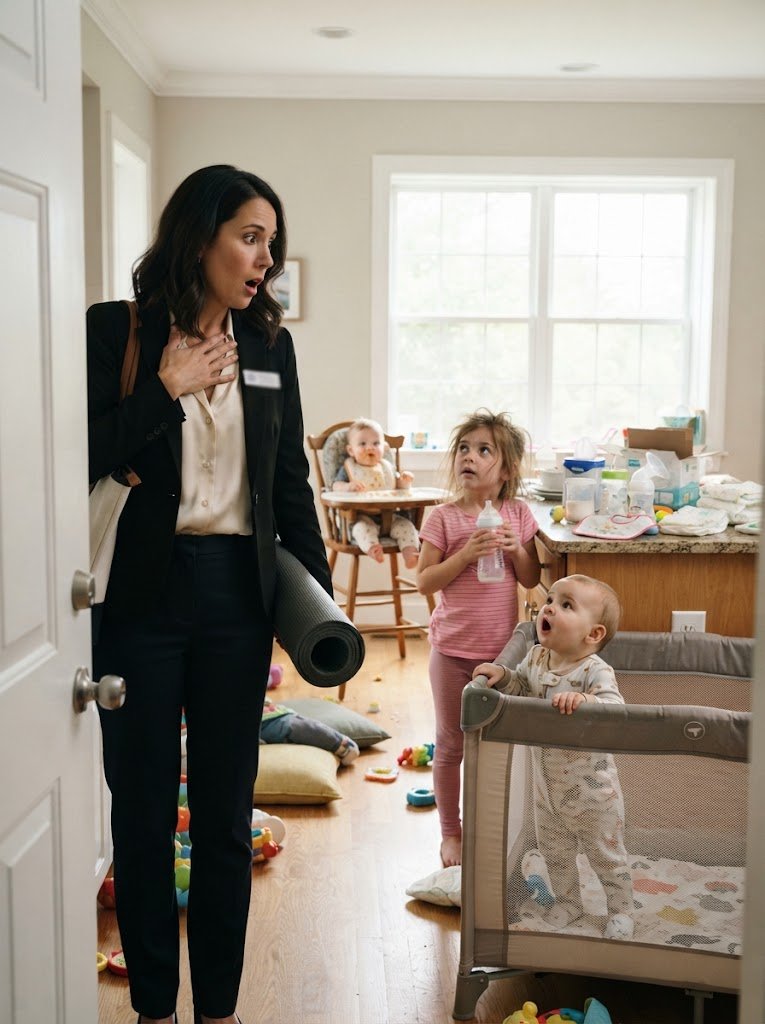
My ten-year-old daughter was standing in the kitchen with a bottle in one hand and a crying baby against her shoulder.
She was supposed to be at school.
“Hallie, where’s Dad?”
She looked at the floor.
“Golfing.”
Then she whispered, “Mom, please don’t tell him I told you.”
For a second, I just stood there.
My laptop bag was still hanging from my shoulder. My car keys were in my hand. The front door behind me hadn’t even closed.
Theo was crying against Hallie’s chest, his little face red and wet. Jack was strapped into his high chair, banging one plastic spoon against the tray.
The kitchen looked like someone had tried to manage a small emergency and lost.
An open container of formula sat on the counter.
A bottle was warming in a mug of water.
A burp cloth lay on the floor.
Hallie still had on the navy polo she wore to school.
“Why aren’t you at school?”
Her eyes flicked toward Theo.
“He was hungry.”
“I’m not asking about Theo.”
I set my bag down and crossed the kitchen.
“Give him to me.”
Hallie handed her brother over immediately.
Her shoulders dropped the second I took him.
That scared me more than anything else.
Not because she looked frightened.
Because she looked relieved.
I checked Theo quickly. Warm, but not feverish. Wet diaper. Angry because he was hungry.
“How long have you been here?”
Hallie picked at a loose thread on her uniform skirt.
“Since before lunch.”
“What does that mean?”
“Dad picked me up at eleven-thirty.”
I looked at the clock on the microwave.
2:17.
My meeting with a freight vendor had been canceled at the last minute, and for once, I had decided not to sit in my office pretending to be busy until five.
I had thought I might surprise everyone.
Maybe start dinner early.
Maybe fold the mountain of laundry sitting on the guest-room chair.
Instead, I had walked into this.
“Why did Dad pick you up?”
“He said he had a meeting.”
“What kind of meeting?”
Hallie shrugged.
“A short one.”
I looked around.
“Where’s your phone?”
“I don’t have one.”
Of course she didn’t.
Grant and I had decided ten was too young.
Suddenly that decision felt ridiculous.
“How were you supposed to reach him?”
“He left his number by the fridge.”
There was a yellow sticky note beside the grocery list.
DAD — CALL IF EMERGENCY.
I stared at it.
“When is he coming back?”
Hallie swallowed.
“He said forty-five minutes.”
Nearly three hours ago.
I took my phone out and called Grant.
No answer.
I called again.
Nothing.
A third time.
Straight to voicemail.
Theo started rooting against my shoulder. I reached for the bottle.
“Did you make this?”
Hallie nodded.
“I did four ounces, but he was still hungry, so I was making more. Dad said not to microwave it.”
At least Grant had remembered that.
The thought made me furious.
He had given our fifth grader bottle instructions like that made any of this reasonable.
“Where was Jack?”
“In the playpen mostly.”
“Did you change them?”
“Twice.”
“Both?”
She nodded.
I closed my eyes for one second.
Ten years old.
She still occasionally forgot her lunchbox at school.
And she had been changing diapers for two nine-month-old babies alone.
I called Grant again.
This time someone answered.
“Hello?”
A man.
I pulled the phone away and looked at the screen.
GRANT.
“Who is this?”
“Uh… Darren.”
Darren.
Grant’s college friend.
My stomach dropped.
“Where’s Grant?”
“He left his phone in the cart.”
“The cart?”
There was a pause.
“Yeah.”
“What cart, Darren?”
Another pause.
Then, cautiously, “Golf cart.”
Everything inside me went still.
“Where is my husband?”
“We’re at Cedar Ridge.”
The golf course.
I gripped the edge of the counter.
“What hole?”
Darren laughed awkwardly, as if he thought I was joking.
“Fourteen.”
Fourteen.
Not a forty-five-minute meeting.
Not a quick client conversation.
Not even nine holes.
They were playing a full round.
“Tell Grant his wife called.”
“Sure.”
“Tell him to come home.”
Darren stopped sounding amused.
“Is everything okay?”
“No.”
I hung up.
Hallie had been watching me.
She knew.
I could see it in her face.
She knew exactly what I had just learned.
I set Theo into the high chair beside his brother and crouched in front of her.
“Hallie.”
Her chin trembled.
“Did Dad tell you not to tell me where he was?”
“No.”
Too fast.
“Hallie.”
“He just said you were working.”
“That isn’t what I asked.”
Her eyes filled.
“He said it would make you mad.”
There it was.
Not confusion.
Not a misunderstanding.
A secret.
I reached for her hands.
They were cold.
“You are not in trouble.”
She nodded, but tears slipped down her cheeks anyway.
“Dad said it was only forty-five minutes.”
“I know.”
“And the babies were sleeping when he left.”
“Okay.”
“And I’ve watched them before when you take a shower or cook.”
My heart twisted.
“That’s different.”
“I know.”
But from her face, I could tell she didn’t.
Not completely.
She wiped her cheek with her wrist.
Then she lowered her voice.
“Mom?”
“Yes?”
“Please don’t tell Dad I told you.”
I stared at my ten-year-old daughter.
Not please don’t be mad at Dad.
Not please don’t punish me.
Please don’t tell Dad I told you.
That was the moment I stopped believing I had walked in on one bad decision.
Because children don’t usually beg you to protect their secrets after the first time.
They beg after they’ve learned there are consequences for telling.
CHAPTER 2 — FAMILY EMERGENCY
Grant came home at 3:26.
Not ten minutes after Darren called him.
Not twenty.
More than an hour later.
He walked through the garage wearing a gray polo and golf shoes, carrying his sunglasses in one hand.
He stopped when he saw me at the kitchen table.
The twins were napping upstairs.
Hallie sat beside me doing math homework.
Grant looked at her first.
Then me.
“What happened?”
I almost laughed.
“What happened?”
“Darren said you called freaking out.”
I turned the paper lying in front of me around.
It was the school dismissal slip I had found in Hallie’s backpack.
REASON FOR EARLY PICKUP:
FAMILY EMERGENCY.
Grant’s face changed slightly.
Not guilt.
Calculation.
“Erin—”
“You told the school there was a family emergency.”
“I needed to get her early.”
“So you lied.”
“It’s a drop-down category.”
“That makes it better?”
He exhaled and set his sunglasses down.
“Can we not do this in front of Hallie?”
Hallie immediately started gathering her homework.
“No,” I said. “Stay.”
Grant frowned.
“Erin.”
“She was part of what happened today.”
“She doesn’t need to sit through an argument.”
“She sat through almost three hours alone with two babies.”
His jaw tightened.
“They were safe.”
There it was.
The first defense.
“They were safe.”
“Hallie is extremely responsible.”
Second defense.
“I was fifteen minutes away.”
Third.
“My sister watched me when she was nine.”
Fourth.
I stared at him.
“Your sister wasn’t pulled out of school to watch two infants so your father could play golf.”
Grant rubbed both hands over his face.
“It was networking.”
“With Darren?”
“Darren introduced me to two people.”
“You were on fourteen when I called.”
“So?”
“So you told your ten-year-old daughter forty-five minutes.”
“I lost track of time.”
“You lost track of time on a golf course while your fifth grader was responsible for two babies.”
His voice sharpened.
“I didn’t leave her with newborns. Jack and Theo were fed. They were asleep. I was close. She knows how to call me.”
“You left your phone in a golf cart.”
“For ten minutes.”
“You didn’t answer any of my calls.”
“I said I made a mistake.”
“No. You said they were safe.”
Grant looked toward Hallie.
“Go upstairs, please.”
She stood.
“Hallie, stay,” I said.
Grant’s eyes flashed.
“Stop putting her in the middle.”
I couldn’t believe the sentence came out of his mouth.
Before I could answer, Hallie hesitated beside the stairs.
“Dad?”
He turned.
“Yeah?”
“Do I still get my twenty dollars?”
Silence.
Not ordinary silence.
The kind that rearranges a room.
Grant froze.
Hallie’s face went white.
She looked at me.
Then him.
Then the floor.
I sat back slowly.
“What twenty dollars?”
“No big deal,” Grant said.
I kept my eyes on Hallie.
“What twenty dollars, honey?”
Her mouth opened.
Nothing came out.
Grant answered for her.
“I told her I’d give her a little spending money for helping.”
“For helping today?”
“Yes.”
Hallie said nothing.
I noticed that.
“Twenty dollars for three hours?”
Grant shrugged.
“She’s saving for art supplies.”
I looked at Hallie.
“Were you getting paid to babysit?”
Grant leaned against the counter.
“Erin, don’t call it babysitting like I hired some random kid.”
“She was alone with two infants.”
“She’s their sister.”
“That doesn’t change what words mean.”
“Can we please not make this into something insane?”
Hallie’s breathing changed.
Shallow.
Fast.
I softened my voice.
“Hallie, look at me.”
She did.
“Is this the first time Dad has paid you twenty dollars to stay with the twins?”
Grant said, “Erin.”
I didn’t take my eyes off her.
“Hallie?”
She looked at her father.
That was answer enough.
I felt my heartbeat in my throat.
“How many times?”
“I don’t know.”
Grant cut in.
“A few.”
I finally looked at him.
“You told me it happened once.”
“Today happened once.”
“What does that even mean?”
“I mean today was the first time I took her out of school for it.”
Hallie’s face tightened.
Again.
A tiny reaction.
But I saw it.
“Is that true?”
She looked down.
“Hallie.”
Her eyes filled again.
Grant pushed away from the counter.
“That’s enough.”
“No, it isn’t.”
“She’s upset.”
“She’s upset because every time I ask a question she looks at you before she answers.”
Grant went quiet.
I turned back to her.
“You won’t be punished for telling me the truth.”
“I know.”
“No. I need you to really hear me. You are not protecting Dad. You are not protecting me. You are not protecting the babies. You’re just telling me what happened.”
She stared at her fingers.
Then whispered, “I have it written down.”
Grant’s head snapped toward her.
I felt cold.
“Written where?”
Hallie swallowed.
“In my pink envelope.”
“What pink envelope?”
She looked at me.
“My babysitting money.”
THE PINK ENVELOPE
Hallie came downstairs carrying a pale pink envelope covered in stickers.
A smiling sun.
A glittery cat.
A rainbow with ART CLUB written underneath it.
Across the front, in purple marker, she had printed:
BABYSITTING MONEY.
My chest hurt.
Because it looked exactly like something a ten-year-old would make.
She sat beside me and opened it.
Three twenty-dollar bills.
A receipt from the school bookstore.
A receipt for colored pencils.
And one folded sheet of notebook paper.
Grant stared at it.
“What is that?”
Hallie looked nervous.
“My list.”
“Why do you have a list?”
“So I’d know when I got paid.”
She unfolded the page.
The handwriting started neat at the top and got messier toward the bottom.
Seven dates.
Beside each one, a start time and end time.
May 8 — 1:30–3:10
May 22 — 2:05–4:00
June 5 — 12:40–3:25
August 29 — 1:20–3:15
September 5 — 12:10–4:43
September 12 — 2:10–4:05
Today — 11:30–?
I read it twice.
Seven days.
I pulled out my phone calculator.
Grant said, “Come on.”
I kept adding.
Nearly seventeen hours.
“Seventeen.”
“It wasn’t seventeen hours alone.”
I looked at him.
“What?”
“Some of those times I was in and out.”
Hallie went very still.
Grant noticed.
“Hallie, remember the day I was working in the garage?”
She nodded slowly.
“That counts on your list, right?”
“No.”
His face tightened.
“What about when I went to Walgreens?”
“That’s the short one.”
I looked at the first entry.
One hour, forty minutes.
“You went to Walgreens for an hour and forty minutes?”
“There was traffic.”
“Where else did you go?”
“I don’t remember. Erin, it’s been months.”
“That’s strange. Hallie remembers.”
He laughed once, but there was no humor in it.
“This is getting ridiculous. She’s tracking time like she’s an employee.”
“You paid her.”
“It was allowance.”
“For babysitting.”
“For helping her family.”
I looked at the list again.
Seven days.
“Were all of these school days?”
Hallie shook her head.
“Two were summer.”
“And the others?”
She nodded.
My stomach turned.
“So today wasn’t the first time you took her out of school.”
Grant’s mouth flattened.
“I might have picked her up early another time.”
“Another time?”
I held up the page.
“There are five school dates.”
“Not all five were pickups.”
Hallie pointed.
“The one in June was the last day, and we got out early.”
“Okay,” I said. “What about the others?”
She looked at Grant again.
He snapped.
“Stop doing that.”
Hallie jumped.
I stood so fast my chair scraped against the floor.
“Do not talk to her like that.”
“I’m not yelling at her.”
“You just scared her.”
“I’m frustrated because you’re interrogating a child about every afternoon I’ve ever asked her to help.”
I took a breath.
This was exactly how arguments became useless.
Volume. Accusations. Everybody defending themselves.
I sat again.
“Hallie, can you tell me what these times mean?”
She touched the September 5 entry.
“This is when Dad left and when he got home.”
“Four hours and thirty-three minutes.”
She nodded.
I looked at Grant.
“Where were you?”
“I don’t know.”
“You don’t know where you left our ten-year-old alone with our babies for four and a half hours?”
“It may not have been the entire time.”
Hallie whispered, “It was.”
Grant looked at her.
She shrank slightly.
I reached across the table and put my hand over hers.
“Tell me what you remember about that day.”
She didn’t answer immediately.
Instead, she traced the edge of the paper with one fingernail.
“Theo got sick.”
I stopped breathing for a second.
“What?”
“He threw up.”
“Babies spit up.”
“It was more.”
Grant said, “He wasn’t sick.”
Hallie looked at him.
“He was hot.”
My attention snapped back to her.
“How hot?”
“I don’t know.”
“You took his temperature?”
“With the forehead thing.”
“What did it say?”
“Hundred point something.”
Grant cut in.
“One hundred point one. It wasn’t a fever.”
“That’s not the point.”
“He was teething.”
“You knew?”
“Hallie called me.”
I looked at my daughter.
“You called Dad?”
She nodded.
“And he came home?”
Nothing.
“Hallie?”
“No.”
Something inside me sank.
“What did he tell you to do?”
“Watch him.”
“For how long?”
She shrugged.
I turned to Grant.
“You knew one of the babies was sick while Hallie was here alone?”
“He wasn’t sick.”
“She called you because she thought he was.”
“He was warm and spit up after a bottle. Babies do that.”
“And you didn’t come home?”
“I talked her through it.”
My hands started shaking.
Not dramatically.
Not visibly enough for anyone else to notice.
But I could feel it.
“What did you tell her?”
Grant stared at me.
“Erin.”
“What did you tell her?”
He didn’t answer.
Hallie did.
“He told me not to call you.”
The room went silent again.
I looked at her.
“He said what?”
Her eyes dropped to the notebook paper.
“I asked if I should call you.”
“And?”
“He said you were working.”
I waited.
There was more.
I could tell.
“And?”
Hallie’s voice got smaller.
“He said only call you if it turned into a real emergency.”
I stared at my ten-year-old daughter.
A child who still asked me sometimes whether a stomachache meant she was going to throw up.
A child who had once cried because she couldn’t decide if a scraped knee needed a Band-Aid.
And Grant had left her alone to decide when a sick nine-month-old became a real emergency.
CHAPTER 4 — DON’T CALL MOM
That night, I put the twins to bed myself.
Grant stayed downstairs.
Hallie followed me from one nursery crib to the other.
I gave Jack his pacifier.
Theo rolled onto his side and kicked his sleep sack.
Hallie watched him.
“You don’t have to check him,” I said gently.
“I know.”
But she kept looking.
“Did something happen the day he was sick?”
She shook her head.
“No.”
“You can tell me.”
“He just kept sleeping.”
“Babies sleep a lot.”
“I know.”
Her voice cracked.
“I kept touching him.”
My stomach clenched.
“Why?”
“To see if he was breathing.”
I sat on the edge of the nursery chair.
“Come here.”
She stood between my knees.
I held both her hands.
“How long did you do that?”
“I don’t know.”
“Until Dad got home?”
She nodded.
“Did you tell him you were scared?”
“He said Theo was fine.”
“Did that make you feel better?”
A small shrug.
“I thought maybe I was being stupid.”
“No.”
She looked at me.
“You were not being stupid.”
She blinked hard.
I pulled her into me.
For a minute, she just stood there.
Then her arms went around my neck.
That was when I felt how hard she was trying not to cry.
I didn’t say anything.
Neither did she.
Downstairs, Grant was sitting at the kitchen table when I opened my laptop.
“What are you doing?”
“Checking the school portal.”
He leaned back.
“Erin, it’s almost ten.”
“I know what time it is.”
I logged in.
Hallie’s grades looked normal.
Attendance did not.
Seven early dismissals.
Seven.
Not five.
Seven.
I clicked the first one.
Family appointment.
Second.
Medical appointment.
Third.
Family matter.
Fourth.
Family emergency.
My eyes blurred.
I scrolled.
“Why didn’t I get these notifications?”
Grant didn’t answer.
“Grant.”
“You probably did.”
“No.”
“Maybe they went to spam.”
“All seven?”
He rubbed his forehead.
“The school usually calls me.”
“Why?”
“My schedule is more flexible.”
I looked up.
“What does that have to do with who gets notified?”
“I’m primary contact.”
“You’re what?”
“We changed it.”
“We?”
“You said last year it made sense because I can answer during the day.”
I remembered the conversation.
Vaguely.
Grant had complained that the school always called me first when Hallie forgot a lunch or needed to come home sick.
I had been preparing for a quarterly logistics review and said something like, Fine, put your number first if you’re easier to reach.
At the time, it had sounded like sharing responsibility.
Not hiding it.
“You changed yourself to primary contact.”
“I didn’t change anything behind your back.”
“Did you remove my work number?”
“No.”
“Did you change the notification preference?”
He looked away.
My skin went cold.
“What did you do?”
“Nothing.”
“Grant.”
“Attendance texts come to the primary contact.”
“And emails?”
He didn’t answer.
I opened account settings.
There it was.
Grant’s email.
Grant’s cell phone.
My personal email was listed under secondary guardian.
Email notifications only.
No text alerts.
I stared at the screen.
“You changed it.”
“I updated it.”
“You knew I wasn’t getting the messages.”
“I didn’t think about it like that.”
“You picked Hallie up from school repeatedly and knew the school wasn’t alerting me in real time.”
“You make it sound sinister.”
“Because you hid it.”
“I was managing things.”
“You were managing me.”
He pushed back from the table.
“That is ridiculous.”
“You knew if I got a text that said Hallie left school at noon, I would ask where she was.”
“Because you overreact.”
I laughed.
It came out sharp.
“You thought I would overreact to finding out our ten-year-old was missing school so she could babysit?”
“I thought you’d turn it into exactly this.”
I stared at him.
“This exists whether I know about it or not.”
He opened his mouth.
Footsteps sounded in the hallway.
Hallie stood there in pink pajamas.
Her hair was messy from bed.
“What are you doing up?”
She rubbed her eyes.
“I wanted water.”
She looked from Grant to me.
Then to my laptop.
“Are you looking at school?”
“Yes.”
Her face changed.
Grant said, “Go back to bed.”
She didn’t move.
I asked gently, “Hallie, did you know Dad was the person school called first?”
She nodded.
Grant stood.
“That’s enough.”
Hallie looked at me.
“He said it was easier.”
“When?”
“When he changed it.”
Grant’s face hardened.
“She doesn’t know what she’s talking about.”
Hallie looked hurt.
“I was there.”
I turned to her.
“Where?”
“In the office.”
“When?”
“After school one day.”
She pointed toward my laptop.
“He asked them if they could call him first because you were really busy.”
Grant said, “That’s true.”
I looked at him.
Hallie continued.
“He said you didn’t need to get interrupted unless it was important.”
The same wording.
Don’t call Mom unless it becomes a real emergency.
I suddenly understood what Grant had done.
Not in one grand, evil plan.
That almost would have been easier.
He had simply built a family system around protecting his convenience.
If Hallie missed school, he handled the school.
If Hallie watched the babies, he handled Hallie.
If something went wrong, he decided whether I needed to know.
And somehow he had convinced himself that controlling information was the same thing as carrying responsibility.
I closed the laptop.
“Tomorrow morning, I’m calling the school.”
Grant folded his arms.
“About what?”
“All of it.”
His eyes narrowed.
“You’re going to embarrass Hallie.”
Hallie spoke before I could.
“They already know.”
We both looked at her.
Her face went pale.
“What do you mean?” I asked.
She swallowed.
“Mrs. Leighton asked me why I keep leaving early.”
WE THOUGHT YOU KNEW
Principal Moreno didn’t sound shocked when I called.
That bothered me at first.
Then she explained why.
“Mr. Caldwell is Hallie’s father. He is listed as an authorized guardian, and he was the primary contact. When he signed her out, we had no reason to believe the pickups weren’t known to both parents.”
I closed my eyes.
“I understand.”
There was a pause.
“Mrs. Caldwell, is Hallie safe?”
“Yes.”
“Is there a custody issue we should know about?”
“No.”
Grant was still my husband.
Still the father of all three children.
Still the man who made pancakes shaped like Mickey Mouse on Sundays and got up with Jack at 5:30 on mornings when I had early calls.
That was what made everything harder.
There was no neat box marked MONSTER.
Just a man I had trusted making choices I no longer understood.
“I’m not asking you to prevent her father from picking her up,” I said. “I need both parents notified.”
“We can absolutely do that.”
“And I want my number restored as primary.”
“Of course.”
Then Principal Moreno said, “There is one thing I think you should discuss with her teacher.”
Mrs. Leighton called me during her planning period.
Her voice was kind.
Too kind.
“Hallie’s a wonderful student.”
I braced myself.
“But?”
“She’s been distracted on Friday afternoons.”
Friday.
Of course.
“She missed two short quizzes because she left early. Nothing that affected her grade significantly, but I noticed a pattern.”
“What pattern?”
“She started asking early in the day whether she was going to be ‘needed at home.’”
I pressed my fingertips to my forehead.
“She used those words?”
“Yes.”
Mrs. Leighton continued carefully.
“She’s also missed art club three times.”
Art club.
The thing Hallie talked about every Wednesday night.
The thing she saved her babysitting money to buy pencils for.
“I thought she had stopped wanting to go.”
“No. She still talks about it constantly.”
I felt sick.
“Did she ever tell you why she was going home?”
“Not exactly.”
Mrs. Leighton hesitated.
“I asked her once if everything was okay because she seemed anxious. She said, ‘The babies need me sometimes.’”
Not Dad needs help.
Not Dad asked me to babysit.
The babies need me.
As though Jack and Theo had personally assigned her the job.
That afternoon, I picked Hallie up myself.
We stopped for milkshakes.
Not because I wanted to bribe her into talking.
Because for once I wanted her afternoon to contain something that was only for her.
She ordered chocolate.
I got vanilla.
We sat in a booth by the window.
“Mrs. Leighton says you’ve missed art club.”
Hallie looked guilty.
“I can make it up.”
“That’s not why I’m asking.”
She pushed her straw around.
“Did you want to miss it?”
“No.”
“Then why didn’t you tell me?”
She took a long time to answer.
“Dad said it was helping.”
“Helping who?”
“Everybody.”
“What does that mean?”
She shrugged.
“You have work.”
“Yes.”
“And Dad has work.”
“Yes.”
“And the babies can’t be by themselves.”
“No, they can’t.”
“So somebody has to do it.”
I chose my words carefully.
“Why did you think that somebody had to be you?”
She looked confused.
“Because Dad asked me.”
“That doesn’t automatically make it your responsibility.”
“But he needed help.”
“Adults can need help. That doesn’t mean a child has to solve the problem.”
Her eyes dropped.
“Was I not supposed to help?”
That sentence hurt worse than anger would have.
“No, honey. That’s not what I mean.”
She looked close to tears.
“I like helping with Jack and Theo.”
“I know.”
“They like me.”
“I know.”
“I’m good with them.”
“I know that too.”
She finally looked at me.
“Then why is everybody mad?”
I moved my milkshake aside.
“I’m not mad because you took care of them.”
“Dad is.”
“At you?”
She shook her head.
“At this.”
Of course.
The argument.
The exposure.
The fact that the arrangement had stopped working once I could see it.
“I need you to understand something,” I said. “Helping your family is different from being made responsible for your family.”
She frowned.
I tried again.
“If Dad is folding laundry and asks you to hold Theo’s bottle, that’s helping.”
She nodded.
“If I’m making dinner and you play with Jack for twenty minutes, that’s helping.”
Another nod.
“If you are the only person in the house responsible for two babies while an adult is gone for hours, that is childcare.”
She stared down at the table.
After a moment, she whispered, “Dad said babysitters cost a lot.”
There it was.
Money.
“What else did Dad say?”
She immediately shook her head.
“Nothing.”
I didn’t push.
Not yet.
But that evening, after the kids were asleep, I remembered a conversation from four months earlier.
I had suggested hiring a sitter for Friday afternoons when Grant had sales events.
He had rejected it instantly.
Seventy to ninety dollars a week, he said, was ridiculous.
“We can’t burn three hundred dollars a month on something we can handle ourselves.”
At the time, I thought ourselves meant Grant and me.
Now I knew it had included our ten-year-old daughter.
So I opened our joint credit card statement.
And searched one word.
Golf.
CHAPTER 6 — THE MONEY WE DIDN’T HAVE
The charges weren’t hidden.
That almost made them worse.
Cedar Ridge Golf Club.
$185.
League fee.
$340.
Clubhouse restaurant.
$76.
Golf shoes.
$189.
Cart charges.
$34.
$38.
$34.
$42.
Another clubhouse meal.
$91.
I went back four months.
More than fourteen hundred dollars.
Not enough to bankrupt us.
Enough to pay for a lot of Friday-afternoon babysitters.
Grant came into the kitchen while I was writing the numbers on a legal pad.
He saw the statements.
His shoulders dropped.
“Oh, come on.”
I turned the page toward him.
“We couldn’t afford a sitter.”
“Golf is part of my networking.”
I pointed at one charge.
“August twenty-ninth. Cedar Ridge. Seventy-two dollars.”
“So?”
“Who were you with?”
“I don’t remember.”
“Hallie remembers that date.”
His face tightened.
“That doesn’t mean—”
“She babysat from one-twenty until three-fifteen.”
“I’ve already told you, not every time was golf.”
“Who were you with?”
He looked away.
“Darren.”
I let that sit there.
Darren sold commercial flooring.
Grant sold logistics software.
They had been friends since college.
“Your client, Darren?”
“Networking isn’t only clients.”
“No. Sometimes it’s apparently your roommate from nineteen years ago.”
He slapped his palm lightly against the counter.
“What do you want me to say?”
“The truth.”
“I’ve told you the truth.”
“No. You’ve given me whatever version makes the last thing I found sound acceptable.”
His mouth opened.
I kept going.
“When I found Hallie today, you said it happened once.”
“I meant—”
“Then I found out it happened seven times.”
“Erin—”
“Then you said she wasn’t alone the whole time.”
“She wasn’t always.”
“Then I found out Theo got sick.”
“He did not get sick.”
“Then I found out you changed school contacts.”
“You agreed to that.”
“I agreed to you being called first. I did not agree to you using that arrangement to take our daughter out of school without telling me.”
He turned away.
I hated that part of me wanted him to turn back and say the one thing that would make sense of it.
Something.
Anything.
I panicked.
I got overwhelmed.
I didn’t realize what I was doing.
Instead he said, “You act like I contribute nothing.”
I stared at him.
“I never said that.”
“You don’t have to. I get up with the twins. I take Hallie to soccer. I do grocery pickup. I work full-time. I’m allowed to have one thing.”
“This isn’t about whether you’re allowed to play golf.”
“It sure feels like it.”
“It’s about who paid for your one thing.”
“I paid for it.”
“No.”
I pointed upstairs.
“Hallie paid for it.”
His face went red.
“She got twenty dollars.”
“I’m not talking about money.”
He fell silent.
“She paid with school. She paid with art club. She paid by sitting upstairs checking whether her baby brother was breathing because she didn’t know if he was sick enough to interrupt me at work.”
Grant’s expression changed.
Only slightly.
But I saw the hit land.
Then footsteps came from the hallway.
Hallie stood there holding a sketchbook.
“Can you sign this?”
I softened immediately.
“What is it?”
“Art club form.”
She handed it to me.
I signed the bottom.
“Do you want Dad to sign too?”
She shook her head.
“You can.”
Grant flinched.
Hallie didn’t notice.
She took the paper back.
I said, “Hallie, I need to ask you one more thing.”
Grant stiffened.
She looked at me.
“Okay.”
“Why didn’t you ever tell me you were babysitting?”
Her eyes went to her father.
I waited.
Eventually she said, “Because you were busy.”
“I’m busy a lot. You can still tell me things.”
“Dad said you couldn’t keep leaving work.”
I felt the room change.
“Why would I leave work?”
She looked confused by the question.
“For the babies.”
I glanced at Grant.
He shook his head.
“Erin, that is not what I said.”
I turned back to her.
“What did Dad tell you?”
Her lower lip trembled.
“He said your job pays most of the bills.”
Grant stepped forward.
“I said that one time when she asked why you worked late.”
Hallie continued.
“And if you have to keep coming home, you could get in trouble.”
“That is not—”
I raised my hand.
“Let her talk.”
Hallie’s eyes filled.
“And if you lost your job, we wouldn’t have enough money.”
“Hallie.”
Grant sounded horrified now.
Not angry.
Horrified.
She looked at him.
“You said that.”
“I said we all have to pitch in because Mom has a big account at work. I never said we’d lose the house.”
Hallie started crying.
“But if we don’t have enough money, they take your house.”
My breath caught.
“Who told you that?”
“Nobody.”
“Then why do you think that?”
She wiped her face.
“Madison’s family moved because her dad lost his job.”
Oh God.
She had built it herself.
Piece by piece.
Adult conversations.
A friend’s family moving.
Grant saying my job paid most of the bills.
Grant telling her I couldn’t keep leaving work.
Babysitters being too expensive.
Him needing her help.
And because no adult had sat down and explained any of it, Hallie had filled in the blanks.
“If I watch the babies,” she whispered, “you don’t have to leave work.”
I couldn’t speak.
“And then you won’t get fired.”
Grant whispered, “Hallie, no.”
“And we can keep the house.”
She was sobbing now.
I stood and pulled her against me.
She buried her face in my shirt.
Over her shoulder, I looked at Grant.
He had gone completely pale.
For weeks, I had thought the worst part was that my husband left our ten-year-old with two babies so he could golf.
Then I thought the worst part was that he did it repeatedly.
Then that he hid it.
Then that we somehow had money for golf but not childcare.
I had been wrong every time.
The worst part was that our daughter had believed she was helping keep a roof over our heads.
And we had been praising her for being responsible while she did it.
SOMETHING I’M GOOD AT
Grant slept in the guest room.
Not because I threw him out.
Because neither of us knew what to say.
The next morning, he apologized to Hallie before school.
Not the useless kind.
Not I’m sorry you were upset.
He sat beside her at the breakfast table.
“I made something your responsibility that should not have been.”
Hallie stared into her cereal.
“I didn’t mean to make you scared about Mom’s job.”
“You didn’t.”
“Yes, I did.”
She looked up.
Grant swallowed.
“I said things without thinking about how they sounded to you.”
She frowned.
“So are we poor?”
Despite everything, I almost laughed.
“No,” I said.
Grant shook his head.
“No.”
“Are we losing the house?”
“No,” we said together.
Hallie looked embarrassed.
“Okay.”
Grant reached toward her hand.
She let him touch it.
That was something.
It wasn’t everything.
Two days later, the school counselor emailed me.
Hallie had written a short classroom assignment the week before.
Mrs. Leighton had shared it because she thought I should see it.
The prompt was simple:
SOMETHING I AM GOOD AT.
Hallie had written:
I am good at taking care of my baby brothers.
Theo likes the green pacifier and Jack likes the blue one.
Jack cries less if you bounce him but Theo likes when you walk in circles.
I know how much formula goes in four ounces and six ounces.
I know where Dad keeps the emergency numbers.
I stopped there.
Grant was standing beside me.
Neither of us spoke.
I kept reading.
If there is a fire, I would take Jack first because his crib is closer to the door and then I would get Theo.
Grant sat down.
Hard.
I read the next line.
I think I could carry both if I had to.
My eyes filled.
“She thought about a fire.”
Grant didn’t answer.
“She planned which baby to carry first.”
“I see it.”
His voice sounded rough.
The last line was worse.
Sometimes I miss art club but my family needs me more.
Grant put his face in his hands.
For several seconds, all I could hear was the refrigerator running.
Then he said, “I really thought she liked helping.”
“She does.”
He looked up.
“I mean watching them.”
“I know what you mean.”
“She always acted proud when I asked.”
“Of course she did.”
“Why ‘of course’?”
“Because she loves you.”
His eyes dropped.
“And because you told her being needed made her useful.”
“I never said that.”
“You didn’t have to.”
He was quiet.
“You paid her.”
“That was supposed to make it fun.”
“You told her she was responsible.”
“I told her she was responsible enough.”
“You told her I couldn’t keep leaving work.”
“I was trying to keep you from being stressed.”
“And you gave the stress to her.”
He flinched.
That evening, Hallie sat at the dining table drawing while the twins rolled around on a foam mat.
Grant watched them.
Theo started fussing.
Hallie immediately put her pencil down.
“I can get him.”
Grant picked Theo up first.
“I’ve got him.”
Hallie sat back.
Ten minutes later, Jack began whining.
She started to stand again.
“I can—”
“I’ve got him too.”
Grant looked at me.
Something passed between us.
Not forgiveness.
Recognition.
This had become automatic for her.
Later, after the twins were asleep, I sat on Hallie’s bed.
“Can I ask you something?”
“Okay.”
“Do you like helping with Jack and Theo?”
She smiled.
“Yeah.”
“Do you like watching them by yourself?”
Her smile disappeared.
She glanced toward the hallway.
“Dad said I don’t have to anymore.”
“I know. I’m asking how you feel.”
She shrugged.
“Hallie.”
“What?”
“Do you?”
She looked toward the door again.
Grant was standing down the hallway, but she couldn’t see him.
He started to step forward.
I held up my hand.
He stopped.
“I asked Hallie.”
My daughter picked at a tiny dried spot of paint on her thumbnail.
“I like the babies.”
“I know.”
“I like when Jack laughs if I make the weird noise.”
I smiled.
“He does love that noise.”
“And Theo likes falling asleep on me.”
“He does.”
She went quiet.
Then she whispered, “But I don’t like being the grown-up.”
Grant closed his eyes.
There it was.
No screaming.
No accusation.
No dramatic speech.
Just a ten-year-old girl finally separating two things the adults around her had allowed to become tangled.
Loving her brothers.
And being responsible for them.
I kissed her forehead.
“You’re not the grown-up.”
She looked at me.
“What if you need help?”
“We’ll ask.”
“What if Dad has work?”
“We’ll figure it out.”
“What if the babysitter costs too much?”
“We’ll budget for it.”
“What if you have your big account?”
“I’ll handle my job.”
“What if—”
I took her hand.
“You don’t have to solve all the what-ifs.”
Her eyes filled.
“Then who does?”
I smiled sadly.
“Me and Dad.”
From the hallway, Grant said quietly, “Us.”
Hallie looked toward him.
He walked in and sat on the other side of her bed.
“I’m sorry,” he said.
She leaned against me.
Grant continued.
“I should never have made you think helping me was the same thing as keeping our family okay.”
Hallie sniffed.
“Are you still mad I told Mom?”
His face crumpled.
“No.”
“You were.”
“I was embarrassed because I knew I’d done something wrong.”
“That looked like mad.”
“I know.”
He nodded slowly.
“I’m sorry for that too.”
Hallie studied him.
Then asked the question that proved she was still ten.
“Can I still keep the sixty dollars?”
Grant laughed.
A real laugh this time.
“Yes.”
“Even though I’m not babysitting anymore?”
“Especially because you’re not babysitting anymore.”
She smiled.
And for the first time since I had come home early, the room felt like ours again.
Not fixed.
But honest.
CHAPTER 8 — I NEED YOU TO BE TEN
Grant’s consequences were boring.
That was how I knew they were real.
There was no dramatic scene where he smashed his golf clubs.
No grand speech.
No overnight personality change.
He met with Principal Moreno and admitted he had used misleading reasons for Hallie’s early dismissals.
I was restored as the first school contact, with both parents receiving attendance notifications.
We added a rule: neither of us would remove Hallie from school outside illness or appointments without telling the other.
Grant withdrew from the Friday golf league for the rest of the season.
Not from golf forever.
I wasn’t interested in becoming the person who controlled whether my husband was allowed hobbies.
I was interested in making sure his hobbies stopped being subsidized by our daughter’s childhood.
The money we had been calling the “golf budget” became a backup childcare fund.
We hired a college student named Paige who lived three streets away and charged eighty dollars on Friday afternoons.
Grant complained about the price exactly once.
I looked at him.
He said, “Yep. Never mind.”
Friday childcare became his responsibility to arrange.
Not mine.
Not Hallie’s.
His.
We started marriage counseling.
Not because I had already decided whether our marriage would survive.
Because “sorry” did not answer the larger question.
How had the two of us built a family where Grant believed protecting my career meant hiding problems from me?
Why had I accepted being “the busy one” so completely that I hadn’t noticed Hallie was being pulled into the gap?
And why did both of us feel proud whenever Hallie acted older than ten?
Those conversations were uncomfortable.
They were supposed to be.
Hallie returned to art club.
The first Friday she went back, she came home with green paint on her sleeve and talked for twenty straight minutes about perspective drawing.
I listened to every second.
Three weeks after everything blew up, I stood in the kitchen packing snacks while Grant finished an early sales call at the dining table.
The twins were on the living-room rug.
Hallie came downstairs wearing jeans, sneakers, and her old paint-splattered hoodie.
Her backpack was stuffed with markers.
“You ready?” I asked.
“Yep.”
Grant ended his call.
“Have fun.”
“I will.”
Theo picked that exact moment to start crying.
Hallie froze.
It was so quick I almost missed it.
One second she was reaching for the front door.
The next, her backpack was sliding off her shoulder.
“I can get him.”
Grant crossed the room and scooped Theo up.
“Nope.”
Hallie blinked.
“But he’s crying.”
“Babies do that.”
Theo screamed louder as if trying to prove him right.
Hallie smiled slightly.
“You sure?”
“I’m sure.”
Jack started fussing too.
Hallie shifted her weight.
“I can take Jack while you—”
“No.”
Grant tucked Theo against his chest and reached for Jack with his free arm.
It was awkward.
Jack grabbed his collar.
Theo kicked him in the ribs.
Grant almost lost a slipper.
I bit back a laugh.
Hallie watched him struggle.
“You look like you need help.”
“Oh, I absolutely need help.”
She immediately put her backpack down.
Grant pointed toward the door.
“Not from you.”
She frowned.
“Why?”
“Because you have art club.”
“I can be late.”
“No.”
“But—”
“Hallie.”
She stopped.
Grant adjusted Theo on his hip.
“I need you to be ten.”
Everything in the room seemed to pause.
Hallie stared at him.
Then a slow smile spread across her face.
“Ten-year-olds can help.”
“Yes.”
“So what if I want to?”
“Then you can help when you get home.”
“What if they’re sleeping?”
“Then congratulations. You get the evening off.”
She laughed.
Grant jerked his head toward the door.
“Go.”
Hallie put her backpack on again.
She opened the front door.
Then stopped.
For months, she had developed a habit I hadn’t recognized until after all of this.
Every time she left the house, she looked back.
If she went to school, she checked the twins.
If she walked to Madison’s house, she asked whether we were sure we didn’t need her.
If she went upstairs to shower, she told us where she would be.
Small things.
Things I had mistaken for maturity.
That Friday, she walked outside.
The door swung closed behind her.
She didn’t turn around.
Grant stood in the living room holding one baby while the other tugged on his pant leg from the floor.
I looked at him.
He looked at me.
Neither of us said anything.
We didn’t need to.
For months, we had praised our daughter for being mature enough to carry responsibilities that never belonged to her.
Teaching her to put them down took longer.
Hallie was allowed to go to school.
She was allowed to go to art club.
She was allowed to spend her twenty dollars on markers instead of earning it because an adult wanted an afternoon off.
She was allowed to leave a crying baby with his father.
She was allowed to believe the mortgage, my job, our schedule, childcare and every other adult problem in this house belonged to the adults.
Most of all, she was allowed to be ten.