For nine years, I bought medicine and cooked meals for my elderly neighbor, never thinking he noticed more than I gave. After his funeral, I received a letter in his handwriting. “You left food at my door for years. Now look inside the old freezer in your basement.”
The Envelope Harold Left Behind
The lawyer found me beside the coffee urn after Harold Bennett’s funeral, holding a paper cup I had not touched.
“Nora?” she asked gently.
I nodded.
She offered me a sealed envelope with my name written across the front. “Harold asked me to give this to you after the service.”
Before I could take it, his estranged son, Mark, stepped closer.
“What’s that?”
“A private letter addressed to Nora,” the lawyer said.
“From my father?”
“Yes.”
Mark looked at me as if I had already done something wrong.
For a second, my hand froze. That was my old habit: step back, keep peace, and avoid making a scene. But Harold had written my name on that envelope.
So I took it.
Mark’s mouth tightened. “Funny. I didn’t realize bringing casseroles made someone family.”
I held the letter against my chest and met his eyes.
“It doesn’t, Mark,” I said. “But showing up does.”
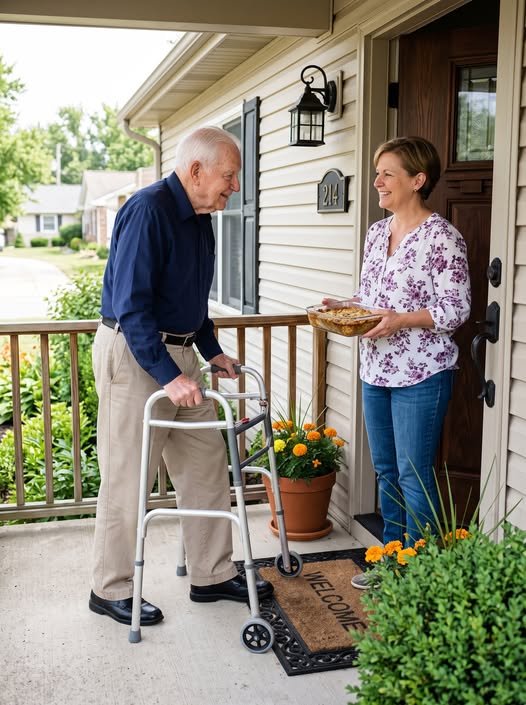
Nine years earlier, I had moved into the small white house next door with my two children, Ava and Miles, and a divorce decree folded in my glove box. I was forty-eight, newly divorced, and trying to make the house feel like a fresh start instead of the place we landed after everything fell apart.
One snowy January afternoon, I noticed Harold’s mailbox overflowing, his steps untouched, and a pharmacy bag wedged in his door. I told myself it was none of my business.
Then I filled a container with chicken soup and crossed the lawn.
Harold opened the door in a robe, pale and irritated.
“I’m fine,” he barked.
“I didn’t ask,” I said. “Your mail says otherwise.”
He refused charity, but he took the soup. The next day, he returned the empty container and complained there was too much pepper.
That was how it started: soup, medicine, errands, and two stubborn people pretending they were not lonely.
Ordinary Kindness
After that, a quiet routine formed.
When I cooked stew or roasted chicken, I brought Harold a portion. When I went to the pharmacy, I texted him first.
His answer was always, “No.”
Five minutes later, another message would arrive.
“Maybe milk.”
Then, “And those crackers Alice liked.”
Alice was his late wife. Little by little, Harold let me see the parts of the house that still belonged to her: her mug by the sink, her sweater over a chair, her recipe cards tucked in a tin.
One morning, I found him on the porch with two cups of coffee.
“It’s Alice’s birthday,” he said.
I did not tell him I was sorry. Instead, I asked, “What kind of cake did she like?”
“Lemon. From scratch. She hated shortcuts.”
The next day, I brought him lemon cake. It had sunk in the middle.
arold stared at it. “Alice would’ve judged that.”
“Then Alice can file a complaint.”
He laughed, and something between us softened.
The Place I Mentioned Once
Years passed.
I drove Harold to appointments. He fixed my back gate. I picked up his heart medicine. He sat with me on the porch when my house felt too quiet.
Once, after a hospital stay, a nurse asked if I was family.
Before I could answer, Harold said, “She’s close enough to argue with me.”
Mark rarely came around. Harold never spoke of him with bitterness, but I noticed how he checked the phone whenever it rang.
Seven years after I met him, I stopped by with groceries and found him waiting on the porch.
“It’s the anniversary of my divorce,” I admitted. “I thought I’d feel free by now. Some days, I just feel used up.”
Harold looked toward my house, where Ava and Miles were growing into lives of their own.
“What would you do if nobody needed you for one whole day?” he asked.
“I’d go somewhere quiet,” I said. “A cabin by a lake. No dishes. No bills. No one calling ‘Mom’ from another room.”
“That sounds lonely.”
“No,” I said. “Lonely is being needed all day and still feeling unseen.”
He nodded slowly.
I thought he understood because of Alice.
I did not know he was listening for me.
The Freezer in My Basement
Two weeks before Harold died, we played Scrabble after beef stew. He beat me by twenty-three points and looked far too pleased about it.
That was our last full evening together.
A few days later, Harold died peacefully in his sleep.
After the funeral, I did not open his letter in front of Mark. I walked to my car with Ava and Miles and waited until my hands stopped shaking.
Then I tore it open.
Harold’s handwriting was slanted but steady.
“You left food at my door for years, Nora. Now look inside the old freezer in your basement.”
I knew exactly which freezer he meant.
Years earlier, my refrigerator had died before Thanksgiving. Harold had rolled an old chest freezer across the yard and told me it had belonged to Alice.
“I can’t take that,” I had said.
“Then borrow it.”
It had stayed in my basement ever since.
When we got home, I went straight downstairs. Beneath frozen peas and a frost-covered package, I found something wrapped in butcher paper.
Under it sat a small plastic container.
The tape on the lid had faded, but I could still read the words.
“Nora’s first soup. January 14.”
I covered my mouth.
Inside was a brass key taped to a folded note.
“You thought it was just soup,” Harold had written. “It wasn’t. It was proof someone would notice if I disappeared.”
My knees weakened.
He had saved the first meal I ever gave him.
What Harold Really Left Me
The note continued.
“You gave me nine years of ordinary kindness. Meals, medicine, lemon cake Alice would have loved. But I saw you too, Nora.”
My hands trembled around the key.
“I remembered the night you said you wanted one quiet place where nobody needed anything from you. The cabin by the lake is yours now. It isn’t grand. The porch creaks, and the kitchen window sticks. But it is quiet.”
Ava whispered, “He really listened.”
I wiped my face.
“I only said it once.”
The next morning, I walked into the lawyer’s office with the key in my coat pocket.
Mark was already there.
“My father was confused,” he said before I sat down.
The lawyer slid a document across the table. “Harold confirmed the trust again last spring. His doctor’s capacity letter is included.”
Mark turned on me.
“You manipulated him.”
“No,” I said. “I cooked for him. I drove him home when your voicemail was full. I sat with him on Alice’s birthday. I checked on him in snowstorms. Don’t make my care ugly because you feel guilty.”
“He had dementia.”
“Two weeks before he died, he beat me at Scrabble with ‘qat’ on a triple-word score,” I said. “Your father was sharper than both of us.”
Then the lawyer read Harold’s final message to him.
“I didn’t leave the cabin to Nora because I stopped loving you. I left it to her because she was there for the ordinary days. A life is mostly ordinary days. You missed too many of mine.”
Mark stared at the page.
At the door, he said, “You got what you wanted.”
I touched the key in my pocket.
“No. I got what he wanted me to have.”
One Quiet Place
Two days later, Ava, Miles, and I reached the cabin.
The porch sagged. The blue door had faded. The lake behind it was still and silver under the afternoon light.
Inside, Ava rinsed mugs while Miles carried in the bags.
“Wait,” I said. “This place has one rule. When we come here, we cook together, clean together, and sit together. Nobody turns me into the help.”
Ava nodded.
Miles set down the bags and nodded too.
Later, I sat on the porch with coffee in Alice’s yellow mug. For once, nobody called my name from another room.
For nine years, I thought I was leaving food at Harold’s door.
I never knew he was leaving me a way back to myself.