The final seconds began with the scrape of a chair across my parents’ patio.
For a moment there was only party noise.
A child laughing near the bounce house.
Paper plates shifting.
Someone asking where the candles had gone.
Then my mother’s voice came through clearly.
“We need to get Brooke calmed down before Ryan makes this bigger than it is.”
My father answered from farther away.
“He’ll cool off.”
Then Brooke said something quieter.
“What if he takes her somewhere?”
My mother replied, “Then we say she fell while she was playing.”
I stopped the recording.
For several seconds, I just stood in my hallway with one earbud still in and my phone hanging at my side.
There are moments when anger arrives hot.
This wasn’t one of them.
This was colder.
My sister had already told me to say Emma fell.
My father had called and told me to say Emma fell.
And now I had a recording made before those conversations showing that the same explanation had already been discussed at the party.
It was not three worried relatives independently remembering an event differently.
It was a story.
And my five-year-old daughter was the inconvenient part they needed the story to cover.
Emma was still sitting at the kitchen table when I walked back in.
Her yellow crayon lay on the floor where she had dropped it during my father’s call.
She had switched to blue.
She was coloring a crooked little house with two windows, a giant front door and flowers almost as tall as the roof.
I picked up the yellow crayon and set it beside her.
She looked up.
“Was Grandpa mad?”
“No.”
It was the easiest answer I could give her without lying about something she was too young to carry.
“He was talking about grown-up stuff.”
She nodded and kept coloring.
Then she asked, “Is Aunt Brooke still mad at me?”
That question did something every angry phone call had failed to do.
It stripped the whole situation down to its actual size.
The adults in my family were worried about Brooke’s stress.
Brooke’s reputation.
My parents’ embarrassment.
The party.
The guests.
What people might think.
Emma was worried that the adult who frightened her was still angry with her.
I pulled out the chair beside her.
“No, sweetheart. You don’t have to worry about Aunt Brooke being mad.”
“Do I have to tell her sorry?”
“No.”
She looked at me carefully, almost checking whether the answer might change.
“No?”
“No.”
Her shoulders dropped.
I had seen that same little movement hundreds of times when Claire was alive.
Claire used to say children carried tension in places adults forgot to look.
Their shoulders.
Their stomachs.
Their hands under the dinner table.
Two years earlier, in a hospital room that smelled faintly of disinfectant and coffee, Claire had made me promise to take care of Emma.
I used to think that promise meant keeping food in the refrigerator, getting her to school, learning how to brush tangles out of her hair and remembering which stuffed animal had to travel with us.
Standing in my kitchen that morning, I understood another part of it.
Protection sometimes meant disappointing people who shared your last name.
I forwarded the recording to the child protection worker who had spoken with us at the hospital.
I also sent the screenshots of Brooke’s messages.
I included the time of my father’s call and wrote down, as accurately as I could remember, what he had told me.
I didn’t add adjectives.
I didn’t call anyone a monster.
I wrote times, words and actions.
The doctor had already documented what she saw on Emma’s cheek and arms.
Brooke had already admitted grabbing Emma.
My mother had already left a handwritten note asking me to think about Brooke’s future instead of asking about Emma.
Now there was a recording showing that the “she fell” explanation had been discussed before three different relatives tried to hand it to me.
Facts did not need me to make them louder.
They only needed me to stop letting other people erase them.
The guest who sent the video called me later that afternoon.
She sounded nervous.
“I’m sorry I didn’t say something yesterday.”
“You sent it now.”
“I should’ve stopped Brooke.”
I looked through the kitchen doorway at Emma.
She was lining up her crayons by color.
“You didn’t know what was happening.”
The woman went quiet.
Then she told me what she remembered.
She had seen Emma near the cupcake table shortly before the crying started.
One tray had been bumped.
Some cupcakes had tipped.
Several children were around it.
She had not seen who caused it.
What she did see was Brooke focus immediately on Emma.
The recording supported that much.
Brooke could be heard telling Emma to stop crying and apologize to Sophie.
Then Brooke took her by the arm toward the house.
The camera didn’t follow them.
There was no secret second angle showing everything that happened inside.
No miraculous piece of footage explaining every mark.
I didn’t need to invent one.
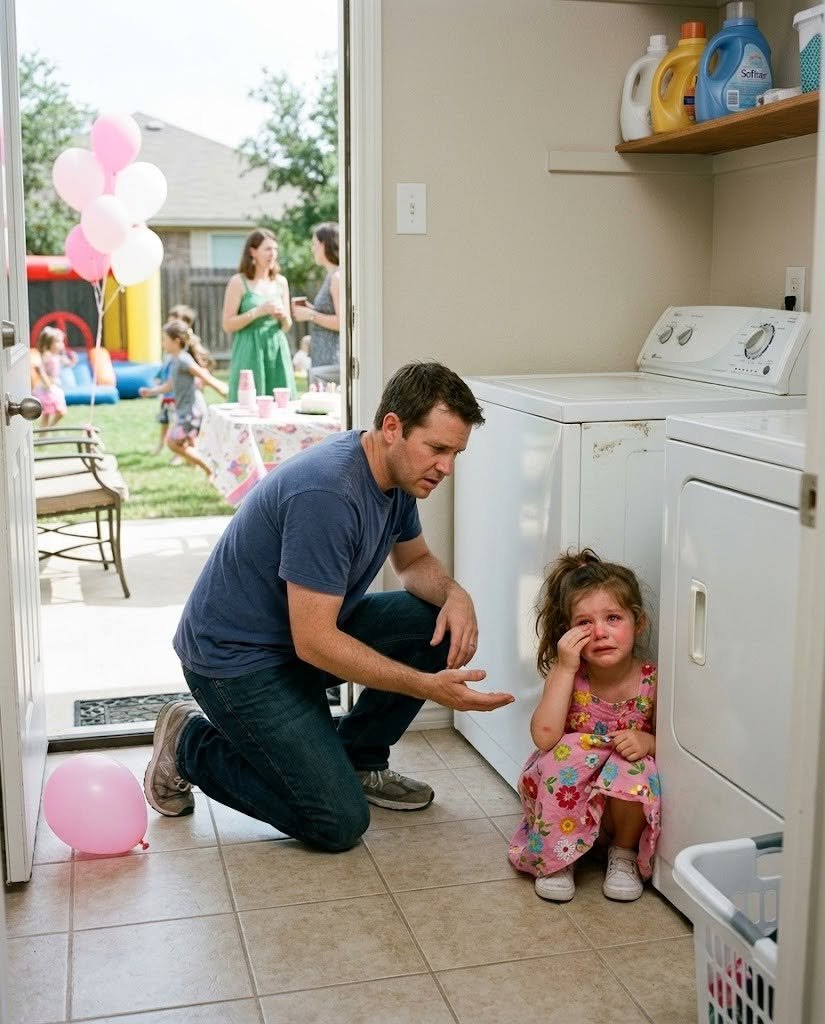
Emma had been found crying behind the washing machine.
Her cheek was red.
Her arms were marked.
She had flinched when her own father reached toward her.
Brooke admitted grabbing her.
And afterward, the adults who should have been asking whether she was okay were asking me to say she fell.
That was enough for me to know what I needed to change.
Brooke called that evening.
I let it ring.
She called again.
Then came a text.
Can we please talk like adults?
I almost laughed.
Instead, I wrote one sentence.
Not tonight.
Three dots appeared.
Disappeared.
Appeared again.
You are punishing Sophie too.
That stopped me.
For years, Brooke and I had survived family disagreements the way a lot of siblings do.
We complained.
We cooled down.
Somebody brought food.
Mom told us life was too short.
Dad made a joke.
Eventually everyone acted normal again without anyone naming what had actually happened.
This time, there was a five-year-old child in the middle.
Normal was no longer good enough.
I replied:
Do not contact Emma. Do not come to my house. I will contact you if that changes.
Her answer arrived almost immediately.
This is insane.
Then:
I DID NOT HURT HER.
Then:
Mom is devastated.
That last message told me exactly where we still were.
My mother’s feelings had entered the conversation before Emma’s had.
I blocked Brooke’s number.
Then I called my parents.
My mother answered.
“Ryan, thank God.”
“I heard the recording.”
Silence.
Not confusion.
Not “What recording?”
Silence.
My father came onto the line.
“What exactly did you hear?”
The question was so careful that it hurt more than yelling would have.
I told them.
My mother started crying.
She said they had been panicking.
She said Brooke had been overwhelmed.
She said nobody wanted things twisted into something worse.
I listened until she ran out of sentences.
Then I asked one question.
“Why didn’t either of you ask how Emma was?”
My mother stopped.
My father tried to answer for her.
“That isn’t fair.”
“It’s been more than twenty-four hours.”
“Of course we care about her.”
“You brought her doll to my porch with a note about Brooke.”
“We were trying to keep the family together.”
There it was.
The phrase adults use when they want the person who was hurt to absorb the cost of everyone else staying comfortable.
I looked toward the living room.
Emma had fallen asleep sideways on the couch with her white jacket tucked beneath her chin.
That little jacket had spent the night at the hospital in her hands because it smelled like home.
My parents had been talking about preserving a family.
Emma had been clutching a jacket because the family gathering she had just left no longer felt safe.
“I am keeping my family together,” I said.
My father’s voice hardened.
“By cutting everyone off?”
“By protecting my daughter.”
My mother whispered my name.
I knew that voice.
It was the voice she had used when Claire died.
The voice she used when something frightened her enough that she wanted everyone close.
For one second, I wanted to give in.
I wanted my mother to come over, sit at my kitchen table and tell me she was sorry.
I wanted my father to admit he had panicked.
I wanted Brooke to understand what she had done without being forced to understand it.
Most of all, I wanted Emma to still have the family I thought she had before Sophie’s birthday.
Wanting something does not make it true.
“You won’t be seeing Emma for now,” I said.
My father exhaled sharply.
“Ryan.”
“No unsupervised visits. No picking her up. No surprise visits. And neither of you will carry messages from Brooke to her.”
My mother started crying harder.
I hated hearing it.
I did not change my answer.
Over the next several days, the child protection worker stayed in contact with me while the information from the hospital, my statement, the messages and the recording were documented.
I gave her exactly what I had.
Nothing more.
Nothing less.
For the first time since the party, I also stopped answering family members who called to tell me what Brooke “meant.”
Intent had become the favorite word of people who did not want to discuss impact.
Brooke hadn’t meant to frighten Emma.
Mom hadn’t meant to pressure me.
Dad hadn’t meant to ask me to lie.
Nobody had meant anything.
And somehow my five-year-old was still the one who had hidden behind a washing machine asking whether she owed an apology.
A few days later, Emma asked if she could go back to preschool.
“Yes.”
“Will Aunt Brooke be there?”
“No.”
“Grandma?”
“No.”
She thought about that.
Then she put on her backpack.
That was the first irreversible change.
I updated the people permitted to pick Emma up and made sure nobody in my family could collect her without my approval.
The second change happened at home.
I stopped telling Emma she had to hug relatives.
That had never seemed dangerous before.
It had seemed like manners.
Now, if she didn’t want physical affection, she could wave.
If she wanted space, she could have space.
If an adult told her she had to keep a secret from me, she knew the secret should come straight to me.
And if someone scared her, she never had to apologize for being scared.
Weeks passed.
My mother sent messages.
I read some.
I ignored others.
My father called twice.
I didn’t answer.
Brooke tried contacting me through another relative.
I shut that down too.
The consequence for Brooke was not a dramatic scene where I stood in a courtroom and watched someone pronounce her ruined.
It was more ordinary and more permanent.
She lost access to my daughter.
She lost my trust.
She lost the assumption that “family” automatically entitled her to another chance with Emma before Emma felt safe.
My parents lost something too.
Until that birthday, I had trusted them without thinking.
Afterward, trust had conditions.
They could not minimize what happened.
They could not repeat the fall story.
They could not pressure Emma to forgive Brooke.
And they could not use Claire’s death to tell me my judgment was distorted by grief.
Months later, my mother finally came to my porch alone.
She did not bring a paper bag.
She did not bring Emma’s toys.
She did not tell me Brooke was stressed.
She stood beside the same front door where she had once left that note and said, “I should have asked about Emma first.”
I didn’t invite her inside immediately.
That mattered.
Old Ryan would have opened the door because she was my mother.
The man standing there now needed more than a relationship title.
“I need you to understand something,” I said. “Emma is never going to be responsible for making the adults in this family comfortable about what happened to her.”
Mom nodded.
“And if she never wants to see Brooke?”
Her eyes filled.
“I understand.”
I watched her face.
“Do you?”
This time, she didn’t defend anyone.
“Yes.”
Rebuilding anything with my parents happened slowly after that, and only within boundaries I chose around Emma.
Brooke remained outside them.
There was no forced family dinner.
No surprise reconciliation.
No moment where somebody told Emma to hug her aunt and put the unpleasantness behind us.
That was the old definition of peace in my family.
Everybody returns to the table.
Nobody mentions why somebody left it.
I wanted something better for my daughter.
One evening, Emma and I were folding laundry together.
She liked matching socks because she considered it a game.
I was pulling towels from the dryer when she suddenly climbed behind me and squeezed into the narrow space beside the washing machine.
My whole body tightened.
Then she popped back out laughing.
“Daddy, look. I fit.”
For half a second, all I could see was the yellow dress.
The tears.
The red cheek.
Her knees pulled against her chest.
Then Emma held up two socks that did not match at all and announced that they were “best friends anyway.”
I laughed.
A real laugh.
She had taken the place where I had found her terrified and turned it back into an ordinary corner of our home.
That mattered more to me than any apology Brooke could have offered.
The question Emma had whispered in the car after Sophie’s party finally had a complete answer.
No, she did not have to apologize to Aunt Brooke.
She did not have to apologize for crying.
She did not have to apologize for being frightened.
And she would never again be asked to protect an adult’s comfort by pretending her own fear had not happened.
Claire had asked me to take care of Emma.
For a long time, I thought that promise meant making sure my daughter never felt the absence her mother left behind.
I know better now.
I cannot spare Emma every painful moment.
I can make sure she knows where safety is when one comes.
That night, after she fell asleep, her white jacket was draped over the back of a kitchen chair.
I left it there.
For once, nobody needed to hold it.