The Lock My Husband Begged Me Not to Open
My duffel slipped from my hand when I saw my four-year-old daughter sitting on the floor, clutching a dirty cereal bowl.
“Mama? Are you really here?”
I knelt beside Ella, and she touched my face before crying silently. After six months overseas, I had expected a joyful homecoming, not a filthy kitchen and a child who looked frighteningly thin.
I’m Major Claire Bennett, an Army intelligence officer. I had returned to Chesapeake, Virginia, three weeks earlier than expected.
“Where’s Daddy?”
“On the giant ship.”
Nobody had been staying with her. Her grandmother had said our neighbor, Ruth Palmer, would bring crackers.
I called 911, gave Ella small sips of water, and offered applesauce from my field bag. When I asked how long her father had been gone, she raised three fingers.
Seventy-two hours alone.
Paramedics arrived with Officer Daniel Hayes. While they examined Ella, I opened my husband Ryan’s social media and found him smiling aboard a Caribbean cruise ship with his mother, Diane, his sister, Megan, and other relatives.
Nearly $19,000 had vanished from our account—my military pay and our emergency savings, spent on the cruise, excursions, and his credit cards.
Ruth hurried inside. “I saw Ella at the window yesterday. A man answered through the doorbell camera and said a babysitter was upstairs.”
Then Ryan called.
“Why are you home early?”
“Where is our daughter’s caregiver?”
He claimed she had canceled and his mother thought Ruth would check in.
“You left a four-year-old alone for three days.”
“Keep your voice down. We’ll be back Sunday.”
When I told him police were present, his tone changed.
“Don’t let them search the house.”
“It’s my property. Why shouldn’t they?”
His answer sent everyone’s eyes toward the hallway.
“Stay away from the linen closet.”
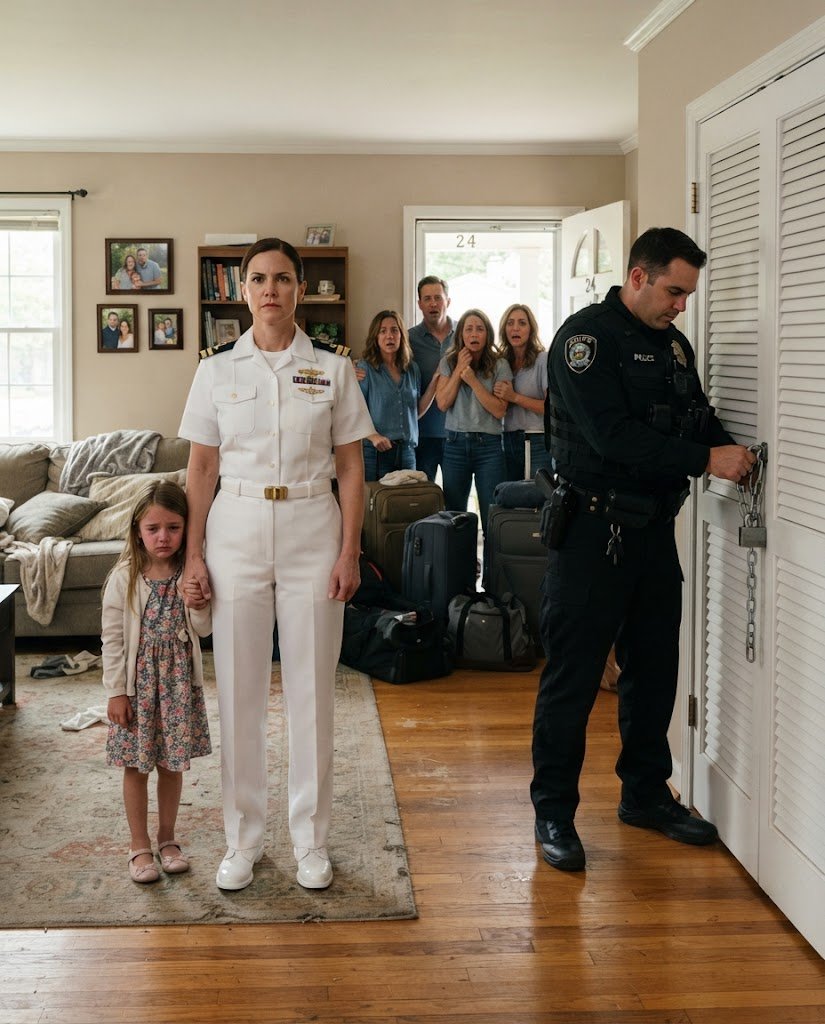
A heavy brass padlock secured its handles. It had never been there before.
Officer Hayes approached with bolt cutters, and Ryan began shouting.
“Open that, and you’ll destroy everything!”
I stared at the unfamiliar lock. Whatever my husband had hidden behind it frightened him more than the police discovering our abandoned daughter.
The Room Behind the Wall
Ryan begged me to stop Hayes. I gave him one final chance to explain, but he only warned that I didn’t understand what I was entering.
As a paramedic carried Ella toward the ambulance, Hayes offered to secure the house and obtain any additional authorization needed. I confirmed that I owned the property and wanted the unexplained lock investigated.
The shackle snapped.
Behind the doors, the shelves had vanished. Someone had opened the wall toward the garage and built a concealed room roughly six feet deep, complete with insulation, electricity, and ventilation.
Storage bins, locked cases, folders, prepaid phones, a laptop, and a printer filled the space. Photographs covered the walls.
Most showed me: leaving Fort Eustis, collecting Ella from preschool, jogging, and meeting another officer for coffee. Notes listed routes, schedules, and pickup times.
A map connected addresses across Virginia, Maryland, and Washington. My mother’s house was circled three times. Ella’s preschool and an address associated with my brother were marked too.
One partly open bin contained envelopes of cash.
“Don’t touch anything,” Hayes said, putting on gloves.
Ryan urged me to leave with Ella. When I demanded an explanation, he finally whispered, “It wasn’t supposed to be there when you came home.”
The call ended.
Detectives and supervisors arrived, photographed the room, and sealed it. Ella went to Children’s Hospital of The King’s Daughters in Norfolk, where doctors confirmed dehydration and undernourishment. Mercifully, she was stable.
She had survived on bathroom tap water, dry cereal, and crackers Ruth left on the porch.
At 9:43 p.m., Hayes returned with Detective Sofia Reyes. Outside Ella’s room, Reyes showed me photographs of passports found in a metal case.
Some belonged to Ryan and relatives on the cruise. Two carried photographs of Ella and me under different names: Mia and Anna Lawson.
“They’re convincing counterfeits,” Reyes said.
Investigators had also found approximately $80,000—far more than the missing household money—and fraudulent death certificates for both of us.
Mine listed a fatal car accident on October 14.
That date was twenty-nine days away.
The hidden laptop contained military personnel information, travel plans, deployment schedules, and a folder bearing my unit designation. Federal investigators, including the FBI and NCIS, had been notified.
I called my commanding officer.
“Sir, we may have a compromise involving my residence and deployment information.”
He ordered me not to discuss details on an unsecured line, then asked whether I was safe.
Looking at Ella asleep through the glass, I answered honestly.
“I don’t know.”
The Agent My Mother-in-Law Recognized
By midnight, Special Agent Julia Brooks and another agent, Michael Foster, were questioning me at the hospital.
They asked about Victor Hale, Meridian Strategic Logistics, and Blackshore Consulting. None meant anything to me. Brooks showed me a photograph of Ryan outside Washington’s Willard hotel with an unfamiliar man, taken five months earlier while I was deployed.
They examined what Ryan might have learned from ordinary conversations about my work. He had never used my military laptop, but I couldn’t be certain whether he still had access to my personal email.
At 1:17 a.m., Diane called from an unknown number.
Ryan had disappeared from their cabin twenty minutes earlier. When she learned we had opened the closet, she began crying and blamed me.
“My daughter nearly starved while you were on vacation,” I said.
Diane insisted Ryan had told her a friend’s daughter was babysitting. She admitted knowing he had begun earning substantial money through supposed consulting work about a year earlier, but claimed she had avoided asking questions.
She hadn’t known his construction business collapsed eight months ago. Nor had she questioned how he could afford a cruise for twelve relatives.
Then she admitted delivering boxes to our house the previous Thursday. Ryan had knocked three times on the closet door, and someone inside had answered.
He called the occupant Mr. Hale.
Before disappearing from the ship, Ryan had left her a message for me: “The closet was never about Claire.”
Someone began pounding on Diane’s cabin door, claiming to be ship security. Foster leaned toward my phone, identified himself, and advised her to verify that through the cabin telephone.
Diane went silent.
“Michael Foster?”
His expression changed.
“Claire, get away from him,” she whispered. “I met him at your house. Ryan said he worked with Meridian.”
Brooks drew her weapon. As she handcuffed Foster, he told me Ryan had tried to escape the organization.
The counterfeit identities, cash, routes, and death certificates, he suggested, were preparations to disappear—not necessarily evidence of a murder plan.
“Why wouldn’t he tell me?”
“Because he didn’t know which side you were on.”
Foster said Ryan had discovered a network selling military personnel information and knew someone within it possessed details connected to me.
“He wasn’t watching you. He was finding out who else was.”
Inside her room, Ella woke and asked whether I had found the secret room. She knew about “the man who sleeps in the wall,” whom her father called Uncle.
Then she saw Foster and screamed.
He shoved Brooks and tried to run. Hayes tackled him before he reached the elevator, and security helped restrain him.
“Check your house,” Foster told me. “Opening that door told him you found it.”
My phone displayed a motion alert from a hallway camera I had never known existed.
Onscreen, a man emerged from the concealed room. Ryan followed, bruised and apparently bound. The man held up a sign:
One traitor. One child. One choice.
On the reverse was my mother’s address.
My mother’s phone rang mine moments later. A man answered and said this began during my first deployment eleven years earlier.
In the camera feed, I noticed a photograph of six soldiers beside an armored vehicle. One figure had been crossed out. Beneath it was June 19—the day our convoy was ambushed and my older brother, Captain Nathan Bennett, was presumed dead.
We had buried an empty coffin.
The man removed his cap. I recognized his eyes and the scar above his eyebrow.
“Hello, Claire.”
The Brother We Buried
Nathan said our mother was safe and that he was protecting her. Behind him, Ryan protested that the information he had sold was worthless. Nathan struck him, stopping when Ella screamed.
“You let us mourn you for eleven years,” I said.
He explained that an unofficial intelligence unit had extracted him after the ambush. It was tracking a network moving weapons, identities, personnel records, and access through private contractors.
That network became Meridian.
Three years earlier, Meridian began watching me after I flagged suspicious travel records in a contractor-corruption analysis. My report had disappeared two weeks later, marked closed.
Nathan said Ryan discovered the surveillance. Meridian, meanwhile, believed Ella could lead them to Nathan.
The room had been Nathan’s intermittent hiding place for nearly a year. He had been collecting evidence and monitoring the people watching us.
“Then why was Ella alone?”
Ryan finally explained the cruise.
Meridian had quietly bought debts connected to Diane’s mortgage, Megan’s medical bills, and a cousin’s failed business. Foster offered Ryan relief in exchange for apparently harmless information: deployment windows, contractors’ names, and family routines.
Ryan cooperated until he realized military families were being tracked. When he tried to withdraw, Nathan appeared in our garage and persuaded him to help undermine the network.
They fed Meridian false information. The photographs had been taken from its surveillance files; the map showed escape routes. The $80,000 and counterfeit documents were intended to give Ella and me new identities if we needed to flee.
Six months earlier, Ryan had planned the cruise as an operation. Meridian expected him to hand a courier a drive identifying Nathan’s location. Nathan’s federal contacts were supposed to intercept the exchange.
But Foster was among those trusted contacts. The operation had been compromised from the beginning.
Ryan had hired a vetted babysitter, Bethany Cole, to arrive thirty minutes after their departure. Meridian intercepted her before she reached the house. Her car had been found the previous day after a fatal hit-and-run.
Foster sent Ryan fabricated doorbell images claiming she had arrived.
But Ryan later suspected something was wrong. Rather than expose the operation by leaving the ship, he relied on assumptions that Ruth or Nathan’s contacts would watch Ella.
“You chose the operation over our daughter.”
Ryan bowed his head.
“Yes. It was cowardice.”
Then Nathan turned sharply toward a noise behind him. A crash shook the camera, Ryan shouted, and the feed went dark.
Through my mother’s telephone, I heard her scream.
Then a gunshot.
The Evidence Inside a Unicorn
By 3 a.m., police, federal tactical officers, and military investigators surrounded our house. Foster refused to speak, the camera remained offline, and my mother’s phone was dead.
I sat beside Ella for the next two hours, watching her breathe.
At dawn, Brooks returned. My mother had been found locked in her pantry, alive and without major injuries. Ryan and Nathan were still missing.
Brooks showed me security footage stamped 12:58 a.m. Nathan and Ryan had arrived near our house with a third man wearing federal markings.
I recognized Deputy Director Graham Sutton, the liaison who had closed my contractor-corruption report three years earlier.
Investigators believed he had built Meridian from an unofficial intelligence project designed to expose vulnerabilities in foreign procurement networks. It had become a marketplace trading in American families’ debts, movements, secrets, and access.
Nathan had discovered the operation eleven years earlier. The convoy attack had been arranged to erase him, followed by his extraction into a world our family knew nothing about.
Now Sutton wanted the evidence Nathan had accumulated. Ryan—and Ella—gave him leverage.
An unknown number sent a photograph of Ryan tied to a chair with Sutton behind him, followed by an address and two words:
Come alone.
Brooks refused to let me walk into it unprotected. When she said I didn’t possess the evidence Sutton wanted, I thought about Nathan’s caution and the obvious contents of the hidden room.
He would have kept another copy somewhere less conspicuous.
I asked Ella whether Uncle Nathan had given her anything. She reached beneath her hospital pillow and produced a pink plastic unicorn.
“He said it was treasure.”
A seam ran around its belly. I opened it and found a microSD card.
The Warehouse
At 8:20 a.m., I drove to an abandoned waterfront warehouse outside Norfolk. I wore civilian clothes and appeared alone, but Brooks’s team, NCIS, state police, and tactical officers were positioned nearby.
The card in my pocket was a decoy. Investigators were already copying the real evidence.
Inside, Sutton stood before Ryan, who was tied to a chair with one eye swollen shut.
“Release him,” I said.
“The card first.”
When I asked about Nathan, Sutton claimed he had helped build Meridian rather than merely fought it.
“He designed the system. I financed it. Foster recruited people.”
I recognized the attempt to make me doubt everything, but uncertainty still caught me.
Then Nathan stepped out of the shadows, apparently unharmed, and aimed a pistol at me.
“I’m sorry,” he said.
Ryan shouted. Sutton reached for the card, and I handed it over.
Nathan fired.
The shot struck Sutton’s shoulder. Ryan toppled sideways with his chair as I dropped to the floor. Tactical teams entered amid shouting and gunfire.
I dragged Ryan behind a concrete column while Nathan tackled Sutton. Moments later, officers called the warehouse clear.
Sutton was alive and handcuffed. Nathan, bleeding from his arm, surrendered his weapon when Brooks ordered him to drop it.
Ryan looked at me.
“I’m sorry.”
I cut his restraints without offering forgiveness.
“First, we get Ella.”
“First Ella,” he agreed.
Consequences and Another Daughter
Sutton’s arrest exposed Meridian, but Nathan’s microSD card dismantled it. Eleven years of bank records, encrypted communications, payments, blackmail, and victims’ names connected the operation to powerful people.
Three senators resigned. Two Pentagon contractors were arrested. Several intelligence officials disappeared from public view. Foster accepted a plea agreement; Sutton insisted the operation served national security, despite evidence to the contrary.
Ryan faced charges for child neglect, financial theft, obstruction, and unauthorized data access. At his arraignment, he accepted responsibility.
“I endangered my daughter. Whatever else I believed I was doing, those decisions were mine.”
That mattered, but it could not erase Ella’s seventy-two hours alone. She woke screaming, hid crackers beneath her pillow, and repeatedly asked whether I would still be home in the morning.
Nathan entered a secure medical facility while investigators addressed his eleven years of official absence. When our mother saw him, she slapped him, then embraced him so tightly they both cried.
Later, he asked whether I hated him.
“I don’t know. You let Mom bury you. You let me blame myself.”
He admitted it. Eventually, I hugged him too.
When I asked why he entrusted the evidence to Ella’s toy, he explained that he knew I would put her safety above my clearance, career, or any operation.
Then he handed me an envelope containing a DNA comparison involving Ella and genetic material from an unidentified casualty file. It reported a 99.98 percent probability of a biological relationship.
Before I could understand, he told me about Marissa, a civilian analyst he had known before disappearing. There had been a child, and Nathan learned about her only years later.
He produced a birth record for a girl born four years before Ella. Her original name was Lucy Marissa Bennett; her name had changed after adoption.
“Where is she?” I asked.
“We’ve been searching.”
Brooks entered with a social worker and an eight-year-old girl holding a stuffed rabbit. She had our family’s gray-blue eyes.
“We found her,” Brooks said.
The girl looked at Nathan.
“Are you my father? My mom said you were dead.”
He sank to his knees.
“So did mine.”
After eleven years of absence, my brother had returned to discover a daughter waiting for him.
No More Secret Doors
A year later, we had demolished the hidden room and turned the hallway into a reading nook. Ella chose yellow paint because, she said, yellow wasn’t frightening.
She regained her weight and began thriving. We let her keep crackers beside her bed as long as she needed them.
Ryan served a prison sentence reduced by his cooperation, though his contribution to the investigation did not excuse abandoning Ella.
I visited him once for closure.
“I don’t expect you to wait,” he said.
“I’m not.”
I told him I could forgive the man who tried to expose Meridian more easily than the husband who lied or the father who left our child. Some parts might take years.
Before leaving, I brought Ella to the partition with my mother. Ryan cried as father and daughter pressed their palms against opposite sides of the glass.
Lucy and her adoptive mother moved nearby. Nathan made no attempt to uproot her. Instead, he learned fatherhood through school pickups, pancakes, soccer games, and awkward conversations.
Our mother insisted on Sunday dinners. They were noisy and imperfect: spilled milk, unwanted peas, burned bread, and children arguing over dessert. For a while, we kept an empty chair for Ryan while deciding what place he might eventually have.
Six months later, I left operational intelligence for a training role in insider-threat prevention and military-family protection. Nathan quietly consulted. When Lucy first called him Dad at a school play, he cried in the parking lot.
One spring morning, Ella stood beside the reading nook holding the old brass padlock.
“Can I throw this away?”
“Are you sure?”
She nodded.
“It doesn’t belong here.”
She dropped it in the trash and ran outside. Nathan appeared with coffee and agreed.
Then my phone buzzed with a message from Ryan’s attorney.
Parole approved. Release Friday.
On Friday, I took Ella to meet him. Ryan stepped through the gate carrying a cardboard box and stopped when he saw us.
Ella ran into his arms.
I watched them cry together. Their reunion did not restore our marriage or undo what happened, but neither of us had to pretend the damage wasn’t real.
That evening, Ryan came to the house and paused before the yellow reading nook.
“What happened to the closet?”
“We opened it.”
Ella looked up from her book.
“Daddy, you can stay for dinner.”
He waited for my answer. I nodded.
Dinner was a beginning, not a promise about the rest of our lives.
At the table, Nathan warned him never to leave his niece alone again. Our mother swatted Nathan with a napkin, Ryan accepted the warning, and the tension gradually gave way to laughter.
Later, I passed Ella’s reading nook and noticed a drawing taped where the lock once hung. It showed our family holding hands beneath an enormous yellow sun.
At the bottom, she had written:
No more secret doors.
I touched the paper, switched off the light, and joined my family.