THE DEAD MAN WHO NEVER DIED
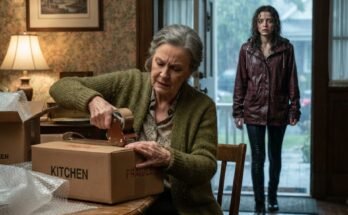
The federal agent said Nathan Cole’s name, and for one impossible second, Juniper Hollow Drive disappeared beneath my feet.
The houses vanished.
The police cars vanished.
Even Logan Whitmore’s stunned face blurred into nothing.
All I could see was a mountain valley twelve years earlier, black beneath a moonless sky, while tracer fire stitched red lines through the darkness.
Nathan had been twenty-nine then.
A Ranger.
A husband without a wife.
A father without children.
A man who laughed at terrible coffee, hated helicopters, and somehow remained calm whenever everyone else had begun to lose control.
And I had watched him disappear.
Not metaphorically.
Literally.
Our team had been extracting from a compromised position when the rear vehicle took a hit. Nathan had gone back for two men.
He got one out.
Then the ridge exploded.
By the time we returned, there was nothing left but fire and rock.
No body.
No gear.
Nothing.
The Army declared him killed in action.
I had believed it because I needed to.
Now a federal agent stood in my quiet suburban street and said his name as if Nathan had simply missed a meeting.
“What about him?” I asked.
The agent glanced at Grant Whitmore.
“We should speak somewhere private.”
Grant laughed softly.
“No,” I said.
Everyone looked at me.
I pointed toward Grant.
“He showed me a classified image and told me I left someone behind. Whatever this is, he already knows enough.”
The agent’s expression tightened.
Then Grant said something that made Logan turn toward him in horror.
“Tell her, Marcus.”
The federal agent froze.
I noticed immediately.
His name tag was not visible beneath his jacket.
Grant shouldn’t have known his first name.
“Dad,” Logan whispered. “What is going on?”
Grant looked at his son.
For the first time, the wealthy, arrogant developer seemed old.
“Go home.”
“No.”
“Logan.”
“You used me.”
Silence fell.
Grant closed his eyes.
And that was answer enough.
Logan stepped back.
“You told me she was some fake officer who liked intimidating civilians.”
Grant said nothing.
“You told me if I embarrassed her on camera, people would finally see what she was.”
“I needed a reaction.”
“You made me attack her.”
“I never told you to hit her.”
“You knew I would!”
Grant flinched.
That mattered.
I had thought Grant Whitmore incapable of shame.
I had been wrong.
Agent Marcus Hale stepped between us.
“Mr. Whitmore, put your hands behind your back.”
Grant didn’t resist.
That surprised me more than anything else.
As Patel cuffed him, Grant looked at me.
“You’re asking the wrong question, Claire.”
“What question should I be asking?”
“Not how I know Nathan Cole.”
He leaned closer.
“Ask who signed the order that got your team ambushed.”
Something inside me went still.
Marcus Hale immediately grabbed Grant by the arm.
“That’s enough.”
I looked at Hale.
“What does he mean?”
“We’ll discuss it.”
“No. We’ll discuss it now.”
Hale lowered his voice.
“Colonel.”
The way he said my rank irritated me.
Not respectful.
Containment.
I had used that tone myself.
Which meant he was controlling information.
I stared at him.
Then I noticed the smallest detail.
His right hand was trembling.
Only slightly.
A man trained to appear calm.
A man frightened by the direction of the conversation.
And suddenly Nathan’s letter came back to me.
Don’t trust the man who says he sent us.
My eyes moved to Hale.
“You weren’t an agent twelve years ago.”
“No.”
“What were you?”
He didn’t answer quickly enough.
Grant smiled from behind him.
I understood.
“You were military.”
Hale exhaled.
“Army intelligence.”
My heartbeat slowed.
“Were you involved in the operation?”
“No.”
Grant laughed.
Hale turned sharply.
Grant looked directly at me.
“He approved the intelligence package.”
The street erupted into noise.
Hale shoved Grant toward the SUV.
“He’s lying.”
But Grant shouted over his shoulder.
“Ask him who identified the safe route through Al-Mazir Valley!”
I stared at Hale.
He looked away.
That was all I needed.
He had been there.
Not physically.
But in the chain.
In the paperwork.
In the decisions.
Hale finally faced me.
“The route was based on intelligence we believed reliable.”
“We?”
“Claire—”
“Who is we?”
He paused.
Then said the name.
“General Daniel Reeves.”
The phone was still in my hand.
Reeves was still connected.
Nobody spoke.
For several seconds, there was only static.
Then Reeves said, very quietly:
“Claire, do not believe Grant Whitmore.”
I looked at the phone.
“Did you sign the mission order?”
A long pause.
“Yes.”
It felt as if someone had opened a door beneath me.
Reeves continued.
“But I did not betray you.”
I remembered Nathan’s letter.
Don’t trust the man who says he sent us.
Reeves had sent us.
My jaw tightened.
“Then who did?”
Reeves said nothing.
Grant turned as Patel guided him toward the vehicle.
And he shouted the sentence that changed the entire story.
“Nathan Cole is alive.”
I stopped breathing.
Logan stared at his father.
Hale swore.
Reeves went silent.
Grant smiled at me.
“And he’s coming for the man who left him there.”
THE HOUSE NEXT DOOR WAS NEVER HIS HOME
By sunset, Juniper Hollow Drive was sealed off.
Neighbors were questioned.
Phones were collected for copies.
Grant Whitmore was gone.
Logan sat alone on the curb across from my house, staring at his hands.
For the first time since I had met him, he looked twenty-two.
Not intimidating.
Not arrogant.
Just young.
I walked toward him.
He stood immediately.
“I’m not going to hit you,” I said.
His face reddened.
“I know.”
“You sure?”
He actually laughed.
A broken, embarrassed sound.
Then he sat again.
I stayed standing.
After a moment, he said, “I didn’t know.”
“I know.”
“My dad told me you ruined someone’s life.”
I looked at him.
“Whose?”
“He never said.”
That interested me.
Logan continued.
“He said you were dangerous. That you hid behind rank and medals. That you’d abandoned people and never faced consequences.”
My throat tightened.
“Did he mention Nathan Cole?”
“No.”
“Did he mention the military at all?”
“Only that you were some officer who thought she was untouchable.”
He looked down.
“I believed him.”
“Why?”
Logan’s jaw clenched.
“Because he’s my dad.”
There was nothing to say to that.
A child could grow into a twenty-two-year-old fighter and still remain a child in one specific place.
The place where a father’s voice lived.
“What was he doing before he moved here?” I asked.
“Development.”
“Before that.”
“He worked overseas.”
That got my attention.
“Where?”
“Afghanistan. Iraq. UAE. I don’t know. Construction contracts.”
My pulse quickened.
Contracting.
Infrastructure.
Security.
Supply routes.
A world adjacent to military operations without officially being military.
“What was his company called?”
Logan hesitated.
“Whitmore Strategic Development.”
I had heard the name.
Not recently.
Twelve years ago.
Under another name.
Whitmore Logistics.
A civilian subcontractor that had handled convoy mapping and local-source vetting in the region where Nathan disappeared.
My stomach turned.
Grant had not merely known about the operation.
Grant Whitmore had been inside the machinery that supported it.
That night, Marcus Hale arrived at my house.
I let him in because I wanted answers.
Noah sat at the kitchen table.
He refused to go upstairs.
I didn’t argue.
Hale placed a thin folder in front of me.
“That’s all I can legally show you.”
I opened it.
Most pages were heavily redacted.
One name wasn’t.
NATHAN COLE.
Status:
Recovered.
Not recovered deceased.
Recovered alive.
My hands went numb.
The date was nine days after the mission.
Nine days.
Nathan had been alive for nine days while I stood at a memorial briefing believing we had lost him.
“Where was he found?”
Hale leaned back.
“Local militia intercepted a transfer. He had been held by a group connected to an intelligence intermediary.”
“Why wasn’t I told?”
“Because he was compromised.”
I looked up.
“That doesn’t answer my question.”
“He believed someone inside the coalition structure had intentionally exposed your team.”
“And?”
“And there was evidence he might have been right.”
Noah whispered, “Mom…”
I closed the folder.
“Where is Nathan now?”
Hale’s silence answered me.
“You lost him.”
“He disappeared from protective custody eleven years ago.”
I stared at him.
“Eleven years?”
“We thought he was dead again.”
“You seem very comfortable declaring people dead without bodies.”
Hale absorbed that.
Then I asked, “Why now?”
“We received evidence six months ago that Cole was alive.”
Six months.
Exactly when I moved to Silver Creek.
I looked at Hale.
“You moved me here.”
“No.”
“Someone did.”
He didn’t deny it.
A sound came from the hallway.
The old floorboard near the laundry room.
I stood instantly.
Hale reached beneath his jacket.
I raised a hand.
Noah went pale.
Someone was inside my house.
I moved toward the hall.
Slowly.
Then a figure stepped from the darkness.
Gray hair.
Lean face.
A scar running from left temple to jaw.
My brain refused what my eyes were seeing.
The man looked older.
Thinner.
But the expression was the same.
That slightly crooked half-smile.
The one that always appeared immediately before he said something inappropriate in serious moments.
“Still clear rooms like you’re angry at the furniture,” he said.
I couldn’t move.
Noah looked between us.
Hale stood frozen.
The man’s eyes found mine.
And suddenly I was thirty again.
Cold.
Exhausted.
Covered in dust.
Calling his name into smoke.
“Nathan.”
His smile disappeared.
“Hi, Claire.”
I crossed the room.
And slapped him.
Hard.
Noah gasped.
Nathan touched his cheek.
“I probably deserved that.”
I hit him again.
He nodded.
“Definitely deserved that one.”
Then I grabbed him.
Not violently.
I wrapped both arms around him and held on.
For twelve years, I had carried the weight of a dead man.
Now he was breathing against my shoulder.
“I buried you,” I whispered.
“I know.”
“I gave your mother the flag.”
“I know.”
“You were alive.”
His voice broke.
“I know.”
I stepped back.
There were tears in his eyes.
That shocked me more than his presence.
Nathan Cole had once stitched his own arm under fire without making a sound.
Now he could barely look at me.
“I couldn’t come back,” he said.
“Why?”
He glanced toward Hale.
“Because the people who betrayed us were still wearing uniforms.”
THE TRAITOR WORE STARS
Daniel Reeves arrived shortly after midnight.
He came alone.
No aides.
No uniform.
Just jeans, a dark coat, and the exhausted face of a man who had spent twelve years fearing this exact night.
Nathan sat across from him in my living room.
I stood between them.
Hale remained near the doorway.
Noah was upstairs now, though I knew he was probably listening from the landing.
Reeves looked at Nathan.
“I thought you were dead.”
Nathan smiled without humor.
“You people keep saying that.”
Reeves closed his eyes.
Then I placed Nathan’s old letter on the coffee table.
I had retrieved it from the drawer.
The paper was yellowed along the folds.
Reeves recognized the handwriting.
“You kept it.”
“Explain it.”
Nathan looked at him.
“Do you want to tell her?”
Reeves said nothing.
Nathan leaned forward.
“The intelligence that sent us into Al-Mazir Valley was manufactured.”
I already suspected that.
But suspicion and confirmation were different things.
“By Grant?”
“Partly.”
Nathan continued.
“Whitmore Logistics paid local intermediaries to reroute coalition patrols away from specific corridors.”
“Why?”
“Mineral transport.”
I frowned.
“Minerals?”
“Rare earth deposits. Illegal extraction sites. Smuggling routes. Weapons moved one direction. Raw materials moved the other.”
Reeves added quietly, “Billions were involved.”
I looked at him.
“You knew?”
“Not then.”
Nathan laughed.
“You knew enough.”
Reeves flinched.
Nathan turned toward me.
“The ambush wasn’t meant to kill the team.”
“What?”
“It was meant to capture someone.”
“Who?”
“Me.”
The answer made no sense.
“Why you?”
Nathan looked at Hale.
Hale finally spoke.
“Nathan had discovered financial records connecting a defense contracting network to senior government and military figures.”
My stomach twisted.
“How senior?”
Nobody answered.
I understood.
Very.
Nathan continued.
“I copied files. Grant learned about it. So did the people above him.”
I turned toward Reeves.
Nathan followed my gaze.
“He signed the operation.”
Reeves stood.
“I signed it based on false intelligence!”
“But you ignored the warning.”
Reeves went silent.
Nathan’s voice became colder.
“I warned your office the route was compromised forty-eight hours before insertion.”
I stared at Reeves.
“Is that true?”
He looked at me.
“Yes.”
The room changed.
I had trusted Daniel Reeves for years.
He had promoted me.
Supported my command.
Sat at Noah’s birthday dinner once when we were stationed nearby.
And now he admitted that before one of the worst nights of my life, someone had warned him the route was unsafe.
“Why?” I asked.
Reeves’ eyes filled with something I had never seen in them.
Shame.
“My commanding general ordered the operation to proceed.”
“Who?”
Reeves looked at Nathan.
Nathan nodded.
“Tell her.”
Reeves whispered the name.
“General Howard Vance.”
I knew Vance.
Everyone did.
Retired four-star.
Television commentator.
Defense consultant.
National hero.
A man who had testified before Congress about integrity and duty.
He had pinned a medal on my uniform five years after Nathan disappeared.
The thought made me sick.
Nathan said, “Vance owned part of the contracting network through shell companies.”
Hale added, “We believe Grant handled the money.”
“And Nathan?” I asked.
“Was leverage,” Hale said.
I looked toward Grant’s empty house next door.
“Then why did Grant move beside me?”
Nathan answered.
“Because Vance told him you had something.”
“I don’t.”
“Yes, you do.”
I frowned.
Nathan nodded toward the old letter.
My stomach dropped.
I picked it up.
“I’ve read this hundreds of times.”
“Read the first word of every paragraph.”
I stared at him.
Then unfolded it.
There were eight paragraphs.
I read the first words.
If.
Copper.
North.
Window.
Seven.
December.
Mercy.
Blue.
Meaningless.
Until Nathan said, “Coordinates.”
My breath stopped.
“You encoded something in a goodbye letter?”
“I was twenty-nine and dramatic.”
Despite everything, I almost laughed.
Reeves did not.
Nathan pointed toward the paper.
“The words correspond to a storage location.”
“What’s there?”
“The original financial ledger.”
Hale’s face changed.
“You told us it was destroyed.”
“I lied.”
“Where?”
Nathan looked at me.
“Fort Carson.”
Reeves swore.
Then every light in the house went out.
Noah shouted upstairs.
Glass shattered in the kitchen.
Hale drew his weapon.
Nathan pulled me down.
A red laser moved across the wall.
Then another.
Someone outside fired.
The room exploded into motion.
I crawled toward the stairs.
“Noah!”
“I’m here!”
“Stay down!”
Nathan reached the front window and looked through the broken edge.
“Two shooters. Maybe three.”
Reeves stared at him.
“How did they find us?”
Nathan looked at Hale.
Hale’s face went white.
Then his phone began ringing.
Unknown number.
He answered.
A voice came through.
Calm.
Older.
Powerful.
“Marcus.”
Everyone heard it.
Hale whispered, “General Vance.”
The voice continued.
“Give me the letter.”
Then Nathan smiled.
Not happily.
The old Ranger smile.
The one I remembered from twelve years ago.
And he said:
“Howard, you always were terrible at knowing when you’d already lost.”
THE TRAP WE BUILT TWELVE YEARS TOO LATE
The attack ended as quickly as it began.
Not because the shooters escaped.
Because Nathan had expected them.
Within thirty seconds, additional federal vehicles appeared from both ends of the street.
The gunfire stopped.
Three suspects were arrested.
No neighbors were hurt.
And I realized something.
Nathan had used my house as bait.
I cornered him in the kitchen afterward.
“You knew they might come.”
“Yes.”
“My son was here.”
“I had surveillance teams outside.”
“My son was here.”
He lowered his eyes.
“I know.”
I punched him.
Not hard.
Enough.
He nodded.
“Also deserved.”
“No more secrets.”
“No more.”
We drove to Fort Carson before sunrise.
Reeves, Hale, Nathan and I.
Noah stayed with Mrs. Alvarez under federal protection.
The storage location was not dramatic.
No underground bunker.
No hidden vault.
It was an old archival cage in a decommissioned administration building.
Nathan had hidden the ledger inside a hollowed emergency radio battery twelve years earlier.
It was still there.
A tiny encrypted drive.
Hale plugged it into an isolated system.
Files opened.
Names.
Accounts.
Transfers.
Contracts.
Payments.
Enough evidence to destroy careers, companies and reputations across three countries.
At the top of the network sat Howard Vance.
But one detail stunned us.
Grant Whitmore was not merely a participant.
For the last six years, he had been secretly feeding information to federal investigators.
“He turned informant?” I asked.
Hale nodded.
“After his wife died.”
Logan’s mother.
I remembered almost nothing about her.
Grant never mentioned her.
Hale opened another file.
“She discovered what he was involved in. Tried to expose him. Vance had her killed in what was ruled a boating accident.”
That explained Grant’s strange sadness.
His fear.
His anger.
His desperation.
“He moved beside me because of the letter,” I said.
Nathan nodded.
“He knew Vance was looking for it too.”
“So he provoked me to see whether I still had operational instincts.”
“Yes.”
“That is the stupidest plan I have ever heard.”
Nathan looked toward the ceiling.
“Grant is not famous for subtlety.”
I almost smiled.
Then Hale discovered something else.
A scheduled transfer.
Vance planned to leave the United States that evening.
Private aircraft.
Colorado Springs.
We moved fast.
But Vance was faster.
By the time federal teams reached the airport, his plane was gone.
Or appeared to be.
The flight plan showed departure.
Radar showed an aircraft climbing south.
But Nathan stared at the screen.
“That’s not him.”
“How do you know?” Hale asked.
“Because Howard Vance never runs.”
Nathan turned toward me.
“He makes other people run.”
I understood immediately.
“He wants us chasing the plane.”
“Exactly.”
“Then where is he?”
My phone rang.
Mrs. Alvarez.
I answered.
Her voice was shaking.
“Claire.”
My blood went cold.
“What happened?”
“It’s Noah.”
I stood.
“What about Noah?”
“He’s gone.”
Everything inside me stopped.
“What do you mean gone?”
“There was a delivery van. Two men. They showed federal badges.”
I looked at Hale.
He was already calling his team.
Mrs. Alvarez started crying.
“I thought they were with you.”
I couldn’t hear anything after that.
Nathan grabbed my shoulders.
“Claire.”
I looked at him.
“He took my son.”
Nathan’s face changed.
No jokes.
No guilt.
Only purpose.
“Yes.”
Then a text arrived.
Unknown number.
One photograph.
Noah sitting in a chair.
Alive.
Terrified.
Below it:
BRING THE LETTER AND THE DRIVE TO JUNIPER HOLLOW. COME ALONE.
I looked at Nathan.
“No.”
He knew exactly what I was thinking.
“No, Claire.”
“He wants me.”
“He wants the evidence.”
“He has Noah.”
“He’ll kill both of you.”
“Then stop him.”
I started toward the door.
Nathan caught my arm.
“I lost twelve years because I tried doing this alone.”
I looked at him.
“My son is fifteen.”
“And he needs you alive.”
I stared at Nathan.
Then I realized something.
Vance had made the same mistake Logan had.
He assumed pressure would make me irrational.
That love would make me reckless.
He didn’t understand.
Love had made me disciplined for fifteen years.
I turned to Hale.
“Get me a duplicate drive.”
Nathan smiled.
Reeves looked at me.
“What are you planning?”
I picked up my keys.
“Giving General Vance exactly what he thinks he wants.”
THE LAST FIGHT ON JUNIPER HOLLOW DRIVE
General Howard Vance was waiting in Grant Whitmore’s house.
Of course he was.
There was something theatrical about that.
The man behind twelve years of lies had chosen the quietest street in Colorado for his final stand.
I walked across the cul-de-sac alone.
Or appeared to.
The duplicate drive was in my pocket.
Nathan’s letter was folded inside my jacket.
Every instinct I had told me where the overwatch teams were.
Roofline.
Drainage ditch.
Unmarked van.
Darkened bedroom window.
Vance’s people would know too.
Which meant nobody could move until he made the first mistake.
I entered the Whitmore house.
Noah sat in the dining room.
His hands were tied.
He looked frightened but unhurt.
Behind him stood Vance.
Seventy-one years old.
Silver hair.
Straight posture.
The same polished face television audiences trusted.
He held a pistol near Noah’s shoulder.
“Claire.”
“Howard.”
His smile was almost warm.
“You became exactly what I expected.”
“I’ll take that as an insult.”
“You always were difficult.”
“That’s why you kept promoting me?”
“That’s why I kept you close.”
The truth hurt more than I expected.
He had watched my career.
Guided it.
Not from affection.
From surveillance.
“You were afraid I had Nathan’s evidence.”
“I suspected.”
“For twelve years?”
“For twelve years.”
I looked at Noah.
He was watching me carefully.
I gave him the smallest nod.
He understood.
Vance extended his free hand.
“The drive.”
I removed it.
“And the letter.”
I held it up.
“Let Noah walk outside.”
“No.”
“Then you get nothing.”
He smiled.
“You’re not in command here.”
I looked around.
“Interesting thing about command.”
“What?”
“It only exists if people keep obeying you.”
His smile faded.
From upstairs came footsteps.
Then Logan Whitmore appeared.
My eyes widened.
His face was bruised from our fight.
His hands were raised.
And behind him walked Grant.
No cuffs.
No federal escort.
Just Grant.
Vance looked genuinely shocked.
“You.”
Grant smiled.
“Me.”
Logan stared at his father.
“What are you doing here?”
“Fixing something.”
Vance swung the gun toward Grant.
That was the mistake.
Noah dropped.
I moved.
Grant moved.
Logan moved.
Everything happened at once.
I hit Vance’s wrist.
The pistol fired into the ceiling.
Noah rolled beneath the table.
Logan tackled his own father out of the line of fire.
Grant shouted.
Federal teams stormed the doors.
Vance tried to reach another weapon.
Nathan appeared from the hallway.
“Don’t.”
Vance froze.
For the first time, the legendary general looked afraid.
Nathan stood ten feet away.
Older.
Scarred.
Alive.
Vance whispered, “You should have died.”
Nathan smiled.
“So I’ve been told.”
Hale entered behind him.
Weapons lowered only after Vance was restrained.
I ran to Noah.
He collided with me.
For a few seconds, I was not Colonel Bennett.
Not a Ranger commander.
Not an officer.
I was a mother holding her son so tightly he complained he couldn’t breathe.
“Mom.”
“I know.”
“Mom.”
“I know.”
“You’re crushing me.”
I released him slightly.
He laughed.
Then cried.
So did I.
Across the room, Logan helped Grant stand.
For once, Logan didn’t look like a bully.
He looked like a son realizing his father was flawed, frightened and human.
Grant approached me.
“I’m sorry.”
I stared at him.
“For which part?”
He almost smiled.
“All of it.”
“Using your son?”
“Yes.”
“Targeting me?”
“Yes.”
“Threatening me?”
“Yes.”
“Being generally unbearable?”
Logan snorted.
Grant looked at him.
Then back at me.
“Yes.”
I nodded.
“That’s a start.”
Federal agents led Vance outside.
Neighbors had gathered behind barricades again.
The same street that had watched Logan challenge me now watched a four-star general leave Grant Whitmore’s house in handcuffs.
It should have felt victorious.
Instead, it felt quiet.
Nathan came to stand beside me.
“So.”
“So?”
“You hit me twice.”
“You were dead for twelve years.”
“Fair.”
I looked at him.
“What happens now?”
He smiled.
“I was hoping you’d tell me.”
Before I could answer, Hale approached.
He looked strangely amused.
“What?”
He held up his phone.
“You need to see this.”
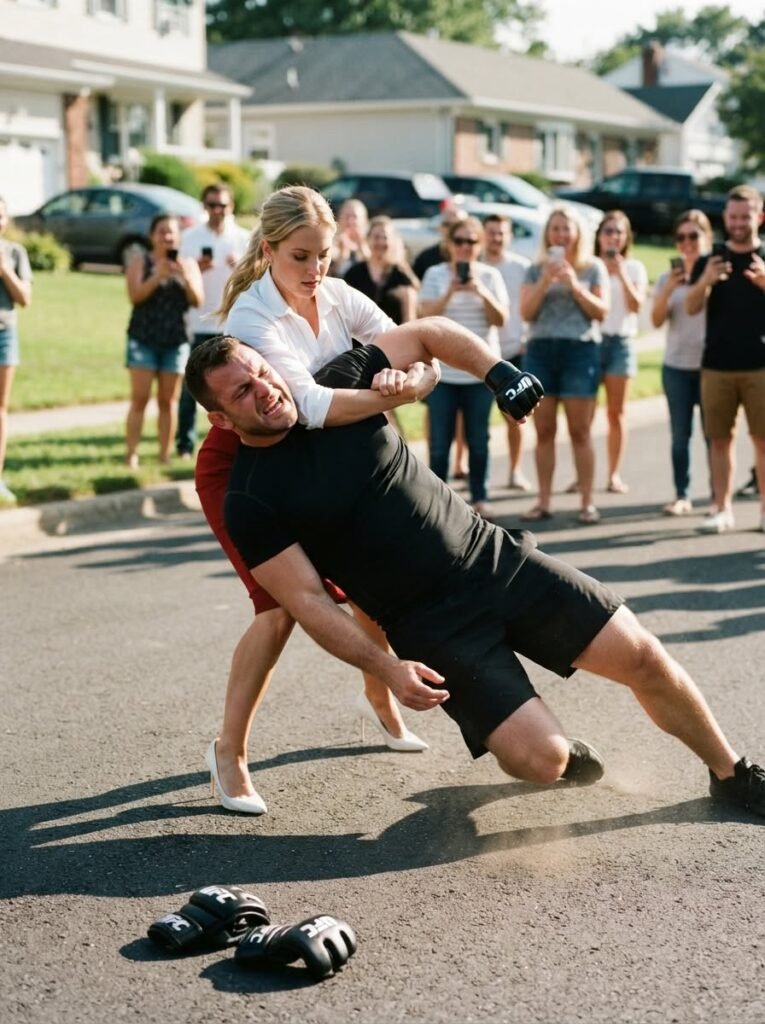
It was the video.
The original confrontation.
Logan throwing the gloves.
Me refusing.
The shove.
The punches.
The takedown.
Someone had uploaded it.
Views:
18.7 million.
Logan stared.
“Oh no.”
I closed my eyes.
The peaceful anonymous life I had wanted was officially dead.
Noah started laughing.
Nathan joined him.
Even Grant smiled.
I looked at all of them.
“Not one word.”
Nathan raised both hands.
“Yes, Colonel.”
For the first time in twelve years, hearing that title didn’t feel like a weight.
It felt like coming home.
But the greatest surprise was still waiting.
THE WOMAN AT THE END OF THE CUL-DE-SAC
Six months later, Juniper Hollow Drive looked ordinary again.
That was the miracle.
Grant sold most of his company and used the proceeds to fund legal restitution connected to the old contracting network.
He accepted a reduced sentence in exchange for testimony.
Logan changed too.
Not overnight.
Real change rarely happened overnight.
He returned to his gym.
Stopped filming every workout.
Started coaching teenagers.
And one afternoon, I watched him carry Mrs. Alvarez’s groceries without being asked.
She made him carry them back to her car because she had forgotten her coupons.
Humility came in strange forms.
Noah never stopped teasing me about the video.
Neither did the internet.
People gave me nicknames I hated.
The Cul-de-Sac Colonel.
Ranger Mom.
The Blue House Assassin.
I hated that one most.
Nathan loved all of them.
Because Nathan stayed.
That was the part nobody could have predicted.
He bought a small cabin fifteen minutes away and spent three months repairing everything badly.
I eventually started fixing the things he fixed.
One evening, we sat on my porch while Noah and Logan argued over a basketball game across the street.
Nathan drank terrible coffee.
Some things survived twelve years.
“You ever think about leaving?” he asked.
“Silver Creek?”
“The Army.”
I looked toward the mountains.
I had spent twenty-three years serving.
For most of my life, the uniform had been the clearest answer to the question of who I was.
But lately, another answer had begun to feel possible.
“I think I’m ready.”
Nathan nodded.
“For peace?”
“No.”
He looked at me.
I smiled.
“For something I choose.”
Three months later, I retired.
The ceremony was small.
No cameras.
No speeches from politicians.
No dramatic music.
Noah stood beside me.
Nathan stood behind him.
Sergeant Mercer came.
Mrs. Alvarez brought too much food.
Even Logan attended wearing a suit that clearly made him miserable.
Grant appeared by video from federal custody.
At the end, Noah handed me the folded flag.
Not from a coffin.
From my career.
I held it against my chest.
And cried.
I had thought retirement would feel like losing something.
Instead, it felt like setting down a pack I had forgotten I was carrying.
Afterward, Nathan found me alone near the edge of the parade field.
“You okay?”
“Yes.”
“You sure?”
“No.”
He smiled.
“Better answer.”
I looked at him.
“Twelve years ago, I thought I left you behind.”
“You didn’t.”
“I did.”
“No.”
He stepped closer.
“You came back.”
“We couldn’t find you.”
“That’s not what I mean.”
I frowned.
Nathan touched the scar on his face.
“There were nights I stayed alive because I knew you would keep looking until someone forced you to stop.”
My throat tightened.
“You never told me that.”
“I’ve been dead. My communication skills are rusty.”
I laughed.
Then he became serious.
“Claire, you didn’t leave me behind.”
He took my hand.
“You carried me for twelve years.”
That broke something in me.
Something old.
Something hard.
Something I had mistaken for strength because I had carried it for so long.
I kissed him.
It wasn’t dramatic.
No fireworks.
No cheering crowd.
Just two people who had lost twelve years discovering they still had time.
Behind us, Noah shouted:
“FINALLY!”
I jumped away.
Nathan laughed.
Logan yelled from across the lawn.
“I had twenty bucks on Thanksgiving!”
Mrs. Alvarez shouted, “I had Christmas!”
I stared at all of them.
“You were betting?”
Noah grinned.
“Whole neighborhood.”
I looked at Nathan.
He shrugged.
“I had Friday.”
I punched his shoulder.
He pretended it hurt.
And that was how the woman who had moved to Silver Creek searching for silence finally found something better.
Not silence.
Life.
Messy.
Loud.
Unexpected.
Grant had believed power meant controlling the story.
Logan had believed strength meant making people fear you.
Vance had believed command meant everyone beneath him belonged to him.
They had all been wrong.
Power was surviving what was meant to destroy you.
Strength was knowing when not to strike.
And command?
Command was never about forcing people to follow.
It was about becoming someone they trusted enough to stand beside.
A year after the fight, I stood in my driveway at sunrise with a coffee mug in my hand.
The neighborhood was waking.
Mrs. Alvarez was arguing with her sprinkler.
Logan was jogging without filming himself.
Noah was late for school.
Nathan was under my truck claiming he knew how to fix the transmission.
He did not.
I looked toward the exact place where Logan’s gloves had landed.
The concrete was ordinary.
No mark remained.
It amazed me that something so small had opened the door to everything we had buried.
A challenge.
A shove.
A camera.
A dead man.
A traitor.
A son in danger.
A truth twelve years late.
And somehow, after all of it, I had gotten the one thing I came to Silver Creek searching for.
Not peace.
Something better.
A home.
Nathan rolled out from beneath the truck.
“I fixed it.”
Oil dripped onto his shirt.
I raised an eyebrow.
“You disconnected the battery.”
He looked underneath.
“Oh.”
Noah burst through the front door.
“Mom! We’re late!”
I sighed.
Nathan smiled.
Mrs. Alvarez shouted from across the street.
“Colonel! Your dead boyfriend broke your truck again!”
Nathan stared at her.
“Can we please stop calling me that?”
“No!” three neighbors shouted at once.
I laughed so hard I nearly spilled my coffee.
And standing there beneath the Colorado morning sun, surrounded by people who knew exactly who I was and chose to stay anyway, I finally understood something.
For most of my life, I had believed survival meant walking away from the battlefield.
I had been wrong.
Sometimes survival meant discovering that the battlefield was over.
Sometimes it meant letting people know you.
Sometimes it meant forgiving without forgetting.
Sometimes it meant opening the door.
And sometimes the greatest victory was not defeating an enemy.
It was realizing you no longer needed one.
I looked at Noah.
At Nathan.
At the ridiculous blue house I had once chosen because I wanted to disappear.
Then I looked down Juniper Hollow Drive.
The street where everyone had once watched a wealthy young fighter throw his gloves at the feet of a quiet single mother.
They thought they were about to witness her humiliation.
Instead, they had witnessed the first moment of her life beginning again.
I raised my coffee.
“Come on,” I said. “We’re late.”
Noah ran toward the truck.
Nathan followed.
I stopped him.
“You’re not driving.”
“I fixed it.”
“You broke it.”
“Those are technically related skills.”
I opened the driver’s door.
Nathan climbed into the passenger seat.
Noah jumped into the back.
And as the old pickup rolled out of the cul-de-sac, the dented tailgate rattling behind us, I caught one last glimpse of the blue house in the mirror.
For the first time since I moved there, I didn’t see a hiding place.