The Porch on Third Street
3:40
The school bus squeals to a stop at the corner of Third Street every afternoon at 3:40.
I can hear it coming from two blocks away. The brakes are bad. The driver, a cheerful woman named Bev, has been asking the school district to fix them since August. Every day, I hear that squeal and something in my chest lifts like a kite.
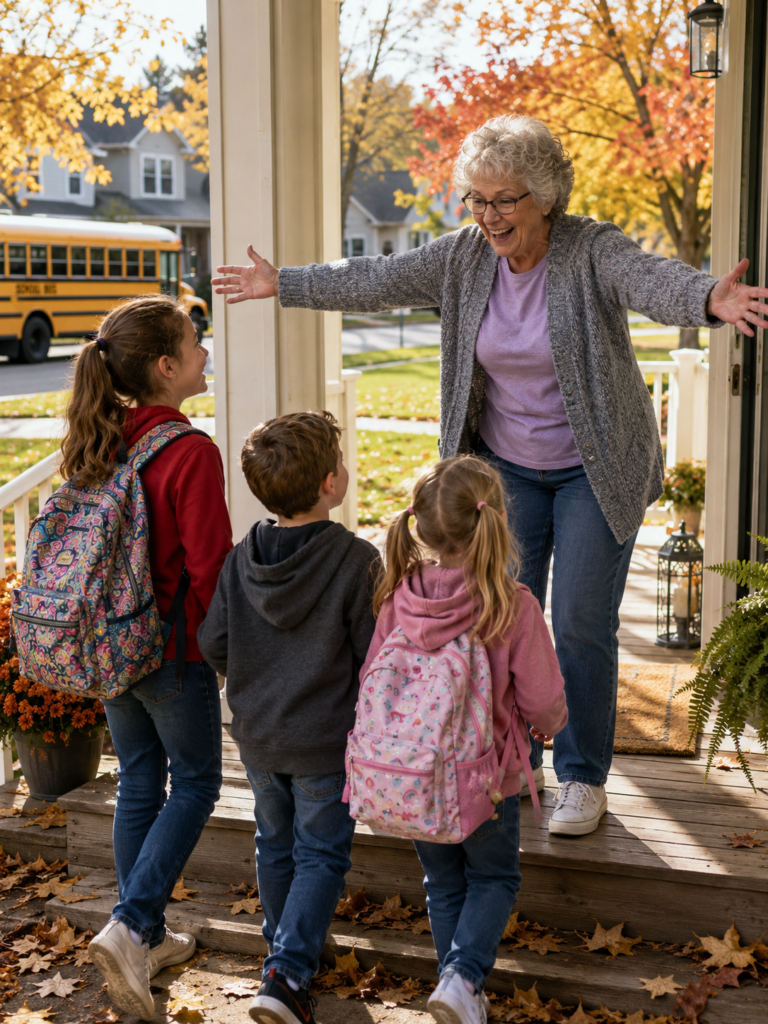
I’m usually already standing at the top of my porch steps by then. I’ve learned to time it.
Lily is always first off.
She’s ten now, with her mother’s long brown hair and her mother’s serious eyes. She carries her backpack on one shoulder because that’s how the fifth graders do it. She jumps the last step of the bus every single time.
Owen is next, in his ball cap. He’s eight. The cap is a faded red Cincinnati Reds hat that used to belong to his mother. It’s two sizes too big, and he wears it every day anyway.
Gracie comes last. She’s six, with blonde pigtails that bounce when she walks and a pink backpack as bright as bubblegum. She waves to Bev before she climbs down. Bev always waves back.
I wait at the top of my porch steps in my red cardigan with my arms open.
They come running up the cracked sidewalk, past the maple tree and the crooked mailbox. Lily hugs me first, quick and tight. Owen hugs me second and pretends he’s too old for it. Gracie hugs me last and longest, her face pressed into my cardigan.
“Hi, Grandma Roxie,” she always says. “I missed you all day.”
“I missed you more,” I always say.
It’s the best four seconds of my day.
Kelsey
Three years ago, my daughter, Kelsey, died of a brain aneurysm.
She was thirty-one.
It happened on a Tuesday in March. She’d dropped the kids at day care and gone to work at the bank in Shelbyville, Indiana, where she was a loan officer. Around ten o’clock, she told a coworker she had the worst headache of her life.
By noon, she was in an ambulance. By two o’clock, she was gone.
I was on my mail route when Nick called.
I’d been a rural mail carrier for the post office for twenty-six years. Same route the whole time. A hundred and twelve miles of county roads, farmhouses, and trailer parks south of town. I knew every dog, every mailbox, every widow who waited at the end of her driveway just to have someone to say good morning to.
When my phone rang, I was pulled over at the Hendricks farm, sorting their seed catalogs.
I don’t remember driving to the hospital. I only remember Nick standing in the hallway with his hands over his face.
She left three babies.
Lily was seven. Owen was five. Gracie was three and still sleeping with a stuffed lamb named Biscuit.
She left a husband who was drowning.
Nick Brennan was thirty-three then. He was a good man. He worked as a supervisor at a tire distribution warehouse off the interstate. He’d loved Kelsey since they were juniors in high school. He was the kind of father who did bath time and read bedtime stories in silly voices.
But in the weeks after the funeral, he couldn’t get out of bed. He couldn’t eat. He’d stand in the kitchen staring at the coffee maker like he’d forgotten what it was for.
The kids were eating cereal for dinner. Gracie was crying for her mommy every night. Lily had stopped talking at school.
I was fifty-seven years old.
I’d been divorced for twenty years. Kelsey was my only child. I lived alone in a small brick house on the edge of town with a vegetable garden and a cat named Mister.
One night, about a month after the funeral, I sat in Nick’s kitchen after the kids were asleep. He was at the table with his head in his hands.
“I can’t do this, Roxanne,” he said. “I can’t do it alone. I don’t know how.”
“You won’t have to,” I said.
I retired early.
The post office gave me a little party in the break room with a sheet cake from Kroger. The other carriers signed a card. My supervisor said he’d never had anyone cover a route as well as I did.
I sold my little house for ninety thousand dollars. I gave Mister to my neighbor, who’d always loved him.
And I moved into Nick’s spare room, in the house on Maple Ridge Drive where Kelsey had lived for nine years.
The Money
Nick’s house had a mortgage. Kelsey’s income had covered half of it. Without her paycheck, Nick couldn’t keep up.
The bank started sending letters. Nick hid them in a drawer. I found them while looking for scissors.
“Nick,” I said, holding them up. “Why didn’t you tell me?”
He wouldn’t look at me.
“Because I didn’t want you to think I was failing them,” he said. “Kelsey would’ve known what to do.”
I put fifty-two thousand dollars of the house money on his mortgage.
I did it the next week. I went to the bank in Shelbyville, the same bank where Kelsey had worked. Her coworkers hugged me at the counter. One of them cried while she processed the payment.
It brought the mortgage current and paid down enough principal that Nick’s payments dropped by almost four hundred dollars a month.
The kids could stay in the only home they knew. Their mother’s home. The house with her handprints in the concrete on the back patio and her height marks on the pantry doorframe.
The rest of the money went to everything else.
Groceries. Shoes, because children grow out of shoes every five minutes. School pictures. Field trips. The dentist, when Owen chipped his front tooth on the monkey bars. A new mattress for Lily, who’d been sleeping on one with a broken spring. Gracie’s speech therapy when she started stuttering after the funeral.
By the end of the second year, there was almost nothing left.
There was never any paper.
Nick didn’t ask me to sign anything. I didn’t ask him to sign anything either. It never occurred to me.
It was family. It was my daughter’s house and my daughter’s children. You don’t write up a contract for that.
And even if I’d thought about it, I knew one thing for certain. Dragging my daughter’s husband into court would have cost me the only pieces of her I had left.
Those three kids.
The Years in Between
I packed lunches every morning.
Turkey and cheese for Lily, cut into triangles. Peanut butter and honey for Owen, crusts off. Gracie wanted something different every day, and I learned to keep track.
I drove them to school. I went to every parent-teacher conference, because Nick couldn’t get off work. I sat in the bleachers at Owen’s T-ball games and cheered louder than any of the parents.
I sat up with Owen through the croup when he was six.
He woke up at two in the morning barking like a seal and struggling to breathe. I carried him into the bathroom, turned the shower on as hot as it would go, and sat on the closed toilet holding him in the steam. Then I wrapped him in a blanket and took him out to the back porch into the cold January air, the way my own mother taught me.
He fell asleep on my shoulder around four. I didn’t move until the sun came up.
I learned every word of every song Gracie loved.
Songs from cartoons. Songs from a movie about a frozen princess that I watched, by my best guess, three hundred times. Songs she made up herself in the bathtub about her stuffed lamb and the moon.
I can still sing all of them. I probably always will.
I braided Lily’s hair every morning, the way Kelsey used to. French braids on school days, a ponytail on weekends. It took me months to get as good as her mother.
One morning, about a year after the funeral, Lily looked at me in the bathroom mirror while I braided.
“You do it the same,” she said quietly. “Like Mommy.”
I had to stop for a minute. She didn’t say anything else. She just waited.
Nick worked overtime. As much as they’d give him. He came home at seven or eight most nights, ate whatever I’d saved on a plate in the oven, and went to bed.
Some nights, I heard him in the garage.
He’d go out there after the kids were asleep and sit in Kelsey’s car. Her little blue Honda, which he couldn’t bring himself to sell. I could hear him through the kitchen wall. Crying. Deep, terrible sobs, like something was being pulled out of him.
I never said anything about it. I never told him I could hear.
I never held it against him. Not once. Grief doesn’t have a schedule. Grief doesn’t care if you have three children who need dinner.
There were good days too. I want you to know that.
The Christmas Gracie gave everyone a rock she’d painted herself. The summer we drove to Lake Monroe and Owen caught his first fish and cried because he felt sorry for it. The birthday when Lily turned nine and asked for a cookbook so she could make her mother’s chocolate chip cookies.
We made them together. They didn’t taste exactly like Kelsey’s. But they were close.
Ashley
Last winter, Nick met Ashley.
She was thirty, a receptionist at a dental office in Greensburg. She was soft-spoken, with light brown hair and big gray eyes. She’d grown up in a small town about an hour south.
Nick met her at a grief support group at the Methodist church. Her mother had died a year earlier. They sat next to each other three weeks in a row before he worked up the nerve to ask her to coffee.
He brought her to the house for dinner in February.
She was nervous. She brought a pan of brownies and apologized for them before anyone had tasted them. She asked the kids about their favorite subjects at school. She laughed at Owen’s knock-knock jokes, even the bad ones.
She was good with the kids. Gracie climbed into her lap by the end of the evening.
I liked her. I really did.
After she left, I found Nick in the kitchen washing dishes.
“She’s lovely,” I said.
He stopped washing. His shoulders relaxed a little.
“You think so?”
“I do,” I said. “Kelsey would have liked her.”
He didn’t say anything for a long time. Then he turned around and hugged me. He’d never done that before.
“Thank you, Roxanne,” he said.
They married in June.
A small ceremony in the backyard of her aunt’s house. Fifty guests. A string of lights across the patio. Lily was a junior bridesmaid in a lavender dress. Owen carried the rings on a little pillow. Gracie threw rose petals so hard that half of them hit the minister.
I sat in the second row. I cried a little. Not from sadness. From something more complicated.
I was happy for Nick. Truly. He’d been drowning for two and a half years, and now somebody had thrown him a rope.
But my daughter’s husband was marrying someone else. And somewhere inside me, a small, quiet voice whispered, What happens to me now?
Rent
Two weeks after the wedding, Nick sat down across the kitchen table from me.
It was a Sunday evening. The kids were in the backyard catching fireflies. Ashley was upstairs unpacking boxes. I’d made pot roast, and the dishes were still in the sink.
Nick folded his hands on the table. He looked at them, not at me.
“Roxanne,” he said. “I think it’s time you got your own place.”
I didn’t say anything for a moment.
I’d known it was coming. Of course I had. A newly married couple doesn’t want their dead wife’s mother living in the spare room. I’d been preparing myself for weeks.
Still, it hit me like cold water.
“All right,” I said quietly. “I understand.”
He seemed relieved. He started talking faster.
“It’s just that Ashley and I need to build our own family,” he said. “The kids need to see her as their mom now. It’s hard for them to do that with you here. With you being, you know, Kelsey’s mom.”
“I understand,” I said again.
Then I asked him the question I’d been afraid to ask.
“Nick,” I said quietly. “What about the house money?”
He didn’t look up.
“The fifty-two thousand,” I said. “That I put on the mortgage. I don’t need all of it back at once. But I’m going to need first and last month’s rent for an apartment. And I don’t have much left.”
He was quiet for a long time. He kept looking at his hands.
Then he said it.
“That was rent,” he said. “You lived here almost three years. That covers it.”
Rent.
For raising his children.
For the croup and the braids and the parent-teacher conferences. For three hundred viewings of a movie about a frozen princess. For every lunch and every bath and every night I lay awake listening to him cry in the garage.
Rent.
I didn’t argue.
I didn’t raise my voice. I’ve never been good at raising my voice. Twenty-six years of delivering mail teaches you to keep your head down and keep moving.
“All right,” I said. “I’ll start looking tomorrow.”
I got up from the table. I washed the dishes. I dried them and put them away. Then I went upstairs to my room and closed the door.
I didn’t cry until I was alone.
I sat on the edge of the narrow bed in the spare room and pressed a pillow over my face so the children wouldn’t hear me. I cried for Kelsey. I cried for my little brick house and Mister the cat. I cried for twenty-six years on the same mail route that I’d given up without a second thought.
And I cried because I knew Nick wasn’t cruel.
He wasn’t cruel by nature. I’d lived with him for almost three years. I’d seen him cry. I’d seen him tuck Gracie in and kiss Lily’s forehead and teach Owen how to throw a curveball.
He was grieving. He wanted a fresh start. He wanted his children to see Ashley as their mother.
And with me in the house, Kelsey was still in every room. In every braid and every lunch box and every lullaby.
I understood that.
I just didn’t know why it had to cost me everything.
Third Street
I found a little rental on Third Street for six hundred and fifty dollars a month.
It was the smallest house on the block. One bedroom, one bathroom, a kitchen barely big enough to turn around in. The roof needed work. The porch steps were cracked. The landlord, an old farmer named Mr. Dietrich, told me he’d fix the porch “eventually,” which I understood to mean never.
I picked it for one reason.
The school bus stops at the corner.
Nick and Ashley both worked until after five. Nick’s shift ended at five-thirty. Ashley’s dental office closed at five, and she had a forty-minute drive home from Greensburg.
The kids got off the bus at 3:40. That left two hours with nobody home.
Nick had been talking about putting them in an after-school program at the YMCA. It cost three hundred dollars a month. He didn’t have three hundred dollars a month.
I called him the day I signed the lease.
“Nick,” I said. “My new place is on Third Street. The bus stops at the corner. If you want, the kids can come to my porch after school. I’ll give them a snack and help with homework. You can pick them up when you get off work.”
There was a long pause on the line.
“You’d do that?” he said.
“Of course I would,” I said.
“I can’t pay you,” he said quietly.
“I’m not asking you to,” I said.
Nick signed the bus form the next week. After-school drop-off location: 412 Third Street. Contact: Roxanne Miller (grandmother).
The Porch
So every school day at 3:40, they come up my steps.
Homework at my kitchen table, which is too small for three kids, so Gracie sits on the counter. Apple slices and peanut butter. Sometimes cookies, if I’ve been baking. Sometimes grilled cheese, if somebody had a bad day.
Lily does her math first. She’s good at it, like her mother was. Kelsey used to say numbers made sense when people didn’t.
Owen reads out loud to me. He’s in second grade and struggling a little, and his teacher says reading aloud every day helps. We read books about sharks and volcanoes and a boy who turns into a dog. When he gets stuck on a word, I don’t tell him. I wait. He usually figures it out.
Gracie draws. She draws all of us. Me in my red cardigan. Lily with her braid. Owen in his ball cap. Herself with pigtails so big they go off the edge of the paper.
She never draws Ashley. I noticed that. I didn’t say anything.
Nick picks them up at 5:45.
He pulls up in front of the house and honks once. He never comes inside. He never gets out of the truck.
He waves through the windshield. I wave back. The kids pile into the back seat. Gracie always presses her face against the window and blows me a kiss until they turn the corner.
Ashley never came at all.
Not once. Not for three months. Not to drop off a forgotten lunch box or pick up a sick kid or say hello.
I figured she’d been told what kind of woman I was. That I was the clingy mother-in-law who wouldn’t let go. That I’d taken advantage of Nick’s grief. That I’d overstayed my welcome by almost three years.
I didn’t blame her. If I’d been her, I might have stayed away too.
October
Then one afternoon in October, the maples on Third Street went orange all at once.
It happens like that sometimes in Indiana. One day the trees are green, and the next morning you wake up and the whole street is on fire. Orange and red and gold. The leaves drift down onto the sidewalks and the cars and the porch steps.
I was standing at the top of my steps in my red cardigan when I heard the bus squeal around the corner.
The bus pulled away from the corner.
Lily was first off, like always. She jumped the last step. She came up the sidewalk through the falling leaves.
But she didn’t run to me.
She stopped on the top step. She slid her backpack off her shoulder.
“Ashley sent something,” she said.
Behind her, Owen and Gracie had stopped on the sidewalk. They were very quiet. Owen had his hands in his pockets. Gracie was holding his sleeve.
They looked like children carrying a secret they weren’t sure they were allowed to keep.
Lily unzipped the front pocket of her backpack.
“She said to give it to you before we did anything else,” Lily said. “Before homework. Before snack. Before anything.”
She pulled something out.
“She said you’d know what it was.”
It was a small tin box.
Red, faded almost to pink. About the size of a paperback book. The lid had a picture of a rooster on it, scratched and worn. One corner was dented.
I knew exactly what it was.
It was my mother’s recipe box.
My mother kept it on her kitchen counter in our farmhouse for forty years. It was full of index cards in her handwriting, stained with butter and flour and vanilla. Her chicken and dumplings. Her sour cream coffee cake. Her persimmon pudding.
When my mother died, the box came to me. I kept it on my counter for twenty years.
When Kelsey got married, I gave it to her.
“Grandma?” Lily said. “Are you okay?”
I realized I’d sat down on the top step. I didn’t remember doing it.
“Where did Ashley find this?” I asked.
“In the pantry,” Lily said. “On the top shelf. Behind the paper towels.”
She hesitated.
“She’s been cleaning out the house,” she said. “To make it hers.”
I held the box in my lap.
I’d looked for it after the funeral. I’d searched every cabinet in that kitchen. I assumed Nick had packed it away somewhere with Kelsey’s things, in a box in the attic he couldn’t bear to open.
“She said to look inside,” Owen said quietly from the sidewalk. “Under the cards. At the bottom.”
What Was Inside
I opened the lid.
The smell came out first. Butter and vanilla and something older, like my mother’s kitchen on a Sunday morning. I had to close my eyes for a second.
The cards were all there. My mother’s handwriting. My handwriting. And newer cards, in Kelsey’s neat, careful print. Kelsey’s chocolate chip cookies. Owen’s favorite mac and cheese. Gracie’s birthday pancakes (shaped like stars!).
I lifted the cards out carefully. At the bottom of the tin was an envelope.
It was a plain white envelope, a little yellowed. On the front, in Kelsey’s handwriting, it said:
For Mom and Nick. Just in case.
The envelope had been opened. Carefully, along the top, with a letter opener.
Tucked behind it was a second envelope. This one was newer, bright white. On the front, in handwriting I didn’t recognize, it said:
Roxanne.
I opened Kelsey’s envelope first.
My hands were shaking. Lily sat down on the step beside me. Owen and Gracie came up the steps and sat below us. Nobody said anything.
Inside was a single sheet of paper. Folded in thirds. Kelsey’s handwriting.
At the top was a date. Four years ago. Six weeks after Gracie was born.
Mom and Nick,
I know this is silly. I’m writing it at 3 a.m. while Gracie is nursing, and I’m so tired I might be losing my mind. But I had a bad dream tonight that something happened to me, and I couldn’t stop thinking about it. So I’m writing it down, and then I’m going to hide it in Grandma’s recipe box, and probably nobody will ever read it.
If anything ever happens to me:
Nick, please let Mom help you. I know you. You’ll try to do everything yourself and you’ll fall apart. Let her in. She raised me alone and she’s the strongest person I know.
Mom, please don’t let Nick do it alone. And please teach Lily to braid her own hair someday, because you’re the only one who does it right. And sing Gracie the song about the moon. And make Owen read every day, because he’s going to hate it.
I had to stop reading. I couldn’t see.
Lily took the letter gently out of my hands.
“Can I read the rest?” she asked. “Out loud?”
I nodded.
Lily read in her clear, serious voice. Her mother’s voice.
“And Nick, this part is important,” she read. “If Mom ever helps us, with money or with the kids or with anything, you take care of her back. She will never ask you for anything. She will give you everything she has and never say a word. That’s how she is. So you have to be the one to remember.”
Lily swallowed.
“Mom is not a guest in our house,” she read. “She’s family. She’ll always be family. Even if someday you love someone else. And I hope you do. I hope you find someone wonderful. But promise me Mom always has a place at our table.”
“I love you both. Now I’m going back to sleep. Gracie’s done eating and she’s staring at me like I’m crazy.”
Lily looked up.
“Love, Kels,” she read.
Nobody spoke for a long time.
The maple leaves kept falling around us. Orange and red and gold. One landed in Gracie’s pigtail. She didn’t notice.
Owen wiped his nose on his sleeve. Lily folded the letter very carefully and handed it back to me.
Then Gracie reached into the tin and pulled out the second envelope.
“This one’s from Ashley,” she said. “She said to read this one second.”
Ashley’s Letter
The second envelope had a single folded page inside. The handwriting was neat and a little slanted.
Roxanne,
I found Kelsey’s letter on Saturday while I was cleaning out the pantry. I sat on the kitchen floor and read it four times. I’m sorry I opened it. I didn’t know what it was until I’d already started reading.
I need to tell you some things. I’m not good at saying hard things out loud, so I’m writing them down. I hope that’s okay.
When Nick and I got engaged, he told me you wanted to move out. He said you’d been talking about getting your own place for a long time, and that you were tired of being a live-in babysitter. He said you’d been staying out of obligation, and that you’d be relieved once we were married.
I believed him. I’m sorry. I didn’t know you well enough to know it wasn’t true.
He also told me that you’d been living rent-free for three years. That you’d moved in with nothing and he’d been supporting you.
I didn’t know about the house money until last week.
I was looking for a bill in the desk drawer and found the bank statement from three years ago. The payment from your account. $52,000. The day after Kelsey’s funeral.
I asked Nick about it. He got very quiet. Then he told me the truth.
He said he couldn’t pay you back. He said every time he looked at that number, he felt like he’d failed Kelsey and failed the kids and failed you. He said calling it rent was the only way he could make it stop feeling like a debt he’d never be able to pay.
He cried, Roxanne. I’ve never seen him cry like that. He said he’d been ashamed of it for three years.
I’m writing you this because I need you to know something.
I don’t want to replace Kelsey. I could never do that, and I wouldn’t want to. Those children had a mother who loved them so much she wrote this letter at 3 a.m. while nursing a baby.
I want to be added. Not to replace anyone. Just added.
And I need you to know something about me.
My mother died when I was nine. My dad remarried when I was eleven. My stepmother didn’t like my grandmother, my mom’s mom. She said Grandma Joyce was a bad influence and kept my mother’s memory too alive in the house.
So my dad stopped taking us to see her. Bit by bit. First it was every week. Then every month. Then only on holidays. Then not at all.
Grandma Joyce died when I was fifteen. I hadn’t seen her in two years. I didn’t get to say goodbye.
I’ve spent my whole life angry about that. And when I found Kelsey’s letter, I realized I was about to let the same thing happen to Lily and Owen and Gracie.
I’m not going to do that.
There’s one more thing in the box. Look under the bottom card.
Ashley
I lifted the last index card out of the tin. It was my mother’s recipe for persimmon pudding, the one with the grease spot shaped like a heart.
Under it, taped to the bottom of the tin, was a key.
It was a house key. Brass. On a little ring with a plastic tag.
I knew it. I’d carried it for almost three years.
It was my key to the house on Maple Ridge Drive. The one I’d left on the kitchen counter the day I moved out.
On the plastic tag, in fresh marker, someone had written:
Grandma Roxie. Always.
Five O’Clock
I didn’t do homework with the kids that afternoon.
I sat on the porch steps with the tin in my lap and the key in my hand. Lily sat on one side of me. Owen sat on the other. Gracie climbed into my lap and fell asleep against my red cardigan, her pigtails tickling my chin.
The leaves kept falling.
At 5:10, a small silver car pulled up in front of the house.
It wasn’t Nick’s truck. It was a Toyota with a dent in the back bumper and a dental office parking permit hanging from the rearview mirror.
Ashley got out.
She was still in her scrubs, light blue with little cartoon teeth on them. Her hair was pulled back. Her eyes were red, like she’d been crying in the car.
She stood on the sidewalk for a long moment, looking at me on the porch with the kids.
Then she walked up the steps.
“I left work early,” she said. “I didn’t know if—I wanted to make sure you got it. And I wanted to say it in person. Not just in a letter.”
She stopped on the step below me.
“I’m sorry, Roxanne,” she said. “For staying away. For believing what I was told. For letting you sit on this porch alone every day for three months while I never once came by.”
I looked up at her.
At this young woman in cartoon-teeth scrubs who’d found my daughter’s letter on a pantry floor and read it four times. Who’d lost her own grandmother because nobody stood up for her.
Who’d decided not to let it happen again.
“Ashley,” I said. “Would you like to sit down?”
She sat on the step below us. Owen scooted over to make room. Gracie woke up for a second, saw her, and mumbled, “Hi, Ashley,” before falling back asleep.
We sat there for a while without saying anything.
“Can I ask you something?” Ashley said finally.
“Of course.”
“Would you teach me the persimmon pudding?” she asked. “The one with the heart-shaped grease spot?”
I laughed. It came out wet and shaky.
“It’s a terrible recipe,” I said. “It takes all afternoon and half the time it doesn’t set.”
“I don’t care,” Ashley said. “I want to learn it. I want to learn all of them.”
Nick
Nick’s truck pulled up at 5:45, like always.
He honked once. Then he saw Ashley’s car parked in front of the house. He saw his wife sitting on my porch steps.
He sat in the truck for a long time.
Then he turned off the engine and got out.
He walked up the sidewalk slowly. Through the falling leaves. He stopped at the bottom of the steps.
He looked at the tin in my lap. At the key in my hand. At the letter in Lily’s hands.
His face crumpled.
“Roxanne,” he said. “I’m sorry.”
He didn’t say anything else for a long time. He just stood there at the bottom of my cracked porch steps with his hands at his sides.
“Nick,” I said gently. “Come up here.”
He climbed the steps. He sat down beside Ashley. She took his hand.
“I called it rent,” he said. “I called it rent because I couldn’t stand looking at that number. Fifty-two thousand dollars. Every time I thought about it, I thought, I’ll never be able to pay her back. So I just decided I didn’t owe it.”
He wiped his face.
“That’s not what Kelsey would have wanted,” he said. “She’d have been so ashamed of me.”
“She’d have understood,” I said.
He looked at me.
“She knew you, Nick,” I said. “She wrote it in the letter. You’ll try to do everything yourself and you’ll fall apart. She knew exactly who you were. She married you anyway.”
He laughed a little. It sounded like it hurt.
“She also wrote that I’d have to be the one to remember,” he said. “Because you’d never ask.”
“I didn’t ask,” I said.
“I know,” he said. “That’s what makes it worse.”
Lily spoke up from beside me.
“Dad,” she said. “Why did you never come inside? When you picked us up?”
Nick looked at his daughter.
“Because if I came inside,” he said quietly, “I’d have to see Grandma Roxie’s house. Her little kitchen. Her cracked steps. And I’d know I put her here.”
He looked at the porch.
“I didn’t want to see it,” he said. “So I just honked.”
What We Decided
We talked for a long time that evening.
The sun went down. The streetlights came on. I made grilled cheese sandwiches for everyone, all five of them, in my tiny kitchen. We ate them on the porch because there wasn’t room at the table.
Ashley and Nick had talked about it the night before, after she found the letter. They’d already decided some things.
Nick was going to pay back the fifty-two thousand dollars.
Not all at once. He couldn’t. But Ashley had looked at their budget. They could refinance the house now that both of them were working. With her income added, they could manage five hundred dollars a month.
“It’ll take about nine years,” Nick said. “I know that’s a long time.”
“I’m sixty,” I said. “I plan to be around for nine more years.”
“You’d better be,” Ashley said.
They asked me to move back into the house.
I said no.
I’d thought about it while I was making grilled cheese. And I realized I didn’t want to go back to the spare room on Maple Ridge Drive. Not because I was angry. Because I’d spent three years living in my dead daughter’s house, in her life, in her kitchen. I loved every minute of it. But it was her house.
And now it was Ashley’s.
“I like my porch,” I said. “I like my bus stop. I like having a place that’s mine.”
Nick looked like he wanted to argue. Ashley put her hand on his arm.
“Then we’ll help with the rent,” Ashley said. “Out of the five hundred. And we’ll fix the porch steps. And the roof.”
“Mr. Dietrich says he’ll fix them eventually,” I said.
“Mr. Dietrich is ninety-one,” Nick said. “I’ll fix them Saturday.”
Then Ashley said something else.
“Sunday dinners,” she said. “At our house. Every Sunday. You cook with me. Teach me the recipes. All of them. I want the kids to grow up eating Kelsey’s chocolate chip cookies and your mother’s persimmon pudding.”
She looked at me.
“And I want them to grow up knowing their grandmother is family,” she said. “Not a guest. Not a babysitter. Family.”
I couldn’t speak. I just nodded.
Gracie, who’d been listening from my lap, sat up.
“Does that mean we still get to come to the porch after school?” she asked.
“Every day,” I said.
“Even when Ashley’s home?”
Ashley laughed.
“Especially when I’m home,” she said. “Maybe I’ll come too.”
Saturday
Nick fixed the porch steps on Saturday.
He came at seven in the morning with lumber and tools in the back of his truck. Owen came with him, wearing his mother’s Reds cap and a pair of safety goggles that were much too big.
They pulled up the cracked old steps and built new ones out of pressure-treated pine. Nick showed Owen how to measure twice and cut once. Owen hammered most of the nails crooked. Nick let him.
By noon, the steps were done.
Nick stood on the sidewalk and looked at them. Then he went back to his truck and came back with a small brass plate and a screwdriver.
He knelt down and screwed it onto the top step.
When he stood up, I bent down to read it.
Grandma Roxie’s Porch. Bus stop 3:40. Everyone welcome.
I looked at him.
“It was Lily’s idea,” he said. “She picked the words. Gracie wanted it to say Grandma Roxie’s Castle, but we compromised.”
I laughed. Then I hugged him.
He hugged me back, tight, the way he had the night Kelsey died.
“Thank you, Roxanne,” he said. “For everything. For all of it. I should have said it three years ago.”
“You’re saying it now,” I said.
Sunday Dinner
The first Sunday dinner was a disaster.
Ashley and I tried to make my mother’s persimmon pudding. We spent four hours on it. It didn’t set. It came out of the oven looking like brown soup.
We stood in the kitchen on Maple Ridge Drive staring at it.
“I told you,” I said. “Half the time it doesn’t set.”
Ashley started laughing. Then I started laughing. We laughed so hard we had to hold on to the counter.
We served it anyway. In bowls, with spoons. Nick said it was the best brown soup he’d ever eaten. Owen asked for seconds. Gracie put whipped cream on hers and declared it a milkshake.
Lily ate hers slowly, at the end of the table. When she was done, she looked up at me.
“It tastes like the cards smell,” she said.
After dinner, I stood at the sink washing dishes. Ashley dried.
Through the kitchen window, I could see the backyard. The swing set. The patio with Kelsey’s handprints in the concrete. Nick was out there with the kids, chasing them in circles in the dark with a flashlight.
“Roxanne,” Ashley said quietly. “Can I ask you something?”
“Of course.”
“Do you think Kelsey would be okay with me?” she asked. “With me being here? In her house? With her kids?”
I dried my hands on a towel.
I went to the counter, where the red tin recipe box sat in its old spot by the backsplash. Ashley had put it back there that afternoon, right where Kelsey used to keep it.
I opened it. I took out Kelsey’s letter. I unfolded it and pointed to one line.
I hope you find someone wonderful.
“She already told you,” I said.
Ashley read the line twice. Then she put her hand over her mouth and started crying.
I hugged her. She hugged me back, hard, like a child.
“I’m so glad it’s you,” I whispered.
Spring
It’s April now.
The maples on Third Street are bare and starting to bud. The school bus still squeals around the corner at 3:40. The school district still hasn’t fixed the brakes. Bev says she’s given up asking.
I’m still standing at the top of my porch steps in my red cardigan with my arms open.
The new steps don’t creak anymore. The brass plate shines in the afternoon sun.
Lily is first off the bus. She’s eleven now. She braids her own hair, French braids every school day. She does it exactly right. Exactly like her mother.
Owen is next, in his mother’s ball cap. It fits a little better now. He’s reading two grades above his level. He reads to me every afternoon whether I ask or not, mostly books about sharks.
Gracie comes last, pigtails bouncing, pink backpack bright as bubblegum. She waves to Bev. Bev waves back.
But today, there’s someone else.
A silver Toyota with a dent in the back bumper pulls up in front of my house. Ashley gets out in her cartoon-teeth scrubs. She left work early again. She does that every Friday now.
She’s carrying a covered dish.
The kids run up the sidewalk. They hug me one at a time. Lily first, quick and tight. Owen second, pretending he’s too old. Gracie last and longest.
“Hi, Grandma Roxie,” she says. “I missed you all day.”
“I missed you more,” I say.
Then Ashley comes up the new steps. She hugs me too.
“I made it,” she says, holding up the dish. “All by myself. It set.”
She lifts the lid.
It’s my mother’s persimmon pudding. Dark and glossy and perfectly set. On top, she’s drawn a little heart in powdered sugar.
We take it inside to my tiny kitchen. There still isn’t room at the table for everyone. Gracie sits on the counter. Owen sits on the floor. Lily and Ashley share a chair.
We eat the pudding straight out of the dish with five spoons.
It tastes exactly like my mother’s. Exactly like Sunday mornings in the farmhouse. Exactly like the smell that comes out of a little red tin with a rooster on the lid.
Gracie looks up at me with pudding on her chin.
“Grandma,” she says. “Is this a family recipe?”
I look around my tiny kitchen. At my granddaughter on the counter. At my grandson on the floor. At Lily with her perfect braid. At Ashley, who found a letter on a pantry floor and decided not to let a grandmother disappear.
At the red tin on my windowsill, where I keep it now on weekdays. Ashley and I trade it back and forth. Sunday at her house. Monday through Friday at mine.
“Yes,” I tell Gracie. “It’s a family recipe.”
“Whose family?” she asks.
I think about my mother, with her hands in the flour. About Kelsey, writing a letter at three in the morning with a newborn in her arms. About Ashley, who lost her own grandmother and decided it would never happen again.
“Ours,” I say. “All of ours.”
Gracie nods seriously, like that settles it. Then she licks her spoon.
At 5:45, Nick’s truck pulls up in front of the house.
He doesn’t honk anymore.
He gets out, walks up the new steps, opens the screen door, and comes inside. He takes off his boots by the door. He kisses Ashley on the cheek and ruffles Owen’s hair.
Then he turns to me.
“Is there any pudding left?” he asks.
“There’s always a place at the table,” I tell him.
And there is.