My mother reached across the table for the worn photo album beside the birthday cake, pulled it toward herself, and told me there was something inside I needed to see before I decided what happened next.
For a second, I just stared at her hand resting on the cover.
Lily was still against my chest.
My six-year-old daughter felt heavier than she had twenty minutes earlier, not because she had changed, but because every part of me was suddenly aware of how small she was.
Her yellow unicorn dress was wrinkled where my arms held her. The glitter barrette was still clipped into her brown hair. One side of her face was swollen.
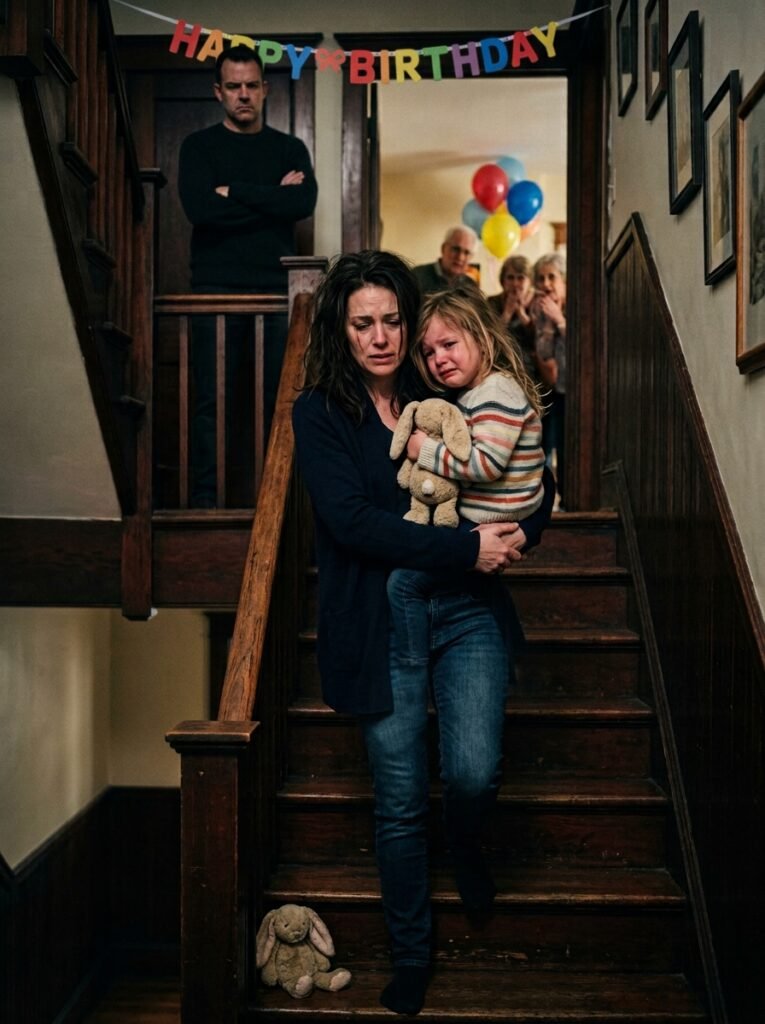
Behind us, the birthday decorations were still hanging as if this were an ordinary family afternoon.
Cake.
Balloons.
Champagne glasses.
A gold birthday banner.
Everything looked cheerful enough to belong in a photograph.
Nothing felt cheerful anymore.
People had spent the afternoon taking pictures of my niece Madison, admiring her cake, arranging balloons, and making sure the party looked perfect.
Now the people at the front door were focused on Lily.
My parents had spent years caring about appearances. Their house always looked prepared for visitors. Their front lawn was neat. Their parties were arranged so nobody could miss who was being celebrated and who mattered most.
That afternoon, Lily had been made to understand exactly where she stood.
I should have recognized it sooner.
When we arrived in my old SUV, my father looked past me toward the driveway and asked if the thing still ran.
He said it casually, with the same tone someone might use to comment on the weather.
I knew the tone.
It was how my parents insulted people while giving themselves enough room to claim they had only been joking.
My mother was no better.
She looked at Lily’s yellow unicorn dress and asked, “You let her wear that?”
Lily didn’t understand the full weight of the question.
She was six.
She only knew she had picked a dress she loved.
She had glitter in her hair and a stuffed rabbit she carried when she was tired. She had come to a birthday party expecting cake, family, and the kind of afternoon children assume adults will keep safe for them.
I understood my mother’s meaning.
I swallowed my answer anyway.
That had become a habit around my parents.
Ignore the comment.
Keep things moving.
Don’t turn a family gathering into an argument.
Tell yourself you can leave in another hour.
I had spent years doing versions of that because I wanted Lily to have grandparents.
I wanted family to mean more than the difficult parts of my own relationship with my parents.
I kept thinking there had to be a line they would never cross with a child.
That afternoon taught me how dangerous that assumption had been.
The party itself had made the hierarchy obvious.
Madison had the huge cake.
Madison had the balloons.
Madison had the photographer.
Madison had everyone’s attention.
Lily had a paper plate and a chair pushed close to the wall.
I noticed.
Of course I noticed.
But I kept making excuses for what I was seeing.
It was Madison’s birthday. Maybe everyone was distracted. Maybe my parents were being rude, but only rude. Maybe I could get Lily through the afternoon without making her feel the tension between adults.
That was what I told myself.
Then Lily got sleepy.
Her head began to dip the way it always did when she tried to fight a nap.
I picked her up and carried her upstairs to the guest room.
She still had her unicorn dress on. Her stuffed rabbit was under her arm. I left the door open after settling her down because I wanted to hear her when she woke.
Before I walked away, I kissed her forehead.
“I won’t let them start without me,” I promised.
It was such an ordinary thing to say.
I would remember it differently later.
Not because the words were important by themselves, but because I had spoken them while believing Lily was safe in my parents’ house.
Twenty minutes later, the guest room door was closed.
Before I saw that door, I heard something downstairs that changed the entire afternoon.
The champagne flutes made a light, delicate sound.
It should have belonged to a toast.
Then my father’s voice carried from the other room.
“Finally she’ll look as worthless as she is.”
The glasses touched.
My mother laughed.
There are moments when your mind tries to reject what your ears have already understood.
I knew he was talking about Lily.
I also knew, before I had any proof of what had happened upstairs, that I needed to get to her.
I ran.
The guest room door that I had deliberately left open was shut.
I pushed inside.
Lily was lying too still.
Her stuffed rabbit was pinned beneath her arm.
Her glitter barrette looked absurdly bright against the scene, a tiny piece of a normal birthday afternoon that no longer existed.
One side of her face was swollen.
“Lily. Baby, wake up.”
She didn’t answer me.
I didn’t go downstairs to demand an explanation first.
I didn’t give my parents an opportunity to tell me I had misunderstood.
I called 911.
My hands were shaking so badly that holding the phone felt like a task I had to concentrate on.
I answered the questions I was asked.
Age.
Condition.
Location.
What I knew.
What I didn’t know.
“She’s six,” I kept saying.
Then again, because six suddenly seemed like the most important fact in the world.
“Please. She’s only six.”
I lifted her carefully and carried her downstairs.
The party was still there waiting for us.
That detail bothered me almost as much as anything.
The birthday cake hadn’t changed.
The balloons hadn’t changed.
The champagne glasses hadn’t changed.
The adults had.
Or maybe I had finally stopped pretending I didn’t know who they were.
I stood there holding Lily and looked at the people who had been close enough to hear my mother laugh.
Some of them looked uncomfortable.
Some looked at Lily.
Some looked anywhere that allowed them to avoid looking directly at me.
I didn’t need a speech.
“They did this,” I said. “They hurt her while she was sleeping.”
My father denied it.
He didn’t respond like a grandfather seeing his six-year-old granddaughter injured.
He responded like a man being accused.
My mother acted annoyed.
That reaction stayed with me.
Not frightened.
Not confused.
Annoyed.
As if Lily’s swollen face had created an inconvenience during a party that was supposed to belong to someone else.
Then she said something that stripped away the last excuse I had ever made for her.
“I wanted the whole family to know only my real grandchild matters.”
The sentence landed harder than yelling would have.
There was no misunderstanding hidden inside it.
No awkward joke.
No generational difference.
No excuse about being tired or stressed or having too much champagne.
She had said exactly what she meant.
I looked down at Lily.
For years, I had told myself that giving her grandparents was a gift.
I had confused access with love.
I had assumed a family title meant the person carrying it would eventually behave like family.
Lily had been the one paying for that hope.
Then the sirens reached the driveway.
Red light swept across the birthday banner.
It moved over the walls and across my father’s face.
He looked afraid for the first time that afternoon.
That told me something too.
My daughter’s condition hadn’t frightened him.
The possibility of consequences had.
The front door handle began to move.
My father started trying to explain before the door was fully open.
The people entering didn’t stop to admire the lawn.
They didn’t care about the cake display or the balloons or how carefully my parents had arranged the house.
Their attention went directly to Lily.
That shift changed the room.
For most of the afternoon, my parents had controlled what mattered.
They had decided who deserved the best chair, the biggest cake, the most attention, and the warmest welcome.
Now none of those decisions mattered.
There was an injured six-year-old in my arms.
Everything else became background.
My mother reacted almost immediately.
Her voice changed.
The woman who had laughed after my father’s cruel remark suddenly sounded concerned with being reasonable.
She started explaining.
Everyone was misunderstanding what had happened.
I was emotional.
There had to be another explanation.
I listened to her try one version and then another.
I had heard that style of argument my whole life.
If she couldn’t deny your memory, she questioned your interpretation.
If she couldn’t question the event, she questioned your reaction.
If she couldn’t make herself look right, she tried to make you look unstable.
But this time Lily was right there.
Her yellow dress was pressed against me.
The room still smelled like birthday cake and champagne.
The decorations my mother had helped arrange were still surrounding us.
There was no private version of the afternoon she could rewrite for me later.
Too many people had been there.
Then my brother David spoke.
Until then, he had been part of the silence.
His admission was simple, but it changed what I understood about the hours leading up to the party.
He said he had heard our parents talking upstairs before everything started.
They had been angry that Lily was getting attention that day.
My father turned toward him.
The look on his face wasn’t the expression of a man grateful that someone was helping clarify a terrible situation.
He looked at David as if David were the one betraying the family.
I understood then how thoroughly my parents had trained the rest of us.
The rule had never been that cruelty was unacceptable.
The rule had been that exposing it was.
That realization didn’t excuse anyone who had stayed quiet.
It did explain why silence had become so easy in that family.
Everyone knew how exhausting it was to challenge my parents.
Everyone knew how quickly they could turn the argument around.
Everyone knew it was simpler to survive one uncomfortable comment and move on.
I had done it myself.
Again and again.
I had told myself I was keeping the peace.
I had told myself Lily deserved grandparents.
I had told myself there was a difference between the way my parents treated me and the way they would treat a child.
Standing in that room, I couldn’t hide behind any of those explanations anymore.
Protecting Lily mattered more than protecting the family’s image.
It mattered more than whether my parents called me dramatic.
It mattered more than whether relatives thought I had overreacted.
It mattered more than birthdays, holidays, photographs, or keeping everyone comfortable.
My daughter’s safety was not something I could bargain against the idea of family.
That was the decision forming in me while my mother kept talking.
She must have seen it.
Maybe she recognized that the old methods weren’t working.
Her explanations weren’t bringing me back into the role she expected me to play.
I wasn’t apologizing for making a scene.
I wasn’t lowering my voice to protect her from embarrassment.
I wasn’t looking around for another relative to tell me what I should do.
I was holding Lily.
And I was listening.
David’s admission remained in the room between us.
My father’s denial remained there too.
So did my mother’s own words about her “real grandchild.”
There are some statements you can’t smooth over once they’re spoken in front of witnesses.
The party had been built around appearances, but appearances had stopped being useful.
The perfect lawn couldn’t protect them.
The decorated kitchen couldn’t protect them.
The family gathering couldn’t protect them.
Even silence had started breaking apart.
David had already chosen to speak.
That mattered to me, but it didn’t erase how long everyone had stayed quiet.
The worst part wasn’t only that my parents had crossed a line I once believed no grandparents would cross.
It was realizing how many smaller lines had been crossed before that while the rest of us adjusted ourselves around them.
A cruel remark dismissed as humor.
A child pushed to the side because another child mattered more.
A parent humiliated over an old SUV.
A little girl’s dress mocked because it didn’t meet someone else’s standard.
None of those moments looked like the final disaster when they happened.
That was why they had been so easy to excuse.
You tell yourself the next gathering will be different.
You tell yourself you can stay for one afternoon.
You tell yourself a six-year-old won’t notice the adult tension.
Then one day you discover that all those excuses didn’t create peace.
They created access.
I looked at the table again.
The cake was still there.
So were the champagne flutes that had made that bright little sound before my father’s sentence.
I hated those glasses now.
Not because they had caused anything, but because they had captured the exact contrast of the afternoon.
Something delicate beside something vicious.
A celebration surrounding a child who had not been safe.
My mother followed my eyes.
Then she moved.
Beside the cake sat an old family photo album.
Until that moment, it had been just another object among the decorations and family things scattered around the room.
My mother reached for it.
David watched her.
My father was still close enough to hear every word.
Lily remained against my chest.
My mother pulled the album toward herself and put her hand over the cover.
Her voice changed again, but this time she wasn’t simply denying what had happened.
She told me there was something I needed to see before I made my decision.
I looked at the album.
Then I looked at her.
Whatever those pages contained, they could not change Lily’s swollen face.
They could not erase my father’s words.
They could not erase my mother’s laugh.
They could not erase the fact that I had left my daughter sleeping in a room I believed was safe and returned to find the door closed.
But my mother clearly believed the album mattered.
That was enough to make everyone near the table watch what she did next.
Her fingers slipped beneath the cover.
Then she lifted it.