Mom’s hand moved toward the USB. I shifted before she could touch it and put the little black drive into Officer Reyes’s waiting palm.
The plastic was cold from the January air.
Mom stopped with her fingers still half-raised.
For the first time since the Tesla had moved into my son, she wasn’t looking at the scrape over the wheel.
She was looking at what I had just given away.
Officer Reyes closed his hand around the drive and asked Mom to step back from us.
She did, but only one pace.
“I wasn’t trying to take anything,” she said. “I was trying to explain what that is.”
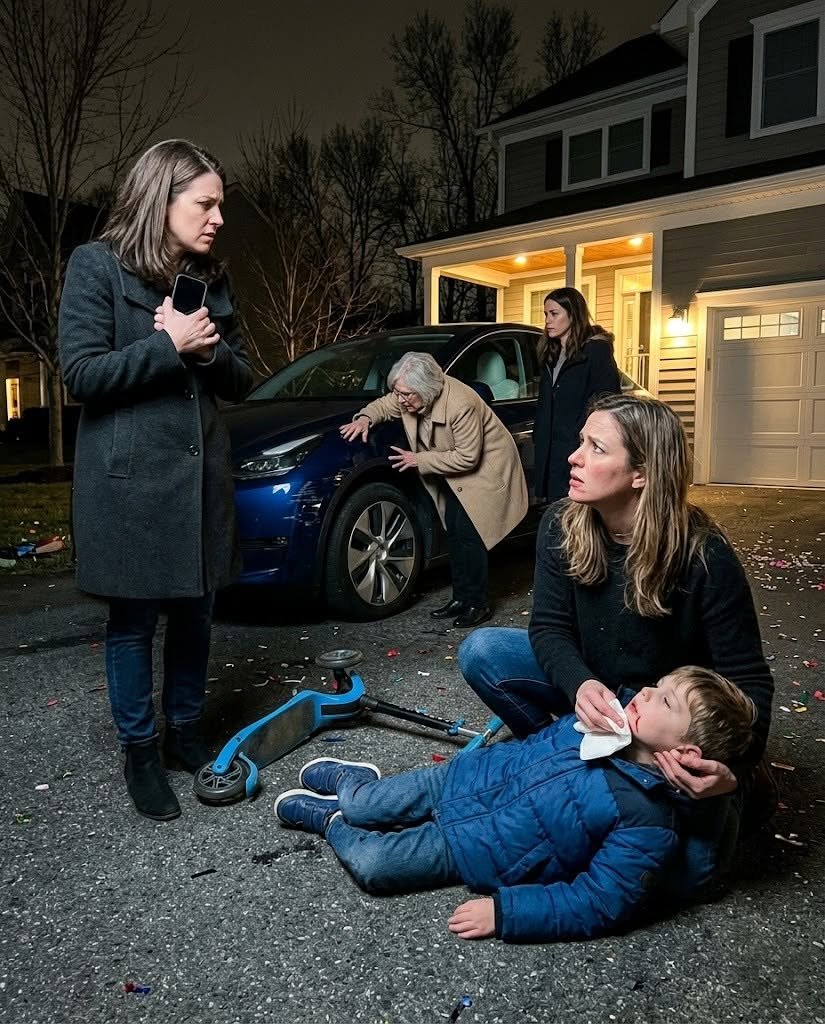
Dana stood beside the open passenger door with her arms folded tightly against herself.
She didn’t defend Mom this time.
She didn’t defend me either.
One of the paramedics called my name from behind us, and every other argument stopped mattering.
My son was being lifted onto the stretcher.
His face looked smaller under the porch light than it had a few minutes earlier, his chin covered now with clean gauze instead of the folded party napkin I’d been pressing there.
I went to him.
I went immediately.
I went without asking anyone in my family for permission again.
As they rolled him toward the ambulance, he reached one hand toward me and said, “Are you coming?”
“Right beside you.”
That was enough for him.
He closed his eyes.
Mom followed us to the gate.
“Please call me as soon as you know he’s okay,” she said.
I kept walking.
Then she added, “This really was an accident.”
I stopped.
Not because I wanted another fight.
Because I finally understood what she was asking me to do.
She wasn’t asking whether her grandson was okay.
She was asking me to agree on the story before anyone else could establish the facts.
I turned around.
“Then the facts will show that.”
Mom’s mouth tightened.
Dana stared at the driveway.
The ambulance doors closed between us.
At the hospital, the brightness made everything feel strangely ordinary.
A nurse asked questions while I held my son’s sneakers and his little jacket in my lap.
The staff cleaned his chin and closed the cut, then kept checking him because he had been dizzy and confused after the impact.
Every few minutes somebody asked him his name, where he was, or what day it was.
He answered better as the night went on.
That helped.
It did not erase the driveway.
While he rested, I noticed dried blood in the creases around my thumbnail.
I had washed my hands twice.
I had missed that spot both times.
My phone kept vibrating against the plastic chair beside me.
Dana.
My other sister.
Mom.
Dana again.
I ignored all of them until my son opened his eyes and asked for water.
I held the cup while he took two careful sips.
Then he looked at me and whispered, “Is Grandma mad?”
The question landed harder than I expected.
“No one is allowed to be mad at you for getting hurt.”
He frowned.
“She was mad about the car.”
I didn’t correct him.
I couldn’t.
He had seen exactly what I had seen.
A seven-year-old had been lying on cold pavement with blood running down his chin, and his grandmother’s first clear grief had been for a three-week-old vehicle.
“You don’t have to worry about the car,” I told him. “Your job is to rest.”
He accepted that because he was seven.
I didn’t.
A little after that, I finally checked my phone.
There were messages stacked on top of each other.
Mom wanted me to know she loved him.
My other sister said everyone had been terrified and people said stupid things when they were scared.
Dana wrote that handing the USB to an officer had been unnecessary because the video already showed it was an accident.
I read that message twice.
Then a third time.
She had just admitted something without realizing it.
The video showed enough for her to know what it showed.
Yet twenty minutes earlier she had told a paramedic, “We’re not sure exactly what happened.”
I typed a response.
Deleted it.
Typed another.
Deleted that too.
My son shifted under the hospital blanket, and I put the phone face down.
This wasn’t going to be settled in a family group chat.
Near dawn, Officer Reyes came by to confirm a few details from the driveway.
He did not give me a speech.
He didn’t tell me what was going to happen to Mom.
He asked simple questions and wrote down simple answers.
Had I seen who was driving?
Yes.
Had my son been on the scooter?
Yes.
Had anyone asked me not to identify the driver before emergency help was called?
Yes.
Who?
Dana.
Was Mom present when that happened?
Yes.
Had someone removed the USB from the car after emergency services were already on the way?
Yes.
Dana had.
Had Mom reached toward it after I took possession of it?
Yes.
Then Officer Reyes asked the question that made my stomach tighten.
“Why did you agree not to identify the driver?”
I looked through the glass panel in the door at my son sleeping under a thin hospital blanket.
“Because they made calling an ambulance conditional on it.”
He wrote that down too.
No reaction.
No lecture.
Just ink moving across paper.
Somehow that was worse for Mom than anger would have been.
Anger she knew how to manage.
Facts were harder.
Before he left, he told me that if anyone contacted me about changing what I’d said, I should preserve the messages and not argue about them.
I nodded.
Then I went back to my son’s room.
Mom arrived less than an hour later.
Dana came with her.
My other sister stayed in the hallway.
Mom had changed clothes.
She had washed her face and fixed her hair, and the shaking Dana had been so worried about was gone.
She carried my son’s favorite chocolate milk from the convenience store near her house.
It was the kind she always bought when he slept over.
For half a second, seeing it hurt more than seeing her angry would have.
That carton belonged to ordinary Saturdays.
Cartoons.
Pancakes.
Grandma letting him stay up twenty minutes late.
It did not belong beside a hospital bed after she had driven into him and then helped delay his ambulance.
Mom held it out to me.
“For when he’s allowed to drink normally.”
I didn’t take it.
“He’s sleeping.”
“I can just leave it.”
“Not in here.”
Her expression changed slightly.
Dana noticed.
“Can we not do this in the hospital?” Dana whispered.
I looked at her.
“I didn’t bring anyone here.”
Mom lowered the carton.
“I came because he’s my grandson.”
“Then why did I have to bargain for somebody to call 911?”
Dana flinched.
Mom’s eyes moved toward her.
There it was again.
Not concern about the question.
Concern about who might answer it.
Dana spoke first.
“I panicked.”
“You had a phone in your hand.”
“I know.”
“You told me you’d call if I promised not to say Mom was driving.”
“I know what I said.”
Mom stepped between us verbally before Dana could go any further.
“Everyone was in shock. She was trying to stop the whole thing from becoming a circus before we even knew whether he was seriously hurt.”
I stared at her.
That sentence gave me more clarity than the video had.
The video could show where the Tesla moved.
It could show where my son was.
It could show seconds.
Mom’s sentence showed priority.
Reputation first.
Control first.
My son second.
“He was dazed and bleeding,” I said. “That was enough to call.”
Mom’s voice dropped.
“You promised.”
Dana looked up.
My other sister stopped pretending not to listen from the hallway.
“Yes,” I said. “I promised because my child needed an ambulance and you were all making me earn one.”
Mom’s face went still.
“So your promise meant nothing.”
“It meant he got help.”
That ended the argument for me.
Not for her.
She started explaining again.
She said she’d barely touched the accelerator.
She said she’d thought my son was clearing the driveway.
She said the scooter was low and hard to see from where she was sitting.
She said she would never intentionally hurt him.
I believed one part of that.
I did not believe she had intentionally aimed a car at her grandson.
But that wasn’t the part I was struggling to understand anymore.
Accidents happen in seconds.
The choices afterward had lasted much longer.
The scrape.
The refusal to call.
The condition Dana put on the emergency call.
The warning Mom dismissed.
The USB Dana removed.
Mom reaching for it when Officer Reyes asked about the original file.
Those were not one startled movement of a driver’s foot.
They were decisions.
Mom tried one more time.
“Can I see him?”
“Not today.”
“I’m his grandmother.”
“Not today.”
“You can’t punish him because you’re angry with me.”
“I’m not.”
“That’s exactly what this is.”
“No. This is me deciding that the person who was hurt gets a quiet room.”
Dana closed her eyes.
Mom set the chocolate milk on a windowsill outside the room and left.
She did not say goodbye to me.
My sisters followed her.
Dana made it halfway down the hallway before turning back.
She stood there for several seconds with her coat folded over one arm.
“I should’ve called immediately,” she said.
I said nothing.
“I know that now.”
“You knew it then.”
She swallowed.
“I was scared of Mom.”
That surprised me.
Not because Mom was physically frightening.
She wasn’t.
Mom’s power in our family had always been softer than that.
She could decide who was being unreasonable before the unreasonable person had finished speaking.
She could turn somebody else’s boundary into cruelty.
She could be injured by your reaction to what she had done.
Dana had spent years smoothing those moments over.
So had I.
The difference was that Dana was still doing it while my son was on the pavement.
“Being scared of her doesn’t make what you did okay,” I said.
“I know.”
This time I believed she knew at least part of it.
She left.
My son came home later that day.
He was sore, tired, and quieter than usual.
The doctors gave me instructions about what to watch for and when to bring him back if anything changed.
I followed every line.
For the first night, I barely slept.
He did.
I checked on him anyway.
At 2:17 a.m., I found one foot sticking out from under the blanket and the stuffed shark wedged under his arm.
I covered his foot.
At 3:41, I checked again.
At 5:06, he opened one eye and said, “Dad, you’re being weird.”
I laughed for the first time since the driveway.
“Go back to sleep.”
“You too.”
Fair enough.
The next several days were less dramatic than people expect after a family blows apart.
Mostly, they were inconvenient.
Meals.
Medicine.
School notifications.
A damaged scooter leaning against the garage wall.
A phone full of messages I did not want to answer.
Mom sent apologies that always seemed to carry a second sentence asking me to reassure her.
“I’m sorry this happened, but you know I’d never hurt him.”
“I’m sorry everyone got so emotional.”
“I’m sorry you felt unsupported.”
She never wrote, “I am sorry we delayed calling for help.”
She never wrote, “I am sorry I asked you to protect me while he was hurt.”
She never wrote, “I am sorry I cared about the car before I cared about the child lying beside it.”
So I stopped responding.
My other sister accused me of trying to break the family apart.
Dana did not.
That mattered.
A few days later, she came to my house alone.
She stood on the porch with her hands in her coat pockets and asked whether my son was awake.
I said yes.
Then I asked why she was there.
“To apologize to you first,” she said.
That was new.
Usually apologies in our family were designed to get access back as quickly as possible.
She didn’t ask to come inside.
She didn’t mention Mom.
She didn’t tell me how hard this had been for everyone else.
She just said, “I made you promise something no parent should’ve had to promise before I called for an ambulance.”
I waited.
“And when the paramedic asked who was driving, I lied by pretending we didn’t know.”
I kept waiting.
Dana looked toward the garage.
The scooter was visible through the open side door.
Its front end was scratched, and one handlebar sat crooked.
“I thought I was protecting Mom from one mistake,” she said. “I didn’t realize I was helping her make more of them.”
That was the first apology I’d heard that didn’t ask me to erase anything.
I let her come inside.
My son was on the couch watching cartoons with the shark beside him.
Dana sat at the opposite end and didn’t touch him until he leaned toward her first.
He asked if Grandma was coming.
Dana looked at me.
Then she answered him herself.
“Not today.”
No excuse.
No pressure.
Just the truth.
That helped too.
The official side of what happened moved at its own pace after that.
I answered follow-up questions when I was asked.
I preserved the messages I’d received.
I did not try to turn myself into an investigator.
I didn’t need to.
The little black drive had already done the narrow job it needed to do.
It preserved the moment everyone on the driveway had been trying to turn into competing memories.
My son was stopped.
The Tesla moved forward.
That fact did not answer every question about intent, responsibility, or consequence.
It did something more important for us.
It stopped my son from being rewritten as the cause of his own injury.
Mom hated that distinction.
She called me one evening and said the video made everything look “more deliberate than it felt from the driver’s seat.”
I told her I wasn’t discussing the video with her.
She said she wanted to explain.
I said she had already explained many times.
She said family should be able to forgive accidents.
I said forgiveness and access were not the same thing.
Then I ended the call.
For weeks, Mom did not see my son.
I did not tell him he could never see her again.
I did not make him choose sides.
I simply stopped putting him in a room where adults expected him to make them feel better about what had happened to him.
When he asked about Grandma, I answered what I could.
When I couldn’t, I said so.
When he asked whether she had meant to hit him, I told him I didn’t know what had been in her mind before the car moved.
Then he asked a harder question.
“Why didn’t she call the ambulance?”
I sat beside him on the edge of his bed.
There was no seven-year-old version of that answer that would make the adults look better.
“She should have,” I said.
He thought about that.
“Aunt Dana should’ve too.”
“Yes.”
“But she said sorry.”
“She did.”
He nodded as if sorting pieces into different boxes.
Children are often better at that than adults.
One person can do something wrong and admit it.
Another can do something wrong and keep explaining why everyone else should understand.
The difference becomes visible over time.
Dana kept showing up carefully.
She brought homework he had left at Mom’s house.
She sat through one of his painfully long explanations of a video game she did not understand.
She never once asked him to tell me he wanted to see Grandma.
She earned her way back into ordinary life one uneventful visit at a time.
Mom kept asking for a date.
A date when this would be over.
A date when she could come by.
A date when we could all have dinner and “put the worst night of our lives behind us.”
I stopped giving her deadlines.
My son’s recovery wasn’t a customer-service ticket.
Neither was trust.
By early spring, the cut under his chin had faded into a thin line.
The scooter was still in the garage.
I had offered more than once to replace it.
He always said no.
Then one Saturday morning, he walked outside while I was sorting tools and pointed at it.
“Can we fix that one?”
“Yeah.”
“Even though the wheel’s messed up?”
“We can try.”
He dragged over the little folding stool he used when he wanted to help me work.
We straightened what could be straightened and replaced what couldn’t.
He held a flashlight even after I told him the garage was bright enough without it.
That was his job, apparently.
So I let him do it.
When the front wheel finally turned cleanly, he spun it with one finger and watched it go around.
“Grandma said I scratched her car,” he said.
My wrench stopped.
I put it down.
“You remember that?”
“Yeah.”
I waited for the rest.
“Was she more sad about the car than me?”
There are moments when protecting your child means softening the world.
There are other moments when protecting your child means refusing to teach him that what he clearly saw did not happen.
“That night, she paid attention to the car when she should’ve been paying attention to you.”
He looked at the scooter wheel.
“That’s messed up.”
“Yeah.”
He spun the wheel again.
A month later, the black USB drive came back into my possession.
I did not plug it into anything.
I did not show the video to relatives.
I did not post it online.
I put it in a small envelope with the other paperwork from that winter and placed it in the back of a drawer.
The drive had never been a trophy.
It had never been revenge.
It was simply the thing that kept an injured seven-year-old from carrying an adult family’s lie.
Mom and I were still not repaired.
Maybe one day we would be different.
Maybe not.
Dana and I were different too, but in a way that left room for work instead of pretending nothing had happened.
My son was the only person whose timeline I cared about anymore.
One warm afternoon, he carried the scooter out to the sidewalk himself.
He wore his helmet without arguing.
I walked beside him while he tested the repaired wheel, one sneaker pushing against the concrete and the other planted carefully on the deck.
At first he moved only a few feet.
Then he stopped, checked the handlebars, and tried again.
This time he went farther.
I stayed next to him.
He pushed once more and rolled steadily down the sidewalk while I walked alongside.