Sunflowers in Grocery-Store Plastic
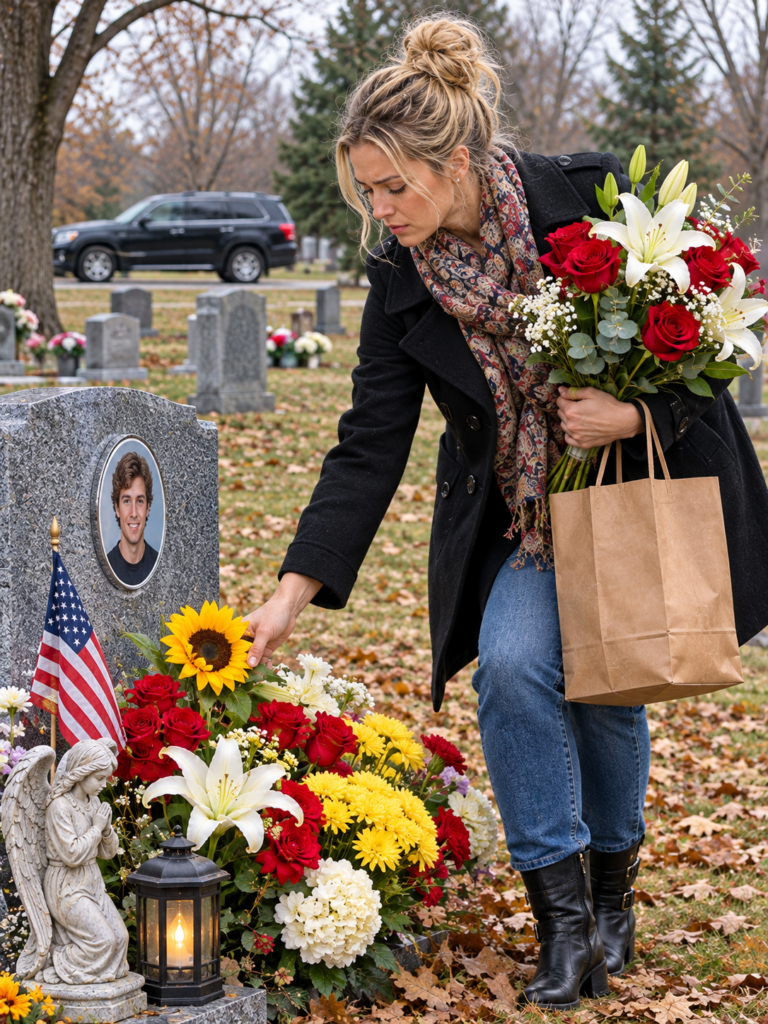
I caught a stranger stealing flowers from my son’s grave.
I want to tell you that right away, because for a long time afterward, that was how I told the story to myself. A thief. A woman in a gray coat with a shopping bag full of other people’s grief, picking through the cemetery like it was a farmers’ market.
I was wrong about almost everything. But I didn’t know that yet.
So let me start where it started. With the sunflowers.
Ezoic
Yesterday would have been my son’s thirty-fifth birthday.
Instead of a cake, I bought sunflowers.
I bought them at the Kroger on Wendell Street, in the little flower section by the front doors. Six stems for $9.99, wrapped in clear grocery-store plastic with a rubber band around the bottom. I stood there for a long time picking them out, turning each bunch around, looking for the biggest faces.
The cashier was a young girl with purple braces. She smiled when she rang them up.
“These are so pretty,” she said. “Somebody special?”
“My son,” I said. “It’s his birthday.”
“Aw. Tell him happy birthday!”
I said I would. I didn’t explain. What would I have said? That I was going to tell him happy birthday in a cemetery? That he couldn’t hear me? She was nineteen. She had braces. I let her keep her nice afternoon.
Ezoic
Sam used to bring me sunflowers.
Never in a vase. Never from a real florist. Always a bunch from the grocery store, still wrapped in that crinkly plastic, tucked under one arm. His toolbox would be in his other hand, because there was always something in my house that needed fixing and Sam could never walk past a broken thing.
He’d come through my back door without knocking. He’d hold out the flowers.
“For the prettiest girl on the block,” he’d say.
“I’m the oldest girl on the block,” I’d tell him.
Ezoic
“Same thing,” he’d say, and kiss my cheek, and go straight to whatever was dripping.
Seven months ago, on a Thursday night in March, Sam died in a car accident.
A police officer came to my door at eleven-forty at night. A young man with his hat in his hands. I knew before he said anything. You always know. There’s only one reason a police officer takes off his hat on your front porch.
Ezoic
He said Sam’s truck had gone off the road on Hollis Avenue. He said the road was wet. He said it was fast, and that Sam probably didn’t feel anything. They always say that. I’ve since learned they say it whether it’s true or not.
He said Sam had been on his way home from work.
I nodded. I signed something. I made a phone call to my sister in Dayton. And then I sat at my kitchen table until the sun came up, staring at the faucet, which was dripping.
Ezoic
I still reach for my phone to call him sometimes.
Not on purpose. My hand just does it. Something happens, a funny thing on the news, a squirrel stuck in the bird feeder, and my hand goes to the phone and my thumb goes to his name before my brain catches up.
His name is still the first one in my favorites. Sam, with a little wrench emoji he put there himself, years ago, as a joke.
Ezoic
I haven’t taken it off. I don’t think I ever will.
On his birthday, I drove out to Oak Hill Cemetery with the sunflowers on the passenger seat. It was a bright October Saturday, cold and blue. The maples along the cemetery road had turned red and gold, and the leaves crunched under my tires.
Sam’s grave is in the newer section, near the back fence, under a young oak tree. The headstone is gray granite. Samuel James Callahan. Beloved Son. Below that, I had them carve a small wrench. The man at the monument company looked at me funny when I asked. Then he said it was the nicest idea anybody’d had all week.
Ezoic
I knelt down on the cold grass. I cleared away a few dead leaves. I took the rubber band off the sunflowers, trimmed the stems with my pruning shears, and arranged them in the metal cup at the base of the headstone.
Then I sat back on my heels and talked to my son.
“Happy birthday, honey,” I said. “Thirty-five. Can you believe it?”
Ezoic
The wind moved the oak leaves above me.
“The kitchen faucet’s leaking again,” I told him. “The cold side. It’s been dripping for two weeks. I put a bowl under it.”
I could hear exactly what he would have said. I could hear his voice, the little exasperated laugh in it.
Mom. Why didn’t you just call me?
I sat there in the cold for a long time, with my knees getting wet through my pants. Then I said goodbye and drove home.
Ezoic
It wasn’t until I was back in my kitchen, staring at the bowl under the faucet, that I realized I’d left my pruning shears on the grass beside his grave.
Chapter Two: The Woman in the Gray Coat
I almost didn’t go back for them.
They were just shears. Twelve dollars at the hardware store. But they were the ones Sam bought me, the spring before he died, when he caught me trying to cut rose stems with kitchen scissors.
“Mom, you’re crushing the stems,” he said. “They can’t drink like that.” He went out to his truck and came back with a brand-new pair, still in the package. “Use these. Clean cut. Angle it.”
Ezoic
So the next morning, Sunday, I drove back out to Oak Hill.
It was early, a little after eight. The cemetery was empty and quiet. Frost still lay on the grass in the shady spots. Somewhere a crow was complaining.
I parked on the narrow road near the back section and started walking toward Sam’s oak tree. My shears were right where I’d left them, lying in the grass beside his headstone, the red handles bright against the frost.
Ezoic
But I didn’t go to them right away.
Because there was someone else in the cemetery.
A woman was standing about six rows over from Sam. She was old, older than me, maybe in her mid-seventies. She was small and a little hunched, and she was wearing a long gray wool coat that had seen a lot of winters. The hem was frayed. One of the buttons didn’t match.
She was holding a big reusable shopping bag. The kind you buy at the checkout for a dollar.
It was full of flowers.
Roses. Carnations. A few lilies, still tightly closed. Mums in orange and yellow. Baby’s breath poking out the top. The bag was so full the flowers were pressing against the handles.
Ezoic
I stood still behind a tall monument and watched her.
She bent over a grave. A big bouquet of pink roses sat in the vase, the kind of bouquet you buy at a real florist for forty or fifty dollars. She looked at it carefully. Then she pulled one rose out, a fresh one, still half-closed. She slipped it into her bag.
She glanced over her shoulder.
Then she moved to the next grave.
I couldn’t believe it at first. I actually thought I was seeing it wrong.
Ezoic
But she did it again. And again. At each grave, she bent down and looked carefully at the flowers. She didn’t take the wilted ones. She didn’t take the dead ones. She only took the freshest stems, the ones that still had days left in them.
I watched her pull a white carnation out of an arrangement in front of a stone that said Beloved Wife and Mother. I watched her take two orange mums from a pot on a child’s grave. A child’s grave. With a little ceramic angel on top.
She was choosing the freshest ones.
I was sure I knew why. You could sell flowers like that. Bundle them together, wrap them up, sell them at a stand on the side of the road or to a grocery store or at one of those weekend markets. Fresh flowers are expensive. Free flowers are pure profit.
Ezoic
I felt sick. Then I felt angry. The anger came up hot from somewhere in my stomach, and it felt good, honestly, because it was the first strong thing I’d felt in weeks that wasn’t sadness.
She kept moving. Row by row. Getting closer to the back fence. Closer to the young oak tree.
Closer to Sam.
I came out from behind the monument. I didn’t decide to. My legs just started walking.
Ezoic
She was standing over my son’s grave now. She was looking down at the sunflowers I’d arranged the day before. Their big yellow faces were tilted up toward the sky, still perfect, still bright.
She bent down. She reached out with one thin hand.
And she pulled out a sunflower.
“Don’t touch that.”
My voice came out loud. Louder than I meant it to. It rang off the headstones.
Ezoic
She flinched like I’d hit her. She straightened up so fast she almost dropped the bag.
I walked over. I didn’t hurry. I didn’t want her to see that my hands were shaking.
I stopped in front of her and held out my hand.
Ezoic
“Give it back.”
She looked at me. Her face was pale and lined, with deep creases around her eyes. Her eyes were very blue. They looked wet, but it was cold, and old people’s eyes water in the cold.
She handed me the sunflower without a word.
Up close, I could see how full her bag really was. There had to be forty or fifty stems in there. Water from the vases was dripping out of the bottom of the bag and onto her shoes, old brown lace-up shoes with a crack across one toe.
“How many graves have you taken those from?” I asked.
Ezoic
She lowered her head. She didn’t answer.
“I asked you a question.”
“I’m sorry,” she said. Her voice was soft and had an accent I couldn’t place. Something Eastern European, maybe.
“I brought these for my son yesterday,” I said. My voice was shaking now, and I hated it. “For his birthday. He would have been thirty-five.”
I held the sunflower against my chest.
“This is all I can do for him now,” I said, and my voice broke right in half. “This is all that’s left. And you’re taking them to sell?”
Ezoic
Chapter Three: Please Follow Me
Her head snapped up.
“I’m not selling them,” she said.
She said it sharply. Not angry, exactly. More like I’d accused her of something so far from the truth that it shocked her.
“Then what are you doing with them?”
She didn’t answer right away. She looked down at the sunflower in my hand. She looked at it for a long time, the way you’d look at a photograph of someone you used to know.
Then she looked back up at Sam’s headstone. At his name. At the little wrench carved under it.
Ezoic
Something moved across her face. I couldn’t read it.
“Please,” she said quietly. “Follow me. You need to see this.”
“I’m not following you anywhere.”
“Please.”
“You’re putting every one of those flowers back,” I said. “Every single one. Right now. Where you found them.”
“I will,” she said. “I promise you, I will. But first, let me explain. Please. I live just across the street.”
Ezoic
I almost said no. Every sensible part of my brain said no. A strange old woman in a cemetery, stealing flowers, asking me to come to her house? My sister Joanne would have had a fit.
But there was something in the way she’d looked at Sam’s name. Something that didn’t fit with a woman who sold stolen flowers by the side of the road.
And honestly, I wanted to see. I wanted to see what kind of person did this. I wanted to stand in her house and look her in the face while she explained.
Ezoic
“Fine,” I said. “But I’m keeping this.” I held up the sunflower.
“Of course.”
I picked up my pruning shears from the grass. I put the sunflower back in Sam’s vase with the others, and I fixed the arrangement so the faces turned toward the stone again. She watched me do it without saying anything.
Then I followed her.
She walked slowly, with a slight limp. I had to keep slowing down so I didn’t pass her. We went out through the small pedestrian gate at the back of the cemetery, the one by the toolshed, and crossed Hollis Avenue.
Ezoic
I stopped on the curb.
Hollis Avenue. I hadn’t noticed which road the back gate opened onto. I’d only ever come in through the front entrance on Cemetery Road.
Hollis Avenue was where Sam died.
Not right here. About a mile north, where the road curves near the creek. There’s a white wooden cross there now, nailed to a telephone pole. I put it up myself in April. I haven’t been able to drive past it since.
“Are you all right?” the woman asked.
“Fine,” I said. “Keep going.”
Her house was a small brick ranch directly across from the cemetery. It had a chain-link fence and a cracked concrete walk and a porch light still on in the daytime. The yard was neat. There were rosebushes along the front, pruned back for winter, and a little birdbath with no water in it.
Ezoic
She unlocked the front door with a key on a long cord around her neck.
“My name is Marta,” she said as she opened it. “Marta Kowalczyk.”
“Ruth,” I said. I didn’t offer my hand. “Ruth Callahan.”
Ezoic
She stopped in the doorway. For just a second. Her hand stayed on the doorknob.
Then she went inside, and I followed her.
The house smelled like coffee and something sweet, like dried herbs. It was small and very clean. A living room with a flowered couch and a doily on the armrest. A small television. On the wall, a crucifix, and next to it a framed photo of a young man in a graduation gown, dark hair, big smile.
There were flowers everywhere.
Not fresh ones. Dried ones. Bundles of roses and lavender hanging upside down from a string across the kitchen doorway. A row of glass jars on the windowsill with dried petals in them, sorted by color. A big flat wooden press on the kitchen table, the kind with screws on the corners, with blotting paper sticking out the sides.
Ezoic
“What is all this?” I asked.
She didn’t answer. She set the shopping bag of flowers down carefully on the kitchen counter, like she was setting down a sleeping baby.
Then she took my arm, gently, and led me down a short hallway to the back of the house.
There was a door at the end of the hall. It was closed. There was a brass padlock on it, the old-fashioned kind.
Ezoic
Marta took a second key from the cord around her neck. Her fingers were shaking a little. It took her two tries to get it in.
The lock clicked open.
She pushed the door and reached in and switched on the light.
Chapter Four: The Room at the Back
I stopped on the threshold.
It was a small room. Probably a spare bedroom once. The window was covered with a white sheet, so the light was soft and even, like the light in a church.
Ezoic
Along one whole wall stood shelves. Wooden shelves, homemade, from the floor almost to the ceiling. Six shelves high.
On every shelf, in neat rows, were objects covered in soft white cloths. Some were small, the size of a book. Some were bigger, the size of a shoebox. Each one had its own white cloth draped over it carefully, the corners smoothed down.
Under each object, taped to the edge of the shelf, was a small handwritten label. Names. Dates. Dozens of them.
Ezoic
Eleanor Whitfield. 1938 to 2024.
Baby Thomas Reyes. 2023.
Harold and June Bishop.
Gerald Oyelaran. Beloved Grandpa.
My heart was pounding. I didn’t understand what I was looking at. It looked like a shrine. Or a museum. Or something worse.
“What is this?” I whispered.
Marta didn’t answer. She was watching my face.
My eyes moved along the shelves. Row by row. Name by name.
And then they landed on a name I knew.
Third shelf from the top. On the right side. A label in neat, slanted handwriting.
Ezoic
Samuel Callahan.
I couldn’t breathe.
I turned to her slowly. My voice came out strange, like it belonged to somebody else.
“This isn’t the first time you’ve taken his flowers.”
“No,” she whispered.
“How long?”
She didn’t answer.
“How long, Marta?”
“Since April,” she said.
Since April. Since the first time I brought him flowers. Every single Saturday for seven months, I had driven out to Oak Hill with a fresh bunch from the grocery store. And every week, I had come back to find the old ones gone, and I’d assumed the groundskeepers took them. I never thought about it. Why would I?
“You’ve been stealing from my son,” I said. “Every week. For seven months.”
Ezoic
She closed her eyes. When she opened them, they were wet. Not from the cold this time.
“Please,” she said. “Look first. Then you can say anything you want to me. Anything. I will deserve it.”
She walked to the shelf. She reached up to the cloth above Sam’s name.
Ezoic
I watched her fingers take hold of the edge. I watched her lift it, slowly, the way you’d lift a veil.
The moment I saw what was underneath, I felt all the color drain out of my face.
It was a shadow box. A deep wooden frame with a glass front, about the size of a big picture book.
Inside, arranged on cream-colored paper, were sunflowers. Pressed sunflowers. Dozens of them. Their petals flattened and dried to a deep golden brown, their centers dark. They were arranged in a circle, overlapping, like a wreath. Each one had a tiny date written beneath it in pencil.
April 6. April 13. April 20. All the way around the circle. Every Saturday I’d been to the cemetery. Every bunch I’d brought.
My sunflowers. She’d kept every single one.
But that wasn’t what made the room tilt under my feet.
In the very center of the wreath, inside the circle of pressed petals, there was one more sunflower. Bigger than the others. Pressed flat and perfect.
And beneath it, pinned to the paper, was a strip of clear crinkly grocery-store plastic, and a small white card.
The card was folded once. It was smudged and a little water-stained. On the front, in blue ballpoint pen, in handwriting I would know anywhere, in handwriting I’d seen on birthday cards and grocery lists and the back of a cereal box when he was six, it said:
For the prettiest girl on the block.
At the bottom of the card, there was a date. Penciled underneath, in Marta’s slanted hand.
March 14.
The day Sam died.
Chapter Five: For the Prettiest Girl on the Block
I don’t remember sitting down.
I just remember that suddenly I was on the floor of that little room with my back against the doorframe, and Marta was kneeling beside me, holding a glass of water I didn’t remember her getting.
“Drink,” she said. “Please. Just a little.”
I took the glass. My hands were shaking so hard the water splashed on my coat.
Ezoic
“That’s his handwriting,” I said.
“Yes.”
“That’s my son’s handwriting. That’s what he said to me. That’s what he said. To me.”
“I know,” Marta whispered.
“He brought those to you.” I looked up at the shadow box. At the sunflower in the center. At the little card. “He brought you sunflowers. The day he died. He wrote you a card.”
“Yes.”
“Why?” My voice cracked. “Why would my son bring you flowers? Who are you?”
Marta sat down on the floor across from me. It took her a long time. Her knees cracked. She leaned her back against the shelves, under all those white cloths and all those names, and folded her hands in her lap.
She looked very small. Very tired.
“Your son fixed my pipes,” she said.
I stared at her.
“Two years ago,” she said. “In the winter. The pipe under my kitchen sink froze and burst. Water everywhere. I called three plumbers. Two didn’t answer. One said he would come in a week and it would cost four hundred dollars just to look.”
She looked down at her hands.
“I am seventy-four years old,” she said. “My husband is gone eleven years. My son is gone twelve. I have Social Security and a little pension from the school cafeteria. Four hundred dollars just to look.” She shook her head. “So I called a number from a card on the bulletin board at the hardware store. It said, Small jobs. Fair prices. Sam.”
“He put those cards up everywhere,” I said faintly. “His boss used to tease him.”
“He came that same night. In the snow. He fixed the pipe. He fixed the drip in my bathtub also, which I didn’t ask him to do. He charged me thirty-five dollars.” She almost smiled. “I tried to give him more. He wouldn’t take it. He said, ‘You can pay me in coffee.’”
That sounded exactly like Sam. I put my hand over my mouth.
“He came back,” Marta said. “The next month. To check the pipe, he said. Then the month after. He fixed the porch step. He fixed the furnace filter. He put new batteries in my smoke alarms because he said the chirping would drive him crazy. He came maybe once, twice a month. For two years.”
“I didn’t know,” I whispered. “He never told me.”
“He said you would worry. He said you worried about everything. He said you would say he works too much.” She looked at me. “He talked about you all the time, Ruth. All the time. Your garden. Your terrible faucet. Your pot roast. How you cut roses with kitchen scissors.”
A sound came out of me. Half a laugh, half a sob.
“He brought me flowers sometimes,” Marta said. “From the grocery store. In that plastic. He said, ‘Every woman should get flowers.’ And he always said the same thing when he gave them to me.”
She didn’t have to tell me what he said. We both looked up at the card.
For the prettiest girl on the block.
I sat there on her floor for a long time.
There was a part of me, I’m ashamed to say, that felt jealous. That was my line. Sam’s and mine. He said it to me for twenty years. I thought it was ours. I thought it was the only thing in the world that was just ours.
And all that time, he’d been saying it to a lonely old widow across from a cemetery.
But there was another part of me, a bigger part, that felt something else. Something warm and terrible, rising up through my chest.
Ezoic
Because of course he did. Of course my son did that. Of course he saw a seventy-four-year-old woman alone in a house with a frozen pipe, and he went back, and back, and back again, and he never told anyone, and he brought her flowers.
That was Sam. That was exactly who he was.
“Why do you have his card?” I asked. “Why is it in there? With the date?”
Marta’s face changed. Something closed in it, like a door.
Ezoic
She didn’t answer.
“Marta,” I said. “Why does it say March fourteenth?”
She looked down at her hands. When she spoke, her voice was so quiet I almost couldn’t hear it.
“Because that was the last time,” she said.
Chapter Six: Hollis Avenue
I knew before she told me. I think some part of me had known since I stood on the curb and saw the street sign.
Hollis Avenue.
For seven months, one thing had bothered me about Sam’s accident. Just one small thing, like a stone in my shoe. I never said it out loud to anyone, except once to the insurance adjuster, who wrote it down and didn’t seem to think it mattered.
Ezoic
Sam worked for Pruitt Plumbing, on the south side of town. He lived in an apartment on Fairview, also on the south side. Every day, for eight years, he drove home the same way. Down Route 4, then Fairview, ten minutes. He never went north. Never.
But his truck went off the road on Hollis Avenue. On the north side of town. Nowhere near his job. Nowhere near his home.
The police report said he was on his way home from work. That was what the officer said on my porch. That was what everyone said. But it never made sense, and I didn’t have the strength to ask why.
Ezoic
“It was a Thursday,” Marta said. “In March. It had rained all day. In the evening, the pipe under my sink, the same pipe, it started leaking again. Not bad. Just a little. A drip.”
She was staring at the floor between us.
“I should have put a bowl under it,” she said. “Like you do. I should have waited until Saturday. But I was alone and I was nervous, and it was dark, and I thought, what if it bursts again like before? So I called him.”
My chest was so tight I could barely breathe.
“He said he was just finishing work. He said he’d stop by on his way. I said no, no, it’s raining, it’s late, come Saturday. He said, ‘Marta, it’s ten minutes. I’ll be there.’”
She pressed her fingers against her eyes.
“He came at seven-thirty. He fixed it in fifteen minutes. A washer. Just a little washer. Then he sat at my kitchen table and drank a cup of coffee and ate two of my poppy seed cookies. He gave me the sunflowers. He said, ‘For the prettiest girl on the block.’ He said he had to go because he was meeting a friend to watch the basketball.”
She took a long, shaking breath.
“He left at eight-ten,” she said. “I stood at the window and watched his truck. His taillights. Going north on Hollis. In the rain.”
She stopped.
“At eight-thirty I heard the sirens,” she said. “I didn’t know. I didn’t know it was him. Not until two days later, when I saw it in the newspaper.”
Ezoic
I don’t know how long we sat there. The room was very quiet. I could hear a clock somewhere in the house. I could hear a car go by outside on Hollis Avenue.
He wasn’t on his way home from work. He was on his way home from her.
He was on that road because she called him about a drip. A little drip. A washer.
Ezoic
“You,” I said.
My voice didn’t sound like mine. It sounded like it was coming from the bottom of a well.
“You called him.”
“Yes.”
“For a drip.”
“Yes.”
“He drove out here in the rain for a drip in your sink.” I was getting louder. I couldn’t stop it. “And then he died. Ten minutes later. A mile up the road. Because you didn’t want to put a bowl under your sink.”
Marta didn’t flinch. She didn’t defend herself. She just sat there against the shelves and let me say it.
Ezoic
“Yes,” she whispered.
I stood up. I don’t know how. My legs were shaking.
“You knew,” I said. “You knew who I was. When I told you my name on the porch. You stopped. I saw you stop.”
“I knew your face before that,” Marta said quietly. “I have seen you every Saturday. Seven months. From my window. I watched you sit by his stone and talk to him.”
Ezoic
“And you never came out. Not once. You never told me.”
“How could I?” Her voice finally broke. “How could I walk across the street and say to his mother, it was me? He was on that road because of me? How could I say that?”
“So instead you stole his flowers.”
“I kept them,” she said.
“You stole them!”
“They throw them away!” She said it loud, the first loud thing she’d said. It rang off the walls of the little room. “Every Monday morning. Seven o’clock. The men come with a truck and a big bin, and they take every flower off every grave in that cemetery, and they throw them all into the dumpster behind the toolshed. Every week. Every flower. Everything you brought him. Into the garbage with the coffee cups and the leaves.”
I stared at her.
“I watched them do it,” she said. “The first Monday after his funeral. I watched them throw your sunflowers into the dumpster. And I couldn’t.” She put her hand flat on her chest. “I couldn’t let them do that to him. Not to him.”
Chapter Seven: The Bin Behind the Toolshed
I left.
I’m not proud of it. I walked out of that room, down her hallway, through her kitchen past the bag of dripping flowers and the wooden press, and out the front door. I didn’t say goodbye. I didn’t look back.
I crossed Hollis Avenue without checking for cars. A pickup truck honked at me. I didn’t even turn my head.
I went back through the pedestrian gate and walked straight to Sam’s grave, and I sat down on the frozen grass in front of his headstone, and I cried so hard I couldn’t see.
I’m not going to pretend I was fair to her that day. I wasn’t.
All I could think was that my son was dead because an old woman didn’t want to wait until Saturday. Seven months of not understanding. Seven months of lying awake wondering why he was on that road, what he was doing, if he’d been somewhere he shouldn’t have been. And now I knew, and it was so small. So stupid. A washer.
I wanted someone to blame. I’d wanted someone to blame for seven months. The rain. The road. The other cars. God. Myself, for not calling him more, for not making him come to dinner that Thursday.
And here she was. A real person. With a name and a face and a padlocked room.
I sat there until my legs went numb. The crow came back and walked around on the next row of graves, looking at me.
Ezoic
Finally I wiped my face on my sleeve. I looked at the sunflowers in the metal cup. Five of them now. Big and yellow and perfect.
Ezoic
Tomorrow was Monday.
I thought about what Marta said. I didn’t believe her. It sounded like an excuse. A story she made up to make herself feel better about creeping around graves with a shopping bag.
But I’d been coming here for seven months, and every Saturday the old flowers were gone. I’d just assumed. I’d never asked.
I got up and walked to the toolshed by the back gate.
Behind the toolshed, half hidden by a row of overgrown hedges, there was a big green dumpster. The lid was open.
I walked over and looked inside.
It was full of flowers.
Dead ones mostly. Brown roses. Dried-up carnations. Wilted lilies, their petals gone slimy. Old wreaths with faded ribbons. Plastic flowers, sun-bleached. A heart-shaped arrangement of white mums with a ribbon that said MOM.
All of it mixed together with soggy leaves, broken pots, coffee cups, a cracked ceramic angel.
I stood there looking at it for a long time.
Somewhere in that pile, from last week, and the week before, and the week before that, there should have been sunflowers. My sunflowers. If Marta hadn’t taken them.
Ezoic
There weren’t any.
Ezoic
On my way back to my car, a man in a green work jacket came out of the toolshed carrying a rake. He was maybe fifty, with a gray beard and a name tag that said DENNIS.
“Morning,” he said. “You okay, ma’am?”
“Do you clear the flowers?” I asked. “From the graves?”
“Every Monday,” he said. “Cemetery policy. Seven a.m. Fresh flowers come off after a week, so they don’t rot and draw bugs. Fake flowers, every thirty days. It’s posted on the sign by the front gate.” He looked at me more carefully. “Is something wrong with your plot?”
“No,” I said. “What happens to them?”
“Dumpster. Goes out with the trash on Tuesday.” He shrugged, not unkindly. “I know. It’s a shame. Some of them are still pretty nice. But we got four thousand graves out here. We can’t keep ’em.”
I nodded. I couldn’t say anything.
“There’s a lady across the street,” Dennis said, nodding toward Hollis. “Little old lady. Polish, I think. She comes Sunday mornings. Picks out the good ones before we clear. Been doing it for years. We let her. She never takes anything from a grave that’s newer than six days.”
“Years?” I said.
“Oh, since before I started.” He leaned on his rake. “Six, seven years, at least. Her boy’s buried out here. Section C, by the chapel. Tomasz something. Motorcycle accident, I think.”
Ezoic
He went back toward the toolshed. I stood on the path and looked across Hollis Avenue at the little brick house with the porch light still on in the daytime.
Ezoic
Chapter Eight: Tomasz
I didn’t go back that day. I couldn’t.
I drove home and stood in my kitchen and looked at the faucet. The cold side. Drip. Drip. Drip. Into the bowl.
I thought about my son, sitting at Marta’s kitchen table eating poppy seed cookies, with a little washer in his pocket. Saying, Marta, it’s ten minutes.
That was Sam. That was the thing about Sam that I loved the most, and it was the thing that killed him. He could never walk past a broken thing.
I had told him a hundred times. Slow down, Sammy. You can’t fix everything. You can’t help everybody.
And he’d always say the same thing. “Somebody has to, Mom.”
That night I called my sister, Joanne, in Dayton. I told her everything. She listened without interrupting, which for Joanne is a miracle.
When I finished, she was quiet for a long time.
“Ruthie,” she said finally. “If somebody called you with a broken pipe and Sam was available, what would you have told him to do?”
I didn’t answer.
Ezoic
“You’d have told him to go,” Joanne said. “You’d have said, that poor woman, go help her. Wouldn’t you?”
Ezoic
“Yes,” I whispered.
“So you’d have called him too. If it was you.”
“It’s not the same.”
“It’s exactly the same,” she said. “That woman didn’t kill your son, Ruthie. The rain did. The road did. That curve by the creek that the county’s been promising to fix for fifteen years did. All she did was let him be who he was.”
I didn’t sleep that night.
I lay in bed and thought about the shelves in that little room. All those white cloths. All those names. Eleanor Whitfield. Baby Thomas Reyes. Gerald Oyelaran, Beloved Grandpa.
Six or seven years, Dennis said. Every Sunday morning. Picking through the graves for the good ones, before they went into the dumpster with the coffee cups.
What was she doing with them? Was every one of those white cloths covering a box like Sam’s?
And who was Tomasz?
On Tuesday, I went to the cemetery office.
Ezoic
It’s a small stone building by the front gate, with a heater that clanks and a woman named Pat behind the counter who’s worked there since the Carter administration. I asked her for the location of a grave. Kowalczyk. Tomasz.
Ezoic
She looked it up on an old computer. “Section C, row four. By the chapel.” She printed out a little map and circled it with a pen. “You family?”
“No,” I said. “A friend.”
It took me ten minutes to find it. A modest gray headstone, older and more weathered than Sam’s. The grass around it was neatly trimmed.
Tomasz Kowalczyk. 1976 to 2012. Our Beloved Son. Kochamy Cię.
Thirty-six years old.
The vase in front of the stone was empty. There was nothing on the grave at all. Not a flower. Not a wreath. Not a single dried petal.
I stood there a long time looking at that empty vase.
Every Sunday, for years, she’d been walking through this cemetery saving other people’s flowers. Pressing them. Framing them. Keeping them.
And there was nothing at all on her own son’s grave.
Chapter Nine: The Keeping Room
I knocked on Marta’s door on Wednesday morning.
Ezoic
It took her a long time to answer. When she opened it, she was wearing a blue housecoat and slippers. She looked at me through the gap in the door and didn’t say anything.
Ezoic
I was holding a bunch of sunflowers. Grocery-store plastic. Rubber band around the stems.
“I’m sorry,” I said. “For what I said. For walking out.”
She looked at the sunflowers. Then at me.
“You don’t have to be sorry,” she said.
“Yes, I do. Can I come in?”
She opened the door.
We sat at her kitchen table. She made coffee in an old stovetop pot, strong and dark, and set out a plate of poppy seed cookies without saying anything. I looked at them for a long moment before I took one.
They were very good. Of course they were. Sam ate two.
“I went to see Tomasz,” I said.
Marta went still. Her cup stopped halfway to her mouth.
“There aren’t any flowers on his grave,” I said.
She set the cup down. She looked at the table for a long time.
“I don’t bring flowers,” she said finally. “Not since the first year.”
Ezoic
“Why?”
Ezoic
“Because they throw them away.” She said it simply, like it was the most obvious thing in the world. “The first year, I brought him flowers every week. Roses. He liked yellow roses. And every Monday, they went in that dumpster. I went to get them back once. I climbed in.” She shook her head. “I was sixty-three years old, Ruth, climbing in a dumpster in my church shoes. Looking for my son’s roses in the garbage.”
“Did you find them?”
“Some. Broken. Covered in coffee.” She looked out the window, toward the cemetery. “After that, I stopped bringing flowers. I couldn’t stand to see them thrown away again. So I just go and sit. And I talk to him.”
“And the others?” I asked. “The room. All those names.”
She was quiet for a long moment. Then she stood up.
“Come,” she said.
She took me back down the hallway to the room with the padlock. She opened it, and switched on the light, and this time she went to the shelves first.
She lifted a cloth near the top. Eleanor Whitfield.
Underneath was a frame. Pressed pink roses arranged in a heart, with tiny sprigs of dried lavender between them.
She lifted another. Baby Thomas Reyes.
Ezoic
A small round frame. Tiny blue forget-me-nots, pressed flat, arranged around the edges. In the center, a single white carnation.
Ezoic
She lifted another, and another. Each one different. Each one made with flowers from one grave, collected over weeks or months, pressed and dried and arranged with so much care it took my breath away.
“I started after the dumpster,” Marta said. “The first one was for Tomasz. I had a few of his roses that I saved. I pressed them in a book. Then I thought, all these other mothers, these wives, these children, every week they bring flowers. And every week their flowers go in the garbage too. And they don’t even know.”
She touched the edge of the shelf.
“So I started keeping them,” she said. “Only the ones that will be thrown away the next morning. Only the freshest, so they are good for pressing. I make something. And when it’s finished, I take it to the office, and Pat puts a little card on the grave. It says, Someone made a keepsake from your flowers. Please ask at the office.”
“How many?” I asked.
“Two hundred and twelve,” she said. “Since 2018. Most of the families come. Some don’t. Those ones stay here.” She looked at the shelves. “I keep them for them. Until they’re ready.”
I looked at Sam’s frame. At the ring of pressed sunflowers, every Saturday since April. At the one big sunflower in the middle, and the card in his handwriting.
“Were you going to give it to me?” I asked.
Marta was quiet for a long time.
“I made it the week after the funeral,” she said. “The center. His sunflower. His card. I thought, when it’s finished, I will take it to the office. But then I saw you on Saturdays. Sitting by his stone. Talking to him. Every week.” She shook her head. “And I knew if I gave it to you, you would ask about the card. Why it was here. Why I had it. And I would have to tell you.”
Ezoic
“So you kept adding to it.”
Ezoic
“I kept adding,” she said. “Every Sunday. Another sunflower. Another week of not being brave enough.” She looked at me, and her eyes filled. “I am so sorry, Ruth. He was a good boy. He was such a good boy. And it was me who called him.”
Chapter Ten: What Sam Would Have Said
I stood in that little room for a long time without speaking.
There were a hundred things I could have said. I’d thought of most of them during my long sleepless night. Some of them were cruel. Some of them were fair. Some of them were both.
But looking at that frame, at all those sunflowers, every single Saturday since April, I couldn’t find any of them.
Because I understood something, standing there. Every week for seven months, I had driven out to Oak Hill with flowers for my son. And every week, this woman had walked across the street and picked them up, so they wouldn’t end up in the garbage with coffee cups and broken pots.
She’d been taking care of my grief while I was too deep in it to see.
“Marta,” I said. “Do you know what Sam would say? If he were standing here right now?”
She looked at me. Her chin was trembling.
“He’d say, ‘Mom, why didn’t you just call me?’” I said. “That’s what he always said. Every time. Every broken faucet, every flat tire. ‘Why didn’t you just call me?’”
I swallowed.
Ezoic
“Because he wanted us to call him,” I said. “That was the whole point. That was who he was. He didn’t want people to sit alone in the dark with a leaking pipe because they were afraid to bother anybody.” My voice cracked. “If you hadn’t called him, and he found out you’d sat there scared all night with a bowl under your sink, he’d have been so mad at you. He’d have come over the next morning and fixed it and lectured you the whole time.”
Ezoic
Marta let out a sound, half sob, half laugh. She put her hand over her mouth.
“He did lecture me,” she said. “The first time. About the frozen pipe. He said, ‘Marta, you call me before it bursts. Not after.’”
“That’s my son,” I said.
I didn’t forgive her all at once. I want to be honest about that. Forgiveness doesn’t work like a light switch. It’s more like a faucet with a bad washer. It drips a little at a time.
But that morning, standing in that room, I reached up and took hold of the edge of the white cloth that lay folded beside Sam’s frame.
I covered his frame again, gently. Not to hide it. Just to keep the dust off. The way you’d tuck a blanket over a child.
“It’s not finished yet,” I said.
Marta looked at me.
“There’s going to be more sunflowers,” I said. “Every Saturday. I’m not going to stop bringing them. So you’re not going to stop keeping them. Okay?”
She nodded. She couldn’t speak.
“And Marta?”
Ezoic
“Yes?”
Ezoic
“Next time your sink drips,” I said, “you call me.”
Chapter Eleven: Two Mothers on Hollis Avenue
The next Saturday, I brought two bunches of sunflowers.
I put one in the metal cup at Sam’s headstone, like always. I trimmed the stems with the shears he gave me. Clean cut. At an angle.
Then I walked across the cemetery to Section C, row four, by the chapel.
Marta was already there. She was sitting on a little folding stool beside Tomasz’s grave, in her gray coat, with her hands folded in her lap. When she saw me coming with the flowers, she looked up, confused.
I knelt down and put the second bunch of sunflowers in Tomasz’s empty vase.
“Ruth,” she said. “They’ll throw them away on Monday.”
“I know,” I said. “So tomorrow you’ll come get them.”
She stared at me. Then she looked at the sunflowers, bright yellow against the gray stone, the first flowers on her son’s grave in eleven years.
“He liked yellow roses,” she said quietly.
“Next week, I’ll bring yellow roses.”
She reached over and took my hand. Her fingers were cold and thin and very strong.
Ezoic
We sat there together for a long time. Two mothers, in the cold, beside a stone. Neither of us said much. We didn’t need to.
Ezoic
On Monday morning, I went to the cemetery office and asked to speak to whoever was in charge.
It turned out to be a man named Harold Pruett, the cemetery manager, who wore a tie with little cartoon ducks on it and seemed alarmed that anyone wanted to speak to him. I sat in his small office and told him about Marta. About the dumpster. About the two hundred and twelve keepsakes in her back room.
He listened. He knew some of it. Pat had told him years ago.
“We can’t change the policy,” he said apologetically. “Four thousand graves. We have to clear them. The board would never…”
“I’m not asking you to change the policy,” I said. “I’m asking you to tell people.”
“Tell them what?”
“That their flowers are going in the trash on Monday,” I said. “And that if they want them saved, there’s a woman across the street who’ll save them. Put it on the sign by the front gate. Put it on the website. Put a little box in the office where people can leave their name if they want a keepsake made.”
He looked at me for a long time. Then he looked down at his duck tie.
“My mother’s buried in Section F,” he said quietly. “I bring her lilies every Mother’s Day.” He paused. “I never thought about where they went.”
“Most people don’t,” I said.
Ezoic
The new sign went up by the front gate three weeks later. It was a simple wooden board with white letters.
Ezoic
Fresh flowers are cleared every Monday at 7 a.m. If you would like your flowers preserved as a keepsake, please leave your name and plot number at the office. This service is offered free of charge by a neighbor who understands.
Marta cried when she saw it. She stood in front of it in her gray coat with her hand over her mouth and cried for five minutes. Then she told me the letters were crooked and the board should have been oak, not pine.
“Sam would have built it better,” she said.
“Sam would have built it better,” I agreed.
The first week, eleven families left their names. The second week, nineteen. By Christmas, there was a waiting list.
Marta couldn’t do it alone anymore. Her hands were too slow, her eyes not good enough for the tiny arrangements. So I started going over on Tuesdays and Thursdays. She taught me how to press flowers flat between blotting paper. How to change the paper every two days so they didn’t brown. How to handle a dried petal with tweezers so it didn’t crumble.
“Gently,” she’d say, every time, watching my hands. “Like they’re still alive.”
We worked at her kitchen table with the radio on, drinking her terrible strong coffee. Some days we didn’t talk at all. Some days we talked for hours. About Tomasz, who rode a motorcycle and played the accordion and was going to marry a girl named Agnieszka. About Sam, who once fixed the toilet at his own high school graduation party.
About how it feels to wake up in the morning and forget, for one second, that your child is gone. And then remember.
Ezoic
“It’s like stepping down a stair that isn’t there,” Marta said once.
Ezoic
I had never heard anyone describe it so exactly. I put down my tweezers and cried, and she let me, and then she handed me a cookie.
Chapter Twelve: The Faucet
In January, the faucet in my kitchen finally gave up.
The cold side stopped dripping and started running. A thin, steady stream I couldn’t turn off. I stood in front of it at six in the morning in my bathrobe, staring at it, with a towel in my hands.
My hand went to my phone. My thumb went to the first name in my favorites. Sam, with the little wrench.
I stopped. I stood there with my thumb over his name.
Then I put the phone down and went out to the garage.
Sam’s toolbox was on the workbench, where I’d put it after the funeral. A big red metal box with SAM written on the lid in silver paint marker. I hadn’t opened it in ten months.
I carried it inside and set it on the kitchen floor in front of the sink.
I opened the lid.
Everything was exactly where he’d left it. Wrenches lined up by size. Screwdrivers in their slots. A roll of plumber’s tape. A tape measure with a broken clip. And in the little tray at the top, a plastic case full of rubber washers, every size, sorted and labeled in his handwriting.
There was also a crumpled receipt from Kroger. Sunflowers, $9.99. Dated March 14.
Ezoic
I sat down on the kitchen floor and held that receipt for a long time.
Ezoic
I called Marta.
“My faucet’s running,” I said. “The cold side. I don’t know how to fix it.”
There was a pause on the line.
“Do you have a washer?” she asked.
I looked down at the little plastic case in Sam’s toolbox. Dozens of them. Sorted by size.
“Yes,” I said. “I have a lot of washers.”
“I’m coming over,” she said.
“Marta, it’s six in the morning. And it’s twenty degrees out. And I live twenty minutes away.”
“Ruth,” she said. “It’s twenty minutes. I’ll be there.”
I laughed. I couldn’t help it. I sat on my kitchen floor with my son’s toolbox and laughed until I cried.
She came in a taxi at six-forty, in her gray coat, carrying a bag of poppy seed cookies.
She didn’t know how to fix a faucet either. Neither of us did. But we found a video on my phone, a young man in a backwards baseball cap explaining it slowly, and we did it together. She held the flashlight. I turned off the water under the sink, which took me three tries because I kept turning the wrong valve. I unscrewed the handle with Sam’s screwdriver. I pulled out the old washer, which was cracked and flattened and black.
Marta held up the little plastic case and squinted at Sam’s labels.
“This one,” she said, and handed me one. “Half-inch. His writing says half-inch.”
I put it in. I screwed the handle back on. I turned the water back on under the sink.
Then I turned the cold faucet on. And off.
Nothing. No drip. No stream. Just silence.
We stood there in my kitchen looking at that faucet like it was a miracle.
“We did it,” Marta said.
“He did it,” I said, looking at the label on the little case. Half-inch. In blue ballpoint pen. “He just did it a little late.”
It’s October again now. A year since I caught a stranger taking flowers from my son’s grave.
Yesterday would have been Sam’s thirty-sixth birthday.
I went to Kroger on Wendell Street and bought two bunches of sunflowers. Six stems each, $10.49 now, wrapped in clear plastic with rubber bands around the bottoms. The girl with the purple braces wasn’t there anymore. The cashier was an older man who didn’t say anything, and that was fine.
I drove out to Oak Hill. I put one bunch in the metal cup beside Sam’s headstone. I trimmed the stems with his shears. Clean cut. At an angle. I told him about the faucet, which hasn’t dripped since January. I told him about the waiting list at the cemetery office, which is up to forty-one families now. I told him his frame in Marta’s back room has twenty-nine sunflowers in it, and that we decided it will never be finished. Not as long as there are Saturdays.
Then I walked out the back gate, past the toolshed and the dumpster, and across Hollis Avenue.
I didn’t go to Marta’s door right away. I stood on the curb for a moment and looked north, up Hollis, toward the curve by the creek.
The county finally put up a guardrail there in August. A long gray steel one, and two yellow signs with a curving arrow. Slow. Sharp curve ahead. The white wooden cross is still on the telephone pole. I touched it on my way past last month, for the first time.
Ezoic
I turned around and went up Marta’s cracked concrete walk. The porch light was on in the daytime, the way it always is.
Ezoic
I didn’t knock. Sam never knocked.
I opened the front door and stepped into the kitchen, where she was sitting at the table with her wooden press and her tweezers and her terrible coffee. She looked up.
I held out the sunflowers in their crinkly grocery-store plastic.
“For the prettiest girl on the block,” I said.
Marta looked at the flowers for a long time. Her eyes filled. Then she smiled, and stood up, and took them from me with both hands, very gently.
Like they were still alive.