Two Cokes on a Friday
Part One: Fish Night
Gil froze behind the bar with a dish towel in his hand.
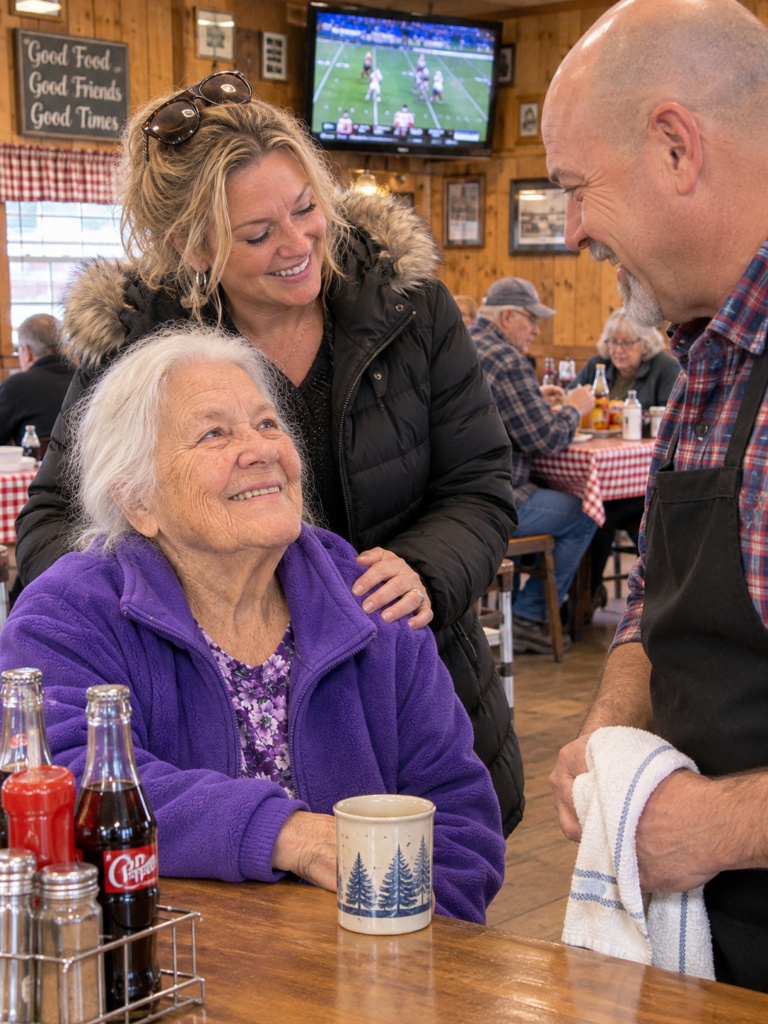
It was a quarter past five on a Friday in early March. Fish night. The early crowd was already in. Retired men from the paper mill at the end of the bar, working through their first plate of perch. Couples in the booths along the wall. Two tables of bowlers from the Thursday league who always came in on Fridays to argue about Thursday.
The jukebox was playing Patsy Cline.
Then it wasn’t. Somebody must have pulled the plug, or the song just ended, and nobody put in another quarter.
The tables behind us went quiet, one at a time.
I could feel it happen. Like a wave going out. First the booth closest to us. Then the bowlers. Then the couples by the window.
The men at the end of the bar stopped eating. They set down their forks.
They stared.
My grandmother sat on a barstool at the center of the bar. Right in front of the taps. Right where Gil couldn’t look anywhere else.
She was eighty-six years old.
She was wearing her royal blue wool coat. The good one. The one she wears to funerals and to Christmas Eve Mass and to absolutely nothing else. Pearl earrings that my grandfather gave her for their fortieth anniversary. Her white curls set that morning at the beauty shop on Main Street, the way they’ve been set every Friday since 1961.
Two glass bottles of Coca-Cola sat on the bar in front of her. The old-fashioned kind, with the bottle caps already popped off. Sweating a little in the warmth of the bar.
I stood beside her in my camel coat with my hand on her back.
Going there was Grandma’s idea, not mine.
I want you to know that. I want everyone to know that.
If it had been up to me, I’d have gone home and cried in the bathtub and never set foot in Pliska’s Tap again.
Part Two: Pliska’s Tap
Pliska’s Tap sits on the corner of Second and Clark in Mosinee, Wisconsin. A little paper mill town on the Wisconsin River, fifteen miles south of Wausau.
It’s a two-story brick building with a green awning and a neon Leinenkugel’s sign in the front window. The upstairs is an apartment. The downstairs is the bar.
Stan Pliska opened it in 1971.
He was my husband’s father. He came home from Vietnam in 1969 with a bad knee and a little bit of money and a big laugh. He bought the building from a widow whose husband had run it as a tavern since the end of Prohibition.
He named it after himself. He hung his Army discharge papers behind the bar in a frame. He started a Friday fish fry the first week, because every bar in Wisconsin has a Friday fish fry, and if you don’t, nobody comes.
For fifty years, Pliska’s was the place.
Mill workers stopped in after second shift. The Lions Club met there on Tuesdays. The bowling leagues came after their games. Wedding receptions in the back room. Funeral lunches. Graduation parties.
Every Friday, the line for fish went out the door.
Stan died in 2014.
His oldest son, Gil, took over the bar.
Part Three: Russ
My name is Shari Pliska. I’m forty-one years old.
I’m a teller at the Mosinee branch of River Valley Credit Union. I’ve worked there for eighteen years. I count other people’s money all day. I balance my drawer to the penny every night.
I’ve been married to Russ Pliska for nineteen years.
Russ is Stan’s younger son. He’s forty-three. He works second shift at the paper mill, running a winder. He’s worked there since he was nineteen, same as his father did before Stan bought the bar.
He’s a good man.
I need to say that before I say anything else.
He’s kind. He’s gentle. He’s patient with my grandmother and with the neighbor kids who throw their football over our fence. He fixes things for people without being asked. He cries at the end of Field of Dreams.
He has one weakness.
He never once told his big brother no.
Gil is six years older. When Russ was a little boy, Gil was the one who taught him to ride a bike and throw a spiral and bait a hook. When Russ was in high school, Gil was the one who drove him to every basketball game in his rusted Chevy.
When their mother left in 1988, Gil was the one who made Russ’s lunches.
Russ worships him.
So when Gil needs something, Russ gives it.
Five hundred dollars in 2016, for a new beer cooler. Russ said it was a loan. I never saw it again.
Two thousand in 2019, for a lawyer, after a slip-and-fall lawsuit. Russ said Gil would pay it back. He didn’t.
Twelve hundred in 2021, for the property taxes. That one I found out about when I saw the check clear.
I said something every time.
Russ would look at me with his sad brown eyes and say, “He’s my brother, Shar. He’s all I’ve got left of Dad.”
And I’d let it go.
Part Four: Grandma Flossie
My grandmother is Florence Duda. Everybody calls her Flossie.
She was born in 1939 in a farmhouse outside Rhinelander. She married my grandfather, Leo Duda, in 1958. They moved to Mosinee in 1960 when he got a job at the paper mill.
She worked, too. In the 1970s, when Grandpa was laid off for two years during a strike, she got a job cooking.
At Pliska’s Tap.
She was Stan’s first fish fry cook.
From 1971 to 1985, every Friday, Flossie Duda stood in the little kitchen at the back of Pliska’s Tap and fried fish. Walleye and perch and bluegill. In a beer batter she made from scratch, with Leinenkugel’s and flour and a little bit of paprika and a secret she never told anybody.
She made coleslaw. Potato pancakes. Rye bread from a bakery in Wausau. Tartar sauce in a big stainless steel bowl.
Stan used to say the line went out the door because of her batter.
That’s how I met Russ.
I was twenty-one. I was visiting Grandma at her house on a Sunday afternoon. Stan Pliska stopped by to drop off a casserole dish she’d left at the bar thirty years ago. He’d found it in a cupboard.
He brought his son along.
Grandma and I raised our families on the same streets as the Pliskas. We’ve gone to the same church. We’ve sat in the same bleachers at the same high school football games.
When Stan died in 2014, Grandma sat in the front row at his funeral.
She cried harder than his own sons.
Part Five: Forty Acres
Last spring, Grandma sold my grandpa’s forty acres of hunting land.
Grandpa died in 2017. He left her the land up north, near Tomahawk. Forty acres of pine and birch and swamp, with an old deer stand and a little cabin with no running water.
He’d hunted there every November since 1962.
Grandma couldn’t use it. She’s eighty-six. She hasn’t been up there since the funeral.
The taxes were killing her. The cabin roof was falling in. A neighbor kept calling to say kids were partying out there on weekends.
So she sold it. To a family from Minneapolis who wanted somewhere to go on weekends.
She got a hundred and twenty thousand dollars.
She put most of it in a CD at my credit union. For her funeral, she said. For her nursing home, if it ever comes to that.
And she gave us forty-three thousand of it.
She did it at her kitchen table. In April. Russ and me sitting across from her. She wrote the check herself, in her careful Palmer Method handwriting.
Pay to the order of Russell and Shari Pliska. Forty-three thousand dollars and no cents.
“For a house,” she said.
She slid the check across the table.
“Not a duplex,” she said. “Where the landlord never shovels.”
We’d been renting a duplex on Fourth Street for nineteen years.
Two bedrooms. One bathroom. Shared basement with a neighbor who plays heavy metal at two in the morning. A landlord named Mr. Krebsbach who lives in Arizona and never once shoveled the walk.
Grandma slipped on that walk in January. She broke her wrist.
“Forty-three thousand,” she said. “That’s twenty percent down on a little place. I looked it up.”
She looked at Russ.
“Leo wanted you two to have a house,” she said. “He said so before he died. He said Shari’s lived in other people’s buildings her whole life.”
She looked at me.
“Find something with a garage,” she said. “So you don’t have to scrape your windshield.”
We cried.
Both of us. At her kitchen table. Russ held her hand for a long time.
“Thank you, Flossie,” he said. “Thank you. We’ll make Leo proud.”
We put the check in our joint savings account at River Valley.
And we started looking for a house.
Part Six: The House
It took us ten months.
The housing market in central Wisconsin is tight. Everything good sells in a weekend. We looked at thirty houses. We lost four bidding wars.
Then, two weeks ago, we found it.
A little ranch on Maple Avenue. Two bedrooms, one and a half baths. A finished basement. A big backyard with an old apple tree.
And a two-car garage.
Two miles from the mill. Six blocks from Grandma’s.
It was listed at a hundred and sixty-five thousand. We offered a hundred and sixty. The sellers accepted.
I almost fainted in the realtor’s office.
The next morning, I went to the credit union. My own credit union. Where I work.
I needed a cashier’s check for the earnest money. Three thousand dollars. To hold the house.
I sat down at my own teller computer. I pulled up our joint savings account.
Our savings account had eight hundred and twelve dollars in it.
I stared at the screen.
I refreshed it.
I logged out and logged back in.
$812.47.
I’m a bank teller.
I count other people’s money all day.
I had not looked at ours since fall.
Russ handled our bills. He always had. He was better at it than me, he said. I counted money for eight hours a day at work. I didn’t want to come home and count more.
I trusted him.
I pulled up the transaction history.
My hands were shaking so badly I could barely work the mouse.
Nov 3: Withdrawal, $15,000. Cash.
Nov 19: Transfer to external account, $10,000.
Dec 8: Withdrawal, $8,000. Cash.
Jan 12: Transfer to external account, $6,500.
Feb 2: Withdrawal, $3,500. Cash.
Forty-three thousand dollars.
Gone.
I sat at my teller window with my hand over my mouth.
My coworker, Brenda, looked over from the next window.
“Shari?” she said. “You okay, hon? You look like you’ve seen a ghost.”
“I’m fine,” I said.
I wasn’t fine.
Part Seven: The Kitchen Table
That night, Russ told me everything at our kitchen table.
He came home from second shift at eleven-thirty. I was sitting at the table in the dark, with the transaction history printed out in front of me.
He saw it.
He sat down across from me without turning on the light.
He didn’t make me ask.
Every dollar had gone to Gil.
“The walk-in cooler died in October,” Russ said.
His voice was very quiet.
“The big one. In the back. Where he keeps the fish and the beer kegs. It just quit one night. The compressor burned out.”
He rubbed his face with both hands.
“It was eighteen thousand to replace,” he said. “Gil didn’t have it. He was going to have to close. He couldn’t run a fish fry without a cooler.”
“Then the property taxes,” Russ said. “He was two years behind. The county sent a letter in November. They were going to put the building up for a tax sale.”
He looked at me.
“Fourteen thousand,” he said. “Plus penalties.”
“Then the beer distributor,” Russ said. “He owed them six thousand. They stopped delivering. Then the insurance lapsed. Then the furnace.”
He put his face in his hands.
“Forty-three thousand,” he said. “Five months.”
I didn’t say anything.
I couldn’t.
“Their dad opened that bar in 1971,” Russ said. Into his hands. “My dad. I grew up in that bar. I learned to walk in that bar. I learned to count making change behind that bar.”
He looked up.
His eyes were wet.
“I couldn’t watch it close, Shar,” he said. “I couldn’t. It’s all I’ve got left of him.”
“And Grandma’s money?” I said. My voice was shaking. “The money she gave us for a house? The money from Grandpa’s land?”
Russ flinched.
“I was going to pay it back,” he said. “Before you ever knew. Gil said business would pick up after Christmas. He said he’d pay me a little every month. I was going to put it back in the account.”
He swallowed.
“I was going to pay it back before you ever looked,” he said.
“Has he paid any of it back?” I asked.
Russ didn’t answer.
“Russ.”
“No,” he said.
I sat at that kitchen table in the dark for a long time.
He is not a bad man.
I want to say that again. Because it’s true. And because it made it worse.
He is not a bad man.
He just never once told his big brother no.
Part Eight: The Law
I didn’t sleep that night.
I lay in bed next to Russ and stared at the ceiling and did the math over and over.
Forty-three thousand dollars. Five withdrawals. Five months.
At three in the morning, I got up and sat at the computer.
I looked up the law.
Here’s what I found.
The money was a gift. To both of us. Russ and Shari Pliska. A joint gift, into a joint account.
Russ had every legal right to take it out. Every dollar. It was his money as much as mine.
He could give it to his brother. He could spend it on lottery tickets. He could set it on fire in the backyard.
There was nothing to sue over.
I couldn’t sue Gil. He hadn’t stolen anything. Russ had given it to him.
I couldn’t sue Russ. Not without a divorce.
The only person with the right to ask about that money was Grandma.
Because it was hers. Before it was ours.
Part Nine: Sheepshead
The next morning, I drove to Grandma’s and told her the truth.
She lives in a little white house on Jefferson Street. Two bedrooms. A front porch with a swing. A kitchen that hasn’t changed since 1972.
Every Saturday morning, she plays sheepshead with three ladies from church. It’s a card game. A Wisconsin thing. Nobody outside the state has ever heard of it.
They were at her kitchen table when I knocked on the back door.
Grandma looked up from her cards.
She saw my face.
She looked at the three ladies.
“Girls,” she said. “Let’s call it for today.”
The ladies left. Mrs. Kowalczyk and Mrs. Zielinski and Mrs. Becker. They patted my arm on the way out. They didn’t ask questions.
Grandma didn’t put down her cards.
She just nodded at the chair across from her.
“Sit, honey,” she said.
I sat.
I told her everything.
The house on Maple Avenue. The two-car garage. The earnest money. The teller computer. $812.47.
The walk-in cooler. The property taxes. The beer distributor.
Russ at the kitchen table in the dark. I was going to pay it back before you ever knew.
She listened with her sheepshead cards still in her hand.
She didn’t interrupt. She didn’t gasp. She didn’t say anything at all.
When I was done, she was quiet for a long time.
Then she laid her cards face down on the table.
One at a time. Neatly. Squaring the edges.
“Friday,” she said.
I stared at her.
“Friday?”
“You’ll drive,” Grandma said. “I’ll wear my good coat.”
“Grandma,” I said. “What are you going to do?”
She looked at me over her reading glasses.
“I’m going to have a Coke,” she said. “At Pliska’s Tap. On fish night.”
She picked up her coffee cup.
“And I’m going to ask Gilbert how my money is doing,” she said.
Part Ten: Russ Knows
I told Russ that night.
He was getting ready for second shift. Packing his lunch at the kitchen counter. Bologna sandwich and an apple and a thermos of coffee.
“Grandma wants to go to the bar,” I said. “On Friday. During fish fry.”
He stopped packing.
“Why?” he said.
“To ask Gil about the money,” I said. “In person.”
Russ looked at me for a long time.
I thought he’d argue. I thought he’d say, Don’t do that. Don’t embarrass him. Not in front of his regulars.
I thought he’d call Gil and warn him.
He didn’t.
He just stood there with his bologna sandwich in his hand.
Then he nodded.
“Okay,” he said quietly.
“Okay?” I said.
He set the sandwich down.
“She’s the only one who’s got the right to ask,” he said. “It was her money. Her husband’s land.”
He looked at me.
“I won’t stop her, Shar,” he said. “I don’t have the right to stop her.”
He knew we were going.
He didn’t try to stop us.
He didn’t call Gil.
Part Eleven: Friday
On Friday, I picked Grandma up at four-thirty.
She was waiting on her front porch swing in her royal blue wool coat. Her pearl earrings. Her white curls set that morning.
She had her purse on her lap. A black leather one with a gold clasp.
She got into my car without saying a word.
We drove six blocks to Second and Clark.
The parking lot was already half full. Fish night starts at four-thirty at Pliska’s. The early crowd comes right after the day shift lets out at the mill.
I parked by the side door. I came around to help her out.
She took my arm.
“Walk me in, honey,” she said.
We walked in through the front door.
Pliska’s Tap hasn’t changed much since 1971.
Dark wood paneling. A long oak bar with brass rails. A row of red vinyl stools. Booths along the wall with Formica tables. A pool table in the back with a tear in the felt. A jukebox that still takes quarters.
Stan Pliska’s Army discharge papers still hang in a frame behind the bar. Next to a photograph of Stan in 1971, grinning, holding up a walleye the size of his arm.
The whole place smelled like fried fish and beer and fifty years of cigarette smoke soaked into the wood.
Grandma walked to the center of the bar.
She stopped in front of the stool right in front of the beer taps.
I helped her up onto it.
Gil was at the other end of the bar, pouring a Leinie’s for one of the mill guys.
He looked up.
He saw her.
He finished pouring the beer. He set it down.
He walked down the bar. Slowly. Wiping his hands on a dish towel.
He stopped in front of her.
“Mrs. Duda,” he said.
He was smiling. The bartender smile. The one he gives everybody.
But his eyes went to me. And back to her.
“What can I get you?” he asked.
“Two Cokes,” Grandma said. “In the glass bottles. If you still have them.”
“We still have them,” Gil said.
He reached into the cooler under the bar. He pulled out two glass bottles of Coca-Cola. He popped the caps off with the bottle opener screwed to the side of the bar.
He set them in front of her.
Then he stood there. Holding his dish towel.
Waiting.
Part Twelve: How Is It Doing
Gil froze behind the bar with the dish towel in his hand.
He knew. I could see it on his face. The second she asked for two Cokes, he knew.
The early crowd was already in.
The tables behind us went quiet. One at a time.
The men at the end of the bar stopped eating and stared.
Gil set the dish towel down.
“Mrs. Duda,” he said. “I didn’t know you were coming in.”
“I know, honey,” Grandma said.
She picked up one of the Coke bottles.
“That’s why I came,” she said.
Somebody’s fork hit a plate.
The sound rang out across the silent bar like a bell.
“Russ tells me you’ve had my money since November,” Grandma said.
She didn’t raise her voice. She didn’t need to. Every person in that bar could hear her.
“Forty-three thousand dollars,” she said. “For my granddaughter’s house.”
She took a small sip from the bottle.
She set it down on the bar. Carefully. On a cocktail napkin.
“So,” she said. “How is it doing?”
Gil went red from his collar to the top of his head.
He’s fifty years old. Big. Barrel-chested. A thick neck and a gray goatee and arms covered in faded tattoos. He’s been behind that bar for thirty years. He’s thrown out drunks twice his size. He’s broken up fights in the parking lot.
He went red like a schoolboy.
He looked at me.
I did not look away.
“Russ said Shari was fine with it,” he said quietly.
“Shari was never asked,” Grandma said. “And neither was I.”
Part Thirteen: Gil
For eighteen years, I had watched Gil run that bar the way his dad did.
Loud. Generous. First to buy the round.
He’s the kind of man who knows everybody’s name. Who remembers your kids’ birthdays and your mother’s surgery and your dog’s name. Who sends a free basket of cheese curds to the table when a couple comes in on their anniversary.
He’s the kind of man who carries a mill worker’s tab for six months when he’s laid off. Who hosts a free funeral lunch in the back room when a regular dies with no family. Who sponsors the Little League team and the bowling league and the Lions Club Christmas party.
He’s the kind of man who can’t say no either.
He was not loud now.
He stood behind his father’s bar, under his father’s discharge papers, with his face red and his hands flat on the oak.
He didn’t say anything for a long time.
“I can’t give it back tonight, Flossie,” he said finally.
His voice was barely above a whisper.
“I don’t have it,” he said.
“I didn’t ask for it tonight,” Grandma said.
Gil looked up.
“I asked how it was doing,” Grandma said.
She folded her hands on the bar. Her old, spotted, arthritic hands. With her wedding ring still on the left one, worn thin after sixty-six years.
“And I would like to hear your plan,” she said.
Part Fourteen: The Menu
Gil looked out at his Friday regulars.
At the mill guys at the end of the bar, forks down, staring at him. At the bowlers. At the couples in the booths. At old Hank Wierzbicki, who’s been coming to Pliska’s every Friday since 1972, sitting in the corner booth with his walleye going cold.
At thirty years of people who’d watched him be loud and generous.
He didn’t say anything.
Then he reached under the counter.
He pulled out a menu.
A paper one. Laminated on the front. PLISKA’S TAP — FRIDAY FISH FRY — EST. 1971. Walleye, perch, bluegill, cod. Potato pancakes or fries. Coleslaw. Rye bread.
He pulled out a pen. A cheap blue Bic from the cup by the register.
He turned the menu over to the blank side.
He set it on the bar between them.
He uncapped the pen.
He stood there, holding it over the blank paper.
His hand was shaking.
Grandma slid the second bottle across the bar to him.
The second Coke. The one she’d ordered.
It slid across the smooth old oak and stopped right in front of Gil.
“Take your time, Gilbert,” she said.
She smiled at him.
“I ordered one for you,” she said.
Part Fifteen: The Plan
Gil looked at the Coke bottle for a long time.
Then he picked it up. He took a drink.
He set it down.
He started to write.
The whole bar watched him.
Nobody went back to eating. Nobody put a quarter in the jukebox. Nobody went to the bathroom.
Old Hank Wierzbicki stood up from his corner booth and came to stand by the end of the bar. So he could see.
Gil wrote for a long time.
He crossed things out. He wrote them again. He did math in the margin.
Twice, he stopped and looked at the ceiling and closed his eyes.
When he was done, he turned the menu around.
He slid it across the bar to Grandma.
She put on her reading glasses. The ones on a chain around her neck.
She read it.
I read it over her shoulder.
PLAN — Gil Pliska — owes Flossie Duda / Russ & Shari — $43,000
1. Sell the bass boat. Lund, 2018. $14,000. (Craigslist, this weekend.)
2. Sell the Harley. $9,000. (Dealer in Wausau said he’d take it.)
3. Rent the apartment upstairs instead of living in it. $900/month. (Move in with Mom’s sister in Rothschild.)
4. Close Mondays & Tuesdays. Save on staff + utilities. $1,200/month.
5. Pay $1,500/month from bar profits. Starting April 1.
6. All of it back in 12–14 months.
7. Never borrow from Russ again without Shari at the table.
At the bottom, he’d signed it.
Gilbert S. Pliska.
Grandma read it twice.
Then she took off her reading glasses and let them drop on their chain.
She looked up at Gil.
“Your boat,” she said. “You love that boat.”
“I do,” Gil said.
“And the motorcycle. You’ve had that since you were thirty.”
“I have.”
“And you’d move out of your own apartment. Into your aunt’s spare room. At fifty years old.”
Gil swallowed.
“If I have to,” he said.
Grandma looked at him for a long time.
“That’s a good plan, Gilbert,” she said.
Then she picked up the pen.
Part Sixteen: Grandma’s Plan
She turned the menu back around.
She crossed out number four.
Close Mondays & Tuesdays.
She drew a line through it. Neat. Straight.
Gil frowned.
“Flossie,” he said. “That’s twelve hundred a month.”
“Your father,” Grandma said, “never closed a day in his life. Not when his wife left. Not when his knee went out. Not the week after his heart attack in ‘98.”
She looked up at the photograph behind the bar. Stan Pliska in 1971, grinning, holding up his walleye.
“You close two days a week,” she said, “and people will find another bar. They won’t come back.”
She wrote something underneath. In her careful Palmer Method handwriting.
4. Fix the fish.
Gil stared at it.
“Fix the fish?” he said.
Grandma took another sip of her Coke.
“Gilbert,” she said. “How long have you been buying frozen cod from the Sysco truck?”
Gil’s face went red again.
The mill guys at the end of the bar laughed. Not mean. Just surprised.
“Since 2015,” Gil said quietly. “After Dad died. It’s cheaper.”
“It’s terrible,” Grandma said.
The whole bar laughed now. Even Hank Wierzbicki, standing at the end of the bar. Even me.
“Your fish fry used to go out the door,” Grandma said. “When your father was alive. When I was cooking it. People drove from Wausau. From Stevens Point. From Marathon.”
She looked around the half-empty bar.
“Now look at it,” she said.
“The cooler didn’t break your bar, Gilbert,” Grandma said. “The frozen cod did. Ten years of frozen cod and a batter out of a box.”
She set down her Coke.
“Nobody drives twenty miles for frozen cod,” she said.
Gil didn’t say anything.
He looked at his menu. Walleye. Perch. Bluegill. Cod.
“So here’s my plan,” Grandma said.
Part Seventeen: Flossie’s Batter
“Starting next Friday,” Grandma said, “I’m coming back to the kitchen.”
Gil stared at her.
The whole bar stared at her.
“Flossie,” Gil said. “You’re eighty-six.”
“I’m aware of how old I am, Gilbert,” Grandma said. “Thank you.”
“I can’t stand at a fryer for six hours anymore,” she said. “My hip won’t let me. But I can sit on a stool and show your cook how to make my batter.”
She looked at him.
“Leinenkugel’s,” she said. “Not light. The Original. Flour. A little paprika. And the secret.”
“What’s the secret?” Gil asked.
Grandma smiled.
“I’ll tell your cook,” she said. “Not you. You’ll put it on Facebook.”
The whole bar laughed again.
“Fresh fish,” Grandma said. “Walleye and perch from the market in Wausau. Not frozen. Fresh. Every Friday morning.”
“That costs twice as much,” Gil said.
“And you’ll sell three times as much,” Grandma said.
“Potato pancakes,” she said. “From scratch. Not the frozen ones. I’ll show your cook. They have to be grated by hand. With onion. Fried in lard.”
“Lard,” Gil said.
“Lard,” Grandma said.
“Rye bread from Mittelstaedt’s Bakery in Wausau,” she said. “Your father bought it there for thirty years. They’re still open.”
She looked at him.
“And coleslaw,” she said. “My coleslaw. Not the stuff in the tub.”
Then she picked up the pen again.
She wrote one more thing at the bottom of the menu. Under Gil’s signature.
8. Flossie gets her fish for free. Every Friday. For as long as she lives.
She set the pen down.
She looked at Gil.
“Do we have a deal, Gilbert?” she asked.
Gil stood behind his father’s bar for a long time.
His eyes were wet.
He looked at the menu. At his own handwriting. At her handwriting underneath. At the line through Close Mondays & Tuesdays.
At Fix the fish.
Then he held out his hand.
Across the bar. Over the two Coke bottles.
Grandma took it.
Her small, spotted, arthritic hand in his big, tattooed, bartender’s hand.
“Deal,” Gil said.
Part Eighteen: The Regulars
Somebody started clapping.
It was old Hank Wierzbicki. Standing at the end of the bar. Eighty-one years old. He worked at the mill for forty-three years. He’s been coming to Pliska’s every Friday since 1972.
He was clapping his big, rough hands together, slow and loud.
Then the mill guys at the end of the bar started clapping.
Then the bowlers.
Then the couples in the booths.
Then Hank walked down the bar. He stopped beside Grandma’s stool.
He reached into his back pocket. He pulled out his wallet. Old brown leather, held together with a rubber band.
He took out a hundred-dollar bill.
He set it on the bar. On top of the menu.
“Prepaid fish,” Hank said. “Ten Fridays. Walleye. Flossie’s batter.”
He looked at Gil.
“I’ve been eating that frozen cod for ten years, Gil,” he said. “Out of respect for your dad.”
He grinned.
“I’d like to eat some real fish before I die,” he said.
The whole bar laughed.
Then one of the mill guys stood up. A big man named Darrell Schultz. He works second shift with Russ.
He pulled out his wallet.
“Ten Fridays,” he said. “Perch.”
He set a hundred-dollar bill on the menu.
Then a woman in one of the booths. Mrs. Kaminski. A widow. She comes every Friday with her sister.
“Two of us,” she said. “Ten Fridays.”
She set two hundred dollars on the bar.
Then the bowlers.
Then a couple I didn’t know, visiting from Stevens Point.
Then everybody.
By six o’clock, there was a pile of cash on Gil’s menu.
Twenties and fifties and hundred-dollar bills. Folded and crumpled. Prepaid fish fries.
Gil counted it with shaking hands.
Four thousand, two hundred dollars.
He stood behind the bar holding the stack of cash.
He looked out at his Friday regulars. At the faces he’d known for thirty years.
He put his hand over his eyes.
“I’ll write everybody a ticket,” he said. His voice was breaking. “A punch card. I’ll get some printed tomorrow.”
“Gil,” Hank said. “We know where you live.”
Part Nineteen: Gil and Me
Gil came around the end of the bar.
He walked over to where I was standing beside Grandma’s stool.
He stopped in front of me.
He’s six-foot-two. I’m five-four. I had to look up at him.
His face was still red. His eyes were wet.
“Shari,” he said.
“I should have asked you,” he said. “I should have called you. I knew it was Flossie’s money. I knew it was for your house.”
He looked at the floor.
“Russ said you were fine with it,” he said. “And I wanted to believe him. Because I needed it so bad.”
He looked up at me.
“I’m sorry,” he said. “I’m so sorry.”
I didn’t say anything for a long time.
I thought about nineteen years of loans. Five hundred for the beer cooler. Two thousand for the lawyer. Twelve hundred for the taxes.
I thought about the house on Maple Avenue. The two-car garage. The apple tree.
The earnest money check I couldn’t write.
“Gil,” I said. “We lost the house.”
He closed his eyes.
“I called the realtor on Tuesday,” I said. “I told her we couldn’t make the earnest money. They sold it to somebody else on Wednesday.”
Gil didn’t say anything.
He just stood there in front of me with his eyes closed.
“I’m not saying that to hurt you,” I said. “I’m saying it because it’s true.”
I took a breath.
“Pay her back,” I said. “Every dollar. On time. Every month.”
I looked at Grandma, sitting on her barstool with her Coke.
“And when you do,” I said, “we’ll find another house.”
Gil opened his eyes.
“I will,” he said. “I swear to God, Shari. On my dad.”
Part Twenty: Russ
Russ came home from second shift at eleven-thirty that night.
I was sitting at the kitchen table in the dark again. But this time, I had a cup of tea. And I wasn’t crying.
He sat down across from me.
“How did it go?” he asked quietly.
So I told him.
The two Cokes. How is it doing? Gil going red from his collar to the top of his head.
The menu. The plan. The boat and the Harley. Fix the fish.
Hank Wierzbicki and his hundred-dollar bill.
Russ put his face in his hands.
“I should have been there,” he said.
“You were at work,” I said.
“I should have been there,” Russ said again. “I should have been standing next to Grandma. Not you. It was my mistake. My brother.”
He looked up at me.
“Shar,” he said. “I need to tell you something.”
“Okay.”
“Darrell called me,” Russ said. “On my break. At the mill. He told me what happened.”
He swallowed.
“He told me about Gil going red,” he said. “He told me about Grandma’s Coke.”
Russ shook his head slowly.
“I’ve never seen Gil embarrassed in my whole life,” he said. “Not once. Not when Mom left. Not when Dad died.”
“And he did it,” Russ said, “because of me. Because I never told him no.”
He reached across the table. He took my hand.
“I’m going to learn how,” he said. “To tell him no. I’m going to call Dr. Hanson’s office on Monday. The counselor. The one at the church.”
He looked at me.
“Will you come with me?” he asked.
I looked at my husband.
At his sad brown eyes. At his big rough hands holding mine across the kitchen table.
At nineteen years of a good man who never once told his big brother no.
“Yes,” I said.
Then I said one more thing.
“And Russ,” I said. “From now on, I’m doing the bills.”
He laughed. A real laugh. The first one in two weeks.
“That’s fair,” he said.
Part Twenty-One: The Next Friday
The next Friday, Grandma came back to Pliska’s Tap.
At two o’clock in the afternoon. Before fish fry. Before the crowd.
I drove her. She wore her old housedress and an apron. Not the royal blue coat.
Gil was waiting at the back door. He’d set up a tall stool in the kitchen. Right beside the fryer. With a cushion on it.
His cook was there. A young man named Tyler, twenty-four, with a hairnet and a lot of tattoos. He’d been frying frozen cod at Pliska’s for three years.
He looked terrified.
Grandma sat down on the stool.
She looked at the fryer. At the boxes of Sysco cod in the new walk-in cooler. At the bag of batter mix on the counter. Golden Dipt. Just Add Water.
She picked up the bag of batter mix.
She dropped it in the garbage can.
“Tyler,” she said. “Get me a bowl.”
For four hours, she sat on that stool and taught Tyler how to make her batter.
Leinenkugel’s Original. Flour. Paprika. Salt. White pepper.
And the secret.
I’m not going to tell you the secret.
I promised her I wouldn’t.
She taught him how to dredge the fish. How to let the excess batter drip off. How to lay it in the oil away from you so you don’t get splashed. How to tell by the sound when it’s done.
“Listen,” she said. “When it stops singing, it’s ready.”
She taught him potato pancakes. Grated by hand. With onion. Squeezed dry in a dish towel. Fried in lard until the edges were lacy and brown.
She taught him her coleslaw. With a little bit of sugar and celery seed.
Gil drove to Wausau that morning and bought fresh walleye and perch from the fish market. And six loaves of rye bread from Mittelstaedt’s.
At four-thirty, the doors opened.
Part Twenty-Two: The Line
The line went out the door.
I’m not exaggerating. I was there. I saw it.
By four-forty-five, every booth was full. Every stool. Every table in the back room.
By five-fifteen, there was a line down the sidewalk on Second Street.
Word had gotten around.
Somebody posted on the Mosinee community Facebook page. Flossie Duda’s back in the kitchen at Pliska’s. Real fish fry. Like 1975.
It got two hundred shares.
People came from Wausau. From Stevens Point. From Marathon and Rothschild and Weston. Old men who remembered Stan’s fish fry in the seventies. Their sons. Their grandsons.
They came for the batter.
Grandma sat on her stool in the kitchen for three hours.
She didn’t fry anything. Tyler did all of it. But every time he pulled a basket of walleye out of the oil, he held it up for her to see.
She’d look at it. She’d nod. Or she’d shake her head.
“Too dark,” she’d say. “Thirty seconds less.”
Tyler would nod and try again.
By eight o’clock, they’d run out of fish.
All of it. Forty pounds of walleye. Thirty pounds of perch. Gone.
Gil had to put a sign on the door. SOLD OUT. COME BACK NEXT FRIDAY.
That night, after closing, Gil counted the drawer.
He came into the kitchen. Grandma was still on her stool, drinking a Coke out of a glass bottle.
He held up the receipt tape.
“Flossie,” he said. “That’s the best Friday since 2009.”
Grandma looked at the number.
She nodded.
“Fix the fish,” she said.
Part Twenty-Three: Every Month
Gil paid the first installment on April first.
He came to our duplex on Fourth Street on a Sunday afternoon. He knocked on the door. He was carrying a white envelope.
He handed it to me.
Inside was a cashier’s check. From River Valley Credit Union. My own credit union.
Pay to the order of Russell and Shari Pliska. Three thousand, five hundred dollars and no cents.
“Fifteen hundred from the plan,” Gil said. “And two thousand extra.”
“Gil,” I said. “That’s not the plan.”
“Fish fry was good last month,” Gil said. “Really good. And I sold the boat.”
He looked past me into our living room. At Russ, sitting on the couch.
“Hey, little brother,” he said.
Russ stood up.
They looked at each other for a long time.
Then Russ walked to the door. He held out his hand.
Gil shook it.
Then Gil pulled him into a hug.
“I’m sorry,” Gil said. “For making you choose.”
“I’m sorry,” Russ said, “for never telling you no.”
They stood in the doorway of our duplex, hugging.
Two big men. Grown men. Brothers.
Then Gil pulled back. He wiped his eyes.
“So,” he said. “Can I tell you no now? About something?”
“What?” Russ said.
“No more frozen cod,” Gil said. “Ever.”
Russ laughed so hard he had to sit down.
Part Twenty-Four: The Payments
Gil paid every month.
April. May. June. July.
Sometimes fifteen hundred. Sometimes two thousand. Once, in August, after the county fair, four thousand.
He sold the Harley in June. Nine thousand dollars. He brought the whole check to our door.
He moved out of the apartment above the bar. Into his aunt’s spare room in Rothschild. Fifteen minutes away.
He rented the apartment to a young teacher from the high school. Nine hundred a month.
He never closed on Mondays or Tuesdays.
Grandma was right. Business picked up every day of the week. People who came for the Friday fish fry started coming back on Wednesday for burgers. On Saturday for the Badgers game.
Grandma kept coming to the kitchen every Friday.
At two o’clock. On her stool. With her Coke.
Tyler doesn’t need her anymore. He’s got the batter down perfect. He can tell by the sound when the fish is ready.
But she comes anyway.
“I like the noise,” she says.
Part Twenty-Five: Maple Avenue
By February, Gil had paid back thirty-one thousand dollars.
Eleven months. Every payment on time.
In March, one year after the night Grandma ordered two Cokes, the house on Maple Avenue came back on the market.
The people who bought it got transferred to Green Bay.
I saw the listing on a Monday morning at my teller window.
1218 Maple Avenue. Ranch. 2BR/1.5BA. Finished basement. Two-car garage. Mature apple tree.
$171,000.
I called Russ on his break.
I called Grandma.
I called Gil.
Gil showed up at our duplex that night with an envelope.
Inside was a cashier’s check for twelve thousand dollars.
The rest of it. All of it.
“Gil,” Russ said. “How?”
Gil grinned.
“Fish fry,” he said. “The line goes out the door every Friday now. Flossie’s batter.”
He looked at me.
“And I took out a small business loan,” he said. “From River Valley. I had a teller there help me with the paperwork.”
He winked at me.
“Very smart lady,” he said. “Counts money all day.”
Part Twenty-Six: The House
We closed on the house on Maple Avenue in April.
A little ranch with a garage. Two miles from the mill. Six blocks from Grandma’s.
On moving day, Gil brought a truck from the bar. He and Russ carried every box. Every piece of furniture. Every bag of clothes.
Hank Wierzbicki came. Darrell Schultz came. Tyler the cook came, with a cooler full of fried walleye in Flossie’s batter.
At the end of the day, when everything was moved in, we all sat in the backyard under the old apple tree.
On lawn chairs and overturned buckets. Eating walleye out of a cooler.
Grandma sat in the best lawn chair. The one with the cushion.
She was wearing her royal blue wool coat. It was cold. Wisconsin in April.
She was drinking a Coke out of a glass bottle.
Gil stood up.
He had a Coke too. He held it up.
“To Flossie,” he said.
Everybody raised their bottles.
“To Flossie,” they said.
Grandma shook her head.
“Not to me,” she said.
She looked at the house. The little ranch with the two-car garage.
She looked at me.
“To Leo,” she said. “He wanted Shari to have a house.”
“To Leo,” everybody said.
Part Twenty-Seven: The Menu
The menu hangs behind the bar at Pliska’s Tap now.
In a frame. Right next to Stan Pliska’s Army discharge papers. Right next to the photograph of Stan in 1971, grinning, holding up his walleye.
It’s the menu from that Friday.
Laminated on the front. PLISKA’S TAP — FRIDAY FISH FRY — EST. 1971.
And on the back, in blue Bic pen, Gil’s plan.
Sell the bass boat. Sell the Harley. Rent the apartment. Pay $1,500/month.
Never borrow from Russ again without Shari at the table.
And underneath, in a different hand. Careful Palmer Method cursive.
4. Fix the fish.
8. Flossie gets her fish for free. Every Friday. For as long as she lives.
People ask about it sometimes.
New customers. Tourists from Minneapolis on their way up north. College kids from Stevens Point.
“What’s that?” they ask. Pointing at the frame.
Gil tells them.
He tells them the whole story. The cooler. The taxes. Forty-three thousand dollars. The two Cokes.
So how is it doing?
Then he points to the kitchen door.
“She’s back there right now,” he says. “Every Friday. Two o’clock. On her stool.”
Part Twenty-Eight: Two Cokes
Last Friday, I picked Grandma up at the bar at eight o’clock.
She’d been on her stool in the kitchen since two. Watching Tyler fry fish. Drinking Cokes. Telling him when the walleye was too dark.
She’s eighty-seven now.
On the way out, she stopped at the bar.
Gil was behind it, pouring beers. The place was packed. Every booth. Every stool. The line still going out the door.
He saw her. He came down the bar.
“Flossie,” he said. “You heading home?”
“In a minute,” Grandma said.
She sat down on a stool. The one in the center. Right in front of the taps.
“Two Cokes,” she said. “In the glass bottles.”
Gil smiled.
He reached into the cooler. He pulled out two glass bottles. He popped the caps.
He set them in front of her.
She slid one across the bar to him.
“I ordered one for you, Gilbert,” she said.
He picked it up.
They clinked the bottles together. Across the old oak bar. Under his father’s photograph.
“So,” Grandma said. “How’s it doing?”
Gil looked out at his bar.
At every booth full. At every stool taken. At the line still going out the door into the cold March night.
At Hank Wierzbicki in his corner booth, eating real walleye.
At Russ, sitting at the end of the bar with me, drinking a Leinie’s on his night off.
“It’s doing good, Flossie,” Gil said quietly. “It’s doing real good.”
Grandma nodded.
She took a small sip of her Coke.
She set it down on a cocktail napkin.
“Good,” she said.
Then she looked at me.
“Take me home, honey,” she said. “My hip hurts. And I want to sit in your garage.”
“My garage?” I said.
She smiled.
“I want to see a car that doesn’t need its windshield scraped,” she said.
I laughed.
I took her arm. I walked her out.
Past the booths. Past the framed menu behind the bar. Past the line of people waiting in the cold for Flossie Duda’s batter.
At the door, she stopped.
She looked back at the bar. At Gil, pouring beers. At Russ, laughing with his brother. At her own handwriting in a frame behind the taps.
“You know what Leo used to say?” she said.
“What, Grandma?”
“He used to say you can always tell a good man from a bad one,” Grandma said. “You just watch what he does when somebody asks him a hard question in front of people he loves.”
She patted my hand.
“Bad men lie,” she said. “Good men pick up a pen.”
Then she buttoned her royal blue coat.
And we walked out into the cold.