Sam’s Table
Part One: The Quiet One
My daughter, Lily, has always been a quiet kid. Even as a baby, she hardly cried. She’d lie in her crib and watch the ceiling fan turn with an expression of total concentration, like she was working out a math problem, and when I came to pick her up, she’d reach for me with both arms without making a sound.
Her father used to say she was an old soul. “She’s been here before,” Sam would say, holding her up over his head in the kitchen while she studied his face. “She’s just checking to see if we’re doing it right this time.”
Sam died four years ago, when Lily was eleven. After that, my quiet kid got even quieter.
My name is Megan Porter. I’m forty-one years old, and I live in a small white house with green shutters on a gravel road outside Mountain Grove, Missouri, in the hills of the Ozarks. I drive a school bus for the Mountain Grove school district in the mornings and afternoons, and in between I clean rooms at the Super 8 out by the highway. It isn’t glamorous, but it keeps the lights on. Most months.
Sam was a lineman for the electric cooperative. He climbed poles in ice storms and tornadoes and hundred-degree heat to put the power back on for people he’d never meet. He had big, scarred hands and a laugh you could hear from the barn, and he sang Merle Haggard songs off-key while he washed the dishes.
He used to say one thing to Lily over and over, every time she asked him why he went out in storms to fix other people’s lights.
“Being a good person means helping when nobody’s watching, Lil,” he’d say. “Anybody can be good when they’re getting a medal for it.”
Part Two: The Flood
It happened in April, four years ago, during the worst flooding the Ozarks had seen in a generation.
It rained for six days straight. The creeks came over the low-water crossings, the rivers came up over the roads, and the whole county turned brown and roaring. Sam had been working nearly around the clock, restoring power to substations, sleeping three hours a night in his truck.
On the sixth night, driving home on Highway 95 near the Gasconade River bridge, he saw headlights in the water.
A car had driven into a flooded low spot where the road dipped near Beaver Creek. The water was moving fast, four feet deep and rising, and the car was already drifting sideways off the pavement toward the creek channel. There was a man inside. Sam could see him through the windshield in the glare of the truck’s headlights, beating on the glass.
Sam called 911 from his truck. The dispatcher told him a swift-water rescue team was twenty-five minutes out. The car didn’t have twenty-five minutes.
So Sam got out of his truck. He tied a tow rope around his waist and the other end to the front bumper of his co-op truck, and he walked into the water.
I know all this from the sheriff’s report, and from the two people in a pickup truck who stopped on the far side of the flood and watched it happen. They said Sam reached the car in about a minute, fighting the current the whole way. They said he broke the driver’s window with his elbow. They said he got the man out through the window and turned around with him and started back along the rope.
They said that halfway back, the rope snapped.
The swift-water team found the car the next morning, a mile downstream, wrapped around a sycamore tree. They found Sam three days later, two miles farther down, in a logjam at the bend of Beaver Creek.
The sheriff came to my door at six o’clock on a Tuesday morning. His name was Dale Huff, and he’d known Sam since high school. He stood on my porch with his hat in his hands, rain dripping off his slicker.
“Megan,” he said. “I’m so sorry. Sam’s gone.”
I remember holding on to the doorframe. I remember Lily coming down the stairs in her pajamas behind me.
“And the man in the car?” I asked. I don’t know why that was my first question. Maybe because I knew Sam would ask it.
Dale shook his head. “We lost him too,” he said. “They’re both gone.”
Part Three: Four Years
The weekly paper ran the story that Thursday. Local Lineman, Motorist Lost in Beaver Creek Flood. There were two photographs side by side on the front page: Sam in his co-op hard hat, grinning, and a man from out of state, identified from his driver’s license, whose name I’ve never been able to forget. Elliot Graves, fifty-four, of Memphis, Tennessee.
I read that article once. Then I folded it up and put it in the back of my Bible, and I didn’t read anything else about that flood ever again. Not the follow-up stories, not the corrections, not the letters to the editor. I couldn’t. I had an eleven-year-old daughter and a funeral to plan and a mortgage I couldn’t pay on one income.
The first year was the worst. Sam’s life insurance through the co-op paid off the truck and the funeral and about four months of mortgage. After that, it was just my bus route and the Super 8.
I learned how to stretch a pound of hamburger across three dinners. I learned which grocery store marked down its bread on Tuesdays. I learned to stand in the checkout line with a running total in my head and quietly put things back when the number got too high: the name-brand cereal, the strawberries, the ice cream Lily liked. I’d tell the cashier I’d changed my mind.
And I learned to skip dinner. Not every night, just when the money ran thin at the end of the month. I’d make Lily a plate and say I’d eaten at work. I’d say I wasn’t hungry, I’d had a big lunch. I’d sit across the table from her with a cup of coffee and watch her eat.
I thought I was hiding it from her. I was so sure.
There was one more loss after Sam died, one I don’t talk about much.
Sam’s mother, Rose Porter, lived alone in a little yellow house on the other side of Mountain Grove. She’d been a widow for twenty years, and Sam was her only child. At the funeral, standing beside his casket at the Methodist church, she said something to me I’ve never been able to forget.
“He went into that water because he never could say no to anybody,” she said. “You should have made him stay home, Megan. You should have made him rest.”
I didn’t answer her. I couldn’t. We hadn’t spoken since. Not at Christmas, not on Lily’s birthdays. I sent cards with school pictures in them for the first two years, and they were never answered. After that, I stopped sending them.
Part Four: The Job
Last spring, Lily turned fifteen. That fall, she told me she’d found a weekend job.
We were sitting at the kitchen table on a Sunday night in September. I was doing the bills with a calculator and a stack of envelopes. Lily was doing her geometry homework across from me. She set down her pencil.
“Mom,” she said. “I got a job.”
I looked up. “A job? Where?”
“The Junction,” she said. “The restaurant out on Highway 60, by the truck stop. Busing tables. Saturdays and Sundays.”
I knew the Junction. Everybody in Wright County knew the Junction. It’s a roadside diner with a red tin roof and a sign shaped like an arrow, the kind of place that’s been serving chicken-fried steak and pie to truckers and farmers since 1962. Sam used to stop there for breakfast after night shifts, two eggs over easy and biscuits and gravy.
“You’re only fifteen, sweetheart,” I said. “Why do you want to work already?”
Lily shrugged. She picked her pencil back up. “I just want to buy some things with my own money, Mom,” she said.
For months she’d been talking about a new phone. Hers was an old hand-me-down from Sam’s cousin, four years old, with a cracked screen that spidered out from the corner and a battery that died by noon. Every one of her friends had newer ones. I’d seen her at the bus stop trying to read texts through the cracks, tilting the screen in the light.
I’d been trying to save for a new one for her birthday. I’d gotten to sixty-two dollars before the truck needed new brakes.
So I figured she’d finally decided to save for it herself. I was proud of her, and a little ashamed, and I said yes.
Part Five: Saturdays
Every Saturday morning, Lily left the house at eight o’clock. Patricia, her manager, didn’t let anyone under sixteen work early mornings, so her shift started at eight-thirty and ran until four. I’d drive her the fifteen minutes out to Highway 60 in the bus barn’s spare pickup, which my supervisor let me borrow on weekends.
She’d wear her old sneakers with the soles coming loose, black jeans, a plain T-shirt, and her hair in a ponytail. She carried a small blue backpack she’d had since sixth grade.
Every Saturday afternoon, I’d pick her up at four-fifteen. She’d come out the side door of the diner exhausted, smelling like coffee and fried food and dish soap. Her hands would be red and chapped from the hot water. Some days she’d have a burn on her forearm from the coffee machine.
On Sunday afternoons, she’d come home even more tired, and she’d go straight to the couch. Sometimes she’d fall asleep there before dinner, still in her work clothes, with her backpack on the floor beside her.
“Lil,” I said one Sunday in October. “You’re working too hard. Let me help you find something easier. The library’s hiring shelvers. Or the pharmacy in town.”
She shook her head without opening her eyes. “I like it there, Mom,” she said. “Really.”
“But you’re exhausted.”
“It’s a good tired,” she said. Then she smiled a little with her eyes still closed. “Dad used to say that. After storms.”
She never talked about how much she was saving. She never showed me her paychecks. When I asked, she’d say, “Getting there,” and change the subject.
I didn’t push. I figured she wanted to surprise me with her new phone. I figured she’d come home one day in December with a shiny box and a big grin, and I’d act surprised.
That’s not what happened.
Part Six: The Call
One Thursday afternoon in November, my phone rang while I was sitting in the bus barn between routes.
I didn’t recognize the number. I almost didn’t answer. Then I saw the area code was local and thought it might be the school.
“Hello?”
“Is this Megan Porter?” a woman asked. Her voice was gravelly, like she’d spent a lifetime talking over a busy kitchen. “Lily’s mother?”
“Yes,” I said. “Is everything okay?”
There was a long silence on the line. Long enough that my heart started pounding.
“My name’s Patricia Dunn,” the woman said. “I manage the Junction. Your daughter works for me.”
“Is she hurt? Is she okay?”
“She’s fine,” Patricia said quickly. “She’s at school, I assume. She’s not in any trouble, Mrs. Porter.”
Then she paused again.
“But I think you should come down here,” she said. “There’s something you need to see.”
My stomach dropped.
“What is it?” I asked.
“I’d rather show you,” Patricia said. “Can you come now? It won’t take long.”
I looked at the clock on the bus barn wall. I had forty-five minutes before my afternoon route.
“I’ll be right there,” I said.
Part Seven: The Junction
I drove the fifteen minutes to the restaurant imagining every possible disaster.
That Lily had been stealing. That she’d been hurt and was hiding it. That she was mixed up with some older boy, a trucker, somebody dangerous. That she’d been doing something I didn’t want to name. By the time I pulled into the gravel lot under the arrow-shaped sign, my hands were shaking on the steering wheel.
Patricia met me near the entrance. She was waiting for me outside the front door in her apron, smoking a cigarette, which she stubbed out on the side of the building when she saw my truck.
She was about sixty, maybe a little older. Short and sturdy, with gray hair in a tight bun and reading glasses hanging on a beaded chain. She had tired eyes and a gentle voice, and when she shook my hand, her palm was rough with forty years of hot plates and dishwater.
“Mrs. Porter,” she said. “Thank you for coming.”
“Please tell me what’s wrong,” I said.
Patricia looked at me for a long moment.
“Your daughter,” she said, “is one of the hardest-working kids I’ve ever hired. And I’ve been running this place for twenty-six years.”
“Then what’s wrong?” I said again.
Patricia didn’t answer. She just held the door open for me and nodded toward the back.
Part Eight: The Locker
She led me through the dining room. It was the middle of a weekday afternoon, the slow time between lunch and dinner, and only a few booths were occupied. Two truckers at the counter. An old couple in a corner booth sharing a slice of pie.
The old woman looked up as we passed and smiled at me, a little too long. Like she knew who I was.
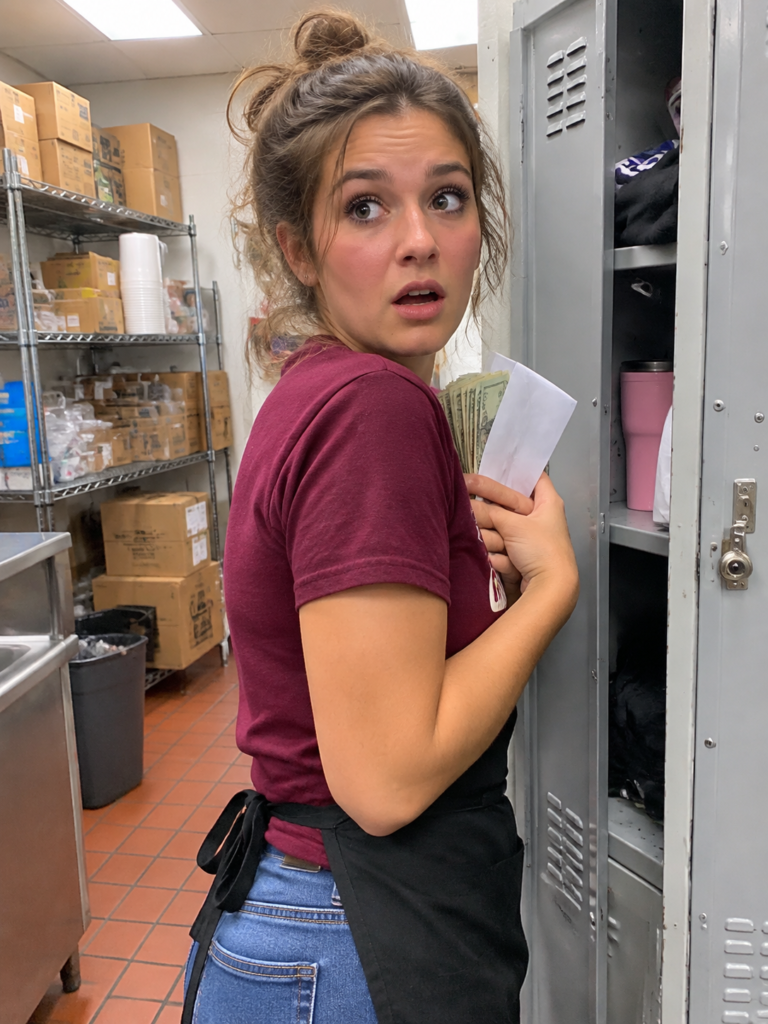
Patricia led me through the swinging kitchen doors, past the grill and the fryers and the dish pit, to a small storage room at the back. Shelves of canned tomatoes and flour sacks and paper towels. A mop bucket in the corner. And against the far wall, a row of metal lockers, the kind you see in high school gyms, dented and painted beige.
One of them had a strip of masking tape across the top. Written on the tape, in purple Sharpie, in my daughter’s careful, slanted handwriting, was one word: LILY.
“She doesn’t keep a lock on it,” Patricia said. “Nobody here does. I found it open this morning when I was looking for the spare apron.” She hesitated. “I wasn’t snooping, Mrs. Porter. I swear. But I saw what was inside, and I sat down on that milk crate and cried for twenty minutes.”
She opened the locker.
There was Lily’s blue backpack. An extra T-shirt, folded. A hairbrush. And a stack of grocery receipts held together with a binder clip, from the Walmart in Mountain Grove and the IGA in Cabool and the Dollar General on Main Street.
There were several envelopes, white, neatly folded and labeled.
And there was a little notebook. A spiral notebook with a purple cover, the kind you buy at the drugstore for a dollar.
Patricia reached in and handed me the notebook.
Part Nine: The Notebook
I recognized the handwriting immediately. Lily’s handwriting is small and careful and leans to the right, the same way Sam’s did.
On the first page, she’d written a heading and underlined it twice.
Mom’s grocery money.
Underneath were dates and amounts, all from September and October.
Sept 14 — $35
Sept 21 — $48
Sept 28 — $62
Oct 5 — $41
Oct 12 — $55
I stared at the page.
“Mom’s grocery money,” I read out loud. “What does that mean?”
Patricia didn’t answer. She just nodded at the notebook.
I turned the page.
The next page had a different heading. Sundays.
Underneath, more dates and amounts. And beside them, names.
Oct 6 — Mrs. Bennett — milk, bread, eggs, soup — $22
Oct 13 — Mrs. Bennett — groceries + Mr. Bennett’s Ensure — $38
Oct 13 — Mr. Wilson — prescription pickup (copay) — $15
Oct 20 — Mrs. Bennett — groceries — $31
Oct 20 — Grandma Rose — groceries — $27
Oct 27 — Grandma Rose — groceries + furnace filter — $34
I stopped reading. I looked up at Patricia.
“Grandma Rose,” I whispered.
Patricia nodded slowly. “Rose Porter,” she said. “From over on Elm Street. She comes in every Tuesday for the senior special.”
“That’s Sam’s mother,” I said. My voice cracked. “That’s Lily’s grandmother. We haven’t spoken in four years.”
“I know,” Patricia said gently. “Lily told me.”
I sat down hard on the milk crate. The notebook trembled in my hands.
“What is all this?” I said. “Patricia, what is my daughter doing?”
Patricia pulled a folding chair over from the corner and sat down across from me.
Part Ten: The Soup
“About two months ago,” Patricia said, “Lily noticed something.”
She folded her hands in her lap.
“We’ve got a regular. An elderly woman named Dorothy Bennett. Eighty-one. She comes in every Saturday at noon, sits in the corner booth, and orders a cup of soup. Just the cup. A dollar ninety-five. Takes her an hour to eat it, real slow, with all the free crackers she can get.”
She shook her head.
“I’d noticed it too,” Patricia said. “I’d been here twenty-six years, and I’d noticed. I’d send her out a free piece of cornbread sometimes. But I never asked.”
“Lily asked,” Patricia said.
She looked at the notebook in my hands.
“Second Saturday she worked here, she went over to Dorothy’s booth to clear the crackers and sat down across from her. Just sat down, in her apron, like it was the most natural thing in the world. Asked her how she was doing.” Patricia’s eyes were getting wet. “Dorothy told her everything. Her husband, Harold, has Parkinson’s. She takes care of him alone. Their Social Security barely covers his medications. She orders the cup of soup on Saturdays because it’s the only time she gets out of the house, and she can’t afford more.”
“Lily bought her dinner,” Patricia said. “That afternoon. With her first paycheck. Chicken-fried steak, mashed potatoes, green beans, and a slice of coconut cream pie. And a second dinner to go, for Harold.”
I covered my mouth.
“Then she found out where the Bennetts lived,” Patricia continued. “Out on County Road AA, about two miles from here. And your daughter started bringing them groceries every Sunday after her shift. She asks Joe, our cook, for a ride. He drops her off with the bags and waits in the truck.”
I looked down at the notebook. Mrs. Bennett — groceries + Mr. Bennett’s Ensure — $38.
“But these other people?” I asked. “Mr. Wilson? Rose?”
Patricia’s eyes filled with tears.
“She started asking our regulars,” she said. “Real quiet. One at a time. Whether they knew anybody who was struggling. Anybody who needed help and wouldn’t ask for it.” She shook her head. “Every week, she sets aside money from her paycheck to help somebody. Every single week.”
Part Eleven: Rose
“How did she find Rose?” I asked. My voice was barely a whisper.
“Rose found her,” Patricia said.
“Third week of October,” Patricia said. “Rose came in for the Tuesday senior special, the way she always does, but she couldn’t afford it that day. She ordered a coffee. Just a coffee. And she sat there in the booth by the window and looked out at the highway.”
Patricia took a breath.
“I told Lily about it the next Saturday. Just in passing. I said there was an old lady named Rose Porter who used to come in every week and was having a hard time.” She looked at me. “I didn’t know she was Lily’s grandmother. I swear I didn’t. Lily went white as a sheet.”
“She went to Rose’s house that Sunday,” Patricia said. “Walked there. Three miles, from here to Elm Street. Knocked on the door with two bags of groceries.”
I put my hand over my mouth.
“Rose didn’t recognize her at first,” Patricia said. “Lily was eleven the last time Rose saw her. Then Lily said, Hi, Grandma. It’s me. It’s Lily. Sam’s girl.” Patricia’s voice cracked. “Rose sat down on her front steps and cried for an hour. Lily sat beside her the whole time.”
“She’s been going every Sunday since,” Patricia said. “Bringing groceries. Fixing things. She changed Rose’s furnace filter last week. Joe had to drive her to the hardware store to find the right size.”
I looked at the notebook. Grandma Rose — groceries + furnace filter — $34.
“She never told me,” I said.
“She didn’t want you to feel bad,” Patricia said quietly. “She told me Rose said terrible things to you at the funeral. Lily didn’t want you to think she was taking sides.”
Part Twelve: The Last Envelope
Then Patricia reached into the locker and took out one final envelope.
It was white, like the others, but thicker. On the front, in purple Sharpie, in my daughter’s careful handwriting, was one word.
Mom.
I took it with trembling hands.
Inside was a stack of bills. Tens and twenties and a few fives, folded neatly in half. I counted them without meaning to, the way you count money when you’ve spent four years counting every dollar.
Four hundred and thirty dollars.
There was a folded note on top of the bills. A sheet of notebook paper, folded into quarters.
I unfolded it.
Mom,
I know you think I don’t notice when you skip dinner and say you’re not hungry. I notice. I know you put things back at the grocery store so I can have what I need. I see you do it. You always put back the strawberries first, even though you love them more than I do.
I know you still cry sometimes when you think I’m asleep. I can hear you through the wall.
Dad always told me that being a good person means helping when nobody is watching.
I can’t bring him back. But I can help you carry things until life gets easier.
This is for groceries. For the strawberries. For you to eat dinner.
Please don’t be mad that I kept this a secret.
I love you, Mom.
— Lily
I sat down on the storage room floor.
I didn’t decide to. My legs just gave out. I slid off the milk crate onto the cold concrete floor between the canned tomatoes and the mop bucket, with the note in one hand and four hundred and thirty dollars in the other.
And I cried.
Part Thirteen: What I Missed
For four years, I’d been trying to convince my daughter that she didn’t have to grow up too quickly.
I’d told her not to worry about money. I’d told her we were fine. I’d smiled at her across the dinner table with my cup of coffee and said, I ate at work, sweetheart, every time the money ran short. I’d put the strawberries back at the checkout and told the cashier I’d changed my mind, and I’d thought, every single time, that Lily wasn’t watching.
She was always watching.
She’d been watching for four years. She’d seen every skipped dinner and every put-back carton of strawberries. She’d heard every night I cried through the bedroom wall. And instead of telling me, instead of asking me for anything, my quiet, old-soul daughter had gone out and gotten a job busing tables at a truck stop diner, so she could quietly make sure that nobody around her felt alone.
Not her mother. Not an old woman eating crackers in a corner booth. Not the grandmother who’d blamed me for her son’s death.
Patricia knelt beside me on the storage room floor. She put her rough hand on my shoulder.
“Mrs. Porter,” she said gently. “Your daughter is the best person I’ve ever met.”
I couldn’t answer. I just held the note against my chest.
“She hasn’t bought a single thing for herself,” Patricia said. “Not once. I asked her about the phone. She said, It still makes calls.”
Then she said something that made me look up.
“There’s one more thing you should know about Lily,” Patricia said.
I wiped my face with the back of my hand. “What?”
Patricia hesitated. She looked at the storage room door, then back at me.
“Yesterday,” she said, “a man came into the restaurant asking for her.”
Part Fourteen: The Photograph
My heart stopped.
“A man?” I said. “What man? Patricia, she’s fifteen.”
“I know,” Patricia said quickly. “I know. It’s not like that. I promise.” She held up both hands. “He’s older. Late fifties, maybe sixty. Gray hair. Real gentle. He sat in the corner booth and asked if Lily Porter worked here.”
“What did you tell him?”
“I told him she only works weekends,” Patricia said. “And I asked him what he wanted with a fifteen-year-old girl.” Her eyes were wet again. “When he told me why he’d driven nearly three hundred miles to find her, I almost didn’t believe him.”
She stood up. She went to a small desk in the corner of the storage room, where she did the restaurant’s paperwork, and opened the top drawer. She took out a photograph.
It was a picture printed off a phone on cheap paper. I recognized the inside of the Junction in the background, the red booths and the old Coca-Cola sign on the wall.
“He came back this morning,” Patricia said. “Before you got here. Lily had already left for school, so he just asked me to give her a message. He showed me a picture he’d taken of her. He said he saw her on Facebook.”
“On Facebook?”
Patricia nodded. “I posted about her,” she said. “Three weeks ago, on the restaurant’s page. Just a little post. Our Lily, fifteen years old, spends every Sunday bringing groceries to folks who need them. Her daddy was Sam Porter, the lineman who died in the Beaver Creek flood. She’s carrying on his legacy.” Patricia shook her head. “It got shared about four thousand times. I had no idea.”
She handed me the photograph.
It was a picture of my daughter. Lily in her apron, standing beside the corner booth. She was smiling, a small, shy smile, the kind she only does when she’s really happy. And standing beside her, with one hand on her shoulder, was a man.
The moment I saw his face, my heart nearly stopped.
Because I recognized it.
I’d seen it once, four years ago, on the front page of the Mountain Grove Journal, right beside a photograph of my husband in his co-op hard hat. I’d folded that newspaper and put it in the back of my Bible and never looked at it again.
But I’d never forgotten the face.
Elliot Graves. Fifty-four, of Memphis, Tennessee.
The man in the car.
The man Sam died trying to save.
And there was absolutely no reason he should have been alive.
Part Fifteen: Elliot
He came back to the Junction that Saturday.
Patricia called him. He’d left his number. She told him Lily would be working, and that Lily’s mother wanted to meet him.
I almost didn’t go. I sat in the bus barn’s pickup in the gravel parking lot for twenty minutes with my hands on the steering wheel, staring at the arrow-shaped sign. Then Lily came out the side door in her apron. She’d seen me through the window. She walked over and opened the passenger door and climbed in beside me.
“Patricia told me,” she said quietly. “That you found the locker.”
I looked at my daughter. My quiet, old-soul daughter, fifteen years old, with dish soap on her hands and a burn on her forearm from the coffee machine.
“I’m not mad,” I said.
She burst into tears. I pulled her across the bench seat into my arms and held her there in the parking lot of the Junction until she stopped.
Then we went inside together.
He was sitting in the corner booth, the same one Dorothy Bennett sat in every Saturday with her cup of soup. He stood up when he saw us coming.
He was a tall man, thin, with silver hair and a gray mustache and the careful posture of somebody who’d been badly hurt once and never fully healed. He walked with a slight limp. He was wearing a corduroy jacket and a plaid shirt buttoned all the way up, the way old men do when they’re nervous.
He looked at me, and his eyes filled with tears.
“Mrs. Porter,” he said. “My name is Elliot Graves. Your husband saved my life.”
Part Sixteen: What the Paper Didn’t Say
We sat down in the corner booth, the three of us. Patricia brought coffee without being asked, and a slice of coconut cream pie for Lily, and then she went away and left us alone.
Elliot held his coffee cup in both hands. They were shaking a little.
“The newspaper said I died,” he said. “I know. My sister showed me the article later. She’d kept it.”
He shook his head.
“I didn’t die,” he said. “I came close.”
He told me what happened.
He was driving home to Memphis that night after visiting his daughter in Springfield. It was raining so hard he could barely see. He came around the bend on Highway 95 and saw the water across the road too late. He hit the brakes, and the car hydroplaned into the low spot, and the current caught it and started pulling it toward the creek.
“The doors wouldn’t open,” he said. “The water was pressing against them. The windows wouldn’t go down. The electrical was shorted out. I was beating on the glass.” He swallowed. “I thought I was going to drown in that car.”
“Then there were headlights,” Elliot said. “On the road. A truck. And a man got out and walked into the water.”
He looked at me.
“He had a rope tied around his waist,” he said. “He came all the way out to the car. The water was up to his chest. He broke my window with his elbow, and he reached in, and he pulled me out by my jacket.”
He wiped his eyes.
“He said, I’ve got you, buddy. Hold on to me. We’re going home.”
“Halfway back,” Elliot said, “the rope broke.”
He was quiet for a long time.
“We went under,” he said. “Both of us. The current took us. I don’t remember much after that. Tumbling. Hitting things. Cold.” He shook his head slowly. “And his hand. He never let go of my jacket. Not once.”
“The rescue team found me the next morning,” Elliot said. “Hung up in a fallen tree about half a mile downstream, on the bank. Unconscious. Hypothermic. Broken pelvis, broken arm, head injury. They took me to the hospital in Springfield.”
He looked at his coffee.
“The deputies at the scene found my car first, empty, with my wallet in the console. They found your husband’s truck with the rope still tied to it. And somebody, in all that confusion, in the worst flood in fifty years, told the newspaper both men were dead.” He shook his head. “The paper printed a correction the next week, after the hospital identified me. Small, on page six.”
I closed my eyes. I hadn’t read page six. I hadn’t read anything.
“I was in a coma for nineteen days,” Elliot said. “When I woke up, I didn’t remember anything about the flood. Not the car. Not the water. Not your husband. My family moved me to a rehab hospital in Memphis. I spent two years learning to walk again.”
He looked up at me.
“The memory came back slowly,” he said. “In pieces. A rope. A broken window. A man’s voice. I’ve got you, buddy.” His voice cracked. “And a hand on my jacket that never let go.”
Part Seventeen: The Watch
“I tried to find you,” Elliot said. “When I remembered enough. Two years ago. I called the sheriff’s office here. They told me Sam’s name and said his widow had moved. That was a mistake too, I found out later. They were thinking of somebody else.” He shook his head. “I didn’t know where else to look.”
He looked at Lily.
“Then three weeks ago, my granddaughter showed me a post on Facebook,” he said. “A restaurant in Mountain Grove. A girl named Lily Porter. Her daddy was Sam Porter, the lineman who died in the Beaver Creek flood.”
He smiled at Lily through his tears.
“I got in my car the next morning,” he said.
Then he reached into the pocket of his corduroy jacket.
He took out something wrapped in a white handkerchief. He set it on the table between us and unfolded the cloth carefully, one corner at a time.
It was a watch. A big, old steel Timex, the kind with the expandable metal band, scratched and dented, its glass face cracked in one corner. The band was broken, one side snapped clean through.
I knew it the second I saw it.
“I had it in my fist when they found me,” Elliot said. “The rescue team had to pry my fingers open. The nurses told me later. I was holding it so tight I’d cut my palm on the band.”
He pushed it gently across the table toward Lily.
“It was his,” he said. “I grabbed his wrist when we went under. The band broke. I’ve been holding on to it for four years.” He swallowed hard. “I didn’t know who to give it back to.”
Lily picked up the watch with both hands. She turned it over.
On the back of the steel case, engraved in small letters, were six words. I’d paid a jeweler in Springfield fifteen dollars to engrave them for our tenth anniversary.
Come home safe. Love, M & L.
Lily held her father’s watch against her chest and cried.
Part Eighteen: His Last Words
“Mr. Graves,” I said, when I could speak. “Did he say anything else? In the water?”
Elliot looked at me for a long moment. Then he nodded.
“Right before the rope broke,” he said, “when we were halfway back, and the water was up to our necks, he said something. I didn’t understand it at the time. I’ve thought about it every day for four years.”
He took a breath.
“He said, Tell my girls I’m sorry I’ll be late for dinner.”
I couldn’t breathe.
Sam always said that. Every time he got called out in a storm. He’d stand at the back door in his rain gear and his hard hat with his keys in his hand, and he’d say it. Sorry I’ll be late for dinner, girls. Save me a plate.
We always saved him a plate. That night, I saved him a plate too. Meatloaf and mashed potatoes. It sat in the oven until morning, when the sheriff came.
“I’m sorry it took me four years to deliver the message,” Elliot said quietly.
Lily reached across the table and took his hand. The one with the scar across the palm from the watch band.
“You came,” she said. “That’s what matters.”
Part Nineteen: What Elliot Did With His Life
We talked for three hours. Patricia kept the coffee coming. The lunch rush came and went around us, and nobody bothered us in the corner booth.
Elliot told us about his life since the flood. He’d been a pharmaceutical sales representative before, driving all over the South, making good money, always on the road. After the accident, he couldn’t drive long distances anymore. His pelvis didn’t allow it. So he retired.
“I spent the first year angry,” he said. “At the flood. At my body. At God. Then my daughter asked me a question one day. She said, Dad, what do you think that man would want you to do with the life he gave you?”
He started volunteering at a food pantry at his church in Memphis. Then he started driving groceries to homebound seniors in his neighborhood, short trips, never far. Then he got a few friends from church to help. Then a few more.
“There are forty-one of us now,” he said. “We deliver groceries to two hundred families every week in South Memphis. We call it Sam’s Route.”
He looked at Lily.
“I didn’t know his name was Sam when I started,” he said. “I just knew he was a lineman. My daughter looked it up. When I found out, I cried for a week.”
“So when I saw that post,” Elliot said, “about a fifteen-year-old girl bringing groceries to people on Sundays, I knew. I knew exactly whose daughter she was.”
He smiled at Lily.
“Your father told me I’ve got you, buddy in that water,” he said. “And then he held on until the very end. And you’ve been doing the same thing, haven’t you? Every Sunday. Holding on to people.”
Lily didn’t say anything. She just held her father’s watch in both hands.
Part Twenty: Rose
The next morning, Sunday, I drove Lily to Elm Street.
She’d asked me to. In the truck on the way home from the Junction the night before, she’d said, very quietly, “Mom, will you come with me tomorrow? To Grandma’s?”
I didn’t answer for a long time. I thought about the funeral. About the casket and the Methodist church and Rose’s face. You should have made him stay home, Megan.
“Yes,” I said.
Rose’s house was small and yellow, with peeling paint and a crooked porch swing. I parked at the curb. Lily got out with two bags of groceries from the IGA. I followed her up the cracked sidewalk.
Lily knocked on the door.
Rose opened it.
She was seventy-eight. Thinner than I remembered. Her white hair was pinned up, and she was wearing a blue housedress and a cardigan with a button missing. She saw Lily and smiled. Then she saw me standing behind her granddaughter on the porch, and her face changed.
For a long moment, nobody said anything.
Then Rose looked down at Lily’s wrist.
Lily had put on her father’s watch. It was too big for her, with its broken band held together with a safety pin, sliding loose around her thin wrist.
Rose stared at it.
“Where did you get that?” she whispered.
So we told her. Standing on her front porch, in the cold November morning, with two bags of groceries at our feet. All of it. Elliot Graves. The corner booth at the Junction. The car in the water. The rope that broke. The hand that never let go.
Tell my girls I’m sorry I’ll be late for dinner.
When we finished, Rose was holding on to the doorframe with both hands, the way I held on to mine the morning the sheriff came.
Part Twenty-One: What Rose Said
“I said terrible things to you,” Rose said to me. “At the funeral.”
I didn’t answer.
“I said you should’ve made him stay home,” Rose said. Her voice was shaking. “I said it was your fault.”
She looked down at the watch on Lily’s wrist.
“It wasn’t your fault,” she said. “It was never your fault. It was mine.”
I stared at her. “Rose, what are you talking about?”
Rose sat down on the porch swing. Slowly, like her knees hurt. She looked out at the street.
“When Sam was nine,” she said, “a little girl fell through the ice on Miller’s Pond behind our house. He saw it from his bedroom window. He ran out in his socks. He laid down on his belly on the ice and pulled her out by her coat collar.”
She shook her head.
“I was so proud of him,” she said. “I told him, Sammy, that’s what good people do. They go in when everybody else stands on the bank.”
She looked at me with tears running down her face.
“I raised him to walk into that water, Megan,” she said. “I told him that every day of his life. And then he did it. And I blamed you, because I couldn’t stand to blame myself.”
I sat down on the porch swing beside her.
I didn’t say anything for a long time. Lily stood in front of us, holding the grocery bags, her father’s watch sliding loose on her wrist.
Then I put my arm around my mother-in-law.
“Rose,” I said. “He went into that water because of both of us. And because of who he was.” I looked at Lily. “And look who he left behind.”
Rose looked at her granddaughter for a long time.
“She’s just like him,” she whispered.
“I know,” I said.
“Every Sunday,” Rose said. “She just shows up. Never asks for anything. Just shows up with groceries and fixes whatever’s broken.” She laughed through her tears. “She changed my furnace filter. Sam used to do that.”
Part Twenty-Two: Sam’s Table
Elliot didn’t go home to Memphis right away. He stayed at the Super 8 out by the highway for another week. I made sure he got the good room, the one on the end with the view of the hills, and I cleaned it myself every morning.
On Wednesday, he sat down in the corner booth at the Junction with Patricia and Lily and me. He had a yellow legal pad and a pen.
“I want to do something,” he said. “Here. In Sam’s town.”
That’s how Sam’s Table started.
It’s a bulletin board on the wall by the register at the Junction, under the old Coca-Cola sign. Customers can pay for a meal in advance, any meal, any amount, and Patricia writes it on a little paper ticket and pins it to the board. Anybody who can’t afford to eat can walk in, take a ticket off the board, and order whatever they want. No questions. No forms. No explanation needed.
Elliot paid for the first hundred tickets himself. He said it was the least he could do.
The truckers started it. A man named Big Earl who hauls chickens for Tyson heard about it on his CB radio and stopped in the next morning and paid for twenty meals. Then the farmers. Then the teachers from the high school. Then a busload of Baptists on their way to Branson who saw the sign in the window.
By Christmas, there were four hundred and twelve tickets pinned to the board.
Dorothy Bennett doesn’t order the cup of soup anymore. She orders the chicken-fried steak with a slice of coconut cream pie, and a second dinner to go for Harold. She takes a ticket off the board every Saturday, and every Saturday she leaves a dollar ninety-five in the tip jar. “For the next one,” she says.
Part Twenty-Three: The Money
I never spent the four hundred and thirty dollars.
I tried. Lily made me try. The week after I found the locker, she stood with me in the IGA with a cart and made me buy strawberries, two pints of them, and a half-gallon of the good ice cream, and steaks. Actual steaks. She stood at the checkout with her arms folded and watched me to make sure I didn’t put anything back.
But I paid for all of it with my own money. When I got home, I put her envelope in my dresser drawer and left it there.
On New Year’s Day, I drove out to the Junction and went into the storage room in the back and opened Lily’s locker.
I put the envelope back inside, with all four hundred and thirty dollars, and a note of my own.
Lily,
I’m not mad. I’ve never been prouder of anything in my life.
I found something out this year. I’ve been so busy trying to protect you from growing up too fast that I didn’t notice you’d already grown up into the best person I know.
Your dad used to say being a good person means helping when nobody’s watching. I want you to know something. I was watching. Your grandmother was watching. Patricia was watching. Elliot Graves drove three hundred miles because he was watching.
This money isn’t for groceries anymore. It’s for whoever needs it next. You’ll know who. You always do.
I love you.
— Mom
P.S. I ate dinner. Steak. With strawberries for dessert.
Part Twenty-Four: The Phone
Lily never bought the new phone.
In February, for her sixteenth birthday, Elliot mailed her a box from Memphis. Inside was a brand-new phone with a note. For calling your grandma. — E.G.
She thanked him. She called him to say so, on her cracked old phone, and talked to him for an hour about Sam’s Route and the Junction and her chemistry class. Then she drove out to Rose’s house on Elm Street with her new learner’s permit and me in the passenger seat, and gave the new phone to her grandmother.
“So you can call me anytime, Grandma,” she said. “Even when it’s not Sunday.”
Rose’s old phone was a flip phone from 2009. She held the new one in both hands like it was made of glass. Then she cried, which Rose does a lot now. She says it’s making up for four years of not.
Lily still has her cracked phone. The screen still spiders out from the corner. The battery still dies by noon.
“It still makes calls,” she says.
Part Twenty-Five: Sunday
It’s spring again now. April. The creeks are high from the rains, and the redbuds are blooming pink all along the ridges, and the Gasconade is running fast and brown under the Highway 95 bridge.
Every Sunday, after her shift at the Junction, Lily makes her rounds. I drive her now. I took over from Joe, the cook, who said he was glad to get his Sundays back but who still slips extra biscuits into her grocery bags.
We go to the Bennetts’ place on County Road AA first. Dorothy makes us coffee, and Harold, who can barely talk anymore, holds Lily’s hand while she tells him about her week. Then we go to Mr. Wilson’s trailer by the lake to pick up his prescription. Then two more families that Big Earl the trucker told her about.
And last, always last, we go to Elm Street.
Rose waits on her porch swing for us every Sunday now. She has the new phone in her cardigan pocket, and she shows Lily the pictures she’s taken on it. Mostly her own thumb. Some of her rosebushes. One very blurry picture of a cardinal.
Last Sunday, after Lily had put away the groceries and checked the furnace filter, the three of us sat on Rose’s porch swing together. Rose on one side, me on the other, Lily in the middle, wearing her father’s watch.
She’d had the band fixed. A jeweler in Springfield replaced the broken link for free when Lily told him the story. It still slides around on her wrist because it’s too big. She won’t let me have it sized down.
“It’s supposed to be big,” she says. “It was Dad’s.”
We sat there on the porch swing in the warm April evening, watching the sun go down over the hills.
“Mom,” Lily said. “Can I ask you something?”
“Always.”
“Do you think Dad knows?” she asked. “About the Junction? About Sam’s Table and Elliot and Grandma and everything?”
I thought about it for a long time.
I thought about Sam standing at the back door in his rain gear with his keys in his hand. Sorry I’ll be late for dinner, girls. I thought about him walking into that water with a rope around his waist. I thought about his hand on a stranger’s jacket that never let go.
I thought about our daughter, fifteen years old, in old sneakers with the soles coming loose, sitting down across from an old woman eating crackers in a corner booth and asking her how she was doing.
“I think he knows,” I said. “I think he’s been watching the whole time.”
Lily leaned her head on my shoulder.
“Good,” she said. “But I’d still do it if nobody was watching.”
“I know you would, baby,” I said. “That’s the whole point.”
On the other side of her, Rose laughed softly.
“That’s exactly what Sammy used to say,” she said. “Exactly.”
She reached over and put her hand on top of Lily’s, on top of the big steel watch.
And the three of us sat there together on the porch swing until it got dark. Nobody was in a hurry to get home. For the first time in four years, nobody was late for dinner.