The Stop We Didn’t Take
“Mom, please don’t make me get off here.
Gregory’s back at the house, and I’m scared of him.”
My daughter whispered it against my sleeve as the bus doors hissed open at a busy avenue in downtown Milwaukee, and it stopped me cold, one foot already lifting toward the step.
Abigail was eight years old.
She had never in her life been afraid to go home.
Behind us the packed commuters began to grumble and press, because a mother and daughter frozen in the doorway of a crowded bus at rush hour is an obstacle, and my first instinct — I am ashamed of it now — was the instinct of a woman who has been taught all her life to manage other people’s inconvenience before her own child’s fear: to take her hand and pull her down the steps and apologize to the strangers with my eyes.
But then I looked at her.
And Abigail was not sulking, and she was not being difficult.
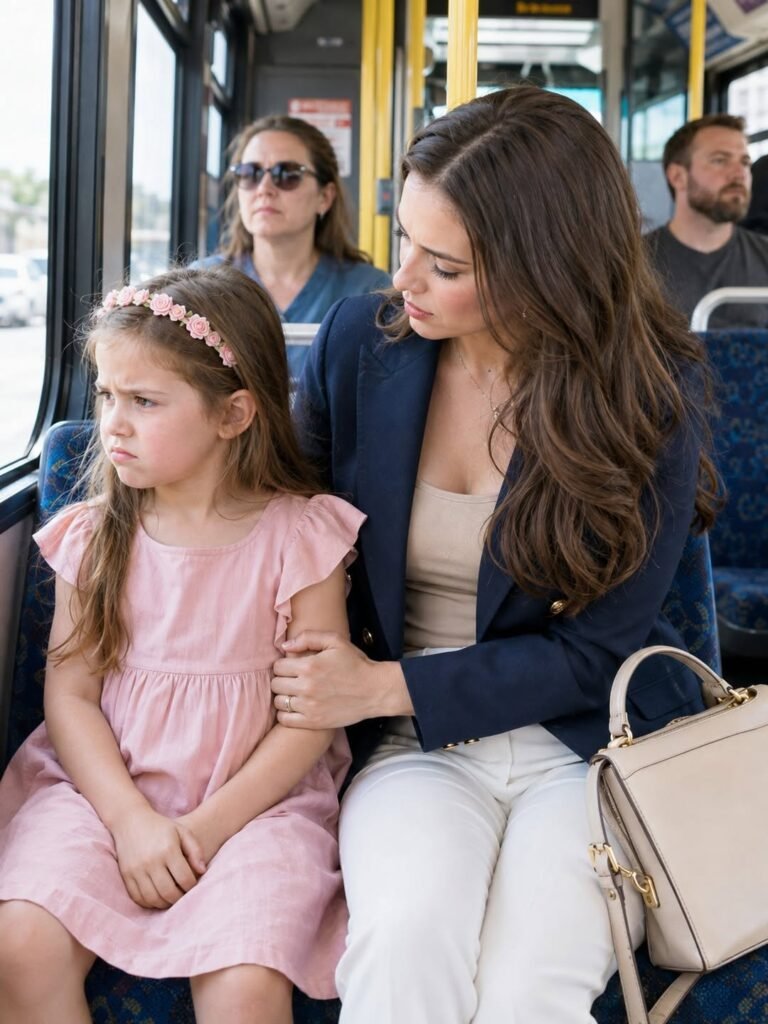
She was gray-faced, gripping her backpack against her chest, staring out the window at the sidewalk as though something might rise up out of it.
“Please keep going to the next stop,” I heard myself say to the driver.
The doors sighed shut on the muttering, and the bus lurched back into traffic, and my daughter let out a long, shaking breath of pure relief.
I did not know yet that those doors closing were the single most important thing I would ever do for her.
I have gone back to that instant a thousand times, because everything turned on it, and because I came so close to getting it wrong.
The pull to pull her off that bus was enormous, and I want to be honest about where it came from, because I think it lives in a great many of us.
It was not that I did not love my daughter.
It was that I had been trained, my whole life, to rank a stranger’s mild inconvenience above my own child’s distress — to read a crowded bus full of glaring commuters as a jury I owed a smooth exit, and my daughter’s fear as an embarrassment to be managed before it drew any more eyes.
We teach mothers this without ever saying it aloud: that a good mother is one whose child does not make a scene, whose child is quiet and easy and does not inconvenience the adults around her.
And a child who has absorbed that lesson learns, in turn, that her feelings are a burden to be swallowed, that speaking up is selfish, that the highest virtue is to be no trouble.
Abigail had not yet fully learned it.
That was what saved us — that she was still young enough, still brave enough, to say the frightening thing out loud in a public place full of strangers, before the training took.
And I was, by the grace of something I still cannot name, just barely present enough in that moment to hear her over the noise of everyone else’s impatience.
If I had done what a lifetime had trained me to do — smiled at the strangers, pulled her down the steps, whispered don’t make a scene — we would have walked straight home to the man waiting there for us.
The whole rest of this story, every part of it, hangs on the fact that for once, in a doorway, with a bus full of people willing me to move, I chose my daughter’s fear over their convenience.
Chapter 2 — What She Heard
When she could speak, it came out in a small, careful voice, the voice of a child reporting something she does not understand but knows is wrong.
“Last night I woke up because I wanted water.
And Gregory was standing in my room, by the closet, talking on his phone.” I made myself breathe.
“What did you hear him say, honey?” “He told someone they could take the kid later,” Abigail whispered.
“But first he needed to get the mother’s signature on the papers.
And then he said the apartment was clear because I officially live with Grandma.” I sat very still while the words arranged themselves into something I did not want to see.
Because Abigail knew nothing about deeds, or powers of attorney, or the fact that her registration at my mother’s address — done years ago, for the school district and the clinic near Catherine’s house — was a legal detail.
To my daughter, “I live with Grandma” meant only that her school was near Grandma’s.
She had no idea she had just repeated the load-bearing sentence of a criminal plan.
But I did.
And with it, a dozen conversations from the past eight months rearranged themselves in an instant, every one of them turning from innocent to sinister as I watched.
Gregory asking, so casually, who actually held the title to the condo.
Gregory wondering aloud whether my ex-husband still had any claim on it.
Gregory, more than once, asking why Abigail was registered at my mother’s.
I had thought he was taking an interest.
He had been taking inventory.
What undid me most, once I understood, was the innocence of how she’d carried it.
Abigail had not known she was reporting a crime.
She had woken up thirsty, seen a grown-up doing something that felt wrong in a way she couldn’t name, and filed it away with the quiet, careful watchfulness that children have and adults forget they ever had.
She could not have told you what a power of attorney was.
She did not know that “the apartment is clear because she lives with Grandma” was the keystone of a fraud.
She only knew that a man had been standing in her bedroom in the dark, talking about taking her, and that it had frightened her enough to hold onto for a whole day and finally say out loud on a bus.
Children are extraordinary witnesses precisely because they do not understand what they are seeing.
An adult overhearing that phone call might have rationalized it, explained it away, found the reasonable interpretation that let them keep their comfortable life intact — because adults are very good at not seeing what it would be expensive to see.
Abigail had no such filter.
She could not talk herself out of it, because she had nothing to talk herself out of it with.
She simply reported, faithfully, the frightening true thing, in the plain words of a child: he said they could take the kid, but first he needs the mother’s signature.
It was the most accurate account of the entire scheme that anyone gave in the whole affair, and it came from the one person at the table young enough to still say exactly what she saw.
Chapter 3 — The Call
My phone buzzed in my hand before I could finish the thought.
It was him.
“Where are you two?” Gregory asked, no greeting, a coldness in his voice I had somehow never let myself hear before.
“Abigail wanted water, so we missed our stop and stayed on,” I said, and I heard my own voice come out light and false.
There was a silence on the line, heavy and total.
“Don’t lie to me, Alison.
I watched your bus go past the stop.
I know you didn’t get off.” My heart slammed against my ribs.
“You were waiting at the stop?” “I came down to meet you,” he said, and the warm, easy charm I had loved for eight months was simply gone, peeled off like a sticker, and underneath it was something flat and hard.
“Turn around and come back.
Now.
And stop letting a little kid decide what grown adults do.” I hung up without another word.
And instead of turning around, I walked Abigail off at the next stop and straight into a bright, busy shopping center full of security cameras, and I called my mother.
Catherine listened to the whole thing without interrupting once.
“Do not go back to that apartment,” she said, in the steady voice I had needed my whole life.
“I’m coming to get you.
And you need to call Christopher, right now.”
Chapter 4 — Call Christopher
I hesitated over that, and I am not proud of the reason.
Because for eight months Gregory had worked, patiently, to convince me that my ex-husband was a danger — that Christopher was just waiting for me to slip so he could take Abigail away, that I should keep my distance, that Gregory was the only one truly on my side.
I had believed him.
That was the thing I would have to live with: that a stranger had spent months turning me against the one person who would drop everything to protect my daughter, and I had let him.
But standing in that shopping center with Abigail’s hand cold in mine, I dialed Christopher anyway.
He arrived in under an hour, and he did not say a single bitter word, did not mention the months of frost between us, did not make any of it about himself.
He knelt down and pulled our daughter into his arms and held her.
And then he stood and said, quietly, “Show me everything on your phone.” I understood, in that moment, exactly how thoroughly Gregory had lied to me about him.
Christopher had not been circling us waiting to pounce.
He had been a father, held at arm’s length by a man who needed him gone — and the reason Gregory had needed him gone was about to become horribly clear.
I understand now that the isolation was not a side effect of Gregory’s scheme.
It was the scheme, or the foundation of it, the first and most important thing he built.
Because a woman with people around her — an involved ex-husband, a sharp-eyed mother, a circle of friends who know her well — is a woman who is very difficult to rob.
Someone will notice.
Someone will ask the inconvenient question.
Someone will say, that contract doesn’t sound right, let me look at it.
So the very first work of a man like Gregory, long before any paperwork, is to thin the herd around his target — to become, gently and by degrees, the person whose judgment she trusts most, and then to use that trust to turn her, one careful conversation at a time, against everyone else whose judgment might contradict his.
He did not attack Christopher directly.
That would have been clumsy and obvious.
Instead he worried about me.
He noticed, sadly, how Christopher seemed to be positioning himself.
He wondered whether I should be so trusting.
He planted, over months, a low steady hum of doubt, always framed as concern for my wellbeing, until I had drifted far enough from the one man who would have protected me that I no longer even called him.
That is the terrible craft of it.
Gregory never once told me to cut Christopher off.
He simply made me want to, and made me believe it was my own idea, and made me grateful to him for the warning.
By the time I dialed Christopher’s number from that shopping center, I had to override eight months of careful conditioning to do it — which is exactly how well the conditioning had worked, and exactly why my daughter’s terror had to be the thing that finally broke it, because nothing smaller could have.
Chapter 5 — The Photo
It hit me all at once, standing there: my passport, the deed to the condo, Abigail’s birth certificate — all of it was still in the apartment.
With him.
As if he had heard the thought, a voice note arrived.
Gregory’s voice, smooth again, reasonable.
“I’ve put all your important documents somewhere safe so they don’t get misplaced.
Please don’t make a scene about this.” A minute later, a photograph.
Spread across my own kitchen table were my blue passport, the copies of my deed, my daughter’s birth certificate, and a thick contract flagged with little yellow sticky tabs.
And across the top of the main document, in bold: PROMISE OF SALE AGREEMENT.
Then a final text.
“Come back within ten minutes and sign, and stop listening to a child, or I’ll decide for myself how to save this family.” I looked down at Abigail, drawing on a bench with a pen from my purse, swinging her feet, and I understood that my eight-year-old had not had a bad dream.
She had overheard the truth.
Gregory was trying to sell my home out from under me — and from the sticky tabs, from the waiting contract, from the buyer the paperwork already named, it was plain that he did not intend to take no for an answer.
What I could not yet see was how much larger and colder the thing behind him really was.
But I could see enough, standing in that shopping center, to understand that the ground had shifted permanently.
Because it was not the threat itself that frightened me most — it was the paperwork.
A man in a rage might grab your documents.
A man who has laid out your passport and your deed and your child’s birth certificate on a table, and photographed them beside a contract already flagged with sticky tabs, already naming a buyer, already pricing your home, is not a man in a rage.
He is a man executing a plan that was in motion long before you noticed it.
The sticky tabs undid me.
They were so ordinary, so clerical, so patient — the little yellow flags a person uses to show someone where to sign, placed there in advance, in confidence, by someone who had never once doubted that I would eventually be standing where he told me to stand, pen in hand.
He had prepared for my signature the way you prepare for an appointment you are certain will happen.
And that certainty told me everything about how he saw me: not as a partner he was betraying, but as a formality he was processing, a name that needed to go on a line.
I looked at my daughter swinging her feet on that bench, and I understood that the warmth of the last eight months and the sticky tabs on that contract were not in contradiction.
The warmth had been in the service of the tabs the entire time.
Chapter 6 — Reclaiming the Apartment
We spent that night at the home of a friend whose address Gregory did not know.
Christopher stayed close.
And a family lawyer named Nadia Okafor told me, before anything else, to back up every screenshot, every audio clip, every thread — to make the record before anyone could touch it.
The next morning we went back to the apartment with police.
Gregory opened the door leaning against the frame, insolently calm.
“You brought the police over a lovers’ quarrel?” The folder was still on the kitchen counter, right where the photo had been taken.
Inside it the officers found a drafted power of attorney, the business card of a real estate agent named Stephanie, and a purchase contract pricing my home at thirty percent below what it was worth.
“It was going to be a surprise,” Gregory said, unbothered.
“Alison’s been talking about moving somewhere nicer for months.” “Saying I’d like to move someday,” I said, “is not the same as authorizing you to sell my home.” As they searched, the officers turned up more: photographs of the building’s floor plan, copies of my ID, sticky notes with the addresses of notary offices around the city.
They made him pack a bag and leave, and that afternoon I paid a locksmith to change every lock on the door.
For a few hours, it felt like it was over.
It was not close to over.
Chapter 7 — The Nightmare Continues
The next afternoon, a bank transfer landed in my account.
One dollar.
The memo line read: “Don’t try to be smart.
You still need these papers.”
A few hours after that, Gregory appeared at my workplace with an armful of flowers, and in front of my coworkers he arranged his face into something wounded and warm.
“Your bitter ex-husband is poisoning your mind, Alison,” he said, loud enough for the whole office to hear.
“All I ever wanted was to give our family a better home.” When I turned toward the security desk to have him removed, he leaned in close, and under his breath, in a voice only I could hear, he said: “You should be very careful about making Abigail a part of this.” He meant it to frighten me, and it did.
But my phone was in my hand, recording, and it caught every word.
That was the moment the fear in me began, at last, to turn into something more useful.
He had just made a threat toward my child, on tape, and I was no longer a frightened girlfriend.
I was a woman building a case.
That shift, from fear to record-keeping, was the single most important thing that happened inside me during the whole ordeal, and I recommend it to anyone who ever finds themselves where I was.
Fear is a state that a man like Gregory can use; it is, in fact, the exact fuel his whole method runs on.
A frightened woman freezes, complies, second-guesses herself, keeps quiet to avoid making things worse.
But the moment I stopped experiencing his menace as something happening to me and started experiencing it as evidence being handed to me, the entire power dynamic between us quietly inverted.
Every threat he made became a deposit in a file.
Every appearance at my workplace, every whispered warning, every reasonable-sounding lie told loudly in front of witnesses, was no longer a wound — it was documentation, dated and captured, building toward the day a stranger in a robe would hear it all played back.
He did not understand that this had happened.
He kept performing his menace as though it still worked, as though I were still the woman he had spent eight months softening, and all the while I was letting him narrate his own case against himself into a phone in my bag.
There is a particular strength that a person can find on the far side of fear, and it is not the strength of not being afraid — I was afraid the whole time — but the strength of having something to do with the fear, a task, a method, a way of turning the thing that was meant to paralyze you into the thing that will eventually undo him.
I stopped bracing against Gregory’s threats and started collecting them.
And a man who is threatening a woman who is calmly collecting his threats is not, though he does not yet know it, in charge of anything at all.
Chapter 8 — Colette
That week, Nadia found something that changed the entire shape of the thing.
She located a woman named Colette, and the moment Colette was shown a photograph of Gregory, she went still.
“When I knew him,” Colette said, on a quiet phone call, “he called himself Beckett.” She had been raw from a hard breakup when he appeared in her life.
He had made himself indispensable — around the house, in her days, in her plans for the future — and then, at just the right moment, a real estate agent had materialized to press her, gently and then not so gently, into selling her home.
The agent’s name, in Colette’s story, was also Stephanie.
And the buyer named on Colette’s old paperwork was the same man named on mine: Raymond.
I sat with the phone against my ear and felt the ground shift under everything.
This was not a boyfriend who had turned out to be a thief.
This was an operation.
A practiced, patient, repeatable machine that selected divorced and lonely and exhausted women, earned their trust over months, worked its way to their private documents, and then maneuvered them into signing away their homes.
Gregory was not a man who had stopped loving me.
He was a man who had never started — who had run a script on me, the same script, word for word, that he had run on Colette, and on how many others none of us yet knew.
There was, strangely, a kind of grim comfort in learning that — not at the scope of it, which was horrifying, but in the way that shared suffering dissolves shame.
For the days between understanding what Gregory was and finding Colette, I had been drowning in a private humiliation, certain I was uniquely foolish, that some weakness in me had let this happen, that other women would have known better.
And then here was Colette, a stranger on a phone line, describing my own relationship back to me in her own words — the same becoming-indispensable, the same talk of a shared future, the same agent appearing at the same moment — and I understood that I had not been singled out for my foolishness.
I had been selected for my circumstances, by a professional, using a method refined on women before me.
The sameness was the proof of my innocence: you cannot both be a uniquely gullible fool and the interchangeable output of a repeatable process.
Gregory had counted on each of us feeling alone, singular, ashamed, because a woman who believes she is the only one this happened to stays quiet — does not compare notes, does not go to the police for fear of looking stupid.
The isolation was not just how he ran the con.
It was how he kept it running, victim after victim, each of us sealed in her own private embarrassment.
And what broke it was Colette agreeing to speak, and then another woman, and then another, the sealed rooms opening one after another, until what each of us had carried alone became a case no jury could look away from.
Chapter 9 — Every Gesture
The nausea came in waves that week, because with the shape of it clear, I could not stop re-seeing our whole relationship through it.
The slow Sunday breakfasts.
The evening walks.
The little wooden shelf he had put up in Abigail’s room, standing back to admire it, asking if she liked it.
I had read every one of those as tenderness.
Now I understood that a man searching a home for where the deeds are hidden has excellent reason to spend an afternoon in the closets, and that a man who wants a mother relaxed and unguarded has excellent reason to make her breakfast.
Not one gesture had been real.
Every kindness had been a line item in a budget, an investment toward a signature.
And the part that Nadia made me sit with, because she saw me starting to turn it on myself, was this: that he had not chosen me because I was stupid.
He had chosen me because I was tired.
Divorced, overworked, raising a child alone, aching for someone to share the weight — I had been, on paper, an ideal target, and he had read the paper carefully.
“He weaponized the best thing about you
That is his crime, not yours.”
I did not believe her, at first.
That is the cruelest afterlife of being conned: the con does not end when the con man is caught.
It moves inside you and keeps running, in the form of a voice that says you should have known, that the signs were there, that a smarter or more careful or less needy woman would have seen through him.
I spent many nights with that voice, taking apart every month of the relationship, hunting for the moment I should have caught it, punishing myself for every kindness I had accepted at face value.
And what Nadia helped me understand, slowly, over more than one conversation, was that the voice had the whole thing backward.
The signs were not there to be missed.
That was the entire design.
A competent predator does not leave signs; he spends months, at real effort and expense, making sure there are none — that every gesture reads as love, that every question reads as interest, that the trap is indistinguishable from a gift right up until it closes.
To “see through” that, I would have had to approach the man who cooked me breakfast and fixed my daughter’s shelf as a suspect, to audit the affection of someone who had given me no reason to doubt him, to be, in other words, a person incapable of being loved at all — permanently guarded, permanently suspicious, permanently alone.
That is not wisdom.
That is just a different kind of prison, and it is the prison these men would sentence every trusting woman to if we let their crimes teach us that trust itself is the mistake.
It is not.
The mistake was his, entirely his, the choice to take a good and ordinary human capacity — the willingness to believe someone who says they love you — and turn it into a crowbar.
I will not give up that capacity to protect myself from the next Gregory.
I will only, now, watch more carefully for the one thing that actually gave him away, which was not any flaw in me.
It was my daughter, telling the truth.
Chapter 10 — The School
The worst call came Thursday, from Abigail’s school, and I want to say at the outset that my daughter was safe the entire time, because the people around her did their jobs.
“Mrs.
Alison,” the principal said, tight and careful, “a woman came to the front office a few minutes ago with a note she says you signed.
It claims you were in a serious car accident, that you’re hospitalized, and that Abigail is to be released to her right away.” The floor tilted under me.
“Where is my daughter?” “In my office, with the door locked.
We did not release her.
We do not release a child to anyone without hearing your voice first, and the note gave me a bad feeling.” I have thanked that woman in my heart every day since.
The forged signature at the bottom of that note, they told me later, was nearly a perfect match for my own — traced, practiced, good enough to fool almost anyone.
But the school had a rule, and the rule did not care how good the forgery was, and the rule kept my child in a locked office with an adult who would not hand her over.
Security footage caught a blonde woman I did not recognize walking fast away from the entrance once she was refused.
She had come for my daughter with a piece of paper, and a locked door and a stubborn principal had been enough to stop her.
This time.
I want to stay on that a moment, on the locked door and the stubborn principal, because in a story with so much cunning and cruelty in it, they are the part I hold onto.
That principal did not know anything about Gregory, or the fraud ring, or the deed, or any of it.She knew only that a woman had appeared with an alarming story and a note, and that her school had a rule — a boring, inflexible, bureaucratic rule that a child is not released to anyone, ever, on the strength of a piece of paper, without the parent’s own voice on the line.
The forgery was good.
The story was plausible and frightening; a mother in a car accident, a child who needed collecting.
A softer-hearted or more easily rushed person might have let the urgency override the rule.
She did not.
She followed the boring rule, and the boring rule was a wall, and the wall held.
I have thought a great deal, since, about how much of what protects our children is exactly that — not heroics, not intuition, but ordinary people quietly refusing to bend ordinary safeguards under pressure.
The systems that guard kids are made of small stubborn rules like that one, and they only work if the people holding them are willing to be, in the moment, a little rigid, a little inconvenient, a little unwilling to be charmed or hurried.
That principal was all three, on the one afternoon it mattered most, on behalf of a child who was not even hers.
I will be grateful to her for the rest of my life.
And I have tried, ever since, to be that kind of stubborn myself — the kind that would rather be wrong and cautious than agreeable and sorry.
Chapter 11 — The Protection Team
That night Abigail sat at the kitchen table wedged between her father and me, looking from one of us to the other with those wide, careful eyes.
“Are you both going to stay together tomorrow too?” she asked
Christopher looked at me across the table, and then at her, and nodded.
“As your parents?
Yes.
We’re always going to stand together.” She considered this with great seriousness, and then folded her small hands on the table and said, with a little smile, “So we’re on Abigail’s protection team.” Neither of us corrected her, because there was nothing to correct.
That was exactly what we were, and it was the first time in longer than I could remember that Christopher and I had been on the same side of anything, and it had taken a monster to put us there.
I looked at my ex-husband over our daughter’s head — the man a stranger had spent months teaching me to fear — and understood that the safest place in the world for Abigail was the two of us, together, refusing to be divided.
Which was, of course, exactly the thing Gregory had worked so hard to prevent.
He had not tried to keep Christopher away out of jealousy.
He had tried to keep him away because two parents who stand together are very hard to rob.
I have turned that phrase of Abigail’s over many times since — Abigail’s protection team — because in her innocent, literal way she had named the exact thing that saved her, the thing Gregory had spent eight months trying to prevent.
A child protected by two parents who are aligned is protected in a way that is more than doubled, because it is not just two adults but two adults who cannot be played against each other, who compare notes, who catch what the other misses, who present a united front that a manipulator cannot slip a wedge into.
That was what Gregory feared, and rightly.
It is why his very first project, before the deed or the documents or any of it, had been to drive Christopher and me apart — to make me see my daughter’s own father as a threat, so that the strongest wall around her would come down before he ever went to work on the rest.
And the tragedy of the years before all this was that he had not needed to work very hard, because Christopher and I had already been doing his job for him, letting our divorce curdle into a low cold war, each of us so busy being wounded by the other that we had left our daughter’s protection team disbanded and undefended.
It took a criminal to reassemble it.
I am not glad of what happened.
But I am glad, fiercely and permanently, that it put me back on the same side as the one other person on earth who loves my daughter the way I do — and that Abigail, at the kitchen table that night, got to look up and see both her parents, together, and give the arrangement its true name.
Chapter 12 — The Appointment
Gregory summoned me, at last, to a meeting — to “settle the property dispute,” he said, “before it escalates.” The police knew every detail in advance.
I walked in with a recorder running in my handbag.
The address took me to the second floor of a run-down industrial building, wedged between an auto shop and a tile warehouse.
There was no notary’s plaque, no reception desk, nothing but a sheet of printer paper taped to the wall reading STRICTLY BY APPOINTMENT ONLY.
And standing in that grim hallway, I understood the truth of it.
They had never meant to take me to a real notary.
They meant to get me alone in a room, frighten me into signing a power of attorney, and push the sale through crooked channels afterward
It was a trap dressed as a negotiation.
What I did not know — what none of us in that building knew yet — was that at the very moment I was walking through those doors, the same blonde woman from my daughter’s school was walking up the front steps of my mother’s house.
And this time, she knew exactly where Abigail was.
Chapter 13 — The Office
Stephanie opened the door in a tailored suit and a smile that never reached her eyes.
“So glad you finally decided to be a rational adult, Alison.” Inside sat Gregory and Raymond, and on the table lay a fat folder, a gold pen, and a receipt falsely claiming I had already accepted a cash advance for my home.
“I’m here to listen,” I said, keeping my arms folded.
“You’re here to fix the mess you made,” Gregory snapped.
Stephanie slid the power of attorney toward me.
“One signature, and I handle all the rest.
The buyer has set aside capital and taken losses because you changed your mind.” I did not touch it.
“Where’s the original agreement showing I ever agreed to sell?” Her smile flickered.
“And which account is the money going into?
Mine?” “That will be decided later,” she said smoothly.
Gregory’s palm came down on the table hard enough to make the papers jump.
“Stop playing lawyer!
You’ve complained about that apartment for a year!” “Wanting a new home,” I said, “does not give you the right to steal my old one.” I turned to Raymond, who was sweating.
“Explain why the same agent who tried to take Colette’s house is running this one.
And why a woman tried to pull my daughter out of school yesterday with a forged note.” Stephanie’s composure cracked at last.
“Don’t bring the child into this.” “My daughter,” I said, “is already in this.
You put her in it.” And Gregory came around the desk, the loving mask gone entirely, and took my wrist in a hard grip, and said, low, that I should think very carefully — that children left unattended sometimes end up in places their mothers never meant them to be.
I reached into my open bag with my free hand and pressed the panic button on my phone.
Chapter 14 — The Confession
The door came in with a crash.
Christopher first, then two officers who had been watching from the street.
“Get your hands off her.” Gregory let go and raised his palms, reasonable again in an instant.
“A misunderstanding, officers.
A private conversation about our relationship.”
“Holding a fraudulent power of attorney and a fake receipt while threatening a child,” the lead officer said, “is not a conversation.” Stephanie tried to slide the folder into her briefcase and was told to step back from the desk.
And then Christopher’s phone rang — my mother — and he put it on speaker, and Catherine’s voice filled the room: “Christopher, that blonde woman from the school is on my porch, asking about the deed.
Abigail is inside with me, safe.
I’ve locked every door and window.” Raymond went the color of paper.
The officer turned on him.
“Who is that woman at the grandmother’s house?” And Raymond broke, all at once, the way a man breaks when he realizes which crime he is about to be charged with.
“I bought in for a discount property to flip, that’s all — I never signed up to kidnap a little girl!” The room went silent.
“They said they’d only use the kid to scare the mother into signing,” he babbled.
“Renata picks her up, holds her at a rented apartment a few hours, they call the mother for the signature, and then the girl goes home and everyone walks away rich —” Gregory lunged at him and the officers put Gregory on the floor.
“He’s lying!
I love Alison!
Her ex set this whole thing up to get her back!” I did not move, and I did not cry.
Every piece had just clicked into place.
It is a strange, cold clarity, the moment a story you have been living inside turns inside out and shows you its real shape.
In the space of Raymond’s confession, eight months of my life rearranged themselves one last time, and everything that had confused me became obvious.
I understood, at last, why Gregory had worked so hard and so patiently to make me fear Christopher — not out of any jealousy, but because a devoted father was a structural problem for the scheme, a second adult who would notice, who would ask, who could not be charmed or isolated the way I could.
I understood why he had asked, over and over, in that mild curious way, about Abigail’s registration at my mother’s address — not out of interest in her school, but because a child officially domiciled elsewhere was a box that needed checking before a home could be quietly sold.
I understood why he had spent those long afternoons reorganizing the master closet, which I had found so touching, so domestic — because that was where I kept the deed, and he had been looking for it.
And I understood the final, worst thing: that when it became clear I would not sign over my home for love, when the affection failed to produce the signature, he had simply moved to the next tool in the kit, and the next tool was my daughter.
He had looked at an eight-year-old child and seen leverage.
That was the whole of what he was, under all the breakfasts and the walks and the shelf on the wall.
Not a man who had loved me and gone wrong.
A man who had never seen either of us as people at all — only as an address, and the obstacle standing in front of it.
Chapter 15 — She Saved Us
Ten minutes later Christopher’s phone rang again.
They had picked up Renata two blocks from my mother’s house.
In her bag: a copy of the forged school note, the key to an apartment she had rented for the afternoon, and a string of texts from Stephanie telling her exactly when to take the child.
Abigail had seen none of it.
My mother had kept her in a back bedroom the whole time with a stack of cartoons, and to this day my daughter does not know how close it came, and I intend to keep it that way until she is grown enough to hear it as a story about her own courage rather than her own danger.
My legs gave out and I sat down hard in a plastic chair, and Christopher crouched in front of me and took my cold hands.
“She’s safe, Alison.
Abigail’s safe.” “I know,” I said.
“You listened to her in time.” I shook my head, because that was not quite the truth of it, and the truth mattered.
“No,” I said.
“She saved us.
All of us.” Because she had.
In the weeks that followed, investigators pulled apart a whole web — photos of other women’s homes, forged IDs, template contracts — and Colette’s statement brought other victims out of the silence they’d been living in.
The structure came clear: Gregory the charming front man who got in the door, Stephanie the one who drew up the papers, Raymond the money, Renata the one who did the dangerous physical work.
Four people, one machine, and a great many women who had been made to feel they were the only fool it had ever happened to.
“He didn’t pick a foolish woman,” Nadia said to me again, when I could not stop blaming myself.
“He picked an exhausted one.
There’s a difference, and the difference is not your fault.”
There was one more thing that came out of that terrible season, and it is the thing I did not expect and would not trade.
Christopher and I found each other again — not the way you might imagine, not in some sudden rush of rekindled romance, but slowly, sidewise, in the ordinary work of standing on the same side of a shared fear.
For two years after our divorce we had let every interaction curdle into an argument; we had become, to each other, the sum of our old grievances, two people who could not be in a room without relitigating the marriage.
And Gregory had read that estrangement like a weather report and moved into the gap it left.
But when the danger came, all of that fell away as if it had never mattered, because it turned out it never had — not against this.
Faced with a real threat to our daughter, Christopher and I discovered that underneath two years of pettiness we still shared the one thing that had always been solid: we would both, without hesitation, walk into fire for Abigail.
That was the ground we rebuilt on.
Not the romance first, but the alliance — two parents who had remembered, under pressure, that they were on the same team and always had been.
I have since thought that this was Gregory’s final, unintended gift, the one thing he did for us by accident while trying to destroy us: he frightened Christopher and me back into being partners.
He had spent eight months prying us apart because two parents united are hard to rob.
And in the end, it was exactly that — two parents united — that he ran into, and broke against, and could not get past.
Chapter 16 — Say It Louder
Abigail changed, after.
For weeks she checked her closet every night before she could sleep.
She asked, more than once, whether Gregory had a secret key.
She asked whether a stranger could really take her just by saying her mother was in the hospital.
Christopher and I gave her the same answer every time, until it was worn smooth as a stone.
“No one is ever allowed to take you without our word.
And if anything ever scares you, you say so right away — even if a grown-up gets upset, even if you think you might be making a big deal out of nothing.” One night she looked up at me and asked the question that went through me like a wire.
“What if I say it and nobody believes me?” And I thought of a crowded bus, and angry strangers, and how close I had come to pulling her down those steps.
“Then you say it again, louder,” I told her.
“And you keep saying it, louder and louder, until you find someone who listens.
And I promise you that I will always be someone who listens.” Months later the case went to trial, and the mountain of it spoke for itself: the recorded threats, the one-dollar transfer with its written extortion, the forged note, the rental receipt, Stephanie’s texts, Colette’s testimony, Raymond’s confession, Renata’s phone.
And Abigail’s deposition, taken with a child psychologist so she never had to sit in that room — her small clear voice coming through the speaker: First he needs the mother’s signature, and then the kid can be taken later. I closed my eyes and wept, because those words no longer sounded like a frightened child.
They sounded like the sentence that had stopped a monster.
Gregory got a long sentence as the mastermind; Stephanie and Renata went away for the extortion and the attempt on my daughter; Raymond cooperated and was held to account for the fraud.
As they led Gregory out, he turned to me.
“Alison — you know I’d never have let anyone hurt her.” “You turned an eight-year-old into a bargaining chip to force my signature,” I said, and my voice did not shake.
“You didn’t need your own hands for it to be unforgivable.” “I loved you!” he called, at the door.
“No,” I said.
“You needed me to trust you.
They are not the same thing.” And I turned my back and walked out.
A year later — after a great deal of therapy, and a great many honest, difficult conversations — Christopher moved back in, not by pretending the past had not happened but by building something new on top of it.
Abigail set the only rule for the wedding that mattered: a giant chocolate cake, and both of us arriving on time for once.
That is exactly what we did, in my mother’s backyard, our daughter guarding the rings in a wooden box like state secrets.
And that night, home again, she ran to her room and threw open the closet and looked inside and walked back out and announced, to the whole apartment, “All clear!” I have thought since about what I used to believe being a good mother meant — having every answer, keeping control, never being fooled.
I know better now.
Sometimes it means only this: that in the noise of a crowded bus, with strangers glaring and your own face burning, you make the brave and simple choice to believe your child.
She found the courage, at eight years old, to say she was afraid to go home.
And for once, I did not talk her out of it.
That single decision saved our home, and our safety, and taught my daughter the truest thing I know — that her fear has a voice worth listening to, and that in a real family, no one ever has to suffer in silence just to keep the peace.I think, in the end, that is the whole of what I learned, and I would give it to every parent if I could.
We spend so much of our energy trying to protect our children from the world — the locks, the rules, the warnings, all of it necessary, none of it enough.
But the deepest protection I can give my daughter is not a lock.
It is the certainty, built into her before she can even reason about it, that when she says something is wrong, she will be believed — that her mother will not smile at the strangers and pull her down the steps, will not tell her she is exaggerating, will not rank the comfort of the adults in the room above the fear in her child’s chest.
Because the predators of this world do not, in the end, rely on locked doors failing.
They rely on children not being believed.
They count on the little girl being told she is making a big deal out of nothing, on her learning to swallow the frightening true thing to keep the peace, on the long training that turns a brave eight-year-old into a quiet, doubting, silent victim.
Gregory’s whole scheme, in the end, ran aground on the one thing he could not corrupt or forge or buy: a child who spoke, and a mother who, for once, listened.
That is the lock that actually holds.
Not the one on the door.
The one that opens — the open channel between a frightened child and a parent who will always, always believe her first and ask questions second.
I keep that channel open now like my life depends on it, because once, it turned out, all our lives did.