Forty Dozen Before Noon
Part One: The Coffee Can
The receipt was on her kitchen counter.
I saw it on a Sunday afternoon in late August, when I stopped by my mother-in-law’s farmhouse to drop off a pan of zucchini bread. She was out on the back porch snapping green beans into a dishpan. I set the bread on the counter next to the bread box, and that’s when I saw the slip of paper tucked under the edge of her sugar canister.
Pink. Carbon copy. The kind the feed store still uses because old Mr. Hartley refuses to buy a computer.
Hartley Feed and Seed. Account: D. Lund. Paid in full. $2,400.00.
I knew that number.
I knew it the way you know your own phone number, or your kids’ birthdays, or the price of a gallon of milk. I’d watched it grow in a coffee can on my kitchen windowsill all summer long.
Twenty-four hundred dollars.
That was my kids’ money.
My name is Amy Lund. I’m thirty-nine years old.
I live on twenty acres outside New Bremen, Ohio, in the flat, green farm country of the western part of the state. The land out here is so level you can watch your neighbor’s dog run away for two days. Corn and soybeans in every direction. Red barns. Church steeples. Grain elevators standing up against the sky like giants.
I’m a dental hygienist in Celina, three days a week. My husband, Jeff, manages the parts department at a tractor dealership in Minster. We have two kids.
Caleb was twelve that summer. Tall and skinny, with his father’s sandy hair and his father’s habit of saying very little and noticing everything. He’d started reading Louis L’Amour westerns at nine and never stopped.
Hannah was nine. Small, freckled, fierce. She had opinions about everything and announced all of them. She wanted to be a veterinarian, a professional softball player, and the president, in that order.
That summer, they wanted one thing.
To earn their own money.
Part Two: The Stand
My mother-in-law is Deanna Lund. Everyone in town calls her Dean. She’s sixty-eight.
She lives on the home place, two miles south of us on Kuether Road. A hundred and sixty acres that have been in the Lund family since 1893. Jeff’s father, Walt, farmed it until he died of a stroke three years ago. Since then, Dean has rented out most of the ground to a neighbor and kept twelve beef cows and a few acres for herself.
And every summer, for as long as anyone can remember, she’s grown sweet corn.
Three acres of it. In the field along the county road, right in front of the house. Peaches and Cream, mostly, and some Silver Queen for the late season. People drive out from Celina and Wapakoneta and St. Marys just to buy Dean Lund’s sweet corn.
She sells it from a little wooden stand at the end of her driveway. Walt built it in 1981. Painted white with a green roof. A hand-painted sign hangs from the front, faded but still readable.
DEAN’S SWEET CORN. $5 A DOZEN.
Dean’s knees got bad two summers ago. She couldn’t stand at the stand all day anymore. Couldn’t do the early-morning picking.
So in May, she called Jeff.
“Do you think the kids would want to run the stand this summer?” she asked. “They’re old enough now. Caleb especially.”
We had her over for supper that Sunday to talk about it.
I remember it clearly. Roast chicken and mashed potatoes and Dean’s own canned green beans from last summer. Iced tea in tall glasses. Dean sitting at the end of our kitchen table, where she always sits when she comes over.
She laid out the plan.
The kids would pick in the morning while it was cool. Run the stand from seven to one, six days a week. She’d show them how to pick, how to bag, how to count change.
“And whatever you make,” she said, looking right at Caleb and Hannah, “you keep.”
Hannah’s eyes went wide.
“All of it?” she asked.
“All of it,” Dean said. She smiled. “It’s time you two learned the value of hard work. Can’t learn that if somebody takes your money.”
She reached across the table and shook Caleb’s hand. Then Hannah’s. A real handshake. Firm.
“Deal?” she said.
“Deal,” the kids said together.
I remember that handshake. I remember the iced tea sweating on the table. I remember Jeff smiling at his mother like he hadn’t seen her smile in a long time.
There was no paper. Of course there wasn’t. You don’t write up a contract with your grandmother over roast chicken.
It was family.
Part Three: Five in the Morning
They started the first week of July.
Every morning, I’d set my alarm for four-forty-five. I’d stand in the kids’ doorways and flip on the lights. Caleb would groan. Hannah would bounce out of bed like it was Christmas.
By five, they’d be in the truck. By five-ten, I’d drop them at the end of Dean’s lane. They’d walk out into the corn in the gray morning light with five-gallon buckets, and I’d sit in the truck for a minute and watch them go.
You pick sweet corn in the cool of the morning. That’s the rule. Dean taught them that.
“Corn picked at noon tastes like cardboard by supper,” she said. “Sugar turns to starch in the heat. You want it cold off the stalk.”
So they picked in the cool. Down the rows, bent over, checking the silk. Brown and dry means ready. Green and wet means wait. Squeeze the ear. Feel for the fat kernels all the way to the tip. Pull down and twist.
By seven o’clock, they’d have forty or fifty dozen in the bins at the stand.
Caleb did the heavy work. He hauled the full buckets from the field, two at a time. He stacked the ears in bundles of thirteen, a baker’s dozen, the way Dean always did. He kept the stand swept and the bins full.
Hannah ran the money.
The cash box was an old green metal one, the kind with a little key and a handle on top. Walt bought it in 1981 along with the lumber for the stand. It sat on a shelf at the back of the stand, a little too high for a nine-year-old.
So Hannah stood on a bucket.
An overturned five-gallon pickle bucket from the restaurant supply store. She stood on it every morning for nine weeks, counting change, making small talk with customers, telling everyone who stopped that her grandma grew the best corn in Auglaize County.
They worked six days a week. Seven to one. Monday through Saturday. Sundays off because Dean said the Lord rested, so they could too.
Rain or shine. Heat or not. July in western Ohio can hit ninety-five with humidity so thick you can drink it. Some days the cars came one after another. Some days they sat for an hour without a single customer.
Five dollars a dozen.
At one o’clock, Dean would come out of the house and walk down to the stand. She’d count the cash box. She’d write the number in a little spiral notebook. Then she’d put the money in an envelope and hand it to Hannah.
“Good day,” she’d say. Or, “Slow day. Tomorrow’ll be better.”
Every afternoon when I picked them up, Hannah would climb into the truck holding that envelope like it was made of gold.
When we got home, the kids would go straight to the kitchen windowsill.
There was an old Folgers coffee can there. Red, with a plastic lid. Caleb had cut a slot in the lid with my kitchen scissors. Hannah had decorated it with stickers. Unicorns and baseballs and a sticker from the dentist that said I WAS BRAVE TODAY.
On a strip of masking tape on the front, in Caleb’s careful handwriting, it said: CALEB & HANNAH — CORN MONEY.
They’d count it every night after supper. Spread it out on the kitchen table. Fives and tens and twenties and a few ones. Hannah would sort the bills into piles by size. Caleb would write the total on a piece of notebook paper taped to the side of the refrigerator.
July 8 — $85. July 9 — $140. July 10 — $210.
By the end of July, it was over a thousand.
They had plans for that money.
Caleb wanted a used compound bow for deer season. A good one. He’d been looking at one on Facebook Marketplace for months. Three hundred and fifty dollars.
Hannah wanted to go to softball camp at Wright State in Dayton. A week in August next summer. Four hundred dollars.
The rest was going into savings. College, maybe. Or a car someday. Caleb had already done the math on how much he’d have by sixteen if they did this every summer.
Part Four: The Envelopes Stop
By the third week of August, the corn was nearly done.
The last of the Silver Queen was coming in. The stalks were going brown at the edges. The customers were thinning out as school got closer.
Hannah came home one afternoon without an envelope.
“Grandma said she’d settle up at the end,” Hannah said, climbing into the truck. “She said it’s easier to do it all at once.”
I didn’t think anything of it.
The next day, no envelope.
The day after that, none.
“Grandma’s keeping it,” Caleb said at supper that Thursday. “She says she’ll pay us at the end of the season. All of it together.”
Jeff nodded. “Makes sense,” he said. “Easier bookkeeping.”
On the last Saturday in August, the stand closed for the season.
Caleb and Hannah picked the last few ears. They swept out the stand. They wiped down the bins. They took down Dean’s faded sign and carried it up to the house to store in the garage for the winter.
Hannah carried the green cash box.
When I picked them up at one o’clock, they were sitting on the porch steps.
No envelope.
“Grandma said she’d bring it by,” Hannah said. “She said she had to go to town first.”
Caleb didn’t say anything. He was looking at the corn field. At the brown stalks standing in rows.
She didn’t bring it by.
Not that day. Not the next week.
Every night, Caleb looked at the paper on the refrigerator. At the numbers he’d written down. He’d kept track of every day, even after the envelopes stopped. He’d counted the dozens in his head.
Four hundred and eighty dozen. $2,400.
The coffee can on the windowsill held eleven hundred and twenty dollars. The money from the envelopes they’d gotten in July.
Dean had the rest.
Part Five: The Porch
So on that Sunday, when I saw the receipt on her kitchen counter, I knew.
Twenty-four hundred dollars. Hartley Feed and Seed. Paid in full.
The whole summer.
I picked up the receipt. I looked at it for a long time.
Then I set the zucchini bread on the counter, and I walked out to the back porch.
Dean was sitting in her rocker with a dishpan of green beans in her lap. Snapping. One bean at a time. Snap. Snap. Snap. The ends went into a paper grocery bag at her feet. The beans went into the pan.
She didn’t look up when I came out.
“Dean,” I said. “Can I ask you something?”
“Mm-hmm.”
I held up the receipt.
“The feed bill,” I said. “Twenty-four hundred dollars. Paid in full.”
Snap. Snap.
“Is that the corn money?” I asked. “The kids’ money?”
She kept snapping beans.
She didn’t stop. Didn’t look up. Didn’t even slow down.
“My corn,” she said. “My field. My name on that sign.”
Snap.
“They didn’t grow one ear of it,” she said.
“They picked it,” I said. “Every morning at five. They ran the stand six days a week. Hannah stood on a bucket for nine weeks.”
Snap. Snap.
“I fed that field all summer,” Dean said. “I bought the seed. I paid for the fertilizer. I hoed the weeds in June when my knees were screaming.”
She tossed a bean end into the paper bag.
“I did the work,” she said. “They just sold it.”
“You told them they could keep what they made,” I said. “At our table. You shook their hands.”
She finally looked up.
Her eyes were flat. Hard. The eyes of a woman who’d been keeping books for sixty-eight years and had never once let them come up short.
“I said they could keep what they made,” she said. “And they made five dollars an hour picking somebody else’s corn. That’s what I’d have paid a hired man. That’s what’s fair.”
She looked back down at the beans.
“The rest belongs to whoever grew it,” she said.
I stood there on her porch for a long time.
She felt she was owed. I could see it on her face. She truly believed it.
She’d bought the seed. She’d paid for the fertilizer. She’d hoed the weeds with bad knees. And in her mind, the kids had just been the help.
I did not scream.
I wanted to. Believe me, I wanted to. I wanted to throw that receipt in her dishpan of beans and tell her exactly what I thought of a grandmother who’d take money from a nine-year-old on a bucket.
But you don’t win that one.
Not out here. Not two women keeping books on a porch. Not with your husband’s mother. Not over corn.
I just set the receipt down on the porch railing.
“I hope your cows enjoy the feed, Dean,” I said quietly.
Then I walked to my truck and drove home.
Part Six: The Law
That night, after the kids were in bed, I sat at the kitchen table with my laptop.
I looked up the law. I read about verbal contracts in Ohio. About oral agreements. About small claims court in Auglaize County.
There was no paper. No written agreement. Only a handshake over iced tea at our kitchen table, with two children and two adults as witnesses.
Maybe I could have won. Maybe a judge would have listened to me and Jeff and the kids and said a deal was a deal.
But I sat there and thought about what that would look like.
Caleb and Hannah, in their church clothes, sitting in a courtroom in Wapakoneta. Raising their hands to swear to tell the truth. Testifying against their grandmother over twenty-four hundred dollars of sweet corn.
Dean, sixty-eight, widowed, with bad knees, sitting across the aisle.
They’d remember that longer than the money.
They’d remember it their whole lives. The year Mom took Grandma to court. They’d tell their own kids about it someday.
I closed the laptop.
Jeff came into the kitchen around eleven. He’d been in the garage, fixing the riding mower. He had grease on his hands and his face was tight.
He’d been quiet all evening. Ever since I told him about the receipt.
“You talked to her,” he said.
“I talked to her.”
He sat down across from me. He looked at the coffee can on the windowsill. At the stickers. At the masking tape label in Caleb’s handwriting.
“She did the same thing to me,” he said quietly.
I looked at him.
“When I was fourteen,” Jeff said. “I mowed every lawn on Kuether Road one summer. Eleven yards. Every week. Dad’s mower. I made almost nine hundred dollars.”
He rubbed his face.
“Mom held the money for me,” he said. “So I wouldn’t waste it. At the end of the summer, she said she’d put it toward my school clothes and my share of the electric bill.”
He was quiet for a moment.
“I never saw a dime,” he said.
“You never told me that,” I said.
“I never told anybody,” Jeff said. “Dad found out. They had the biggest fight I ever heard. Dad wanted her to give it back. She wouldn’t.”
He looked at his greasy hands.
“Dad paid me back himself,” he said. “Out of his own pocket. A little at a time. Fifty dollars here and there. Over two years. He never said a word to her about it after that.”
“Why does she do it?” I asked.
Jeff thought about it for a long time.
“Grandma Hofmann did it to her,” he said. “Mom grew up on a farm by Fort Loramie. Seven kids. Mom was the oldest girl. She ran her mother’s egg stand from the time she was eight.”
He looked at me.
“She told me once she never kept a single dollar,” he said. “Not one. Her mother said the eggs came from the family’s chickens, so the money belonged to the family. Mom said she didn’t own a pair of shoes that weren’t hand-me-downs until she got married.”
“So she’s doing to our kids what her mother did to her,” I said.
“She thinks it’s fair,” Jeff said. “She thinks that’s how it works. You don’t get paid for helping family. Family helps family.”
He stood up. He looked at the coffee can for a long moment.
“I let it go when I was fourteen,” he said. “I let it go because Dad paid me back and because I didn’t know how to fight my own mother.”
He turned off the kitchen light.
“I’m not letting it go this time,” he said.
Part Seven: Winter
But we did nothing all winter.
Jeff didn’t confront his mother. Neither did I. We didn’t know how. Every Sunday, Dean came to church and sat in her usual pew. Every other Sunday, she came over for supper. We passed the mashed potatoes. We talked about the weather.
Nobody said a word about the corn.
Caleb and Hannah stopped going to the home place after school.
They used to stop at Grandma’s on the bus ride home twice a week. She’d give them cookies and let them help with the cows. That fall, they stopped. When the bus went past her lane, Caleb would look out the window at the empty stand.
Dean noticed. I could tell. She stopped asking where they’d been.
The coffee can stayed on the windowsill.
Eleven hundred and twenty dollars. The money from July. Caleb didn’t buy the compound bow. Hannah didn’t sign up for softball camp.
“We should save it,” Caleb said in October, when I asked about the bow. “In case.”
“In case of what?” I asked.
He shrugged.
“In case somebody takes it,” he said.
That broke my heart more than anything Dean had said on the porch.
My twelve-year-old son, afraid to spend his own money. Because someone he trusted had taken it once.
Part Eight: The Question
Then, in February, Caleb asked a question at supper.
It was a Tuesday. Snowing outside. We were eating chili and cornbread at the kitchen table. Hannah was telling a long story about a girl in her class who’d brought a ferret to school.
Caleb wasn’t listening. He was staring at his chili.
Then he looked up.
“Dad,” he said. “Could we grow our own?”
The table went quiet.
Hannah stopped talking about the ferret.
Jeff put his fork down. Slowly.
“Grow our own what?” he asked. But he knew. We both knew.
“Sweet corn,” Caleb said. “Our own corn. In our own field. So nobody can say it’s theirs.”
Jeff looked at him for a long time.
Then he looked out the kitchen window. Out at the snow. Past the swing set and the woodpile and the machine shed.
“We’ve got the half acre behind the shed,” he said slowly.
The half acre behind the shed was where the old garden used to be. Back when the previous owners lived here. It had been grass for ten years. We mowed it in the summer and parked the boat trailer on it in the winter.
“It’d need to be plowed,” Jeff said. “And worked. Probably limed. The soil’s been sitting a long time.”
“I can do that,” Caleb said.
“You’d need seed,” Jeff said. “And fertilizer. And a way to water it in a dry spell.”
“We’ve got eleven hundred and twenty dollars,” Hannah said.
Jeff looked at his daughter. At her serious, freckled face.
“And then you’d need somewhere to sell it,” he said. “We’re on a gravel road. Nobody drives past here but the mail lady and the milk truck.”
Caleb thought about that.
“We’ve got a truck,” he said.
Jeff smiled. A slow smile. The first real one I’d seen on him since August.
“And we’ve got a truck,” he said.
Part Nine: Planting
We planted the last week of April.
Jeff borrowed a garden tiller from a buddy at the dealership. He and Caleb worked up the half acre on a Saturday in March, turning over ten years of grass and thatch. They spread lime and composted manure from a neighbor’s dairy barn. They tilled it again.
By April, the soil was dark and loose and smelled like spring.
Caleb did the research.
He went to the library in New Bremen and checked out four books on growing sweet corn. He read them all. He took notes in a spiral notebook. He drew a map of the half acre on graph paper, with every row marked and labeled.
He calculated how many seeds they’d need. How far apart to plant them. How many ears they could expect from a half acre if everything went right.
“Maybe three hundred dozen,” he said. “If we get rain.”
They bought their own seed.
Caleb and Hannah went with Jeff to Hartley Feed and Seed in New Bremen. The same feed store whose pink receipt had been sitting on Dean’s kitchen counter.
Old Mr. Hartley was behind the counter. He’s eighty-one. He’s run that store since 1968. He knows every farmer in four counties.
He looked at the kids. At the coffee can Hannah was carrying.
“What are you two buying?” he asked.
“Sweet corn seed,” Caleb said. “Peaches and Cream. And Silver Queen for late season.”
Mr. Hartley looked at the coffee can. He looked at Jeff.
He didn’t say anything for a long moment.
Then he went into the back room and came out with two bags of seed.
“That’ll be sixty-two dollars,” he said.
Hannah counted it out of the coffee can. Carefully. A twenty, two twenties, two ones.
Mr. Hartley wrote out a receipt. Pink. Carbon copy.
He handed it to Hannah.
Hartley Feed and Seed. Customer: Caleb & Hannah Lund. Paid in full. $62.00.
“Your grandma’s been buying her seed here for forty years,” Mr. Hartley said quietly.
Hannah looked up at him.
“I know,” she said. “This is ours.”
We planted on a Saturday.
The last week of April. Cool and bright. The four of us on our knees down the rows.
Jeff marked the rows with string and stakes, thirty inches apart, just like Caleb’s map. Caleb dug the furrows with a hoe. Hannah dropped the seeds, two at a time, eight inches apart. I came behind and covered them, patting the soil down with my hands.
It took all day.
By late afternoon, my knees were black with dirt. Hannah had mud on her face. Caleb had blisters on both palms from the hoe.
We stood at the end of the half acre and looked at it. Twenty-four rows of bare brown dirt. Nothing to see yet.
“Now what?” Hannah asked.
“Now we wait,” Jeff said.
Part Ten: The Sign
The corn came up in nine days.
Little green spears poking through the dirt in perfect rows. Hannah ran out every morning before school to count them.
They hoed weeds in May. They side-dressed with nitrogen in June. When July came in hot and dry, they dragged garden hoses from the house and watered by hand, row by row, in the evenings.
By the middle of July, the corn was taller than Jeff.
Jeff would not buy a sign.
I offered. There’s a sign shop in Celina that makes vinyl banners. Fifty dollars for a big one, bright colors, professional.
“No,” Jeff said. “I’ll make it.”
He lettered one himself on cardboard.
He took a big flat box from the appliance store in Minster. The box a refrigerator came in. He cut out one side, four feet wide and three feet tall. He painted it white with leftover house paint from the garage.
Then he sat at the kitchen table one night with a can of green paint and a brush and lettered it by hand.
It took him three hours.
SWEET CORN
The letters were a foot tall. Green. A little crooked. The R leaned to the right.
And under it, in smaller letters, he painted their names.
Grown by Caleb & Hannah Lund.
When he was done, he held it up for the kids to see.
Hannah clapped. Caleb just looked at it for a long time.
“Your names go on it,” Jeff said quietly. “Nobody else’s. Ever.”
Jeff didn’t want to sell on the county blacktop.
That’s where Dean’s stand was. Two miles south. People drove past it on their way to the lake. It would have looked like we were competing with her. Trying to steal her customers.
“Not the blacktop,” Jeff said. “Somewhere else.”
He thought about it for a week.
Then he called Chief Barnes.
Part Eleven: The Firehouse
The New Bremen Volunteer Fire Department sits right at the one four-way stop in town. Corner of Main and Monroe. Everybody in town drives past it at least once a day.
It’s a red brick building with two big bay doors. An engine, a tanker, and an old brush truck. A flagpole out front. A sign that says PANCAKE BREAKFAST 2ND SAT. ALL YOU CAN EAT $8.
Chief Dave Barnes has run the department for nineteen years. He’s sixty-two, a retired lineman from the electric co-op, with a gray buzz cut and forearms like Christmas hams.
He’s also Jeff’s old Little League coach.
Jeff called him on a Sunday night.
“Dave,” he said. “My kids grew sweet corn this summer. They need somewhere to sell it. Could they set up on your apron on Saturdays? Out of the truck?”
Chief Barnes was quiet on the phone for a moment.
“Your kids grew it?” he asked.
“Every ear,” Jeff said.
“Your mom’s still got her stand out on Kuether Road?”
Jeff paused.
“She does,” he said.
Another long pause.
“I heard something,” Chief Barnes said slowly. “Last fall. At the co-op. About the money from your mom’s stand. About the kids.”
Jeff didn’t say anything.
“Bring ’em Saturday,” Chief Barnes said. “Seven o’clock. Park right on the apron. I’ll move the brush truck.”
Part Twelve: Saturday Morning
We picked Friday night and Saturday morning at five, in the cool.
Caleb and Hannah, in their headlamps, out in the half acre with five-gallon buckets. Squeezing ears. Checking silks. Pulling down and twisting, the way their grandmother taught them.
They stacked them in baker’s dozens in old apple crates Jeff found at a farm sale. Thirteen to a bundle. Just like Dean always did.
By six-thirty, we had sixty dozen in the bed of the pickup.
We pulled onto the apron at a quarter to seven.
The big red bay door was standing open. Engine 1 sat inside, shining, freshly washed. The firefighters had come early for some reason. I counted five cars in the lot.
Jeff backed the truck onto the apron. He dropped the tailgate. He leaned the cardboard sign against the back bumper.
SWEET CORN. Grown by Caleb & Hannah Lund.
Hannah set up her bucket. The same overturned pickle bucket she’d stood on all last summer at Grandma’s stand. She’d brought it from home.
She climbed up on it. She set the Folgers coffee can on the tailgate beside her. The one with the stickers. She’d made a change box out of an old tackle box from the garage.
Caleb stood beside the crates with his arms crossed. Ready to haul.
Chief Barnes came out of the station with his coffee.
He was wearing his blue department T-shirt and a ball cap. He walked slowly across the apron toward the truck.
He looked at the crates of corn.
He looked at the leaning cardboard sign with its crooked R.
He looked at Hannah standing on her bucket.
“Look at this operation,” he said.
He reached into his shirt pocket.
He pulled out a five-dollar bill.
He held it out.
Not to Jeff. Not to me.
To Hannah.
“First bag’s mine,” he said.
Hannah took the five. She looked at it for a second.
Then she put it in the coffee can, and she picked up a baker’s dozen from the crate. Thirteen ears, tied with twine.
She handed it to the chief with both hands.
“Thank you for your business, Chief Barnes,” she said.
He took the corn.
He didn’t put it in his truck. He didn’t take it home.
He carried it into the bay. He walked past Engine 1, up to the front of the truck.
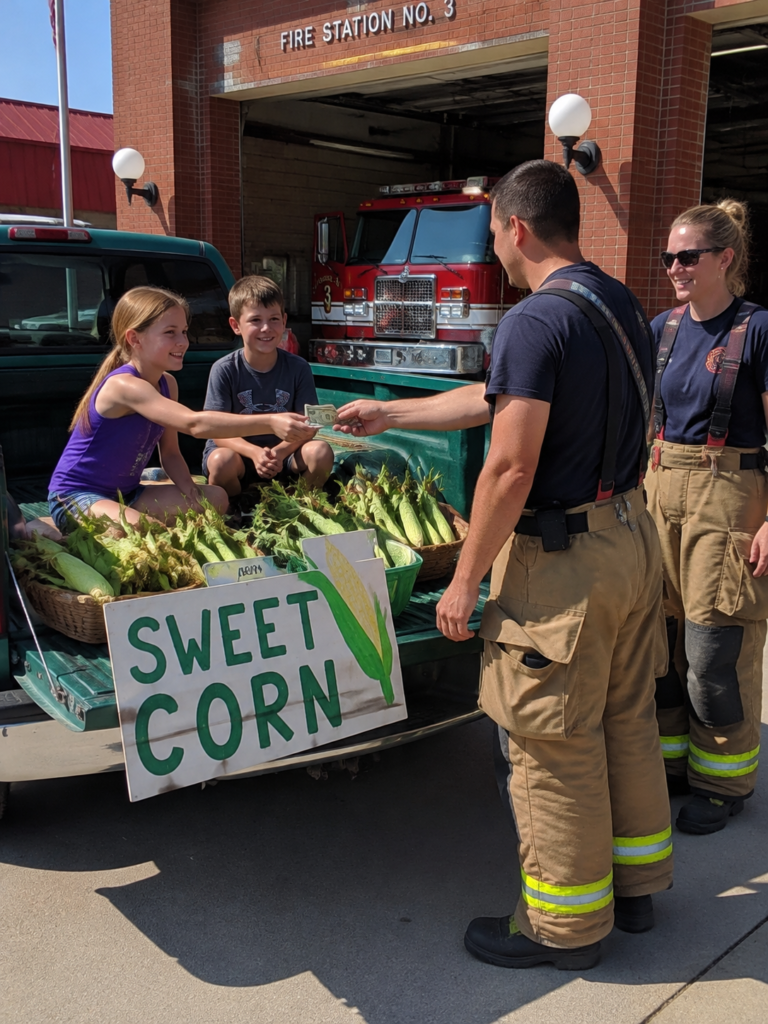
He set the corn right on the engine’s hood. Right in the middle. In front of the big chrome grille with NEW BREMEN FIRE in gold letters across the top.
Where the whole town could see it through the open bay door.
Part Thirteen: Everybody Came
The crew came first.
There were five of them. Volunteer firefighters. A plumber, a teacher, a farmer, a guy who worked at the Crown factory, and a nineteen-year-old named Tyler who’d just finished his EMT training.
They walked out of the station one at a time. Each one bought a dozen.
Then they took out their phones.
I don’t know who posted it first. Maybe Tyler. Maybe the teacher.
But by seven-thirty, there was a picture on the New Bremen Community Facebook page. A baker’s dozen of sweet corn sitting on the hood of Engine 1. A little girl on a bucket behind a pickup truck. A cardboard sign.
Stop by the firehouse this morning! These two kids grew their own sweet corn. $5/dozen. Chief bought the first one.
Then everybody came.
The hardware man came. Gene Moeller, who’s run Moeller’s Hardware on Main Street since his father retired. He bought two dozen and said his wife would kill him if he didn’t.
The church ladies came. Six women from St. Paul’s, in their aprons, on their way to set up the rummage sale in the church basement. They bought a dozen each. One of them, Mrs. Kremer, who was ninety, made Caleb carry hers to her car.
The mail lady came. The milk truck driver came. The high school softball coach came and talked to Hannah for ten minutes about her swing.
Cars started lining up at the four-way stop. People pulled over on Monroe Street and walked. Somebody brought their kids. Somebody brought their dog.
Hannah stood on her bucket the whole time. Counting change. Making small talk. Telling everyone, “We grew it ourselves. Behind our shed. My brother read four books about it.”
Caleb hauled. He never sat down once. Up and down from the truck bed, bringing fresh crates to the tailgate, carrying bags to cars for the old folks.
Jeff and I stood off to the side by the flagpole. We didn’t help.
The kids didn’t need us.
At ten o’clock, Jeff drove home and picked twenty more dozen. He came back with them at ten-forty.
They were gone by eleven-thirty.
At eleven-forty, Caleb came around the truck.
He was sweaty. His T-shirt was soaked. His hands were green from corn silk.
He walked right up to me.
“Mom,” he said. “We sold forty dozen.”
“Forty dozen?” I said.
He nodded. He couldn’t stop grinning.
“Before noon,” he said. “Forty dozen before noon. Hannah counted.”
He looked at the coffee can on the tailgate.
“That’s two hundred dollars,” he said. “In one morning.”
Part Fourteen: The Buick
That’s when the tan Buick turned off the highway.
I saw it coming from a block away. I knew that car. A 2006 LeSabre. Tan, with a dent in the back bumper from a deer on Route 66 in 2019. A Lund Family Reunion sticker in the back window.
My stomach dropped.
Grandma Dean parked it crooked.
Half on the apron, half in the street, angled like she hadn’t quite decided whether she was staying.
She sat in the car for a long minute.
Engine running. Hands on the wheel. Looking out the windshield at the pickup truck. At the cardboard sign. At the corn on the hood of Engine 1.
At her grandchildren.
Jeff saw her too. He went still beside me.
“Amy,” he said quietly.
“I know,” I said.
The engine turned off.
The car door opened.
Dean got out slowly. Her bad knees. She held on to the door for a second.
She was wearing her church dress. Blue, with little white flowers. She must have come straight from the rummage sale setup at St. Paul’s. The church ladies must have told her.
She walked across the apron.
Past the flagpole. Past the open bay door. Past Engine 1 with the corn on its hood.
She didn’t look at me. She didn’t look at Jeff.
She walked straight up to the tailgate.
The crowd went quiet.
Not all at once. But the people near the truck noticed. They knew who she was. Everybody in New Bremen knows Dean Lund. And by then, after the Facebook post, I think half of them knew the story.
The hardware man stopped talking. The church ladies stopped bagging. Chief Barnes set down his coffee.
Dean stood at the tailgate.
She looked at the cardboard sign. Grown by Caleb & Hannah Lund. She read it twice. I watched her lips move.
She looked at the crates of corn. Baker’s dozens. Tied with twine. Exactly the way she’d taught them.
She looked at Caleb, standing beside the truck with his arms crossed. He didn’t say anything. He just looked back at her.
Then she looked at Hannah.
My daughter. Standing on her pickle bucket. Behind the coffee can with the unicorn stickers.
Dean opened her purse.
She got out her little change purse. Black leather, worn at the corners. The one with the clasp that snaps. She’s had it as long as I’ve known her.
She opened it. She took out a five-dollar bill. She unfolded it carefully.
“I’ll take a dozen,” she said.
Her voice was not the porch voice.
It wasn’t hard. It wasn’t flat. It wasn’t the voice of a woman keeping books.
It was small. And it shook a little.
Hannah looked up at her from the bucket.
I held my breath.
I had not told my girl what to do.
I’d thought about it. Of course I had. All week, I’d wondered if Dean might show up. I’d thought about pulling Hannah aside and telling her what to say. Be polite. Be kind. Don’t say anything about last summer.
But I didn’t.
Because it wasn’t my corn.
It was hers.
Part Fifteen: What Hannah Did
Hannah looked at her grandmother for a long time.
At her blue church dress with the little white flowers. At her bad knees. At the five-dollar bill shaking a little in her hand.
The whole apron was silent. I could hear the flag snapping on the flagpole. A car idling at the four-way stop.
Then Hannah climbed down off her bucket.
She walked to the end of the tailgate. She looked through the crates. She took her time.
She picked out a dozen. Not just any dozen. She held up ears one at a time. She squeezed them. She checked the silk. Brown and dry. She felt for fat kernels all the way to the tip.
Thirteen ears. The best ones in the truck.
She tied them with twine. A double knot, the way Dean had taught her.
She walked back to her grandmother.
She held out the corn with both hands.
Dean held out the five.
Hannah didn’t take it.
“That’s five dollars, Grandma,” Hannah said. “That’s what it costs.”
She looked at the five-dollar bill. Then she looked up at her grandmother.
“But you don’t have to pay me,” she said.
Dean’s face went very still.
“Why not?” she asked quietly.
Hannah thought about it. The way she thinks about everything. With her whole face scrunched up.
“Because you taught us,” she said. “How to pick in the cool. How to check the silk. How to tie a baker’s dozen.”
She held the corn out a little further.
“Caleb read four books,” she said. “But you taught us first.”
Dean didn’t move.
She stood there at the tailgate of my husband’s pickup truck, in front of the whole town, holding a five-dollar bill.
Her chin started to shake.
“Hannah,” she said. “Honey. I took your money.”
The words came out cracked. Barely above a whisper.
“Last summer,” she said. “All of it. I paid my feed bill with it. I told your mother it was mine.”
Hannah nodded.
“I know,” she said. “Caleb kept count. Four hundred and eighty dozen.”
“I was wrong,” Dean said.
It was the first time I’d ever heard her say those words. In twelve years of being married to her son, I had never once heard Dean Lund say she was wrong about anything.
“I was wrong,” she said again. “Your grandpa would’ve been ashamed of me.”
Part Sixteen: The Envelope
Then Dean reached into her purse again.
She took out an envelope. A plain white envelope, the kind you buy at the drugstore. It was thick.
She held it out to Hannah.
“This is yours,” she said. “Yours and your brother’s.”
Hannah didn’t take it. She looked over at me.
I shook my head slightly. Your choice, honey.
She looked at Caleb.
Caleb came around the side of the truck. He stood next to his sister.
“What is it?” Caleb asked.
“Twenty-four hundred dollars,” Dean said. “The whole summer. Every dozen.”
She swallowed.
“I sold Walt’s tractor,” she said. “The old John Deere. The 4020. Sold it to the Brockman boy on Thursday.”
Jeff made a sound beside me.
That tractor had been his father’s pride. Bought new in 1971. Walt had restored it himself three times. It sat in the machine shed at the home place, polished, under a tarp. Dean wouldn’t let anybody touch it after he died.
“Mom,” Jeff said. “You didn’t have to—”
“Yes, I did,” Dean said.
She didn’t look at him. She kept looking at her grandchildren.
“Your grandpa paid your dad back,” she said. “When he was fourteen. When I took his lawn money. Did you know that?”
Caleb shook his head.
“Fifty dollars at a time,” Dean said. “For two years. Out of his own pocket. He never told me he was doing it. I found out after he died. In his checkbook.”
She wiped her eyes with the back of her hand.
“I’m not going to make anybody else pay my debts,” she said. “Not this time.”
Caleb looked at the envelope.
Then he looked at his sister.
They had one of those silent conversations that siblings have. A whole argument with nothing but their eyebrows.
Then Caleb nodded.
Hannah took the envelope.
She held it for a moment. Then she opened the Folgers coffee can and put the envelope inside. On top of the morning’s fives and tens.
She put the lid back on.
“Thank you, Grandma,” she said.
Then she held out the corn again.
“Now you have to take this,” she said. “Or it’ll go to waste. And you always say wasting corn is a sin.”
Dean laughed.
It came out wet and shaky. Half laugh, half sob.
She took the corn.
She held the thirteen ears against her chest. Against her blue church dress with the little white flowers.
Then she bent down, bad knees and all, and she hugged her granddaughter.
Part Seventeen: The Napkin
Dean stayed at the firehouse until one o’clock.
She sat in a folding chair Chief Barnes brought out from the station. In the shade of the bay door. Next to Engine 1.
She watched her grandchildren sell corn.
She didn’t help. She didn’t give advice. She didn’t tell them they were doing it wrong.
She just watched.
When a customer asked her, “Dean, is this your corn?” she shook her head.
“No,” she said. “It’s theirs. They grew it.”
Around twelve-thirty, the corn ran out.
Every crate empty. Sixty dozen sold. Plus the twenty Jeff picked at ten.
Eighty dozen. Four hundred dollars. In one morning.
Caleb came over and sat down on the apron next to his grandmother’s chair. Cross-legged on the concrete. He was sunburned and sweaty and grinning.
Dean looked down at him.
“Caleb,” she said. “Can I ask you something?”
“Sure, Grandma.”
“Would you two run my stand again this summer?” she asked. “In August? When my corn comes in?”
Caleb didn’t answer right away.
He looked at his sister, who was counting money in the coffee can.
He looked at me.
He looked at Chief Barnes, who was standing by the bay door with his coffee, pretending not to listen.
“Only if we write it down,” Caleb said.
Dean looked at him for a long moment.
Then she nodded slowly.
“That’s fair,” she said.
Chief Barnes went into the station. He came back with a paper napkin from the kitchen and a pen.
“Here,” he said. “I’ll witness.”
They wrote it on the napkin.
Caleb wrote it. In his careful handwriting, the same handwriting as the masking tape on the coffee can. Dean read every word over his shoulder.
AGREEMENT — DEAN’S SWEET CORN — AUGUST
Grandma Dean grows the corn. Caleb and Hannah pick it and sell it.
Grandma gets half. Caleb and Hannah get half.
Every day, the money gets counted at 1 o’clock and split right then.
Nobody holds anybody’s money.
Dean signed it. Deanna Lund.
Caleb signed it. Hannah signed it, with a little heart over the i.
Chief Barnes signed at the bottom. Witness: D. Barnes, Fire Chief.
Dean looked at the napkin for a long time.
“I never had anything in writing,” she said quietly. “With my mother. With the egg stand. I never knew you could ask for that.”
She looked at Caleb.
“You’re smarter than I was at twelve,” she said.
“I’m thirteen now, Grandma,” Caleb said.
She laughed.
“Smarter than I was at thirteen too,” she said.
Part Eighteen: The Stand
In August, the stand on Kuether Road opened again.
The same little white stand with the green roof. The same green metal cash box from 1981. The same overturned pickle bucket for Hannah.
But the sign was different.
Dean’s faded old sign still hung from the front. DEAN’S SWEET CORN. $5 A DOZEN.
But underneath it, Jeff hung a second sign. Cardboard. Hand-lettered. Green paint. The R still leaned a little to the right.
Picked & sold by Caleb & Hannah Lund.
Every day at one o’clock, Dean walked down to the stand with her bad knees and her spiral notebook. She counted the cash box with the kids. She wrote the number down.
Then she split it right there. Half in her envelope. Half in theirs.
Every day.
The napkin hung on her refrigerator. In a frame from the dollar store. Next to a pink receipt from Hartley Feed and Seed.
Not the twenty-four-hundred-dollar one.
The other one. Sixty-two dollars. Paid in full. Customer: Caleb & Hannah Lund.
Hannah gave it to her. She said Grandma should have it.
Part Nineteen: Walt’s Tractor
There’s one more thing.
In September, after the corn was done, Jeff drove over to the Brockman farm.
The Brockman boy is twenty-four. His dad, Larry, is a friend of Jeff’s from high school. Jeff knocked on the door and asked if he could talk about the tractor.
The old John Deere 4020 was sitting in the Brockmans’ machine shed. Still under Walt’s tarp. They hadn’t even started it yet.
“Jeff,” Larry said. “Your mom sold it fair. Six thousand. That’s a good price for a ‘71.”
“I know,” Jeff said. “I’m not here to complain. I’m here to buy it back.”
Larry looked at him for a long time.
“Your dad and I used to bale hay together,” Larry said. “Every summer. Back when we were kids. With that tractor.”
He looked at the shed.
“Your mom told me why she was selling it,” he said. “About the kids. About the corn.”
He scratched his chin.
“Tell you what,” he said. “Pay me what she paid me. Six thousand. You can do it over a year. Five hundred a month.”
Jeff paid him back over twelve months.
Five hundred a month. Out of his own paycheck. He didn’t tell his mother he was doing it.
Just like his father did.
The tractor’s in our machine shed now.
Under Walt’s tarp. Polished. Caleb starts it once a month to keep the battery charged.
Jeff says when Caleb turns sixteen, the tractor’s his. It’s in writing. On a napkin. Framed on our refrigerator.
Part Twenty: Next July
It’s July again now.
The half acre behind the shed is planted again. Twenty-four rows. Peaches and Cream and Silver Queen. Caleb read three more books over the winter. He’s trying a new variety this year called Ambrosia.
Hannah’s ten now. She’s still standing on the bucket. She says she doesn’t need it anymore, but she likes it.
Last Saturday, we pulled onto the firehouse apron at a quarter to seven.
The big red bay door was standing open.
Chief Barnes came out with his coffee. He looked at the crates. He looked at the leaning cardboard sign.
He pulled a five from his shirt pocket.
He held it out to Hannah.
“First bag’s mine,” he said.
She handed him a dozen.
He carried it into the bay. He set it on the hood of Engine 1.
The crew came. Then everybody came.
At eleven-thirty, a tan Buick turned off the highway.
It parked straight this time.
Dean got out. She walked across the apron. She wasn’t wearing her church dress. She was wearing her gardening clothes. Jeans and a faded T-shirt and a straw hat.
She stopped at the tailgate.
She got out her little change purse.
“I’ll take a dozen,” she said.
Hannah picked out the best thirteen ears in the truck.
She tied them with twine. A double knot.
She held them out with both hands.
Dean held out a five.
This time, Hannah took it.
“Thank you for your business, Grandma,” she said.
Dean smiled.
“Thank you for the corn,” she said.
Then she pulled a folding chair from the back seat of her Buick. She set it up in the shade of the bay door, next to Engine 1.
She sat down.
She watched her grandchildren sell their corn.
At one o’clock, when the last crate was empty, Caleb came around the truck. He was sunburned and sweaty and grinning.
He sat down on the apron next to his grandmother’s chair.
“Grandma,” he said. “We sold forty dozen before noon. Again.”
Dean reached over. She put her hand on his head. On his sandy hair, so much like Walt’s.
“I know,” she said. “I counted.”
I’ve thought a lot about that summer.
About the receipt on the counter. About the porch and the green beans. My corn. My field. My name on that sign.
About a woman who’d stood at an egg stand at eight years old and never kept a single dollar. Who grew up believing that’s how family works. That the work belongs to whoever owns the field.
She wasn’t a bad woman. She’d just never had anybody write it down.
And I think about the cardboard sign my husband lettered by hand at our kitchen table. With a can of leftover paint and a crooked R.
Not Dean’s Sweet Corn. Not Lund Family Farm.
Grown by Caleb & Hannah Lund.
Because the hardest thing to give a child isn’t money.
It’s their own name on something.
Something nobody can take.