Room for Everyone
Part One: The Red Line
I’ve been riding the Red Line in Chicago for twenty-six years, and I like to think I’ve seen everything a train car can hold. I’ve seen a man play a full set on a tuba between Belmont and Fullerton. I’ve seen a woman knit an entire baby sweater on her commute over the course of one winter, and when she finished it, half the car applauded. I’ve seen a wedding proposal, three fistfights, a lost parakeet, and once, at two in the morning, a priest and a drag queen splitting a bag of Garrett popcorn and arguing about the Cubs. What I’d never seen before that Saturday in October was the kind of quiet, deliberate meanness that wears a nice coat and tells itself it’s just taking up its fair share.
My name is Teresa Kowalski. I’m fifty-two years old, and I’m a charge nurse in the emergency department at a hospital on the South Side. I work Saturday days, seven to seven, and I take the Red Line from my apartment in Edgewater all the way down to work, forty minutes each way if nothing goes wrong. Twenty-six years of emergency nursing teaches you a few things. It teaches you to read a room fast. It teaches you that the people who are loudest about their pain are usually not the ones in the most trouble. And it teaches you to tell the difference between a person who’s taking up space because they don’t know any better and a person who’s taking it because they know exactly what it costs someone else.
That Saturday morning I’d gotten a seat near the middle doors of the sixth car, which is my car, the same one I ride every week, because it stops right at the stairs at Sox–35th. I had my coffee in a travel mug and a paperback mystery I’d been trying to finish for a month. The train was about two-thirds full: weekend riders, a few tourists with maps, some kids in Bears jerseys headed somewhere early, a man asleep against the window with his mouth open. It was a perfectly ordinary October morning, gray and cold off the lake.
I was sitting across from him when I first noticed.
He was a big man, broad through the shoulders, maybe forty, and well-dressed in a way that told you he wanted you to notice. Charcoal wool overcoat, open over a navy quarter-zip. Good jeans. Brown leather boots that had never seen salt or slush. He had a fresh haircut and a watch that caught the light every time he lifted his phone. He was scrolling something with his thumb and wearing the faint, satisfied expression of a man who has never once in his life wondered whether he was in anyone’s way.
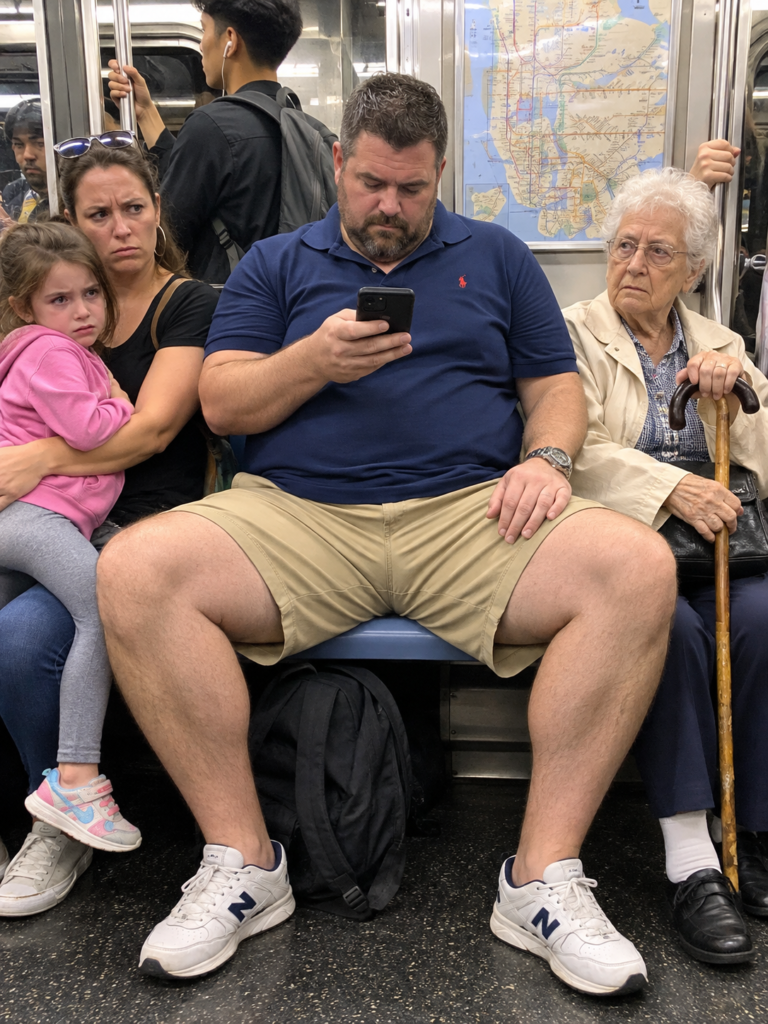
And his knees were spread so wide that the women on both sides of him were squeezed into half of their own seats.
I don’t mean a little. I mean he was sitting in the center of three molded plastic seats and occupying the better part of all three. His left knee pressed hard against the leg of a young woman holding a toddler on her lap, and his right knee jutted across into the seat of a middle-aged woman with a grocery tote, who had folded herself sideways against the pole like a closed umbrella. Both of them were trying, in the way women have learned to try, to make themselves smaller without making a fuss. The young mother had her son pulled tight against her chest and her own knees pressed together and angled toward the aisle, and still that big knee followed her, sitting heavily against her thigh as the train rocked.
I watched for two stops. I told myself it might be an accident. Some big men honestly don’t notice. My own late husband, God rest him, used to sprawl across our couch like a dropped coat and was always genuinely surprised to learn he was crushing somebody. So I waited to see whether the man would catch himself.
He didn’t. Every time the young mother shifted a fraction of an inch away from him, his knee drifted that same fraction to follow.
Part Two: “Then Stand”
The younger woman finally spoke. She couldn’t have been more than twenty-five, with her hair pulled back in a quick ponytail and a diaper bag hanging off one shoulder. Her son was maybe two, sleepy and heavy against her, sucking his thumb with his eyes half closed. She cleared her throat and said it politely, the way you’d ask a stranger to pass the salt.
“Excuse me. Could you move your leg?”
He barely looked up from his phone. “I’m a big guy.”
“Your knee is in my seat,” she said. Her voice was steady, but I saw her arm tighten around her son.
“Then move over.”
“There’s nowhere to go.” She nodded at the end of the bench, where the metal partition pressed against her other shoulder. She was already sitting on the last two inches of plastic.
He finally looked at her then, and he smirked. It was a small smile, almost lazy, the kind that tells you a person has had this exact conversation many times before and has always won it.
“Then stand,” he said.
He went back to his phone. The young woman looked at him for a moment, and I watched her decide that it wasn’t worth it, not with a two-year-old on her lap and a long day ahead of her. She looked out the window instead. Two stops later, at Roosevelt, she gathered up her son and her diaper bag and got off the train. I don’t know if that was really her stop. I suspect it wasn’t.
A tiny elderly woman with a cane took her place.
She had boarded at Roosevelt, moving slowly and carefully through the doors, and she must have been in her eighties: five feet tall at most, in a long camel-colored wool coat that had been beautiful once and was still very well kept, with a plum-colored beret pinned to her white hair and a church bulletin sticking out of her handbag. She leaned on a dark wooden cane with a brass tip, and she lowered herself into the open seat with the particular care of someone who has learned not to trust her hips.
Within seconds, his knee was pressing against her coat.
She noticed. I watched her notice. She shifted toward the partition, gathered her coat around her legs, tucked her cane against her shoulder. The knee followed. She looked down at it, and then she looked up at him with an expression I recognized from a thousand patients: polite, patient, and just a little bit disappointed in the world.
“Sir,” she said, “could you give me some room?”
He sighed, a long and theatrical exhalation, like she had asked him to carry her groceries up four flights. “I’m six-four,” he said. “Where do you expect my legs to go?”
She considered the question seriously, as if it deserved an answer. “Just,” she said, “in front of you?”
Part Three: Nobody Asked You
I couldn’t stay quiet anymore. Twenty-six years in the ER, and I have stood between a lot of people and a lot of bad decisions. My mouth was open before my better judgment had a chance to weigh in.
“She shouldn’t have to sit sideways,” I said, “because you want two seats.”
His head snapped toward me. For the first time he really looked at me: a short, round, gray-haired woman in navy scrubs and a puffy purple coat, holding a travel mug with a sticker on it that said World’s Okayest Nurse. I watched him dismiss me in about half a second. I’ve been dismissed by surgeons with better haircuts than his.
“Nobody asked you,” he said.
“She’s asking you,” I said.
A few people in the car had started paying attention. The kids in the Bears jerseys had stopped talking. A man in a Northwestern sweatshirt lowered his earbuds. The woman with the grocery tote on the man’s other side, still folded against her pole, glanced at me with an expression that was half gratitude and half please don’t make it worse.
He leaned back against the window and spread his arms along the top of the seat back, like he was settling into his own living room. “If she’s uncomfortable,” he said, loud enough for the whole car, “she can stand. Give her your seat if you care so much.”
And then the elderly woman started pushing herself up. She did it slowly, with her cane planted on the floor and her free hand on the pole, a tiny woman in her eighties getting to her feet on a moving train so that a forty-year-old man could have more room for his knees. I’ve seen a lot of things make me angry in my life, but I’m not sure I’ve ever been as angry as I was in that moment.
“No,” I said, and I said it in my charge-nurse voice, the one I use when a drunk in Bed Four is trying to pull out his IV. “Stay.”
She looked at me, surprised. Then, slowly, she sat back down.
The man laughed. He actually laughed, a short bark of a sound. Then he leaned back even further and spread his knees even wider, until the old woman’s coat was crumpled against the partition and the woman with the grocery tote was practically hugging her pole.
“What are you gonna do?” he said, grinning at me across the aisle. “Make me close my legs?”
Before I could answer, the train pulled into Cermak–Chinatown and the doors slid open. A huge man in a work jacket stepped on. I mean huge, six-six at least, built like a refrigerator, in a canvas Carhartt jacket stiff with drywall dust and a hard hat clipped to his belt. He looked like he’d come off an overnight shift and wanted nothing in this world but to sit down. The car was full except for one spot: the narrow sliver of seat between Mr. Big Guy’s right knee and the woman with the grocery tote.
The woman with the tote, God bless her, saw her chance. She stood up, smiled at the construction worker, and said, “Here, honey, take mine,” and moved to stand by the doors. The construction worker nodded his thanks, turned around, and sat.
Instantly, the knees snapped together.
I mean instantly. It was like watching a pair of garden shears close. One moment, Mr. Big Guy was sprawled across three seats with his arms along the backs like a king on a throne. The next, the construction worker’s thigh was pressed against his, and his knees had pulled in so fast I heard the fabric of his good jeans whisper. He put his arms down. He pulled his elbows in. He sat up straight. For two stops, all the way to Sox–35th, he somehow fit perfectly inside his own seat, as neat and compact as a schoolboy in the principal’s office.
He did not look at the construction worker once. He did not say a word about being six-four.
Part Four: The Smile
At Sox–35th the construction worker got off, and I should have gotten off too. That was my stop; I had a shift starting in twenty minutes. But I sat there with my coffee and my paperback in my lap, because something had just become very clear to me, and I wanted to see if I was right.
A woman took the construction worker’s place: a slender woman in her thirties in a gray coat with a laptop bag, who sat down carefully with her knees together and her bag on her lap. For about thirty seconds, nothing happened. Then, slowly, as the train swayed out of the station, that knee began to drift outward again. An inch. Two inches. Until it was resting heavily against her thigh.
She glanced down at it and shifted toward the aisle. He noticed her discomfort. I watched him notice it. And he smiled.
That was when I understood. It wasn’t an accident, and it wasn’t that he didn’t know how big he was. He knew exactly how big he was, and he knew exactly what he was doing. He’d folded himself up as small as a pocketknife the moment a man bigger than him sat down, and he’d unfolded again the moment that man was replaced by a woman. He wasn’t taking up space because he needed it. He was taking up space because he could, because he’d figured out a long time ago that most women would rather stand than fight, and he enjoyed watching them choose.
I’ve treated men like that in the emergency room. Not physically like him, but in the way they move through a room. They’re very polite to the doctors and very rude to the nurses. They call the male residents “Doc” and call me “sweetheart.” They know exactly whose discomfort they can afford.
I looked at the old woman with the cane, still squeezed against the partition, her plum beret slightly askew. I looked at the woman in the gray coat, now perched on the edge of her seat with her laptop bag clutched to her chest. Then I looked out the window at the gray October morning sliding past, and I took out my phone and did some quick arithmetic in my head.
It was 7:22 on a Saturday. The next stop was 47th, then Garfield, then 63rd. And on the third Saturday of every October for the last six years, I knew exactly who would be standing on the platform at 47th Street at 7:26 in the morning, because I’d ridden with them a dozen times and cheered for them twice that many. I sent a quick text, and I got an answer back in under ten seconds, because my daughter has never once in her life been more than three inches from her phone.
Part Five: Would You Trust Me?
At Garfield, I stood up.
He watched me rise from my seat, and his smirk came back. “Finally leaving?” he asked.
“No,” I said.
I crossed the aisle, holding the pole as the train lurched, and I leaned down toward the women on either side of him: the elderly woman with the cane on his left and the woman in the gray coat on his right. I spoke quietly, but not so quietly that I was hiding anything. I wanted him to hear that something was coming. I just didn’t want him to hear what.
“Would you trust me,” I asked them, “for two minutes?”
The two women exchanged a look across him, the old woman’s pale blue eyes meeting the younger woman’s brown ones over the broad expanse of his navy quarter-zip. I saw something pass between them, the silent conversation women have been having across men for about ten thousand years. Then they both nodded.
I leaned closer and whispered one thing to them. Just one sentence. The old woman’s eyebrows went up under her plum beret. The woman in the gray coat put a hand over her mouth, and I saw her shoulders shake once.
The man laughed. “Oh, this should be good,” he said. “What are you doing, lady? Organizing a protest?”
“You’ll see,” I said, and I went back to my seat across the aisle and sat down with my coffee.
He kept smirking. He tipped his head back against the window and closed his eyes, the very picture of a man who had never lost an argument on public transit and did not intend to start now. His knees stayed exactly where they were, spread wide across three seats’ worth of plastic.
The train slowed for 47th Street. Through the window I could see the platform sliding into view, and on it, right where the sixth car would stop, a crowd of young women in matching navy-and-gold warm-up jackets, with duffel bags over their shoulders and their hair pulled back in tight braids. A few of them were holding cleats tied together by the laces. One of them was carrying a ball shaped like an oversized egg.
When the doors began to open, I winked at the two women.
“Ready?” I asked.
They nodded.
Part Six: The Lakeshore Ladies
For a second, he still looked smug. He had his eyes closed and his head back, and he didn’t see the doors open or the crowd of young women stepping on, laughing and talking, the car suddenly full of the sound of twenty voices and the squeak of sneakers on the rubber floor.
Then the old woman with the cane stood up, quick and neat, and the woman in the gray coat stood up at the same moment on his other side. “Here, girls,” the old woman said brightly, in a voice that carried. “We’re getting off soon. Take ours.”
And the two largest members of the Lakeshore Ladies Women’s Rugby Football Club sat down on either side of him.
I should explain about the Lakeshore Ladies. They’re an amateur women’s rugby club in Chicago, one of the best in the Midwest, and on the third Saturday of every October they play their biggest match of the fall season against a club from Milwaukee at a park on the South Side. They board the Red Line together at 47th Street because their captain lives on that block and makes everybody meet at her apartment for oatmeal at six-thirty. I know this because their captain, for the past three seasons, has been my daughter.
Madeleine Kowalski is twenty-six years old. She’s five-eleven and weighs one hundred and ninety pounds, and she plays tighthead prop, which, for those who don’t follow rugby, is the position in the front of the scrum where you lock shoulders with the biggest player on the other team and push. She has a degree in civil engineering, and she can deadlift more than any man in her office. She is also, I’ll have you know, the gentlest person I’ve ever met. She cries at dog food commercials. She knits.
The text I’d sent from my seat was short. Car 6, middle doors. Need my two biggest girls to sit in two seats. Long story. Trust me.
Her answer had come back nine seconds later. Me and Big Shan. Coming in hot.
Big Shan is Shannon Okafor, the team’s loosehead prop, Maddie’s partner in the front row. She’s twenty-eight, six-one, and she’s played rugby since she was fourteen. She’s a kindergarten teacher in Bronzeville. She has a laugh you can hear from across a field, and shoulders like a doorway.
So that’s who sat down on either side of him. My daughter on his left, in the old woman’s seat. Big Shan on his right, in the gray coat woman’s seat. Both of them in their warm-up jackets with their duffel bags on their laps, both of them smiling the warm, open, friendly smiles of women who had just been given a seat on a crowded train.
And his knees snapped together.
It was even faster than with the construction worker. His eyes flew open and his whole body jerked upright as two very large, very solid women settled into the plastic seats beside him, each one sitting exactly the way she always sits, which is to say comfortably, naturally, like an athlete, with her knees at a normal angle and her shoulders square. Neither of them sprawled. Neither of them pressed. They simply occupied their own seats fully, the way he never had, and there turned out to be no room left over for his.
His knees came together with a soft clap. His elbows pulled in against his ribs. His good wool coat bunched up around his shoulders. He was suddenly sitting bolt upright, perfectly straight, his hands flat on his thighs, squeezed into exactly one seat and not a fraction of an inch more, like a man in a middle seat on a cross-country flight.
Part Seven: What He Saw
Someone across the aisle burst out laughing. It was the man in the Northwestern sweatshirt, who had been watching the whole thing with his earbuds in his lap. He tried to stop himself and failed, and his laugh came out as a kind of honking snort.
Then another person laughed. One of the kids in the Bears jerseys. Then the woman in the gray coat, standing by the doors, put her face in her hands and laughed until her shoulders shook. And then the elderly woman with the cane, holding the pole beside her, started to laugh too, a high, delighted giggle like a schoolgirl’s.
He looked around, confused. He looked at the people laughing, and then at the two women on either side of him, who were sitting there smiling pleasantly as though nothing at all had happened. I don’t think he’d figured it out yet. I think at first he thought they were laughing at something else, a video somebody was watching, a joke he’d missed.
Then he saw it.
He looked down at Maddie’s warm-up jacket, which was zipped open over her practice jersey. And across the front of the jersey, in big gold letters, it said: LAKESHORE LADIES RFC. And under that, smaller: WOMEN’S RUGBY.
He looked to his right. Big Shan’s jacket said the same thing. He looked up and down the car, at the twenty young women standing in the aisle and holding the poles and leaning against the doors, every one of them in navy and gold, every one of them with LADIES across her chest, every one of them looking at him with the bright, interested expression of a team that had just been told by its captain, on the walk down the platform, that there was a man on this car who thought women should stand if they didn’t like it.
His face turned bright red. It started at the collar of his quarter-zip and climbed up his neck and into his cheeks and all the way to the roots of his fresh haircut, a deep, rising, mottled crimson I usually only see in the ER on people whose blood pressure is about to become my problem.
He whipped his head toward me across the aisle. His knees were still pressed together, his hands still flat on his thighs. “What the hell did you do?!” he said.
Part Eight: Where Do You Expect My Legs to Go?
The whole car went quiet, waiting for my answer. I took a sip of my coffee first. I’ll admit I enjoyed that. Then I set the mug down on my knee.
“I found you some neighbors,” I said. “You said if somebody was uncomfortable, they could stand. These ladies were standing on the platform, and these other ladies were uncomfortable, so they traded.”
“That’s—” He looked from Maddie to Shan and back again. “You set this up.”
“I sent a text,” I said. “That’s my daughter on your left. Say hi, Maddie.”
Maddie gave him a little wave, three fingers. “Hi,” she said. “Sorry if I’m crowding you. I’m a big girl.”
A ripple of laughter went through the car. He opened his mouth, and Big Shan turned toward him with the most sympathetic expression I have ever seen on a human face, the one she probably uses on kindergartners who’ve dropped their ice cream.
“Is your knee okay, sir?” Shan asked. “You look kind of cramped.”
“I’m fine,” he said through his teeth.
“Because if you need more room,” Shan said kindly, “you could always stand.”
The car exploded. The kids in the Bears jerseys were bent over, holding onto each other. The Northwestern man was wiping his eyes. One of the rugby players in the aisle actually did a little dance. And the old woman with the cane laughed so hard she had to sit down in an empty seat by the doors that someone quickly offered her.
He sat there between the two women with his face burning, his knees clamped together, and I watched him try to think of something to say. I watched him run through the options: anger, sarcasm, a cutting remark about women’s sports. I watched him look at the twenty rugby players in the aisle and decide against every single one of them.
Finally, he said, very quietly, almost to himself, “I’m six-four.”
Maddie nodded agreeably. “I’m five-eleven,” she said. “Shan’s six-one. And look.” She gestured down at her own knees, which were sitting comfortably in front of her, inside the boundaries of her seat. “Turns out they go in front of you.”
Part Nine: Mrs. Odom
It might have ended there, with a red-faced man and a car full of laughter, and honestly, that would have been enough for me. But then the elderly woman with the cane did something none of us expected.
She had caught her breath by then, and she was looking at him from her seat by the doors with her head tilted to one side, the way you look at a photograph you’re trying to place. Then she leaned forward on her cane, squinting a little behind her glasses.
“Young man,” she said. “What’s your name?”
He blinked at her. “Why?”
“Humor an old lady,” she said.
He hesitated, and I think something in her voice reached him, because he answered. “Marcus.”
“Marcus what?”
“Bell,” he said. “Marcus Bell.”
The old woman sat back against her seat. She put one gloved hand flat against her chest, over the church bulletin in her coat pocket, and she shook her head slowly. “Marcus Bell,” she said. “From Langley Avenue? Mama’s name is Denise?”
He stared at her. The red in his face changed to something else, something paler. “How do you know my mother?”
“Because I taught you third grade, Marcus,” she said. “At Doolittle Elementary. Room 114. Nineteen ninety-two.” She smiled, and it was a smile with forty years of classrooms in it. “I’m Mrs. Odom.”
The car went silent all over again, but it was a different silence this time. The rugby players in the aisle looked at each other. Maddie turned in her seat to look at the old woman, and so did Big Shan.
Marcus Bell looked like a man who had just been hit by a very small, very polite truck. His mouth opened and closed. “Mrs. Odom,” he said finally. His voice had gone up about an octave. “Florence Odom?”
“That’s right.” She folded both hands on top of her cane. “You were the biggest boy in the class, even then. Bigger than the fifth graders. Do you remember Tanya Pruitt?”
He swallowed. “Little Tanya with the braids?”
“Little Tanya with the braids,” Mrs. Odom said. “She was the smallest child in my room, and she used to get pushed out of line at the water fountain every single day by the fourth-grade boys. Do you remember what you did about it?”
Marcus didn’t answer. He looked down at his hands.
“You stood behind her,” Mrs. Odom said, and her voice carried through the whole quiet car. “Every day at recess for the whole spring. You’d stand behind that little girl in line with your arms folded like a bodyguard, and nobody pushed her again. When I asked you why, you said, Because she’s little, Mrs. Odom, and I’m big, and big is for helping.”
She let that sit for a moment in the swaying car.
“I wrote it on the chalkboard,” she said. “I left it up all year. Big is for helping. Your mother cried when she saw it at parent-teacher night.”
Part Ten: Big Is for Helping
Nobody laughed this time.
Marcus Bell sat between my daughter and Big Shan with his knees pressed together and his face in his hands. When he finally lifted his head, his eyes were wet. He looked across the car at the tiny woman in the camel coat and the plum beret, and for a moment he didn’t look like a well-dressed forty-year-old man in an expensive overcoat. He looked like a big eight-year-old boy who’d just been caught.
“Mrs. Odom,” he said. “I didn’t recognize you.”
“I know,” she said gently. “That’s all right. I’m a lot smaller than I used to be.” She tapped her cane on the floor. “And you’re a lot bigger. But I’d have thought you’d still remember what it was for.”
He didn’t say anything for a long time. The train rocked through the gray morning toward 63rd Street, and the whole car seemed to be holding its breath.
“I don’t know when that happened,” he said finally, so quietly I almost didn’t hear him. “I used to be the one standing behind somebody.”
“I know you did,” Mrs. Odom said. “I was there.”
He wiped his face with the back of his hand, and then he did something that surprised everyone, maybe even himself. He turned to Maddie on his left and said, in a voice that sounded like it hadn’t been used for this kind of thing in years, “I’m sorry for being a jerk.”
Maddie looked at him for a moment, the way she looks at an opposing player after a hard tackle, measuring him. Then she nodded. “Okay,” she said. “Apology accepted.”
He turned to his right. “Sorry,” he said to Big Shan.
“We’re cool,” Shan said. “But you owe Mrs. Odom one too.”
He looked across the car at the old woman. He opened his mouth. And then, instead of speaking, he stood up.
He stood all the way up, six-four in his good wool coat, and he walked across the swaying car, holding the pole, and he crouched down in front of her seat so that his face was level with hers, the way you’d crouch to talk to a small child, except that it was the other way around. “Mrs. Odom,” he said, “I’m sorry. I’m sorry I tried to make you stand up.”
She reached out one gloved hand and patted his cheek, twice, the way I imagine she patted a lot of third-grade cheeks in Room 114. “I know, baby,” she said. “Now go tell that young lady with the gray coat too. And next time you see the girl with the little boy, you’ll know what to do.”
Part Eleven: 63rd Street
At 63rd Street, the Lakeshore Ladies got off the train in a great noisy wave of navy and gold, duffel bags bumping and cleats swinging, and Maddie leaned in to kiss my cheek as she passed. “You owe me a story, Mama,” she whispered. “A long one. Tonight.”
“Go win your match,” I said.
Big Shan stopped in front of Marcus Bell on her way out. He’d gone back to his seat, and he was sitting in it now, just one seat, knees forward, coat buttoned, looking smaller than I’d have believed possible for a man that size. Shan held out her fist, and after a moment he bumped it with his own.
“Big is for helping,” Shan said, grinning. “I’m stealing that for my kindergartners.”
Then they were gone, and the doors closed, and the car felt very quiet and very empty. The woman in the gray coat had taken a seat near the doors, and I watched Marcus get up again and go over to her. I couldn’t hear what he said, but I saw her face soften, and I saw her nod, and when he came back, he didn’t sit down at all. He stood holding the pole near the middle doors, even though there were half a dozen open seats now.
I’d missed my stop by four stations. I was going to be late for the first time in eleven years, and the night charge nurse was going to give me a look I’d hear about for a month. I didn’t care. I got up and went over to sit next to Mrs. Odom.
“That was something,” I said.
She chuckled. “Forty-one years of teaching,” she said. “You’d be surprised how many of them I meet again on this train. The good ones mostly wave. The ones who forgot what they learned,” she shrugged, “I remind them.”
“You remembered him after thirty years?”
“Teacher’s secret,” she said, and leaned toward me conspiratorially. “I remember all of them. Every face. They grow up and grow beards and get big coats, but the eyes are the same.” She looked over at Marcus, standing by the pole with his head bowed, staring at the floor. “He had good eyes, that boy. He just let somebody teach him different.”
Part Twelve: The Next Saturday
I didn’t expect to see Marcus Bell again. Chicago is a big city and the Red Line is a long train, and people who are humiliated in public usually change cars, or change lines, or start driving to work. But the following Saturday morning, at 7:14, when I took my usual seat near the middle doors of the sixth car, I looked up and he was standing at the far end of the car, holding a pole.
There was an empty seat right in front of him. He wasn’t in it.
At Roosevelt, a young woman got on holding a little boy on her hip and a diaper bag over her shoulder. I didn’t recognize her at first. Then I saw the quick ponytail and the tired eyes and the toddler with his thumb in his mouth, and I realized it was the same young mother who’d been pushed out of her seat the week before.
She looked around the crowded car for somewhere to sit. And Marcus Bell, six-four in his good wool coat, stepped forward and gestured at the empty seat. “Please,” he said. “Take it.”
She hesitated. She recognized him, I could tell; her face went guarded and careful. But he just stood there with his hand out toward the seat, not smiling, not smirking, just waiting. After a moment she sat down. Her son looked up at the big man standing over them, and Marcus looked down at him and, very solemnly, made a goofy face, crossing his eyes and puffing out his cheeks. The little boy took his thumb out of his mouth and laughed.
“Thank you,” the young mother said.
“I owe you one,” Marcus said quietly. “From last week. I’m sorry about that.”
She looked at him for a long moment. Then she nodded. “Okay,” she said.
He stepped back to his pole and held on, and he stood there for the rest of the ride with his knees pointed straight ahead.
At Sox–35th, as I headed for the doors, he caught my eye across the car. He didn’t say anything. He just gave me a small nod, the kind one stranger gives another when they both know something they’re not going to talk about. I nodded back.
I’ve ridden the Red Line every Saturday since then, and I see him most weeks. He always stands. Sometimes he’s holding a pole and reading his phone, and sometimes, when the car gets crowded, I see him do something small: shift his bag so a woman can get by, hold the door for a man on crutches, crouch down to pick up a dropped glove. Once, at Cermak, I watched him stand up to give his seat to an elderly man and then stand guard beside him the whole ride, arms folded like a bodyguard, while a group of loud teenage boys pushed their way through the car around them.
He never sits in the middle of three seats anymore.
Part Thirteen: The Chalkboard
In December, I ran into Mrs. Odom on the platform at Roosevelt. She was wearing the same camel coat with a red scarf for the holidays, and she was carrying a tin of cookies for her church choir. I helped her onto the train, and we sat together, and as the doors closed I asked her the question I’d been wondering about for two months.
“Do you think he really changed?” I asked. “Or do you think he’s just embarrassed?”
She thought about it for a while, the way I imagine she thought about everything her third graders ever asked her. “I don’t know that there’s much difference, at first,” she said. “Most people start changing because they’re embarrassed. That’s what embarrassment is for. It’s the body’s way of telling you that you’ve wandered away from who you meant to be.” She tapped her cane on the floor. “The question is what they do once the red goes out of their face.”
“He stands now,” I said. “Every week.”
“I know,” she said with a little smile. “He came to see me.”
I stared at her. “He did?”
“At church, three Sundays ago.” She opened her handbag and took out an envelope, a plain white card, which she handed to me. “He found me in the bulletin. I’m on the welcome committee, you see, so my name’s on the back page every week. He came to the eleven o’clock service, sat in the back pew, and afterward he gave me this.”
I opened the card. Inside was a photograph, old and faded, of a classroom chalkboard. In neat white cursive across the top, in a teacher’s careful hand, it said: BIG IS FOR HELPING. — Marcus B., age 8. Below it, in blue ink, a man had written a note in blocky capital letters.
Mrs. Odom,
My mother kept this picture on her refrigerator for twenty years. She passed in 2014. I found it when I cleaned out her apartment, and I put it in a drawer, and I forgot about it until you reminded me on the train.
I’m sorry I forgot. I’m going to try to be the kid on that chalkboard again. Thank you for remembering him when I didn’t.
— Marcus
I read it twice. Then I handed it back to her, and she tucked it carefully into her handbag next to the church bulletin.
“Forty-one years,” Mrs. Odom said, looking out the window as the train came up out of the tunnel into the gray December daylight. “Do you know what I learned in all that time, standing in front of a room full of eight-year-olds?”
“What?”
“That every one of them already knows the right thing,” she said. “Every single child. They know you share. They know you don’t push. They know the big ones look out for the little ones.” She turned to me, and her pale blue eyes were bright behind her glasses. “And then they grow up, and the world spends thirty years teaching them to forget. All you can do is stand in front of them and remind them. Sometimes on a chalkboard. Sometimes on a train.”
Part Fourteen: Room for Everyone
The Lakeshore Ladies won their match against Milwaukee that October, thirty-one to twelve. Maddie scored a try in the second half and dedicated it, in the team group chat, to “Mama and her secret weapon.” She told the story at the post-match party at a bar in Bridgeport, and by Christmas half the women’s rugby players in the Midwest had heard it. Big Shan made a sign for her kindergarten classroom that said BIG IS FOR HELPING in rainbow letters, and she hung it over the coat hooks where every child sees it twice a day.
I still ride the sixth car every Saturday. Twenty-seven years now. I still read my mysteries and drink my coffee from my World’s Okayest Nurse mug and watch the city slide past the windows on the way to the South Side. And I still watch people, because that’s what twenty-seven years in the emergency room does to you. You can’t stop reading the room.
Here is what I’ve learned from reading it. Most people on a crowded train aren’t trying to hurt anybody. They’re tired and distracted and thinking about their own day, and they take up a little more room than they should, and when you ask them nicely, they pull in and apologize. Then there are a few people who take up space on purpose, who’ve figured out whose discomfort they can afford and who’ve built their whole lives around never having to give anything back. They’ll tell you they’re just big, and they’ll tell you to stand if you don’t like it.
But I’ve learned something else too, watching a tiny eighty-four-year-old woman with a cane remind a six-foot-four man of who he used to be. Size was never the problem. A big man and a big woman and a tiny old woman can all sit side by side on a plastic bench on the Red Line, and there turns out to be plenty of room for everybody. All it takes is for each of them to keep their knees in front of them and remember the oldest lesson there is, the one every eight-year-old already knows.
Last Saturday the car was crowded, and at Roosevelt a young father got on with a baby in a carrier on his chest and a toddler by the hand. He looked around for a seat and didn’t see one, and before I could stand up to offer mine, a big man in a charcoal overcoat across the aisle was already on his feet. He waved the father into his seat and then crouched down to the toddler’s eye level, crossed his eyes, and puffed out his cheeks. The little girl giggled.
Then Marcus Bell stood back up, took hold of the pole, and rode the rest of the way to work standing, with his knees in front of him, exactly where they belonged.