My mother didn’t take her coat off.
That was the first thing I noticed.
She sat down at my kitchen table on a Tuesday night in March with her purse still hooked over her arm. Like she might need to leave in a hurry.
Dad sat down next to her with his seed cap in his lap. He turned it around and around by the bill. The same way he used to in the pew when the sermon ran long.
“We won’t keep you,” Mom said. “You’ve got the route in the morning.”
“I’ve got coffee on,” I said. “Stay as long as you want.”
My husband, Dale, was at the end of the table in his barn socks. He’d come in from the hog barns twenty minutes earlier, showered, and was still pink around the ears.
He nodded at my folks. He didn’t say anything. Dale doesn’t say anything unless it needs saying.
Mom looked at Dad.
Dad looked at his cap.
“It’s about Jeff,” Mom said.
I’d figured that. Everything that winter had been about Jeff.
Ezoic
My little brother is forty-three years old. His wife, Amber, packed up her car the second week of January and moved to Sioux Falls. She told him she’d been unhappy for six years.
She left him the kids. The bills. And the lease on a rental house in town that the landlord was selling out from under them.
Since February, Jeff and his three kids had been living in my parents’ basement.
Ezoic
Brody is twelve. Kenzie is nine. Cole is six.
They were sleeping on air mattresses. Right next to Dad’s deer mounts and the chest freezer.
“Those kids can’t keep living like that,” Mom said. “Cole wet the bed twice last week. Kenzie cries in the bathroom with the fan on so her dad won’t hear her.”
“I know, Mom.”
“So your father and I have been talking.”
She took a breath.
“We’d like you to sell us the house back. For a dollar. The same way we sold it to you. So Jeff can have it.”
Ezoic
Down in the basement, the furnace kicked on. I could hear it hum up through the floor register by my feet.
It was a good furnace.
I knew exactly what it cost.
My name is Tammy Rensink. I’m forty-six years old. I’ve been a rural mail carrier for the post office in Sheldon, Iowa, for nineteen years.
And I need to tell you about this house. Or none of the rest will make any sense.
It sits on a gravel road four miles out of town in northwest Iowa. A white two-story with a porch across the front, and a windbreak of cedar trees on the north side.
My great-grandfather Kirchner built it in 1912. My dad grew up in it. So did I. So did Jeff.
In 2005, my folks sold the cows, rented the farm ground to the neighbor, and bought a little ranch house in town. With a walk-in shower and no stairs. Dad’s knees were done. Mom was tired of hauling groceries four miles on gravel.
The farmhouse sat empty that whole winter.
Then in 2006, I married Dale. And Dad sat the two of us down at this same kitchen table.
“Your mother and I want to sell you the house,” he said. “For a dollar. We want you close.”
I laughed. I thought he was joking.
He wasn’t.
Dad split the house and two acres off the farm. The surveyor came out. Their accountant in town filed the gift tax paperwork, because a house worth a lot more than a dollar going for a dollar counts as a gift in the government’s eyes. Nobody owed a cent of tax. It was just paperwork.
At the closing, I took a dollar bill out of my wallet and handed it across the table to my father.
He folded it in half. He put it in his shirt pocket. And he patted it.
“Paid in full,” he said.
Everybody laughed. Mom cried a little.
I was twenty-six years old.
What my parents sold me that day was a hundred-year-old house that needed absolutely everything.
That first winter, Dale and I wore stocking caps to bed.
The old oil furnace ran day and night, and the upstairs never got warmer than fifty-five degrees. So we closed off the three upstairs bedrooms and lived downstairs like a couple of old bachelors.
In 2009, an electrician from Sheldon came out to look at a light switch that buzzed. He went down to the basement. He looked up at the ceiling. And he came back up the stairs white as flour.
“You’ve got knob-and-tube wiring down there,” he said. “And somebody spliced into it with lamp cord. I wouldn’t sleep in this house tonight.”
Rewiring the whole house cost us eleven thousand, five hundred dollars. We took out a home equity loan and paid it off over five years.
In 2011, hail took the roof. Insurance covered part of it. We paid fourteen thousand dollars out of our own pocket for a new roof, decking and all. The old boards underneath were rotten clear through.
In 2014, the oil furnace died for good. On the coldest night of January. We put in a propane furnace and new ductwork for seven thousand, eight hundred dollars. Dale says it’s the best money he ever spent. He says it every single winter.
Then came the well pump. The septic. The windows on the north side. The front porch floor. The water heater. Twice.
I’m a mail carrier. I keep track of things. That’s the whole job.
I kept every receipt from that house in a spiral notebook in the hutch drawer. And every January, when the propane bill came, I added it all up.
By that Tuesday night in March, it came to sixty thousand, three hundred and forty dollars.
That’s not counting the work Dale and I did ourselves. Every wall I patched. Every window I reglazed. Every Saturday Dale spent under that porch with a jack.
So I sat there with my coffee going cold, and I looked at my mother.
She’s seventy-four. She has a bad hip and a good heart. And she’s been rescuing my little brother since the day he was born.
When Jeff broke his arm on the trampoline, Mom drove him to the hospital in Sioux City in her nightgown. When he wrecked his first car, Dad paid the deductible. When he and Amber couldn’t make rent, Mom slipped him checks I wasn’t supposed to know about.
None of that ever made me angry. Jeff was the baby. That’s what you do with the baby.
But this was my house.
I could feel Dale’s eyes on me from down the table.
I knew what he was thinking, because I was thinking it too. Twenty years of propane bills and stocking caps. Twenty years of Saturdays.
Then, under the table, Dale’s hand found my knee. He squeezed it once.
That was Dale telling me: it’s your family. It’s your call. And whatever you say, I’m standing right behind you.
I looked at Mom.
I looked at Dad, who still hadn’t looked up from his cap.
“Thank you,” I said.
Mom blinked.
“Thank you for asking me to my face,” I said. “You could’ve sent Jeff out here to ask me. You could’ve written it in a letter. But you came yourselves. You sat at my table. And you said it out loud. That took something. I know it did.”
Mom’s mouth opened a little. Then it closed again.
She’d come out here ready for a fight. Or for a yes. She had her whole speech ready for either one.
She didn’t have anything ready for thank you.
“I’ll give you an answer on Saturday,” I said.
Dad finally looked up. His eyes were wet.
“Tammy,” he said.
And then he didn’t say anything else.
They left a few minutes later. I stood at the kitchen window and watched their taillights go down the gravel toward the blacktop until the cedars swallowed them up.
Dale didn’t say a single word until we were in bed.
The wind was coming hard out of the northwest, the way it does in March, rattling the storm windows we hadn’t taken down yet. Dale lay on his back with his hands folded on his chest.
“What are you going to do?” he said.
“I don’t know yet.”
“It’s your folks,” he said. “And it’s your brother. I’m not going to tell you what to do about your own family.”
He turned his head on the pillow and looked at me.
“But it’s my house too, Tam. I put my back into it. I want you to know I’m not giving it up quiet.”
“I know.”
“Whatever you decide, I’m with you. I just want you to know where I stand.”
That’s the most Dale has said in one breath since he proposed.
I lay awake a long time after he started snoring.
I thought about Cole wetting the bed on an air mattress next to a chest freezer.
I thought about Kenzie crying in my parents’ bathroom with the fan running so her daddy wouldn’t hear.
And I thought about this house. The roof. The wiring. The notebook in the hutch drawer.
By two in the morning, I knew two things.
I was not going to let my brother’s three kids go one more month without a real roof over their heads.
And I was not going to sign away the house Dale and I had rebuilt with our own hands.
Both of those things were true.
I just had to find the door between them.
Around three in the morning, I found it.
It was right over my head.
The upstairs of our house has three bedrooms and a little bathroom with a clawfoot tub. We closed it all off in 2006 to save on heat.
After the new furnace went in, we opened it back up for our daughter Hannah’s room. She’s fifteen now. But the other two bedrooms stayed shut.
They’d become what upstairs rooms in a farmhouse always become. Boxes of Christmas decorations. Dale’s old 4-H ribbons. A crib. A treadmill nobody ever used.
Two bedrooms and a bathroom. Hannah’s room in between.
It would be tight. It would be loud.
It would be a roof.
The next morning, I called Jeff from my route.
I was parked at the Casey’s gas station in the next town over, eating a breakfast pizza out of the box on my steering wheel. Which is how a rural mail carrier eats lunch.
“Hey, sis.” He sounded tired. He always sounded tired that winter.
“What are you doing Saturday?” I said.
“Working till noon. Why?”
“Because Dale and I are cleaning out the upstairs. And I want you and the kids moved into it by supper.”
There was a long quiet on the line.
I could hear the grain elevator running behind him. The hum of the leg. A truck backing up.
“Tammy,” he said finally. “I can’t do that to you.”
“You’re not doing anything to me. I’m doing it.”
“I’ve got three kids. Cole still gets up in the night. Brody eats like a horse.”
“I’ve got a deep freeze full of pork,” I said. “Dale raises hogs, Jeff. Brody can eat.”
He laughed. But it came out wrong. Like it hurt him.
“Does Dale know?”
“It was half his idea,” I said.
That was a stretch. But it was Dale’s hand on my knee that told me I could do it. So I figured it counted.
“Just until you’re back on your feet,” I said. “However long that takes.”
Another long quiet.
“Okay,” my brother said. Very quietly. “Okay. Thank you.”
He didn’t say anything about the house. He didn’t say anything about Mom and Dad.
I thought that was strange at the time.
I’d understand why on Sunday.
Saturday came up bright and cold. The kind of March morning in Iowa where the sky is so blue it hurts your eyes, and the frost on the yard doesn’t melt till ten.
Dale ran two space heaters upstairs to take the chill off the closed rooms.
Hannah vacuumed what looked like twenty years of dead flies off the windowsills. She made a face the whole time.
“Mom. This is disgusting.”
“That’s farm living, honey.”
“This is not farm living. This is a fly graveyard.”
We hauled the Christmas boxes out to the machine shed. Dale took the old crib apart with a socket wrench and carried it out piece by piece.
I put clean sheets on the double bed in the east room for Jeff. Dale hauled Hannah’s old bunk beds up from the basement for the boys.
Kenzie would get the little room under the eaves. The one with the slanted ceiling.
I slept in that room until I was ten. So did Jeff, before he graduated to the east room.
I cleaned that whole little room top to bottom. I washed the window. I scrubbed the baseboards. I hung a pink curtain I found in the hall closet.
I did not open the closet in that little room.
I knew what was in there.
I wasn’t ready for it yet.
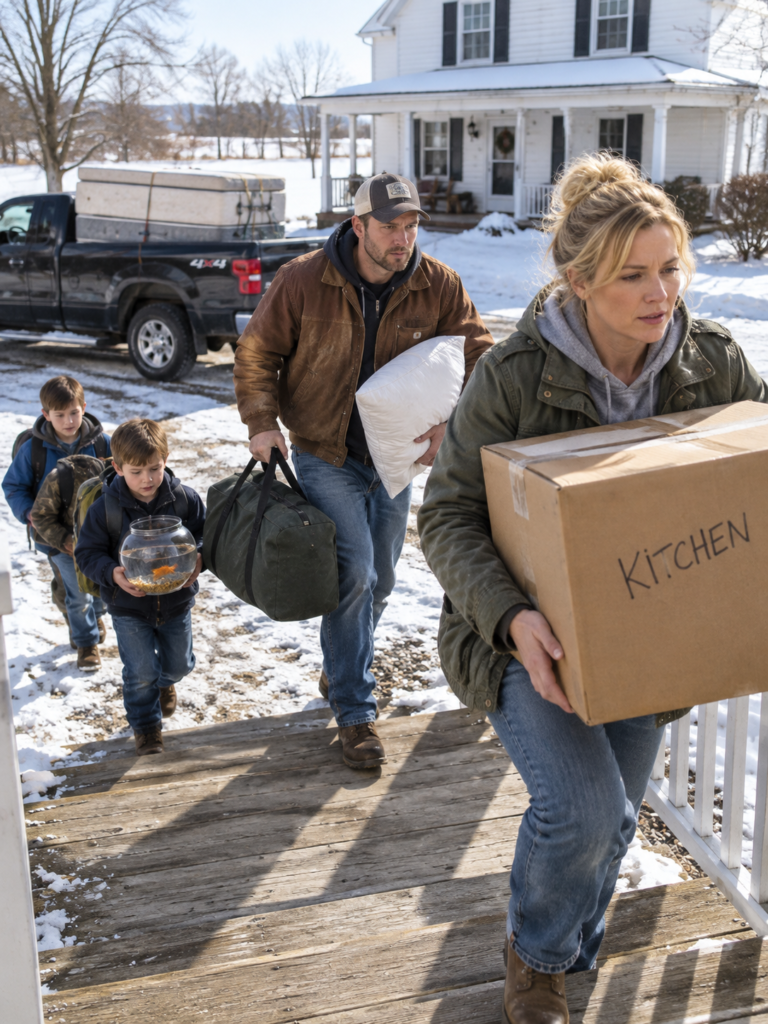
At noon, Jeff’s pickup came up the gravel with a queen mattress tied down in the bed and black garbage bags of clothes wedged in all around it.
I was carrying a box up the porch steps when they pulled in. It said KITCHEN in my brother’s handwriting.
Jeff got out. He took a duffel bag and a pillow out of the cab. And he just stood there holding them. Looking at the house like he’d never seen it before.
Brody got out with his backpack and his shoulders hunched up around his ears.
Kenzie got out with her backpack and her hair hanging in her face.
Cole got out last. Very slowly. With his backpack on and a goldfish bowl held in both hands out in front of him. Like he was carrying the offering plate up the aisle at church.
“This is Pickles,” Cole told me. “He’s a fish.”
“Hi, Pickles,” I said. “Welcome to the farm.”
“Does Pickles get his own room?”
“Pickles gets the dresser in your room,” I said. “Best view in the house.”
Cole looked at me very seriously. Then he nodded. Like we’d just made a deal.
Jeff came up the porch steps behind me with his duffel bag.
He wouldn’t look at me. He looked at the porch floor, the one Dale rebuilt in 2017. And the new storm door. And the porch light.
“Place looks good, Tam,” he said. To the floor.
“Twenty years,” I said. “It better.”
Mom called at four o’clock.
I was standing in the kitchen with my hands in a bowl of hamburger.
“Tammy.” She didn’t even say hello. “Jeff says he is moving into your upstairs.”
“He moved in about noon,” I said. “Kenzie’s already picked out a curtain.”
“What on earth are you doing?”
“I’m giving my brother a place to live,” I said. “That’s what you asked me for, isn’t it?”
There was a silence on the line so long I thought the call had dropped.
“That’s not what I asked,” Mom said.
“It’s my answer,” I said. “Come out for Sunday dinner. You and Dad both. I’m making a roast.”
She hung up without saying goodbye.
My mother has never once in her life hung up without saying goodbye.
I washed the hamburger off my hands. Then I stood at the sink for a long time, looking out the window at the cedars.
Supper that night was the loudest meal that kitchen had seen in years.
Seven of us crammed around a table built for six.
Brody ate three sloppy joes and asked for a fourth. Dale gave him his own. Brody looked at him like he’d just been handed a twenty-dollar bill.
Hannah sat down next to Kenzie.
And halfway through supper, without saying anything, Hannah reached over and gently pulled Kenzie’s hair back out of her face. And started to braid it.
Kenzie went completely still. She had a sloppy joe in both hands. She didn’t move a muscle.
“Did your mom used to do this?” Hannah asked her softly.
Kenzie shook her head.
“Daddy tries,” she said. “He’s not good at it.”
“I’m not good at it,” Jeff said from across the table. He tried to smile.
“I’ll teach you,” Hannah told Kenzie. “Then you can do it yourself. And then you can do mine.”
I had to get up and go get more napkins from the pantry so nobody would see my face.
Cole asked if the furnace was a monster. Because it made a loud noise when it kicked on.
“That’s not a monster,” Dale told him. “That’s the best seven thousand, eight hundred dollars I ever spent.”
“What’s seven thousand, eight hundred dollars?”
“A lot of hogs,” Dale said.
Cole laughed so hard milk came out his nose.
By nine-thirty, the kids were all upstairs. I heard the boys arguing over who got the top bunk. Then Jeff’s low voice settling it.
I heard Hannah’s door. Then Kenzie’s little voice through the wall, asking Hannah if she was still awake.
By ten, the whole house was quiet.
Dale went to bed. I stayed up at the kitchen table with a cup of decaf and the spiral notebook from the hutch drawer.
I didn’t open it. I just sat there with my hand resting on top of it.
Then I heard Jeff on the stairs.
He came down slow, one hand on the rail. The way you do on old stairs in a dark house.
When he stepped into the kitchen light, he was holding something flat against his chest.
It was Mom’s yardstick.
The old wooden one from the lumberyard in Sheldon. With the advertising half worn off it. And a little notch cut at the forty-inch mark, where our grandpa once used it to measure a calf.
It had lived on the shelf in that closet since before I was born.
And Jeff had a look on his face I hadn’t seen since we were kids. Since he was five years old and found a litter of kittens in the haymow and came running to get me so I could see them too.
“Tam,” he said. “Did you know this was still up there?”
I got up and followed him upstairs.
He’d left the closet door open in the little room under the eaves.
Kenzie was asleep in the bed with the pink curtain pulled shut. Her new braid lay across the pillow. We stepped around her in our socks.
Jeff shined his phone light into the closet.
And there they were.
Pencil marks. On the inside of the door frame. All the way up.
Each one a short level line with a name, an age, and a year. In my mother’s handwriting.
TAMMY 3 1983.
TAMMY 5 1985. JEFF 2 1985.
TAMMY 8 1988. JEFF 5 1988.
Every summer, on the last day of school, Mom stood us up against that door frame barefoot. She laid that yardstick flat on top of our heads and drew the line.
Jeff always cheated by going up on his tiptoes. Mom always caught him.
The marks went up and up.
TAMMY 15 1995. JEFF 12 1995.
Then Jeff passed me.
JEFF 14 1997. And his line was above mine for the first time. And next to it, Mom had written, in tiny letters:
finally.
The very last mark said JEFF 15 1998. That was the year Mom said we were too big for the closet door.
“You painted this whole room,” Jeff whispered. “I can smell it. It’s new.”
“2008,” I said. “And again last spring.”
“You painted around them.”
“I taped off that door frame both times,” I said. “Dale thought I was crazy. I told him it was a historic preservation project.”
Jeff laughed through his nose. He wiped his face with the heel of his hand.
He put his finger on JEFF 5 1988.
It came up to the middle of his thigh.
“I don’t even remember being that small,” he said.
“I do,” I said. “You were a pain.”
He stood there for a long time.
Then he said, “Hang on.”
And he went across the hall to the boys’ room.
He came back carrying Cole.
Cole was mostly asleep, in his superhero pajamas. Jeff stood him up barefoot against the door frame. Right next to JEFF 5 1988.
Cole leaned his head back against the wood and blinked at the light.
“Stand up straight, bud,” Jeff whispered. “No tiptoes.”
He laid Mom’s yardstick flat across the top of Cole’s head.
I handed him the pencil from my pocket. A mail carrier always has a pencil.
Jeff drew the line.
Then, in his blocky handwriting, he wrote:
COLE 6 2026.
Cole’s line was an inch and a half higher than his daddy’s at the same age.
“Is that good?” Cole mumbled.
“That’s real good, buddy,” Jeff said.
His voice broke clean in half.
“You’re gonna be bigger than me.”
He carried Cole back to bed.
I stood there in that closet and looked at all those marks. Forty-three years of my family going up a door frame. And one brand-new mark at the bottom, in a different hand.
When Jeff came back, he didn’t say anything for a minute.
“Why are you doing this, Tam?” he finally said. “All of this. The room. The kids.”
I almost told him right then.
I almost said, Because Mom and Dad asked me to give you this house.
But I didn’t.
It wasn’t mine to tell. It was theirs.
“Because you’re my brother,” I said. “And because Pickles needed a dresser.”
My parents came at noon on Sunday, right after church.
Mom carried in a pan of scalloped corn like it was a shield.
Dad shook Dale’s hand and looked around the kitchen.
The kids’ boots were piled by the back door. Brody’s sweatshirt hung on a hook. Kenzie’s braid was still in from the night before, a little frizzy now. And Cole came running in from the porch to tell Grandma he was taller than Daddy.
“Is that right,” Mom said. And she looked at me.
We sat down. Dale said grace.
The roast was good. The kids talked over each other. For about fifteen minutes, it was just a regular Sunday.
Then Mom put down her fork.
“Well, Jeff,” she said. In her bright church voice. “This is a nice start. And once the papers on the house are signed, you can fix the upstairs up however you want. Or the whole place, really.”
Jeff stopped chewing.
“What papers?” he said.
Nobody said anything.
Hannah looked at me. Dale set his water glass down very carefully.
“What papers, Mom?” Jeff said again.
Mom looked at Dad.
Dad looked at his plate.
“Your sister is selling the house back to us,” Mom said. “For a dollar. So you and the kids can have it. We talked to her on Tuesday.”
“She’s not,” I said quietly. “I never said that.”
“You said you’d have an answer Saturday.”
“I did,” I said. “He’s living upstairs. His kids are in it.”
Jeff put both hands flat on the table.
I watched him go red from the collar up. The way Dad does.
“You asked Tammy to give me her house,” he said. “Without telling me.”
“We were going to tell you when it was done,” Mom said. “We wanted it to be a surprise. Jeff, honey, you have nothing. Amber took the good car. You’ve got three kids on air mattresses.”
She waved her hand toward me.
“Your sister has Dale. And the hog barns. And Dale’s folks’ farm ground coming to them someday. She’ll land on her feet. She always lands on her feet.”
There it was.
I’d known it for forty-three years. Nobody had ever said it out loud before.
I always landed on my feet.
So I was the one who could afford to fall.
Jeff stood up from the table.
I thought he was going to walk out.
Instead, he stood there with both hands on the back of his chair, and he looked at our parents.
“I’m forty-three years old,” he said.
His voice was very calm. That’s how I knew how mad he was. Kirchners don’t yell when it really matters.
“I’ve got a job. I’ve got a pickup that runs. I had a wife who left me. I’m ashamed of that. And I’m ashamed my kids are living in somebody else’s house.”
He looked at Mom.
“But I never asked you for this house. And I’m not going to take it.”
He looked at me.
“Not my sister’s. Not after what she did last night. Not ever.”
“Jeff,” Mom said.
“Mom. She and Dale put sixty thousand dollars into this place. I know they did. I helped Dale with the porch. I watched them freeze in here for years.”
He swallowed hard.
“You were going to take that away from her so you didn’t have to watch me struggle. That’s not for me, Mom. That’s for you.”
Mom’s face crumpled. She put her napkin over her mouth.
Nobody at that table had ever said anything like that to my mother.
Least of all the baby.
Dad cleared his throat. He hadn’t said one word yet.
“Son,” he said. “Sit down.”
Jeff sat down.
Dad looked at me across the roast. He looked at me the way he’d looked at me at the closing in 2006, with that dollar in his shirt pocket.
Except older. And tireder. And with something in his face I’d never seen before.
“Tammy,” he said. “Did you ever think about just saying no?”
“Every single minute since Tuesday,” I said.
“Why didn’t you?”
“Because I wasn’t going to let Cole sleep next to a chest freezer one more night,” I said. “And I wasn’t going to let you take the house either. So I gave you the only answer I could live with.”
Dad nodded slowly.
“You could’ve been ugly about it,” he said. “You’d have had every right.”
“You asked me to my face, Dad. That’s how I knew you weren’t being mean. You were being scared.”
I looked at Mom.
“You were both scared for him. So was I.”
Mom took the napkin away from her face. Her mascara was smeared.
She reached across the table. Past the scalloped corn. And she put her hand on top of mine.
She didn’t say sorry. Not that day.
But she didn’t take her hand away for a long, long time.
Cole broke the silence.
“Grandma,” he said. “Daddy measured me in the closet. I’m taller than he was.”
Mom turned her head and looked at him.
“In the closet?” she said. “In the little room?”
“Your lines are still there, Mom,” Jeff said quietly. “Tammy never painted over them.”
Mom put both her hands over her face.
And Dad put his arm around her.
And nobody ate any more roast for a while.
The upstairs worked.
I didn’t know if it would. But it did.
Dale put Brody on hog chores after school. Ten dollars a day.
Our barns are shower-in, shower-out. So every afternoon, Brody went through the shower, put on barn clothes, and walked the alleys with Dale. Checking waterers. Checking feeders. Pulling out any pig that looked sick. Then he showered out again and came in for supper smelling like Dial soap. And hog anyway.
The first week, Brody barely said a word.
By the third week, he was telling us at supper which pen had a pig that wouldn’t come up to the feeder. And what Dale thought was wrong with it.
“He’s a good hand,” Dale told me one night in bed. “Better than I was at twelve.”
From Dale, that’s a parade.
Hannah taught Kenzie to braid. They practiced on each other every night after supper at the kitchen table, with a jar of hair ties between them.
By April, Kenzie could do a French braid on herself without a mirror.
By May, she was doing mine every morning before I left for the route.
Cole and Pickles both survived. Cole found the barn cats and named every single one of them after a different kind of pie. Pecan. Cherry. Rhubarb. Lemon Meringue.
The kitchen got loud. There were boots everywhere. The water heater ran out every morning. I bought milk two gallons at a time, and it still wasn’t enough.
Some nights, I wanted to lock myself in my pickup and just sit there.
But other nights, at the end of supper, I’d look down that crowded table at seven people and a fishbowl.
And I’d think about Great-Grandpa Kirchner building this house in 1912 with four bedrooms. Because he expected to fill them.
Jeff insisted on paying. We argued about it for a week.
Finally I told him: four hundred dollars a month for groceries and propane. Not one penny more. And he could put the rest away.
He put the rest away. Every paycheck.
He works agronomy at the co-op. That spring, during planting, he ran the sprayer fourteen hours a day. He’d come home with his eyes red from the dust and go straight upstairs to read to Cole.
Mom came out every Wednesday after that. She brought a pan of something every single time. A hotdish. A coffee cake. Bars.
She didn’t mention the house. I didn’t either.
She helped Kenzie with her spelling words. She showed Hannah how to make pie crust with lard, the way Grandma Kirchner did.
One Wednesday in May, I came home from the route and found her standing all alone in the little room upstairs. The closet door was open. Her hand was resting flat against the door frame.
Right on JEFF 5 1988.
I didn’t go in.
I went back downstairs and put the coffee on.
In August, the old Vander Woude place came up for sale.
It’s a little one-and-a-half story house a mile and a half down our gravel road. A detached garage. A big garden spot. Two old lilac bushes by the back door.
Old Mrs. Vander Woude had gone to live with her daughter in Orange City.
They were asking a hundred and thirty-eight thousand dollars.
Jeff had saved nine thousand, four hundred dollars since March.
One night, he came downstairs with his loan papers and spread them out on the kitchen table. He asked Dale and me to look them over.
A conventional loan. A little over five percent down. And a monthly payment smaller than the rent he and Amber used to pay in town.
“Is it enough?” he asked me. “Be honest.”
“It’s enough,” Dale said, before I could open my mouth. “I’ll go look at the furnace for you.”
“I already did,” Jeff said. “It’s newer than yours.”
Dale looked personally offended.
Hannah laughed so hard she had to leave the room.
Jeff closed on the Vander Woude place the second week of October.
Nobody gave him anything. Nobody signed anything over to him. He bought it himself. With his own down payment. From his own work.
We moved them on a Saturday. Same pickup. Same mattress.
Only this time, it was going down the road instead of up.
Cole rode the whole mile and a half in the cab with Pickles in his lap, both hands wrapped around the bowl.
And Pickles survived that too.
Dad came out by himself the next morning.
He never comes out by himself. Mom was at her Circle meeting at church.
He stood in my kitchen with his seed cap in his hands. He wouldn’t sit down.
“I’ve got something of yours,” he said.
He took out his wallet. The same brown leather wallet he’s carried my whole life, shaped to his back pocket.
He opened it. He dug behind his driver’s license with two fingers.
And he pulled out a dollar bill.
It was folded in quarters. Soft as cloth. The fold lines had gone almost white.
“This is the one you gave me,” Dad said. “At the closing. 2006. I put it in my shirt pocket. And that night I put it in my wallet. And I never took it out.”
I didn’t know what to say. I just stood there looking at it.
“Twenty years,” he said. “Every time I paid for gas, I saw it in there. I told myself it was a joke. I was proud of it. I’d show it to the guys down at the elevator. That’s the dollar I sold the home place for.”
He laid the dollar down on the kitchen table between us. He smoothed it flat with his big thumb.
“I never once asked myself what you paid for it after,” he said. “The roof. The wiring. All those cold winters. I came out here in March and asked for it back like it was still worth a dollar.”
His voice went rough.
“I’m sorry, Tammy.”
My father has never apologized for anything in his whole life.
Not for missing my high school graduation for a farm sale. Not for the time he backed over my bike with the pickup. Not for anything.
Kirchner men don’t.
He apologized standing in my kitchen at seventy-six years old, with his cap in his hand.
“I forgive you, Dad,” I said. “I forgave you on that Tuesday. I just wasn’t going to give you the house.”
He laughed. A short, wet laugh.
And he pushed the dollar across the table toward me.
“Keep it,” he said. “You paid more for it than anybody.”
That dollar is in the hutch drawer now. Folded up inside the spiral notebook, with all the receipts.
That seemed like the right place for it.
That night was the first night Jeff’s kids slept in their own house. A mile and a half down the road.
I went up to bed at ten, like always.
I lay there next to Dale and listened.
No boys arguing about the top bunk. No Kenzie whispering through the wall to Hannah. No little feet on the stairs at two in the morning. No Jeff reading the same dinosaur book for the hundredth time in his tired voice.
Just the furnace kicking on. And the wind in the cedars. And the old house settling around us, like it was breathing out.
It was the quiet I’d wanted every single night since March.
Some nights, I’d prayed for it.
And I lay there in the dark and found out I missed every bit of the noise.
“You awake?” Dale said.
“Yeah.”
“Too quiet,” he said.
“Yeah,” I said.
In the morning, I went upstairs and opened the closet door in the little room under the eaves.
I looked at COLE 6 2026, down at the bottom of the door frame. In my brother’s blocky handwriting.
Then I went back downstairs and found a roll of blue painter’s tape.
Because next spring, when we paint that room again, I’m going to need it.
And the spring after that.
And the one after that.
There’s a lot of door frame left. And Cole’s going to be bigger than all of us.