Patrick put his key in the front door of the lake house and turned it.
The lock didn’t move.
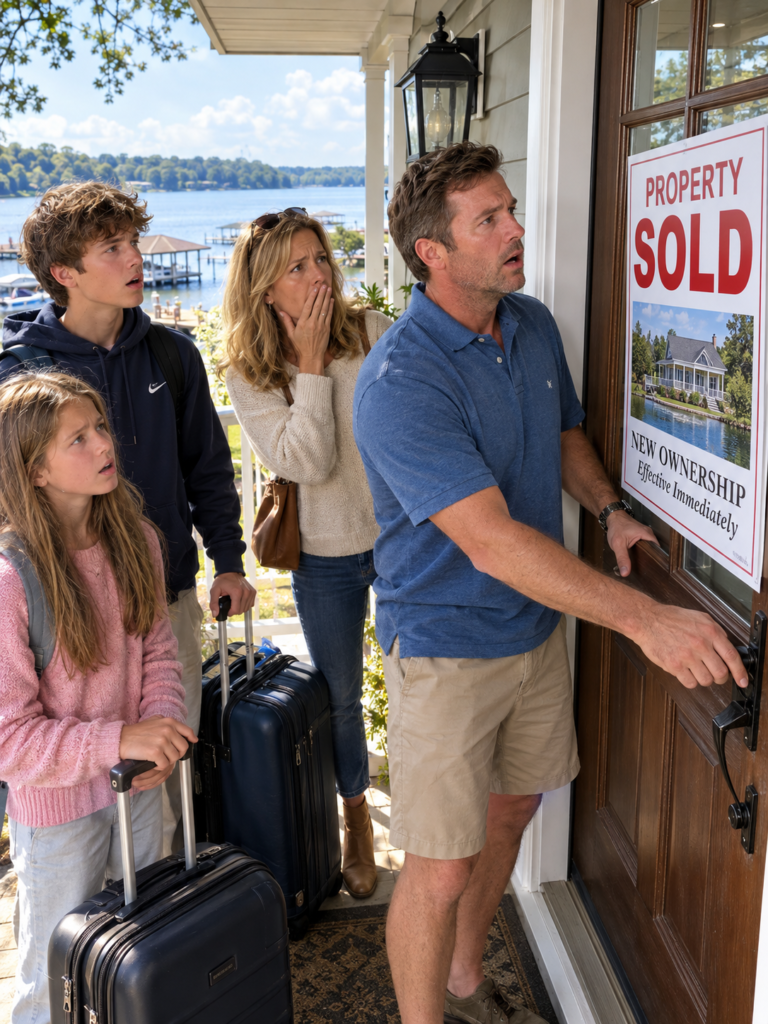
He tried again, harder. He jiggled the key the way his father used to when the door swelled in the summer heat. He pulled it out, checked it was the right one, and pushed it back in.
Nothing.
That was when he noticed the small white sign that had been put up in the front window.
PRIVATE PROPERTY.
Underneath, in smaller letters:
Please do not disturb the residents.
Behind him, his wife, Megan, took off her sunglasses.
“Why is that there?”
Patrick looked toward the driveway. Their SUV was parked where he always parked it, under the old maple tree. The back was packed to the roof with luggage from the cruise. Their son, Owen, was asleep in the back seat with his cheek pressed against the window. Their daughter, Sophie, was already out of the car, hopping from foot to foot on the gravel, asking if she could go swim.
Ezoic
Patrick took out his phone and called me.
I know all of this because he told me later, and because I know that porch and that driveway and that maple tree better than I know my own face. I can see every second of it.
But at that moment, I was twenty minutes away, sitting at the kitchen counter of a small apartment in town.
I watched his name light up my screen.
For several seconds, I just stared at it.
Through the apartment window, I could see a thin sliver of the lake between two brick buildings. It wasn’t the same view I’d had for forty years. But it was peaceful. It was mine.
Ezoic
My moving boxes were still stacked against the wall. I hadn’t decided yet where to hang George’s fishing photographs.
The phone stopped ringing. Then it started again.
I answered.
“Mom, the lock’s been changed.”
His voice was tense. Not angry yet. Just confused.
“I know,” I said.
“What do you mean, you know?”
“I sold the house.”
There was silence on the line.
Not the stunned silence I had imagined while I was signing the papers. This was something different. It was the silence of someone waiting for the other person to laugh and admit it was all a joke.
“You sold the lake house?”
“Yes.”
“To who?”
“The new owners moved in this morning.”
In the background, I heard Megan’s voice rise.
“Put me on speaker.”
Patrick didn’t.
“Mom, what are you talking about? We’re here. We’re standing on the porch.”
Ezoic
“I understand.”
“You knew we were coming back today.”
“Yes.”
“And you didn’t tell us?”
“You didn’t ask.”
I heard his breath catch.
For a moment, I wondered whether he was remembering the last message he’d sent me from the ship. The excursion desk had declined my credit card, and he’d written to me like I’d made some silly clerical mistake that I needed to fix right away.
I’d answered him with four words.
Use your own card.
He hadn’t spoken to me since.
To understand how I ended up selling my home out from under my own son, you have to know about the lake house.
And about George.
My name is Eleanor Henderson. I’m seventy-one years old. George and I bought that house on Wren Lake when Patrick was four. It was a wreck back then. A sagging cabin with a leaking roof and a dock that tilted into the water like a sinking ship.
Ezoic
We were young and broke and stubborn. We fixed it ourselves, one room at a time, over twenty years. George built the stone fireplace with rocks he pulled out of the lake. He built the boathouse. He built a workshop out back that smelled like cedar shavings and motor oil, and he spent his Saturdays out there making things. Bird feeders. Bookshelves. A little wooden box with a compass rose carved on the lid, which he gave me our first winter there.
“So you always know which way is home,” he said.
Patrick grew up in that house. His father taught him to swim off the end of that dock. His first dog, a golden retriever named Biscuit, is buried under the willow tree by the water. There are still marks on the kitchen doorframe where we measured him every birthday.
Ezoic
I loved that house with my whole heart.
But it was always ours. George’s and mine. That’s important. Remember that.
George died six years ago.
He got sick in the fall. Pancreatic cancer. By the time they found it, it had already spread. He was gone in four months.
I remember every day of those four months. The hospital corridors. The plastic cups of ice chips. His hand searching for mine in the dark at three in the morning.
Ezoic
I remember Patrick visiting. Not as often as I wanted, but he came. He’d stand at the foot of the bed with his hands in his pockets. Sometimes he’d ask his father questions about the house. The boathouse roof. The well pump. Whether the dock needed new pilings.
At the time, I thought he was trying to distract his father. Give him something normal to talk about.
I didn’t know then what those conversations really were.
After George died, Patrick started needing help.
It began small. His business, a landscaping company he’d started a few years before, had failed. He was behind on a few things. Could I help with the car payment, just this once?
Ezoic
Of course I could. He was my son. He was grieving too.
Then it was Sophie’s preschool tuition. Then a business credit line he said was temporary, just until he got a new venture off the ground. Then their rent.
Then, four years ago, their landlord sold the building, and Patrick called me on a Sunday night.
Ezoic
“Mom, it would just be for a few months. Until we find something. The kids love the lake. And honestly, you shouldn’t be out there alone anyway. What if you fall?”
I wasn’t going to fall. I was sixty-seven and swam a mile in that lake every summer morning.
But the house was very quiet without George. And I missed the sound of children.
Ezoic
“A few months,” I said.
They moved in two weeks later.
They never moved out.
At first, it was wonderful.
I’m not going to pretend it wasn’t. Sophie was four and Owen was a baby. The house was full of noise again. Toys on the stairs. Sticky fingerprints on the windows. Sophie followed me around the garden asking the names of every flower.
Megan was polite. A little cool, maybe. She was a careful, organized woman who worked part-time in marketing and came from a family that had always had money. Her parents, Richard and Diane, lived in a big house in the suburbs and came to visit twice a year. They always brought expensive gifts for the children and looked at my furniture like it might give them a disease.
I didn’t mind. Not then.
But slowly, without anyone ever saying it out loud, things changed.
Ezoic
They stopped paying for groceries. I’d notice it at the checkout, my total getting bigger every month. Patrick’s truck payment started coming out of my account “just for now.” Then the kids’ swim lessons. Then their phone bill. Then, somehow, the payment on the SUV Megan bought when Owen turned three. A big white luxury one with leather seats.
“We needed something safer for the kids,” she said.
I paid it.
I never got a thank you for most of it. Not because they were cruel. Because the payments had become invisible. They were just how things worked. Like electricity. You don’t thank the light switch.
I tried to talk to Patrick about it. More than once.
Ezoic
I’d say, “Honey, I’m a little worried about money this year.”
He’d say, “You’re fine, Mom. Dad left you plenty.”
I’d say, “I’ve always wanted to travel. Before I’m too old.”
He’d say, “You should. Someday.”
I’d say, “The roof on the boathouse is really bad. I need to get it done.”
Ezoic
That last time, he was sitting at the kitchen table, looking over a contractor’s estimate for the boathouse. He’d asked to see it. He frowned at the number. Then he looked up at me and smiled.
“Don’t worry about it, Mom,” he said. “It’s all going to be mine someday anyway. I’ll deal with it then.”
He said it so easily. With such confidence.
Not someday, maybe. Not if you want.
Just eventually. Like it was already decided. Like I was just keeping his seat warm.
Ezoic
I remember that sentence better than almost anything he’s ever said to me.
I found the folder last spring.
I was looking for a pen in the drawer of the hallway desk. The one by the stairs. It had always been my desk. My bills, my checkbook, my stamps.
There was a red folder in there that I’d never seen before.
Ezoic
I opened it, thinking it was mail.
It was a remodeling plan.
For my house.
There were printouts of kitchen designs. White cabinets. A big marble island where my old butcher-block table was. Paint swatches stapled to the corner of one page. Pale Oak. Agreeable Gray. Swiss Coffee. Someone had circled Swiss Coffee twice and written kitchen beside it.
There was a contractor’s estimate. For taking down the wall between the kitchen and dining room. For replacing the old stone fireplace George built with “a modern linear gas insert.”
And there was a floor plan of the second floor. My bedroom was labeled PRIMARY — P & M.
Ezoic
The little sewing room at the end of the hall was labeled OFFICE (or Mom?).
I sat down on the stairs with the folder in my lap.
Or Mom?
With a question mark.
I sat there for a long time. Long enough that the light changed on the floor. Then I put the folder back in the drawer, exactly where I’d found it.
Ezoic
I didn’t say anything to anyone.
I just started thinking.
Two weeks before the cruise, I called a realtor.
I want to be honest about that. I didn’t sell the house because of the cruise. I’d already decided. The cruise was just the moment I stopped pretending I hadn’t.
The realtor was a kind, brisk woman named Pam who’d sold half the houses on Wren Lake. She walked through the whole place with me on a Tuesday morning while Patrick was at a meeting and Megan had the kids at a birthday party.
“It’ll sell fast,” Pam said. “Lake houses always do. Are you sure, Eleanor?”
Ezoic
I looked out at the dock. At the willow tree.
“No,” I said. “But I’m doing it anyway.”
She had a couple in mind already. People who’d been looking on the lake for two years. Claire and Daniel Hart. Schoolteachers from the city who wanted to live somewhere quiet. Pam showed them the house privately on a Thursday when the family was out.
I met them on the porch.
Claire was in her early forties, with short brown hair and paint on her sweatshirt. Daniel was quiet and tall and kept running his hand along George’s porch railing like he was checking the joinery.
Ezoic
“Who built this?” he asked.
“My husband.”
“It’s beautiful work. Really beautiful.”
Claire stood at the end of the dock for a long time, looking out at the water. When she came back, her eyes were wet.
“I’m sorry,” she said, laughing a little. “We’ve been looking for so long. I just— I can see us here.”
I liked her. I liked them both.
Not because they were going to pay a good price, though they did. Because they looked at the house the way George and I had looked at it forty years ago.
Ezoic
Like a home.
Not an inheritance.
The cruise was for Patrick and Megan’s tenth wedding anniversary.
I paid for it.
I know how that sounds. But it had been planned for almost a year, long before the folder, long before I called Pam. A seven-day Caribbean cruise. Patrick and Megan, the two kids, and me.
“It’ll be so good for you, Mom,” Patrick said when he first suggested it. “You never go anywhere.”
Ezoic
Then, a month before we left, Megan sat down across from me at the kitchen table.
“I need to talk to you about the cabin situation,” she said.
The cabin situation was this. Megan’s parents wanted to come.
Ezoic
“They’ve never been on a cruise with the kids,” she said. “And they’re getting older. And the suite only sleeps six. So I was thinking. Maybe you could sit this one out? And come next time?”
I looked at her.
“I’m paying for it, Megan.”
“I know. And we’re so grateful. Honestly. But Mom and Dad are paying for their own flights. And you’ve had the kids all year. You see them every day. My parents barely see them at all.”
I didn’t say anything.
“It’s just one trip,” she said. “You understand, right?”
I did understand. That was the problem.
I said yes. I gave up my spot. I told myself it was generous. I told myself grandparents should share.
Ezoic
I paid the deposit anyway, the balance, and the onboard credit, because it had already been booked on my card months before. Patrick hugged me and said, “You’re the best, Mom.”
On the second day of the cruise, Megan posted a picture.
The whole group on the deck of the ship. Patrick and Megan in the middle. The kids in front, in matching sun hats. Richard and Diane on either side, tanned and smiling, holding cocktails with little umbrellas.
Ezoic
The caption said:
Finally, a vacation with the WHOLE family! Ten years and counting!
I read it on my phone, sitting alone on the porch of the lake house, with a cup of coffee going cold in my hand.
The whole family.
I read it five times.
Then I put the phone face-down on the table, and I called Pam.
Ezoic
“Let’s move up the closing,” I said.
Three days later, my phone buzzed with a message from Patrick.
Mom, the excursion desk declined your card. We’re trying to book the dolphin swim for the kids. Can you call the bank and fix it? Need it in the next hour.
I’d called the bank the day before. Not to fix the card. To cancel the onboard charges. Every charge after the cruise fare itself. The excursions. The spa. The specialty dinners. The drinks package Richard and Diane had apparently been enjoying on my account.
Ezoic
I looked at Patrick’s message for a long time.
Then I wrote back.
Use your own card.
An hour later, a message came from Megan instead.
I can’t believe you would do this to us in the middle of our anniversary trip. The kids were so excited for the dolphins. Whatever your feelings are about not coming, the children shouldn’t have to be affected by them.
I read it twice.
She didn’t ask whether my feelings had been affected by being left behind. She didn’t ask whether I was hurt by the post. She only objected when the bills stopped being paid.
I didn’t answer.
Neither of them wrote to me again for the rest of the trip.
Ezoic
The sale closed the day before they came home.
I’d moved everything I wanted into the apartment in town. Pam had found it for me. Two bedrooms, third floor, with an elevator and a little balcony and that small sliver of lake between the buildings.
Everything else was sold or donated or left for the Harts, who’d asked if they could keep George’s workbench.
“We’d be honored,” Daniel said.
Patrick’s family’s things I had packed carefully, every box labeled, and moved into a storage unit in town. I paid the first three months. The key was in an envelope at the realtor’s office with Patrick’s name on it.
Ezoic
I wasn’t trying to throw my grandchildren into the street.
I just wasn’t going to keep pretending.
So that’s where we were when Patrick called me from the porch.
“What do you mean, the new owners moved in?” he asked.
Ezoic
“I mean the sale closed yesterday.”
“Yesterday?”
“Yes.”
“Mom, you can’t do that.”
“I already did.”
Megan finally got close enough for me to hear her clearly.
“Patrick, give me the phone.”
He hesitated. Then her voice came through, sharp and controlled.
“You had no right to sell that house without telling us.”
Ezoic
“I was the owner.”
“That doesn’t mean you could make a decision like this without considering the family.”
“I considered the family for years.”
“That house was supposed to stay with Patrick.”
“No,” I said. “It was supposed to stay mine until I decided otherwise.”
“You knew we were planning our future there.”
I looked at the boxes stacked around me in that little apartment. The words sounded different now that I wasn’t standing in the lake house, surrounded by their expectations.
Ezoic
“You were planning a future in a home you didn’t own,” I said.
“We assumed you understood that.”
“I understood that you had started choosing paint colors for my kitchen.”
Megan went quiet.
In the background, Patrick said, “What are you talking about?”
Ezoic
“I found your remodeling folder,” I said.
“That was private,” Megan said.
“In my house?”
“It was just an estimate,” she said quickly. “We were thinking ahead.”
“You were thinking ahead to a life that depended on me disappearing.”
“That’s not fair.”
“No,” I said softly. “It isn’t.”
Behind them, one of the children started asking where they were going to sleep.
Ezoic
I heard Sophie say she wanted the blue room. The blue room was hers. It had been her room since she was four. Her voice had that ordinary, tired impatience of a ten-year-old who’d been in a car for three hours and had no idea that the adults’ whole world had just collapsed on the porch.
I closed my eyes.
“I don’t want the children standing outside this conversation,” I said. “Take them somewhere safe and comfortable. Your things are in a storage unit on Mill Street. The key is at Pam Wheeler’s office. Then call me tonight.”
“Mom—”
“I’m not discussing this while everyone is upset.”
“You can’t just sell our home and hang up.”
“It was never your home,” I said.
And I ended the call.
My hands were trembling.
Not because I regretted it. Because saying those words out loud made the truth impossible to soften.
It had never been their home.
I sat at the counter for a long time with the phone in my hand. Then I got up and started unpacking. One box at a time. Slowly.
George’s winter coats went into the hall closet. I couldn’t give them away. I’d tried three times.
My good china, which had sat untouched in the lake house dining room for years, went onto the little shelves above the sink. I’d never used it. I was always saving it for a special occasion. That night I took down one of the teacups and drank chamomile out of it.
I hung George’s fishing photographs by the window, where the late afternoon light touched the frames. George holding up a bass on the dock. George and Patrick, maybe seven years old, both of them grinning, Patrick holding a fishing rod with a big stick hooked on the end of it.
The apartment was small. No wide porch. No stone fireplace. No lake stretching out past the back lawn.
But every single thing in it was there because I had chosen it.
That evening, Patrick called again.
This time he was alone.
“Are you somewhere private?” I asked.
“Yeah.”
“Are the children all right?”
“They’re with Megan’s parents. We got a hotel.”
“I’m sorry you had to make arrangements so suddenly.”
He gave a short, humorless laugh.
“You’re sorry?”
“I’m sorry the children were inconvenienced. I’m not sorry I sold the house.”
He was quiet. Then he said, “I don’t understand how you could do this.”
“I think you do.”
“I never thought you’d actually sell it.”
“That was the problem.”
“You told me it was the family home.”
“You called it that.”
“You never corrected me.”
“Every time I tried to talk about the house, you told me we’d figure it out later.”
“Because I thought there’d be a later.”
“There is a later,” I said. “It just doesn’t include the lake house.”
His breathing got heavier.
“Did you do this because of the cruise?”
“The cruise made me stop pretending.”
“You’re punishing us because Megan didn’t want you there.”
“No. I’m responding to something that started long before the cruise.”
“Mom, she didn’t mean it the way you think.”
“I saw the caption.”
“She was trying to make her parents feel included.”
“And I wasn’t family?”
He didn’t answer that.
“She made a stupid post,” he said finally.
“She sent me a message saying the children shouldn’t be affected by my feelings,” I said. “She never once asked if my feelings had been affected by being left out. She only cared when her expenses stopped being covered.”
He had no answer for that either.
For the first time since the sale, I felt something other than anger.
I felt tired.
“Patrick,” I said. “I love you. That has never been the question.”
“Then why does it feel like you’re cutting us off?”
“Because you confused love with access.”
He didn’t speak.
I kept going, before I lost my nerve.
“Your father and I helped you because we wanted you to have a good start. But help turned into a system. You stopped asking whether I could afford something. You just assumed I’d pay it. You stopped thanking me because the payments became invisible.”
“I did thank you.”
“Sometimes. But gratitude isn’t just saying thank you after somebody rescues you. It’s making sure you don’t need rescuing every single month.”
His voice got softer.
“I didn’t know you felt this way.”
“I told you.”
“When?”
“In small ways. I told you I was worried about money. I told you I wanted to travel. I told you the boathouse needed a new roof. And you told me not to worry about it because it was all going to be yours someday.”
Ezoic
He went completely silent.
I think he remembered. I think he could see himself at that kitchen table with the estimate in his hand.
“When did you decide to sell?” he asked.
“Two weeks before the cruise.”
“So you were planning this while you were paying for everything?”
“I was still trying to believe we could fix things.”
“Why didn’t you tell me?”
“Because I knew you’d ask me to wait.”
“Maybe I would’ve changed.”
“I needed to see the change before I made another sacrifice.”
He let out a long breath.
“Who bought it?”
“A couple named Claire and Daniel Hart.”
“Do they know what they bought?”
“They know they bought a house.”
“Do they know about us?”
“I told them you grew up there.”
Ezoic
“That’s not what I mean.”
“I know.”
Another silence settled between us. This one was different. Less defensive. More honest.
“Megan wants to talk to you,” he said finally.
“I’ll talk to her tomorrow.”
“She thinks you owe us an explanation.”
“I’ve given you one.”
“She says you humiliated her.”
“I didn’t tell anyone about the payments.”
“You didn’t have to. She knows people will ask why we’re not living there anymore.”
“That isn’t my responsibility.”
“No,” he said quietly. “I guess it isn’t.”
And I heard something in his voice then that I hadn’t expected.
Not anger.
Loss.
Despite everything, I understood it. He’d lived in that house since he was four. His father taught him to swim off that dock. Biscuit was buried under the willow. George’s workshop still smelled like cedar and motor oil. Selling it hadn’t just taken a property away from him. It had closed a chapter he truly believed belonged to him.
But grief doesn’t turn an assumption into a right.
“I’m not trying to erase your memories,” I said.
“It feels like you erased our future.”
“I gave you the chance to build your own.”
“That’s easy for you to say.”
“No,” I said. “It isn’t. I know exactly what it feels like to start over.”
After we hung up, I sat in the quiet apartment until the sky outside went dark.
The next morning, I drove out to the lake house.
I had no practical reason to go. The Harts had their keys. Pam had delivered the last of the paperwork. Everything of mine was gone.
Ezoic
I just wanted to see it one more time.
Claire opened the door before I even reached the porch. She was wearing the same paint-stained sweatshirt. Behind her, Daniel was carrying a box of books toward the living room.
“Come in,” she said warmly. “I’m so glad you came.”
“I wasn’t sure if I should.”
“You’re always welcome to visit,” she said. Then she smiled. “As long as you call first.”
Ezoic
I laughed. The first real laugh in days.
“That seems fair.”
She stepped aside.
The house looked familiar and strange at the same time. The rooms echoed a little. But there were signs of new life everywhere. Dishes stacked on the counter. Daniel’s books on George’s shelves. A vase of yellow flowers on the kitchen table, where I’d always kept a bowl of fruit.
“We found something while we were cleaning,” Claire said.
My stomach tightened.
“What?”
She glanced at Daniel. Something passed between them.
“We weren’t sure whether to give it to you,” she said. “It looked personal.”
Ezoic
She walked to the hallway and opened the small drawer under the built-in shelves, the ones George had made the year Patrick was born. She reached all the way to the back.
Ezoic
She pulled out a narrow wooden box.
I knew it immediately.
The compass rose carved on the lid. So you always know which way is home.
“I thought I packed this,” I said.
“It had slipped down behind the drawer,” Claire said. “Daniel found it when he was fixing the slide.”
She handed it to me.
It felt heavier than it should have.
I opened the lid.
Inside were three things.
A brass key to the old boathouse.
A photograph of George and me standing by the lake, both of us young and sunburned and squinting into the sun.
And a sealed envelope.
My name was written across the front in George’s handwriting.
For Ellie, when the house is no longer hers.
I couldn’t breathe.
I’d seen George’s handwriting thousands of times. On grocery lists. On birthday cards. On little notes he left beside the coffee maker every morning for forty-two years. Back by 5. Love you. Eat something.
But I had never seen this envelope.
Claire’s face changed.
“Do you want us to leave you alone?”
I nodded.
They went into the kitchen quietly, without making a fuss about it.
I sat down on the empty floor by the window, right where George’s armchair used to be.
George had been gone for six years. Six years of paperwork, closing accounts, answering sympathy cards, and learning how to sleep on just one side of the bed. Six years of believing there were no more words waiting for me anywhere.
My fingers were shaking when I opened it.
It was a single folded sheet.
My darling Ellie,
I stopped.
Outside, the lake moved quietly in the afternoon wind. I looked at the bare walls. At the doorway Patrick used to run through with muddy shoes when he was eight.
Then I looked back down at the letter.
The second line made my heart start to race.
If Patrick is asking you to give him this house, there is something you need to know about the promise I made to him.
I read it again.
The ink had faded a little, but it was George’s handwriting. Slanted, careful, with the long tail he always gave the letter y.
I made myself keep going.
He came to me three months before I got sick. You were visiting your sister. He stayed late after helping me fix the dock, and we sat in the workshop with the door open, listening to the water.
Ezoic
He asked me if the house would be his one day.
I told him that you and I built this place together, and it would stay yours for as long as you wanted it. He said he understood. Then he asked me to promise that when the time came, I’d leave it to him.
I made the promise.
The sentence sat alone on the page. Under it, George had crossed something out and started again.
Ezoic
I made it because I was afraid. Not afraid of Patrick. Afraid for him. His business had just failed. He and Megan were fighting about money. He thought losing the house would mean losing the only steady thing he had left. I thought a promise would calm him down.
But a promise made to ease one person’s fear can turn into a weight on someone else’s back. I knew that the next morning. I meant to tell you.
Then the doctor called about the tests, and everything became appointments and prescriptions and things neither of us was ready to say out loud.
Ezoic
My throat burned.
Patrick asked me again two weeks before I went into the hospital. He said he needed to know if he could plan his future. I told him the house was yours, and no one could make plans for it without you.
He got angry. He said I’d promised.
I closed my eyes.
A memory came back to me, sharp and clear.
The hospital room. Late afternoon. I’d gone down the hall to get two coffees. When I came back, Patrick was standing beside George’s bed with his face flushed red. His voice was low and sharp.
“You told me.”
George looked exhausted. “I told you what I hoped would happen.”
“That’s not what you said.”
Then they saw me in the doorway with the coffee cups, and they both stopped talking.
I’d assumed it was about the illness. Something too hard to say in front of me.
It had been about the house.
I told him I was sorry. I told him a promise couldn’t take away your right to choose. He said I was changing the rules because I was dying.
Ezoic
I wanted to tell you everything, but I was ashamed. I’d given him hope I had no right to give.
Ezoic
A tear fell onto the paper. I wiped it away fast, before it could spread the ink.
Ellie, if he ever uses my promise to make you feel guilty, remember this. I made it. You didn’t. And I release you from it.
For a long moment, I couldn’t move. The room seemed to tilt gently around me.
George had released me from a promise I’d never even known existed.
But the letter kept going.
There’s one more thing. Before I got sick, I put money aside for Patrick. It isn’t the house, and it isn’t enough to support his family forever. It’s meant to help him recover from the business and build something of his own. I told him about it. I made one condition. He had to meet with a financial counselor and make a real plan.
He refused. He said he didn’t need advice. Only time.
I read that paragraph three times.
I’d never heard of any account. George had always handled our investments. After he died, Mr. Lawson, our attorney, had walked me through everything. Life insurance. Retirement funds. The sale of some workshop equipment. I’d signed papers for months that I barely understood.
There was no account for Patrick. Not that anyone ever told me.
The money is still in the family trust. If Patrick has come to depend on you, I suspect he never took the steps to receive it. That isn’t your failure. It’s his unfinished choice.
At the bottom of the page, George had written one last sentence.
Ezoic
Don’t give him the house to prove you love him. If he loves you, he won’t ask you to.
Ezoic
“Eleanor?”
Claire was standing in the doorway with two mugs.
“I’m sorry,” she said. “I didn’t mean to interrupt.”
“You’re not.”
She set one mug on the floor beside me and sat down a few feet away. Close, but not too close.
“You don’t have to tell me what it says.”
“I know.” I looked down at the box. “But I might need to tell someone.”
She nodded and waited.
I ran my fingers over the compass rose.
“Did you see anything else back there? Behind the drawer?”
“No. Just the box.”
“Would you mind if we looked?”
“Of course not.”
Claire helped me pull the drawer all the way out. Daniel came in with a flashlight.
Ezoic
Behind the drawer was a shallow gap in the wall, partly covered by old dust and a loose strip of molding.
Ezoic
I leaned in.
“There,” I said.
A corner of something blue was sticking out from under the molding.
Daniel eased it free.
It was a thin blue folder, bent nearly in half, shoved into that gap like somebody had hidden it in a hurry.
My name was written on the front.
MOM.
Not in George’s handwriting.
In Patrick’s.
My stomach turned over.
Claire looked at me.
“Do you want to open it here?”
I should have said no. I should have taken it home and called Mr. Lawson and let a professional explain whatever was inside.
Instead, I opened it.
Ezoic
The first page was a copy of a trust agreement. From Mr. Lawson’s firm. Dated six months before George died.
Ezoic
At the top, in bold type:
The George Henderson Family Support Trust.
Under that, the beneficiaries. Patrick Henderson. Megan Henderson. And in a separate section, the grandchildren.
It was a lot of money. Not enough to buy the lake house. But enough to pay off Patrick’s debts, cover the children’s education, and give him a real chance to rebuild his business without leaning on anyone.
There were conditions. Patrick could only access the money after three sessions with a financial counselor, and after signing a statement that the money was meant to support his family, not replace earning a living.
On the last page, there were two signatures.
George’s.
And Patrick’s.
Dated three weeks before George went into the hospital.
“He signed this,” I whispered.
Clipped behind the agreement was a letter from Mr. Lawson to Patrick.
As discussed, the trust has been set up according to your father’s instructions. Your first meeting with our financial counselor is scheduled for Tuesday, October 14. Please bring current statements for all personal and business accounts. Your father has stressed that this trust is meant to create long-term stability, not to provide indefinite monthly support.
At the bottom, in blue ink, someone in the office had scribbled:
Ezoic
Patrick called to cancel. Says he’ll reschedule.
Ezoic
There was no record of another appointment.
The last thing in the folder was a handwritten note.
I knew the handwriting right away.
Dad — I’m not signing up for some program that makes me look irresponsible. If the house is mine, I don’t need the trust. Mom will understand. She always does.
The sentence drained all the warmth out of the room.
Mom will understand. She always does.
I read it again. Not because I doubted the words. Because I wanted them to mean something else. Maybe he’d written it in anger. Maybe he’d apologized afterward. Maybe George had misunderstood.
But the date at the top was clear. Two months before George died.
And I remembered that winter. That was the winter Patrick first asked for help with his car payment.
Then the tuition. Then the credit line. Then the rent. Then the house.
I’d paid for everything.
Not once had he mentioned the trust.
A sharp, bitter laugh escaped me.
Ezoic
“He knew,” I said.
Ezoic
Claire’s face was gentle. “Knew what?”
“That his father left him money. He knew there was a way to stand on his own, and he chose not to tell me. For six years.”
Daniel leaned against the wall, frowning. “Maybe he was embarrassed.”
“Maybe.”
“And signing something doesn’t always mean you understood it.”
I looked down at the note.
“He understood enough to say he’d rather have the house.”
Nobody said anything after that.
Outside, the lake had turned silver. Somewhere down by the shore, a loon called once, then went quiet.
I gathered up the papers.
“I need to take this to the attorney.”
“Do you want me to come with you?” Claire asked.
The question startled me. I’d known this woman for less than a week. And she was offering me the kind of quiet company I’d once expected from my own family.
Ezoic
“I might take you up on that,” I said.
Ezoic
“Call me. Anytime.”
Before I left, I walked through the house one last time.
The living room was theirs now. Their books were filling George’s shelves. The kitchen smelled like fresh paint and coffee. In the hallway, a framed photograph of the lake hung where the portrait of George and me used to be.
I stopped at the front door.
“I’m glad you bought it,” I said.
Claire looked surprised. “Why?”
“Because you see it as a home. Not an inheritance.”
She thought about that for a moment.
“We’re going to take good care of it,” she said.
I believed her.
When I got back to my apartment, Patrick had called four times.
I didn’t call him back right away. I put the blue folder on the kitchen table. I set George’s letter beside it. I made myself a cup of tea in one of my good china cups.
Then I called him.
Ezoic
He answered on the first ring.
Ezoic
“Mom.”
“Where are you?”
“At the hotel.”
“Is Megan with you?”
“She took the kids to the indoor pool.”
“Good.”
A pause.
“I found a letter from your father,” I said.
The line went completely silent.
“What letter?”
“One he wrote before he died.”
“I don’t know what you’re talking about.”
“It mentions a promise.”
His breathing changed. I could hear it.
“Mom, whatever Dad told you—”
Ezoic
“Did he promise you the lake house?”
Ezoic
The silence that came after that told me everything.
When he spoke again, his voice was barely a whisper.
“He said it would be mine.”
“He wrote that he told you later it was mine to keep.”
“He was sick.”
“He wrote that he regretted making the promise.”
Patrick let out a shaky breath.
“I didn’t know he wrote anything.”
“He also left a trust.”
This silence was even longer.
“You knew about it,” I said.
“I knew Dad wanted to set something up.”
“You signed it, Patrick.”
“I never took the money.”
“You never told me.”
Ezoic
“I was going to.”
Ezoic
“When?”
“I don’t know.”
“You let me pay your bills for six years.”
“I didn’t ask you to pay all of them.”
“No,” I said. “You only ever asked for the next one.”
His voice went defensive. “I was trying to hold everything together.”
“So was I.”
“I thought the house was going to be mine.”
“It wasn’t.”
“Dad promised me.”
“And then he took the promise back.”
“He had no right to do that.”
“He had every right,” I said. “It was my house.”
Patrick didn’t answer.
Ezoic
“There’s something else,” I said. “The folder was hidden behind the hall drawer. With Mom written on the front. In your handwriting.”
Ezoic
He made a sound. Small. Like something cracking.
“I found it in Dad’s workshop desk,” he said slowly. “After the funeral. When I was helping you clean out his things. I wrote your name on it. I was going to give it to you that night. I swear I was.”
“What happened?”
“You were sitting at the kitchen table crying over the sympathy cards. And I stood in the hall holding it, and I thought, if I give her this, she’ll see what I wrote. She’ll know Dad tried to help me and I said no. She’ll know I chose the house over everything.” His voice broke. “So I stuck it behind the drawer. I told myself I’d give it to you when things were better. Things never got better.”
I closed my eyes.
He’d been standing ten feet away from me, holding the answer, while I cried.
“Why did you hide it from me?” I asked. “Really?”
“Because I was ashamed.”
The answer came so fast that it unsettled me.
“Of what?”
“Of needing help. Of not making the business work. Of Megan’s parents always asking what our plan was. Of Dad looking at me like I was a kid.”
Ezoic
“You were his son.”
Ezoic
“I was thirty-eight years old, Mom.”
“And you thought owning my house would make you feel successful?”
“I thought it would mean I hadn’t completely failed.”
His voice cracked on the last word.
And for the first time, I heard the fear underneath all of it. The fear under the entitlement. It didn’t excuse what he’d done.
But it explained some of it.
“I’m sorry you felt that way,” I said. “But you made me pay the cost of protecting your pride.”
“I know.”
“Do you?”
“Yes.”
He was quiet for a moment.
“Can the trust still be used?” he asked.
“I don’t know.”
“Are you going to take it away from me now?”
Ezoic
“I’m going to ask the attorney what the documents say.”
Ezoic
“Mom—”
“I’m not trying to punish you, Patrick. But I won’t hide this, I won’t keep paying for your life, and I won’t give you something that was never mine to promise in the first place.”
“I don’t want the money if it means you think I’m a failure.”
“Accepting help responsibly isn’t failure,” I said. “Refusing every path to standing on your own feet while somebody else pays your way, that’s failure.”
He breathed in slowly.
“What happens now?”
“I don’t know.”
It was the first completely honest answer I’d given him in years.
Neither of us spoke for a while.
Then, very quietly, he said, “I’m sorry.”
The words were small. They didn’t erase the cruise, or the caption, or the declined card, or six years of being treated like a bank instead of a mother.
But it was the first apology he’d offered without adding but right after it.
“I hear you,” I said.
Ezoic
“Can I come see you?”
Ezoic
“Not tonight.”
“Okay.”
“Tomorrow. After I talk to the attorney.”
“Will you tell me what he says?”
“Yes.”
After we hung up, I sat at the table and looked at the two documents side by side.
George’s letter. Patrick’s note.
Two men who loved me in very different ways. One trying to protect me from a promise. The other trying to protect himself from the consequences of not keeping his own.
I picked up the last page of the trust folder to put it away.
That’s when I saw a line I’d missed.
At the very bottom, under Mr. Lawson’s signature, someone had added a handwritten note.
Trust amended by George Henderson, November 3. See sealed addendum.
I turned the page over.
Ezoic
A narrow white envelope was taped to the back of the folder. Sealed.
Ezoic
Across the front, in George’s handwriting:
Only open this after you sell the house.
I didn’t open it that night.
I set it beside the lamp, where I could see it from the bed. I lay awake most of the night looking at it.
First thing in the morning, I called Mr. Lawson’s office. The receptionist recognized my name. Within an hour, I was sitting across from him.
He’d gotten older. His hair was almost completely white, and he still wore the same narrow glasses perched at the very end of his nose.
When I set the blue folder on his desk, he looked at it for a long time.
“I wondered if you’d ever find this,” he said.
“You knew about it?”
“I knew there was an addendum. I didn’t know where George kept it.”
“You knew Patrick signed the trust.”
“Yes.”
“And you knew he never finished the requirements.”
Ezoic
Mr. Lawson folded his hands on the desk.
Ezoic
“George told me Patrick canceled the first appointment. I sent two follow-up letters after George passed. Your son never answered.”
“Why didn’t you tell me?”
“Because the trust was confidential. And because George specifically told me not to discuss it with you unless Patrick used it, or you asked about it yourself.”
I looked down at the white envelope.
“And this?”
“Also confidential,” he said. “Until you sold the house.”
“Why?”
His face softened.
“George thought the house might become a fight. He wanted you to have all the information before you made any decisions about Patrick’s future. But only after you’d made your decision about the house on your own. Without the letter pushing you one way or the other.”
I let out a quiet breath.
“He knew.”
“He knew his son very well,” Mr. Lawson said.
There was no judgment in it. That made it harder to hear.
Ezoic
“May I open it?”
Ezoic
He nodded.
I broke the seal.
Inside was one page in George’s handwriting, and a smaller document with the firm’s stamp on it.
Ellie,
If you’re reading this, you made a decision about the lake house without letting guilt make it for you. I hope that means you’re still listening to your own heart.
I pressed my fingers to my lips.
The paper enclosed changes the trust in one important way. Patrick can’t access the money just by sitting through three counseling sessions. First he has to say, in writing, that the house was never promised to him in any way that counts, and that this money isn’t a replacement for something that was yours.
I’m not asking you to make him apologize. An apology you have to demand is just another performance. I’m asking that he take responsibility before he gets help.
If he can’t do that, the money stays safe for the grandchildren’s schooling and for your care.
The amendment said the same thing in lawyer’s language. The trust would be split in two. One part for Patrick and Megan, only after the counseling, a written financial plan, and the signed acknowledgment. The other part protected for the grandchildren’s education and medical needs.
If Patrick said no, the money didn’t disappear. It stayed for the children, and for me.
Ezoic
“He protected the grandchildren,” I said.
Ezoic
“And you,” Mr. Lawson said.
“From what?”
“From being pressured into being the only one holding everyone up.”
I looked at the date. George signed it four days before he went into the hospital for the last time.
“He knew he was running out of time.”
“I believe he did.”
At the very bottom of the letter, George had added one final paragraph.
Don’t mistake kindness for giving in, Ellie. You can love your son and still ask him to stand on his own two feet. If he stumbles, give him your hand. Don’t carry him forever.
I closed my eyes.
For six years, I’d thought carrying Patrick was what love required. Maybe George knew I’d mix the two up. He always did know me better than I knew myself.
“Did George ever say why he thought Patrick would pick the house over the trust?” I asked before I stood.
Mr. Lawson gave a small, sad smile.
“He said Patrick wanted proof that he was trusted.”
Ezoic
“By owning the house?”
Ezoic
“By being given something nobody could take away from him.”
I looked out the window at the street below. People driving to ordinary appointments with ordinary problems.
“Patrick thought owning it would prove he hadn’t failed.”
“Perhaps.”
“And George thought taking responsibility would teach him that instead.”
“Yes,” Mr. Lawson said. “I think that’s exactly what he thought.”
Patrick was waiting in the lobby of my building when I got back.
He was standing by the mailboxes with both hands shoved in his coat pockets. He looked tired. Not dramatically changed. Just tired, the way a person looks when the story they’ve been telling themselves doesn’t hold together anymore.
“I didn’t know if you’d let me come up,” he said.
“I wasn’t sure either.”
We rode the elevator in silence.
Inside, I put the kettle on. Patrick sat down at my little kitchen table and looked around at the shelves and the photographs. His eyes stopped on the one of him and George with the fishing rod.
“I remember that day,” he said.
Ezoic
“You caught nothing.”
Ezoic
“I caught a branch.”
“You insisted it was a very large fish.”
He smiled for a second. Then the smile faded.
“I’m sorry about the house.”
The kettle started to whistle. I turned it off.
“I know.”
“I mean it.”
“I believe you.”
He looked down at his hands.
“I was angry because I thought Dad gave me his word. Then I was angry because you sold it without telling me. But mostly—” He stopped. “Mostly I was embarrassed. I kept thinking if I had the house, everybody would see I’d built something. That I had something permanent.”
“You had a family.”
“That didn’t feel like enough.”
That honesty hurt more than any amount of arguing would have.
“Patrick, your worth was never measured by the lake house.”
Ezoic
“I know that now.”
Ezoic
“Do you?”
“I’m trying to.”
I brought two cups of tea to the table. He wrapped both hands around his, like he used to with hot chocolate when he was little.
“Did you see the attorney?”
“Yes.”
“And the trust?”
“It still exists.”
His shoulders dropped a little. But he didn’t look relieved.
“There are conditions,” I said. “You go to the financial counseling. You make a real plan. And you sign a statement saying the house was never yours, and Dad’s promise didn’t give you any claim to it.”
He stared at his tea.
“That sounds like a confession.”
“It’s an acknowledgment.”
“Everybody will know I failed.”
Ezoic
“Patrick. The people who love you already know you struggled. What they’ve been waiting for is for you to stop pretending you didn’t.”
Ezoic
He flinched. But he didn’t argue.
“What happens if I don’t sign?”
“Your part of the money stays locked up. The children’s part still pays for their school and doctors.”
“And you?”
“I have my own money.”
He looked up quickly. “Are you sure?”
“Yes. The sale gave me enough to live comfortably. I have my retirement. I’m not asking you to support me.”
“I didn’t think you were.”
“You thought the house would.”
He lowered his eyes.
“Yes.”
The admission settled between us. Not like a wound. Like a stone finally set down where it belonged.
“I want to sign it,” he said.
I studied his face.
“Because you need the money?”
Ezoic
“Because I need to stop hiding.”
Ezoic
That answer mattered. It wasn’t enough to undo six years. But it was enough to start something different.
“Megan’s angry,” he said after a while.
“I expected that.”
“She says you’ve changed.”
“I have.”
“She says the kids are losing their home.”
“They’re losing a house they never owned,” I said. “They still have their parents. Their grandparents. Their school. Their friends. Somewhere to sleep. They’ll be all right.”
“We’re staying at her parents’ for another week.”
“Good. It’ll give you time to make a real plan instead of rushing back into the old one.”
He looked toward the window.
“Are you going to sell everything now?”
“No.”
“Then what?”
Ezoic
“I’m going to live.”
Ezoic
That made him smile a little.
“I guess that’s fair.”
“I’m thinking about a trip,” I said.
“Where?”
“Somewhere your father and I always talked about going.”
“Europe?”
“Maybe. Maybe Scotland. He always wanted to see the cliffs.”
“You should go, Mom.”
“I intend to.”
A few days later, Patrick went to the first counseling session.
He showed up early. He brought every bank statement they’d asked for.
It wasn’t easy for him. He had to look straight at debts he’d been avoiding for years. Subscriptions he’d forgotten he was paying. The habit of grabbing a short-term fix every time a bigger problem scared him.
Megan came to the second session.
She was defensive at first. Patrick told me about it afterward. She said the family had been under a lot of pressure. She said the lake house had always been talked about as part of their future. She said I’d made a sudden decision that affected everyone.
The counselor listened to all of it without interrupting.
Then she asked Megan one simple question.
“How much of your future depended on something you didn’t own?”
Megan didn’t have an answer.
By the third session, she did.
“Too much,” she said.
It wasn’t an apology. But it was the beginning of one.
Megan called me two weeks after that.
It was a short call. Stiff. She didn’t say she was sorry for the caption. She didn’t mention the cruise.
But at the end, she said, “Sophie wants to know if you’ll come to her soccer game Saturday.”
I paused.
“Tell her I’ll be there.”
“She’d like that,” Megan said. Then, after a moment, quieter: “So would I.”
I went. I sat on the bleachers in the cold with a thermos of coffee. Sophie scored a goal and ran straight to the fence to make sure I’d seen it.
Megan sat two seats away from me. Neither of us said much. But when Sophie scored, Megan turned and grinned at me, and I grinned back, and for a second we were just two women cheering for the same little girl.
The children adjusted faster than the adults did.
They stayed with Megan’s parents while Patrick and Megan looked for a rental near the school. Their routines didn’t change. Soccer practice. Fights about whose turn it was to pick the movie. Asking whether Grandma was coming Sunday.
I did come. Not every Sunday.
That was another line I had to learn to draw. Love didn’t mean being available every hour of every day. It meant being real when I was there.
Three months after the sale, Patrick signed the acknowledgment.
Mr. Lawson mailed me a copy.
It said, in plain language, that the lake house had belonged to me. That nothing George promised could have given it to anyone else. That Patrick accepted responsibility for his own financial choices.
At the bottom, Patrick had added one handwritten sentence.
I thought being given the house would prove I was worthy of it. I understand now that taking responsibility for my own life is the proof I was looking for.
I put that copy in the drawer beside George’s letter.
Patrick’s business didn’t suddenly take off. There was no miracle.
He sold the big white SUV. He cut back on everything. He took a part-time consulting job while he slowly rebuilt his work. Megan went back to working full-time once the kids were settled in school.
Their lives got less shiny.
They also got more honest.
The trust paid the grandchildren’s school costs directly. Patrick and Megan handled everything else according to the plan they’d made with the counselor.
Some months were still hard.
But when Patrick needed help now, he called early, and he asked clearly. He didn’t wait until the card was declined.
Sometimes I said yes.
Sometimes I said no.
And for the first time in years, both answers were possible without breaking us.
A year after the sale, Claire and Daniel invited me to the lake house for dinner.
They’d rebuilt the old dock. They’d planted a row of lavender along the path down to the water. They’d remodeled the kitchen, but they’d kept the original windows looking out over the lake, and they’d kept George’s stone fireplace exactly as it was.
When I arrived, Claire handed me a glass of lemonade.
“We saved one thing for you,” she said.
She led me into the living room.
Above the fireplace hung a framed photograph. George and me, young and sunburned, standing by the lake.
The one from the compass box. They’d asked to borrow it a month before, and I’d said yes without asking why.
I stared at it.
“You don’t have to put that up,” I said.
“We wanted to,” Daniel said. “This house had a whole life before us. We didn’t want to erase it.”
My eyes filled.
“Thank you.”
We ate outside on the porch as the evening settled over the water. Claire told me about her garden. Daniel described the little workshop he was building out of George’s old one.
They talked about the house like something they were building.
Not something they were waiting to get.
When I left, Claire hugged me at the door.
“Come anytime,” she said.
“I’ll call first.”
“Please do,” she said, and we both laughed.
I drove home under a sky streaked pink and gold.
My apartment didn’t feel temporary anymore. I’d painted the bedroom a soft green. I’d hung George’s fishing pictures all along the hallway. The balcony was full of herbs. Basil, rosemary, thyme.
It was smaller than the lake house. But everything in it was something I’d chosen to carry forward.
That winter, I booked a trip to Scotland.
I went alone. I carried George’s photograph in my suitcase.
On the third day, I stood on top of a cliff on the northern coast, under a wide gray sky, with the wind pulling at my coat. The sea was crashing far below. George would have loved it. He would have stood right at the edge, much too close, and I would have yelled at him to step back.
I stood there a long time and thought about all the promises people make because they’re afraid.
Some get kept.
Some get released.
And some have to be replaced with something better. The truth. Responsibility. The freedom to choose a life that’s actually yours.
On New Year’s Day, Patrick called.
“Happy New Year, Mom.”
“Happy New Year, honey.”
“We’re having dinner at home. The kids wanted to call you.”
I could hear them in the background, bright and talking over each other. Sophie told me about a book she was reading. Owen told me about a dog he’d seen at the park and asked if dogs could eat cheese. After they’d both talked my ear off, Patrick came back on.
“I wanted to tell you something,” he said.
“All right.”
“I don’t think of the lake house as ours anymore.”
I smiled, even though he couldn’t see it.
“What do you think of it as?”
“A place we were lucky to grow up in.”
“That sounds right.”
“And I think I finally understand why you sold it.”
I waited.
“Because you wanted your life to belong to you,” he said, “while you were still living it.”
My throat tightened.
“Yes.”
“I’m glad you did, Mom.”
Those were words I’d once thought I’d never hear.
Not because I needed his permission. I didn’t. I never had.
Because I needed to know he’d found his way past the loss and into understanding.
“Thank you,” I said.
After we hung up, I opened the drawer and took out George’s letter.
The last line was as clear as the day I first read it, sitting on the floor of an empty house.
Don’t give him the house to prove you love him. If he loves you, he won’t ask you to.
Patrick had asked.
And then, slowly and painfully, he’d learned to stop.
And I’d learned something too. That keeping something for myself didn’t make me selfish. Sometimes it was the most honest way to show the people I loved that they were strong enough to stand on their own.
The lake house isn’t mine anymore.
It isn’t Patrick’s, either.
It belongs to two people who chose it, and worked for it, and understood that a home is built with care, not handed down like a debt.
And my life, at long last, belongs entirely to me.