The charge nurse took my phone past the badge reader and vanished into pediatrics.
For the first time since Lizzy had called me from that closet, I had nothing in my hands.
No phone. No photographs. No little fingers twisting into my jacket.
Just Adam beside me, two untouched coffees cooling on the plastic table, and my parents sitting twenty feet away as if we were all waiting for the same delayed flight.
Gloria kept watching the locked pediatric entrance.
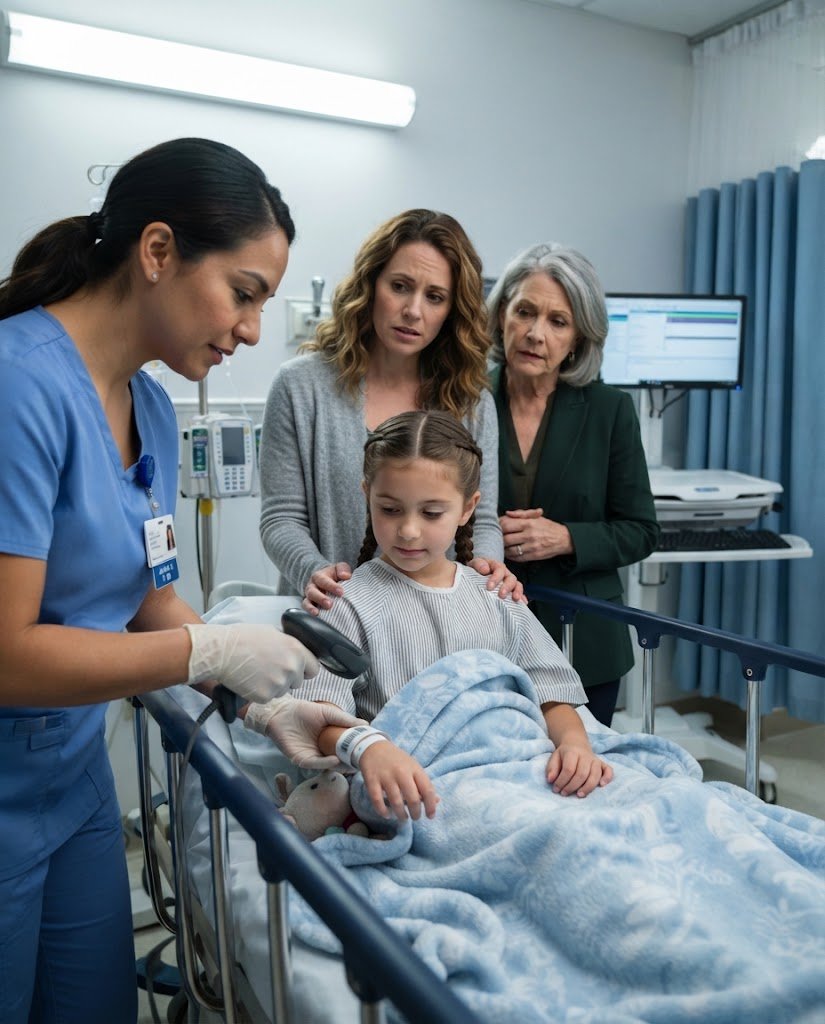
Walt watched me.
A few minutes later, another woman came out wearing hospital identification and carrying a thin folder. She introduced herself as Rachel, the hospital social worker.
She asked Adam to remain in the waiting room and took me into a consultation room.
My phone was already on the table.
Beside it was a printed page from Lizzy’s chart.
Rachel did not slide it toward me.
She said, “I need you to tell me exactly what happened this morning, beginning with the call. Don’t tell me what you think your parents intended. Just tell me what you saw and what Lizzy said.”
So I did.
I told her Lizzy had whispered that she was locked in and hungry.
I told her nobody answered the door.
I admitted breaking the kitchen window before she could ask.
I described the Christmas bins in the upstairs hall, the metal latch fixed to the outside of the closet, and Lizzy curled behind the coats.
Rachel stopped me there.
“Was the latch engaged when you found her?”
“Yes.”
“Could she have opened it from inside?”
“No.”
“How long had she been there?”
“I don’t know.”
That answer hurt more than the others.
Rachel looked down at the notes.
Then she told me what the barcode had shown.
Eleven weeks earlier, Gloria had brought Lizzy to the same hospital for dehydration. The physician recommended a social-work consultation because of Lizzy’s condition and because staff had concerns about how long she had apparently gone without adequate fluids.
Gloria had declined the follow-up and left after Lizzy was medically cleared.
Nothing in that earlier record proved a crime by itself.
But the old visit had changed meaning the moment the nurse saw my photographs.
A child previously treated for dehydration had now arrived hungry after calling for help from a closet secured from the outside.
Rachel said the hospital had made a mandated report to child protective services.
My stomach dropped even though I had expected something like that.
“Are they taking her somewhere?”
“Right now, she’s staying here while she’s evaluated. No discharge decision has been made.”
“Can my parents take her?”
Rachel held my gaze.
“Not while the safety assessment is active.”
That was the first consequence my mother could not talk her way around.
When I returned to the waiting area, Gloria stood immediately.
“Where is she?”
I sat beside Adam.
“She’s being examined.”
“By whom?”
I didn’t answer.
She looked at my empty hand and realized the hospital had my phone.
Her face tightened.
“You gave strangers private photographs of our house?”
“I gave them photographs of where I found Lizzy.”
Walt leaned forward.
“After you smashed a window and trespassed.”
“Yes.”
He seemed almost relieved that I said it again.
My mother reached for her own phone.
“Good. Then we’ll let the police sort this out.”
She made the call in front of me.
She told the dispatcher that her adult daughter had broken into her home and removed a child for whom she and her husband were legal guardians.
She used the word kidnapped twice.
Then she gave my name.
Adam whispered, “Don’t leave.”
I hadn’t planned to.
Two officers arrived less than twenty minutes later.
One spoke with Gloria and Walt. The other asked Adam and me to move farther down the hall.
I told him everything I had told Rachel.
When he asked about the window, I said I broke it.
When he asked whether I had permission to enter, I said no.
When he asked why I did it, I told him about Lizzy’s call.
My phone came back from pediatrics while we were speaking. The charge nurse had documented the photographs and timestamps with my permission, but the originals were still there.
I unlocked the screen and handed it to the officer.
He went through the images slowly.
The bins.
The latch.
The closet.
The call log.
He enlarged the photograph showing the screws fastening the metal plate to the frame.
Then he asked, “Did you move any of this before you photographed it?”
“Only the latch. I had to open it to reach her.”
He nodded and wrote that down.
My mother appeared at the end of the corridor before he finished.
“Officer, she has a history of overreacting where Lizzy is concerned.”
He looked toward her.
“Ma’am, I’ll speak with you again when I’m done here.”
Gloria did not move.
“She’s trying to take our granddaughter because she doesn’t approve of how we discipline her.”
The officer closed his notebook.
“Ma’am. Please wait over there.”
She finally walked away.
That tiny exchange seemed to shock her more than shouting would have.
For years, explanations had been enough.
Now people were writing them down.
A pediatric physician came out next and asked to speak with me privately.
Lizzy was dehydrated again, though not severely enough to require intensive treatment. She was underweight compared with the measurement documented at her earlier visit. The doctor had also found older bruising in places that needed explanation, but she was careful not to tell me what had caused it.
“We’re documenting what we can medically establish,” she said. “The investigators will determine the rest.”
I appreciated that sentence because everybody else in my family had spent months doing the opposite.
We had been explaining things before establishing them.
Lizzy was tired because school overwhelmed her.
She was thinner because she was picky.
She flinched because she was sensitive.
I had repeated some of those excuses myself because accepting them had been easier than imagining the alternative.
The doctor asked whether Lizzy had any safe relatives besides me.
I said, “Her father. My brother Ian. But he’s in treatment.”
She asked whether he could be contacted.
“I don’t know.”
Rachel returned a few minutes later and said the number listed for him in the old chart had been disconnected.
For a moment, that felt like the floor giving way.
My parents were Lizzy’s legal guardians. Ian was not available. I had a seven-year-old son at home and suddenly understood exactly why my mother’s threat had worked so well.
She had chosen the one fear that could make me hesitate.
What if helping Lizzy somehow put Noah under scrutiny too?
Rachel must have seen it on my face.
“Natalie, a child-protection investigation does not automatically mean someone takes your son. They’re looking at Lizzy’s safety and the adults responsible for her care.”
I nodded, but my hands were still shaking.
Then Adam said something I had forgotten in the chaos.
“Ian called me at Christmas.”
I turned toward him.
“What?”
“You were putting Noah to bed. He called from the treatment center. I saved the number because he asked me to tell you he was okay.”
Rachel had been wrong about Ian being unreachable.
The old chart number was dead.
Adam’s wasn’t.
He found it in his contacts.
Rachel used the consultation-room phone and asked for Ian by full name.
We waited through two transfers.
Then I heard my brother’s voice through the receiver.
Weak at first.
Then suddenly sharp when Rachel said Lizzy was in the emergency department.
She did not tell him everything. She verified who he was and asked whether he could participate in a call with the investigator handling his daughter’s case.
He said yes before she finished the question.
When Rachel handed the phone to me, neither of us spoke for a second.
Then Ian said, “Nat, is she alive?”
I closed my eyes.
“Yes.”
His breath broke against the phone.
“Is she hurt?”
“She’s safe right now.”
“Mom told me she stopped asking about me.”
I looked through the small window in the consultation-room door toward the waiting area.
Gloria sat with her arms folded tightly across her chest.
“Ian, when did you last talk to Lizzy?”
“Months ago. Every time I called after that, Mom said Lizzy was sleeping, at school, sick, or didn’t want to talk.”
He hesitated.
“I sent letters.”
“Did Lizzy get them?”
“I don’t know.”
That opened a different part of the story.
Not a secret bigger than the closet.
A mechanism.
Lizzy had not simply become quieter while Ian was away.
The adults controlling her home had also controlled who could reach her.
Ian gave Rachel permission to share his contact information with the investigator and said he would speak to anyone necessary.
Before we hung up, his voice changed.
“Nat?”
“Yeah?”
“Don’t let them convince you this is normal.”
I couldn’t answer for a moment.
Because that was exactly what they had done to all of us.
The child-protection investigator arrived near midday.
Her name was Dana, and she did not look impressed by anybody’s family history.
She spoke separately with me, Adam, my parents, the medical team, and eventually Lizzy.
Nobody was allowed to sit in for Lizzy’s interview.
That mattered.
Gloria objected.
Dana explained that she was interviewing Lizzy privately.
My mother asked whether six was really old enough for a child to understand what had happened.
Dana said, “She’s old enough to tell me what she remembers.”
My mother stopped talking.
Hours passed.
Adam bought another coffee and forgot it on a windowsill.
Walt paced twice to the elevator and back.
Gloria made three calls in a low voice.
Then the police officer who had taken my statement returned with another investigator.
They had gone to my parents’ house.
The broken kitchen window was still there.
So were the bins upstairs.
So was the latch.
The scene in my photographs matched the house.
That confirmation changed the room.
My parents could still argue about why the latch existed.
They could not argue that I had invented it.
Walt tried anyway.
He said the closet was a quiet space Lizzy sometimes used during tantrums and the latch prevented her from running down the stairs while upset.
Dana asked why the latch was outside the door.
Walt said it was temporary.
The officer asked how a six-year-old could leave a quiet space that another person had latched from the hallway.
Walt looked at Gloria.
Gloria answered for him.
“We were protecting her.”
Dana wrote that down too.
Then Lizzy came through the pediatric doors holding a juice box.
Everyone stopped.
She saw Gloria first.
Her entire body changed.
Her shoulders rose.
The juice box crumpled slightly in her hand.
She stepped behind the nurse.
Nobody had asked her a question.
Nobody had accused anyone.
She simply saw my mother and tried to disappear behind another adult.
Dana noticed.
So did the police.
Gloria stood.
“Sweetheart, Grandma’s here.”
Lizzy pressed closer to the nurse.
My mother took one step forward.
The nurse lifted her hand.
“Please stay where you are.”
Mom stared at her.
Then at me.
“Natalie did this.”
I thought I would finally shout.
Instead I looked at Lizzy.
“No,” I said. “Lizzy called me.”
That was the moment the family argument ended for me.
I had spent the morning defending what I had done.
I didn’t need to anymore.
Lizzy had asked for help.
I had come.
Everything after that belonged to the people whose job was to determine why she had needed to call at all.
Dana informed my parents that Lizzy would not be released to them that day.
The agency was initiating an emergency protective placement while it investigated the conditions in the home.
Gloria demanded to know where Lizzy would go.
Dana told her that information would be handled through the case process.
Then Mom pointed directly at me.
“You cannot give her to Natalie. She broke into our home. She has a child of her own. She is unstable.”
The same threat, repackaged for a professional audience.
Dana looked at me.
“Do you understand that a kinship placement, if considered, involves screening your household?”
“Yes.”
“That includes speaking with your husband and making sure the home is appropriate for another child.”
“Yes.”
“And you are willing to do that?”
Adam answered before I could.
“Yes.”
Dana looked back at me.
I said, “Yes.”
Gloria’s expression changed.
The threat had depended on me believing scrutiny itself was punishment.
But there was a difference between someone looking at my home because I had rescued a hungry child and someone finding a closet latched from the outside.
I wasn’t afraid of that difference anymore.
The placement did not happen instantly.
For one night, Lizzy remained under protective supervision while paperwork, background checks, and emergency approvals were completed.
That was the sideways step I hated most because I had imagined that once the truth was visible, everything would move quickly.
It didn’t.
Systems moved at the speed of forms, phone calls, supervisors, and people who had to sign their names to decisions.
But slow was not the same as stopped.
The next afternoon, Dana called.
Our preliminary kinship screening had cleared.
Lizzy could come to our house temporarily while the investigation continued.
I sat on the edge of my bed after hanging up and cried for the first time since the closet.
Not because it was over.
Because it wasn’t.
My parents still had lawyers.
Ian still had treatment to finish and a long road before anyone could determine what role he could safely resume in Lizzy’s daily life.
Lizzy still woke at small noises.
And Noah, who knew only that his cousin was staying with us for a while, gave up half his blanket collection without being asked.
Three days later, the collapse came.
Police executed a warrant connected to the child-welfare investigation and documented more than the hallway latch. Investigators also recovered Ian’s unopened letters to Lizzy from a drawer in my parents’ home.
His name was on every envelope.
Several had been mailed months earlier.
Lizzy had never seen them.
When Dana told me, I sat at my kitchen table and stared at the ceramic frog I had brought home from my parents’ porch after an officer said the damaged window area had been processed and personal property could later be sorted through properly.
I remembered that frog lying on its back in the rain the morning I arrived.
I had thought the worst thing in that house was the locked closet.
The closet was the most visible thing.
The isolation had started earlier.
A missed call here.
A letter hidden there.
A medical follow-up declined.
A child’s fear explained away until everyone around her learned to mistrust what they were seeing.
My parents were later ordered to have no unsupervised contact with Lizzy while the case proceeded. The court did not decide every long-term custody question at the first hearing, and nobody handed me a neat ending.
What we got instead was something more important.
Time.
Distance.
Records nobody could erase with a family explanation.
Ian joined the hearing remotely from treatment.
He looked thinner than I remembered.
When the judge asked whether he understood that his own recovery and parental fitness would be evaluated separately from the allegations against Gloria and Walt, he said he did.
He didn’t demand Lizzy back immediately.
He said, “I want her safe while I earn my way back into her life.”
That was the first thing anyone had said about Lizzy all week that required something from the adult instead of from her.
Afterward, Gloria tried to speak to me in the courthouse hallway.
She said my name the way she used to when I was a teenager and she wanted me to stop embarrassing her.
“Natalie.”
I kept walking.
“You’re destroying this family.”
I stopped then.
Not because the sentence hurt.
Because Lizzy was standing beside me holding Dana’s hand, and I saw her listening.
I turned around.
“No. We’re finally making the adults answer for what happened to a child.”
Then I left.
I didn’t give her a speech about forgiveness.
I didn’t tell her she would regret it.
I didn’t need to.
Consequences had already begun doing what arguments never had.
Weeks later, Lizzy was still with us under the temporary placement.
She ate quickly at first and hid crackers in the pocket of her pajamas.
We didn’t punish her or make a performance out of discovering them.
Adam put a basket of snacks on the lowest pantry shelf and told both kids they never had to ask before taking something from it.
For several nights, the crackers disappeared.
Then fewer disappeared.
Eventually the basket stayed full between meals.
Ian called on a schedule approved by the caseworker.
The first time Lizzy heard his voice, she wouldn’t speak.
He didn’t push.
He told her he loved her and would call again when he was supposed to.
The second time, she whispered hello.
The third time, she told him Noah cheated at Go Fish.
Noah shouted from across the room that she was lying.
Lizzy laughed so suddenly that every adult in the kitchen went quiet.
She noticed us watching and stopped.
So Adam accused me of cheating too, Noah protested louder, and the moment moved on.
That mattered.
Not every good sound needed witnesses.
One evening before her bath, Lizzy held out her wrist.
The white hospital band was still there, softened at the edges from several days of wear.
“Can this come off now?” she asked.
I found the small scissors from the bathroom drawer.
For a second, I remembered the nurse turning that same band beneath the scanner.
Beep.
A record opening.
A face going pale.
A door locking behind Lizzy for the first time that morning in order to keep the wrong people out instead of keeping her in.
I slid one blade carefully beneath the plastic.
“Ready?”
Lizzy nodded.
I cut the band.
She rubbed the pale mark around her wrist, then handed the strip to me instead of throwing it away.
“You keep it.”
So I did.
Not because a hospital bracelet saved her.
Lizzy saved herself first when she found a phone and whispered my name.
The band only connected that morning to a history the adults around her had tried to explain away.
I put it in the same envelope as the copy of her call log.
The closet latch belonged to an evidence photograph now.
The BAND belonged to the day people finally listened.