My husband never got to hold our daughters.
They were born in March, by then he was already away. He saw them only on a laptop with choppy sound, often saying the hardest part wasn’t the environment but knowing they’d recognize his voice before his face.
He was arriving on Tuesday.
He called nine hours earlier from the other airport, saying he was waiting at the gate.
“I miss you so much. I can’t wait to see my little girls.” Then a laugh, “Although apparently they’re not that little anymore.”
He repeated his familiar words: “I’m so sorry. I’m so, so sorry I wasn’t there.”
I assured him not to worry; what counted was he was coming back, and his family was waiting.
He sent a video boarding the plane. I watched it countless times.
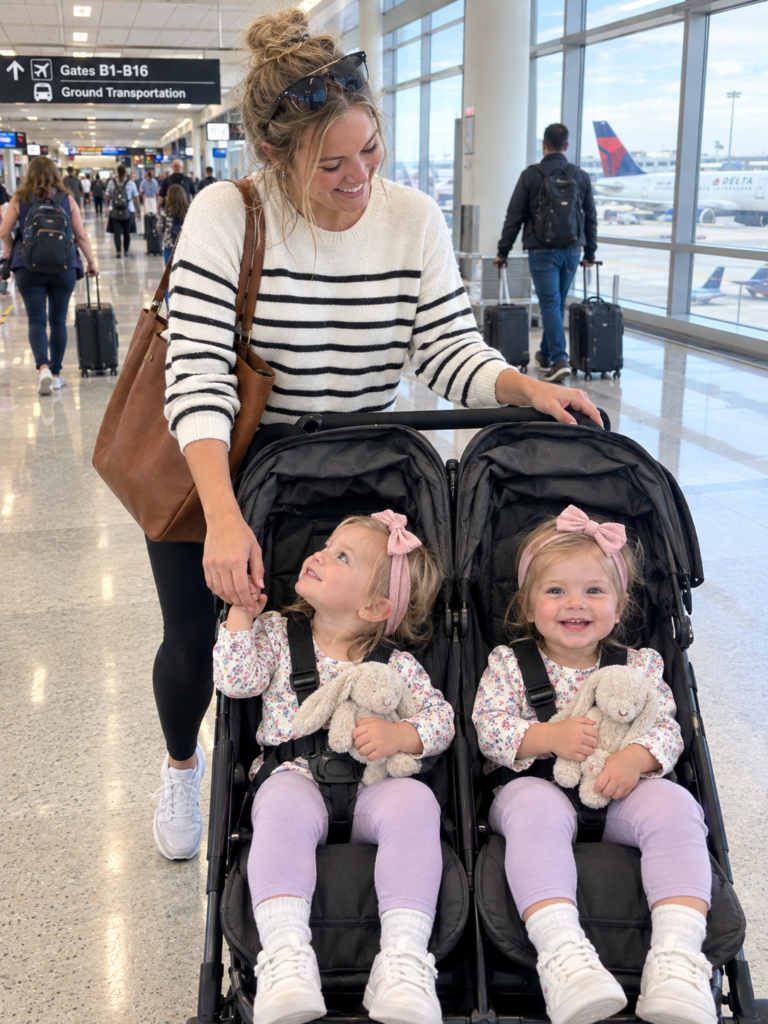
Monday night brought no rest. The twins wore outfits saying DADDY’S HOME, gifts from his mother. Three balloons were attached to the stroller.
I kept watch on the flight, following the animated plane on my phone.
The arrivals board flashed LANDED.
People exited. Next to me, a woman screamed and rushed a uniformed kid, with applause spreading through the hall.
Then someone tapped my shoulder and called my name.
I turned, but it was not him.
A soldier in dress uniform stood without a bag.
“Sorry,” was my response. “You must have the wrong person.”
“You’re here for Calvin?”
“Yes. That’s my husband.”
“He’s not coming.”
Despite myself, I laughed lightly, explaining I tracked his flight and received his video.
“Ma’am. He was never on that flight. You should go home immediately.”
“What did you just say?” — I faced the soldier fully at last…
He didn’t repeat it. He only looked at the stroller, at the pink glitter letters and the three balloons bobbing above my daughters, and I saw his jaw tighten.
“Is my husband dead?”
“No, ma’am.”
The airport seemed to tilt. “He’s alive?”
“Yes.”
“Then where is he?”
“He’s receiving medical care.”
“What happened?”
“There was a complication.”
Both babies started crying. I bent over the stroller, fumbling for a pacifier, and my hands shook so badly that I dropped it.
“Please,” I whispered. “I have his children here. Don’t make me guess what happened to their father.”
“I served with Calvin. I’m Preston Doyle.”
I knew the name. Calvin had talked about him for months.
“He asked me to meet you. He didn’t want you coming to see him yet.”
“What?”
“He wants you to go home.”
“He’s alive, and he doesn’t want his wife?”
“That’s not what I meant.”
“Then tell me what you mean.”
Preston glanced at the girls. “Calvin was injured six weeks ago. His back. It affected his legs.”
I gripped the stroller. I remembered our calls: Calvin propped against pillows, the camera never showing below his shoulders. Whenever I asked him to stand and show me his room, he made a joke.
“He’s using a wheelchair,” Preston said. “He thought he’d be walking again before he came home.”
All those apologies. I had thought he meant the birth.
“He called you from the other airport, waiting at the gate, and sent that video boarding the plane. All true. But he never got on. The pain became unbearable, and his legs were weaker than before. Medical staff took him to a nearby hospital before the flight left.”
“Why didn’t he call me?”
“He couldn’t during the emergency. Afterward, he was ashamed.”
“Of what?”
Preston looked away. “Of letting you down.”
I wanted to scream. Instead I tucked a blanket around my crying daughter.
“Doctors have cleared him for assisted travel,” he said. “A medical transport is bringing him by road to a rehabilitation facility forty minutes from here. He should arrive this evening.”
“Then I’ll be there.”
“He asked me to take you home.”
“I thought you were about to tell me he was dead.”
His face tightened. “I know. I should have told you he was alive first. He made me promise not to bring you. I handled this badly.”
“Take me to him.”
He nodded.
We waited in a quiet family room at the rehabilitation center. The hours crawled. I called Calvin twice, and neither call was answered. I fed the girls, Rosie and June, and changed them, and watched their tiny fingers curl around mine. I remembered the night they were born: two cries, two small bodies against my chest, and a phone propped beside my pillow waiting for a call that came too late. Calvin had cried when I showed him their faces. I had promised there would be other firsts.
I hadn’t imagined we would have to fight so hard for this one.
By evening, Preston said Calvin had arrived. I followed him down a hallway that smelled of disinfectant. Outside Room 12, he stopped.
“He’s scared.”
“So am I.”
He knocked and went in. I waited with the stroller and heard Calvin’s voice.
“I told you not to bring her. I just needed another week.”
Another week. After nine months.
I pushed the door open.
Calvin turned. Neither of us moved. Preston slipped out, leaving us alone.
My husband sat on the edge of the bed. He was thinner, his hair shorter, shadows under his eyes. Beside him stood a wheelchair.
But he wasn’t looking at me anymore. He was staring at the stroller. One daughter slept with her mouth open. The other had a fist pressed against her cheek.
Calvin covered his mouth. “They’re real,” he whispered. “They’re really here.”
He reached toward the stroller. Then he looked down at his legs, and his hand fell back to the blanket. I watched him try to smile, to be the man he had promised himself he’d be when he finally met them.
June stirred. Calvin looked up at once. “Was that her?”
“She does that when she’s waking up.”
He smiled through tears. “I don’t even know that about my own daughter.”
I had imagined running into his arms. Instead I stood by the door.
“Calvin.”
He looked down. “I’m sorry.”
Those words again.
“How long?”
“Six weeks.”
Six weeks of phone calls. Six weeks of him asking about bottles and naps and first smiles, while I told him how much we needed him.
“You lied to me.”
“I didn’t want you to worry.”
“When that soldier touched my shoulder, I thought you were dead,” I said, and my voice shook. “I thought I’d have to tell our daughters about you instead of introducing them to you.”
He started to cry. “I’m sorry.”
“Stop. I don’t need another apology.” I pointed at the stroller. “I need their father.”
“I wanted to walk through those doors,” he said. “I wanted to pick them up. Both of them.”
“You can hold them.”
He shook his head. “I’ve been practicing. Standing without help. Taking steps between the bars. Some days my legs cooperate, and some days they don’t. The therapists told me to slow down, but I kept pushing.”
“Why?”
“Because I thought if I worked hard enough, you would never have to see me like this.”
I sat beside him. “You thought I’d stop loving you?”
“No.” He stared at the girls. “I promised myself I’d never become my father.”
Calvin rarely talked about his father. I knew there had been an accident, that his father had used a wheelchair afterward, and that he died while Calvin was young. But I didn’t know what Calvin remembered most.
“I was seven,” he said. “Before the accident, we built things together every Saturday. We started a wooden airplane. It wasn’t finished when he got hurt.”
I thought of the little plane wrapped in a towel in our bedroom.
“Afterward, he stayed in his room. I took the airplane to his door and asked if we could finish it. He said, ‘Go away.’ I tried again the next Saturday. And the next.” He swallowed. “Eventually, I stopped knocking. The last time, I left the airplane outside his door. I couldn’t carry it back again.”
For a while neither of us spoke.
“He didn’t want me,” Calvin whispered. “And now I can’t even walk across a room to pick up my own daughters.”
“You don’t have to walk to love them.”
“You don’t understand.”
“Then listen. Your father hurt you by shutting you out. You’re hurting us by doing the same thing.”
His face crumpled. “I know.”
I wrapped my arms around him, and he pulled me against his chest and buried his face in my neck. For the first time in nine months, I felt his arms around me. I held him tighter, not because everything was forgiven but because he was warm and breathing and alive.
“God, I missed you,” he whispered.
“I missed you too. I love you. But you cannot disappear every time you’re frightened. I need the truth, even when it’s ugly.”
“You’ll have it.”
At last he pulled back enough to look at me. “Can I see them?”
I rolled the stroller closer. He reached toward one daughter, then stopped. “What if I drop her?”
“You won’t.”
“I practiced with a weighted doll in therapy,” he whispered. “But she never moved or cried.”
A nurse helped him settle in the wheelchair and showed us how to position the baby. His hands still trembled. “We’ll do it together,” I said, and lowered June against his chest.
For the first time, Calvin held his child.
He didn’t move. He just watched her breathe. Then he brushed a finger across her cheek. “I’ve been waiting for you.”
He began to sob. “I’m here, baby. Daddy’s here.”
June blinked, then cried. Calvin panicked. “She doesn’t know me.”
“Give her a moment.”
“Take her, please.”
I steadied his arm. “Talk to her.”
“What do I say?”
“Sing. The song from your calls.”
He began softly, the same silly song he had sung through crackling speakers for months. June cried once more, then turned her face toward him. Her breathing settled.
He stopped. I touched his shoulder. “Keep singing.”
He did.
“She knows me,” he whispered.
“She knows your voice.”
Then Rosie woke and started crying, and Calvin laughed through his tears. “That’s my other girl?”
“That’s your other girl.”
We stayed until both needed feeding. He watched me change them and asked which one hated baths and which one smiled first. He wanted every detail he’d missed. Before we left he asked, “Tomorrow?”
“Tomorrow.”
That night I lay awake beside two sleeping babies, thinking about a little boy knocking on a closed door.
The next morning I called Calvin’s mother. I told her what Calvin had said, and then I mentioned the airplane.
“Oh, sweetheart.” Her voice cracked. “Calvin still has it?”
“Yes.”
“His father finished that airplane.”
I sat down. “What?”
“After Calvin stopped knocking, his father finished it himself and put it back in the box with Calvin’s childhood things. Calvin never took it out of the towel. When he moved out, he took the whole box without opening it.”
I remembered how Calvin never let anyone touch that towel.
“His father asked about him every Saturday,” she said, “even after Calvin stopped coming. After the accident he fell into a terrible depression. He was ashamed of needing help, and he thought Calvin would be better off without him. When Calvin stopped coming, he thought his son didn’t want him anymore. I told Calvin his father loved him, but he said I was making excuses. I should have told him about those Saturdays anyway.”
I went to our bedroom and unwrapped the towel. The little plane had two finished wings, smooth edges, a polished wooden tail. I turned it over.
Four words were carved underneath: FOR CALVIN. ALWAYS DAD.
I sat on the floor and cried.
That afternoon, I carried the airplane to the rehabilitation center. Calvin smiled at the stroller, then saw what I was holding.
“Why did you bring that?”
“Your father finished it.”
His smile vanished. “No.”
“After you stopped knocking. Your mom said he asked about you every Saturday.”
I placed it in his hands. I turned it over, and he read the words once, then twice. Then he pressed the airplane to his chest and couldn’t speak for a long time.
“I spent my whole life thinking he didn’t want me,” he finally whispered. “And he thought I didn’t want him.”
“He loved you,” I said. “But he hurt you too.”
“He should have opened that door.”
“Yes.”
He looked at our daughters. “And I should have told you. I almost did the same thing to them.”
I took his hand. “Then don’t.”
“I won’t.”
Recovery wasn’t instant. There were appointments and painful exercises, days when he needed help, and conversations neither of us could avoid anymore. But Calvin stopped hiding.
He came home in his wheelchair. We took the photograph we’d imagined for months: both daughters in his arms, their matching outfits now a little tight, the wheelchair visible, the wooden airplane on the table beside him.
That night, one baby woke crying. Before I could get up, Calvin rolled beside her crib.
“I’m here, sweetheart.”
He began to sing, and she quieted.
I stood in the doorway and remembered the airport: three balloons, two babies, a man who never came through the doors. Now I was watching him sing our daughter back to sleep.
For nine months he had worried that they’d know his voice before his face.
Now his voice helped them feel safe. And this time, when his daughter needed him, her father was there.