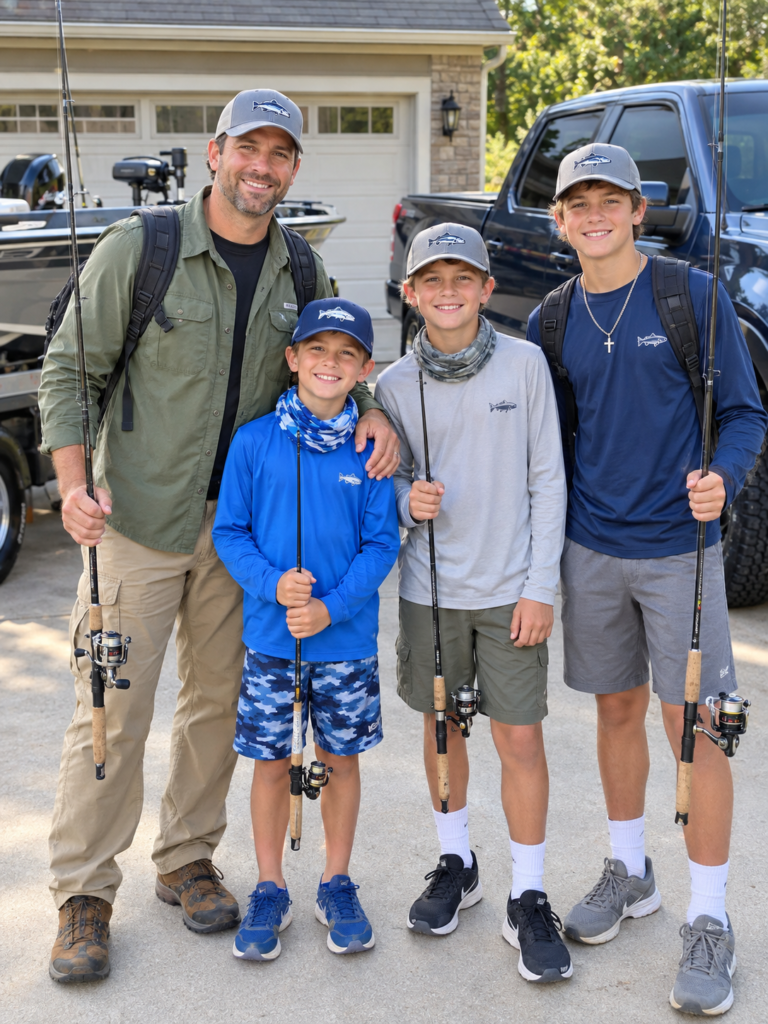
My husband took our three sons fishing, but none of them returned home. Six years later, our oldest daughter discovered his old cellphone and whispered, “Mom, I finally know what happened to Dad and the boys.”
She pressed the play button.
For a moment, nothing happened.
The screen remained dark except for the faint reflection of Sophie’s frightened face. Then the picture shuddered into focus.
Daniel appeared.
My breath stopped.
Six years disappeared in an instant.
There he was at our kitchen table, wearing the faded blue T-shirt I had thrown away only three months after he vanished because I could no longer bear seeing it in the laundry room.
His hair was slightly damp. His eyes looked tired.
Alive.
Daniel leaned toward the phone.
“Okay,” he said quietly. “I feel ridiculous doing this.”
My knees weakened.
Sophie caught my arm.
“Mom?”
“I’m fine.”
I wasn’t.
Daniel glanced toward something beyond the camera.
The clock above our refrigerator was visible behind him.
11:17 p.m.
I remembered that night.
It had been the Thursday before the fishing trip.
I had gone upstairs early because our youngest daughter, Emma, had a fever. Daniel stayed downstairs, saying he had paperwork to finish.
On the screen, my husband rubbed both hands over his face.
Then he looked directly into the camera.
“If you’re watching this, Laura, then something happened before I got the chance to explain.”
Sophie inhaled sharply.
My hand flew to my mouth.
Daniel continued.
“I’m not expecting anything to happen. I want to be clear about that. But Dean came by tonight, and we argued.”
The room seemed to tilt.
Sophie paused the video.
“Uncle Dean?”
“Yes.”
She stared at me.
“Dad never told you?”
“No.”
I looked toward the back door as though Dean might somehow be standing outside it.
He had been in this kitchen hundreds of times since Daniel disappeared.
He had replaced the broken hinge on that very door.
He had sat at our table on Christmas mornings.
He had taught Emma to drive.
He had carried boxes when Sophie left for college and cried in the driveway after she drove away.
For six years, Dean had been woven into the fabric of our survival.
“Play it,” I whispered.
Sophie did.
Daniel’s image moved again.
“Dean borrowed the boat last weekend,” he said. “He told me he bumped the lower unit against a submerged stump near North Point.”
I remembered nothing about that.
Not one word.
“He said it was nothing,” Daniel continued. “But when I checked the hull tonight, I found a hairline crack near the stern. Maybe it’s superficial. Maybe it isn’t.”
My heart began hammering.
The damaged boat.
The boat rescue crews had found washed ashore.
The boat everyone assumed had been damaged during the accident.
Daniel looked angry now.
Not frightened.
Angry.
“I asked Dean if he had it inspected. He said yes.”
Daniel reached forward and adjusted the phone.
“But I called Ray’s Marine after he left. Ray says nobody brought my boat in.”
Sophie paused the recording again.
Neither of us spoke.
Outside, a car passed along the road.
The ordinary sound felt almost offensive.
I finally whispered, “Dean told the investigators the boat had been in perfect condition.”
Sophie’s face drained of color.
“You remember that?”
“I remember everything.”
There were parts of those weeks I couldn’t recall at all—meals people brought, names of volunteers, entire conversations.
But some moments had been burned so deeply into my mind that I could still hear them.
Dean sitting beside me in the police station.
An investigator asking about the boat.
Dean answering before I could.
Daniel took care of that thing like it was another child.
I remembered Dean smiling sadly.
He’d never take the boys out if there was anything wrong with it.
Six years later, the sentence came back with a different shape.
Sophie restarted the video.
Daniel lowered his voice.
“I told Dean I wasn’t taking the boys unless he came over in the morning and showed me exactly what happened. He got defensive. Said I was accusing him of lying.”
Daniel gave a tired laugh.
“I suppose I was.”
Then his expression changed.
He looked down.
“When we were kids, Dean always did this. Something went wrong and he’d decide hiding it was easier than admitting it.”
I closed my eyes briefly.
That sounded like Daniel.
Not because he complained about his brother often.
He didn’t.
But I had heard him say something similar once, years earlier, after Dean had forgotten to pay an insurance premium on a vehicle they jointly owned.
Daniel looked toward the camera again.
“If the crack is serious, the trip is canceled. The boys will be furious, but they’ll survive disappointment.”
His mouth lifted faintly.
“I’d prefer that.”
I almost made a sound.
Sophie reached for me.
The video continued for another twenty seconds.
Daniel explained that he planned to check the boat himself before sunrise. If Dean produced proof of an inspection, he would take the boys. Otherwise, he would leave it home.
Then he said the words that changed everything.
“One more thing. Dean told me not to mention the damage to Laura because she worries.”
Daniel’s face hardened.
“That bothered me more than anything else.”
He leaned closer.
“If he shows up tomorrow pretending nothing happened, I’m telling her.”
The video ended.
The kitchen fell silent.
I stared at Daniel’s frozen face on the screen.
For six years, investigators had operated under one fundamental assumption.
The boat had been seaworthy when Daniel launched it.
I had believed that because Dean had told me so.
The police had believed it because Dean had told them so.
And now my dead husband was speaking from an old cellphone, telling me the opposite.
Sophie lowered the phone.
“Mom?”
I couldn’t answer immediately.
A strange memory had surfaced.
Friday morning.
The day before Daniel and the boys vanished.
I had been standing at the bathroom sink when I heard voices downstairs.
Daniel’s.
Dean’s.
I hadn’t thought anything of it.
By the time I came down, Dean was gone.
Daniel had been drinking coffee.
“Everything okay?” I had asked.
He kissed my forehead.
“Fine.”
Then he smiled.
“Boat’s good to go.”
Six years later, I heard the sentence differently.
Boat’s good to go.
Because Dean had convinced him?
Because Daniel had inspected it himself?
Or because someone had repaired the crack?
“Mom.”
Sophie’s voice brought me back.
“There’s more.”
I looked at her.
“More videos?”
“No.”
She opened a folder on the phone.
“Messages.”
The phone had no active service, but some old conversations remained stored in its memory.
One thread contained Daniel’s name.
Another belonged to Dean.
Sophie opened it.
Most messages were years old.
Ordinary things.
Can you pick up Dad’s ladder?
Tell Laura thanks for the pie.
Game starts at seven.
Then, near the bottom, there were several unsent drafts.
Daniel had apparently typed them without sending them.
The last one was dated Friday morning.
My eyes moved across the words.
Dean, I looked underneath again. The patch is fresh. Did you do that yourself?
Below it was another.
I’m serious. Call me.
And finally:
If you touched the boat after I told you not to, you’d better tell me now.
Sophie looked at me.
“Why wouldn’t he send them?”
“I don’t know.”
Then I realized something.
“This wasn’t the phone he was using then.”
“What?”
“He had already replaced this one.”
Sophie frowned.
“Then why was Dad recording videos on it?”
That question frightened me.
Daniel had claimed the phone was lost nearly two years before the accident.
Yet somehow it had been charged.
Used.
Hidden.
And then stored among his belongings.
Sophie returned to the gallery.
“I found the video because it was the newest file.”
She scrolled.
“Most of these are old pictures.”
Birthday parties.
School concerts.
Camping trips.
Daniel building a treehouse with the boys.
Then Sophie stopped.
“There.”
A photograph.
It had been taken Friday morning.
The day before the trip.
The image showed the underside of our fishing boat.
Daniel had photographed the stern.
Even on the small screen, I could see a pale strip running across the fiberglass.
A repair.
Sophie enlarged the image.
“There’s another picture.”
This one showed something on the garage floor.
A torn piece of packaging.
The label was partially visible.
MARINE EPOXY.
Below that was a handwritten number.
Daniel had zoomed in on it.
A receipt number.
Sophie whispered, “Could we trace that?”
“After six years?”
“Maybe.”
We stood there for another minute.
Then I picked up my phone.
Sophie knew who I was calling before I touched the screen.
“Mom.”
“I need to speak to Dean.”
“Tonight?”
“Yes.”
“What are you going to say?”
I looked at Daniel’s frozen face.
“The truth.”
Dean answered after three rings.
“Laura?”
His voice was warm.
Familiar.
For a moment I almost lost my nerve.
“Hey,” he said. “Everything okay?”
“Were you at our house the Friday morning before Daniel disappeared?”
Silence.
Not long.
Perhaps two seconds.
But enough.
“Yes.”
“What did you talk about?”
Another pause.
“Where is this coming from?”
“Answer me.”
His voice changed.
Not dramatically.
Just enough.
“We talked about the trip.”
“The boat?”
Silence again.
“Laura—”
“Was the boat damaged?”
I heard him exhale.
“I don’t understand.”
“Yes, you do.”
Sophie stood across from me, arms wrapped around herself.
I continued.
“Daniel made a recording Thursday night. He said you hit something while using the boat.”
Nothing.
“Dean?”
“I’m here.”
“He said there was a crack.”
“Laura, listen to me.”
“He said you claimed you had it inspected, but the marina had no record of it.”
His next breath trembled.
That frightened me more than anger would have.
“Where did you find this?”
“Was the boat damaged?”
“Laura—”
“Yes or no?”
A long silence.
Then:
“Yes.”
Sophie closed her eyes.
My fingers tightened around the phone.
“Did you repair it yourself?”
Dean did not answer.
“Dean.”
“I thought I did.”
The kitchen seemed to disappear around me.
“What does that mean?”
“It means I thought it was minor.”
“Did you tell Daniel?”
“Yes.”
“Everything?”
He went silent.
That was my answer.
I sat down.
“Why did you tell the police the boat was fine?”
“I was scared.”
“Of what?”
“That everyone would blame me.”
My voice broke.
“My husband and my sons vanished.”
“I know.”
“And you were worried people might blame you?”
“I know how that sounds.”
“No. I don’t think you do.”
“Laura, I have lived with this every day.”
“So have I.”
Sophie looked away.
Dean’s voice dropped almost to a whisper.
“I never meant for anyone to get hurt.”
The sentence struck me with physical force.
“What exactly are you saying?”
“I patched the crack.”
“With epoxy?”
“Yes.”
“You’re not a boat mechanic.”
“I know.”
“Did you tell Daniel?”
“I told him I had fixed it.”
I pressed my fist against my mouth.
For six years, Dean had helped raise my daughters.
For six years, he had stood beside me during memorial services.
For six years, he had listened while I wondered why Daniel, a careful man, had taken an unsafe boat onto the water.
And all that time, Dean had known.
“Was the patch still there when the boat was recovered?” I asked.
“I don’t know.”
“You saw the boat afterward.”
Another silence.
My pulse quickened.
“You did, didn’t you?”
“The sheriff asked me to identify it.”
“And?”
Dean breathed unevenly.
“The stern was torn open.”
“Where you patched it?”
“Yes.”
I could hear Sophie crying quietly.
Then Dean said something unexpected.
“But that isn’t why they disappeared.”
I went still.
“What?”
“The repair failed. I know that.”
“Then what are you talking about?”
“Daniel called me Saturday afternoon.”
Every thought in my head stopped.
“No.”
“He called me.”
“His phone records showed no outgoing call.”
“He didn’t call from his phone.”
My grip tightened.
“Where was he?”
“I don’t know.”
“What did he say?”
Dean’s voice became strained.
“He said they were alive.”
Sophie’s head snapped up.
My heart seemed to stop completely.
“What?”
“He said the boat took on water. They got it close enough to shore that he and the boys could swim.”
I stood.
The chair scraped hard against the floor.
“You knew they survived the boat accident?”
“Yes.”
“And you said nothing?”
“I tried to tell the police later.”
“Later?”
“I thought Daniel was coming back.”
“Why?”
“Because he told me not to tell you yet.”
I could barely breathe.
“That makes no sense.”
“I know.”
“Where were they?”
“He wouldn’t say.”
“Why?”
Dean swallowed audibly.
“Because he said he’d found something.”
“What?”
“He didn’t explain.”
I closed my eyes.
My husband had been alive.
My sons had been alive.
After the boat went down.
All four of them.
“What were his exact words?”
Dean was silent for so long I thought the call had disconnected.
Then he said:
“He told me, ‘The accident wasn’t an accident.’”
The kitchen suddenly felt very cold.
“And then?”
“He said he needed time to figure out who had done it.”
I gripped the counter.
“Done what?”
“Something to the boat.”
“But you damaged the boat.”
“I damaged it the week before. I patched the crack.”
Dean’s voice shook.
“But Daniel said the patch wasn’t what failed.”
I stared at the photograph on the old cellphone.
The pale repaired line.
“What did?”
“He said somebody had removed the drain plug.”
I stopped breathing.
Dean continued.
“He told me he found scratches around the fitting. Fresh ones. He said someone had tampered with it after he checked the boat Friday morning.”
Sophie covered her mouth.
“And you believed him?”
“At first I thought he was panicking. Then he told me something only I knew.”
“What?”
“The plug had been replaced.”
“When?”
“Friday afternoon.”
“By whom?”
“I don’t know.”
I whispered, “Who had access to our garage?”
Dean said nothing.
My mind began assembling the possibilities.
Neighbors.
Friends.
Family.
And then I remembered something so ordinary I had not thought about it in six years.
Friday afternoon, I had taken the girls shopping for school supplies.
Daniel had gone to pick up the boys.
The house had been empty for almost two hours.
Except—
No.
Not empty.
I remembered coming home and seeing a vehicle pulling away.
A gray sedan.
At the time, I thought it belonged to one of Daniel’s friends.
“Dean,” I whispered. “Who did Daniel think tampered with the boat?”
“I don’t know.”
“You said he found something.”
“He did.”
“What?”
Dean hesitated.
“A note.”
Sophie stepped closer.
“What did it say?”
“I never saw it.”
“But Daniel told you.”
“Yes.”
I waited.
Dean finally spoke.
“Three words.”
“What words?”
His voice came through the phone barely above a whisper.
“Ask your wife.”
My blood turned to ice.
Sophie stared at me.
For the first time in six years, the mystery of the lake no longer felt like something far away.
It had followed us home long before Daniel and the boys ever left.
And somewhere inside the life I thought I remembered, there was a missing piece with my name on it.
I did not sleep that night.
Sophie didn’t either.
We sat at the kitchen table while the old phone charged between us like an object recovered from an archaeological dig.
Neither of us wanted to touch it.
At four in the morning, Sophie made tea.
At five, I finally told her about the gray sedan.
“I saw it Friday afternoon,” I said.
“Why didn’t you tell the police?”
“Because I forgot.”
The admission sounded terrible.
Sophie shook her head.
“You had four people missing.”
“That doesn’t make forgetting easier.”
“Mom, nobody remembers every car they see.”
But this one bothered me.
The sedan had been parked near our mailbox when I turned onto the street.
By the time I reached the driveway, it was leaving.
I remembered the driver lifting one hand.
A wave.
I had waved back.
“Did you recognize them?”
“I thought I did.”
“Who?”
I stared into my tea.
“Your aunt Rebecca.”
Sophie frowned.
“Uncle Dean’s wife?”
“Yes.”
Rebecca had died four years after Daniel disappeared.
Cancer.
She had been fifty-two.
During her illness, I visited her often.
Never once had she mentioned being at my house the day before the fishing trip.
Sophie searched my face.
“Are you sure?”
“No.”
That was the problem with memory.
After six years, certainty became dangerous.
A shape could become a face.
A color could become a fact.
Grief could polish ordinary details until they glittered with meaning they never possessed.
“I need the police,” I said.
This time, I did not call the emergency number.
I called Detective Mara Quinn.
Mara had been a young detective when Daniel vanished. She had remained involved through most of the original search and had been one of the few investigators who never spoke to me as though I were fragile glass.
She answered at seven twenty-three.
By nine, she was in my living room.
Her hair was more silver now.
Mine was too.
She watched Daniel’s video twice without speaking.
Then she photographed the unsent messages and the images of the boat repair.
When I told her what Dean had admitted, her expression tightened.
“He never told us Daniel contacted him after the boat was found.”
“He says he tried later.”
“He didn’t.”
“You’re sure?”
“I read every interview.”
She looked toward Sophie.
“May I take the phone?”
Sophie glanced at me.
I nodded.
Mara sealed it in an evidence bag.
“Technology has improved,” she said. “We may be able to recover deleted files.”
“What happens now?”
“I speak to Dean.”
“And the case?”
“I’m reopening it.”
The words should have brought relief.
Instead, they terrified me.
For six years, I had wanted someone to tell me the official story was wrong.
Now someone had.
Mara stood.
“There’s something I need both of you to understand. Daniel’s video proves he had concerns about the boat. Dean’s statement, if he confirms it, proves Daniel survived the initial incident.”
“So they were alive.”
“For some period of time.”
“How long?”
“We don’t know.”
She paused.
“And we don’t know whether Daniel’s interpretation about tampering was correct.”
“But the note—”
“Assuming the note existed.”
I looked at her sharply.
“You think Dean is lying?”
“I think Dean hid something for six years. That means I verify everything he says.”
She left.
Sophie sat beside me.
“Do you think Aunt Rebecca wrote the note?”
“I don’t know.”
“Why would she?”
“I don’t know that either.”
By noon, we were in Daniel’s garage.
For years, I had avoided changing much in there.
Daniel’s tools remained arranged on the pegboard.
Coffee cans held screws and bolts.
An old baseball cap hung from a nail.
Sophie opened drawers.
“What are we looking for?”
“I wish I knew.”
We searched for three hours.
Receipts.
Notebooks.
Old fishing maps.
Nothing.
Then Sophie pulled a wooden tackle box from a high shelf.
“This has Dad’s name on it.”
I recognized it immediately.
“That belonged to your grandfather first.”
The brass latch resisted.
Inside were lures, hooks, old photographs, and a small spiral notebook.
Daniel’s handwriting filled the first dozen pages.
Dates.
Water temperatures.
Fishing conditions.
Nothing unusual.
Then we reached the final page.
Three names were written there.
Dean.
Rebecca.
Michael Trent.
Sophie pointed.
“Who’s Michael Trent?”
“I haven’t heard that name in years.”
“Who was he?”
“A friend.”
Of whose, I wasn’t sure.
Daniel knew him.
Dean knew him.
Rebecca definitely knew him.
They had all grown up together.
Michael moved away long before our children were born.
“Why would Dad write his name?”
Below the names was a sentence.
One of them is lying about June 12.
Sophie looked at me.
“When was that?”
I calculated.
“Three weeks before they disappeared.”
“What happened June twelfth?”
“I don’t know.”
Then I remembered Daniel coming home late one evening.
He had said he had been helping Dean move equipment.
Nothing more.
Sophie flipped the page.
Something fell out.
A business card.
HARRIS COUNTY PROPERTY RECORDS.
On the back, Daniel had written an address.
17 Cottonwood Lane.
I knew the address.
Rebecca’s parents had owned a small house there.
After they died, the property had stood empty for years.
“Mom?”
“I know where this is.”
We drove there despite knowing Mara would have preferred we wait.
The house had changed.
Fresh paint.
A new fence.
A young couple answered the door.
I explained that my late husband had written their address in an old notebook.
They were understandably cautious, until I asked who had owned the property before them.
“We bought it from a bank,” the man said.
“Before that?”
He disappeared inside and returned with closing documents.
The previous registered owner was a company.
North Shore Holdings.
I had never heard of it.
But beneath the company name was the signature of its managing partner.
Dean Mercer.
Sophie looked at me.
“Uncle Dean owned this?”
Apparently.
We thanked the couple and left.
In the car, Sophie searched public property records from her phone.
North Shore Holdings owned three parcels.
The Cottonwood house.
A warehouse near the highway.
And fourteen acres on the northern edge of the lake where Daniel disappeared.
My skin prickled.
“What’s on that land?”
Sophie enlarged the map.
“A cabin.”
We called Mara.
She arrived forty minutes later and was visibly unhappy that we had gone investigating alone.
But when Sophie showed her the property records, she stopped scolding us.
“Dean never disclosed owning lake property,” she said.
“Would he have been required to?”
“When his brother vanished less than three miles away? Yes.”
The cabin sat at the end of a narrow gravel road behind a locked gate.
Mara obtained permission to access the property through Dean’s attorney by late afternoon.
Dean himself did not come.
The cabin looked abandoned.
Dust coated the porch.
Inside were two beds, a small kitchen, and shelves filled with old canned food.
Sophie walked slowly through the main room.
“Could Dad and the boys have come here?”
Mara examined the fireplace.
“Possible.”
Something on the mantel caught my attention.
A framed photograph.
Dean and Rebecca.
Behind them stood Daniel.
And beside Daniel—
Michael Trent.
The photograph had been taken years ago.
All four were young.
Laughing.
Daniel had one arm around Michael.
Rebecca stood between the brothers.
On the back, someone had written:
The four of us. Before everything changed.
Sophie read it twice.
“What changed?”
I had no answer.
Mara searched the kitchen.
A drawer near the sink contained an old landline telephone directory and several loose envelopes.
One was addressed to Daniel.
My hands began trembling.
“It was never mailed,” Mara said.
The envelope had been opened.
Inside was a letter.
The handwriting belonged to Rebecca.
Daniel,
I should have told you years ago. I thought keeping quiet protected everyone, but silence has only made things worse.
Dean knows I saw Michael again.
My eyes lifted.
Sophie whispered, “Michael?”
I continued reading.
What happened on June 12 was not what Dean thinks.
Please give me until after your fishing trip. I will tell you everything.
There was no signature.
The letter ended there.
Mara took it carefully.
“Where did this come from?” I asked.
“Someone brought it here.”
“Dean?”
“Maybe.”
“Rebecca?”
“Maybe.”
Sophie pointed toward the envelope.
“There’s something else.”
A tiny drawing appeared beneath Daniel’s name.
Three circles.
A triangle.
I recognized it.
Daniel used to draw the same symbol on maps to mark sheltered coves.
Sophie searched the cabin walls.
Then she found a lake chart folded under several magazines.
Three circles and a triangle had been drawn beside a narrow inlet on the northern shore.
Mara leaned over it.
“That area was searched.”
“How thoroughly?”
“Very.”
“But if Daniel survived?”
Mara studied the map.
“There’s an old forestry road here.”
“Where does it lead?”
“To County Route Nine.”
My heart accelerated.
Someone surviving a boat accident could have reached the inlet, followed the road, and left the lake entirely without crossing a major checkpoint.
Sophie said, “Dad called Dean from somewhere.”
Mara nodded slowly.
“Maybe here.”
She examined the cabin telephone.
“It’s disconnected now.”
We stood in silence.
Then Mara noticed a small answering machine beneath a stack of magazines.
She pressed a button.
Nothing.
She opened the battery compartment.
Empty.
Sophie moved toward a cabinet.
A plastic box inside contained old batteries.
Two still had charge.
Mara inserted them.
The machine clicked.
A red light blinked.
ONE MESSAGE.
No one moved.
Mara pressed PLAY.
Static filled the room.
Then a voice.
Rebecca’s.
“Daniel? It’s me.”
My pulse raced.
“If you’re there, don’t call the house.”
She sounded frightened.
Not hysterical.
Careful.
“I told Michael you found the records.”
Sophie looked at me.
Rebecca continued.
“He says you’ve misunderstood.”
A pause.
“He wants to meet tomorrow.”
The message crackled.
Then:
“Please don’t take the boys.”
My stomach tightened.
“Daniel, whatever you decide to do, don’t bring the boys with you.”
The recording ended.
Sophie stared at the machine.
Mara’s face had gone completely still.
Tomorrow.
Rebecca had apparently left the message Friday.
The fishing trip began Saturday.
Daniel had not simply gone fishing.
He had gone to meet someone.
And he had taken our three sons with him.
“Michael Trent,” Sophie whispered.
Mara pulled out her phone.
“I’m finding him.”
It took less than twenty minutes.
Michael Trent had not moved away permanently, as I had believed.
He had returned to the county seven years earlier.
He had rented a house twenty miles from us.
Then, six months after Daniel disappeared, Michael had left again.
“Where did he go?” I asked.
Mara stared at the screen.
“No forwarding address.”
My heart sank.
Then her phone rang.
She stepped outside to answer.
A few minutes later she returned.
Her expression had changed.
“We recovered additional data from Daniel’s old phone.”
“So quickly?”
“My technician found a cloud backup attached to an old account.”
“What was in it?”
“More photographs.”
Sophie stood.
“Of what?”
Mara looked directly at me.
“The fishing trip.”
My legs nearly gave way.
“That’s impossible.”
“The timestamps are authentic.”
“What do they show?”
Mara swallowed.
“Daniel and the boys.”
“On the lake?”
“No.”
She turned her phone toward me.
The photograph showed my husband standing beside our sons.
All four were wet.
Exhausted.
But very much alive.
Behind them stood a wooden cabin.
The same cabin we were standing in.
The photograph had been taken Saturday evening.
Hours after the time investigators believed the boat accident occurred.
But that wasn’t what made Sophie gasp.
Someone else was standing at the edge of the photograph.
A man.
Older than Daniel.
Tall.
Thin.
Watching the camera.
I knew him immediately, despite not having seen him in nearly fifteen years.
Michael Trent.
And in his hand was Daniel’s missing cellphone.
Mara found Michael Trent in Tennessee.
He was sixty-one now and worked repairing agricultural equipment outside a town called Franklin.
When she called him, he did not hang up.
He did not deny knowing Daniel.
He did not even sound surprised that someone had finally located him.
What he said was:
“I wondered when Laura would find the phone.”
Mara put the call on speaker.
We were back at the station.
Sophie sat beside me.
Dean was in another interview room with his attorney.
“You knew about the phone?” I asked.
“Yes.”
My voice sharpened.
“Then tell me what happened.”
Michael sighed.
“That isn’t a conversation for the phone.”
“You’ve had six years.”
“I know.”
“You knew my children were missing.”
“I knew what everyone knew by Monday.”
“No. You knew more.”
He was quiet.
Mara interrupted.
“Mr. Trent, I need you to understand this is now an active missing-person investigation.”
“I understand.”
“Then answer Mrs. Mercer.”
Michael hesitated.
“The photograph was taken at the North Shore cabin.”
“We know.”
“Daniel and the boys got there around four Saturday afternoon.”
“After the boat sank?”
“Yes.”
“How?”
“They swam partway and walked the rest.”
My eyes closed.
For six years I had imagined cold water closing over my children.
Instead, they had made it out.
“Were they hurt?”
“Mostly scraped up. Frightened. One of the younger boys had twisted an ankle.”
Noah.
It had to be Noah.
He was always the one climbing things he shouldn’t.
“Why didn’t you call for help?”
“Daniel wouldn’t let me.”
I stared at the speaker.
“Why?”
“Because he thought someone had sabotaged the boat.”
“And you believed him?”
“After I saw it, yes.”
Mara leaned closer.
“What did you see?”
“The drain plug assembly had been loosened. Not just removed. The fitting itself.”
“What does that mean?”
“It meant even if Daniel put the plug in correctly, water could seep around the housing.”
That explained why he had not noticed anything during his morning inspection.
“Who did it?” I asked.
“I don’t know.”
“Then why did Rebecca tell Daniel not to take the boys?”
Michael went silent.
When he finally spoke, his voice had softened.
“Because Rebecca knew Daniel planned to confront me.”
“About what?”
“Money.”
Dean and Daniel had inherited several pieces of property from their father.
Unknown to me, Michael had once been involved in managing those assets.
Years earlier, Dean had borrowed money from the family business to keep a failing construction company afloat.
Rebecca had helped hide it.
Michael had discovered what they were doing.
Instead of exposing them, he helped rearrange records.
“It was stupid,” Michael said. “We told ourselves Dean would repay everything.”
“Did he?”
“Most of it.”
“Most?”
“A portion remained unaccounted for.”
Daniel had discovered the discrepancies six years ago.
That was what happened June 12.
He confronted Dean.
“Did Dean sabotage the boat?” Mara asked.
“No.”
“You’re sure?”
“Yes.”
“How?”
“Because the weekend Daniel disappeared, Dean thought Daniel was meeting me to settle the old accounts.”
“And?”
“And Dean wanted Daniel back safely more than anyone.”
I almost laughed.
“You expect me to believe that after he lied for six years?”
“No. I expect you to believe people can be cowards without being killers.”
That silenced the room.
Michael continued.
“Dean hid the damage he caused because he was ashamed. When Daniel vanished, Dean became convinced his repair had killed them. Then Daniel called him, and for one brief moment Dean knew he hadn’t.”
“Why didn’t he tell police?”
“Because Daniel asked him not to.”
“That still makes no sense.”
“Daniel believed whoever tampered with the boat would assume he was dead if the official story remained an accident.”
My stomach turned.
“So he hid?”
“For less than a day.”
“What happened after that?”
Michael went quiet.
Mara leaned toward the speaker.
“Mr. Trent.”
“I left the cabin Saturday night.”
“You left them?”
“Daniel told me to.”
“Why?”
“He wanted me to bring Rebecca there.”
I frowned.
“Rebecca?”
“She knew something.”
“What?”
“Daniel believed she had seen whoever entered your garage Friday afternoon.”
My mind returned to the gray sedan.
“Was Rebecca there?”
“Yes.”
The room seemed to shrink around me.
“Why?”
“She wanted to leave Daniel a letter.”
“The one we found?”
“Yes.”
“Did she tamper with the boat?”
“No.”
“Did she see who did?”
Michael exhaled.
“Yes.”
Sophie whispered, “Who?”
Michael answered.
“I never found out.”
I nearly shouted.
“You’re telling me she knew and you never asked?”
“I did ask. She refused to say over the phone.”
“Then you went to get her.”
“Yes.”
“Did you bring her back?”
Another silence.
“No.”
“Why?”
“Because when I arrived at her house, she was gone.”
My chest tightened.
“Where?”
“I didn’t know.”
“Was Dean there?”
“No.”
“What did you do?”
“I called the cabin.”
“No answer.”
“What time?”
“A little after ten.”
“And after that?”
“I drove back.”
“To the cabin?”
“Yes.”
“When I arrived, the place was empty.”
My hand tightened around Sophie’s.
“All four?”
“Yes.”
“What about their things?”
“Gone.”
“Was there a note?”
“One.”
Mara immediately said, “What did it say?”
Michael’s answer came slowly.
Going to Rebecca. Don’t follow.
I felt sick.
“Daniel wrote that?”
“Yes.”
“Where was Rebecca?”
“I didn’t know until the next morning.”
“Where?”
“At the hospital.”
Sophie looked sharply at Mara.
“Why?”
“Car accident,” Michael said.
I remembered.
Rebecca had crashed her sedan that weekend.
I had forgotten.
Everyone had.
Because by Sunday, Daniel and the boys were the only thing anyone talked about.
Rebecca’s accident had been minor.
She had fractured her wrist and suffered a concussion.
According to the story I remembered, she had struck a deer.
“What time was the accident?” Mara asked.
“Saturday night.”
“Where?”
“County Route Nine.”
The old forestry road.
The road leading away from the cabin.
“Was anyone else in the car?” I whispered.
Michael hesitated.
“The police report said no.”
“What do you say?”
“I say there should have been.”
Silence.
He continued.
“When I visited Rebecca in the hospital Sunday morning, she was confused. Kept asking where Daniel was.”
“Did she say she saw him?”
“Yes.”
“And the boys?”
“Yes.”
My eyes filled.
“Alive?”
“Yes.”
“How late?”
Michael’s voice became gentle.
“Around eleven Saturday night.”
Nearly ten hours after the boating accident.
Sophie started crying.
Not loudly.
She pressed both palms against her eyes.
For six years she had believed her father and brothers had died before sunset.
Now every new fact extended their lives by another hour.
It was a strange kind of grief.
A resurrection measured in timestamps.
“What happened on Route Nine?” Mara asked.
“Rebecca couldn’t remember clearly.”
“Did she ever?”
“I think so.”
“When?”
“Months later.”
“And?”
“She wouldn’t tell me.”
“Why?”
“She said it would destroy what was left of the family.”
I leaned back.
That sentence hurt more than I expected.
What was left of the family.
Us.
Mara asked Michael to come voluntarily to the station the next day.
He agreed.
After the call ended, Sophie said, “Uncle Dean knows.”
“Maybe,” Mara said.
“He has to.”
“Then let’s ask him.”
Dean entered the interview room without his attorney twenty minutes later.
He looked ten years older than he had the previous afternoon.
I placed the photograph of Daniel and the boys in front of him.
His face crumpled.
“You’ve seen this,” I said.
“No.”
“But you knew they reached the cabin.”
“Yes.”
“Did you know Rebecca saw them Saturday night?”
He stared at the photograph.
“No.”
“Did she ever tell you?”
“No.”
Mara sat opposite him.
“Did Rebecca tell you who tampered with the boat?”
Dean looked up slowly.
“No.”
“Did she know?”
His answer was nearly inaudible.
“Yes.”
My chest tightened.
“You knew she knew?”
“She told me after the accident.”
“When?”
“Months later.”
“What did she say?”
“That she saw someone leaving your garage.”
“Who?”
“She wouldn’t tell me.”
I stared at him.
“Everyone suddenly refused to say the one thing that matters?”
Dean flinched.
“She was afraid.”
“Of whom?”
“She didn’t say.”
“Did you believe her?”
“Yes.”
“Why?”
“Because of what happened afterward.”
Mara leaned forward.
“What happened afterward?”
Dean closed his eyes.
“Someone mailed her a photograph.”
He reached into his jacket.
His attorney had apparently advised him to surrender everything.
From an envelope, Dean removed a photograph.
It showed Rebecca standing outside the hospital.
Taken from a distance.
On the back were five words.
Some accidents should stay accidents.
Sophie looked away.
Mara examined it.
“Why didn’t you give this to police?”
“Rebecca begged me not to.”
“You realize how serious that is?”
“Yes.”
Dean looked at me.
“I made the wrong decision every time I had the chance to make the right one.”
There was no defense in his voice.
Only exhaustion.
I wanted to hate him.
Part of me did.
But another part saw the man who had spent six years repairing our broken faucets, attending school plays, and sitting silently beside me on anniversaries he knew were built on a lie.
“Did Rebecca ever tell you what happened to Daniel?” I asked.
“No.”
“Did she know?”
“I think she knew part of it.”
“Why?”
“Because before she died, she gave me something.”
He placed a small brass key on the table.
Sophie stared.
“What does it open?”
“A locker.”
“Where?”
“Bus station in Bell County.”
Mara frowned.
“That station closed five years ago.”
“I know.”
“What was in it?”
“I never went.”
I stared at him.
“Why not?”
“Because Rebecca made me promise.”
My anger returned.
“Another promise?”
“She said Laura had to be the one to open it.”
Dean slid the key toward me.
“She said if you ever stopped believing they drowned, I should give you this.”
The next morning, Mara located the company that had purchased the old bus station lockers.
Most had been dismantled.
Locker 214 remained in storage.
By afternoon, we were standing inside a warehouse watching an employee cut through corroded hinges because the old lock no longer worked.
Inside was a canvas backpack.
Daniel’s.
I recognized it instantly.
My hands shook as Mara opened it.
Clothes.
A flashlight.
Four granola bar wrappers.
A child’s wet sock.
Noah’s.
Then a small digital camera.
Mara removed its memory card.
We viewed the pictures on her laptop.
The first showed the cabin.
The second showed Ethan helping Noah walk.
The third showed our middle son, Caleb, smiling despite a scrape across his cheek.
Then came a short video.
Daniel held the camera.
The boys were sitting behind him.
He spoke quietly.
“Laura, if this ever reaches you, we’re okay.”
I broke down.
Sophie held me.
On screen, Daniel turned the camera.
“Say hi to Mom.”
Ethan forced a smile.
“Hi, Mom.”
Caleb waved.
Noah looked exhausted.
“I want pancakes.”
Daniel laughed.
The sound shattered me.
“Soon, buddy.”
He turned the camera back.
“We’re heading somewhere safe. Rebecca saw the person who touched the boat. She’s going to take us there.”
Daniel paused.
“I’m sorry I didn’t call you. I need you and the girls away from this until I understand what’s happening.”
He glanced toward the door.
“Rebecca’s here.”
Then he lowered his voice.
“She knows who did it.”
The video cut.
The next file began several hours later.
Darkness.
Daniel was walking.
His breathing was uneven.
The camera pointed mostly toward the ground.
Then his voice:
“Rebecca crashed.”
Sophie gripped my arm.
“Boys are okay.”
A pause.
“Someone was following us.”
Mara leaned closer.
Daniel continued.
“We left the car before the ambulance arrived.”
Another pause.
“Ethan says he recognizes the vehicle.”
My blood chilled.
Daniel’s voice dropped.
“He says he’s seen it at our house.”
The video ended.
There was one final photograph.
Blurry.
Taken at night.
Tail lights in the distance.
But the license plate was barely visible.
Mara enlarged the image.
Then she stopped.
Dean leaned over her shoulder.
His face went white.
I looked from him to the screen.
“What?”
Mara read the registration information twice before answering.
“The vehicle belonged to your neighbor.”
I stared at her.
“Which neighbor?”
She turned the laptop toward me.
The name on the registration was one I had known most of my adult life.
Thomas Avery.
Our next-door neighbor.
The man who had organized search volunteers.
The man who had brought food to my daughters.
The man who had stood beside me at the lake and promised:
“We won’t stop looking until we bring them home.”
Thomas Avery was seventy-four years old.
He still lived next door.
That fact somehow made everything worse.
For six years, I had seen him almost every morning.
Watering flowers.
Collecting mail.
Walking his dog.
He had attended birthdays in our backyard and graduation parties on our patio.
When Emma’s tire went flat, Thomas changed it.
When a storm knocked branches onto our roof, Thomas brought over a ladder.
The idea that his vehicle had followed Daniel on the night he disappeared felt impossible.
Mara warned us not to confront him.
She did it herself.
Thomas did not deny owning the sedan.
He did not deny driving on County Route Nine.
He did deny following Daniel.
“I was looking for him,” he explained.
That distinction mattered to him.
Mara brought him in for questioning.
By then, Michael Trent had arrived from Tennessee.
For the first time in nearly seven years, Dean and Michael sat in the same room.
Neither seemed pleased.
Rebecca was the missing center between them.
The only person who had apparently known everything.
Thomas entered last.
He looked at me.
“Laura.”
I said nothing.
He lowered his eyes.
Mara began.
“Why were you on County Route Nine?”
Thomas folded his hands.
“Rebecca called me.”
Dean stared at him.
“She called you?”
“Yes.”
“When?”
“Friday.”
“Why?”
Thomas looked toward me.
“Because she was scared.”
“Of what?”
“Of what Daniel had discovered.”
Mara asked, “Which was?”
Thomas exhaled.
“North Shore Holdings.”
The company Dean had used to hide old debts had another purpose.
Years earlier, the county proposed purchasing land around the northern lake shore for conservation.
The value of several parcels increased sharply.
Thomas, then a county planning consultant, had access to early information about the proposal.
He told Rebecca.
Rebecca told Dean.
Dean purchased land through North Shore Holdings before the plan became public.
“Insider information?” Sophie asked.
Thomas nodded.
“Not criminal in the way you’re thinking, but unethical. If it became public, I would have lost my consulting license. Dean would have faced lawsuits.”
“Daniel found out,” I said.
“Yes.”
“What did that have to do with the boat?”
“Nothing.”
Mara’s gaze sharpened.
“Then who tampered with it?”
Thomas was silent.
Dean stood abruptly.
“No.”
His chair scraped backward.
“No, Tom.”
Thomas closed his eyes.
Dean’s face changed.
“You did it?”
“I didn’t mean to sink it.”
My stomach dropped.
Mara said, “Sit down, Mr. Mercer.”
Dean did not move.
Thomas continued.
“I loosened the fitting.”
“Why?”
“To make it leak.”
“Why?”
“I wanted Daniel to cancel the trip.”
No one spoke.
Thomas looked at me.
“I knew he planned to meet Michael. I thought if the boat had a problem at the ramp, he’d come home.”
“You endangered my children to stop a meeting?”
“No.”
His voice broke.
“I thought it would leak slowly enough that Daniel would notice before launching.”
Mara’s expression remained hard.
“You tampered with a boat.”
“Yes.”
“Then followed the family afterward.”
“Yes.”
“Why?”
“Because Rebecca called me Saturday.”
She had seen Thomas leaving our garage on Friday.
At first, she assumed he had stopped by to see us.
Then Daniel told her about the loosened drain assembly.
Rebecca understood.
“She threatened to tell Daniel,” Thomas said.
“She should have,” Dean replied.
“I know.”
“What did you do?”
“I begged her to let me explain.”
“What explanation is there?”
Thomas rubbed his forehead.
“I thought Daniel would expose all of us. Dean. Rebecca. Me. I had convinced myself I was protecting people.”
Michael spoke for the first time.
“You were protecting yourself.”
Thomas looked at him.
“Yes.”
The simplicity of the admission stunned me.
No grand conspiracy.
No elaborate plan.
Just fear.
A frightened man making one bad decision, then another.
Thomas learned Daniel had survived when he saw Rebecca driving toward County Route Nine.
He followed.
Rebecca noticed.
She panicked.
Her car left the road on a curve.
“She wasn’t seriously hurt,” Thomas said. “I stopped. By the time I got out, Daniel and the boys were gone.”
“Did you look for them?”
“Yes.”
“Why?”
“I wanted to explain.”
“Did you find them?”
Thomas looked directly at me.
“Yes.”
My hands began shaking.
“Where?”
“An old ranger station about two miles away.”
Every person in the room went still.
“Were they alive?”
“Yes.”
“When?”
“Early Sunday morning.”
My heart pounded.
Another extension.
Another piece of their lives returned.
“What happened?”
“Daniel wouldn’t let me near the boys.”
Good, I thought.
Even after six years, a fierce spark of pride moved through me.
“He made me tell him everything,” Thomas said. “The land deal. The boat. All of it.”
“And then?”
“He said he was going home.”
My eyes filled.
“He was coming home?”
“Yes.”
“What stopped him?”
Thomas looked toward Mara.
“Nothing that I know of.”
“What does that mean?”
“He left.”
“How?”
“There was an old service truck at the ranger station. It belonged to the forestry department. Keys were inside.”
Mara immediately began writing.
“Did Daniel take it?”
“Yes.”
“With all three boys?”
“Yes.”
“Which direction?”
“West.”
“Toward home?”
“At first.”
My stomach clenched.
“At first?”
“I followed for about ten miles.”
“Why?”
“I was afraid he’d go straight to police.”
Mara’s face hardened.
“Did you try to stop him?”
“No.”
“Did you threaten him?”
“No.”
“Did you make contact?”
“No.”
“Then what happened?”
“The truck turned north.”
“Where?”
“Highway Forty-Seven.”
That road led away from our town.
“Why?”
“I don’t know.”
“Did you continue following?”
“For a few miles.”
“And?”
“I lost them.”
That was Thomas’s story.
Mara did not accept it at face value.
Neither did I.
But within two hours, investigators confirmed that a forestry service truck had been reported stolen six years earlier.
The report had been filed Monday morning.
It had never been connected to Daniel’s disappearance because the ranger station lay outside the primary search area.
The truck had been found three weeks later.
In Kentucky.
My knees weakened when Mara told me.
“Three weeks?”
“Abandoned at a bus depot.”
“No bodies?”
“No.”
“No sign of an accident?”
“No.”
Sophie whispered, “So they left the state.”
“Possibly.”
Mara studied the old report.
“Four sets of prints were recovered but never identified.”
Daniel and the boys had not been in the national fingerprint system.
The prints were destroyed when the case aged out of evidence retention.
But the truck contained one personal item.
A baseball cap.
Red.
University logo.
I recognized the description.
Ethan’s favorite hat.
They had made it to Kentucky.
Alive.
The realization was almost unbearable.
For the first time, the question was no longer simply how my family died.
The question became:
Why didn’t they come home?
Michael provided part of the answer.
“Daniel called me Sunday morning.”
I stared at him.
“You never said that.”
“You didn’t ask how many times.”
Mara’s patience disappeared.
“Enough.”
Michael nodded.
“You’re right.”
“What did Daniel say?”
“That he was taking the boys somewhere safe.”
“Where?”
“He wouldn’t tell me.”
“Why?”
“Because he no longer trusted anyone connected to Dean.”
“Did that include you?”
“Yes.”
“What about Laura?”
Michael looked at me.
“No.”
“Then why not call her?”
“He tried.”
My breath caught.
“What?”
“He said he called the house twice.”
I remembered that Sunday.
I had been home almost all day.
Almost.
The girls and I had gone to church that morning.
Then Dean persuaded me to meet him at the lake because search crews needed recent photographs.
Our house had been empty for roughly ninety minutes.
“Did he leave a message?”
“He said he did.”
We still had the same landline number, but not the same answering machine.
That machine had stopped working years ago.
I had thrown it into a box in the basement.
Sophie and I drove home.
For twenty minutes, we tore through storage containers.
Christmas decorations.
Old schoolbooks.
Broken lamps.
Then Sophie found it.
A white plastic answering machine wrapped in a grocery bag.
We plugged it in.
Nothing.
The display flickered.
Then:
03 SAVED MESSAGES.
My legs shook.
The first was my mother asking about dinner.
The second was a dental office reminder.
The third began with static.
Then Daniel’s voice filled the basement.
“Laura.”
I collapsed onto a box.
Sophie covered her mouth.
“Laura, it’s me.”
He sounded exhausted.
“The boys are okay.”
I began sobbing.
“I need you not to panic. I can explain everything.”
A long pause.
“I’m taking them somewhere safe for one night. Maybe two.”
One night.
Maybe two.
“I found out who touched the boat. It’s handled. Nobody is following us now.”
Daniel breathed.
“I know you’re going to be furious.”
Despite everything, I laughed through my tears.
He knew me.
“I deserve it.”
His voice softened.
“Tell the girls I love them.”
I pressed both hands against my face.
“And Laura?”
Static crackled.
“I’m coming home.”
The message ended.
Sophie fell against me.
We cried together on the basement floor.
Not because Daniel was dead.
Not because we knew anything final.
But because for six years I had believed he had vanished without saying goodbye.
Now I knew he had tried to reach me.
He had intended to return.
Something happened after Kentucky.
Mara began reconstructing every possible movement.
The bus depot cameras were long gone.
Ticket records from six years earlier no longer existed in accessible databases.
But a retired ticket clerk remembered the story of an abandoned forestry truck.
When shown old photographs, she stared at Ethan for several seconds.
“I remember that boy.”
My heart stopped.
“You do?”
“He was polite.”
“What did he say?”
“He asked which bus went west.”
“West where?”
She frowned.
“St. Louis, maybe.”
“Was his father with him?”
“No.”
I felt the first real fear I had experienced since the investigation reopened.
“No?”
“An older man was.”
“Daniel?”
She studied Daniel’s photograph.
“No.”
“Michael?”
“No.”
“Dean?”
“No.”
“Thomas?”
“No.”
“Then who?”
The woman shook her head.
“I don’t know.”
“Were the other boys there?”
“I remember one little one sleeping across two chairs.”
Noah.
“And the third?”
“Probably.”
“What about their father?”
She shook her head again.
“I don’t remember him.”
Mara showed her several more photographs.
Then the woman tapped one.
“Wait.”
It was an old picture from the cabin.
Four young adults.
Daniel.
Dean.
Rebecca.
Michael.
Her finger rested on the oldest face.
Not Daniel.
Michael.
But when Mara enlarged the image, the clerk corrected herself.
“No. Not him.”
She pointed behind them.
A fifth person stood far in the background.
Barely visible near a truck.
“That’s the man.”
Nobody in the room recognized him.
The image was too blurred for facial identification.
But Sophie stared at it longer than anyone.
Then she whispered:
“Mom.”
“What?”
“Look at his jacket.”
A patch was sewn across the shoulder.
Even blurred, the shape was distinctive.
Three circles.
A triangle.
The same symbol Daniel used to mark sheltered coves.
Except it had never been Daniel’s symbol at all.
It belonged to someone else.
And whoever that man was, he had met my sons at a bus station hundreds of miles from home after their father vanished from their side.
The symbol led us to a youth wilderness program that had closed nearly twenty years earlier.
Fourth Shore.
That was its name.
The program had operated summer expeditions around lakes and forests across three states.
Daniel had attended when he was sixteen.
So had Dean.
So had Michael.
And so, according to archived registration records, had one other person whose name none of them had ever mentioned to me.
Samuel Ward.
When Mara showed Dean the name, his expression changed immediately.
“You know him.”
Dean nodded.
“Sam was our counselor.”
“Is he the man in the photograph?”
“I think so.”
“What happened to him?”
“Nothing.”
“Then why has no one mentioned him?”
Dean rubbed his hands together.
“Because he disappeared from our lives a long time ago.”
Samuel Ward had been twenty-three when Daniel met him.
He was not a teacher or relative.
But Daniel admired him.
Sam taught the boys how to navigate by stars, repair equipment, start fires in wet weather, and stay calm when lost.
“He used to tell us something,” Dean said.
“What?”
“If you panic, you make the world smaller. If you stay calm, you find another shore.”
Fourth Shore.
The name came from the same idea.
Three shores were the ones you could see.
The fourth was the place you discovered when your original route failed.
It sounded exactly like something Daniel would remember thirty years later.
Mara located Samuel.
He was eighty now.
Living in Missouri.
When contacted, he did not avoid investigators.
His first question was:
“Is Laura there?”
Mara looked at me.
“Yes.”
“Then put me on speaker.”
His voice was old but strong.
“Mrs. Mercer, I owe you an apology that is six years overdue.”
I closed my eyes.
“Where are my children?”
Silence.
Then:
“I don’t know.”
My heart sank.
“But you did see them.”
“Yes.”
“At the bus depot?”
“Yes.”
“With Daniel?”
“No.”
“What happened to him?”
Samuel breathed slowly.
“When Ethan called me, he said his father was sick.”
Sophie grabbed my hand.
“Sick how?”
“Daniel had collapsed.”
My stomach tightened.
“Where?”
“A motel outside Louisville.”
“What happened?”
“The boys called an ambulance.”
Mara was already searching records.
“Why didn’t anyone notify me?”
“Daniel was admitted under another name.”
I stared at the speaker.
“Why?”
“Because he was still afraid someone might be looking for them.”
Thomas had already admitted the truth by then, but Daniel did not know that.
He was operating on fear and incomplete information.
“What was wrong with him?”
Samuel’s voice softened.
“He had internal injuries from the boat accident.”
My eyes filled.
“He thought he was fine,” Samuel continued. “He wasn’t.”
The silence afterward seemed endless.
“Did he die?”
Samuel did not answer immediately.
Then:
“Yes.”
Sophie bent forward, crying silently.
My husband had survived the lake.
Survived the cold water.
Survived the night.
Driven hundreds of miles trying to protect our sons.
And then his body had given out.
“When?”
“Monday morning.”
Two days after he disappeared.
I pressed a hand against my heart.
“Where is he buried?”
“He isn’t.”
I looked up.
“What?”
“His identity was discovered eventually.”
Mara’s phone buzzed.
She read something.
Her eyes widened.
“There was an unidentified patient in Jefferson County that weekend.”
Samuel continued.
“When the hospital realized the name he gave was false, police became involved. But before they connected him to anything, there was confusion in the records.”
“How?”
“No identification. No wallet. Daniel had left everything with Ethan.”
“What happened to his body?”
Mara found the answer first.
“He was cremated after remaining unidentified.”
I closed my eyes.
There are griefs that arrive like storms.
And griefs that arrive quietly.
This one settled inside me.
Daniel had not abandoned us.
He had not chosen another life.
He had not willingly kept our sons from me.
He had tried to come home.
“Why did Ethan call you?” I asked.
Samuel answered carefully.
“Daniel told him to.”
“Why you?”
“Because years ago, Daniel made me promise that if he ever needed help and couldn’t reach his family, I would help him.”
“Why wouldn’t the boys simply come home?”
“They wanted to.”
“Then why didn’t they?”
“Because Ethan was seventeen.”
I closed my eyes.
Of course.
I kept thinking of my oldest son as a child.
But Ethan had been seventeen.
Old enough to make decisions.
Young enough to make frightened ones.
“Daniel had told him someone back home had sabotaged the boat,” Samuel said. “Then Daniel died. Ethan became convinced going home would put Caleb and Noah in danger.”
“So you helped them hide?”
“For forty-eight hours.”
My anger sharpened.
“You should have called me.”
“Yes.”
“You were the adult.”
“Yes.”
“They were my children.”
“Yes.”
Each answer came without defense.
“Then why?”
“Because Ethan begged me.”
I stood.
“That doesn’t excuse it.”
“No.”
Samuel’s voice cracked.
“I know.”
He explained that he brought the boys to a farmhouse belonging to his sister.
He intended to contact authorities once Ethan calmed down.
Then something happened.
“What?”
“Ethan left.”
My stomach dropped.
“With the boys?”
“Yes.”
“When?”
“Tuesday morning.”
“Where?”
“I don’t know.”
“You expect me to believe three boys disappeared from your house?”
“No.”
He sounded tired.
“I expect you to believe Ethan was almost a man, terrified, grieving, and convinced he was responsible for protecting his brothers.”
“What did he take?”
“Cash. Food. My old truck.”
Mara leaned forward.
“Was the truck reported stolen?”
“No.”
“Why not?”
“I was ashamed.”
The theme of six years.
Adults ashamed.
Adults afraid.
Adults hiding mistakes.
And three boys lost somewhere between all those silences.
“Did Ethan ever contact you again?” I asked.
A pause.
“Yes.”
My heart jumped.
“When?”
“Four months later.”
Sophie stood.
“What did he say?”
“That they were safe.”
“Where?”
“He wouldn’t tell me.”
“Did you hear Caleb and Noah?”
“No.”
“How do you know they were with him?”
“I don’t.”
My hope twisted painfully.
“But there was another call.”
“When?”
“Three years later.”
My knees weakened.
Three years.
That meant Ethan had been alive three years after his disappearance.
“What did he say?”
“Not much.”
“Tell me.”
“He asked whether anyone had been arrested for sabotaging the boat.”
“What did you tell him?”
“That I didn’t know.”
“Did you tell him his mother was still looking?”
Samuel’s silence answered me.
My anger surged.
“Did you?”
“Yes.”
“What did he say?”
Samuel’s voice became almost a whisper.
“He cried.”
I sat down again.
Sophie squeezed my hand.
“He said he wanted to call you,” Samuel continued. “But he was afraid.”
“Afraid of Thomas?”
“Afraid of everything.”
“Did you give him my number?”
“He already knew it.”
“Then why didn’t he call?”
“He said Caleb wouldn’t let him.”
That surprised me.
“Caleb?”
“Yes.”
Our middle son.
Quiet Caleb.
The child who hated arguments and cried when anyone raised their voice.
“Why?”
“I don’t know.”
Samuel continued.
“The call ended suddenly.”
“And that was the last time?”
“Yes.”
Mara asked for every number, address, and record Samuel possessed.
He cooperated.
One detail mattered immediately.
The three-year call had come from Oregon.
A small coastal town called Tillamook.
The trail was old.
But not dead.
A library card had been issued there five years earlier to an Ethan Mercer.
Same birthday.
Different middle initial.
The address belonged to a rental house.
The landlord remembered three brothers.
“They were good boys,” she told Mara by phone.
“They kept to themselves.”
“How long did they stay?”
“Almost two years.”
My pulse raced.
“What happened?”
“The oldest left first.”
“Ethan?”
“I suppose.”
“The other two?”
“Stayed another few months.”
“Then?”
“Moved.”
“Where?”
“I don’t know.”
The landlord remembered something else.
The youngest boy loved drawing boats.
Noah.
He had given her a picture before leaving.
She still had it.
The next afternoon, she emailed a photograph.
I stared at Noah’s drawing for nearly an hour.
Three boys stood on a shore.
A fourth figure stood farther away.
Above them, written in Noah’s uneven handwriting:
We made it to the fourth shore.
Sophie cried.
I smiled.
For the first time in six years, one of my sons had spoken to me from the past without speaking about death.
Mara pursued records.
School enrollments.
Employment.
Addresses.
Ethan had apparently used his real first name but changed surnames repeatedly.
Caleb became “Cal.”
Noah kept his first name.
They survived by working temporary jobs, receiving help from churches, and, eventually, reaching adulthood.
They had been alive.
For years.
My emotions became difficult to name.
Joy.
Anger.
Relief.
Heartbreak.
Every motherly instinct in me wanted to demand how they could let me believe they were dead.
Then I pictured Ethan at seventeen.
His father dying beside him.
Two younger brothers staring at him.
A stranger telling him to wait.
The only adults he trusted connected to secrets and lies.
He had made terrible choices.
But he had made them while carrying a burden no seventeen-year-old should have carried.
We learned about Daniel’s final hours too.
A nurse remembered him.
Not his name.
His face.
“He kept asking for his wife,” she told me.
“He said your name several times.”
“Laura?”
“Yes.”
I cried afterward in a quiet hospital hallway six years too late.
Sophie sat beside me.
“He loved you.”
“I know.”
“You always knew.”
“Yes.”
But knowing and hearing were different things.
Thomas was charged with offenses related to tampering with the boat and obstructing the investigation.
Dean cooperated fully with authorities.
I did not forgive him simply because the truth came out.
Forgiveness, I discovered, was not a door.
It was a road.
Some days I could walk a little farther.
Some days I could not.
Dean accepted that.
He stopped coming by unannounced.
He stopped telling me what grief should look like.
For the first time, he learned to say:
“I was wrong.”
And leave the sentence there.
Three weeks after the old phone was discovered, Mara called me at 6:12 in the morning.
I answered before the second ring.
“Laura?”
“What happened?”
“We found Caleb.”
My entire body went still.
“Alive?”
“Yes.”
The word broke me open.
Sophie came running from the hallway.
I put the call on speaker.
“Where is he?”
“Washington State.”
“Does he know you found him?”
“Yes.”
“Is he okay?”
“He’s thirty now.”
Thirty.
My little boy was thirty.
“He works for a marine repair company.”
I laughed and cried at the same time.
Of course he did.
“Can I talk to him?”
Mara hesitated.
“He asked for a little time.”
That hurt.
But I understood.
Six years cannot be crossed in one phone call.
“What about Noah?”
“Caleb says he knows where Noah is.”
“And Ethan?”
Another hesitation.
“He hasn’t seen Ethan in two years.”
My heart sank.
“Why?”
“They had a falling-out.”
“About what?”
“You.”
I closed my eyes.
“Caleb wanted to come home. Ethan said it would destroy you to learn Daniel had survived and died somewhere else.”
“He thought six years of uncertainty was better?”
“He was a frightened kid who became a frightened adult.”
I could live with that explanation.
For now.
“Will Caleb speak to me?”
“Yes.”
“When?”
“He said tonight.”
I spent the entire day wandering through my own house.
I went into Caleb’s old bedroom.
The walls had remained the same pale gray.
A model airplane sat on his shelf.
At seventeen minutes past eight that evening, my phone rang.
Unknown number.
I answered.
“Hello?”
Nothing.
Then breathing.
My heart began pounding.
“Caleb?”
A sound.
Half laugh.
Half sob.
“Hi, Mom.”
I closed my eyes.
Six years vanished.
“Hi, sweetheart.”
“I’m sorry.”
I could have said a thousand things.
Instead:
“I missed you.”
He cried.
So did I.
We talked for nearly three hours.
Not about everything.
That would come later.
He told me Noah was alive.
Living in Idaho.
Married.
I laughed when he said it.
My youngest son.
Married.
“He thinks you hate us,” Caleb whispered.
“I could never hate you.”
“I told him.”
“Tell him again.”
“I will.”
“What about Ethan?”
Silence.
“Caleb?”
“I don’t know where he is.”
“Why did you stop speaking?”
“He wanted us to stay gone.”
“Why?”
“He thinks Dad’s death was his fault.”
“It wasn’t.”
“I know.”
“Does he?”
“No.”
Caleb told me the truth about their last years together.
Ethan had carried Daniel’s final instruction like a commandment.
Keep your brothers safe.
He interpreted every danger through those words.
Even after they learned Thomas had never followed them across state lines, Ethan still feared going home.
Then shame took over where fear ended.
Every month made calling harder.
Every year made returning seem impossible.
“Ethan thinks you’ll ask why.”
“I will.”
“He doesn’t have a good answer.”
“He doesn’t need one.”
Caleb went silent.
Then he whispered, “I think he needs to hear that.”
The next morning, I woke before sunrise.
For the first time in six years, I did not think first about the lake.
I thought about my sons.
Living.
Breathing.
Somewhere beneath the same morning sky.
Sophie came downstairs carrying Daniel’s old phone.
“There’s something strange,” she said.
“What?”
“The technician returned the backup files.”
She placed the phone in front of me.
“One new file appeared after the restoration.”
“A video?”
“No.”
An audio recording.
Undated.
Short.
Seven seconds.
Sophie pressed play.
Static.
Then Ethan’s voice.
Older than I remembered.
Not seventeen.
A man.
“Dad was right.”
A pause.
“There is always another shore.”
Then another voice in the background.
Someone saying Ethan’s name.
Sophie froze.
I recognized the voice.
So did she.
Impossible.
Absolutely impossible.
Because the voice belonged to Daniel.
We played it again.
And again.
Mara sent the file for analysis.
The result arrived that evening.
The recording had not been made six years ago.
It had been created eleven months earlier.
Sophie stared at me.
“That can’t be Dad.”
I wanted to agree.
Daniel had died in a hospital.
There were records.
Doctors.
A cremation report.
But something else had bothered Mara.
The hospital had never formally identified the man as Daniel Mercer.
Everyone had simply assumed so after Samuel described the events.
The patient had used a false name.
His belongings were gone.
His face had never been compared to Daniel’s photograph.
Samuel had never actually seen the body.
“What if we made the same mistake twice?” Sophie whispered.
I understood immediately.
First, we assumed Daniel died in the lake.
Then we assumed he died in the hospital.
Two conclusions.
Both built from incomplete facts.
My phone rang.
Caleb.
I answered immediately.
“Caleb?”
His breathing was uneven.
“Mom.”
“What happened?”
“I talked to Noah.”
“Is he okay?”
“Yes.”
“Then what is it?”
A long silence.
Finally:
“Noah knows where Ethan is.”
My heart began racing.
“Where?”
“He wouldn’t tell me until I promised not to involve the police.”
“Why?”
“Because Ethan isn’t alone.”
I looked at Sophie.
“Who is with him?”
Caleb began crying.
“I don’t know how to say this.”
“Say it.”
Another breath.
Then:
“Mom, Noah says Dad never died.”
The room became silent.
Not peaceful.
Expectant.
For six years, I had asked the lake to give me back my husband and my sons.
Now two of my sons were alive.
A third was somewhere beyond my reach.
And according to the impossible voice hidden inside an eleven-month-old recording, the man I had mourned beside an empty grave might still be out there too.
Somewhere on another shore.
Waiting for us to find him.