The General’s next text was short. The lawful search had found an older welfare incident connected to my son’s previous Army installation. He could not send me the report because I had no legal right to see it, but he gave me an incident number and the office my son could contact.
That distinction mattered to me. I had spent thirty years in counterintelligence learning that facts gathered the wrong way could destroy the very case they were supposed to protect.
I had called my daughter-in-law my daughter when I spoke to the General because, for years, that was how I had treated her. Whatever happened next, I did not want revenge. I wanted to know whether my grandson was safe.
A hospital social worker entered a few minutes later. She introduced herself to my grandson, pulled a chair beside his bed, and told me gently that she needed to speak with him without anyone answering for him.
I moved to the other side of the room.
She asked whether being locked outside had happened before.
My grandson stared at the heated blanket over his knees. For several seconds he said nothing.
Then he whispered, “Not in snow.”
The social worker didn’t rush him.
He told her that months earlier, while his father was away, his mother had made him sit outside their apartment after he called her a liar. It had been summer then. A neighbor eventually found him sitting near the steps and called someone from the installation.
His mother had told everyone he’d gone outside on his own.
I felt my stomach tighten, but I kept my mouth shut.
That was the first lesson my old career was useful for that night: when someone finally starts telling the truth, don’t interrupt just because you’re angry about what you’re hearing.
The social worker asked him why he had called his mother a liar.
He looked toward me, then back at her. “She told Dad she never leaves me alone. But she did.”
There was the thread.
Not proof yet. A thread.
My son was three states away on temporary duty. I called him from the hallway because I did not want my grandson listening while his father tried to understand what was happening.
He answered on the second ring.
I told him exactly where his son was, what the doctors had treated, and what the boy had told the nurse and social worker.
There was a long pause.
Then my son said something I still remember because it hurt more than I expected.
“Dad, she said he’s been acting out again.”
I closed my eyes.
“Again?”
He told me his wife had been calling him for months about tantrums, disrespect, lying, and attention-seeking. She had sent him short videos of their son crying after arguments and messages describing behavior that supposedly happened before the camera came on.
My son had believed her.
Not because he didn’t love his child. Because he was hundreds of miles away and trusted his wife to tell him what was happening inside his own home.
“She told me he threatened to run outside tonight,” he said.
“He was standing outside without a coat when I arrived.”
“She said he wouldn’t put one on.”
I looked through the narrow window in the hospital door at my grandson’s purple-red fingers beneath the blanket.
“He says she took it.”
My son didn’t answer.
I gave him the incident number from the General and told him to call the family advocacy office connected to his old installation himself. Then I added one more thing.
“Don’t call your wife yet. Get the record first.”
He did.
While he was making that call, my daughter-in-law arrived at the hospital with one of the women who had been laughing inside her house.
I saw them through the glass doors before they saw me.
My daughter-in-law walked straight to the nurses’ station and announced that I had taken her child without permission.
The social worker stepped forward before I could.
She explained that my grandson had been treated for serious cold exposure and that the hospital had made a mandatory report. Until the safety assessment was complete, nobody was simply walking him out the door.
My daughter-in-law pointed at me.
“This is because of him. He has hated me for years.”
I almost answered.
Instead, I went to the vending machine, bought a cup of coffee I didn’t want, and left it untouched on a windowsill.
When I came back, the woman who had arrived with my daughter-in-law was no longer standing beside her.
She was speaking quietly with the social worker.
That caught my attention.
My daughter-in-law noticed too.
“What are you telling her?”
Her friend looked uncomfortable. “I’m telling her what happened.”
The hallway went still.
The friend said my grandson had contradicted his mother during the gathering. One of the women had praised her for raising him mostly alone during his father’s assignments. My grandson had said that wasn’t true because she had left him by himself before.
My daughter-in-law demanded that he apologize for embarrassing her.
He refused.
Her friend had assumed the argument ended when he went upstairs.
Instead, my daughter-in-law followed him, came back carrying his winter coat, and put it in the hall closet.
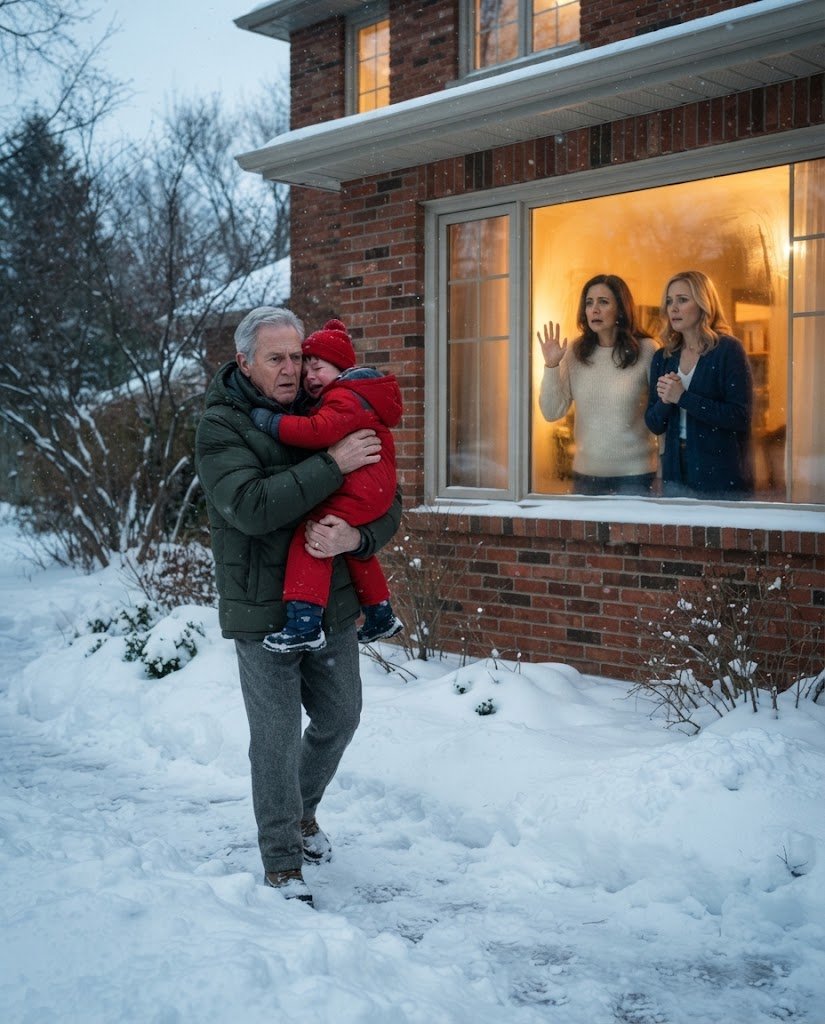
A few minutes later, the boy was outside.
“Did you see her put him out?” the social worker asked.
The friend shook her head. “No. I saw him through the window afterward. I asked if she was going to let him back in.”
“And what did she say?”
The woman looked toward my daughter-in-law.
“She said he’d come in when he learned some respect.”
My daughter-in-law’s face changed.
Not guilt. Calculation.
She said her friend was exaggerating. Then she said the boy had only been outside for a minute. Then she said he had chosen to stay out there because he liked making scenes.
Three versions in less than five minutes.
I didn’t need thirty years of counterintelligence to hear the problem.
My son called me back before midnight.
His voice sounded different.
He had reached the family advocacy office and confirmed that the old incident existed. Because he was the child’s father and had been part of the original household, he was able to request information through the proper channel.
The old report was not a finding that my daughter-in-law had abused their son. That mattered. It documented a neighbor finding the boy outside during a period when his mother said he had left the home without permission.
At the time, there had not been enough evidence to prove otherwise.
My son had been away then too.
His wife had told him the same basic story she had told him tonight: their son was dramatic, defiant, and prone to running outside when angry.
My son had accepted it.
“Dad,” he said quietly, “I told him he needed to stop making things harder for his mother.”
I didn’t rescue him from that sentence.
He needed to hear himself say it.
Then he asked to speak to his son.
I carried the phone inside and asked my grandson whether he wanted to talk to his father. He nodded, but when I handed him the phone, he didn’t say hello.
My son spoke first.
“I should have listened to you.”
My grandson’s eyes filled, but he didn’t cry.
“You always believed her.”
My son went quiet.
“Yes,” he said. “I did.”
That was his mistake, and he didn’t try to dress it up as anything else.
My grandson handed the phone back to me.
He wasn’t ready to forgive him.
I respected that more than any quick reunion could have satisfied me.
The next morning, my son remembered something that changed the case again.
He was the administrator on the family’s doorbell camera account.
He had installed the system before his current assignment and rarely checked it unless a package disappeared. From his hotel room, he opened the stored footage from the previous evening.
At 6:11 p.m., the front door opened.
My grandson stepped outside in his sweatshirt.
My daughter-in-law stood behind him.
There was no audio for the first few seconds, but the camera caught her holding something dark in one hand.
His coat.
She pulled the door closed while he turned back toward her.
Nine minutes later, motion triggered another recording. My grandson was still on the porch, rubbing his hands together. He knocked.
The door opened several inches.
This time the audio was clear.
My daughter-in-law’s voice said, “Are you ready to apologize?”
He said, “No.”
The door closed again.
My son stopped the video.
Neither of us spoke.
There are moments when evidence doesn’t feel like victory. It feels like being forced to watch the instant someone you trusted chose cruelty.
My son sent the footage directly to the investigator handling the safety report. I told him not to send it around the family, not to post it, not to confront his wife with it.
For once, he listened immediately.
The hospital released my grandson the following afternoon under a temporary safety plan approved by the child-protection worker. He went with me until his father could return.
My daughter-in-law protested. She said we were all overreacting to a parenting decision.
The investigator asked her whether taking a child’s coat before sending him into freezing weather was the decision she meant.
She stopped answering questions.
Two days later, my son returned.
He did not go to his wife first.
He came to my house.
My grandson was sitting at my kitchen table working on a puzzle when his father walked through the door. He looked up but didn’t run to him.
My son seemed to expect that.
He sat across from him and said, “I believed things about you that I should have checked for myself.”
My grandson moved one puzzle piece without looking up.
“Why didn’t you believe me?”
My son took longer to answer that.
“Because believing her was easier from far away.”
That was not a flattering answer.
It was probably the first useful one.
The investigation moved slowly after that. The old report helped establish context, but nobody treated it as proof of the current incident. The hospital records, the nurse’s notes, the friend’s statement, the doorbell recordings, and my grandson’s separately conducted interview were what mattered.
There was one stretch where it seemed the entire case might get dragged sideways.
My daughter-in-law retained an attorney who focused immediately on me.
He argued that a retired counterintelligence officer with military connections had orchestrated an investigation against a mother he disliked. He pointed to my call to the General as evidence that I had tried to use influence unavailable to an ordinary grandparent.
I understood why the argument worked.
If I had been sitting on the other side of the table, I would have examined the same thing.
So I turned over the messages.
Every one of them.
Including the General’s warning that he would only check what he was authorized to check, my response agreeing to those limits, and the message directing us toward a record my son had to request through normal channels.
The General had never sent me confidential material.
He had never called the hospital, the police, the child-protection office, or the court.
My career had not built the case.
My grandson’s own words had.
That should have ended the distraction.
It didn’t.
At the first temporary custody hearing, my daughter-in-law produced months of messages she had sent my son describing their child as unstable and defiant. Her attorney argued that the snow incident had been the latest escalation in a long behavioral problem.
For about twenty minutes, I watched the story begin to turn against a ten-year-old boy.
That was the closest everything came to collapsing.
Then my son’s attorney asked for the complete message threads rather than the screenshots my daughter-in-law had selected.
The context changed everything.
Again and again, her complaints about his behavior began immediately after he challenged something she had said. She called him manipulative after he told his father she had left him alone. She called him disrespectful after he corrected her in front of another adult. She called him dramatic after he asked to speak privately with his father.
And several of the videos she had sent my son began only after the argument was already underway.
The court did not have to guess what happened on the night of the snow.
The doorbell camera showed it.
The judge watched my grandson knock on his own front door while his coat remained inside.
Then came the recording of my daughter-in-law opening the door and asking whether he was ready to apologize.
Her attorney stopped describing it as a misunderstanding after that.
The judge left primary temporary custody with my son and ordered that my daughter-in-law have only supervised contact while the investigation and family proceedings continued. The criminal side was separate, and I learned quickly not to expect every consequence at once.
My grandson did not celebrate.
He asked whether his mother hated him.
My son looked at me as though I might know what to say.
I didn’t answer for him.
My son moved closer to his child and said, “What she did was wrong. You did not deserve it. And I should have protected you sooner.”
My grandson stared at him for a long time.
Then he asked, “Are you staying this time?”
My son’s face crumpled before he caught himself.
“Yes.”
That promise cost him something real. He requested a change in assignment arrangements, gave up an opportunity he had been pursuing, and reorganized his life around being physically present while the custody case continued.
He understood that saying sorry was not the same as becoming trustworthy again.
Months passed.
The child-endangerment case against my daughter-in-law moved through the system. The final agreement included court supervision, mandatory counseling, parenting intervention, and continued restrictions on unsupervised contact until professionals determined it was safe.
I never called the General again about her.
There was nothing left for my old world to do.
My grandson started seeing a counselor. At first he hated going. Then one afternoon he came home and told me that the counselor had said children were allowed to tell the truth even when adults found the truth embarrassing.
He repeated the sentence twice, as though testing whether it would still be true the second time.
His relationship with his father repaired more slowly.
That was probably healthier.
My son showed up for school meetings. He learned the names of teachers he should have known years earlier. When my grandson told him something uncomfortable, he stopped asking whether his mother would tell the story differently before deciding whether to listen.
One cold Saturday near the end of winter, my son brought over a cardboard box of belongings recovered from the house.
Near the bottom was the coat my daughter-in-law had taken that night.
My grandson pulled it out and held it by the shoulders.
Nobody spoke.
The coat had become evidence, then property sealed away with the rest of the items collected during the investigation. Now it was simply his again.
I asked whether he wanted to keep it.
He shook his head.
I thought he might want it thrown away.
Instead, he folded it carefully and placed it in the donation bag by my front door.
My son looked at him. “You sure?”
My grandson nodded and pushed the coat deeper into the bag.
“Give it to a kid who needs one.”