The voice on Richard’s phone did not congratulate him. It asked why a signature carrying my name had appeared on paperwork I had never authorized.
I could not hear every word from where I sat on the porch, but I did not need to.
I saw my father stop moving
One hand was still inside Daniel’s desk drawer. The other held his phone against his ear. Kelsey stood behind him near the kitchen, her arms folded, waiting for the conversation to end so they could continue doing whatever they had convinced themselves they had a right to do.
Then Richard looked toward me.
For the first time that morning, he was not angry.
He was calculating.
I knew that look because I had grown up with it. It was the expression he wore whenever shouting had stopped working and he needed another way to control the room.
But this was not his room.
That mattered now.
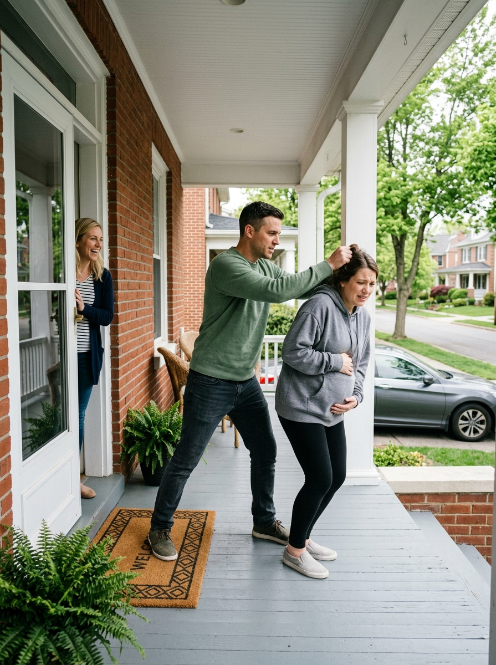
A tightening rolled through my abdomen, and I pressed one hand against the porch beneath me while keeping the other around my stomach.
My clothes were wet. My knee throbbed where I had landed. My scalp burned from where Richard had grabbed my hair.
Daniel had been dead three weeks.
Three weeks.
And somehow I had gone from sleeping with one of my husband’s T-shirts beneath my pillow to sitting outside the home we had shared while my own father searched his desk.
The siren was getting louder.
Richard turned away from me and lowered his voice into the phone.
He started using the tone he always used when he wanted to sound reasonable to strangers.
There had been a misunderstanding, he said.
He was family, he said.
He was trying to protect his daughter, he said.
I almost laughed.
Not because anything was funny.
Because twenty minutes earlier, that same man had dragged his eight-month-pregnant daughter across a kitchen floor by her hair and shoved her through the front door.
Now he wanted to sound protective.
Kelsey finally walked closer to him.
Her smile was gone, replaced by irritation as she tried to understand why the phone call was taking so long.
Richard raised one finger toward her without looking away from me.
Stay quiet.
It was the first order she obeyed all morning.
My own phone rang.
Margaret.
I answered immediately.
Her first question was whether I had called 911.
I told her I had.
Her second question was whether Richard was still inside.
I told her he was standing beside Daniel’s desk.
There was a short pause before she told me not to argue with him, not to enter the house, and not to touch any paperwork he had handled.
Then she gave me the part that made my hands shake for an entirely different reason.
The records review had already found something.
Richard had contacted her office before coming to my house.
He had not called simply to ask questions about Daniel’s estate.
He had presented himself as someone acting with my permission.
And there was paperwork.
Paperwork carrying an authorization I had never given.
Margaret did not make dramatic declarations. That was one of the things Daniel trusted about her.
She spoke carefully.
The signature would have to be examined. The exact legal consequences would depend on what Richard had submitted and where he had submitted it. No one was going to decide everything over a phone call.
But one fact was already clear.
I had not authorized him.
That was enough to stop things.
The bank had been alerted.
No transfer based on Richard’s claimed authority was going forward while the discrepancy was being reviewed.
Any attempt to treat him as my representative was being challenged immediately.
And the protected assets Daniel had arranged could not simply be handed to my father because he walked into an office and said he was family.
I closed my eyes.
For three weeks, grief had made every ordinary task feel impossible.
Opening mail felt impossible.
Choosing dinner felt impossible.
Walking past Daniel’s shoes near the garage door felt impossible.
My father had apparently mistaken grief for helplessness.
That was his mistake.
The first emergency vehicle stopped near the house before Margaret and I finished talking.
Richard came toward the front door.
I tensed automatically.
He stopped when he saw the responders approaching the porch.
Suddenly, the man who had told me to call whoever I wanted seemed very interested in who I had called.
I stayed where I was.
I did not rush toward him.
I did not explain myself.
I did not protect him from what had happened.
When I was asked whether I had been injured, I answered truthfully.
When I was asked how I had ended up outside, I answered truthfully.
When I was asked who had pulled my hair, I pointed at my father.
Richard immediately started talking over me.
He called it a family dispute.
He said emotions were high because my husband had recently died.
He said he had only been trying to get me outside so everyone could calm down.
I looked at him from the porch and realized something I should have understood years earlier.
Richard’s version of events always required everyone else to forget what his hands had done.
Mine did not.
My knee hurt.
My scalp hurt.
My water had broken.
His explanation could not erase any of that.
One of the responders asked him to step away from the doorway.
He argued.
Then he glanced toward the desk behind him.
That glance mattered more to me than anything he said next.
He was worried about the papers.
Even then.
Even with his pregnant daughter being helped off the porch, Richard was still thinking about documents that could give him control.
Kelsey followed him outside and began insisting that she had not touched me.
I had not accused her of touching me.
She kept saying it anyway.
She also stopped laughing.
That detail stayed with me.
Some sounds are difficult to forget after the person making them has shown you exactly who they are.
Her laughter while I knelt on the porch was one of them.
I was taken for medical care while Margaret handled what she could from her side.
There was no satisfying moment where I got to stand in the driveway and watch every consequence fall into place.
Real emergencies do not work like that.
My first responsibility was no longer the deed, the trust, Richard, or Kelsey.
It was my pregnancy.
So I went.
At the hospital, questions came faster than I could process them.
My blood pressure was checked. My baby was monitored. My fall was documented. I repeated what had happened until the story stopped sounding like my life and started sounding like a statement someone else had written.
My father pulled my hair.
My father dragged me.
My father shoved me outside.
My water broke.
Each sentence was simple.
Each one felt impossible.
Daniel should have been there.
That thought arrived without warning and hurt worse than my knee.
He should have been beside the bed making some terrible joke because he hated seeing me scared.
He should have been asking too many questions.
He should have been holding my hand.
Instead, the person helping protect me was his attorney because Daniel had apparently spent part of our marriage preparing for risks he never wanted me to face.
Margaret called again later.
By then, she had more information.
The house was not Richard’s to sell.
That part was straightforward.
Daniel had bought it before our marriage, but after our second anniversary he had added me to the deed exactly as I remembered.
My father could talk about debts all day long, but he could not make my recorded ownership disappear by dropping a folder on my kitchen table.
The larger problem for him was what he had tried to do beyond the house.
Daniel’s planning had separated several important assets from the kind of informal family pressure Richard was trying to use.
The investment accounts were protected.
The controlling shares in Hale-Mercer Logistics were protected.
The trust account Margaret had mentioned was real.
And none of those arrangements gave Richard permission to appoint himself as the man in charge simply because Daniel was dead and I was grieving.
The attempt to act under my name had caused exactly the opposite result from the one he wanted.
Instead of gaining access, he had triggered scrutiny.
Instead of speeding anything up, he had stopped it.
Instead of convincing people that he represented me, he had forced everyone involved to verify that he did not.
Margaret was careful again when we discussed the protective clause.
She would not promise consequences until the documents had been reviewed completely.
But Daniel had built the arrangement around one principle: anyone attempting to obtain control through unauthorized representations could not be rewarded for doing it.
Richard had walked directly into that problem.
I thought about the folder he had thrown on my kitchen table.
He had entered my house believing paperwork made him powerful.
He never considered that Daniel had paperwork too.
Better paperwork.
Older paperwork.
Signed paperwork.
Records created before grief had made me vulnerable and before Richard decided vulnerability was the same thing as permission.
Over the next several days, I learned how much he had counted on me being too overwhelmed to ask questions.
He had expected me to see bills, hear the word debt, panic about the baby, and let him take over.
He had expected the authority in his voice to do the rest.
That strategy had worked on me when I was younger.
It did not work anymore.
Margaret kept the process painfully practical.
She separated what could be proved from what we merely suspected.
My ownership of the house could be proved.
My lack of authorization could be proved.
Richard’s prior contact with her office could be documented.
The materials he had submitted could be preserved and reviewed.
What he had done inside the house after forcing me out would be handled through the statements and records surrounding the incident.
There was no giant speech.
There did not need to be.
Facts were enough.
Richard tried to reach me repeatedly.
I did not answer the first calls.
I did not answer the next ones either.
Eventually, a message appeared in which he called the entire situation a misunderstanding and said we needed to handle it privately because we were family.
Family.
That word had been useful to Richard my entire life.
It usually appeared when he wanted forgiveness before accountability.
This time, I kept the message.
I did not argue with it.
I did not send him a paragraph explaining how badly he had hurt me.
I did not need him to agree with my version of what happened.
I needed boundaries.
The emergency key was one of the first things I thought about when I was finally able to think about the house again.
For years, Richard having that key had seemed harmless.
Parents had keys.
Families had spare keys.
Emergencies happened.
Daniel had once asked whether I wanted it back, and I had shrugged because asking my father to return a key felt unnecessarily confrontational.
That small decision looked very different after Richard used it to walk into my kitchen without knocking.
The locks were changed.
Not ceremonially.
Not as revenge.
They were changed because he no longer had permission to enter.
Simple as that.
The financial side continued moving more slowly than the emotional part of me wanted.
There was no magical button Margaret could press that turned a complicated estate into a finished file by dinner.
But the important thing had already changed.
Richard was not directing it.
He could not sell my house because he announced that it needed to be sold.
He could not take control of protected accounts because he claimed I wanted him to.
He could not treat Daniel’s shares as a family inheritance waiting for the loudest man in the room.
And the disputed authorization became a problem for Richard rather than a tool against me.
That was the reversal he had never planned for.
He had assumed the signature would open doors.
It closed them.
Kelsey contacted me once.
Her message did not contain an apology for laughing.
It focused mostly on how stressful everything had become for Richard and how quickly the situation had gotten out of hand.
I read it twice.
Then I saved it with the rest.
I did not answer.
The woman who had watched me land on one knee while eight months pregnant did not get to reposition herself as a neutral observer simply because consequences had arrived.
I was finished helping people rewrite scenes I had personally survived.
There were still moments when I doubted myself.
Grief does strange things to certainty.
So does family conditioning.
I would wake up and wonder whether I had been too harsh by refusing to speak to Richard directly.
Then I would remember his fist twisted into my hair.
I would remember Kelsey laughing.
I would remember the folder hitting the kitchen table.
I would remember him telling me, with complete confidence, that he was handling everything.
Then I would remember the phone ringing in his hand.
That was the image that changed over time.
At first, I remembered his face and felt satisfaction that something had finally scared him.
Later, I understood the moment differently.
The important part was not that Richard had become afraid.
The important part was that I no longer needed his fear in order to be safe.
Daniel had protected what he could through documents and planning.
Margaret protected the process by refusing to let urgency replace verification.
The responders protected the immediate situation by taking what happened seriously enough to separate us and get me medical attention.
But there was one part no one could do for me.
I had to stop giving Richard access simply because he was my father.
That part was mine.
Weeks earlier, Daniel’s death had made me feel as if every structure in my life had collapsed at once.
I could barely enter our bedroom without seeing the empty side of the bed.
His coffee mug was still in the cabinet where he always kept it.
His jacket was still hanging where he had left it.
And his T-shirt remained folded beneath my pillow because washing it felt like admitting something I was not ready to admit.
Richard had entered that grief and seen opportunity.
Daniel, before he died, had apparently looked at our future and seen responsibility.
The difference between those two things became impossible to ignore.
One man tried to use my weakest month to take control.
The other had quietly arranged for me to keep mine even if he was no longer there to stand beside me.
I wish Daniel had told me more about the trust.
I wish I had asked more questions when he was alive.
I wish there had been no reason for any of it.
But grief is full of wishes that cannot be acted on.
So I concentrated on the decisions I could still make.
My home stayed my home.
The protected property stayed where it belonged while the records were reviewed properly.
Richard’s claimed authority was rejected rather than accepted at face value.
The attempt he had made to step into my affairs without permission became part of the record instead of the beginning of his control.
Everything he and Kelsey had come that morning expecting to take slipped out of their hands because the one thing Richard had underestimated was the thing he thought he understood best: paperwork.
He understood papers as leverage.
Daniel understood them as protection.
That difference mattered.
When I eventually stood inside the kitchen again, the room looked almost offensively normal.
Same table.
Same counter.
Same doorway.
There was no visible mark on the floor showing where Richard had dragged me.
No line on the porch showing where my water had broken.
No sign above Daniel’s desk explaining what my father had been searching for.
Homes do not preserve events for you.
People do.
Records do.
Bodies do.
I walked to the front door and tested the new lock.
Once.
Then again.
The old emergency key would never open it now.
That gave me more relief than any dramatic punishment could have.
Richard had always treated access as proof of authority.
He had a key, so he could enter.
He was my father, so he could decide.
He understood business, so he could take over.
He was older, louder, more certain, so everyone else should move aside.
Not anymore.
A key was permission.
A signature was permission.
A family relationship was not permission.
And grief was definitely not permission.
I went into the bedroom afterward and found Daniel’s T-shirt still beneath my pillow.
For the first time since the collision, I did not hold it because I wanted to pretend he might somehow come back through the door.
I held it because I finally understood something he had left behind that was larger than a trust account or a deed.
Daniel had put my name on our home while he was alive.
He had built protections around our future while we still thought we had years ahead of us.
He had treated me like a partner.
My father had spent one morning trying to convince me I was a dependent who needed him to take over.
That morning ended with the opposite becoming clear.
Richard did not gain my house.
He did not gain control of Daniel’s protected assets.
He did not gain the authority he claimed to have.
And after using an authorization I had never given, he lost the one advantage he had depended on his entire life with me: my willingness to let him cross a boundary just to avoid a fight.
I folded Daniel’s shirt again and placed it back beneath the pillow.
Then I walked to the front door, heard the new lock click behind me, and kept the only key Richard would never be able to take from me again: the right to decide who was allowed inside.