The man holding the door froze.
He was young.
Late twenties, maybe thirty.
Dark suit. Military haircut. Broad shoulders.
For half a second, he looked at my face.
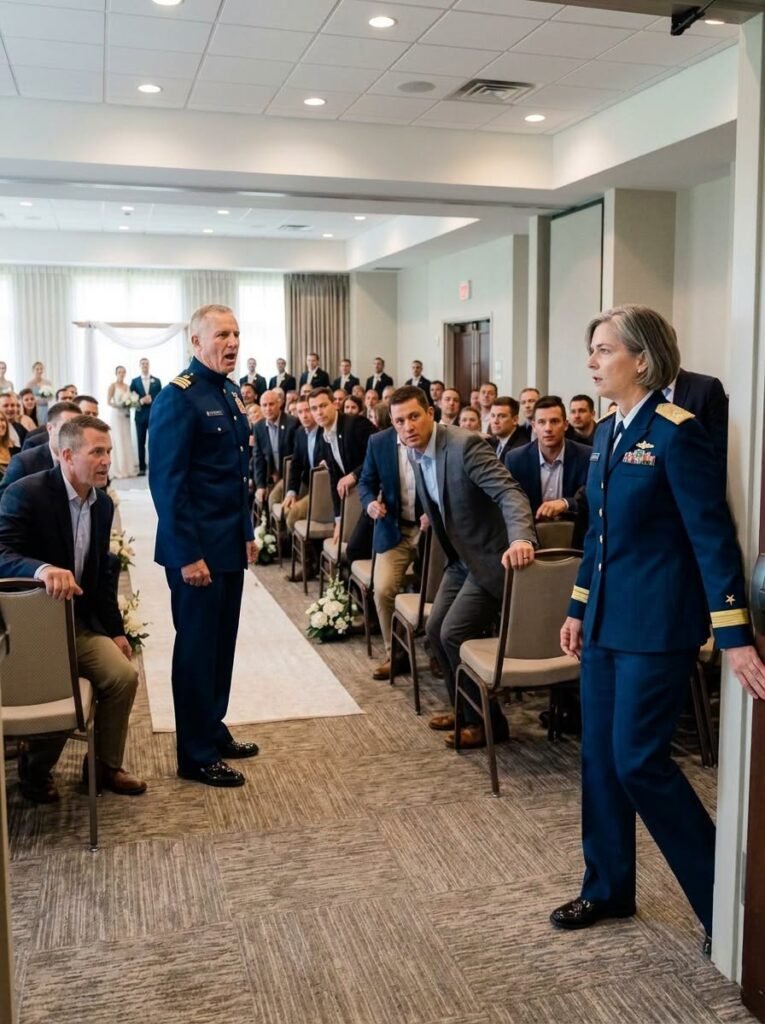
Then his eyes dropped to my uniform.
To the ribbons.
To the gold sleeve stripes.
To the four silver stars on my shoulders.
Everything about him changed.
His back straightened.
His expression snapped from polite confusion to absolute recognition.
“Ma’am.”
He stepped aside so quickly that the door nearly struck the wall.
And then the room saw me.
Two hundred conversations died at once.
Not faded.
Died.
Forks stopped halfway to mouths.
Champagne glasses froze in midair.
Heads turned row by row.
I had walked into rooms full of generals, senators, ambassadors, and heads of state.
I had stood in command centers where one bad sentence could move ships across oceans.
I knew silence.
But this silence was different.
This one moved.
It started near the entrance.
Then traveled through the room like a current.
One man stood.
Then another.
Then ten.
Then fifty.
Chairs scraped against the floor in a rolling wave.
Men and women rose all across the ceremony hall.
Some wore dark suits.
Some wore uniforms.
Some had close-cropped gray hair.
Some carried canes.
Some had scars they didn’t bother hiding.
And I knew exactly what I was looking at.
SEALs.
Active duty.
Retired.
Former commanders.
Operators I had supported in places my family had never heard of and would never understand.
More than two hundred of them.
Standing.
For me.
I stopped three steps inside the door.
That was when a voice cut through the room.
Sharp.
Commanding.
Impossible to mistake.
“ADMIRAL ON DECK!”
Every service member in the room came to attention.
My father was seated in the second row.
I saw his face before I saw anyone else’s.
Richard Bennett.
Seventy-one years old.
Retired insurance executive.
A man who had spent most of my life telling people his eldest daughter was “in the Navy” the same way another father might say his child worked at a grocery store.
His mouth was slightly open.
Beside him, my mother, Eleanor, had gone white.
Melissa sat across the aisle.
Her champagne glass trembled in her hand.
And at the front of the room, standing beside the floral arch in her wedding gown, was Melanie.
My niece.
The bride.
She had one hand pressed over her mouth.
Tears already filled her eyes.
I understood almost nothing.
Then Jack Hayes stepped out from the first row.
Of course.
He had traded his usual jeans and battered leather jacket for a dark suit.
His silver hair was combed back.
His old SEAL trident shone from a small pin above his heart.
He looked at me.
And smiled.
Not a wide smile.
Jack never wasted emotion.
Just enough to say:
I told you.
The officiant looked completely lost.
The civilian guests looked even more confused.
No one sat down.
I took one breath.
Then another.
“Carry on,” I said.
The room sat.
Almost.
My father remained standing.
Not from respect.
From shock.
He looked around as if he had entered the wrong building.
“Claire?”
His voice carried farther than he probably intended.
I looked at him.
“Hello, Dad.”
That was all.
No anger.
No performance.
I moved toward an empty seat near the back.
Jack intercepted me.
“No.”
He pointed toward the front.
“There’s a seat for you.”
I followed his hand.
First row.
Directly beside Melanie’s grandmother on the groom’s side.
A white card rested against the chair.
ADMIRAL CLAIRE BENNETT.
I stopped.
My father saw it too.
His expression hardened.
“What is this?”
Melanie finally lowered her hand from her mouth.
“Grandpa.”
He turned toward her.
“You invited all these people?”
“No.”
Her voice shook.
Then she looked at me.
“Evan did.”
The groom.
I knew very little about him.
Evan Brooks.
Thirty-three.
Quiet.
Polite.
Melanie had told me he worked in “government security.”
My sister had called him “some military-adjacent contractor.”
Apparently, that description had been slightly incomplete.
Evan stepped away from the altar.
He was tall and lean, with the calm stillness I had seen in men who had learned to control their breathing under gunfire.
Then I saw the trident pin beneath his boutonniere.
Navy SEAL.
My eyes narrowed.
Evan met my gaze.
“Ma’am.”
I almost laughed.
“You could have mentioned that.”
A ripple of restrained laughter moved through the operators in the room.
Evan smiled.
“Melanie asked me not to.”
My niece turned pink even through her tears.
“I wanted you to come because you were family,” she said.
Her voice cracked.
“Not because of your rank.”
That hit harder than the salute.
For years, I had told myself I didn’t care.
Birthdays missed.
Christmas calls cut short.
Family photographs where my absence was treated like a personality defect.
I had convinced myself I had stopped needing their approval.
But Melanie had been different.
When she was ten, she had mailed me a handwritten letter aboard a carrier.
Aunt Claire,
Mom says you’re too busy to visit.
Are you saving people?
I had kept that letter for nineteen years.
Folded in a fireproof box.
I looked at her now.
“You knew?”
She nodded.
“About what I do?”
Another nod.
“Some of it.”
Then she looked at Jack.
“Probably not enough.”
Jack leaned toward me.
“She asked questions.”
“I answered the ones that weren’t classified.”
My father finally found his voice.
“This is ridiculous.”
The room shifted.
Not dramatically.
Nobody moved much.
But I felt it.
Two hundred operators heard him.
Richard apparently did not understand what that meant.
“This is Melanie’s wedding,” he continued. “Not some military ceremony.”
Melissa whispered, “Dad.”
He ignored her.
His face was turning red.
He pointed toward my uniform.
“And I specifically asked Claire not to turn this into a spectacle.”
Jack’s jaw tightened.
I touched his arm.
He stopped.
Barely.
Then I looked at my father.
“You sent me a text.”
“Yes.”
“You told me no one gave a damn about my Navy career.”
Several people in the room turned toward him.
My father glanced around.
For the first time, I saw embarrassment replace anger.
He lowered his voice.
“This is a family matter.”
A man behind him spoke.
“No, sir.”
Everyone turned.
He rose slowly.
Late sixties.
Tall.
Silver hair.
Left hand missing two fingers.
I knew him immediately.
Rear Admiral Thomas Vance, retired.
Former commander of Naval Special Warfare Command.
A legend in communities that did not use that word lightly.
He looked at my father.
“With respect, you made it public the moment you tried to shame her for the uniform.”
Richard stared.
Thomas continued.
“I buried three men because your daughter refused to abandon an operation when everyone else told her the political cost was too high.”
My mother inhaled sharply.
Melissa looked at me.
I said nothing.
Because I knew exactly which operation he meant.
Somalia.
Twenty-two years ago.
Before I wore stars.
Before most people in this room knew my name.
A reconnaissance team had been compromised inland.
Weather killed the original extraction plan.
Washington wanted to delay until morning.
I had been operations officer aboard the ship coordinating support.
Morning would have meant body bags.
I pushed for a secondary extraction.
Helicopters in near-zero visibility.
Political risk.
Career risk.
Operational risk.
We got them out.
Three wounded.
No dead.
Thomas Vance had never forgotten.
Neither had I.
My father looked at me as though he had just discovered I spoke another language.
“You never told us.”
I almost smiled.
“You never asked.”
That silenced him.
The officiant cleared his throat.
Very gently.
“Perhaps we should begin.”
Everyone sat.
I took the first-row seat.
My father remained behind me.
I could feel his stare against the back of my head.
The ceremony started.
Melanie walked down the aisle holding her mother’s arm instead of her grandfather’s.
That was the first surprise.
The second came during the vows.
Evan took Melanie’s hands.
“I promise,” he said, “that I will never ask you to become smaller so someone else can feel bigger.”
The room went still again.
Melanie’s eyes filled.
Across the aisle, Melissa lowered her face.
And my father looked down.
I wondered if Evan knew.
Maybe he did.
Maybe Melanie had told him more about our family than I realized.
Then Melanie spoke.
“I promise that when you are called to serve others, I will never punish you for answering.”
My throat tightened.
That one was for me.
I knew it immediately.
She glanced toward me.
Only once.
But it was enough.
I looked away.
The ceremony ended with applause so loud it shook the flowers.
For the first time all day, my father said nothing.
The reception began an hour later.
The venue sat beside the Cooper River, all glass walls and white lights reflected against black water.
A jazz trio played near the dance floor.
Servers moved through the room with champagne.
I hoped the worst was over.
I was wrong.
I had barely reached the bar when a young lieutenant approached me.
Then another.
Then a retired chief.
Then a captain.
Then a woman with a scar crossing the left side of her jaw.
One by one, they introduced themselves.
Not by rank first.
By connection.
“Ma’am, you approved the evacuation package that got my brother home.”
“Admiral, my team was on the Kearsarge during the Red Sea operation.”
“You signed my waiver when command wanted to medically retire me.”
“My father served under you.”
“You called my wife personally after I was wounded.”
“You wrote the recommendation that kept me in the Teams.”
“You don’t remember me, ma’am, but I remember you.”
That sentence kept repeating.
You don’t remember me.
But I remember you.
My father stood across the room with a drink in his hand.
Watching.
At first, he tried to talk to other relatives.
Then he stopped.
Because people kept coming.
An entire life my family had dismissed was walking up to shake my hand.
Not celebrities.
Not politicians.
People with scars.
Widows.
Commanders.
Enlisted sailors.
Men who had spent half their lives in places that never appeared on maps shown to civilians.
They didn’t care about stars.
They cared about decisions.
About whether someone answered the phone at 2:00 a.m.
Whether someone signed a risk waiver.
Whether someone fought the bureaucracy hard enough to bring a body home.
Whether someone remembered their children’s names after the funeral.
That was the Navy career my father said no one cared about.
At 7:40 p.m., Jack handed me a glass of water.
“You look like you’d rather face a congressional hearing.”
“I would.”
“I know.”
I looked toward the dance floor.
Melanie was laughing with Evan.
She looked happy.
“That should be enough.”
Jack followed my gaze.
“It should.”
“But?”
He looked toward my family.
“But tonight isn’t finished with you yet.”
I frowned.
“What did you do?”
“Nothing.”
“Jack.”
“Almost nothing.”
That answer worried me more.
Then the band stopped.
Evan took the microphone.
“Before dinner,” he said, “there’s someone I’d like to recognize.”
My stomach dropped.
Absolutely not.
I gave Jack a look.
He raised both hands.
“This part wasn’t me.”
Evan continued.
“Melanie and I wanted tonight to be about family.”
He glanced toward me.
“And sometimes family is more complicated than blood.”
My father stiffened.
“So before we celebrate ours,” Evan said, “I want to honor someone who taught many people in this room what service actually looks like.”
I shook my head once.
Evan saw it.
Ignored me.
Typical SEAL.
A screen lowered behind the band.
The first photograph appeared.
I was twenty-one.
Naval Academy whites.
Hair shorter.
Face thinner.
Standing beside my parents.
My father looked bored.
My mother looked uncomfortable.
I had forgotten that photograph existed.
Then came another.
My first ship.
Another.
Lieutenant Bennett.
Another.
Commander Bennett.
Another.
Captain.
Then a photograph I had never seen.
Me standing beside a hospital bed.
A wounded sailor asleep under white sheets.
His wife holding their newborn.
I looked exhausted.
Jack whispered beside me.
“Bosnia.”
I remembered.
The slideshow continued.
Disaster relief.
Carrier decks.
Flood zones.
Burial ceremonies.
Briefing rooms.
Ships.
Hospitals.
Graduations.
Rows of sailors saluting.
And then faces.
So many faces.
People I had served with.
Some alive.
Some not.
The music under the slideshow was quiet.
No narration.
It did not need one.
Then the screen went black.
White letters appeared.
THIRTY-SIX YEARS.
147,000 SAILORS UNDER COMMAND.
ELEVEN MAJOR OPERATIONS.
FOUR COMBAT THEATERS.
ZERO SHIPS LOST UNDER DIRECT COMMAND.
My father put his glass down.
Then another line appeared.
31 FAMILIES PERSONALLY NOTIFIED AFTER COMBAT LOSSES.
My mother covered her mouth.
Another.
63 WOUNDED SERVICE MEMBERS VISITED IN HOSPITALS.
Another.
412 PERSONAL LETTERS SENT TO FAMILIES DURING DEPLOYMENT.
I turned toward Jack.
“How did they get that?”
“Public records.”
“And things that weren’t public?”
He shrugged.
“People remember.”
Then the last line appeared.
SHE NEVER ASKED FOR RECOGNITION.
SO WE DECIDED TO GIVE IT TO HER ANYWAY.
The room rose again.
This time there was no command.
No “Admiral on Deck.”
They simply stood.
All of them.
Military.
Civilian.
Young.
Old.
Melanie stood first.
Evan beside her.
Jack.
Thomas Vance.
Then hundreds more.
Even the catering staff stopped.
I did not move.
I had stood in front of thousands of sailors without my hands shaking.
Now they did.
I hated that.
Jack noticed.
He leaned close.
“Let them.”
Two words.
That was all.
So I did.
I let them stand.
I let them applaud.
And for the first time in my life, I did not immediately redirect praise toward the mission.
I did not mention my staff.
I did not say anyone else would have done the same.
I just stood there and received it.
Across the room, my father remained seated.
Everyone around him was standing.
He looked very small.
Then slowly—
He rose.
The applause faded.
Dinner began.
I thought that would finally end it.
It didn’t.
At 9:15 p.m., I found my father alone outside on the terrace.
The river was dark beyond the railing.
Wind moved through the live oaks.
I almost turned around.
He spoke without looking at me.
“I didn’t know.”
I stopped.
There were a thousand answers available.
Most of them cruel.
Most deserved.
I chose none of them.
“No.”
He finally faced me.
His eyes were wet.
My father did not cry.
Not at funerals.
Not when his brother died.
Not when I deployed to a war zone the first time.
I had seen him cry once in my life.
The night our childhood dog died.
Now his jaw trembled.
“Why didn’t you tell me?”
I looked at him.
“Tell you what?”
“All of that.”
“What would you have done with it?”
He had no answer.
So I gave him one.
“When I made lieutenant, you told me not to get arrogant.”
His face tightened.
“When I made commander, you said the Navy handed out titles too easily.”
He looked away.
“When I took my first ship, Mom asked why I couldn’t get a normal job.”
Inside, music drifted through the glass.
“When I made admiral,” I continued, “you didn’t come to the ceremony.”
He closed his eyes.
“You told me parking in Washington was inconvenient.”
“I remember.”
“When I made four-star, Melanie called me before either of you did.”
His shoulders dropped.
I stepped closer.
“You keep asking why I didn’t tell you who I was.”
My voice stayed quiet.
“But Dad, I did.”
“For thirty-six years.”
“You just kept telling me it wasn’t worth hearing.”
He wiped one eye quickly.
“I thought you were choosing the Navy over us.”
That angered me.
Not loudly.
Deeply.
“I chose a life you didn’t approve of.”
“You punished me for it.”
“That is not the same thing.”
He flinched.
I had not raised my voice.
I didn’t need to.
“I missed holidays because I was deployed.”
“You missed my promotions because you were offended.”
“I missed birthdays because sailors were dying.”
“You missed my retirement ceremony because Melissa needed help choosing flowers.”
He looked stricken.
I stepped back.
“We were not making equal sacrifices.”
That ended the argument.
For a while, neither of us spoke.
Then he reached into his pocket.
He took out his phone.
The text was still there.
No one gives a damn about your Navy career.
He stared at it.
Then deleted it.
I almost laughed.
“You think that fixes it?”
“No.”
Good answer.
He looked at me.
“I think I’ve spent thirty-six years being wrong.”
The sentence surprised me.
My father did not apologize well.
He preferred explanations.
Context.
Excuses.
This time there were none.
“I was angry when you left for Annapolis,” he said. “Not because I thought you’d fail.”
I waited.
“Because I knew you might not.”
I stared at him.
He swallowed.
“You were seventeen years old and absolutely certain you could build a life without my approval.”
His laugh was broken.
“And you did.”
There it was.
Not sexism alone.
Not stubbornness alone.
Fear.
Control.
Pride.
The oldest poisons in a family.
“I thought if I made the Navy seem small,” he said, “maybe you’d come back and need us.”
I looked toward the ballroom.
At Melanie dancing with Evan.
At sailors laughing around tables.
At my sister watching us through the glass.
“And instead?”
“You stopped needing me.”
I took a long breath.
“No.”
He looked up.
“I stopped chasing you.”
That hurt him.
I saw it.
But truth was not cruelty.
Sometimes truth was simply the bill arriving.
The terrace door opened.
Melissa stepped outside.
Her face was streaked from crying.
“Claire.”
I turned.
She held something in her hand.
A folded sheet of paper.
“What?”
She crossed the terrace.
“Melanie found this in Mom’s purse.”
My mother appeared behind her.
Pale.
Panicked.
“Melissa.”
“What is it?”
Melissa handed it to me.
My mother said, “It’s nothing.”
I unfolded the paper.
It was an email printout.
From three weeks earlier.
From my mother to Melanie.
Subject:
AUNT CLAIRE.
My stomach tightened.
I read.
Melanie,
Please reconsider inviting Claire in uniform. Your grandfather is already upset about how much attention she always gets when Navy people are around. This weekend should be about you, not Claire’s career.
I continued.
If she insists on wearing it, perhaps seat her toward the back where it won’t become a distraction.
I stopped reading.
My father stared at my mother.
“You sent this?”
Eleanor began crying.
“It wasn’t like that.”
Melissa snapped.
“It is exactly like that.”
“Don’t speak to me that way.”
“For once, Mom, stop.”
I had almost never heard my sister confront her.
Melissa turned toward me.
“I knew they didn’t respect your career.”
Her voice shook.
“But I didn’t know they were doing this.”
I folded the paper.
Very carefully.
My mother looked at me.
“We just wanted one weekend without everything becoming about the Navy.”
I nodded.
“And tonight did become about the Navy.”
She looked relieved too quickly.
Then I finished.
“Because two hundred people loved Melanie enough to show up.”
“And many of them happened to know me.”
Her relief vanished.
“This was never my event.”
I pointed through the glass.
“That man married your granddaughter tonight.”
“He is a SEAL.”
“His closest friends are SEALs.”
“His commanding officers came.”
“His mentors came.”
“Your granddaughter built a life with someone who belongs to the world you spent thirty-six years mocking.”
My mother’s face changed.
She looked through the glass at Evan as if seeing him for the first time.
Then Melanie appeared in the doorway.
Still in her wedding dress.
No veil now.
Hair slightly loose.
Her expression was calm.
Too calm.
“Grandma.”
My mother turned.
Melanie held out her hand.
“Please give me the rest of them.”
Silence.
I frowned.
“The rest of what?”
Melanie looked at me.
“Emails.”
My chest tightened.
My mother said nothing.
Melanie continued.
“She sent Evan’s parents three.”
My father looked horrified.
“Eleanor.”
“She was worried about the guest list!”
“No,” Melanie said.
“You were worried Aunt Claire might be respected.”
That sentence landed with surgical precision.
My mother started crying harder.
Melanie did not soften.
“You told me she made the family uncomfortable.”
“You said she chose strangers over us.”
“You said if I seated her near Evan’s command, she would ‘perform for attention.’”
Jack appeared behind Melanie.
His expression had gone flat.
Dangerously flat.
I held up one hand.
He stayed silent.
Melanie looked at me.
“I almost didn’t invite you.”
That hurt.
She saw it.
“I’m sorry.”
“You don’t owe me an apology.”
“Yes, I do.”
She stepped closer.
“I believed them for a little while.”
Her eyes filled.
“They made it sound like you didn’t care about us.”
I looked at her wedding dress.
At the little girl who once asked if I was saving people.
“Melanie.”
She shook her head.
“No. I need to say this.”
She faced the whole family now.
“Evan found out who Aunt Claire was six months ago.”
My father frowned.
“How?”
Evan stepped onto the terrace.
“Because Admiral Bennett approved the rescue operation that brought my father home.”
Nobody moved.
Evan’s father.
I searched the room beyond him.
Then I saw a man near the dance floor.
Early sixties.
Heavy limp.
Cane.
A face I recognized twenty-eight years too late.
Petty Officer First Class Daniel Brooks.
Yemen.
Helicopter down.
Hostile territory.
Night extraction.
Three wounded.
One with spinal trauma.
Daniel Brooks.
I whispered the name.
Evan heard me.
“Yes, ma’am.”
My eyes closed briefly.
I remembered the radio traffic.
The fuel calculations.
The medical officer telling us Daniel would not survive until dawn.
I remembered overruling the recommendation to wait for daylight.
I remembered taking responsibility in writing.
I remembered nothing after that except exhaustion.
I opened my eyes.
Evan’s voice broke slightly.
“My father walked me into kindergarten because of a decision you made before I was old enough to understand the word Navy.”
I could not speak.
“He watched me graduate.”
Evan continued.
“He saw me earn my Trident.”
“He met Melanie.”
“He is here tonight.”
Daniel Brooks was crying now.
Across the room, he raised one hand.
I raised mine back.
Evan turned to my grandparents.
“So when Melanie told me her family thought Admiral Bennett’s career was embarrassing…”
He stopped.
His expression hardened.
“I had difficulty understanding that.”
My father lowered his head.
My mother sat down in a terrace chair.
No one helped her.
Then Melanie took my hand.
“Aunt Claire.”
“Yes?”
“I want my first family dance to be with you.”
I stared at her.
“What?”
“My father left when I was six.”
That was true.
Melissa’s ex-husband had disappeared from Melanie’s life long ago.
“Grandpa was supposed to dance with me.”
My father looked up sharply.
Melanie turned toward him.
“I love you.”
“But tonight I want to dance with the woman you taught me not to understand.”
Richard closed his eyes.
Then nodded.
No protest.
No anger.
Just acceptance.
The ballroom lights dimmed.
The band began something slow.
Melanie led me onto the dance floor.
I had faced missile warnings with less discomfort.
“I don’t dance.”
She laughed through tears.
“You command fleets.”
“This is worse.”
People laughed around us.
She put one hand on my shoulder.
I took the other.
We moved badly.
Very badly.
But it did not matter.
Halfway through the song, Melanie whispered, “Did you really keep my letter?”
I looked at her.
“What letter?”
“When I was ten.”
My chest tightened.
“How do you know about that?”
“Jack.”
Of course.
“I still have it.”
She started crying again.
“You do?”
“Yes.”
“Why?”
The answer came easily.
“Because you were the only person in the family who asked the right question.”
“What question?”
I smiled.
“Whether I was saving people.”
She laughed.
“Were you?”
I looked around the room.
Daniel Brooks stood beside his son.
Thomas Vance spoke quietly to Jack.
Young operators filled tables.
Widows.
Sailors.
Families.
People connected by invisible threads of choices made over decades.
“Sometimes.”
Melanie shook her head.
“No.”
She squeezed my hand.
“A lot.”
The song ended.
Applause started.
Then my father walked onto the dance floor.
Alone.
The room quieted.
He looked at Melanie.
Then at me.
“I need the microphone.”
I nearly told him no.
Melanie handed it to him.
Richard Bennett stood in front of more than two hundred service members and hundreds of wedding guests.
A man who hated public embarrassment.
A man who had spent a lifetime avoiding emotional exposure.
His hand shook around the microphone.
“My daughter told you I sent her a message yesterday.”
Nobody moved.
He looked at me.
“I wrote that no one gave a damn about her Navy career.”
The silence became brutal.
He swallowed.
“I was wrong.”
My mother stared at him.
He continued.
“I was not uninformed.”
“I was not confused.”
“I was wrong.”
Three clean sentences.
No escape routes.
He looked toward the SEALs.
“I spent most of my life treating her service as if it were some competition between the Navy and our family.”
His voice cracked.
“I thought every person who respected her was taking something from us.”
He looked at me.
“Tonight I learned the truth.”
He paused.
“She gave something to all of you.”
“And we were the ones who kept refusing to receive what she tried to give us.”
Nobody applauded.
Not yet.
He had not earned rescue.
He knew it.
Richard reached into his jacket.
For one insane second, I thought he was taking out his phone.
Instead, he removed a small object.
A photograph.
The one from my Naval Academy graduation.
He held it up.
“I carried this in my wallet for thirty-six years.”
My breath stopped.
“I told people I didn’t care.”
His eyes found mine.
“I lied.”
That was the sentence that broke him.
He lowered the microphone.
Covered his face.
And cried.
Not quietly.
Not with dignity.
Like a man grieving decades he could not recover.
I stood still.
Then something inside me loosened.
Not forgiveness.
Not yet.
Forgiveness was not a door you opened because someone finally knocked.
But possibility?
Maybe.
I walked toward him.
He looked up.
“I’m sorry, Claire.”
I took the photograph from his shaking hand.
The edges were worn soft.
He really had carried it.
All those years.
Pride hidden behind cruelty.
Love strangled by control.
It did not excuse him.
But it explained more than I wanted explained.
I looked at him.
“You don’t get thirty-six years back.”
“I know.”
“You don’t get to apologize tonight and pretend everything is repaired tomorrow.”
“I know.”
“You don’t get to tell me how quickly to forgive you.”
“I know.”
I studied his face.
Then I nodded once.
“But you can start with dinner.”
His mouth opened.
“Dinner?”
“Next Sunday.”
He almost collapsed.
“Yes.”
“Six o’clock.”
“Yes.”
“No speeches.”
A wet laugh escaped him.
“Yes.”
Then Jack shouted from behind us.
“Can he bring bourbon?”
Laughter exploded through the room.
I turned.
“Jack.”
“What?”
“You’re not invited.”
“That’s never stopped me before.”
More laughter.
The tension broke.
People began clapping.
Not for my father.
Not exactly.
For the moment.
For the tiny opening after a lifetime of closed doors.
My mother did not get the same ending that night.
She tried to speak to me near midnight.
I told her we would talk another day.
She nodded.
That was enough.
Melissa hugged me before leaving.
A real hug.
Not the polite kind we had exchanged at funerals and holidays.
“I’m sorry too,” she whispered.
“For what?”
“For laughing when you said you wanted Annapolis.”
I remembered.
Seventeen years old.
Standing in our kitchen.
Melissa choking on soda because my dream sounded ridiculous to her.
“You were fourteen.”
“I still remember.”
“So do I.”
She pulled back.
“Do you hate me?”
“No.”
She blinked.
“Do you forgive me?”
I thought about it.
“Yes.”
That surprised both of us.
Then I smiled.
“You were fourteen.”
She laughed and cried at the same time.
At 12:18 a.m., the reception finally began to empty.
I stood outside near the river.
My jacket was unbuttoned.
My feet hurt.
The four stars on my shoulders reflected in the glass.
Jack joined me.
“You survived.”
“Barely.”
“Combat was easier?”
“Considerably.”
He handed me a small envelope.
“What is this?”
“Retirement gift.”
I opened it.
Inside was a card signed by hundreds of names.
SEALs.
Sailors.
Pilots.
Chiefs.
Officers.
Families.
Some names I knew immediately.
Others I didn’t.
At the top, Jack had written one sentence.
No one gives a damn, huh?
I laughed.
A real laugh this time.
Then I turned the card over.
There was another message.
Different handwriting.
Melanie’s.
Aunt Claire,
When I was ten, I asked if you were saving people.
Now I know the answer.
You were.
But I think you forgot you were one of the people worth saving too.
I read it twice.
Then folded the card.
Carefully.
The same way I had folded her first letter nineteen years before.
“You okay?” Jack asked.
“No.”
He nodded.
“Good.”
I looked at him.
“That makes no sense.”
“Means you’re finally feeling it.”
I watched the river.
Behind us, the last wedding guests drifted toward the exits.
My father stood beside the doorway.
He did not approach.
He simply waited until I looked at him.
Then he raised one hand.
Not a salute.
Just a father saying goodnight to his daughter.
I raised mine back.
Twenty-four hours earlier, he had told me no one cared about my Navy career.
Tonight, more than two hundred warriors had stood when I entered a room.
But that was not the victory.
The stars were not the victory.
The applause was not the victory.
The slideshow was not the victory.
The victory was that for the first time in thirty-six years, I did not shrink myself to make my family comfortable.
I did not remove the uniform.
I did not apologize for the life I built.
I did not pretend my sacrifices were smaller because the people I loved had refused to understand them.
And when my father finally saw me—
really saw me—
I did not use the moment to destroy him.
I gave him something far more difficult.
A chance to do better.
Three months later, I retired from the United States Navy.
My father sat in the first row.
So did my mother.
Melissa sat beside Melanie.
Evan stood with Daniel Brooks.
Jack wore the same dark suit from the wedding.
When the ceremony ended, my father waited until everyone else had finished shaking my hand.
Then he approached.
For a second, neither of us spoke.
Finally, he looked at the four stars on my shoulders.
“I still don’t understand half of what you did.”
I smiled.
“That makes two of us.”
He laughed.
Then his face grew serious.
“But I’m trying.”
I believed him.
That was enough for that day.
He held out his hand.
I looked at it.
Then ignored it.
And hugged him instead.
His arms closed around me.
Tight.
Awkward.
Late.
But real.
Over his shoulder, I saw Jack pretending not to watch.
Melanie crying openly.
Melissa smiling.
My mother standing with both hands clasped at her chest.
And beyond them, rows of sailors who had given me thirty-six years of reasons to keep going when home had given me almost none.
My father whispered into my shoulder.
“I’m proud of you, Claire.”
For most of my life, I had imagined what those words would feel like.
I thought they would heal everything.
They didn’t.
They could not.
Some wounds become scars.
Some lost years remain lost.
Some apologies arrive too late to erase what happened before them.
But scars are not the same as open wounds.
And late is not always the same as never.
I stepped back.
Looked him in the eye.
And said the only thing that felt true.
“Thank you.”
Then I turned toward the sailors waiting beyond him.
Not as Admiral Claire Bennett.
Not as the difficult daughter.
Not as the woman my family had spent decades trying to make smaller.
Just Claire.
Finally retired.
Finally free.
And finally surrounded by people who had never needed me to become less in order to love me more.
Behind me, my father called my name.
I turned.
He held up his phone.
On the screen was the old message.
The one he had recovered from his deleted folder.
No one gives a damn about your Navy career.
He looked at it once.
Then at me.
And pressed delete.
This time permanently.
“I think,” he said, voice shaking, “we proved that one wrong.”
I looked past him at two hundred sailors, operators, families, and friends.
Then I looked back at my father.
“No, Dad.”
I smiled.
“I did.”
And for the first time in thirty-six years—
he didn’t argue.