There was a pulse.
Faint. Uneven. But there.
For one second, I forgot how to breathe.
Then training took over again.
“Violet, stay with me,” I whispered, keeping my voice low even as something inside me was coming apart. “You hear me? Stay right here with me.”
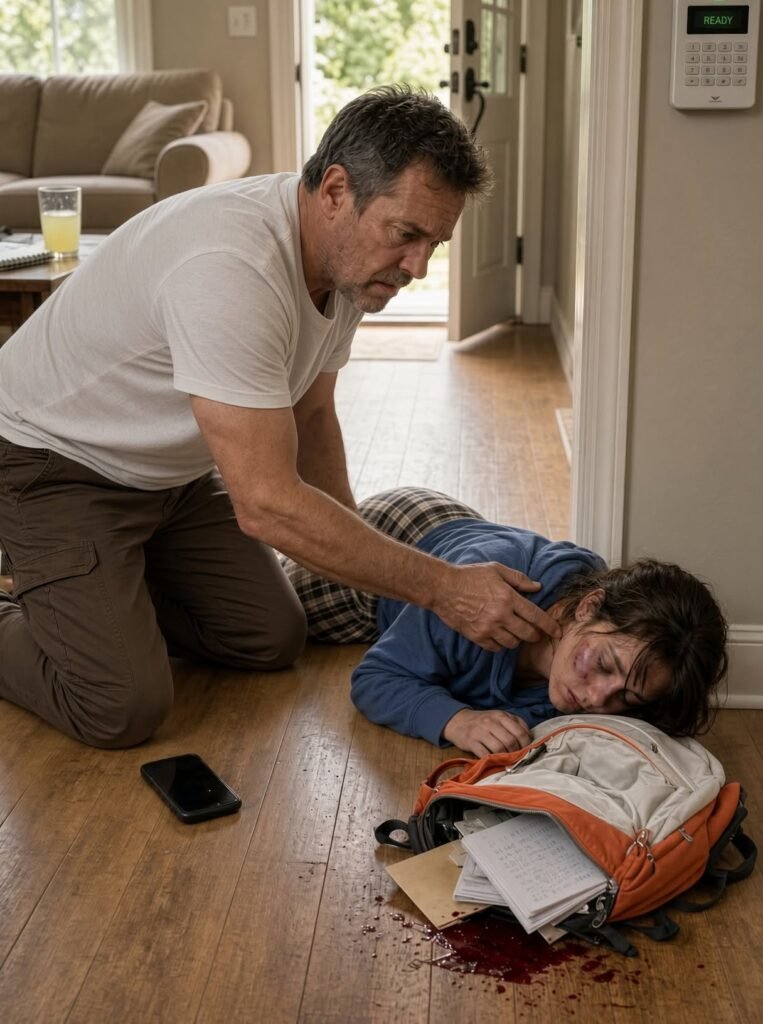
The dispatcher was still speaking through my phone on the hardwood floor.
“Sir, the ambulance is less than three minutes away. Do not move her unless she stops breathing.”
“I know.”
My voice sounded strange.
Too calm.
That was the curse of fifteen years spent in places where panic got people killed. You learned how to make your hands steady while your mind screamed.
Violet’s eyelids fluttered.
Then her fingers moved.
Not toward me.
Toward her backpack.
I followed the motion.
At first I thought she was reaching for the crushed birthday envelope caught beneath the zipper.
Then I saw the corner of a phone beneath two bent math worksheets.
The screen was spiderwebbed.
“Violet?”
Her lips moved.
I leaned closer.
“Don’t… trust…”
The words barely existed.
“Don’t trust who?”
Her eyes opened.
Only for a second.
But I saw something in them I had never seen before.
Not pain.
Not confusion.
Recognition.
Fear of someone she knew.
“Kayla.”
Then she went limp again.
I knew the name.
Kayla Mercer.
Violet’s closest friend since middle school.
She had sat at our dinner table, slept on our living room couch during birthday weekends, borrowed Violet’s hoodies, cried in our kitchen after her parents separated, and laughed so loudly during movie nights that I once threatened to charge her rent.
She knew our house.
She knew where we kept the spare blankets.
She knew which cabinet held the cereal.
And because Violet had trusted her enough to feed our cat during a family trip the previous summer, Kayla knew the alarm code.
The open door suddenly stopped being a mystery.
The green keypad stopped being a clue.
It became an accusation.
Sirens rose outside.
Blue and red light swept across the hallway walls.
Paramedics entered first, fast and efficient, carrying oxygen and trauma bags.
They moved me aside.
I hated them for it even though I knew they were right.
One paramedic crouched at Violet’s head.
Another checked her pupils.
A third cut away part of her sleeve.
I stood three feet away with my hands hanging uselessly at my sides.
A man can spend his adult life being trained to solve impossible problems and still discover there is nothing more helpless than watching strangers save his child.
“She’s got a pulse,” the lead medic said. “Weak but present.”
“Blood pressure dropping.”
“Let’s move.”
They fitted a collar around her neck and lifted her carefully.
Her arm slid toward the floor.
I caught sight of the friendship bracelet on her wrist.
Purple beads.
A tiny silver V.
I had mailed it from overseas six months earlier.
She had sent me a picture wearing it and written:
Now you can’t say I never use your gifts.
That memory nearly broke me harder than the blood had.
“Sir.”
A woman’s voice behind me.
I turned.
Detective Lena Ortiz stood near the foyer, late forties, dark hair tied back, eyes sharp enough to make most people tell the truth before she asked the first question.
She showed me her badge.
“Detective Ortiz. Violent Crimes.”
“Then start with the alarm.”
She glanced toward the keypad.
“What about it?”
“It wasn’t bypassed. It was disarmed properly.”
“You’re sure?”
“I installed the system.”
She looked at the untouched living room, the television, the laptop on the coffee table, the purse hanging from the stair rail.
“Nothing taken?”
“Not that I can see.”
Ortiz’s face changed slightly.
“Could your daughter have let someone in?”
“Yes.”
“Who?”
I looked at the hallway where Violet had been.
“Kayla Mercer.”
Ortiz took out a notebook.
“Friend?”
“Best friend.”
“Reason to hurt her?”
“I don’t know.”
The answer tasted like failure.
That was the worst part.
I knew how insurgent cells operated.
I knew how criminal networks pressured informants.
I knew how fear changed a person’s breathing pattern when they lied.
But I had not known what was happening in my own daughter’s life.
The medics began wheeling Violet outside.
I stepped toward them.
Ortiz touched my forearm.
“Mr. Harper.”
I looked at her hand until she removed it.
“I’m going with my daughter.”
“I understand. But give me thirty seconds.”
“You have ten.”
She didn’t react.
“Who else has your alarm code?”
“My daughter. Me. Kayla.”
“Anyone else?”
“No.”
“Former spouse?”
My jaw tightened.
“Violet’s mother died eight years ago.”
Ortiz gave one short nod.
“I’m sorry.”
I didn’t answer.
Then something buzzed near my boot.
Violet’s cracked phone.
The screen lit up.
A notification stretched across it.
SECURITY CAMERA UPLOAD COMPLETE — 3:47 P.M.
I froze.
Ortiz noticed.
“What?”
I lifted the phone carefully.
“We don’t have indoor cameras.”
She took one step closer.
“Outdoor?”
“Doorbell camera. Garage camera. Nothing inside.”
The phone buzzed again.
UNKNOWN DEVICE DISCONNECTED FROM HOME NETWORK — 3:51 P.M.
Ortiz stared at the message.
“When did you last speak to Violet?”
“Last night.”
“Anything unusual?”
“No.”
Then I remembered.
She had asked me a strange question.
Dad, when you’re deployed, do people ever come looking for your family?
I had laughed softly and told her no.
I had said there were safeguards.
I had said she was safe.
At the time, I thought she was asking because she had watched some military thriller online.
Now my stomach turned.
Before I could tell Ortiz, the phone vibrated again.
A message appeared.
From Kayla.
I’M SORRY, VIOLET. I DIDN’T KNOW THEY WERE GOING TO HURT YOU.
Ortiz went completely still.
A second message arrived.
YOUR DAD CAN NEVER FIND OUT WHY THEY CAME.
The hallway seemed to narrow around me.
“Don’t touch anything else,” Ortiz said.
I barely heard her.
My attention had shifted to the crushed birthday envelope beside the backpack.
There was something wrong with the way it lay.
Too stiff.
Too heavy.
I crouched.
Ortiz said my name sharply.
I ignored her.
Using the edges of the envelope, I lifted it.
Inside was no card.
No money.
No birthday message.
There was a small black memory card wrapped in tissue.
Across the tissue, written in Violet’s handwriting, were four words.
DAD, THEY KNOW ABOUT YOU.
For the first time that afternoon, Detective Ortiz stopped looking at me like the father of a victim.
She looked at me like a man whose daughter might have been attacked because of something he had done.
“What exactly do you do in the Army, Mr. Harper?”
I stood slowly.
“Officially?”
Her eyes narrowed.
“That’s not the answer I wanted.”
“It’s the answer you’re getting until I know what’s on this card.”
Outside, an ambulance door slammed.
I moved.
Ortiz followed.
At the curb, one medic blocked me.
“You family?”
“I’m her father.”
“Ride up front.”
“No.”
“Sir—”
“I’m sitting where I can see her.”
Something in my face made him stop arguing.
I climbed into the rear.
Violet looked impossibly small beneath the straps and white blankets.
A paramedic squeezed fluid through an IV line.
Another monitored her airway.
The monitor showed a rhythm.
Weak.
Fast.
Alive.
I took her hand.
“Listen to me, baby. You are not leaving me today.”
Her fingers did not move.
I leaned closer.
“You still owe me sixteen years of attitude.”
One medic glanced away.
I kept talking.
I told her about the cake I had ordered from the bakery near her school.
Chocolate with raspberry filling.
The one she had pretended not to want because she claimed sixteen was too old for themed cakes.
I told her I had bought her driving lessons.
I told her I had found the vinyl record she had been hunting online for four months.
I told her things I should have said long before blood forced urgency into every sentence.
“I’m sorry I missed things,” I whispered. “I’m sorry I made you understand more than a kid should have to understand.”
The ambulance turned hard.
The monitor chirped.
I watched her chest rise.
“You don’t get to forgive me yet,” I said. “You have to wake up first.”
At St. Matthew’s Medical Center, the doors burst open before the ambulance fully stopped.
They rushed Violet inside.
I followed until two nurses blocked me.
“Trauma bay only.”
“She’s my daughter.”
“We know.”
“No, you don’t.”
I hated how desperate I sounded.
One nurse softened.
“We’ll come get you.”
The doors closed.
And suddenly there was nothing left to do.
That was when the rage returned.
Not loud.
Not wild.
Cold.
Useful.
I walked to the far end of the waiting area and called the one man I trusted when rules and truth stopped occupying the same room.
Chief Warrant Officer Marcus Hale answered on the second ring.
“You home?”
“Yes.”
“You sound wrong.”
“Violet was attacked.”
Silence.
Then his voice changed.
“How bad?”
“Critical.”
“What do you need?”
I looked through the glass doors toward the parking lot.
“Nothing illegal.”
“That wasn’t my question.”
“I need you to tell me whether anyone has been asking about me.”
Another pause.
“You think this is connected?”
“She left me a memory card. Wrote, ‘They know about you.’”
Hale swore softly.
“Where are you?”
“St. Matthew’s.”
“I’m calling you back.”
“Marcus.”
“What?”
“Do not call command yet.”
“That’s exactly who I should call.”
“No.”
“Why?”
“Because if Violet knew enough to hide evidence, somebody got close before today.”
He understood immediately.
“You think there’s a leak.”
“I think I don’t know anything yet.”
“Which means you think there’s a leak.”
I ended the call.
Ortiz arrived twenty minutes later carrying a sealed evidence bag containing the memory card.
“You don’t get that,” I said.
“It’s evidence.”
“It belongs to my daughter.”
“Which makes it evidence.”
I stared at her.
She stared back.
Neither of us moved.
Then she sat across from me.
“Kayla Mercer is missing.”
My pulse slowed.
“When?”
“Her mother says she left school early today.”
“Why?”
“No idea.”
“Phone?”
“Off.”
“Car?”
“She doesn’t drive.”
“Where does she live?”
Ortiz almost smiled without humor.
“Don’t.”
“I asked an address.”
“And I heard the part you didn’t say.”
I leaned back.
“Then answer the part I did.”
“No.”
A surgeon entered the waiting room before I could respond.
Dr. Sanjay Mehta.
He asked if I was Violet’s father.
I stood so quickly the chair scraped.
“Yes.”
“She has a skull fracture and significant soft tissue injuries. We’re concerned about internal bleeding in the brain.”
My mouth went dry.
“Is she going to survive?”
“We’re taking her into surgery.”
“That’s not what I asked.”
“It’s the most honest answer I can give you.”
I looked through him.
Not because I didn’t respect him.
Because I was suddenly seeing Violet at six years old, furious because I had cut her grilled cheese diagonally instead of straight.
At nine, missing one front tooth.
At thirteen, pretending she didn’t cry when I deployed.
At fifteen, sending me a video of her first school debate and then pretending she didn’t care whether I watched it.
“I need you to save her.”
“We’re going to do everything we can.”
I grabbed his arm before he turned.
He looked down.
I released him immediately.
“Sorry.”
He nodded.
“I have a daughter too.”
Then he disappeared through the double doors.
Three hours passed.
I do not remember sitting.
I remember details.
A vending machine humming.
An old man sleeping beneath a television.
Ortiz making calls.
A janitor replacing a trash bag.
The clock moving one minute at a time with deliberate cruelty.
At 8:12 p.m., Marcus Hale entered.
Civilian clothes.
Baseball cap.
Face tight.
He sat beside me.
“I found something.”
Ortiz was ten feet away.
I looked at him.
“Talk quietly.”
“Six weeks ago, someone accessed an archived personnel database tied to a task force you supported in 2021.”
My body went still.
“What task force?”
Hale gave me a look.
I knew.
Operation Cinder.
A classified multinational operation targeting a weapons-financing network operating through private logistics companies.
My team had not arrested the leadership.
We had exposed the financial channels that eventually destroyed them.
At least that was what the reports said.
“Who accessed it?”
“Credential belongs to a contractor.”
“Name?”
“Evan Mercer.”
My eyes shifted toward Ortiz.
She was watching us.
“Mercer.”
Hale nodded.
“Kayla’s father?”
“I don’t know yet.”
Ortiz walked over.
“Interesting conversation?”
I stood.
“Who is Kayla Mercer’s father?”
Her expression changed.
“Evan Mercer.”
“What does he do?”
“Cybersecurity consulting.”
Hale exhaled through his nose.
Ortiz looked between us.
“What?”
I told her about the archive access.
Not everything.
Enough.
She went pale.
“You’re saying Kayla’s father may have accessed a classified military database?”
“I’m saying his credentials were used.”
“Why would Violet know?”
That question bothered me more than anything.
Why would she?
Then I remembered the cracked phone.
The unknown device.
The camera upload.
“She found something.”
Ortiz nodded toward the evidence bag.
“Then we read the card.”
At 8:41 p.m., we entered a hospital administration office converted temporarily into a secure workspace.
Ortiz brought a department laptop disconnected from the hospital network.
Hale examined the card first.
“No obvious tampering.”
He inserted it.
One folder appeared.
VIOLET_PRIVATE.
Inside were six files.
Four videos.
One audio recording.
One text document.
The first video opened.
Violet appeared on screen.
Alive.
Uninjured.
Recorded from her bedroom.
Timestamp: eleven days earlier.
She looked directly into the camera.
“Dad, if you’re watching this, something went really wrong.”
My hands clenched.
She took a breath.
“I’m sorry I didn’t tell you sooner.”
Ortiz glanced at me.
Violet continued.
“Kayla came over last week because she was scared. She found things on her dad’s laptop. Names. Pictures. Military documents. Your name was one of them.”
Hale swore under his breath.
Violet looked close to tears.
“She said her dad had been meeting with people who kept asking about Operation Cinder.”
The room changed.
Ortiz looked at me.
“What is Operation Cinder?”
“Later.”
On screen, Violet swallowed.
“Kayla told me not to tell anyone because her dad said people could disappear over this.”
My stomach turned.
Then Violet held up a flash drive.
“So I copied what I could.”
The next file contained screen recordings from Evan Mercer’s laptop.
Encrypted folders.
Payment ledgers.
Photographs.
Several names I recognized.
Men officially listed as dead.
Others imprisoned overseas.
One name made Hale lean toward the screen.
“Jesus.”
“What?”
He pointed.
Victor Soren.
I knew Soren.
Everyone involved in Cinder did.
He had been the network’s money man.
Official record:
Killed in a vehicle explosion three years ago.
But Violet had captured a recent video call.
Date stamped two weeks earlier.
Soren was alive.
And speaking with Evan Mercer.
The audio was poor, but one sentence came through clearly.
“Harper’s daughter is the pressure point.”
I stopped the video.
No one spoke.
Ortiz finally said, “They targeted Violet because of you.”
The words entered my chest like steel.
Hale said, “Not necessarily.”
I looked at him.
“What does that mean?”
He pointed toward the file list.
“There are still three videos.”
The next recording showed Kayla crying in Violet’s bedroom.
“I didn’t know my dad was part of this,” she whispered. “I swear.”
Violet sat beside her.
“You need to tell the police.”
“I can’t.”
“Why?”
“Because he said your dad isn’t who you think he is.”
My jaw tightened.
Violet frowned.
“What does that mean?”
Kayla looked toward the camera without knowing it was recording.
“He said your dad caused Cinder.”
I felt Ortiz look at me.
Hale looked confused.
“That makes no sense.”
It didn’t.
I had joined Cinder late.
Months after the original investigation began.
But Kayla kept talking.
“He said somebody inside the task force created the whole operation to erase witnesses.”
The video ended.
The third file was worse.
It showed Evan Mercer standing in our kitchen.
Three days earlier.
Inside my house.
Violet had apparently recorded him from upstairs.
He was speaking to someone on the phone.
“She copied the files.”
Pause.
“No, Harper doesn’t know.”
Pause.
“Then we handle the daughter before he gets home.”
My vision went white at the edges.
Ortiz lowered her voice.
“Mr. Harper.”
I stood.
“Sit down.”
“No.”
“Sit.”
“I’m going to find Evan Mercer.”
“If you leave this building, I will arrest you.”
“Then arrest me.”
Hale got between us.
“Daniel.”
I looked at him.
He almost never used my first name.
“Violet is in surgery.”
That stopped me.
Barely.
He continued.
“You leave now, and if something happens to her while you’re gone, you’ll carry that forever.”
I hated him for being right.
I sat.
The final video had been recorded that afternoon.
3:42 p.m.
Violet set the camera somewhere hidden in the hallway.
The image showed the front door.
Kayla entered first.
Crying.
Violet followed.
“What happened?”
“My dad knows.”
“How?”
“I don’t know.”
Then another figure entered.
Evan Mercer.
Violet stepped back.
“Mr. Mercer?”
His voice was calm.
“I just want the files.”
Kayla turned on him.
“You said you only wanted to talk.”
“I do.”
Then two men entered behind him.
Unknown.
Large.
Gloves.
Violet saw them and understood.
She ran.
The camera shook.
Someone grabbed it.
The screen went black.
Audio continued.
A struggle.
Kayla screaming.
Violet shouting.
Evan Mercer yelling, “Stop! Not like this!”
Then a man said something that made all three of us freeze.
“Search the house. Harper kept a copy.”
Hale looked at me.
“What copy?”
“I don’t know.”
The audio continued.
Furniture moving.
Footsteps.
Then Violet screamed.
I turned the sound off.
I could not listen.
Ortiz did not make me.
For several seconds, the only noise in the room was the laptop fan.
Then Hale clicked the text document.
One sentence.
Violet had written it at 3:39 p.m.
If Dad finds this, tell him Mom was right about Cinder.
I stared at the screen.
Ortiz spoke first.
“Your wife knew about the operation?”
“No.”
My voice sounded distant.
“She died eight years ago.”
Hale frowned.
“Cinder started five years ago.”
Exactly.
That was impossible.
Ortiz leaned toward the screen.
“What did your wife do?”
“She was a civilian intelligence analyst.”
Hale looked sharply at me.
“You never told me that.”
“You never asked.”
“What agency?”
“Defense Intelligence.”
The room fell silent again.
My wife, Emily Harper, had died in a car accident on a rainy highway outside Richmond.
Police report said hydroplaning.
No witnesses.
No foul play.
For eight years, I had believed it.
For eight years, I had told Violet her mother’s death was random.
A terrible accident.
Nothing more.
Ortiz said, “Maybe it wasn’t.”
I looked at her.
“Don’t say that unless you can prove it.”
She held my stare.
“I think your daughter may already have.”
A nurse entered before anyone could continue.
“Mr. Harper?”
I stood.
“The surgeon wants to speak with you.”
My legs nearly failed me.
Dr. Mehta waited outside the operating wing.
His mask hung loose beneath his chin.
There was blood on the collar of his gown.
“We controlled the bleeding.”
I closed my eyes.
“Is she alive?”
“Yes.”
The word nearly dropped me to the floor.
He continued.
“She’s critical. The next twenty-four hours matter. There may be swelling. We won’t know neurological outcomes until she wakes.”
“But she made it through surgery.”
“Yes.”
I covered my face with both hands.
For several seconds, I was not a Ranger.
Not an operator.
Not a man trained to survive.
Just a father trying not to collapse.
When I lowered my hands, Ortiz was standing behind the doctor.
Her phone was pressed to her ear.
Her expression had changed.
She ended the call.
“They found Kayla.”
“Alive?”
“Yes.”
“Where?”
“In a drainage culvert six miles from here.”
“Is she hurt?”
“Bruised. Dehydrated. Terrified.”
“Did she say what happened?”
Ortiz hesitated.
“She says her father did not order the attack.”
I stared at her.
“We watched him walk into my house.”
“She says he was trying to stop it.”
“That video says otherwise.”
“She also says Evan Mercer is dead.”
Hale straightened.
“What?”
“Body found in his vehicle twenty minutes ago.”
My skin went cold.
Ortiz continued.
“One gunshot wound. Looks like an execution.”
That changed everything.
If Evan was dead, he was not the architect.
He was a piece being removed.
“Kayla said one more thing,” Ortiz said.
“What?”
“She claims her father was forced to cooperate because they threatened her.”
I looked toward the office with the laptop.
“Who is ‘they’?”
Ortiz studied me.
“According to Kayla, her father only knew the man giving orders by a code name.”
“What code name?”
She looked at Hale.
Then back at me.
“Ranger One.”
For several seconds, I could not speak.
Hale whispered, “That was your callsign.”
“Once.”
“How long ago?”
“Operation Cinder.”
Ortiz’s eyes narrowed.
“So someone is using your old operational identity.”
“Or trying to make this look like me.”
My phone buzzed.
Unknown number.
A text.
I opened it.
One photograph.
Violet at eight years old.
Standing beside Emily.
My dead wife.
The picture had been taken at a park I did not recognize.
In the background stood a man partially turned away.
Hale leaned closer.
His face lost color.
“You know him?”
“Yes.”
“Who?”
I enlarged the image.
The man in the background was Colonel Nathan Crowe.
My former commanding officer.
The man who had personally selected me for Cinder.
The man who had signed my wife’s condolence letter eight years ago.
Beneath the image was one line.
ASK CROWE WHO REALLY CREATED OPERATION CINDER.
Then a second message appeared.
AND ASK HIM WHY EMILY HARPER HAD TO DIE.
My heartbeat slowed to the rhythm it always found before a mission.
Ortiz read the screen.
“No one leaves.”
Hale looked at me.
I looked through the glass toward the ICU corridor where my daughter lay fighting for her life.
Everything I had believed about the afternoon was wrong.
This was not a robbery.
Not revenge.
Not even an attack meant simply to hurt Violet.
Someone had used my daughter to drag buried history into the open.
A history that began years before Operation Cinder was supposed to exist.
A history my wife may have died trying to expose.
And now the man who had built my career was standing at the center of it.
My phone vibrated one final time.
Another message.
This one was only five words.
CROWE IS ALREADY AT THE HOSPITAL.
I looked up.
At the far end of the corridor, the elevator doors opened.
A tall man in a charcoal coat stepped out.
Older now.
Gray at the temples.
Same military posture.
Same calm expression.
Colonel Nathan Crowe saw me.
And smiled.