The Birthday Candles
Claire Whitmore had spent three weeks preparing for her twin sons’ twelfth birthday, not because Miles and Owen expected anything extravagant, but because the past year had been difficult for all of them, and she wanted one afternoon when the house felt light again.
Their white colonial home stood on a quiet street outside Columbus, Ohio, where August afternoons smelled of cut grass and sun-warmed maple leaves. By four o’clock, the backyard was filled with relatives, neighbors, paper lanterns, and the cheerful disorder created by children who had been given too much lemonade and too little supervision.
Claire’s husband, Nathan, carried folding chairs from the garage while the boys argued good-naturedly over who would receive the first slice of cake. Claire’s mother, Margaret Aldridge, moved through the party in her usual efficient way, straightening napkins and quietly correcting details nobody else had noticed.
When the bakery van arrived, Claire carried the chocolate cake inside. Twelve small candles had already been arranged across the frosting.
“There it is!” Owen called, following her into the dining room.
“Nobody touches it until we sing,” Claire warned.
Miles grinned. “What if I’m only checking the frosting?”
“Then you’ll be checking it from your bedroom.”
Nathan laughed and placed a hand on Miles’s shoulder. “Your mother has spoken.”
Margaret offered to light the candles. Her hands shook slightly as she struck the match, but Claire assumed she was emotional. The twins had been Margaret’s greatest joy since the day they were born.
The guests gathered. The room dimmed. Twelve flames flickered above the cake as everyone sang.
Miles and Owen leaned forward together. Claire stood between them with one arm around each boy.
They blew out the candles.
For several seconds, nothing unusual happened.
Then Miles pressed a hand against his chest.
“Mom, I feel strange.”
Claire turned toward him, but his knees gave way before she could reach him. Owen called his brother’s name, took two unsteady steps, and sank beside the table.
The room erupted in confusion.
Claire dropped to the floor, reaching for both boys, but a heavy weakness spread through her arms. The voices around her became distant, as though everyone had moved to the far end of a tunnel.
Nathan caught her as she slipped sideways.
“Claire, look at me.”
She tried, but her eyelids would not obey.
The last thing she saw was Margaret standing beside the extinguished candles, one hand covering her mouth. Her expression was not merely frightened.
It was guilty.
A guest named Helen Parrish, a retired nurse, examined Claire and the boys while emergency services were called. Their breathing was so faint that Helen could not detect it, and their pulses seemed absent beneath her fingers.
At the hospital, a hurried chain of errors followed. Margaret produced medical directives, insisted the family’s religious beliefs required an immediate burial, and refused further examination. Nathan, barely able to comprehend that his wife and sons were gone, signed papers he would later struggle to remember.
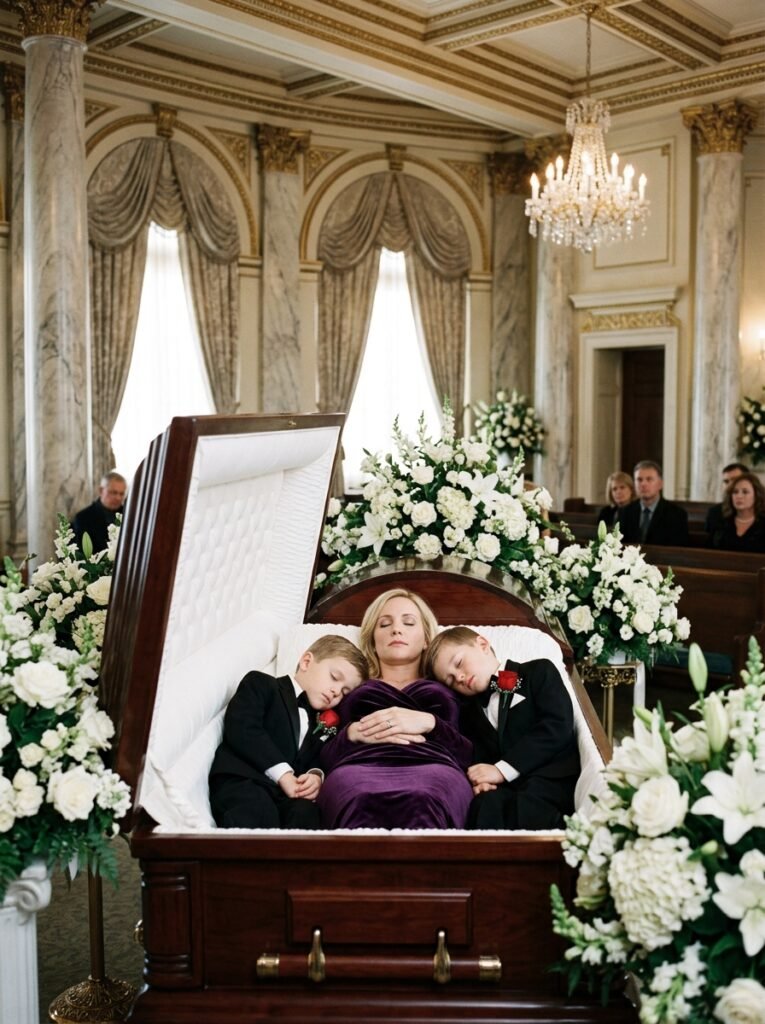
Before sunset, one oversized coffin was placed beneath a white canopy at Pine Haven Cemetery.
Margaret had insisted that Claire and the twins remain together.
“They came into this world as a family,” she told Nathan through tears. “Please don’t separate them now.”
A few people questioned the speed of the arrangements, but grief made reasonable people accept unreasonable things. By dusk, the coffin had been lowered, the mourners had left, and fresh soil covered the grave.
Two hours later, Miles opened his eyes in total darkness.
Beneath the Earth
Miles could not move his arms, yet he could feel Owen beside him and his mother’s hand beneath his cheek. A low mechanical hum came from somewhere near their feet.
Air.
Someone had placed an oxygen unit inside the coffin.
Miles tried to speak, producing only a faint sound. Owen stirred. Claire’s fingers moved.
Above them, a cemetery caretaker named Walter Greene was completing his final inspection when he heard a noise near the new grave. At first, he blamed a loose piece of equipment, but then the ground shifted.
Walter called the police.
Detective Naomi Brooks arrived with firefighters and an excavation crew. Less than twenty minutes later, the coffin was raised and opened.
Claire drew in a ragged breath beneath the cemetery lights.
Nathan, who had remained in his car because he could not make himself drive home, ran toward them. He fell to his knees beside the twins, unable to decide whom to hold first.
“You’re here,” he kept saying. “You’re still here.”
As paramedics examined them, Naomi searched the coffin. Beneath the oxygen unit, she found a cream-colored envelope and a small brass key.
Claire recognized the handwriting immediately.
It belonged to her father, Samuel Aldridge, whom she had believed lost in a boating accident eleven years earlier.
Margaret, still standing near the canopy, saw the envelope and rushed forward.
“Don’t open that.”
Everyone turned.
Naomi studied her. “Why?”
“Claire needs medical attention.”
Claire pushed herself upright despite the paramedic’s protest.
“My father wrote my name on that envelope.”
“It isn’t what you think.”
“Then tell me what it is.”
Margaret’s gaze moved toward the road as if she were expecting someone.
Naomi opened the letter.
“My dearest Claire, if this reaches you, Margaret has finally carried out the plan I begged her to abandon. You were told I was lost eleven years ago, but that story was arranged. I remained away because I believed doing so would protect you. I now understand that silence only gave other people control over your life.”
Claire stared at her mother.
For eleven years, she had visited a memorial stone. She had taken the twins there and told them about the grandfather they would never meet. She had carried anger at the universe when the true object of her anger had been standing beside her all along.
“You knew he was alive.”
Margaret began to cry. “I was trying to keep you safe.”
“From my father?”
“From what followed him.”
The letter described a research organization Samuel had helped establish in the 1980s: the Hawthorne Medical Trust. Its public mission involved emergency medicine, but one project had produced a compound capable of slowing the human system until breathing and circulation became almost impossible to detect without proper equipment.
Samuel had discovered that investors intended to misuse it. He disappeared to protect the research records and his family.
According to the letter, Margaret later used Samuel’s identity to control hidden accounts worth millions of dollars.
Naomi looked toward the oxygen unit.
“Did you arrange this burial?”
Margaret closed her eyes.
“Yes.”
“Did you know they would regain consciousness?”
“I believed they would wake within three hours.”
Nathan moved between Margaret and the twins.
“You put my family beneath the ground.”
“I gave them air.”
Claire’s voice was almost a whisper. “You knew we were alive.”
Margaret sank into a folding chair.
She admitted that she had coated the birthday candles with what she believed was a temporary sedative supplied by an old colleague. The plan was to make Claire and the boys appear unresponsive long enough to convince someone watching them that the family was gone.
“Who were you trying to fool?” Naomi asked.
Margaret looked at Claire.
“Your father. He was coming home.”
The Archive
Doctors confirmed that Claire and the twins had been exposed to a carefully measured compound that suppressed their vital signs without permanently harming them. The dosage had been adjusted for their individual weights, proving that the birthday incident had been planned.
While Claire and the boys recovered, Margaret disappeared from police custody after persuading an officer she was having difficulty breathing. A black SUV collected her near the hospital entrance.
Security footage showed an older man in the passenger seat.
Claire recognized her father’s profile.
The brass key led Naomi, Claire, and Nathan to the abandoned Aldridge family property outside Dayton. Claire had lived there until she was nine, before her parents separated and every happy memory became tangled with the sound of arguments behind closed doors.
In the basement, the key opened a metal plate concealed behind a loose brick. A section of wall shifted inward, revealing a staircase.
Below the house was an archive filled with financial records, medical files, old computers, and hundreds of photographs of Claire taken over eleven years.
Samuel had watched her graduate from college. He had watched her marry Nathan. He had photographed her pushing Miles and Owen through a park when they were toddlers.
Claire stood before the wall of pictures with tears gathering in her eyes.
“He was close enough to take these, but not close enough to speak to me.”
Nathan slipped his hand into hers. “Whatever explanation he gives, you don’t have to accept it.”
On a desk, Naomi found a recorder.
Samuel’s voice filled the room.
“Claire, before you decide who betrayed you most, understand that we all made choices out of fear. Margaret did things that cannot be defended, but she believed a larger threat was approaching. The compound was created to give physicians more time during severe emergencies. When certain investors saw other possibilities, I closed the program. Someone within the trust then turned against us.”
The message ended abruptly.
Nearby, Claire discovered a photograph of Samuel, Margaret, and two other men. Nathan recognized one of them as his father, Franklin Whitmore, a corporate auditor whom Nathan had believed gone since he was sixteen.
Written on the back were four words: THE FIRST HAWTHORNE PARTNERS.
Naomi opened a cabinet bearing the Whitmore name. Inside were altered genetic reports implying that Samuel was Nathan’s biological father, which would have made Claire and Nathan closely related.
A second copy revealed the truth: Samuel was not Nathan’s biological father.
“Why create the false report?” Nathan asked.
Samuel answered from the bottom of the staircase.
“Because Margaret wanted to destroy your marriage.”
Claire turned.
Her father stood before her, older and thinner than the man she remembered.
He opened his arms, but she did not move toward him.
“You watched me grieve.”
“Yes.”
“You watched your grandsons grow up through a camera.”
“Yes.”
“And you still stayed away.”
Samuel lowered his arms. “I thought distance was protection.”
“Everyone keeps using that word as if it makes betrayal noble.”
Samuel explained that Franklin Whitmore had managed the trust’s finances and had spent decades trying to obtain the research. Margaret had recently learned that Franklin was still alive and searching for Miles and Owen.
The twins had been conceived after fertility treatment, and records suggested their genetic material might have been altered at the clinic. Franklin believed the boys carried a rare cellular trait that allowed unusually rapid recovery from the compound.
Nathan stepped closer to Samuel.
“Are they my sons?”
Samuel hesitated.
“The records say they are not biologically yours.”
The words wounded Nathan, but only for a moment.
“Records don’t know who stayed awake when Owen had pneumonia. Records didn’t teach Miles to ride a bicycle. I am their father.”
Before anyone could respond, Naomi received an emergency call.
Miles and Owen had vanished from their hospital room.
The Laboratory Under the Museum
Hospital cameras showed the twins leaving willingly with the retired nurse from the birthday party. Her real name was Leah Rusk, daughter of Dr. Calvin Rusk, the pharmacologist who had developed the original compound.
A note left beneath Owen’s pillow read:
“THE CHILDREN BELONG TO THE RESEARCH.”
Samuel believed Leah had taken them to the Hawthorne Trust’s first laboratory, hidden beneath a children’s science museum in Cincinnati.
The irony made Claire feel ill. Aboveground, painted planets and cardboard rockets welcomed school groups. Beneath them, a locked corridor led into rooms where adults had once treated human lives as scientific property.
Police entered first. Claire and Nathan followed despite Naomi’s objections.
A speaker crackled overhead.
“Welcome back, Samuel,” an elderly voice said.
Calvin Rusk stepped behind a glass wall. Miles and Owen sat nearby, frightened but unharmed.
Claire ran to them. Nathan dropped to his knees, and both boys threw their arms around him.
“Dad!” Miles cried.
Nathan held them as if the force of his embrace could erase everything that had happened.
Calvin watched quietly.
“Whatever a laboratory report claims,” he said, “that is a father.”
Naomi ordered him to unlock every exit.
Calvin complied, explaining that Leah had brought the twins there because Franklin Whitmore had manipulated her. Franklin had convinced Leah that her father had harmed her mother years earlier and that placing the twins in danger would force Calvin to confess.
Calvin then revealed another hidden room.
Inside sat Elliott Aldridge, Samuel’s younger half brother, whom the family had also believed lost more than thirty years earlier.
Samuel could barely speak.
“Elliott?”
Elliott rose slowly. “Hello, Sam.”
The story beneath the family’s history began to emerge. Elliott had shown remarkable resistance during an unauthorized test of the compound. Rather than expose the investors, the adults around him hid him, believing secrecy would keep the research from spreading.
What was meant to last several months became three decades.
Claire looked at the older generation standing around her.
“You loved one another so badly that you erased one another.”
No one contradicted her.
Calvin explained that the birthday candles had been designed as a controlled test. Margaret believed they contained a mild version of the compound. However, chemical analysis showed someone had substituted a stronger formula.
Franklin appeared on a security monitor, breathing through an oxygen tube.
Nathan stared at the father he had mourned since adolescence.
“You left me when I was sixteen.”
“I needed freedom to complete my work.”
“You had a son.”
Franklin’s expression remained calm. “And you became a capable man.”
Nathan recoiled as if struck.
Franklin wanted access to the twins because he believed their recovery trait could reverse his worsening lung disorder. When Claire refused, he initiated a laboratory lockdown, reducing the room’s oxygen and offering to release everyone if the boys were surrendered.
Miles and Owen escaped through an old ventilation passage, reached an emergency console, and disabled the system. Police arrested Leah, who admitted she had followed Franklin’s instructions but insisted she had never intended to harm the children.
Claire faced her.
“You used my sons to force adults to talk.”
Leah lowered her head. “Yes.”
“Then you repeated the same wrong everyone here keeps calling protection.”
Leah began to cry.
The tracker on her phone revealed Franklin’s location at an abandoned research station beside Lake Briar, where he had once staged his own disappearance.
By the time police entered the station, Franklin had already taken Nathan.
The Father Who Wanted to Be Remembered
Franklin contacted Claire from Nathan’s childhood home in Cleveland. He had not restrained Nathan or physically harmed him. He wanted only one thing Nathan had refused to give him: recognition.
During the call, Franklin exposed another family secret.
Margaret had carried Nathan as a surrogate for Franklin and his wife, Eleanor. Eleanor’s genetic material had been used, so Nathan and Claire were not related, but Margaret’s involvement explained why she had interfered in their marriage and why Franklin had maintained control over her.
Claire finally understood the pattern connecting every person in the story. Franklin did not merely collect research or money. He collected leverage. If he knew a person’s parentage, medical history, or private regret, he believed he owned part of that person.
“You don’t love people,” Claire told him over the phone. “You inventory them.”
For the first time, Franklin’s voice weakened.
“I don’t want to leave this world alone.”
“You created your loneliness.”
“You don’t understand what fear does to a person.”
“I understand exactly what it does. I watched fear turn my mother into someone who buried her own daughter. I watched it persuade my father to disappear. Fear may explain your choices, but it does not erase them.”
At the Cleveland house, police found Franklin seated in the living room with Nathan across from him. He surrendered without resistance and provided a wooden box containing financial ledgers, research files, and the names of investors who had supported unlawful studies for decades.
Nathan walked directly to Claire.
“I’m all right.”
She held his face between her hands. “Did he ask you to forgive him?”
“No. He asked me to call him Dad.”
“Did you?”
Nathan looked toward the old man.
“I told him being a father is not a title a man can store for thirty years and collect when he gets lonely.”
Franklin was taken to a secure hospital room. His files allowed investigators to close the Hawthorne Trust and protect the remaining research.
Yet one question remained: who had replaced the mild compound on the birthday candles?
Elliott admitted that the stronger formula was based on a safer version he had developed years earlier. Only one other person had possessed the handwritten formula: Dr. Caroline Mercer, the embryologist who had supervised Claire’s fertility treatment twelve years earlier.
Caroline had disappeared shortly after the twins were born.
When investigators found her current identity, another hidden connection surfaced.
She was Leah’s mother.
More precisely, she was the woman Leah had always believed was her mother.
The Sister Taken at Birth
Caroline’s records revealed that she had also been the physician present when Claire was born.
The original hospital log listed two infant girls.
Claire had a twin.
The second child had been removed from the records without a state certificate or burial documentation. Samuel and Margaret had been told the baby had not survived, but no independent evidence supported that story.
Genetic testing provided the answer.
Leah Rusk was Claire’s identical twin sister.
Claire sat across from Leah in an interview room, studying a face that had always seemed strangely familiar. They shared the same dark eyes, the same slight lift of the left eyebrow, even the same habit of folding their hands when anxious.
“Did Caroline ever tell you about me?” Claire asked.
“No.”
“Did she tell you Calvin was your father?”
“My whole life.”
Calvin, who had also believed Leah was his daughter, left the room in tears.
Leah looked at Claire.
“I helped take your sons.”
“Yes.”
“And now I’m supposed to call you my sister.”
“No. Right now, you’re a person who made a serious choice and a person whose entire childhood was stolen. Both things can be true.”
Caroline was located at a farmhouse in Vermont, where Margaret was staying voluntarily. When police arrived, the two women were seated at a dining table.
Caroline did not deny taking Leah.
She claimed she had removed one twin from the Aldridge family to protect the child from the research surrounding Margaret’s unusual biology.
Claire’s anger remained controlled, which made every word land harder.
“You did not protect her. You selected her.”
Caroline flinched.
“I loved her.”
“You studied her, lied about her parents, and built her identity around your needs.”
“I gave her a peaceful childhood.”
Leah stepped into the room.
“You gave me a childhood that wasn’t mine.”
Caroline’s certainty finally cracked.
She explained that Margaret and Elliott were maternal half siblings who had been adopted into different families. Neither had known the truth when they became romantically involved as young adults, and Claire had been conceived before their shared parentage was discovered.
Samuel later married Margaret and raised Claire as his own.
Claire turned toward Samuel.
“Are you my biological father?”
He shook his head.
“No. Elliott is.”
Elliott looked at her but did not approach.
Claire remembered Samuel teaching her to swim, carrying her home after she injured her ankle, and building a cardboard castle for her eighth birthday.
She also remembered eleven empty years.
“Elliott may be my biological father,” she said, “but you were my dad. Then you chose to become a photograph.”
Samuel lowered his eyes. “I know.”
Caroline also revealed that Franklin had attempted to replace Nathan’s sample during Claire’s fertility treatment with preserved genetic material connected to Elliott’s research. Caroline claimed she had secretly restored Nathan’s original sample.
Independent testing later confirmed that Nathan was, in fact, Miles and Owen’s biological father.
When Claire told him, Nathan laughed and covered his face.
Then he became serious.
“I’m relieved, but I don’t want the boys to think the report gave them back to me.”
“Neither do I.”
“I was their father when I believed the opposite.”
“You were.”
“Then that is what they need to remember.”
The twins’ unusual recovery had come through Claire. During pregnancy, a small number of fetal cells had remained within her, strengthening a repair trait she had inherited through Margaret’s family line. The discovery was not a miracle cure, and it did not make the children medical property. It was simply an uncommon biological relationship between a mother and her sons.
The active compound on the candles, however, had not been placed there by Caroline.
Bakery footage showed an older woman changing the package while the counter was unattended.
Nathan recognized her immediately.
It was Eleanor Whitmore, his mother, whom he had also believed gone for more than twenty years.
What Love Could Not Excuse
Eleanor surrendered at the Columbus hospital and asked to see Nathan.
She was sixty-eight, tall and composed, with white hair pinned neatly behind her head. She carried an old photograph of herself, Franklin, and newborn Nathan.
Nathan did not embrace her.
“Why did you leave me?”
“Franklin controlled my doctors, my money, and every way I could reach you. After I escaped, he threatened to make you disappear too.”
“So you stayed away and called it protection.”
Eleanor nodded. “Yes.”
“Did you replace the candles?”
“Yes.”
Claire stepped closer. “You exposed my children to that compound.”
“I believed it would only make them sleep for a short time.”
“Why?”
Eleanor looked at Nathan.
“I wanted to force Franklin into the open. He had spent decades hiding behind other people.”
Nathan’s voice trembled.
“You used my sons to settle something with my father.”
“Yes.”
She offered no noble explanation. She did not ask them to admire her sacrifice. When Nathan asked whether it had been worth it, Eleanor answered immediately.
“No.”
That simple honesty did not create forgiveness, but it ended the family’s habit of disguising harm as devotion.
In the months that followed, Margaret, Caroline, Eleanor, Leah, and Franklin faced legal consequences appropriate to their individual actions. Samuel and Elliott cooperated with investigators. The useful portions of the research were transferred to independent universities under strict oversight and eventually contributed to safer methods for preserving donor organs during emergency transport.
Claire’s family healed more slowly.
She visited Margaret before the court proceedings.
Her mother sat behind a glass partition, looking older than Claire remembered.
“I thought if I controlled every danger around you, nothing could take you away,” Margaret said.
“Instead, you became one of the dangers.”
“I know.”
Claire placed her hand against the glass.
“I love you. I am also angry, and love does not remove consequences.”
Margaret nodded through her tears. “That may be the healthiest sentence anyone in our family has ever spoken.”
Claire managed a small smile. “The competition wasn’t strong.”
Her relationship with Leah began cautiously. They met in public places, spoke for an hour at a time, and refused to pretend that shared biology could create instant trust.
One afternoon, Leah asked, “Do you forgive me?”
Claire considered the question.
“Not completely.”
“Do you hate me?”
“No.”
“Then what are we?”
Claire studied the sister who had been taken from her before either of them could form a memory.
“Two people learning the truth. Let’s begin there.”
Samuel remained Dad, though Claire required him to earn a place in her life again. Elliott became part of the family gradually and never asked for a title that belonged to someone else.
Nathan visited Franklin once.
The older man asked whether forgiveness meant Nathan would return.
“No,” Nathan said. “Forgiveness means I can stop carrying you. It does not mean I must stand close enough for you to control me again.”
Franklin looked toward the window.
“I never understood how someone could love me and still leave.”
“That is because you confused love with ownership.”
Nathan walked away without looking back.
Thirteen Small Lights
A year after the birthday that had nearly separated them, Miles and Owen turned thirteen.
Claire kept the celebration deliberately simple: pizza in the backyard, a chocolate cake, a board game, and a guest list limited to people who understood that family was a responsibility rather than a claim of ownership.
Samuel brought two enormous pizzas. Elliott arrived with matching baseball gloves. Leah stood nervously near the gate until Owen surprised her with a hug.
Margaret attended under approved supervision. When Claire opened the gate, mother and daughter faced each other in silence.
“I missed you,” Margaret said.
“I missed you too.”
The embrace that followed did not erase what had happened. It was merely an honest beginning.
Nathan carried out the cake. Thirteen battery-powered lights glowed across the frosting.
Owen stared at them.
“It looks like an airport runway.”
“Safety first,” Claire said.
Elliott raised an eyebrow. “Considering this family, I support unreasonable levels of caution.”
Even Margaret laughed.
After everyone sang, Miles leaned toward the cake and stopped.
“How are we supposed to blow these out?”
Nathan looked at Claire. “Excellent planning.”
The twins switched off the lights one by one.
No confusion followed. No sirens waited outside. Nobody disappeared.
There was only laughter, evening sunlight, and a family still learning how to deserve one another.
Later, Claire sat on the porch beside Leah while Nathan and the boys started an overly competitive water-balloon game.
Leah watched them through the railing.
“Do you ever wonder what our lives would have been if Caroline hadn’t taken me?”
“I used to.”
“Why did you stop?”
Claire thought for a moment.
“Because grieving the life we should have had can steal the one we still have time to build.”
Leah rested her head briefly against Claire’s shoulder.
Inside the house, a framed photograph stood on the kitchen counter. It showed Claire, Nathan, the twins, Samuel, Elliott, Leah, and Margaret—a complicated collection of people connected by biology, choice, regret, and the slow work of becoming trustworthy.
Beneath the frame lay the brass key found inside the coffin.
Nathan noticed it after the guests had gone.
“You kept that?”
“Yes.”
“Why?”
Claire looked toward the hallway where Miles and Owen were arguing over whose turn it was to shower.
“It reminds me of the moment every locked secret began to open.”
Nathan slipped his hand into hers.
“Some truths are hard to face.”
“They are.”
“But hiding them was worse.”
Claire nodded.
For generations, the adults in their families had treated love as permission to lie, disappear, manipulate, and decide what another person was strong enough to know. They had called secrecy protection until the word had almost lost its meaning.
Claire and Nathan chose something less dramatic and far more difficult.
They chose honesty.
They chose boundaries.
They chose to let actions have consequences without pretending that love had vanished.
Upstairs, Owen called for his mother.
Claire switched off the kitchen light and followed Nathan toward the stairs.
For the first time in generations, nobody in their family was hiding in the dark.