The first time I saw my father stand in the rain on purpose, I was seven years old.
It was November in Eugene, Oregon. The kind of rain that doesn’t fall so much as hang in the air, gray and cold, soaking through everything. It had been raining for eleven days straight. My mother kept saying she was going to lose her mind.
I was sitting at the kitchen window, drawing on the fogged-up glass with my finger. And I saw Dad walk out the back door.
He didn’t have a coat on. He didn’t have shoes on. He walked barefoot across our muddy backyard, past the swing set, past the dead tomato plants, all the way to the middle of the lawn.
Then he stopped. He tipped his head back. He closed his eyes. And he stood there with the rain falling on his face.
I watched him for a long time. He didn’t move.
I put on my rain boots and went out to him.
“Daddy,” I said. “What are you doing? You’re all wet.”
He opened his eyes and looked down at me. He smiled. But it was a sad smile. I didn’t know yet that smiles could be sad.
“Just checking something, Annie girl,” he said.
“Checking what?”
He held out his hand, palm up, and let the rain land in it.
“It’s cold,” he said quietly. “The rain here is always so cold.”
“Isn’t rain supposed to be cold?”
He laughed a little.
“Not where I come from,” he said. “At home, the rain is warm. Like bathwater. It comes in the afternoon, just for ten minutes, and then the sun comes back out, and everything steams. The whole island smells like flowers and wet dirt.” He closed his eyes again. “And you can smell the ocean before you see it. Wherever you are. Even way up in the mountains. You can always smell the ocean.”
I tipped my head back and closed my eyes like him. I tried to smell the ocean.
All I could smell was wet grass and the neighbor’s wood smoke.
The back door opened. Mom was standing there in her bathrobe.
“Kai,” she said. Her voice was tight. “Come inside. You’ll catch your death.”
Dad opened his eyes. He looked at her for a moment. Something passed between them that I didn’t understand.
Then he picked me up and carried me inside, and he dried my hair with a dish towel, and he didn’t say another word about warm rain.
That night, I heard them in their bedroom. Not shouting. They never shouted. Just Mom’s voice, low and shaking, and Dad’s voice, very gentle.
I only caught one sentence. Mom’s.
“I can’t keep hearing about it, Kai. I can’t. Every time you talk about it, I feel like you’re already halfway gone.”
My name is Annie Akana. I’m twenty-six. I teach second grade at an elementary school in Springfield, Oregon, about ten minutes from the house I grew up in.
My father’s name was Kainoa Akana. Everybody called him Kai.
He was born in Waimānalo, on the east side of Oʻahu, in a little green house a mile from the beach. He grew up swimming before he could walk. He grew up eating fish his uncles caught off the rocks and poi his grandmother pounded by hand. He grew up with his mother, Malia, and his little sister, Leilani, and about forty cousins who all lived within a mile of each other.
He left at twenty.
He got a scholarship to Oregon State. Engineering. He was the first person in his family to go to college. He flew to Portland in September with one suitcase and a lei of plumeria flowers around his neck that his mother put on him at the airport. By the time he landed, the flowers were brown.
He kept them anyway. Dried. In a plastic bag. In his sock drawer. I found them when I was ten.
In his junior year, he met my mother at a coffee shop in Corvallis. Linda Doyle. She was nineteen. A nursing student. Red hair, freckles, a laugh he said he could hear from across a parking lot.
They got married two years later. Mom wanted to stay in Oregon. Her mother was sick. Dad got a job designing bridges for the state. They bought a little yellow house in Eugene.
He never moved back.
He never went back. Not to visit. Not once in thirty-one years.
I was always Daddy’s girl.
I could tell him anything. Every secret. Every crush. Every bad grade I hid from Mom. When I broke the neighbor’s window with a softball at nine, I told Dad first. When I got my heart broken at seventeen, I cried on Dad’s shoulder in the garage while he fixed the lawn mower. When I decided to become a teacher instead of a doctor, which my mother had always wanted, I told Dad first, and he hugged me and said, “Good. The world needs more good teachers than it needs rich doctors.”
But he never told me his secrets.
Not the real ones.
Sometimes I’d come downstairs late at night and find him sitting alone at the kitchen table. Just one light on. The one over the stove. And he’d be holding a photograph.
It was small. Faded. Curling at the corners. A beach. White sand. Turquoise water. Big dark cliffs on one side. A little island out in the water, shaped like a turtle.
He’d turn it over and over in his hands. Like he was trying to read something written on the back that wasn’t there.
“What’s that beach?” I asked once. I was twelve.
“Makapuʻu,” he said. He said it carefully, the way you say a name you love.
“What’s it like there?”
He was quiet for a long time.
“The rain is warm,” he said. “And you can smell the ocean before you see it.”
“I know,” I said. “You always say that.”
He smiled.
“Because it’s true,” he said.
Somewhere in my childhood, Hawaii became a word we didn’t say at the dinner table.
I don’t remember exactly when. It wasn’t a rule anybody announced. It just happened. Like a draft you stop noticing in an old house.
If Dad mentioned it, even something small, like we used to eat mangoes straight off the tree, or my mom made the best chicken long rice, Mom would get up from the table. She’d say she forgot something in the oven. Or she needed to check the laundry. Or she had a headache.
Once, when I was fourteen, Dad was telling me about how his uncles taught him to throw a net for fish off the rocks. I was laughing. Mom set down her fork so hard it bounced off her plate and hit the floor.
“Can we please,” she said, “for one dinner, not talk about how wonderful everything was before you came here?”
The kitchen went silent.
Dad looked at her. Then he picked up her fork from the floor. He wiped it on his napkin. He put it back next to her plate.
“Sorry, Lin,” he said quietly.
He never finished the story about the net.
I was angry at her for that. For years.
I couldn’t stand hearing her shut him down. I couldn’t understand why she took it so personally. It was his home. His childhood. His mother and his sister and his cousins. Why couldn’t he even talk about it?
“She acts like you missing Hawaii means you don’t love us,” I said to Dad once. I was sixteen. We were in the garage. He was changing the oil in Mom’s car.
He didn’t say anything for a while. He just kept working.
“It’s not fair,” I said. “You’re allowed to miss things. She misses Grandma. She talks about her all the time.”
Dad slid out from under the car. He sat up. He wiped his hands on a rag. He looked at me for a long time.
“Try to understand your mother, Annie,” he said.
“I’m trying. I don’t get it.”
“I know you don’t,” he said. “But if you knew the whole story, you wouldn’t be angry with her.”
“Then tell me the whole story.”
He looked at the garage door. At the gray rain falling outside.
“It’s not mine to tell,” he said. “It’s hers.”
He slid back under the car.
I wish I’d asked what he meant. I wish I’d pushed. I wish I’d gone inside right then and asked my mother.
I didn’t. I was sixteen. I thought there’d be time.
There were other things I noticed. Things I didn’t understand until later.
Every December, a card came in the mail. Red envelope. Honolulu postmark. Addressed in neat, old-fashioned cursive handwriting. Kainoa & Linda Akana.
Mom always got the mail first. She’d look at the red envelope. Her face would close. And she’d drop it in the kitchen trash. Unopened.
And every December, sometime that night, Dad would take it out of the trash. I saw him do it once. I was eleven, sneaking downstairs for cookies. He was standing at the trash can in the dark, carefully lifting the red envelope out from under the coffee grounds. Wiping it off with a paper towel. Putting it in the inside pocket of his work jacket.
He didn’t see me. I went back upstairs without my cookies.
I never asked him about it. It felt like something I wasn’t supposed to have seen.
Every month, on the first Sunday, Dad drove to the post office downtown. By himself. He said he was mailing bills. We paid our bills online.
He’d come back an hour later. Quiet. He’d go out to the garage for a while.
And every year in March, for one day, he’d be different. Very quiet. Very gentle with everyone. He’d go for a long walk alone. He’d come back with his eyes red.
“What’s in March?” I asked Mom once.
She was washing dishes. She didn’t turn around.
“His mother’s birthday,” she said.
And that was all.
Two weeks ago, my father was in a car accident.
It was a Tuesday afternoon. Raining. Of course it was raining. A pickup truck ran a red light on Coburg Road and hit his car on the driver’s side.
He was fifty-four.
They said he died before the ambulance got there. They said he didn’t feel anything.
I was in my classroom when the principal came to my door. I was reading Frog and Toad to twenty-two seven-year-olds. I remember I was in the middle of a sentence. I remember I put the book down open on my desk, and it stayed there for three days, because I didn’t go back to school.
Mom was at the hospital when I got there. Sitting in a plastic chair in the hallway outside the ER. Still in her nurse’s scrubs. She’s worked at Sacred Heart for thirty years.
She didn’t cry. She just sat there, very straight, with her hands folded in her lap.
“He was supposed to be at work,” she said, when I sat down next to her. “He wasn’t supposed to be on Coburg Road. His office is the other direction. Why was he on Coburg Road?”
I didn’t know.
Nobody did.
The funeral was the next Saturday. The whole Oregon Department of Transportation came. Engineers in suits. Guys from road crews in their good flannels. Dad had designed half the bridges in Lane County. People kept telling me that. Your father built the bridge I drive across every single day.
Nobody from Hawaii came.
I asked Mom about it. Whether she’d called anyone. His sister. His cousins.
She looked at me with an expression I couldn’t read.
“I don’t have their numbers,” she said. “He never gave them to me.”
I didn’t believe her. I didn’t push. She’d just buried her husband.
We were still trying to understand that he was gone. Still walking past his boots by the back door. Still setting three places at the table and then quietly putting one plate back.
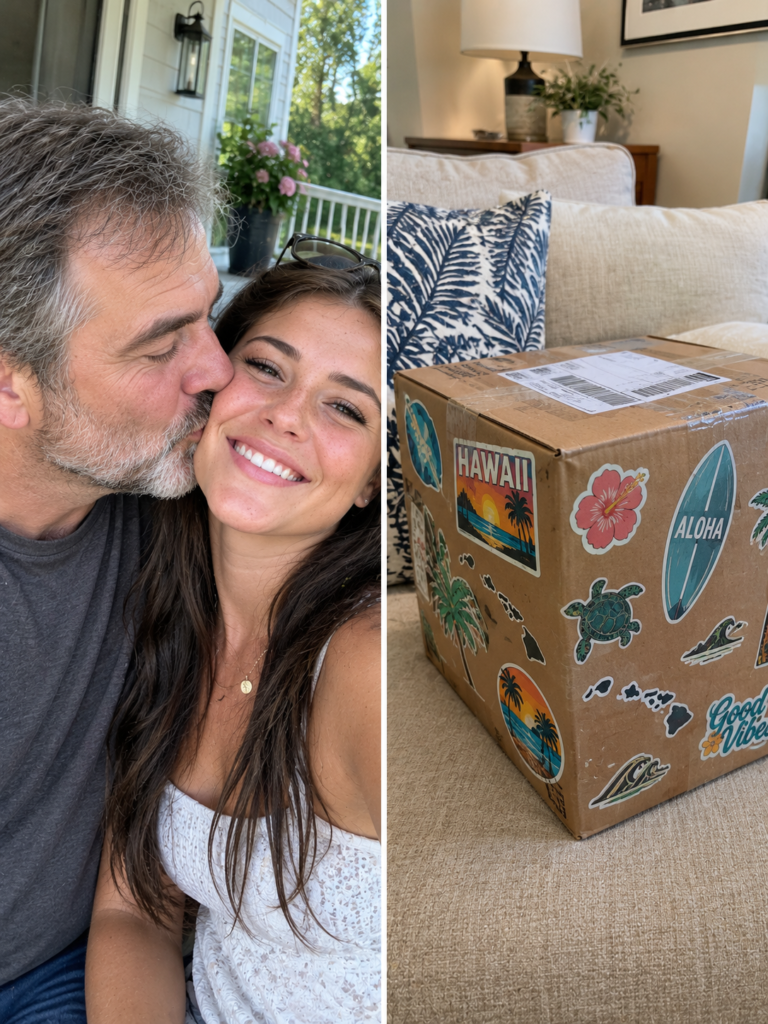
Eleven days after the accident, the mail carrier rang our doorbell.
It was a Thursday morning. I’d been staying at Mom’s house since the accident. Sleeping in my old room. Neither of us could stand to be alone.
I opened the door. The mail carrier was standing on the porch holding a box. A big one. About three feet long. Wrapped in brown paper and covered in tape. Heavy, from the way he was holding it.
“Package for Kainoa Akana,” he said.
I took it. It was heavy. I had to set it down on the floor of the front hall.
I looked at the label.
It was handwritten. In black ink. In neat, old-fashioned cursive. Kainoa Akana. Our address in Eugene.
The postmark was Honolulu.
The date was three days before the accident.
There was no return address.
I stood there in the front hall looking at it.
Someone in Hawaii had mailed my father a package. Three days before he died. And they didn’t know. They had no idea he’d never open it.
Somewhere on an island I’d never seen, someone was waiting for my father to call them back. To say he got it. To say thank you.
And he never would.
I picked it up and carried it into the kitchen. I put it on the kitchen table. Right where Dad used to sit at night with his photograph.
I was going to open it. Find out who sent it. Tell them what happened.
Mom came in from the laundry room.
She saw the box on the table.
She stopped.
I watched her look at the label. At the handwriting. At the Honolulu postmark.
And I watched all the color drain out of her face.
I’ve seen my mother scared exactly twice in my life. Once when I was nine and had an asthma attack in the middle of the night. And once at the hospital eleven days ago.
This was the third time.
“Leave it, Annie,” she said.
“Mom?”
“Leave it,” she said. Her voice was shaking. “Please.”
She crossed the kitchen fast. She grabbed my wrist. Her fingers were ice cold.
“Throw it away,” she said. “Please, Annie. Just throw it away. Let’s pretend it never came.”
I stared at her.
“Mom. It’s for Dad. Someone sent it to him. They don’t know he’s—” I couldn’t finish.
“I know,” she said. “I know. That’s why. Please, honey. I can’t. Not this. Not now.”
I pulled my wrist free.
I couldn’t do it. I couldn’t throw away something that had been meant for my father. The last thing anyone would ever send him. And somewhere in Hawaii, someone might be waiting for an answer he could never give.
“I’m sorry, Mom,” I said.
I picked up a knife from the dish rack. I cut through the tape. I peeled back the brown paper.
Inside, there was a cardboard box. Old. Soft at the corners. I opened the flaps.
The moment I saw what was inside, I covered my mouth with my hand.
“Oh God,” I whispered. I stared into the box. “What are we supposed to do with this?”
On top, folded very carefully, there was a quilt.
Not a regular quilt. Not the kind from a store. I’d never seen anything like it.
It was enormous. When I lifted the edge, it just kept going. White cotton. And sewn on top of the white, in one single piece of deep red fabric, was a pattern. Huge. Symmetrical. Like a giant paper snowflake. Leaves and curves and shapes radiating out from the center. Every edge turned under by hand. And then, all over it, thousands of tiny stitches. In rows. Following the shape of the pattern outward, like ripples spreading in water.
It must have taken years. Years and years.
Pinned to one corner, there was a note. On a piece of lined paper. In the same old-fashioned cursive as the label.
For Linda.
From Malia.
It took me thirty-one years. I am sorry it took so long.
Under the quilt, there were letters. Hundreds of them. Tied in bundles with string. Each bundle a year. I picked one up. The envelopes were all addressed to Malia Akana, Waimānalo, Hawaii. In my father’s handwriting.
Opened. Every one of them. Read so many times the paper was soft as cloth.
The first Sunday of every month. The post office downtown. Mailing bills.
And under the letters, at the very bottom of the box, there was a wooden box. Small. Polished dark wood with a beautiful grain, gold and brown, like tiger stripes. About the size of a loaf of bread.
Taped to the lid, there was an envelope. Different handwriting. Rounder. Younger.
Kai. Open this one last. — Lani
I lifted the wooden box out of the cardboard one. It was heavy for its size. Something shifted inside. Something soft. Like sand.
I knew what it was.
I’ve been to enough funerals. I’d just been to one.
I put it down on the kitchen table very, very gently.
Behind me, my mother made a sound.
I turned around.
She was standing by the counter with both hands over her mouth. Staring at the quilt. At the note. For Linda. From Malia.
She was crying.
Not the way she cried at the funeral, which was quietly, with a tissue, standing up straight. This was different. Her whole body was shaking. She slid down the cabinets until she was sitting on the kitchen floor.
“She finished it,” she whispered. “Oh my God. She actually finished it.”
I sat down on the floor next to her.
I didn’t say anything. I just waited. The way Dad used to wait for me when I was upset. He never pushed. He’d just sit there until you were ready.
It took a long time.
“I need to tell you something,” Mom said finally. “Something your father wanted me to tell you a long time ago. Something I should have told you when you were sixteen and you hated me.”
“I didn’t hate you.”
“You did,” she said. “A little. It’s okay. I deserved it.” She wiped her face with her sleeve. “Your dad used to say, If she knew the whole story, she wouldn’t be angry with you. And I’d say, Then let her be angry. I can’t talk about it.“
She looked at the quilt on the table. The deep red pattern hanging off the edge.
“I’ll talk about it now,” she said.
“I was nine,” Mom said, “when my father left.”
I stared at her.
“Grandpa Patrick,” I said. “You said he died. When you were little.”
“He didn’t die,” Mom said. “Not then. He died in 2009. In Galway. In Ireland. Where he was born.” She swallowed. “I told you he died when I was nine because it was easier than the truth.”
“What’s the truth?”
“He came to America when he was twenty,” Mom said. “From a little town on the west coast of Ireland. He met my mother in Portland. They got married. They had me. He worked at the shipyards.” She was looking at her hands. “And he missed home. Every single day. He talked about it constantly. The green. The sea. The rain. The rain at home is soft, he used to say. Not like this hard American rain.“
I felt something go cold inside me.
“He’d sit at the kitchen table at night,” Mom said. “With a photograph. Of a harbor. With little boats. He’d turn it over and over in his hands.”
“Mom—”
“My mother used to get so upset when he talked about it,” Mom said. “She’d leave the room. She’d say, Why can’t you just be happy here? With us? And he’d say he was happy. He’d say he loved us. He’d say it was just a place.” She closed her eyes. “And then one morning, when I was nine, he packed a suitcase. He kissed me on the forehead. And he said, I’m sorry, Linnie. I have to go home.“
The kitchen was very quiet.
“He went back to Ireland,” Mom said. “He sent me a birthday card every year until I was fourteen. Then he stopped. He married someone else there. Had other kids. I met one of them once, at his funeral. My half-brother. He had my eyes.” She opened her eyes. “My father loved us. I believe that. But he loved home more. And when he had to choose, he chose home.”
“So when I married a man from an island,” Mom said, “who missed it every day, who stood in the rain with his eyes closed, who sat at the kitchen table at night turning a photograph over and over in his hands…”
She didn’t finish.
She didn’t have to.
“Every time he talked about Hawaii,” she said, “I heard my father. Every single time. The rain at home is warm. The rain at home is soft. Same sentence, Annie. Different island. And I’d feel nine years old again. Watching a suitcase by the door.”
“Did Dad know?”
“He knew,” Mom said. “I told him on our third date. I told him everything. I said, If you’re ever going to leave, leave now. Before I love you.” She laughed. It came out broken. “He said, I’m not going anywhere, Linda Doyle. And he didn’t. Not for thirty-one years. Not once.”
“But that’s not all of it,” Mom said. “Is it?”
She looked at the note on the quilt. For Linda. From Malia.
“Your father took me to Hawaii once,” she said. “Right after we got married. To meet his family. It was the only time I ever went.”
I didn’t know that. Nobody had ever told me that.
“It was beautiful,” Mom said. “It was everything he said. The rain was warm. You could smell the ocean before you saw it. His family was so loud and so warm and there were so many of them. They threw a party in their backyard with a whole pig cooked in the ground. His cousins sang. His uncles played ukulele. His grandmother put a lei on me and kissed both my cheeks.” She smiled a little. “I’d never seen your father so happy. He was a different person there. Lighter. Like he’d taken off a heavy coat.”
The smile went away.
“On the last night,” she said, “I went to get a glass of water. And I heard his mother talking to him. Out on the lanai. In the dark. She didn’t know I was there.”
“What did she say?”
Mom closed her eyes.
“She said, Kainoa, you are not happy over there. I can see it in your face. You belong here. Bring her home. Or come home without her. But come home.” Mom’s voice cracked. “And then she said, They always come home, our boys. They always come home in the end.“
I put my hand over my mouth.
“They always come home,” Mom said. “That’s what she said. And I stood in her kitchen in the dark and I was nine years old again. And my father was packing his suitcase.”
“What did Dad say?”
“I didn’t wait to hear,” Mom said. “I went back to the bedroom. I packed my bag. When he came in, I was sitting on the bed with my suitcase. And I said, I want to go home tomorrow. And I don’t want to ever come back here. Promise me.“
She was quiet for a long time.
“He promised,” she said. “That night. Without asking why. He just looked at my face and said, Okay, Lin. I promise.“
“He kept it,” I said.
“He kept it,” Mom said. “For thirty-one years. He never went back. Not for his grandmother’s funeral. Not for his uncles. Not for his cousins’ weddings. Not when Lani had her babies.” She pressed her hands against her face. “Not when his mother got sick.”
I stared at her.
“His mother got sick?”
“Two years ago,” Mom said. “Cancer. Lani called. I answered. She asked for Kai. I gave him the phone.” She shook her head. “He stood in that hallway right there for forty minutes. And when he hung up, he came into the kitchen and he looked at me. And I knew he was going to ask. I could see it.”
“Did he?”
“No,” Mom said. “He didn’t ask. He kissed me on the forehead and went out to the garage. Because he’d promised.” She was sobbing now. “And I let him. I let him keep a promise I made him make when I was twenty-two and scared. I was fifty-two and I was still scared. And I let him not go home to his mother.”
I didn’t know what to say. I sat on the kitchen floor next to my mother and looked at the quilt hanging off the edge of the table.
Deep red on white. Thousands of tiny stitches. Thirty-one years.
“The cards,” I said slowly. “The red envelopes. Every Christmas.”
“From his mother,” Mom said. “To both of us. Every year. Kainoa & Linda.” She looked at me. “I threw them away. Every single one. Unopened.”
“And Dad took them out of the trash.”
Mom stared at me.
“You saw that?”
“Once,” I said. “When I was eleven.”
She closed her eyes.
“I knew he did,” she said. “I never said anything. He never said anything. We both pretended.” She shook her head. “Thirty-one years of pretending. That’s a marriage too, I guess.”
I picked up one of the bundles of letters from the cardboard box. The one on top. The most recent year.
I looked at Mom.
“Can I?” I asked.
She nodded.
I untied the string. I opened the first one. It was from January. Dad’s handwriting. Blocky and neat, the way engineers write.
Mama,
Got your letter. I’m glad the treatment is going okay. Lani says you’re still bossing all the nurses around. Good. Keep doing it.
Annie’s class is doing a unit on oceans. She asked me to come in and talk about Hawaii. About the reef and the fish and the sea turtles. I said yes. I didn’t tell Linda. I’ll tell her after.
I stood in front of twenty-two seven-year-olds and told them about Makapuʻu. About the turtle island. About how you can smell the ocean before you see it. One little boy asked if I missed it. I said every day. He said why don’t you go back. I didn’t know what to say.
How’s the quilt? Lani says you’re almost done. Don’t rush it. Take as long as you need.
I love you. I think about you every day.
Your son,
Kai
I put the letter down.
I remembered that day. Back in January. My ocean unit. Dad came to my classroom on his lunch break in his work boots. He brought a shell. A big pink one. He let every kid hold it up to their ear.
A boy named Mateo asked him if he missed Hawaii.
Dad said, “Every day, buddy.”
Mateo said, “Then why don’t you go back?”
And Dad laughed and ruffled his hair and said, “Because my best girls live here.”
I didn’t know he’d written to his mother about it. I didn’t know he’d been writing to his mother at all.
I opened another one. February.
Mama,
Lani called. She says you’ve stopped eating much. She says the doctors want to talk about hospice. I’m sitting in the garage writing this because I can’t stop shaking.
I want to come. You know I want to come. You know why I can’t.
I keep thinking about the night on the lanai. What you said. I know you didn’t mean it the way it sounded. I know you just missed me. But she heard it, Mama. She heard “they always come home.” And she heard her father.
I’m not going to break her heart the way he did. I made her a promise. I have to keep it. Even if it means I don’t get to say goodbye to you.
Please don’t be angry with her. If you knew the whole story, you wouldn’t be.
I love you.
Kai
Mom was reading over my shoulder.
When she got to I made her a promise. I have to keep it. Even if it means I don’t get to say goodbye to you, she made a sound I’ll never forget. A sound like something tearing.
“I didn’t know,” she said. “I didn’t know she was that sick. He never told me. He never told me it was hospice.”
“He didn’t want you to feel like you had to let him go,” I said quietly. “He didn’t want you to have to choose.”
Mom put her face in her hands.
“I would have let him go,” she whispered. “If he’d asked. I would have. I would have driven him to the airport myself.”
“Would you?” I asked. Gently. “Two years ago?”
She didn’t answer. She just cried.
The last letter in the bundle was from three months ago.
It was shorter than the others. The handwriting was shakier.
Mama,
Lani called. She told me you’re gone.
I’m sitting in the car in the parking lot at work. I can’t go inside. I can’t stop crying. I didn’t get to say goodbye. I kept my promise and I didn’t get to say goodbye.
Lani says you asked for me at the end. She says you said my name. She says you weren’t angry. She says you said, “Tell Kai it’s all right. Tell him to tell her I’m sorry.”
I’m going to tell her. I promise. I’m going to tell Linda everything. And then I’m going to ask her to come with me. Not to stay. Just to visit. Just to put flowers in the water for you.
I’m going to do it the right way this time. I’m going to ask her. Not tell her. Ask.
I love you.
Kai
That was the last one.
No more letters after that.
Because there was nobody to send them to.
“He was going to ask me,” Mom said. Her voice was hollow. “He was going to ask me to go to Hawaii with him.”
“He was,” I said.
“He never did.”
“He didn’t get the chance,” I said.
Then I remembered something. Something the police officer said at the hospital. When they gave Mom Dad’s things. His wallet. His watch. His phone with the cracked screen.
There was an envelope in the glove compartment, ma’am. We’ll release the vehicle contents to you once the investigation’s done.
Mom remembered at the same time I did. I watched it happen on her face.
“Coburg Road,” she whispered. “He was on Coburg Road.”
There’s a travel agency on Coburg Road. Right before the light where the truck hit him. Pacific Wings Travel. A little office in a strip mall next to a nail salon. They have pictures of beaches in the window.
We drove to the impound lot that afternoon.
Dad’s car was in the back. Crushed on the driver’s side. I couldn’t look at it. Mom couldn’t either. She stood there with her hand over her mouth.
The man who ran the lot was kind. He was older, with gray hair and a limp. He’d seen a lot of families come out to that lot. He went and got the bag with the contents of the glove compartment for us so we wouldn’t have to open the car ourselves.
Insurance card. Registration. A tire pressure gauge. Napkins from Dutch Bros. A pack of gum.
And a white envelope.
With a little blue airplane logo in the corner. Pacific Wings Travel.
Mom opened it with shaking hands.
Inside, there were three tickets. Printed out. Round trip. Portland to Honolulu. Leaving the eighth of June.
Mom’s birthday.
Three names.
Kainoa Akana.
Linda Akana.
Annie Akana.
And clipped to the tickets, there was a yellow sticky note. In Dad’s handwriting.
Lin. Happy birthday. Will you come with me? Just to visit. Just to put flowers in the water for Mama. I’ll understand if you say no. I’ll cancel the tickets and we’ll go to the coast instead like always. Either way, I’m not going anywhere. I love you. — K.
My mother stood in the middle of an impound lot in the rain and read that sticky note over and over.
Will you come with me?
I’ll understand if you say no.
Either way, I’m not going anywhere.
The man who ran the lot had walked a little ways off to give us privacy. But I saw him turn around when Mom sank down onto the wet gravel.
He didn’t come back over. He just took off his cap and held it against his chest.
That night, we opened the last envelope.
The one taped to the lid of the wooden box. Kai. Open this one last. — Lani.
Mom and I sat at the kitchen table. The quilt was folded on the chair next to us. The letters were stacked in bundles. The wooden box sat in the middle of the table. Polished. Gold and brown.
I opened the envelope. I read it out loud.
Kai,
By the time you get this, you’ll have the quilt. Mama finished it two days before she died. Her hands were shaking so bad the last few weeks she could only do a few stitches a day. But she did them. Every single day. She said she had to finish it before she could go.
She started it the week after you and Linda left. The honeymoon. Thirty-one years ago. You remember? She felt so bad about what she said on the lanai. She knew Linda heard. She saw her face at breakfast the next morning. She tried to say sorry, but you were already loading the car.
So she started a quilt. For Linda. You know what Grandma always said. You can’t say sorry in a hurry. If you want to really say it, you sew it. One stitch at a time. Until it’s done.
She picked the ʻulu pattern. The breadfruit. Same as the first quilt every Hawaiian girl learns. You know what it means. That the house it covers will never go hungry. That there will always be enough. She said Linda was afraid there wasn’t enough of you to go around. Enough for here and enough for there. She wanted to tell her there was. That a heart is like a breadfruit tree. You can feed a whole village off one tree and it still grows more.
She addressed the box herself. Years ago. She kept it in her closet. She said when the quilt was done, I should send it. So I did.
The other thing in the box is Mama.
Half of her. The rest we’re putting in the water at Makapuʻu on her birthday next March. She asked for that. She said half of her should go home to the ocean. And half of her should go wherever her son is.
She said, “A mother should be where her son is. Even if he can’t come to her. Then she’ll go to him.”
I know you can’t come home. I know about the promise. I’m not asking you to break it. Mama wasn’t either.
But Kai. If you ever want to bring her back. If you ever want to put both halves of her in the water at the same time. We’ll be here. All of us. We’ll always be here.
Tell Linda the quilt isn’t a guilt trip. It’s an apology. And an invitation. And it’s okay if she only takes the apology.
Your sister,
Lani
P.S. Mama’s last words were your name. And then she said, “Tell Linda it’s all right. He’s a good boy. He kept his promise.”
I put the letter down.
I looked at the wooden box on the table. My grandmother. Half of her. Who I’d never met. Who’d sewn a quilt for thirty-one years for a woman who threw her Christmas cards away.
Who’d crossed an ocean in a cardboard box to be with her son.
Three days too late.
“What are we supposed to do with this?” I whispered again. “With her?”
Mom didn’t answer for a long time.
She reached out. Slowly. She put her hand on the lid of the wooden box. Flat. The way you’d put your hand on someone’s shoulder.
“Hello, Malia,” she said quietly.
Then she stood up. She went to the hall closet. She came back with a phone book, an old one, from the bottom shelf, and a small spiral address book I’d never seen before. Dad’s. With a rubber band around it.
She’d known where it was the whole time.
She flipped to the L’s. Lani. A number with an 808 area code.
She picked up the phone.
“Mom,” I said. “It’s eleven o’clock at night.”
“It’s eight o’clock in Hawaii,” Mom said.
She dialed.
I only heard Mom’s half.
“Leilani? It’s Linda. Linda Akana.” A long pause. “No. No, honey. I’m so sorry. I’m calling because—”
She couldn’t say it.
I took the phone from her. I’d never spoken to my aunt in my life. I didn’t even know what her voice sounded like.
“Aunt Lani?” I said. “This is Annie. Kai’s daughter.”
There was a silence on the other end. Then a soft voice. Warm. With an accent that sounded like the way Dad said certain words when he was tired.
“Annie,” she said. “Oh, Annie. I’ve seen your pictures. Every year. Your dad sent them to Mama.” Her voice changed. “Annie. Why are you calling and not him?”
I told her.
She made a sound I’ll never forget. Then I heard voices in the background. Many voices. A man’s. A child’s. Someone saying her name over and over. Someone else crying.
Then my aunt came back on the line.
“When?” she asked. Barely a whisper.
“Two weeks ago,” I said. “A car accident. He was coming back from the travel agency. He bought tickets. For all three of us. For Mom’s birthday. To come see you.”
There was a very long silence.
“He was coming home,” Leilani whispered.
“He was going to ask her first,” I said. “He wrote it on a sticky note. Will you come with me? I’ll understand if you say no.“
My aunt started to cry.
Behind me, my mother took the phone back.
“Lani,” Mom said. Her voice was shaking but clear. “I’m saying yes.”
We flew to Honolulu on the eighth of June.
Mom’s birthday. On Dad’s tickets. Pacific Wings refunded his seat and let us use the other two. The woman at the travel agency on Coburg Road cried when we came in to ask. She remembered him. She said he’d sat at her desk for an hour picking out seats. He wanted Mom to have the window. He said she’d never seen the islands from the air.
We carried two wooden boxes.
The polished one from the cardboard box. And a plain one from the funeral home in Eugene. Dad. Half of him. The other half is buried under a maple tree in the cemetery in Eugene, next to a spot with Mom’s name already on the stone.
That was Mom’s idea.
“He was always half here and half there,” she said. “I made him pretend he wasn’t. I’m done making him pretend.”
Mom had the window seat.
About an hour before we landed, she shook my arm. I’d been sleeping. She was pressed against the window. Her face was wet.
“Look,” she said.
I leaned over her.
Below us, in a sea so blue it didn’t look real, there was land. Green. Impossibly green. Mountains with clouds sitting on top of them like hats. White lines of waves breaking around the edges.
“It’s exactly how he described it,” Mom whispered. “Thirty-one years and I’d forgotten. It’s exactly how he said.”
When we walked out of the airport in Honolulu, the air hit us. Warm and heavy and wet. It smelled like flowers and jet fuel and something else.
Salt.
The ocean. I couldn’t see it. We were in a parking garage. There was concrete everywhere.
But I could smell it.
I stopped walking. I closed my eyes. I breathed in.
“Annie?” Mom said.
“You can smell the ocean,” I said. “Before you see it. Dad was right.”
Mom closed her eyes too.
We stood in the middle of a parking garage at the Honolulu airport with our eyes closed, breathing, while travelers walked around us with suitcases.
They were waiting for us outside baggage claim.
All of them.
I don’t know how many. Forty, maybe. Fifty. Old people and young people and babies in strollers. Men in aloha shirts. Women in long flowered dresses. Kids holding a giant handmade sign on poster board.
WELCOME HOME LINDA AND ANNIE
And in the middle of them, a small woman in her late forties. Dark hair pulled back. Dad’s eyes. Dad’s exact eyes.
Leilani.
She walked toward us. She was holding something in her hands. Two leis. Plumeria. White and yellow. The same flowers in the dried brown bag in Dad’s sock drawer.
She stopped in front of my mother.
They looked at each other for a long time.
My mother was shaking. I could feel it. She was holding my hand so hard it hurt.
Then my aunt lifted the lei and put it over my mother’s head. She settled it on her shoulders. She kissed her on one cheek. Then the other.
“Aloha, Linda,” she said softly. “Welcome home.”
My mother made a sound. Then she put her arms around Leilani and held on.
Fifty people I’d never met stood around them in a circle and didn’t say a word.
We stayed for two weeks.
In the little green house in Waimānalo. The one Dad grew up in. Leilani lives there now with her husband and her three kids. They gave us Grandma Malia’s room.
On the bed, there was a white quilt. With a deep red pattern. Different from ours. Older. Faded.
“Mama’s first one,” Leilani said. “She made it when she was sixteen. Ulu, same as yours. Every Hawaiian girl starts with the breadfruit.”
Mom sat down on the edge of the bed. She ran her hand over the faded red pattern.
“Can I ask you something?” she said. “About the night on the lanai. Thirty-one years ago.”
Leilani sat down next to her.
“Mama told me about it,” Leilani said. “Many times. She said it was the worst thing she ever said. She said she’d lost her husband, our dad, the year before. Heart attack. On his fishing boat. And then her son moved four thousand miles away. And she was so lonely she couldn’t breathe. And when she saw Kai happy, really happy, at the party, at the house, she thought, Maybe he’ll come back. Maybe he’ll stay.“
Mom closed her eyes.
“She didn’t know about your father,” Leilani said gently. “The one who went to Ireland. She didn’t know until Kai wrote to her about it. Years later. When she found out, she cried for a week. She said, I told that poor girl the one thing she was most afraid of. Out loud. In the dark.” Leilani took a breath. “That’s when she started sewing faster.”
Leilani showed us everything.
The beach where Dad learned to swim. The rocks where his uncles taught him to throw the net. The little store where he bought shave ice every summer afternoon. The school where he won the science fair three years in a row.
She showed us the room where he grew up. It was her daughter’s room now. But in the closet, on the top shelf, there was a box. KAI’S STUFF. Mama had kept it. Every report card. Every school picture. His high school graduation cap. A plaster handprint he made in kindergarten.
And a stack of photographs. Hundreds of them. Every picture Dad ever mailed home.
Me at one day old. Me at my first birthday with cake on my face. Me on the swing set. Me in my softball uniform. Me at my high school graduation. Me at my college graduation. Me in front of my first classroom, holding up a sign that said MS. AKANA’S CLASS.
On the back of each one, in Grandma Malia’s cursive, she’d written my age and the date she got it.
And on the back of the very last one, the classroom one, she’d written something else.
My granddaughter Annie. A teacher. Like I always wanted to be. I hope someday she comes. I hope someday I get to tell her I’m proud.
I sat on the floor of my father’s childhood closet and cried for an hour.
On the twelfth day, we went to Makapuʻu.
All of us. The whole family. Fifty people. On a gray morning with clouds hanging low over the cliffs.
It was the beach in Dad’s photograph. Exactly. White sand. Turquoise water. Big dark cliffs on one side. And out in the water, a little island shaped like a turtle.
Two of my cousins, Keoni and Makana, took us out past the reef in an outrigger canoe. Their canoe club’s. Mom and Leilani and me. Keoni in front, Makana in back, paddling.
I held the polished wooden box. Grandma Malia.
Mom held the plain one. Dad.
When we were past the reef, out in the deep blue water, the cousins stopped paddling. The canoe rocked gently. The turtle island was off to our left. The cliffs were behind us.
Leilani sang something. In Hawaiian. Very softly. I didn’t understand the words. I didn’t need to.
Then Mom opened Dad’s box.
Her hands were shaking. She looked at me. I opened Grandma’s.
“Together?” I said.
“Together,” Mom said.
We leaned over the side of the canoe. We tipped the boxes at the same time.
Two gray clouds went into the water. Side by side. They drifted for a moment. Touching. Then the waves took them, and they swirled together, and you couldn’t tell which was which anymore.
Leilani dropped a lei into the water. Plumeria. White and yellow. It floated on top of the place where they’d gone in.
“There,” Leilani said quietly. “Now they’re both home.”
Then it started to rain.
Just like that. Out of nowhere. The clouds over the cliffs opened up, and rain came down on the canoe. On the water. On the floating lei. On us.
I held out my hand. Palm up. The way Dad used to.
The rain was warm.
Warm like bathwater. Soft. It ran down my face and into my mouth, and it tasted like salt and flowers.
Mom tipped her head back. She closed her eyes. She let the rain fall on her face.
Just like Dad. In the backyard in Eugene. Barefoot. When I was seven.
She stayed like that for a long time. With her face up. With her eyes closed. With the rain running down her cheeks so I couldn’t tell which part was rain.
“He was right,” she said finally. Without opening her eyes. “Kai. You were right. It’s warm.”
Ten minutes later, just like he said, the rain stopped. The sun came out. Everything steamed. The cliffs. The water. Our shoulders. Our hair.
The whole island smelled like flowers and wet dirt.
On our last night, the family threw a party. In the backyard of the little green house. Just like they did thirty-one years ago for Dad and Mom’s honeymoon.
A whole pig cooked in the ground. Cousins singing. Uncles playing ukulele. Little kids running everywhere with plates of food bigger than their heads.
Mom sat on the lanai. The same lanai. Where Grandma Malia said the words that started everything.
Leilani came and sat down next to her. They didn’t say anything for a while. They just watched the party.
“Thirty-one years,” Mom said finally. “I kept him from this. From all of this.”
“You didn’t keep him,” Leilani said. “He stayed. There’s a difference.” She looked at Mom. “He could’ve come anytime. He was a grown man. He chose to keep the promise. Because he loved you more than he missed us.”
“That’s what I was afraid of,” Mom said. “That someday he’d have to choose. And he’d choose here. Like my father did.”
“He never had to choose,” Leilani said gently. “That’s what Mama was trying to tell you with the quilt. You don’t have to choose. Not between places. Not between people. A heart’s not a suitcase, Linda. You don’t have to take things out to make room.”
Mom started to cry. Quietly.
“I wish I’d known that thirty-one years ago,” she said.
“Mama wished she’d said it thirty-one years ago,” Leilani said. “So it took both of you a long time.” She put her arm around Mom’s shoulders. “That’s okay. The ʻulu tree is slow. But it feeds everybody in the end.”
We flew home on the twenty-second of June.
Mom had the window seat again.
When the islands disappeared behind us, she kept looking out the window at the empty blue ocean for a long time. Then she turned to me.
“I want to come back,” she said. “Every year. On his birthday. And Malia’s.”
“Okay.”
“And I want you to come with me,” she said. “If you want to.”
“I want to,” I said.
She nodded. She looked back out the window.
“Your father never had to choose,” she said quietly. “I just made him think he did.”
The quilt is on Mom’s bed now.
Deep red on white. The breadfruit. Thirty-one years of tiny stitches. Folded at the foot of the bed during the day. Pulled up to her chin every night.
She sleeps better under it, she says. She doesn’t know why.
I think I do.
The photograph of Makapuʻu is on the refrigerator. The faded one Dad used to turn over at the kitchen table at night. Next to it, there’s a new one. Mom and me and Leilani in the outrigger canoe. Soaking wet. Laughing. In the warm rain.
The red Christmas cards come every December now. From Leilani. Addressed to Linda & Annie Akana.
Mom opens them at the kitchen table. She reads them out loud. Then she puts them on the refrigerator.
Last week, it rained in Eugene.
Of course it did. It’s Oregon. It rains eight months a year.
I came over for dinner. Mom wasn’t in the kitchen. I looked out the back window.
She was standing in the middle of the backyard. Barefoot. No coat. In the cold November rain. Next to the old swing set and the dead tomato plants.
Her head was tipped back. Her eyes were closed.
I went outside. I stood next to her.
“Mom,” I said. “What are you doing? You’re all wet.”
She opened her eyes and looked at me. She smiled. Not a sad smile. Something else. Something I don’t have a word for yet.
“Just checking something,” she said.
“Checking what?”
She held out her hand, palm up, and let the rain land in it.
“It’s cold,” she said. “The rain here is always so cold.”
I held out my hand next to hers.
“At home,” I said, “the rain is warm.”
She looked at me.
“Which home?” she asked.
I thought about it. About the yellow house in Eugene. About the little green house in Waimānalo. About a canoe rocking past the reef, and two gray clouds drifting together, and a lei floating on top of the water. About thirty-one years of tiny stitches.
“Both,” I said.
My mother laughed. Out loud. In the rain.
Then she took my hand, and we stood in the backyard with our faces turned up, cold and soaking wet, in the place where my father kept his promise for thirty-one years.
And I swear, just for a second, I could smell the ocean.