On the morning I turned eight, I woke up at six o’clock and lay in bed listening for the sound of my mother singing.
That’s what happened on birthdays. I’d seen it on TV. I’d seen it at my friend Kaylee’s house when I slept over the night before her seventh birthday. Her mom came into the room at seven in the morning with a cupcake with a candle in it, singing, and her dad came in behind her with a camera, and Kaylee sat up in bed and screamed with happiness, and I sat on my sleeping bag on the floor and smiled and tried not to cry.
So that morning, I lay very still under my purple comforter and waited.
I heard my mother in the kitchen. I heard pans. I heard the coffee maker. I heard her laugh at something my father said.
I heard her singing.
I sat up in bed. My heart was pounding. I ran my fingers through my hair so it wouldn’t look messy for the camera.
Then I heard what she was singing.
“Happy birthday, dear Ry-an! Happy birthday to you!“
My brother, Ryan, and I share a birthday.
April ninth. Eight years apart. He was born at 4:12 in the afternoon in 1993. I was born at 6:40 in the morning in 2001. My mother used to tell people it was “the funniest coincidence.” She’d tell it at parties. At church. At the grocery store. Can you believe it? Same exact day. Eight years apart.
She never told the rest of it. The part where every April ninth for my whole childhood, only one of us got a birthday.
That year, Ryan was turning sixteen. Sixteen was a big one. My parents had been planning for months. They rented the pavilion at Harmon Park. They hired a DJ. They ordered a three-tier cake with a picture of a car on it, because Ryan was getting his license that week. They invited his whole sophomore class.
There were balloons. There was a bounce house, even though most of the guests were sixteen, because my mother said it would be “fun and retro.” There was a taco bar and a chocolate fountain and a photo booth with props.
I went to the party. Of course I went. I was eight. Nobody was going to leave me home alone.
I wore my favorite dress. Yellow, with daisies on it. I’d laid it out the night before. I thought maybe, just maybe, somebody would notice.
I stood by the chocolate fountain for most of the afternoon, dipping strawberries. Nobody talked to me. Ryan’s friends were sixteen. They didn’t talk to eight-year-olds.
At four o’clock, they brought out the cake. Three tiers. A car on top. Sixteen candles.
Everybody sang. Ryan blew out the candles. Everybody cheered. My father took about a hundred pictures.
I stood at the back of the crowd and sang too. I sang the words very quietly.
Happy birthday, dear Jessa.
Nobody heard me.
When we got home that night, I went to my room and sat on my bed in my yellow dress.
I waited until nine o’clock. Then ten.
Nobody came.
At ten-fifteen, there was a soft knock on my door.
It was Ryan.
He was sixteen. Tall and gangly, with braces and a haircut my mother had paid sixty dollars for. He was holding a paper plate. On it, there was a slice of his birthday cake. A corner piece, with a frosting rose on it. And stuck in the frosting, there was one birthday candle. Not lit. Just stuck in there.
“Hey, Jess,” he whispered. “Happy birthday.”
I stared at him.
“I asked Mom if we could do your cake too,” he said. He looked at the floor. “At the party. She said it would be confusing. She said we’d do something for you this weekend.” He shrugged. “So. Here.”
He held out the plate.
I took it. I didn’t know what to say.
“I’m sorry,” he said. “That they forgot.”
“They didn’t forget,” I said. “They just didn’t remember.”
He looked at me for a long moment. Like he wanted to say something else.
Then he went back to his room.
I ate the cake sitting on my bed in my yellow dress. I didn’t light the candle. I didn’t have a match.
I kept it, though. The candle. I kept it in a little box in my dresser drawer. I still have it.
They never did anything that weekend.
It didn’t get better.
When I was nine, they forgot again. Ryan was seventeen. They took him to a Cubs game in Chicago for his birthday. They drove up on April eighth and stayed overnight. I stayed with our neighbor, Mrs. Petrakis, who made me grilled cheese and didn’t know it was my birthday either.
When I was ten, my grandmother sent me a card. Grandma Rose. My mother’s mother. It came in the mail on April eleventh, two days late, because she always mailed things late. Inside, there was a ten-dollar bill and a note in shaky handwriting. Happy 10th, my sweet girl. I hope your mama made you a cake.
My mother saw the card on the kitchen table that evening.
“Oh,” she said. She looked at it. She looked at me. “Was that this week?”
“Tuesday,” I said.
“Oh, honey.” She put her hand on her chest. “With Ryan’s college visits, I just—” She stopped. “We’ll do something this weekend.”
They didn’t.
Grandma Rose died when I was eleven. After that, nobody sent cards.
By thirteen, I’d stopped expecting anything.
That year, Ryan turned twenty-one. My parents bought him a new car. A silver Honda Accord, brand new, with a big red bow on the hood, sitting in our driveway when he came home from college for the weekend. My mother cried. My father filmed it.
I watched from my bedroom window.
Then I went downstairs to the kitchen and microwaved a box of macaroni and cheese and took it back up to my room and ate it sitting on my bed. And I said it out loud, to nobody.
“Happy birthday, Jessa.”
When I turned eighteen, my parents were in Cabo San Lucas.
They’d flown down with Ryan for his twenty-sixth birthday. A week at an all-inclusive resort. Ryan had just dropped out of his third college. Or been asked to leave. I never got the whole story. My parents said he “needed a break.” They said the stress of school was “too much for him.”
They left me a note on the kitchen counter. Back Sunday. $40 for groceries. Don’t have parties. — Mom.
I came downstairs on the morning of April ninth, 2019. I was eighteen. Legally an adult. I could vote. I could sign contracts. I could join the Army.
The house was empty.
I opened Instagram. My mother had posted a picture an hour earlier. The three of them on a white sand beach. Turquoise water behind them. Ryan in the middle with a margarita, grinning. My mother on one side. My father on the other.
Happy birthday to our amazing boy! 26 years of pure joy!
I read it twice.
26 years of pure joy.
I sat at the kitchen table where I’d done my homework for twelve years. I looked at the forty dollars on the counter.
I didn’t cry. I’d stopped crying about birthdays somewhere around eleven.
I just sat there. And for the first time, I let myself think the thought I’d been pushing away for ten years.
They’re never going to see me. No matter what I do.
Ryan never finished college. Three schools. Five majors. He never held down a job for more than a few months. A car dealership. A gym. A sales job at a solar company that lasted six weeks.
My parents paid for everything. His apartment. His car insurance. His phone bill. His credit cards. His “business ideas,” which included a food truck, a clothing line, and a podcast about cryptocurrency that had eleven listeners.
“Ryan’s still finding himself,” my mother would say. “He’s a late bloomer.”
I worked at a grocery store all through high school. Twenty-five hours a week. I paid for my own phone. My own clothes. My own school trips. When I asked my parents about college, my father said they’d “used up the college fund on Ryan” and maybe I should look into community college.
“You’re smart,” my mother said. “You’ll figure it out.”
It was the only compliment she ever gave me. I think she meant it as a way to get out of helping.
I moved out at nineteen.
I’d been accepted to a state university with a partial scholarship. It wasn’t enough. I needed six thousand dollars more for the first year. I asked my parents. I sat at the kitchen table and showed them the numbers.
My father didn’t look up from his phone.
“We don’t have it, Jess,” he said. “Ryan’s lease is up. We’re helping him with the deposit on a new place.”
“How much is the deposit?”
“Four thousand,” my mother said. “Plus first and last month’s rent.”
“So eight thousand,” I said. “For Ryan. To move apartments.”
“He needs a fresh start,” my mother said. “His roommate situation was very toxic.”
I sat there for a long time.
Then I went upstairs and packed a duffel bag.
I took my clothes. My laptop, which I’d bought used from a pawn shop with grocery store money. The little box from my dresser drawer with the unlit birthday candle in it. And three hundred and forty dollars in cash. Every dollar I had.
I left a note on the kitchen counter. Where my mother left hers.
Moved out. Don’t worry about me. — Jessa.
They didn’t call for two weeks. When my mother finally called, she wanted to know if I’d taken the good towels.
I slept on my friend Dani’s couch for eight months.
Dani and I had been best friends since sixth grade. Her family lived in a two-bedroom apartment across town. Her mom, Mrs. Ruiz, cleaned houses. Her dad drove a delivery truck. They had three kids and no room and not much money.
They took me in anyway.
“You’re family,” Mrs. Ruiz said, the first night. She handed me a pillow and a blanket. “Family doesn’t keep score.”
I gave them two hundred dollars a month for rent. Mrs. Ruiz tried to give it back. I left it under the sugar jar every month until she stopped arguing.
I got a job at a call center. Graveyard shift. Ten p.m. to six a.m. Customer service for a credit card company. People called at three in the morning to scream at me about late fees. Fourteen dollars an hour.
I worked there for two years.
My supervisor was a woman named Rhonda Jackson. She was fifty-something, with gray dreadlocks and reading glasses on a beaded chain and a voice like warm honey. She’d been working nights at that call center for eleven years. She was raising two grandkids.
She noticed me. Nobody had noticed me in a long time.
About three months in, at four in the morning on a slow night, she came over to my cubicle. I had a programming tutorial open on my second monitor. Free course. From a website that taught coding.
“What’s that?” Rhonda asked.
I almost closed it. I thought I was in trouble.
“Python,” I said. “It’s a programming language. I’m teaching myself. On breaks.”
Rhonda looked at the screen for a long time. Then she looked at me.
“You any good?”
“I don’t know,” I said. “Nobody’s ever told me.”
She pulled up a chair. She sat down next to me.
“Show me,” she said.
For the next two years, Rhonda let me code during slow hours. As long as my call numbers stayed up. She covered for me when the day managers came in. She brought me coffee at three a.m. She asked questions about what I was building, even though she didn’t understand the answers.
“I don’t know what any of this means,” she said once, looking at my screen. “But I know what it looks like when somebody’s building their way out. I did it once. With a GED and a nursing assistant certificate. Didn’t stick. But I know what it looks like.”
I worked nonstop. Ten p.m. to six a.m. at the call center. Then home to Dani’s couch. Four hours of sleep. Then coding until it was time to go back to work.
I took every free course I could find. I watched lectures from universities I could never afford. I built small apps. A budgeting app. A recipe organizer. A tool that helped call center workers track their schedules.
Most of them were terrible. A few were okay.
When I was twenty-one, I built an app called Shiftmate. It helped people who work night shifts. Nurses. Factory workers. Call center agents. Truck drivers. It tracked your sleep, reminded you to eat, connected you with other night-shift workers in your area, and helped you trade shifts with coworkers.
I built it because I needed it. Because I’d been living on four hours of sleep and gas station burritos for two years and nobody had built anything for people like me.
I put it in the app store for ninety-nine cents.
In the first month, eleven people downloaded it. Rhonda was one of them.
In the second month, a nurse in Houston posted about it on TikTok. She had two hundred thousand followers. This app saved my life on night shift.
By the end of the third month, Shiftmate had four hundred thousand downloads.
By the end of the year, a startup in Austin bought it.
For two hundred and eighty thousand dollars.
I sat on Dani’s couch with the email open on my laptop and read it six times.
Then I called Rhonda.
“Two hundred and eighty thousand,” I said. My voice was shaking. “Rhonda. Two hundred and eighty thousand dollars.”
She didn’t say anything for a long time.
Then I heard her start to cry.
“I knew it,” she said. “I knew it. The first night. Four in the morning. I saw that screen and I knew it.”
I paid off Dani’s family’s car loan. I didn’t tell them first. I just did it. Mrs. Ruiz cried for an hour.
I got an apartment. A real one. With a bedroom and a door.
I paid off Rhonda’s grandkids’ school fees for a year. She tried to stop me. I told her it wasn’t charity. I told her it was back pay. For three a.m. coffee.
And I kept building.
The second app was called Kindling.
I built it at twenty-two. It was for small businesses. Mom-and-pop shops. Taquerias. Laundromats. Barbershops. The kind of places that couldn’t afford fancy software. It helped them manage inventory and schedules and payroll from one simple screen, in English and Spanish, for twelve dollars a month.
I built it because of Mrs. Ruiz. She cleaned houses for six families and tracked everything in a spiral notebook, and once she lost the notebook and couldn’t remember who owed her money for three weeks.
Kindling grew faster than Shiftmate. Much faster.
By twenty-three, I had eleven employees. By twenty-four, I had forty-two. We rented the third floor of an old brick building downtown, above a bakery. We had a big sign on the glass doors.
KINDLING. Small business, big heart.
By twenty-four, I was earning more from Kindling in a year than my parents had earned together in their best five years.
I’m not telling you this to brag. I want you to understand that.
I’m telling you because, deep down, under all of it, under the four hours of sleep and the call center and the couch and the code, there was one small, stubborn, stupid wish that never went away.
I wanted my parents to see me.
Just once. I wanted them to look at me and say, We were wrong. You’re worth something.
I hadn’t seen them in two years. Not since Ryan’s thirtieth birthday party, which I’d heard about on Facebook. I wasn’t invited. I didn’t go.
They never called. They never asked. They didn’t know about Shiftmate. They didn’t know about Kindling. They didn’t know about the apartment or the forty-two employees or the bakery downstairs.
They didn’t know anything about me at all.
There’s one more thing you need to know before I tell you about the parking lot.
Three weeks before it happened, Kindling posted a job opening. Entry-level customer success associate. The people who answer calls from small business owners when they need help. It’s the most important job in the company. It’s the job I did for two years at the call center. It’s the job I care about most.
We got a hundred and forty applications.
One of them was from Ryan.
Ryan Moreno. Thirty-two years old. No degree. A résumé with eleven jobs in ten years. A cover letter that said he was “passionate about helping small businesses grow” and had “extensive experience in customer-facing roles.”
I stared at that application for a long time.
He didn’t know it was my company. I could tell. My name wasn’t on the job posting. The application went through an online portal. There was nothing on it that would tell him.
He was just applying for a job. Because he needed one.
I found out later why. My parents’ money had run out. My father’s plumbing business had been struggling for two years. They’d taken out a second mortgage to keep Ryan in his apartment. And in January, my father finally told Ryan he had to get a job. A real one. Or move home.
I thought about deleting the application.
I thought about it for a whole night.
Then I thought about Rhonda. Four in the morning. Show me.
I called my head of hiring, a woman named Grace Okafor. I told her the applicant was my brother. I told her I was recusing myself completely. I told her to treat his application like anybody else’s. No favors. No punishment. Interview him if he qualified. Reject him if he didn’t. I didn’t want to know the details until it was over.
“Are you sure?” Grace asked.
“I’m sure,” I said. “Everybody deserves somebody who’ll look at their screen.”
Grace scheduled his interview for a Thursday afternoon. At two o’clock. With a team lead named Marcus.
I made sure I’d be out of the office.
Last month, I bought a Mercedes.
Not a flashy one. A silver C-Class. Three years old. Certified pre-owned. I wanted something reliable and nice. Something with heated seats, because my old Corolla’s heater had been broken for two winters. Something I’d earned myself.
I paid cash. I’d never paid cash for anything bigger than a laptop before.
When the salesman handed me the keys, I sat in the driver’s seat for ten minutes before I started it. I put my hands on the steering wheel. I smelled the leather.
I thought about the silver Honda Accord with the big red bow in our driveway. The one I watched from my bedroom window at thirteen, while my microwave mac and cheese got cold.
I thought, Nobody gave me this.
Then I drove it home.
The day it happened was a Thursday.
I’d been out at a meeting with a client all afternoon. A family that owned four laundromats in the suburbs. I’d been gone since noon. I’d forgotten all about Ryan’s interview.
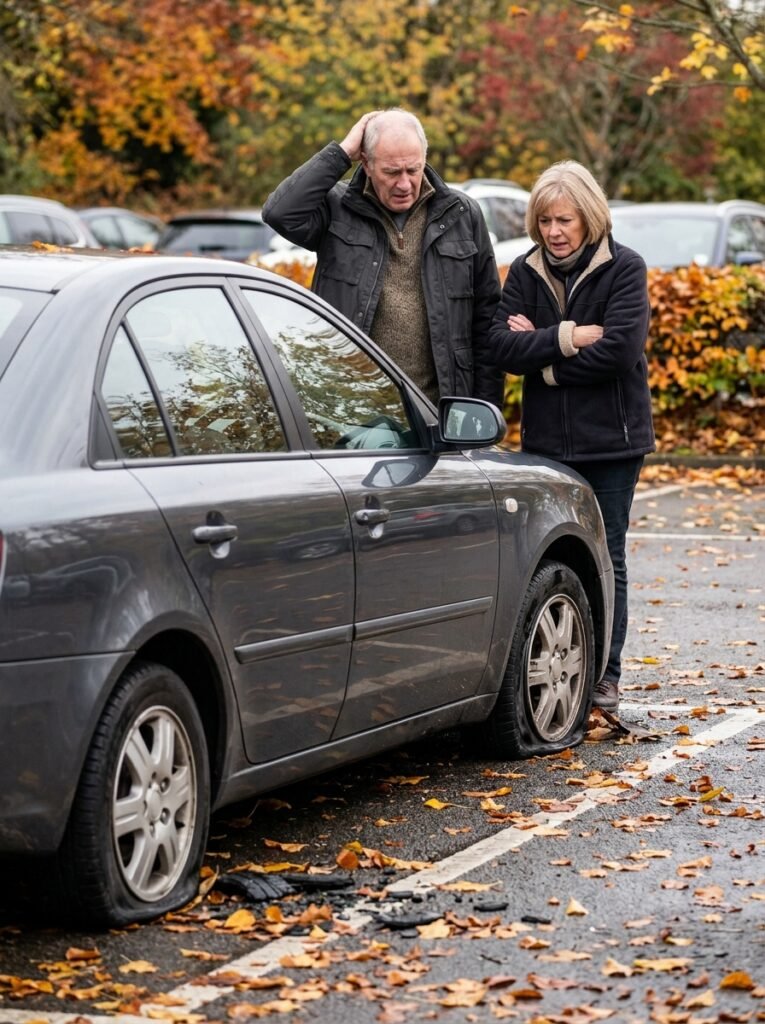
I pulled into the little parking lot behind our building at about three-fifteen. I parked in my spot. Right by the back door, under a big maple tree. I got out. I was reaching into the back seat for my laptop bag.
That’s when a truck pulled into the lot.
I knew the sound before I saw it. A loud, rattling diesel engine. A muffler with a hole in it.
It was my father’s truck. A white Ford F-250 with MORENO PLUMBING painted on the side in blue letters, faded now, with a dent in the back bumper.
It pulled into the space right next to my car.
My parents were in it.
I hadn’t seen them in two years.
My mother saw me first. Through the passenger window.
She went pale.
She said something to my father. He turned and looked. At me. Then at the silver Mercedes I was standing next to.
His face did something complicated. Surprise first. Then confusion. Then, fast, like a match catching, rage.
They both got out of the truck.
My mother was fifty-six now. She’d gained weight. Her hair was blonder than I remembered, with darker roots. She was wearing a purple fleece jacket and big sunglasses pushed up on her head.
My father was sixty. Gray. Heavier. In his work jacket, the one with his name stitched over the pocket. Steve.
“Jessa?” my mother said.
“Hi, Mom,” I said. “Hi, Dad.”
My father didn’t say hi. He was staring at the car.
“Where did you get this car?” he demanded.
“I bought it,” I said.
“With what money?” my mother shrieked. Her voice went up so high and so fast that a man walking his dog on the sidewalk stopped and looked. “You’re a college dropout! You never even went!”
I stood there with my laptop bag in my hand.
They had never once asked about my life. Not in five years. Not when I moved out. Not when I left the note. Not on any birthday. They had no idea that I’d built anything. They didn’t know about Shiftmate. Or Kindling. Or the forty-two people upstairs.
To them, I was still the girl with the duffel bag and the three hundred and forty dollars.
My mother stepped closer. She lowered her voice. Her face twisted into something ugly.
“Come on,” she said. “Which man bought it for you? Some old guy? Aren’t you ashamed? Disgracing our family like that?”
I almost laughed.
“No man,” I said. “I paid for it myself.”
“You stole it,” my father said. Flatly. Like it was a fact. “Or you’re doing something illegal. Selling drugs. Something.” He reached into his jacket pocket. He took out his phone. “I’m calling the police.”
Something inside me snapped.
It was very quiet. Not loud. Not angry. Just a small, clean snap. Like a twig.
Fifteen years. Fifteen birthdays. A slice of cake on a paper plate with an unlit candle. Microwaved mac and cheese. 26 years of pure joy. Forty dollars on the counter. Ryan’s lease is up. Did you take the good towels?
And now this. In a parking lot. Next to a car I paid for with every sleepless night of my twenties.
Which man bought it for you?
You stole it.
I looked at my father with his phone in his hand. I looked at my mother with her big sunglasses and her purple fleece.
And I smiled.
“Go ahead,” I said.
Because at that moment, I’d noticed a small detail behind them. One they had completely missed.
The back door of my building was glass. It led into the stairwell that went up to the third floor. And through that glass door, coming down the stairs, there was someone.
A tall man in a navy blue suit that didn’t quite fit. Too tight in the shoulders. The kind of suit you buy at a department store the day before an interview. A blue tie. Slicked-back hair, going a little thin on top.
Clipped to his jacket pocket, there was a white plastic badge. I couldn’t read it from where I was standing. But I didn’t have to. I knew exactly what it said. I’d designed those badges myself.
KINDLING — VISITOR.
And under that, in our orange logo font:
Interview: Customer Success. Hosted by Marcus T.
It was Ryan.
Coming down the stairs. From his interview. At my company. In a building with my company’s name on every door.
My parents had pulled into the lot to pick him up.
They’d been so busy screaming at me about the Mercedes that they never looked at the building.
They never looked at the big orange letters on the glass doors.
KINDLING. Small business, big heart.
My father dialed 911. He put the phone on speaker. He held it up so I could hear.
“911, what’s your emergency?”
“Yes,” my father said loudly. “I’d like to report a possible stolen vehicle. At 418 Commerce Street. Behind the bakery. A silver Mercedes. My daughter’s driving it. She doesn’t have any money. She can’t possibly have bought it. I think she stole it or she’s involved in something illegal.”
The dispatcher paused.
“Sir, are you saying your daughter stole a vehicle?”
“I’m saying she couldn’t have bought it,” my father said. “She’s twenty-four. She’s a dropout. She’s got nothing. She left home with a duffel bag.”
“Sir, we’ll send an officer to check it out.”
“Good,” my father said. He hung up. He looked at me with something like triumph.
Behind him, the glass door opened.
Ryan stepped out into the parking lot.
He was smiling. Loosening his tie. He looked happy. Hopeful. Like the interview had gone well.
Then he saw them. Mom and Dad. Standing by the truck.
Then he saw me.
He stopped dead.
His face went through about six things in two seconds. Surprise. Confusion. Recognition. Then something that looked a lot like horror.
“Jess?” he said.
My mother turned around.
“Ryan! Honey! How did it go?” She waved at him. Then she pointed at me. “Look who we found. Your sister. With a Mercedes. Your father’s calling the police.”
Ryan didn’t move.
He looked at me. He looked at the car. He looked down at the visitor badge clipped to his jacket.
He looked up at the building. At the glass doors. At the big orange letters.
KINDLING.
And then he looked at me again. And I watched him understand.
“Mom,” he said slowly. “Dad. Stop.”
“What do you mean, stop?” my father said. “She stole a car, Ryan. Look at it.”
“She didn’t steal it,” Ryan said.
“How do you know?”
Ryan reached into the inside pocket of his too-tight suit jacket. He took out a folded piece of paper. Glossy. Orange and white.
He held it up.
It was a company brochure. The one we give every applicant at the start of an interview. Welcome to Kindling. On the front, there was a picture of our office. On the inside, there was a short history of the company.
And on the back, there was a photo.
A twenty-four-year-old woman with dark hair pulled back in a ponytail, wearing a gray Kindling T-shirt, standing in front of the brick wall of our office, smiling at the camera.
Under the photo, in small letters:
Jessa Moreno, Founder & CEO.
My mother took the brochure out of Ryan’s hand.
She looked at it.
She looked at me.
She looked at the brochure again.
I watched all the color drain out of her face. Down from her blond hair, past her big sunglasses, all the way to her purple fleece.
“This is you,” she said.
“That’s me,” I said.
My father grabbed the brochure from her. He read it. He read it twice. His lips moved.
“Founder,” he said. “CEO.“
“Of the company your son just interviewed with,” I said quietly. “Upstairs. Third floor. That’s my office. Those are my employees. Forty-two of them.”
My father looked up at the building. At the three stories of old red brick. At the orange letters on the glass.
His face did something I’d never seen it do. Not in my whole life.
It went blank.
Nobody said anything for a long time.
The man with the dog on the sidewalk had stopped completely now. He was watching us like it was a TV show.
The bakery’s back door opened. Mrs. Kowalski, the owner, stepped out with a bag of trash. She saw me. She smiled.
“Afternoon, Jessa!” she called. “Your croissants are on the counter. The almond ones.” She looked at my parents. “These your folks?”
“They’re my folks,” I said.
Mrs. Kowalski looked at my mother’s white face. My father’s blank one. She looked at me.
“Huh,” she said. She put the trash in the bin and went back inside.
My mother found her voice first.
“How?” she said. “How could you possibly—you’re a dropout. You never went to college. You worked at a call center. How do you have a company?“
“I taught myself,” I said. “On graveyard shifts. With free courses on the internet. On a laptop from a pawn shop. On Dani’s couch.” I looked at her. “I built an app when I was twenty-one. It sold for two hundred and eighty thousand dollars. Then I built another one. That’s this.” I pointed at the building. “That’s Kindling.”
“Why didn’t you tell us?” my mother said. Her voice was high and shaky.
I stared at her.
“Mom,” I said. “When would I have told you?”
She opened her mouth.
“You never called,” I said. “Not once. In five years. You called once. Two weeks after I moved out. To ask if I took the good towels.”
She flinched.
“You never asked where I was working,” I said. “Where I was living. Whether I was eating. Whether I was okay.” I took a breath. “You didn’t ask on my nineteenth birthday. Or my twentieth. Or my twenty-first. Or my twenty-fourth. Because you didn’t know they happened.”
My father lowered the brochure.
“That’s not fair,” my mother said. “That’s not fair, Jessa. We had a lot going on. Your brother—”
“Ryan’s birthday,” I said. “Every year. April ninth. You’ve never once forgotten his. You threw him a party at Harmon Park when he turned sixteen. With a bounce house. And a chocolate fountain. And a cake with a car on it.” I looked at her. “I was there. In my yellow dress. I turned eight that day.”
My mother stared at me.
“You took him to a Cubs game when he turned seventeen,” I said. “I stayed with Mrs. Petrakis. I turned nine. You bought him a car with a red bow when he turned twenty-one. I watched from my window. I turned thirteen.” My voice was very steady. “You took him to Cabo when he turned twenty-six. And posted on Instagram. 26 years of pure joy. I turned eighteen that day. I was home alone with forty dollars on the counter.”
Nobody said anything.
“So no,” I said. “I didn’t tell you. Because you’ve never once asked me anything. You’ve never once remembered I exist.” I looked at the brochure in my father’s hand. “Until right now. When you saw my car. And decided I must have stolen it.”
A police cruiser pulled into the parking lot.
It stopped behind my father’s truck. An officer got out. Young. Maybe thirty. A woman, with her hair in a tight bun.
She looked at the four of us. At the Mercedes. At the white plumbing truck.
“Somebody report a stolen vehicle?” she said.
My father didn’t say anything. He was holding the brochure.
“I think there’s been a misunderstanding, officer,” I said.
I opened my purse. I took out my wallet. My driver’s license. Then I opened the glove compartment of the Mercedes and took out the registration and the bill of sale. Paid in full. With my name.
The officer looked at them. She looked at my license. She looked at the car.
Then she looked up at the building. At the orange letters.
“Kindling,” she said. “Hey. My mom uses that. She’s got a nail salon on the east side. Saved her life with the payroll stuff.” She looked at me. “You work here?”
“I own it,” I said.
The officer’s eyebrows went up. She looked at my father with his phone still in his hand.
“Sir,” she said. “Did you call in a stolen vehicle report on your daughter’s car? That she owns? With a bill of sale in her name?”
My father opened his mouth. Nothing came out.
“He thought I couldn’t afford it,” I said. “He thought some man bought it for me. Or I was selling drugs.”
The officer looked at my father for a long, long moment.
“Sir,” she said. Very calmly. “Filing a false police report is a misdemeanor in this state. I’m going to assume this was a family misunderstanding. And I’m going to put that in my report.” She handed me back my license. “But I’d think real hard before you call us on your daughter again.”
She got back in her cruiser.
Before she pulled away, she rolled down her window.
“Ma’am,” she said to me. “Tell your customer service team my mom says thanks. Her name’s Lupe. Lupe’s Nails. They helped her figure out her taxes at eleven o’clock on a Sunday night.”
“I’ll tell them,” I said.
She drove away.
My parents stood in the parking lot for a long time.
My mother had taken off her sunglasses. She was holding them in both hands. Twisting them.
“Jessa,” she said finally. “Honey. We didn’t know.”
“I know you didn’t,” I said.
“If we’d known—”
“If you’d known,” I said, “what? You’d have called? You’d have come to my birthday?” I shook my head. “You don’t remember my birthday because I have money now, Mom. You remember it because you love me. Or you don’t.”
She started to cry.
My father hadn’t moved. He was still holding the brochure. Looking at my picture on the back.
“I’m sorry,” he said. His voice was rough. Very quiet. I’d never heard him say those words in my life. “I’m sorry I called the police.”
“I know,” I said.
He looked up at me. Then back down at the brochure.
“You did all this,” he said. “By yourself.”
“Not by myself,” I said. “Dani’s mom let me sleep on her couch for eight months. A woman named Rhonda let me code at four in the morning and brought me coffee. A nurse in Houston posted about my app on TikTok. Strangers. People who weren’t family.” I looked at him. “Family doesn’t keep score. Mrs. Ruiz told me that. The first night. She was right.”
My father didn’t say anything.
My mother put her sunglasses back on her head. She wiped her face with the sleeve of her purple fleece.
“Steve,” she said. “Let’s go.”
My father looked at Ryan.
Ryan was still standing by the glass door. In his too-tight suit. With his visitor badge. He hadn’t said a word since he handed over the brochure.
“Ryan,” my father said. “Come on. Get in the truck.”
Ryan didn’t move.
“Go ahead,” he said quietly. “I’ll find a ride.”
My mother stared at him.
“Ryan—”
“Go home, Mom,” he said. “I need to talk to my sister.”
They left.
The truck rattled out of the parking lot with its broken muffler. I watched it turn onto Commerce Street and disappear.
Then it was just me and Ryan. Standing in the parking lot behind a bakery. Next to a silver Mercedes.
He didn’t say anything for a long time. Neither did I.
Then he looked down at the visitor badge on his jacket. He unclipped it. He held it in his hand.
“I didn’t know,” he said. “I swear to God, Jess. I didn’t know it was yours. I found the job online. I didn’t see your name anywhere. Not until the guy gave me the brochure. And I saw your picture on the back. In the middle of the interview.” He laughed. A broken laugh. “I almost walked out. I didn’t. I didn’t know what to do. So I just kept answering his questions.”
“I didn’t interview you,” I said. “I recused myself. Grace in hiring knows. Marcus doesn’t. I didn’t want to know anything about it until it was over.”
He looked at me.
“Why?” he asked.
“Because you deserved a fair shot,” I said. “Like anybody else. Not a favor. Not a punishment. Just a shot.”
He stared at me. His eyes got wet.
“Nobody’s ever given me a fair shot,” he said.
I laughed. I couldn’t help it.
“Ryan,” I said. “They’ve given you everything.”
“No,” he said. He shook his head. “They’ve given me stuff. Cars. Apartments. Trips. They’ve paid for everything. Every time I failed, they caught me. Every time I quit, they had a new place for me to land.” He looked at the badge in his hand. “Do you know what that does to you, Jess? When nobody ever lets you fall?”
I didn’t say anything.
“You never get to find out if you could’ve climbed back up,” he said. “You never get to know if you’re any good at anything. Because nobody ever let you try for real.” He wiped his face with the back of his hand. “I’m thirty-two. I’ve had eleven jobs. I’ve never once been good at any of them. And Mom and Dad keep telling everybody I’m a late bloomer.” He laughed again. “I’m not a late bloomer. I’m a guy who’s never been allowed to bloom at all.”
We went upstairs to my office.
It’s a small room at the end of the hall on the third floor. Brick walls. A big window that looks out over the street. A desk I found at a thrift store. A whiteboard covered in diagrams. A framed photo of Rhonda and me at the call center, at four in the morning, both of us exhausted, both of us laughing.
Ryan stood in the doorway for a long time, looking at it.
“This is yours,” he said.
“This is mine.”
He sat down in the chair across from my desk. Still in his too-tight suit.
“Can I tell you something?” he said. “Something I’ve never told anybody?”
“Okay.”
“Your eighth birthday,” he said. “At Harmon Park. My sixteenth.” He looked at his hands. “I asked Mom three times. Three times. To bring out a second cake. Or to put your name on mine. Or just to sing to you too. She said no. She said it would take away from my day. She said you were too young to remember.” He swallowed. “I stood next to her while everybody sang to me, and I looked at you in the back of the crowd in your yellow dress. And you were singing. Your lips were moving. And I knew you were singing your own name.”
I couldn’t speak.
“I’ve thought about that every single birthday for sixteen years,” Ryan said. “Every April ninth. Every time they threw me a party or took me somewhere or bought me something. I’d look around for you. And you were never there. Because you’d stopped coming.” He looked up at me. “I’m the reason they forgot you, Jess. I took up the whole day. I always have.”
“You’re not the reason,” I said. “You were a kid. They were the parents.”
“I was sixteen,” he said. “I wasn’t a kid. I could’ve said something. Done something. Besides sneak you a piece of cake at ten o’clock at night.” He shook his head. “I could’ve said no to Cabo. I could’ve said, What about Jessa? I never did. Because it was easier to take the margarita.”
He reached into his jacket. He took out his wallet. From behind his driver’s license, he took out something small.
A birthday candle. Blue and white striped. Unlit. The wick never burned.
I stared at it.
“I bought a box,” Ryan said. “When I was sixteen. The day after the party. I took one out every year on April ninth. I always meant to bring it to you. Light it. Sing. I never did.” He set it on my desk. “That’s sixteen candles. I’ve got the rest of the box at home. All of them unlit.”
I didn’t say anything for a long time.
Then I reached into my desk drawer. I took out a little wooden box. I opened it.
Inside, there was a single birthday candle. Pink. With a little dried frosting on the bottom. Unlit.
I put it on the desk next to his.
Ryan stared at it.
“You kept it,” he said.
“I kept it,” I said.
Marcus offered Ryan the job the next morning.
He didn’t know Ryan was my brother. Grace never told him. He came to my office with his notes and said, “That last guy, Ryan? He’s raw. Really raw. But he was honest. He told me straight up he’s never been good at a job. He said he’s done being caught when he falls. He wants to see if he can climb.” Marcus shrugged. “I liked that. I want to give him a shot. Entry level. Ninety-day probation. If he doesn’t work out, he’s out.”
“Do whatever you think is right,” I said.
Ryan took the job.
He shows up at eight-thirty every morning. He sits in a cubicle on the second floor. He answers calls from laundromat owners and taco truck operators and nail salons who can’t figure out their payroll. He’s not great at it. Not yet. He gets flustered. He forgets things.
But he shows up. Every single day. He’s never been late.
He rented a tiny studio apartment across town. He pays for it himself. He told my parents to stop sending him money. My mother cried on the phone for an hour. He didn’t change his mind.
“I need to know if I can do it,” he told her. “Without you catching me. I’m thirty-two, Mom. Let me fall.”
My mother called me three weeks after the parking lot.
It was a Sunday evening. I almost didn’t answer.
“Jessa,” she said. “It’s Mom.”
“Hi, Mom.”
There was a long silence.
“I went through the photo albums,” she said finally. “All of them. From when you were little. I sat on the floor of the living room all day yesterday.”
I didn’t say anything.
“There are forty-one pictures of Ryan’s birthday parties,” she said. “I counted. Forty-one. From when he was one until he was thirty.” Her voice cracked. “There are two of yours. Two. Your first birthday. And your third. That’s it. That’s all.”
I closed my eyes.
“I don’t know how that happened,” she said. “I don’t know how I let that happen. I keep trying to remember. Your eighth birthday. The yellow dress. And I can’t. I can’t remember you being there at all.” She was crying now. “Ryan told me about the cake. At ten o’clock at night. On a paper plate. He told me he asked me three times. I don’t remember that either.”
“I remember,” I said.
“I know,” she said. “That’s the worst part. You remember everything. And I don’t remember anything.”
She didn’t ask for forgiveness. I’ll give her that. She didn’t ask me to come home. She didn’t ask me for money, even though I found out later from Ryan that my father’s plumbing business was close to bankruptcy and they were three months behind on their second mortgage.
She just said one more thing before she hung up.
“Your birthday’s in two weeks,” she said. “April ninth. I wrote it on the calendar. In red. And on my phone. And on a sticky note on the fridge.” She took a breath. “I’m not asking you to come over. I’m not asking for anything. I just wanted you to know it’s written down. It’s finally written down.”
My father never called.
But two weeks later, on the morning of April eighth, something showed up at the Kindling office.
It was a toolbox. An old metal one, red, with rust on the corners. Mrs. Kowalski from the bakery brought it up. She said a man in a white plumbing truck dropped it off at the bakery counter and asked her to give it to “the boss upstairs.” He didn’t leave his name.
Inside, on the top tray, there was a note. On a piece of lined paper. In my father’s big, blocky handwriting. He’s not a writer. I could tell it took him a long time.
Jessa.
This was my father’s toolbox. He gave it to me when I started my business. I was going to give it to Ryan.
I think you’re the one who built something.
Happy birthday.
— Dad.
Under the note, in the bottom of the toolbox, wrapped in an old shop rag, there was a framed photo. One I’d never seen.
It was me. Three years old. Sitting on the tailgate of his plumbing truck in a pair of tiny overalls, holding a wrench almost as big as my arm. Grinning. Covered in grease.
On the back, in faded pen, in my father’s handwriting:
Jessa, age 3. Wants to be a plumber like Daddy. Fixed the leak under the sink all by herself. (Kind of.)
I don’t remember that day. I don’t remember ever sitting on his truck.
But he did. He’d kept it. Somewhere. For twenty-one years.
I sat on the floor of my office with that photo in my lap and I cried for a long time.
On April ninth, I turned twenty-five.
Ryan turned thirty-three.
We didn’t go to my parents’ house. We didn’t go to a pavilion at Harmon Park. We didn’t go to Cabo.
We went to Dani’s family’s apartment. The two-bedroom across town where I slept on the couch for eight months.
Mrs. Ruiz made tamales. Mr. Ruiz made a pitcher of horchata. Dani and her sisters decorated the living room with paper streamers and a banner they made out of printer paper. It said HAPPY BIRTHDAY JESSA AND RYAN in purple marker. They spelled Ryan wrong. RAYN. He didn’t care.
Rhonda came. With her two grandkids, who are fourteen and twelve now. She brought a pound cake she made herself. She wore a dress I’d never seen. She said she hadn’t been to a birthday party for a grown-up in eleven years.
Grace and Marcus from Kindling came. Mrs. Kowalski from the bakery came, with a box of almond croissants.
At eight o’clock, Mrs. Ruiz turned off the lights.
She came out of the kitchen carrying two cakes. One chocolate. One vanilla. Side by side on the same tray.
The chocolate one had JESSA written on top in pink frosting. The vanilla one had RYAN written on top in blue. Spelled right this time.
In the middle of each cake, there was one candle.
Ryan and I looked at each other.
We both reached into our pockets at the same time.
He took out the blue-and-white candle from his wallet. I took out the pink one from the little wooden box.
We pulled out the new candles. We put our old ones in their place. His in my cake. Mine in his.
Mrs. Ruiz lit them.
The pink one. The blue one. Both of them burning for the first time. Seventeen years after Ryan stuck one in a slice of cake on a paper plate in my bedroom. Sixteen years after he bought a box and never used it.
Everybody sang.
They sang my name first. Loud. All of them. Dani and her sisters and Rhonda and her grandkids and Mrs. Kowalski and Grace and Marcus and Mr. and Mrs. Ruiz.
Happy birthday, dear Jes-sa!
Then they sang Ryan’s.
Ryan and I stood side by side in front of two cakes in a crowded two-bedroom apartment. I looked over at him. His eyes were wet. So were mine.
“On three,” he said.
“On three,” I said.
We blew them out together.
Later that night, after the tamales and the cake and Mrs. Ruiz making everybody dance to old cumbias in the living room, my phone buzzed.
It was a text. From a number I hadn’t saved. I knew it anyway.
Happy 25th birthday, Jessa. I remembered. — Mom.
And then, a minute later, another one.
It’s on the calendar for next year too. In red.
I looked at it for a long time.
I didn’t answer right away. I’m not ready for that. Not yet. Maybe not for a long time.
But I didn’t delete it, either.
Ryan came up behind me. He looked over my shoulder at the screen.
“She remembered,” he said.
“She wrote it on a sticky note,” I said.
“That’s a start,” Ryan said.
“It’s a start,” I agreed.
I still have the photo from my father’s toolbox. It’s on my desk at Kindling. Next to the picture of Rhonda and me at four in the morning.
A three-year-old girl in tiny overalls on the tailgate of a plumbing truck, holding a wrench. Wants to be a plumber like Daddy. Fixed the leak all by herself. (Kind of.)
I look at it every day.
People ask me sometimes how I did it. How a college dropout from a call center built a company with forty-two employees above a bakery. They want a secret. A trick.
I tell them the truth.
I tell them that for most of my life, I was waiting for my parents to see me. I thought if I built something big enough, made enough money, drove a nice enough car, they’d finally look up from Ryan’s birthday cake and notice I was standing in the back of the crowd, singing my own name.
And when they finally saw me, in a parking lot behind a bakery, they didn’t see what I built. They saw a Mercedes and assumed I’d stolen it.
That’s when I understood.
I’d spent all those years trying to make them see me. When all along, the people who’d actually seen me were already there. A woman who handed me a pillow and said family doesn’t keep score. A woman who pulled up a chair at four in the morning and said show me. A nurse in Houston I’ve never met. A brother who stuck a candle in a slice of cake on a paper plate.
You don’t build your way into somebody’s eyes.
You build something real. And the people who were always looking at you show up.
Kindling has a policy now. It’s the first thing new employees read in the handbook. I wrote it myself.
Every employee gets their birthday off. Paid. No exceptions.
Your manager will put it on the company calendar in red.
Somebody will bring you a cake.
You will never have to sing your own name.
Ryan’s been at Kindling for eight months now. He passed his probation. He got his first raise last month. Marcus says he’s the most patient person on the customer success team. He says the laundromat owners ask for him by name.
He’s still not great at it. He still gets flustered. He still forgets things.
But he’s good at one thing nobody taught him.
When somebody calls, upset, at eleven o’clock at night, because they can’t figure out their payroll and they’re scared and they feel like nobody sees them, Ryan always says the same thing before he hangs up.
“Hey. Before you go. When’s your birthday?”
He writes it down. On a sticky note. In red.
And on that day, every year, he calls them back.