My father cried exactly twice in my whole life before that summer.
The first time was the day his own father died. I was seven. I remember him standing in the backyard by the woodpile with his back to the house, and his shoulders moving in a way I’d never seen them move before. My mother put her hand on my head and said, “Leave him be, Lucas. Some things a man has to do by himself.”
The second time was the day I graduated from college. He was sitting in the bleachers of the football stadium at Oregon State in his one good jacket, the brown corduroy one with patches on the elbows, and when they called my name, I looked up and saw him wiping his face with a handkerchief. Afterward, he shook my hand. He didn’t hug me. Sinclair men didn’t hug back then. He just shook my hand very hard and said, “Good job, son,” and then he walked away fast toward the parking lot so I wouldn’t see his eyes.
The third time was in a driveway in Cannon Beach, Oregon, on a gray morning in June, when I put a set of keys in my mother’s hand.
My parents are Samuel and Irene Sinclair.
My father worked at the paper mill in Longview, Washington, for forty-three years. He started when he was nineteen, sweeping floors, and he retired at sixty-two as a shift supervisor. In forty-three years, he missed eleven days of work. Nine of them were for my mother’s surgery when I was twelve. The other two were the days my sister and I were born.
My mother worked the front desk at the Longview Public Library for thirty-one years. She knew every regular by name. She knew which old men came in every morning just to read the newspaper because they were lonely. She knew which kids came in after school because there was nobody at home. She kept a box of granola bars under the desk for those kids, and she paid for them out of her own pocket, and she never told anyone.
They were quiet people. That’s the best way I can describe them. They didn’t ask for anything. They didn’t complain about anything. They didn’t want anybody to make a fuss.
We lived in a small blue house on Alder Street with two bedrooms and one bathroom. My sister Fiona got the second bedroom. I slept on a fold-out couch in the den until I was fourteen, when my father finished the attic himself, working nights and weekends for a whole summer, so I could have a room of my own.
My father drove the same truck for twenty-two years. A brown Ford with a white camper shell. He drove it until rust ate through both rear wheel wells and you could see the road through the floor on the passenger side. When I was in high school, I asked him why he didn’t just buy a new one.
“Because this one still runs,” he said.
That was his answer to everything. If something still worked, you kept it. If something was broken, you fixed it. And if you couldn’t fix it, you didn’t complain. You just figured out how to live without it.
Every summer, the other families on Alder Street went on vacation. Disneyland. Yellowstone. Hawaii, once, for the Hendersons across the street, who came back with sunburns and plastic leis and stories that lasted all year.
We never went anywhere.
“Maybe next year,” my father would say. Every year. “Maybe next year.”
I didn’t understand until I was much older. Every dollar they didn’t spend on a vacation went into two savings accounts at the credit union. One for Fiona. One for me. For college.
Fiona went to the University of Washington. I went to Oregon State. My parents paid for most of both. They never told us how much it cost. They never once made us feel like we owed them anything.
The summer after I graduated, I found out. I was looking for my birth certificate in my father’s filing cabinet and I found the bank statements. I sat on the floor of the den and did the math. Between Fiona and me, they had spent almost every dollar they’d saved for twenty years.
They’d been planning to retire to the coast. I found that too. A folder in the same drawer, labeled in my mother’s neat handwriting. SOMEDAY. Inside, there were real estate listings cut out of the newspaper. Little cottages in Seaside and Manzanita and Cannon Beach. Some of them were from the 1990s. The paper was yellow. My mother had circled the ones she liked in blue ink. On one of them, a little gray house with a porch facing the ocean, she’d written in the margin: Sam, look at that view.
They spent their someday on us.
I put the folder back. I never told them I found it.
But I never forgot it either.
I’m forty-four now. I started a logistics company when I was twenty-nine with a used box truck and a loan from a bank that took a chance on me. We move freight up and down the West Coast. We have three hundred and twelve employees and warehouses in Portland, Sacramento and Tacoma. I’m not rich the way people on television are rich. But I’m comfortable. More than comfortable.
I’ve tried to give my parents money for years. They wouldn’t take it.
“We’re fine,” my father would say. “We’ve got everything we need.”
When I offered to buy him a new truck, he said the old one still ran. When I offered to pay off their mortgage, my mother said it was almost paid off anyway. When I offered to send them to Hawaii, my father said he didn’t like airplanes, which wasn’t true. He’d never been on one.
“Lucas,” my mother told me once, “we didn’t raise you so you could pay us back. We raised you so you could have a good life. Have it. That’s all we want.”
Then, two years ago, my father was diagnosed with Parkinson’s disease.
It started with his right hand. A tremor. Just a little shake, at first, when he was holding a coffee cup or turning a page. He tried to hide it. He’d put his hand in his pocket. He’d hold the cup with both hands. My mother noticed first. Then I did, at Thanksgiving, when he tried to carve the turkey and couldn’t hold the knife steady.
The neurologist said it was early. She said with medication, he could have many good years. But it would get worse. Slowly. His balance. His walking. His voice, eventually.
My father took the news the way he took everything. Quietly.
“Well,” he said, in the parking lot afterward. “I guess I’m not going to be a brain surgeon.”
My mother laughed. Then she cried in the car on the way home, and he held her hand on the seat between them with his shaking right hand, and neither of them said anything for an hour.
That was when I decided.
They had given up their someday for me. I was going to give it back. Before it was too late. Before my father couldn’t walk on the beach anymore. Before he couldn’t stand on a porch and look at the ocean.
It took me four months to find the house.
I looked at forty-one properties up and down the Oregon coast. I didn’t tell my parents. I took Fridays off and drove out from Portland and walked through cottages and condos and bungalows with a real estate agent named Patty who started calling me “the pickiest man in Clatsop County.”
Then, in March, she showed me the house in Cannon Beach.
It was cream-colored, with white trim and a gray shingled roof. Two stories, but the main bedroom and bathroom were on the first floor, so my father wouldn’t have to climb stairs as his balance got worse. It had a wraparound porch on three sides. And it sat right on the edge of the dunes, with nothing between it and the Pacific Ocean but sea grass and sand.
From the porch, you could see Haystack Rock. That big black stone that stands up out of the water like a giant’s thumb, with the tide pools around its base and the puffins nesting on its sides in summer.
I stood on that porch in the cold March wind and I thought about the yellow newspaper clipping in my mother’s folder. Sam, look at that view.
It cost four hundred and twenty-five thousand dollars. I bought it in cash.
And there was one thing I did that I didn’t tell my parents about. Not because I was hiding it. Because I didn’t want them to worry about it.
I kept the title in my name.
My attorney, Naomi Reyes, suggested it. Naomi has handled everything for my company for twelve years. She’s sharp and careful and a little terrifying, and she has never once given me bad advice.
“Your father has a progressive neurological disease,” she said, sitting across from me in her office in downtown Portland. “Your mother is seventy-three. They’re kind, trusting people. If the house is in their names, they’re vulnerable. Anyone could pressure them into signing something. A scammer. A contractor. A relative.” She looked at me over her glasses. “I’ve seen it a hundred times, Lucas. Elderly parents get a nice house, and suddenly everybody wants a piece of it.”
“My family’s not like that,” I said.
“Everybody’s family is not like that,” Naomi said. “Until they are.”
So we set it up carefully. The house was mine. In my name only. But I signed a written agreement with my parents that gave them the right to live there for the rest of their lives. No rent. No conditions. Nobody could sell it, mortgage it, transfer it or take it from them. Not even me.
It was simple. It was safe. My parents didn’t have to deal with property taxes or insurance or any of it. I handled all that. They just had to live there.
I put the original deed and a copy of the agreement in a sealed folder with the county recording stamp on the front page. I locked it in the bottom drawer of a little antique writing desk I bought for the house and put by the front windows. I kept the key on my key ring.
“You won’t ever need that,” I told myself.
I was wrong about that too.
Their fiftieth anniversary was on June 14th.
Fiona wanted to throw a big party. She called me in April with ideas. A rented hall. A DJ. A slideshow. Two hundred people.
“Mom and Dad would hate that,” I said.
“Everybody does a big party for their fiftieth.”
“Mom and Dad aren’t everybody.”
She sighed. “Fine. What’s your big idea, then?”
I didn’t tell her. Not yet. I said I had something planned and I’d let her know.
That was a mistake too. I should have told her. Maybe things would have gone differently. I don’t know. I’ve thought about it a lot.
On the morning of June 14th, I picked my parents up at the little blue house on Alder Street. I told them we were going for a drive. Just the three of us. To see the ocean.
My father raised an eyebrow. “On a Thursday?”
“It’s your anniversary, Dad. You can see the ocean on a Thursday.”
It’s about an hour and forty-five minutes from Longview to Cannon Beach. My mother sat in the front seat. My father sat in the back with his cane between his knees. It was gray and misty, the way the coast always is in June. My mother kept saying it was too bad it wasn’t sunny.
“It’s perfect,” I said.
When I pulled into the driveway of the cream-colored house, my father said, “Who lives here?”
I didn’t answer. I turned off the car. I got out. I opened my mother’s door.
Then I reached into my pocket and took out a set of keys. Two keys on a plain silver ring, with a little brass tag shaped like a seashell. I put them in her palm. I closed her fingers around them.
“Happy anniversary, Mom,” I said. “Happy anniversary, Dad. Welcome home.”
My mother looked at the keys in her hand. She looked at the house. She looked at me.
“Lucas,” she said. “What did you do?”
“I bought you your someday,” I said.
She didn’t understand at first. Then she did. I watched it happen on her face. She put her hand over her mouth. The keys were still in her fist.
“The folder,” she whispered. “You found the folder.”
“Twenty-two years ago,” I said. “In Dad’s filing cabinet.”
She started to cry.
No cameras. No party. No speech. That’s how Samuel and Irene Sinclair had lived their entire lives. Quietly. Without asking anybody for anything. I wasn’t going to make them stand in front of two hundred people and be embarrassed. I just wanted them to have it.
My father got out of the back seat. Slowly, with his cane. He didn’t say anything. He walked past us, up the porch steps, one at a time. He walked all the way around to the side of the wraparound porch that faced the ocean.
He stood there. He put both of his weathered hands on the white railing. His right hand was shaking. He gripped the railing harder to hold it still.
He looked out over the dunes, past the sea grass, at the gray Pacific Ocean and Haystack Rock standing up out of the mist.
He didn’t say anything for a long time.
My mother and I came up the steps behind him. She put her hand on his back.
“Sam,” she said. “Look at that view.”
That’s when he cried. The third time in my life.
“You’ve already done too much for us, Lucas,” my mother whispered, holding my arm.
“No,” I said. “You did too much for me. For forty years. Let me do this one thing.”
For three weeks, they were happier than I’d heard them in years.
My mother called me every evening. Every single one. She called to tell me about the tide pools. About the puffins on Haystack Rock. About the little bakery in town that made marionberry scones. About a seal she saw on the beach, just lying there in the sun like a fat old dog.
“Your father walks on the beach every morning,” she said. “With his cane. He goes down to the water and back. The doctor says walking is good for him. He says the sand is better than any physical therapy.”
“Is he careful?”
“He’s careful. I go with him. We hold hands.” She laughed. “Fifty years, and we’re holding hands on the beach like teenagers.”
My father got on the phone once. He doesn’t like talking on the phone. He never has. He said three sentences.
“The porch is good. I sit out there every night and watch the sun go down. Thank you, son.”
Then he handed the phone back to my mother.
Those three sentences were worth more to me than every dollar my company has ever made.
Then my sister arrived.
Fiona is three years older than me. When we were kids, we were close. She taught me to ride a bike. She let me tag along with her friends. When I got beat up in sixth grade, she went and found the kid who did it and dumped a carton of chocolate milk on his head in the cafeteria.
But somewhere along the way, things changed.
I think it started when I started the company. When it started to do well. Fiona was a dental hygienist. She worked hard. She made a decent living. But she married a man named Gregory Halvorsen, and Gregory had big plans.
Gregory sold real estate in Bend, Oregon. Or he tried to. He was always on the verge of a big deal. He drove a big black pickup truck and wore expensive sunglasses and talked very loudly about “leveraging opportunities.” He called me “the trucker” at family dinners, like it was a joke, even though I hadn’t driven a truck myself in twelve years.
“How’s the trucking business, trucker?” he’d say, slapping me on the back too hard. “Still hauling boxes?”
My parents never liked him. They never said so. They wouldn’t. But I saw the way my father went quiet when Gregory talked. The way my mother refilled everyone’s coffee cups a little too often when Gregory was in the room, just to have something to do with her hands.
Fiona and Gregory had two boys. Owen and Caleb. Owen was sixteen that summer. Caleb was fourteen. They were good kids, mostly. Owen was quiet and serious, like my father. Caleb was loud and funny, like Fiona used to be.
Over the years, I saw less and less of them. Fiona stopped calling as much. When she did call, it was usually about something she needed. A loan for a new roof. Money for Owen’s braces. Gregory’s truck payment, just this once, just until a deal closed.
I gave it to her. Every time. She was my sister. And she always paid it back. Eventually. Mostly.
When she found out about the beach house, she called me the same night.
“A beach house?” she said. “You bought Mom and Dad a beach house? In Cannon Beach?”
“For their anniversary.”
“How much did it cost?”
“Does it matter?”
“It matters to me.” Her voice was tight. “You didn’t even tell me. You didn’t ask me to chip in. You didn’t include me at all. You just swooped in and did it yourself. Like always.”
“Fiona, I didn’t think you’d want to—”
“You didn’t think about me at all,” she said. “You never do.”
She hung up.
I sat there with the phone in my hand. I didn’t understand what had just happened. I still didn’t, not really. Not until later.
Two weeks after that, my mother called me in the evening, like always.
“Your sister’s coming to visit,” she said. She sounded happy. “With Gregory and the boys. Just for a few days. The boys love the beach. Isn’t that nice?”
“That’s great, Mom.”
“I’m making up the guest rooms. I bought new sheets.”
“That’s great,” I said again.
I didn’t think anything of it. Why would I? It was my sister. Coming to visit our parents. At the beach. For a few days.
A few days became a week.
Then a week became two weeks.
My mother still called. But the calls were shorter. She sounded tired.
“Everything’s fine,” she said, when I asked. “It’s just a full house. Lots of cooking. You know how it is with teenage boys. They eat everything.”
“When are they leaving?”
“Oh, soon, I think. Gregory’s between things at work. He’s got some time off.”
“Between things?”
“He said there was a slow patch,” my mother said. “In the market. You know.”
At the end of the second week, my father got on the phone for a minute. He didn’t say much. He never does. But he said one thing that stuck with me.
“Gregory’s been asking a lot of questions,” he said. “About the house.”
“What kind of questions?”
“How much it’s worth. What the taxes are. Whether it’s paid off.” He paused. “I told him to ask you.”
“Did he?”
“No,” my father said. Then my mother took the phone back and talked about scones.
Then the calls stopped.
Three days. Four. Five. No call from my mother. I called her. It went to voicemail. I called the house phone I’d had installed. It rang and rang.
I called Fiona.
“Mom’s fine,” she said. Too quickly. “She’s just busy. We’re all having a great time. Stop worrying.”
“Why isn’t she answering her phone?”
“I don’t know, Lucas. Maybe she left it somewhere. She’s seventy-three. She loses things.”
“She’s never lost her phone in her life.”
“Well, maybe she’s starting to,” Fiona said. “People get old. Dad’s sick. Mom’s getting forgetful. You’d know that if you were ever around.”
She hung up.
I sat in my office in Portland and stared out the window at the Willamette River. I had a meeting in twenty minutes. A big one. A contract with a grocery chain that would add sixty jobs.
My phone buzzed.
It wasn’t my mother. It was a text. From a number I didn’t have saved.
Uncle Lucas this is Owen. Please don’t tell my dad I texted you. I got your number from grandma’s phone. Something’s wrong here. My dad keeps yelling at grandpa. Grandma’s scared. I don’t know what to do.
My whole body went cold.
Before I could even type back, my phone rang.
It was my mother. On her cell phone.
“Mom? Mom, are you okay?”
For a second, there was nothing. Just breathing.
Then her voice. So quiet I almost couldn’t hear it. Like she was whispering from inside a closet.
“Lucas,” she said. “Sweetheart. Maybe you should come.”
I heard a man’s voice in the background. Loud. Angry.
Then the line went dead.
I canceled the meeting. I didn’t even explain. I just told my assistant I had a family emergency, grabbed my keys and walked out.
It’s an hour and a half from Portland to Cannon Beach if you drive the speed limit.
I didn’t drive the speed limit.
On the way, I called my mother back four times. It went to voicemail every time. I texted Owen.
I’m on my way. Stay with your grandparents. Don’t let anything happen to them. You did the right thing.
He wrote back right away.
Ok. Hurry.
Then I called Naomi.
“Lucas,” she said. “I’m in a meeting. Can I call you back?”
“Naomi. Something’s happening at the beach house. My sister’s husband is there. Something bad. My nephew texted me. My mother called and said I should come and then the line went dead.”
Her voice changed instantly. “Where are you?”
“Highway 26. About an hour out.”
“Where’s the deed?”
“In the house. In the desk. Locked. I’ve got the key.”
“Okay,” she said. I heard her moving. A door closing. Papers. “Listen to me. Don’t go in there swinging. Don’t start a fight. Whatever’s going on, stay calm. Get your parents safe. And Lucas?”
“Yeah?”
“If anybody has asked your parents to sign anything, don’t let anybody touch it. Don’t let them take it. Don’t let them destroy it. I mean it.”
“Why would they ask them to sign anything? It’s not their house to sign.”
“Because people who don’t know whose house it is,” Naomi said, “always think it belongs to whoever looks weakest.”
There was a pause.
“I’m actually closer than you think,” she said. “I’m in Astoria today. For a client. I can be in Cannon Beach in thirty minutes.”
“You’d do that?”
“Lucas, I’ve been your lawyer for twelve years. I’ve met your parents. Your mother sent me homemade blackberry jam at Christmas. Three years in a row.” She paused. “Call me when you’re outside the house. I’ll be close.”
I pulled into the driveway at 3:40 in the afternoon.
The first thing I saw was Gregory’s truck. His big black pickup. It was parked sideways across the front of the garage, blocking both doors. So nobody else could get a car out.
There were wet towels hanging over every inch of the porch railing. Beach chairs and coolers were piled on the walkway to the front door. A boogie board was lying in my mother’s flower bed, crushing the marigolds she’d planted the first week.
One of the front windows had a crack running across it. A long diagonal line from corner to corner.
And music was pounding through the walls. Heavy bass. Loud enough to rattle the glass in the cracked window.
I sat in my car for a second.
I called Naomi. “I’m here.”
“I’m ten minutes out. Stay calm.”
I got out of the car. I walked up the walkway past the coolers and the beach chairs.
Then I heard Gregory shouting.
I couldn’t make out the words. Just the sound. Loud and angry and mean.
I opened the front door.
The music was even louder inside. It was coming from a speaker on the kitchen counter. The house smelled like beer and sunscreen and something burnt.
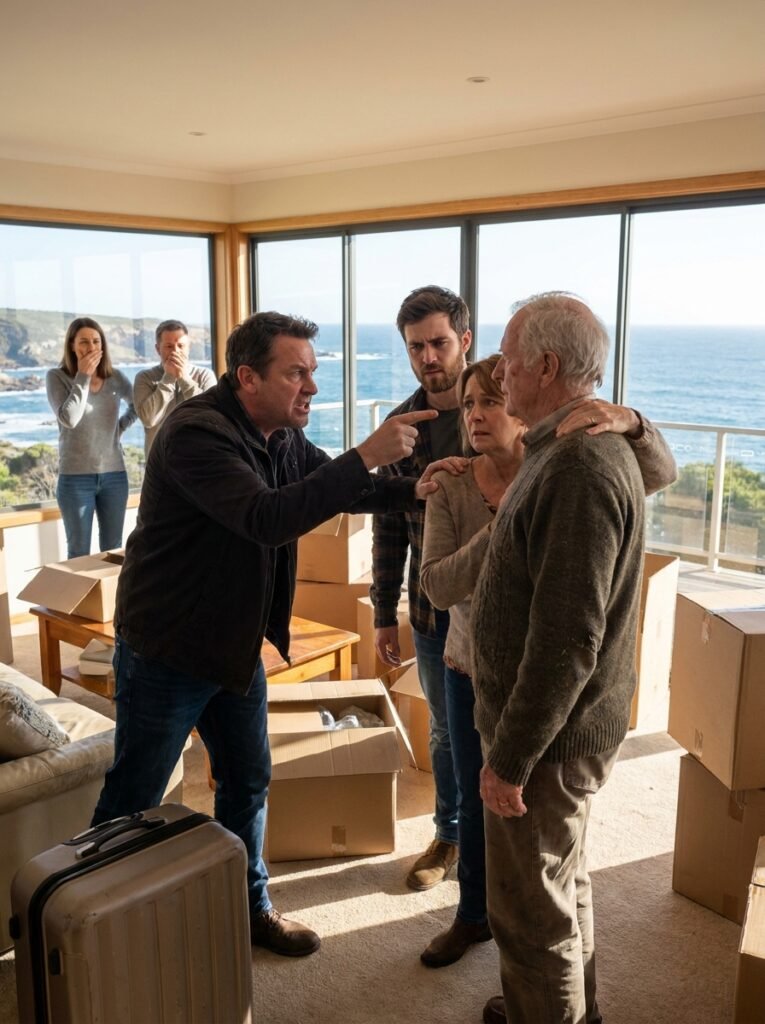
My mother was standing near the bottom of the staircase. She was pressing a kitchen towel against her mouth. Her eyes were red and swollen. She was wearing the blue sweater I gave her for Christmas two years ago.
My father was standing beside the entry table, near the front door. He didn’t have his cane. I saw it lying on the floor by the stairs, like it had been knocked out of his hand.
He was shaking.
Not just his right hand. His whole body. Shaking so badly his glasses had slipped down to the end of his nose. He was gripping the edge of the entry table with both hands to stay up.
At his feet, there was a cardboard box. An old one from a grocery store. BANANAS, it said on the side.
It was packed with his things. His gray cardigan sweaters, folded. His pill organizer, the big one with the days of the week, that my mother fills every Sunday. His reading glasses case. And on top, the framed photograph from their fiftieth anniversary dinner. The one the waitress at the restaurant in Seaside took of the three of us on the night I gave them the keys. My mother laughing. My father holding her hand. Me between them.
Gregory was standing inches from my father. Towering over him. Gregory is six-foot-two. My father used to be five-foot-ten. Now, bent and shaking, he looked about five feet tall.
“This is my house now, old man,” Gregory was shouting. Right in my father’s face. Spit flew from his mouth. “You and Irene need to pack your things and get out.”
Fiona was leaning against the kitchen doorway.
She was holding a wineglass. One of my mother’s crystal wineglasses. The ones from their wedding. My mother’s mother gave them to her in 1974. There were only four left. My mother kept them in the cabinet and only took them out on Christmas.
My sister was drinking white wine out of one of them.
She didn’t defend our father.
She laughed.
“Dad, stop being so dramatic,” she said. “You and Mom don’t need a place this big. It’s just the two of you. Gregory and I have children. Lucas won’t mind.”
Gregory kicked the cardboard box.
It slid across the hardwood floor and hit my father’s shoes. The framed photograph on top tipped over. I heard the glass crack.
“The door’s right there,” Gregory said. “Use it.”
Nobody moved.
In the living room, my two nephews were sitting on the couch. Caleb had his headphones around his neck. He was staring at his hands. Owen was sitting very straight, very still, holding his phone. When he saw me in the doorway, his eyes went wide.
He didn’t say anything. But I saw his shoulders drop. Like he’d been holding his breath for a very long time and could finally let it out.
My father looked down at the box at his feet.
He didn’t answer Gregory. He didn’t argue. He didn’t stand up straight. He just looked down at that box with his things in it and the cracked picture on top.
That hurt more than anything Gregory had said.
My father. Who worked forty-three years and never asked me for a single dollar. Who drove the same rusted truck until you could see the road through the floor. Who skipped every vacation for twenty years so my sister and I could go to college. Who finished an attic by hand so I could have a room.
He was standing in the house I bought him for his fiftieth anniversary, looking down at a cardboard box, like a man who’d been caught trespassing.
I closed the front door behind me.
I walked over to the kitchen counter. I turned off the speaker.
The music stopped.
The silence was enormous.
Fiona’s smile disappeared.
Gregory slowly turned around.
“Lucas,” Fiona said quickly. She set down the crystal glass on the counter. “Good. You’re here. We were actually going to call you.”
“Were you?” I asked.
“We were,” she said. “Tonight. To talk about… arrangements.”
Gregory folded his arms across his chest. He looked at me the way he always did. Like I was something he’d scraped off his shoe.
“Hey, trucker,” he said. “This is family business.”
I looked at the box by my father’s feet. At the cracked photograph. At the pill organizer.
“It certainly is,” I said.
I walked across the room. I picked up my father’s cane from the floor. I put it in his hand. His fingers closed around it. He was still shaking.
I put my hand on his shoulder.
“You okay, Dad?”
He looked at me. His eyes were wet behind his crooked glasses. He didn’t say anything. He just nodded. Barely.
I fixed his glasses. Gently. Pushed them back up his nose.
Then I turned around.
“Somebody want to tell me what’s going on?” I asked.
Fiona stepped forward. She smoothed her blouse. She used her calm, reasonable voice. The one she used to use on her patients when she was about to scrape their teeth.
“Lucas,” she said. “Look. Mom and Dad can’t maintain a property like this. It’s too much. Dad can barely walk. Mom’s seventy-three. They forget things. The gutters need cleaning. The deck needs staining. They can’t do any of that. Gregory and I have been discussing what makes sense for everyone.”
“And throwing them out makes sense?”
“Don’t twist it,” Gregory snapped. “Nobody’s throwing anybody out. We’re taking responsibility for the place. Somebody has to.”
“Where were they supposed to go?” I asked. “Back to Longview? They sold the house on Alder Street last month. You know that.”
“There’s a very nice assisted living place in Bend,” Fiona said. “Near us. Pine Ridge. We looked into it. Dad would get proper care for his Parkinson’s. Mom would have people her own age. It’s really the best thing for them.”
“Pine Ridge,” I repeated.
“It’s very nice,” Fiona said again.
“How much does it cost?”
She hesitated.
“Their savings would cover it,” she said. “For a while. And then there’s Medicaid.”
Their savings. Three hundred and eighty thousand dollars. Every penny they’d put away after Fiona and I graduated. Fifteen years of my father’s overtime and my mother’s library paychecks. Their retirement.
“And you’d live here,” I said.
“We’d take care of it,” Gregory said. “For the family. Keep it in the family.”
Then he made his mistake.
He reached over to the entry table and picked up a manila folder.
“We’ve already got the paperwork ready,” he said. He held it up and waved it at me. Like a trophy. “It’s all legal. Samuel just needs to sign it. Irene already said she would if he does.”
I looked at my mother. She was still standing by the stairs with the towel against her mouth. She shook her head. Very slightly. No.
I looked at my father.
His eyes met mine.
And for the first time, I understood why he was shaking.
It wasn’t just the Parkinson’s. It wasn’t just Gregory yelling. They hadn’t just decided to stay. They hadn’t just made themselves at home and overstayed their welcome.
They’d been pressuring my parents to sign something.
For days. Maybe the whole two weeks. Wearing them down. Scaring them. Taking my mother’s phone. Cutting off the calls. Until my seventy-five-year-old father with Parkinson’s disease was standing in his own front hall with his clothes in a banana box, shaking so hard he couldn’t stand without holding a table.
I held out my hand.
“Give me the folder,” I said.
Gregory pulled it against his chest.
“You don’t need to see it.”
“I think I do.”
“It doesn’t concern you,” Gregory said. “It’s between your parents and us. They’re adults. They can sign whatever they want. You’re not their guardian.”
That was when I smiled.
Not because anything was funny. Nothing was funny. My father was shaking in a corner and my mother was crying into a dish towel and my sister was drinking wine out of my grandmother’s crystal.
I smiled because Gregory still thought he was negotiating with the frightened son of two frightened old people.
He had no idea I was the only person in that room who legally owned a single inch of that house.
“Interesting,” I said. “Why don’t you tell me one more time whose house this is?”
Gregory’s jaw tightened. He looked at Fiona. Fiona looked at the floor.
“Ours,” Gregory said. “Now.”
I took out my phone. I made one call.
“Come in,” I said.
Then I walked across the living room to the little antique writing desk by the front windows. The one I bought at an estate sale in Astoria. Mahogany, with brass handles. I took my key ring out of my pocket. I found the small brass key. I unlocked the bottom drawer.
Gregory was watching me. “What are you doing?”
I didn’t answer.
I took out the sealed property folder. The one I’d put there on anniversary weekend. A thick manila envelope with the Clatsop County recording stamp on the front.
I broke the seal. I took out the first page.
I walked back across the room and laid it flat on the entry table, between Gregory and my father. Right next to the banana box.
Fiona leaned over and looked at it. I watched her read. I watched her eyes go down the page. The legal description of the property. The parcel number. The date.
And the name of the owner.
Lucas Samuel Sinclair.
Not Samuel Sinclair. Not Irene Sinclair.
Me.
Fiona stared at the county recording stamp on the first page. Her face went white.
Gregory stopped talking.
“That’s not…” he said. “That’s not possible. Irene said— she said it was a gift. She said you gave it to them.”
“I did give it to them,” I said. “I gave them the right to live here for the rest of their lives. No rent. No conditions. Nobody can take that away from them. Not me. Not you. Not anybody.” I tapped the deed with one finger. “But I never gave them the title. I kept it. On purpose. So that nobody could do exactly what you’re trying to do right now.”
Gregory looked at the manila folder in his hands. Then at the deed on the table. Then back at the folder. I watched him do the math. I watched him realize that whatever was in that folder was worthless.
Then the front door opened behind him.
Naomi Reyes stepped inside.
She’s not tall. She’s about five-foot-three. She was wearing a navy blue suit and carrying a leather briefcase, and her dark hair was pulled back tight. She looked around the room once. The box. The cracked photograph. My father, shaking. My mother, crying. The crystal wineglass on the counter. The towels on the railing through the window.
Then she looked at the manila folder in Gregory’s hands.
She held out her hand.
“Nobody touch that folder,” she said.
Gregory went pale.
“Who the hell are you?” Gregory said.
“My name is Naomi Reyes. I’m Mr. Sinclair’s attorney.” She set her briefcase down on the entry table next to the deed. “And I’d strongly advise you to put that folder down on this table. Right now. And step back from it.”
“This is a private family matter—”
“Mr. Halvorsen,” Naomi said. Her voice didn’t get louder. It got quieter. Somehow that was worse. “If you destroy, remove, or alter that folder in any way, I’ll make sure the Clatsop County District Attorney hears about it before you get back to Bend. Put. It. Down.”
Gregory looked at Fiona. Fiona was staring at the floor.
Gregory put the folder down on the table.
Naomi opened it. She didn’t pick anything up. She just used the tip of her pen to turn the pages. One by one. Reading. Her face didn’t change at all.
The first document was a quitclaim deed. A form you can buy at an office supply store. It said that Samuel and Irene Sinclair transferred all their interest in the property to Gregory Halvorsen and Fiona Halvorsen. For the sum of ten dollars. There were signature lines at the bottom for my parents. They were blank.
“This is meaningless,” Naomi said. “They don’t own the property. They can’t transfer what they don’t have.” She turned the page. “But it’s very good evidence of what you thought you were doing.”
The second document was a durable power of attorney. For finances and healthcare. It named Fiona Halvorsen as agent for both Samuel and Irene Sinclair. It gave her complete control over their bank accounts, their investments, their medical decisions, and “any and all decisions regarding residence and placement.”
Naomi read every word. Slowly.
“This one,” she said quietly, “is not meaningless.”
She turned the page.
The third document was an application form. For Pine Ridge Senior Living in Bend, Oregon. It was already filled out. In Fiona’s handwriting. Under Reason for Placement, she’d written: Progressive cognitive and physical decline. Family unable to provide care.
Under Source of Payment, she’d written: Private funds (Resident savings), approx. $380,000. Managed by Power of Attorney.
And clipped to the back, there was a sticky note. Yellow. In Gregory’s handwriting.
Mobile notary booked — Fri 10 am. Get Sam to sign tonight. Irene will follow.
Friday. Tomorrow.
The room was completely silent.
Naomi looked up at Fiona.
“Mrs. Halvorsen,” she said. “Does your father have a cognitive impairment?”
Fiona didn’t answer.
“Because I’ve known Samuel Sinclair for six years,” Naomi said. “I sat across a table from him three months ago and went over a twelve-page residency agreement. He caught a typo on page nine that I’d missed. He has Parkinson’s disease. His body is affected. His mind is perfectly sharp.” She tapped the application form with her pen. “So either you were misinformed, or you wrote something false on this form in order to have your parents placed in a facility and gain control of their life savings.”
“That’s not—” Fiona started. Her voice broke. “That’s not what this was.”
“Then what was it?” I asked.
She didn’t answer.
Naomi turned to my parents.
“Samuel. Irene. I need to ask you both something, and I need you to answer honestly. It’s very important.” She said it gently. “Has anyone in this house pressured you to sign these documents? Threatened you? Kept you from calling anyone?”
My mother took the towel away from her mouth. She looked at Gregory. She looked at Fiona. She looked at the floor.
My father put his shaking hand on her arm.
“Tell her, Reenie,” he said quietly.
My mother started to cry again.
“He took my phone,” she said. “Five days ago. He said I was calling Lucas too much. He said Lucas didn’t need to know family business. He kept it in his truck.” She wiped her eyes. “He said if we didn’t sign, he’d tell the doctor Sam was falling down and couldn’t take care of himself. He said they’d take Sam away from me. Put him in a home. Somewhere I couldn’t visit.” Her voice broke. “He said if we signed, at least we could go together.”
I felt something rise up in me. Something hot and huge and terrible. I took a step toward Gregory.
Naomi put her hand flat on my chest.
“Lucas,” she said. Very calmly. “Don’t. That’s what he wants. Let me handle it.”
I stopped. I breathed.
“How did you get your phone back today, Mom?” I asked.
“Owen,” my mother said. She looked over at my nephew on the couch. “Owen got it out of the truck this morning. When his father was in the shower. He gave it to me. He said, Call Uncle Lucas, Grandma. Please.” She smiled at him through her tears. “And I called. And then Gregory heard me and took it again.”
Everyone turned and looked at Owen.
He was sitting very straight on the couch. He was pale. His hands were shaking almost as much as my father’s.
Gregory turned around slowly. He stared at his son.
“You took the phone out of my truck?” he said. His voice was very low. “You went into my truck?”
Owen swallowed.
He stood up.
He was sixteen. He was almost as tall as his father already. Skinny, with big hands and big feet and my father’s serious gray eyes.
“Yeah,” Owen said. His voice cracked. “I did. And I texted Uncle Lucas too. Yesterday. From Grandma’s phone.” He looked his father right in the face. “You were yelling at Grandpa. He’s sick. He’s sick, Dad. And you made him cry. And Mom just stood there.” He looked at Fiona. His eyes were full of tears. “You just stood there, Mom.”
Fiona made a sound. Like something inside her had cracked.
“Sit down, Owen,” Gregory said. Low and dangerous.
Owen didn’t sit down.
“No,” he said.
Naomi had already made a call. I didn’t even see her do it. While everybody was looking at Owen, she’d stepped out onto the porch with her phone.
Twelve minutes later, a Clatsop County Sheriff’s car pulled into the driveway behind Gregory’s pickup.
The deputy was a tall woman in her forties with a gray braid and a calm, flat way of talking. Deputy Hanna Lindqvist. She listened to Naomi for five minutes on the porch. Then she came inside.
She looked at the deed. She looked at the folder. She looked at my father with his cane and his banana box and his cracked photograph. She looked at my mother.
Then she looked at Gregory.
“Sir,” she said. “The owner of this property has asked you to leave.”
“I’m not going anywhere,” Gregory said. “This is my wife’s parents’ house. We’re family. We have every right to be here.”
“No, sir,” Deputy Lindqvist said. “You don’t. You were guests of the residents. The residents and the owner have both asked you to leave. As of right now, you’re trespassing.”
“This is ridiculous.”
“Also,” the deputy said, “Ms. Reyes has informed me that there may have been some coercion of two elderly adults regarding financial documents. Including taking a seventy-three-year-old woman’s phone and threatening her about her husband’s medical care.” She looked at him very steadily. “Oregon takes elder abuse very seriously, Mr. Halvorsen. I’m going to be filing a report with Adult Protective Services tonight. They’ll want to talk to you. And I’d recommend you don’t make my report any longer than it already is.”
Gregory looked at her. He looked at me. He looked at Naomi.
Then he looked at Fiona.
“Get the boys,” he said. “We’re going.”
Fiona didn’t move.
“Fiona,” Gregory said. “Get the boys. Now.”
She looked at him. She looked at Owen, standing next to the couch with his fists clenched. At Caleb, who had taken off his headphones and was staring at his father with his mouth open.
At our father, holding his cane with both shaking hands.
“No,” Fiona said.
Gregory blinked. “What?”
“No,” she said again. Her voice was trembling. “I’m not going with you. Not tonight.”
“Fiona—”
“Go, Gregory,” she said. She was crying now. “Just go.”
Gregory stood there for a long moment. His face was red. His hands were opening and closing.
Then he turned around and walked out the front door. He didn’t slam it. I almost wish he had. He just left it open behind him.
We heard the engine of his black pickup start. We heard it back out from in front of the garage, too fast, and hit one of the coolers on the walkway. We heard it tear out of the driveway.
And then he was gone.
Deputy Lindqvist watched him go from the porch. Then she came back in. She took my parents’ statements at the kitchen table. Slowly. Gently. She let my mother take her time. She brought my father a glass of water and held it for him so he could drink without spilling.
When she was done, she gave Naomi a card with a case number on it. Then she knelt down in front of my father’s chair at the kitchen table so she was at eye level with him.
“Mr. Sinclair,” she said. “My dad had Parkinson’s. For eleven years. He was the bravest man I ever knew.” She put her hand on his knee. “You did good today, sir. You didn’t sign. That took guts.”
My father looked at her. His chin trembled.
“I almost did,” he whispered. “I almost did, last night. I had the pen in my hand.”
“But you didn’t,” the deputy said.
“I didn’t,” my father said.
Naomi left around seven. She took the folder with her, in a big plastic evidence bag. She said she’d call me in the morning.
At the door, she stopped.
“You were right to keep the title,” she said quietly. “I know you felt bad about it. I know you thought it was cold. Not trusting your own family.”
“I did feel bad about it.”
“Don’t,” Naomi said. “Sometimes the most loving thing you can do is make it impossible for anyone to hurt the people you love. Even if that means making it impossible for them to hurt themselves.” She looked back at my parents at the kitchen table. “That’s not coldness, Lucas. That’s a lock on a door.”
Fiona stayed.
She sat on the back steps of the porch, facing the ocean, with her knees pulled up to her chest. She’d been there for over an hour. The sun was going down. The whole sky over the Pacific was orange and red and purple. Haystack Rock was a black shape against it.
I brought her a cup of coffee. I sat down next to her.
We didn’t say anything for a long time.
“We lost the house,” she said finally. Her voice was flat. Empty. “In Bend. Two months ago. Foreclosure.”
I looked at her.
“Gregory hasn’t sold a property in fourteen months. He kept saying the next deal was coming. He kept borrowing against everything. Credit cards. A second mortgage I didn’t even know he took out until the bank sent the letter.” She stared at the ocean. “We were living in a motel for three weeks before we came here. The boys thought it was a vacation. I told them it was a vacation.”
“Why didn’t you tell me?”
She laughed. It was a terrible laugh.
“Tell you? Tell Lucas? The trucker? The one who started a company in his twenties and bought Mom and Dad a beach house in cash?” She shook her head. “Do you know what it’s like to be the older one, Lucas? The one who was supposed to do everything first? I was the one who went to the better school. I was the one everybody said would be something. And then you passed me. And kept passing me. And every Christmas, Mom and Dad would talk about you and your company and your warehouses, and I’d sit there with a husband who called you trucker because it was the only way he could make himself feel bigger than you.”
“Fiona—”
“And then you bought them this,” she said. She waved her hand at the house. At the porch. At the ocean. “And you didn’t even tell me. You didn’t ask me. You just did it. And I thought, there it is. That’s who I am in this family now. The one who needs money for braces and roofs and truck payments. The one who doesn’t get told.”
She put her face down on her knees.
“When Gregory said we should come here, I knew what he was thinking,” she said. Muffled. “I knew. I pretended I didn’t. I told myself it was just a vacation. Then he started asking Dad questions about the house. And I told myself it was just curiosity. Then he started talking about Pine Ridge. And I told myself Mom and Dad really did need more help.” She lifted her head. Her face was wet. “And then he took Mom’s phone. And I didn’t stop him. I watched him take my mother’s phone out of her hand, Lucas. And I didn’t say a word. Because if I said something, he’d turn on me. And we had nowhere else to go.”
“Did he ever hurt you?” I asked quietly. “Or the boys?”
She was quiet for a long time.
“Not with his hands,” she said. “Never with his hands.”
That was enough of an answer.
“I’m sorry,” she said. “I’m so sorry. I don’t even know who I’ve been this summer. I drank Mom’s wine out of Grandma’s crystal and laughed while Dad stood there shaking. I don’t know who that person is. I don’t want to be her.”
“Then don’t be,” I said.
“It’s not that easy.”
“I know it’s not,” I said. “But you said no tonight. When he told you to get the boys. You said no. That’s a start.”
She looked at me.
“Owen said no first,” she said.
“Owen’s a good kid.”
“He’s like Dad,” she said. “He’s so much like Dad. Quiet. Doesn’t say much. And then one day he says the one thing nobody else had the guts to say.” She wiped her face with her sleeve. “He’s going to hate me.”
“He won’t hate you,” I said. “He’ll be disappointed for a while. And then he’ll watch what you do next. That’s what kids do. They watch what you do next.”
Later that night, after everyone else was asleep, I found my father out on the porch.
He was sitting in one of the white rocking chairs I’d bought for the porch. He had a blanket over his legs. He was looking at the ocean. The moon was out, and the waves were silver, and Haystack Rock was black against the sky.
I sat down in the other rocking chair.
For a long time, neither of us said anything. The only sound was the ocean.
“I’m ashamed, Lucas,” he said finally.
“Dad. You’ve got nothing to be ashamed of.”
“I stood there,” he said. “In my own house. That you gave me. And I let him put my sweaters in a box. I let him kick it at my feet. I didn’t say anything. I didn’t fight back.” His voice shook. “Forty-three years at the mill. I stood up to a lot of men. Bigger than Gregory. Meaner. I never backed down. Not once.” He held up his right hand. It shook in the moonlight. “And now I can’t even hold a cup of coffee. And a man yells at me in my own front hall and all I can do is look at the floor.”
“You didn’t sign,” I said.
“I almost did.”
“But you didn’t. Two weeks of him yelling at you. Taking Mom’s phone. Threatening to put you in a home. And you didn’t sign.” I looked at him. “That’s not weakness, Dad. That’s the strongest thing I’ve ever seen anybody do.”
He didn’t say anything. He looked at the ocean.
“There’s something else,” he said after a while. “Something I’ve been thinking about. Since this afternoon.”
“What?”
“When your mother called you,” he said. “Before he took the phone. She said, Maybe you should come.“
“I remember.”
“That was me,” my father said. “I told her to say it. I told her to call you.” He turned his head and looked at me. “That’s the first time in my whole life, Lucas, that I ever asked anybody for help.”
I didn’t know what to say.
“My father never asked anybody for help,” he said. “Not once. He used to say a man takes care of himself and his own, and he doesn’t go begging. I believed that my whole life. I raised you to believe it too. I never asked you for a dollar. I never asked you for anything. I was proud of that.”
He looked down at his shaking hand on the blanket.
“But I’m sick now. And I’m getting sicker. And today, standing in that hallway, I thought, if I don’t ask for help, I’m going to lose everything. My house. My wife. The view.” He swallowed. “So I asked. Through your mother. And you came.”
“I’ll always come, Dad.”
“I know that now,” he said. “I wish I’d known it sooner. I wish I hadn’t been so proud. I wish I’d taught you different.”
“You taught me fine,” I said.
“I taught you to never ask,” he said. “That’s not fine. That’s lonely.” He looked at me in the moonlight. “Promise me something, son.”
“Anything.”
“When it’s your turn. When you’re old and your hands shake and somebody’s yelling at you in your front hall.” He reached over and put his trembling hand on top of mine on the arm of the rocking chair. “Ask. Ask early. Don’t wait until you’re standing next to a box.”
I turned my hand over under his. I held on.
“I promise,” I said.
We sat there for a long time. Holding hands on a porch in the moonlight, looking at the ocean. Two Sinclair men. Who never used to hug.
It’s been a year since that day.
Gregory never came back to Cannon Beach. Adult Protective Services interviewed him. The district attorney looked at the case for a long time. In the end, they didn’t charge him with a crime. Naomi said it would have been hard to prove. He hadn’t actually gotten them to sign anything. He hadn’t actually taken any money.
But there’s a file now. With his name on it. And a protective order that says he can’t come within five hundred feet of my parents or their home.
He tried to call Fiona for a while. Then he stopped. The last I heard, he’d moved to Arizona. He’s selling cars.
Fiona filed for divorce in September.
It was hard. It’s still hard. She and the boys lived with me in Portland for four months, in the guest rooms of my house, while she figured things out. She got a job at a dental office downtown. She saved up. In January, she got an apartment of her own. Small. Two bedrooms. The boys share one. Fiona sleeps on a fold-out couch in the living room.
“Like you did,” she told me, the day she moved in. “Before Dad finished the attic.”
She’s seeing a counselor. Every Tuesday. She says it helps. She says she’s starting to understand why she let it get so far. Why she stood in that kitchen doorway with a glass of wine while our father shook.
“I was so scared of losing what little I had left,” she told me once. “That I let him take everything that mattered.”
She and my father talk every Sunday now. On the phone. She calls him. The first few times, she cried the whole call. Now she mostly tells him about the boys.
My father forgave her. I know he did. He told me so. He said, “She’s my daughter, Lucas. She made a terrible mistake. I’ve made a few myself.” He paused. “But I’m going to keep an eye on her. That’s different from not forgiving.”
Owen is seventeen now. He’s a junior in high school. He wants to be a social worker. Specifically, he says, for Adult Protective Services.
“Because somebody has to be the person who notices,” he told me. “When grandparents stop calling.”
Caleb wants to be a professional skateboarder. We’re working on it.
My father’s Parkinson’s is worse now. That’s how the disease goes. He uses a walker most days instead of a cane. His voice is quieter. His hands shake more. Some mornings are harder than others.
But he still walks on the beach. Every morning. Down to the water and back. My mother on one side. A physical therapist named Gus, who I hired to come three days a week, on the other. Gus is twenty-eight and very patient and he calls my father “Captain.” My father pretends to hate it. He doesn’t.
I come out every other weekend now. I sit with my father on the porch and we watch the sunset. Sometimes we talk. Mostly we don’t. We just sit there. Two quiet men and the ocean.
I had the cracked window replaced. I had the photograph reframed. The one from their anniversary dinner, with my mother laughing and my father holding her hand and me between them. The glass was broken when Gregory kicked the box. But the photo itself was fine.
My mother put it on the mantel. Right in the middle.
She also put the four crystal wineglasses back in the cabinet. All four. Even the one Fiona drank from. My mother washed it by hand three times that night, and then she dried it and held it up to the light and looked at it for a long time.
“Your grandmother gave me these,” she said. “On my wedding day. She said, These are for celebrating, Irene. Only for celebrating.” She put it back in the cabinet. “I think I’ll keep using them that way.”
Last month was their fifty-first anniversary.
We didn’t have a party. My parents still don’t like parties. But this year, they let me invite a few people. Just family.
Fiona came. With Owen and Caleb. She drove out from Portland in an old Honda with a dent in the door that she’d bought with her own money. When she pulled into the driveway, she sat in the car for a long time before she got out. I watched her from the porch. I didn’t go to her. I let her take her time.
When she finally came up the steps, my father was waiting at the top. With his walker.
She stopped two steps below him.
“Hi, Daddy,” she said.
He looked at her for a long moment.
Then he let go of the walker with one hand. He held out his arm. Shaking.
She went up the last two steps and walked into it.
He held her. My father, who never used to hug anyone. He held his daughter on the porch of the house by the ocean, with his shaking arm around her shoulders, and she cried into his gray cardigan sweater.
“I’m sorry,” she kept saying. “I’m sorry. I’m so sorry.”
“I know, Fee,” he said. “I know you are.”
That night, my mother took out the crystal glasses. All four of them. She filled them with sparkling cider, because my father can’t drink alcohol with his medication and Owen is only seventeen. She handed one to my father. One to Fiona. One to me. She kept one for herself.
We stood on the porch. The sun was going down over the Pacific. Orange and pink and gold. Haystack Rock was black against the sky. The puffins were flying home to their nests on its side.
“To fifty-one years,” my mother said.
“To fifty-one years,” we all said.
My father raised his glass. His hand was shaking. Cider splashed over the rim and onto his fingers. He didn’t care.
“And to Lucas,” he said. His voice was quiet. Raspy. But steady. “Who gave us our someday. And then made sure nobody could take it away.”
I didn’t know what to say. So I just raised my glass.
Then my father turned to Fiona.
“And to Fiona,” he said. “Who came back.”
Fiona started crying again. She raised her glass. Her hand was shaking almost as much as his.
Then my father turned to Owen, who was standing at the end of the porch with his brother. Tall and skinny, with big hands and my father’s serious gray eyes.
“And to Owen,” my father said. “Who said no first.”
Owen looked down at his shoes. His ears turned red.
“It wasn’t a big deal, Grandpa,” he mumbled.
“It was the biggest deal,” my father said. “You were sixteen. And you stood up to your own father in front of everyone, because it was right. Do you know how long it took me to learn to do that?” He shook his head. “Seventy-five years. And I still almost didn’t.”
We drank our cider. We watched the sun go down. Nobody said much after that. Nobody needed to.
People ask me sometimes why I kept the title in my name. Friends. Coworkers. People who hear the story.
They say, Didn’t you trust your own family?
And I tell them the truth.
I trusted my parents completely. I just didn’t trust the world around them. I knew that my father was sick and my mother was getting older. I knew they were the kind of people who would rather give away everything they had than make a fuss. I knew they’d never ask for help, no matter how bad things got. That’s how they lived their whole lives. Quietly. Without asking.
And quiet people are easy to push. Not because they’re weak. My father is the strongest man I know. But because they don’t want to fight. Because they’ve spent their whole lives making room for everybody else. Because when somebody stands in their front hall and shouts, their first instinct is to look at the floor and wonder if maybe they’re the problem.
So I made sure that even if they never asked for help, even if they looked at the floor, even if somebody stood over them with a manila folder and a pen, nobody could take the one thing I’d given them.
It wasn’t about not trusting my family.
It was about knowing that the people who love you most quietly are the ones who most need somebody to stand next to them loudly.
My father taught me that. Not by telling me. He never told me much of anything. He taught me by finishing an attic so I’d have a room. By driving a rusted truck so I could go to college. By skipping twenty years of vacations and never once mentioning it.
He taught me by standing in a hallway, shaking, with a pen in his hand, and not signing.
And then he taught me one more thing. On a porch, in the moonlight, holding my hand.
He taught me to ask.
I’m forty-five now. My hands don’t shake. Not yet. Maybe they never will.
But when the day comes that I need help, I know what I’m going to do. I’m going to ask. Early. Before I’m standing next to a box.
I promised him.
And Sinclair men keep their promises.