I Cleaned the Same Woman’s House for Eight Years. Before She Moved Away, She Asked Me to Come Back One Last Time Without My Cleaning Supplies
The first time Mrs. Whitaker called me, I was standing in a grocery store parking lot in the rain, crying into a bag of frozen peas.
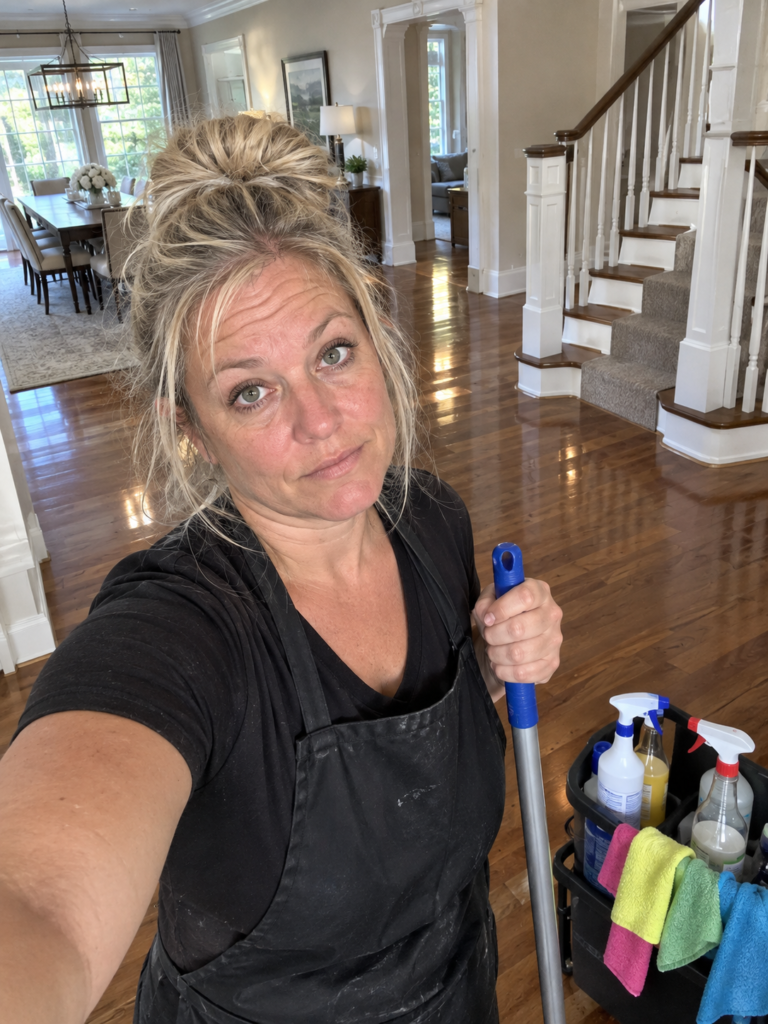
I wasn’t crying about the peas. I was crying because I had exactly forty-one dollars in my checking account, a nine-year-old daughter waiting in the car, and a husband who had moved out three weeks earlier and taken the good vacuum with him.
I remember that part the most. The vacuum. Of all the things to take. I was starting a cleaning business, and he knew it, and he took the vacuum.
I had spent that afternoon taping handwritten ads to every bulletin board in town. The library. The laundromat. The coffee shop. The corkboard by the grocery store exit, next to the lost cat posters and the guy who sold firewood. I wrote each ad by hand on an index card, in my best handwriting, with little tear-off tabs at the bottom.
HOUSE CLEANING. Honest, reliable, thorough. References available. Call Carly.
The references were two neighbors and my old boss at the dental office where I’d worked the front desk before Willa was born. It wasn’t much. But it was true.
My phone rang while I was loading the groceries into the trunk. I almost didn’t answer. I didn’t recognize the number, and I thought it might be Darren’s lawyer.
“Hello?”
“Is this Carly? The house cleaner?” It was an older woman’s voice. Crisp and careful. The kind of voice that sounded like it had never once said “um.”
“Yes. Yes, this is Carly.”
“My name is Margaret Whitaker. I saw your card at the library. I have a house on Linden Street. Four bedrooms, three baths. I need someone once a week. Are you available on Thursdays?”
I was available every day of the week. I was available at three in the morning if she wanted. But I tried to sound like a professional.
“Let me check,” I said. I stood there in the rain holding my phone and counted to five. “Yes. I have Thursdays open.”
“Good. Could you come by tomorrow at ten? So we can meet. And so you can see the house.”
“Of course.”
“You’re crying,” she said.
I froze. I hadn’t made a sound. At least, I didn’t think I had.
“I’m sorry?”
“It’s all right. It’s raining, too. I can hear it.” There was a short pause. “Ten o’clock tomorrow. 418 Linden. The blue door.”
She hung up.
I got into the car. Willa was in the back seat with her library book open on her knees. She had been watching me through the window.
“Who was that?” she asked.
“A lady,” I said. I wiped my face with the back of my hand. “I think she might be our first real job.”
“Is she nice?”
I thought about the crisp voice. You’re crying. She hadn’t asked why. She hadn’t said oh, you poor thing. She just noticed, and said so, and moved on.
“I don’t know yet,” I said. “I think maybe.”
The house on Linden Street was the biggest house I had ever been inside.
It was old, from the 1920s, with a wide front porch and white columns and a blue front door with a brass knocker shaped like a pineapple. There was a big oak tree in the front yard and a garden along the side with roses that had been cut back for winter.
Mrs. Whitaker opened the door before I could knock.
She was about seventy then. Small and straight-backed, with short white hair and reading glasses on a thin silver chain. She was wearing gray slacks and a navy cardigan with pearl buttons. She looked like a librarian, or a judge, or somebody’s very strict grandmother.
She looked me up and down. I was wearing my cleanest jeans and a sweater I’d bought at the thrift store the week before. I had my hair pulled back in a ponytail. I’d put on mascara, and then taken it off, because I was afraid I’d cry again and it would run.
“Come in, Carly,” she said.
She showed me the house. The long front hall with the wooden floors. The living room with the fireplace and the big piano nobody played. The formal dining room with a table long enough for twelve people. The kitchen, which was huge and old-fashioned, with white cabinets and a black-and-white checkered floor. The four bedrooms upstairs. The three bathrooms, one with a claw-foot tub.
“My husband and I bought this house in 1971,” she said as we walked. “We raised our daughter here. Susan. She lives in Oregon now. My husband passed away two years ago.” She said it simply, the way you’d tell someone the time. “The house is too big for one person. But I’m too stubborn to leave it.”
“It’s beautiful,” I said. And I meant it.
“It’s a lot of dust,” she said. “That’s what it is.”
We ended up back in the kitchen. She sat down at the small round table by the window. She didn’t ask me to sit. So I stood.
“I’ll pay you a hundred dollars a week,” she said. “Every Thursday, nine to two. I’ll leave a check on the counter. If you need supplies, tell me and I’ll buy them, or buy them yourself and leave me the receipt.”
A hundred dollars a week. Four hundred dollars a month. I did the math in my head standing there. It wasn’t enough to live on. But it was enough to pay the electric bill and buy groceries. It was a start.
“That sounds wonderful,” I said.
“You’ll have a key. I’m often out on Thursdays. I play bridge. I volunteer at the hospital gift shop.” She reached into a drawer and took out a single brass key on a plain ring. She held it out to me. “Don’t lose it.”
I took it. It felt heavy in my hand. Heavier than a key should feel.
“You don’t know me,” I said before I could stop myself. “You’re just giving me a key?”
She looked at me over her reading glasses.
“I called your references,” she said. “Your old boss at the dental office said you once drove forty minutes to return a patient’s wallet he’d left in the waiting room. Your neighbor said you watched her dog for two weeks and wouldn’t take any money.” She folded her hands on the table. “And you cried in a parking lot and apologized for it. People who are going to steal from you don’t usually apologize for crying.”
I didn’t know what to say. So I said, “Thank you, Mrs. Whitaker.”
“Thursday,” she said. “Nine o’clock.”
That first Thursday, I was so nervous I got there at 8:40 and sat in my car at the curb for twenty minutes so I wouldn’t be early.
Mrs. Whitaker had left a note on the kitchen counter. It was written on thick cream-colored paper in perfect cursive.
Carly —
Supplies are under the sink. Please do not use bleach on the kitchen floor; it’s original. The guest towels are the white ones with the blue stitching. The towels for me are the plain gray. Please don’t move the photographs on the piano. I’ll be back around one.
— M.W.
I followed every word of that note like it was the law.
I cleaned that house harder than I have ever cleaned anything in my life. I scrubbed the grout in the upstairs bathroom with a toothbrush. I dusted the tops of the doorframes. I washed the baseboards on my hands and knees. I cleaned the inside of the oven, which I’m pretty sure hadn’t been cleaned since the Carter administration.
When I dusted the piano, I lifted each picture frame, wiped underneath it, and put it back down in exactly the same spot. I lined them up with the little dust outlines so they wouldn’t move even a quarter of an inch.
There were a lot of pictures. A young couple on their wedding day, in black and white. A little girl with pigtails on a swing. The same girl in a cap and gown. A tall man with a kind face and a bow tie, holding a fish and laughing. I figured that was Mr. Whitaker.
At noon, I was hungry. I had packed a peanut butter sandwich and an apple. I looked around that big, beautiful kitchen with its checkered floor and its round table by the window.
Then I went out and ate my sandwich in my car.
It didn’t feel right to eat in her kitchen. It was her kitchen. I was the cleaner. I didn’t want her to come home and find crumbs, or think I was making myself too comfortable. So I sat in the front seat of my old Honda with the engine off and ate my sandwich and looked at the oak tree.
I did that every Thursday for eight years.
Mrs. Whitaker came home at 1:15 that first day. She walked through the house slowly. I followed her. She didn’t say anything. She ran one finger along the top of the piano. She looked in the upstairs bathroom. She opened the oven.
She stood looking into the oven for a long time.
Then she closed it and turned around.
“Thank you, Carly,” she said.
That was all. But she said it in a way that made me stand up a little straighter the whole drive home.
For the first year, we barely talked.
I came every Thursday at nine. She was usually gone. There was always a note on the counter, on the same thick cream paper, in the same perfect cursive. And there was always a check, made out to Carly Brennan for one hundred dollars. Never late. Never a penny short.
The notes were short and practical.
Carly — The window in the back bedroom sticks. Please don’t force it. — M.W.
Carly — Susan is visiting next week. Could you please make up the blue room? Extra blankets in the hall closet. — M.W.
Carly — There’s soup in the refrigerator if you’d like some. — M.W.
I didn’t take the soup. I thought maybe she was just being polite.
I started leaving notes back. Short ones, on the back of her notes, in my own messy handwriting.
Mrs. W — Out of dish soap. Bought more. Receipt is under the salt shaker. — C.
Mrs. W — The kitchen faucet is dripping. Might need a new washer. — C.
Mrs. W — Found an earring under the couch cushion. Pearl. It’s in the little dish by the door. — C.
Sometimes she was home. On those days, she mostly stayed out of my way. She’d sit in the living room with a book, or out on the back porch with a cup of tea. When I passed her, she’d nod. When I finished, she’d walk through the house and say thank you.
Once in a while, she’d ask a question.
“How is your daughter?”
“She’s good. She’s in fourth grade. She likes to draw.”
“What does she draw?”
“Houses, mostly. She draws houses all the time. Little floor plans. Where the rooms go. She says she’s going to build her own house someday.”
Mrs. Whitaker nodded. “That’s a good ambition.”
And that was it. That was the whole conversation. She went back to her book. I went back to cleaning.
That first winter, I had a problem. Willa’s school closed for three snow days in a row, the week of a Thursday. I had nobody to watch her. My mother lived four hours away. My friends all worked. Darren was “busy,” which is what Darren always was.
I called Mrs. Whitaker on Wednesday night. I was so nervous my voice shook.
“I’m so sorry,” I said. “I know this is unprofessional. Would it be all right if I brought my daughter tomorrow? She’ll be quiet. She’ll just sit in a corner and read. I promise she won’t touch anything.”
There was a long pause on the other end.
“Bring her,” Mrs. Whitaker said.
So I brought Willa. She was nine and a half, with a messy brown braid and glasses that were always sliding down her nose. I sat her at the kitchen table with her library book and a sketchpad and made her promise, four times, that she would not move from that chair.
Mrs. Whitaker was home that day. She came into the kitchen around ten and looked at Willa sitting at her table.
Willa looked back at her. She pushed her glasses up her nose.
“Hi,” Willa said. “I like your house. It has a lot of windows.”
“It does,” Mrs. Whitaker agreed.
“How many?”
Mrs. Whitaker thought about it. “I don’t know, actually. I’ve never counted.”
“Can I count them?”
I was halfway up the stairs with a bucket. I stopped. “Willa. We talked about this. You stay in the chair.”
Mrs. Whitaker looked at me. Then at Willa.
“She can count them,” she said. “I’d like to know.”
So my daughter spent that whole snow day walking around Margaret Whitaker’s house with a sketchpad, counting windows and drawing a floor plan. Room by room. She drew the kitchen with the checkered floor. She drew the living room with the piano. She drew the claw-foot tub.
When she was done, she presented it to Mrs. Whitaker at the kitchen table.
“Forty-two windows,” Willa announced. “And one of them in the attic is broken. There’s a bird’s nest in it.”
Mrs. Whitaker looked at the drawing for a long, long time. She didn’t say anything.
“You can keep it,” Willa said. “If you want.”
“Thank you, Willa,” Mrs. Whitaker said quietly. “I’d like that very much.”
I didn’t think about it again. I figured it would end up in a drawer somewhere, or in the recycling bin.
Life went on. It wasn’t easy. But it went on.
I picked up more clients. By the second year, I had nine houses a week. Mondays were the Garcias and the young couple with the twins. Tuesdays were the dentist’s office and old Mr. Pham. Wednesdays were two houses in the new development out by the highway. Fridays were a real estate office and a woman named Tiffany who liked her throw pillows arranged in a very specific zigzag pattern.
And Thursdays were Mrs. Whitaker.
She was never my biggest client, and she wasn’t my highest-paying. But she was the one I could always count on. The Garcias canceled when they went on vacation. The real estate office cut me back to every other week when the market slowed down. Tiffany fired me once over the throw pillows and then hired me back a month later.
Mrs. Whitaker never canceled. Not once. Not in eight years. Even when she went to visit Susan in Oregon for two weeks at Christmas, she left a note and a check on the counter.
Carly — I’ll be away. Please come as usual. The plants need water and the house needs someone in it. — M.W.
I came as usual. I watered the plants. I dusted the piano. I didn’t know what she meant by the house needs someone in it. I thought maybe she was worried about burglars.
The divorce was final in my second year of working for her. Darren moved to Columbus with his girlfriend and started seeing Willa every other weekend, and then once a month, and then mostly on birthdays. Willa stopped asking when he was coming. That was harder to watch than anything he ever did to me.
In the third year, Willa had her first real asthma attack. We spent a night in the emergency room. The bill came three weeks later, and it was more money than I made in two months. I sat at my kitchen table with that bill in front of me and put my head down on the table and didn’t lift it for a long time.
That Thursday, I must have looked terrible. Mrs. Whitaker was home. She came into the kitchen while I was mopping the checkered floor.
“Is Willa all right?” she asked.
I stopped mopping. I hadn’t told her anything. “How did you know something happened?”
“You’ve mopped that same square three times,” she said.
I looked down. She was right.
So I told her. Not everything. Just that Willa had asthma, and we’d been to the ER, and she was okay now, and they gave her an inhaler.
Mrs. Whitaker listened. She nodded. She didn’t say oh, you poor thing. She didn’t offer me money. I think she knew I wouldn’t have taken it.
She just said, “I’m glad she’s all right.”
And then she said, “Carly, you’ve been working here three years. You can call me Margaret.”
“I don’t think I can,” I said. And I meant it. I don’t know why. It just felt wrong. Like calling your old kindergarten teacher by her first name.
She almost smiled. “All right,” she said. “Mrs. Whitaker it is.”
The next Thursday, there was a check on the counter for one hundred and twenty-five dollars instead of one hundred.
The note said: Carly — Cost of living. — M.W.
That was all. Just those three words. She never mentioned it again. And every Thursday after that, the check was for a hundred and twenty-five.
It was in the fourth year that I found her on the bathroom floor.
It was a Thursday in February. Gray and cold, with old snow crusted along the sidewalks. I let myself in at nine like always. I called out, “Good morning, Mrs. Whitaker!” like always.
She didn’t answer.
That wasn’t unusual. She was often out. But her car was in the driveway. And her purse was on the hall table. And her reading glasses were on the kitchen counter, next to a cup of tea that had gone cold, with the tea bag still in it.
Mrs. Whitaker never left a tea bag in a cup. Never.
I stood in the kitchen and felt something cold go down the back of my neck.
“Mrs. Whitaker?”
Nothing.
I went through the downstairs. Living room. Dining room. The little study with the rolltop desk. Empty.
I went up the stairs. I called her name again. My voice sounded thin and strange in that big quiet house.
Her bedroom door was open. Her bed was made. And the door to her bathroom, the one with the claw-foot tub, was half closed.
I pushed it open.
She was lying on the tile floor between the tub and the sink. She was wearing her flannel nightgown. One arm was under her at a bad angle. Her face was gray. Her eyes were closed.
I don’t remember deciding to do anything. I just remember my knees hitting the tile.
“Mrs. Whitaker! Mrs. Whitaker, can you hear me?”
Her eyes opened. Just a little. They were cloudy and confused. Her lips moved.
“Carly,” she whispered. “It’s Thursday.”
“Yes. Yes, it’s Thursday. I’m here. I’ve got you.”
“I’ve been waiting,” she said. “I knew you’d come on Thursday.”
I called 911 with my hands shaking so badly I dropped the phone twice. I got a towel from the rack, one of the plain gray ones, the ones for her, and I folded it under her head. I got the blanket from her bed and covered her with it. Her hands were ice cold. I held them between mine and rubbed them and talked to her the whole time, about anything, about the weather, about Willa, about the bird’s nest in the attic window, just so she would keep her eyes open.
The paramedics came in eleven minutes. It felt like eleven hours.
She had fallen getting out of the bath on Tuesday night. She had broken her hip. She couldn’t get up. She couldn’t reach the phone, which was on the nightstand in the bedroom. She had been lying on that cold tile floor for almost thirty-six hours.
“Another day,” the paramedic told me quietly as they carried her down the stairs on a stretcher, “and I don’t think she’d have made it. Dehydration. Hypothermia. At her age.” He shook his head. “You found her just in time.”
I rode with her in the ambulance. Nobody told me I could. Nobody told me I couldn’t. I just climbed in, and the paramedic looked at me, and he didn’t say anything.
At the hospital, they asked me if I was family.
“No,” I said. “I’m her cleaner.”
The nurse gave me a strange look. “Is there family we should call?”
I called Susan in Oregon. I had her number because it was on a list taped inside the cabinet by the phone, in Mrs. Whitaker’s perfect cursive. In case of emergency.
Susan cried on the phone. She said she was getting on the first flight she could. She asked me to please stay with her mother until she got there.
So I stayed. I called my other client for the afternoon and canceled. I called my neighbor to get Willa off the bus. I sat in the hospital waiting room while they did surgery on Mrs. Whitaker’s hip, and then I sat next to her bed in the recovery room while she slept.
When she woke up, it was dark outside. She looked at me for a long time without saying anything.
“You’re still here,” she said finally.
“Susan’s flight lands at six in the morning. I told her I’d stay.”
“You have Willa.”
“Willa’s with my neighbor. She’s fine. She sent you this.”
I held up a piece of paper. Willa had drawn it that afternoon, when I called and told her what happened. It was a picture of Mrs. Whitaker’s house. All forty-two windows. And in every single window, she had drawn a little yellow light.
GET WELL SOON, it said at the top, in purple marker. THE HOUSE MISSES YOU.
Mrs. Whitaker looked at it. She didn’t say anything. Her chin trembled.
Then she turned her face toward the wall.
I sat there in the dark and held her hand, and I didn’t say anything either.
She was in the hospital for a week and a rehab center for five more. I kept going to the house every Thursday. I watered the plants. I dusted the piano. I got the mail and put it on the hall table.
Now I understood what she meant by the house needs someone in it.
I went to see her at the rehab center twice. Once with Willa. Willa brought a new drawing, a floor plan of the rehab center, all the hallways and the dining room and the physical therapy gym. The nurses loved it. They taped it to the wall at the nurses’ station.
When Mrs. Whitaker came home in April, walking with a cane, Susan stayed with her for a month. Susan was about my age, maybe a little older. She had her mother’s straight back and her father’s kind face.
On her last day, before she flew home, Susan found me in the kitchen. I was wiping down the counters.
“Carly,” she said. “Can I tell you something?”
“Of course.”
“My mother isn’t a person who says things,” Susan said. “You’ve probably noticed. She was a school principal for twenty-eight years. She ran that school like a navy ship. She loved us, my dad and me. But she never said it much. She showed it. In very, very small ways.” She looked at me. “I just want you to know. She talks about you. On the phone. Every week.”
I stopped wiping.
“She does?”
“Every Sunday when I call. ‘Carly found my pearl earring.’ ‘Carly fixed the sticky drawer.’ ‘Carly’s daughter counted the windows.’” Susan smiled. “I know more about you than I know about some of my own cousins.”
I didn’t know what to say.
“You saved her life,” Susan said. “The doctor said so. And I know she’ll never say it to you. So I’m saying it. Thank you.”
She hugged me. Right there in the kitchen, with the dishrag still in my hand.
After Susan left, things went back to normal. Mostly.
Mrs. Whitaker still left notes. She still left a check. She still called me Carly and I still called her Mrs. Whitaker. I still ate my lunch in my car.
But she stopped going out on Thursdays. She was always home now. She’d sit in the living room with her book and her cane, and when I came through to dust, she’d ask me something.
“How is Willa’s science project?”
“What is Willa reading these days?”
“Did Willa get her braces off?”
And sometimes, not very often, I’d look up from dusting the piano and find her watching me. Not in a checking-up way. In a different way. A way I couldn’t name.
I found out later what it was.
Willa grew up.
That’s the thing nobody warns you about. You’re so busy working and paying bills and making sure there’s food in the fridge that you blink, and your nine-year-old with the messy braid and the sliding glasses is suddenly seventeen, with contacts and a driver’s permit and very strong opinions about everything.
She still drew houses. All the time. She took every art class her high school offered. She took drafting. She took geometry and got an A. In her junior year, she won a regional contest for high school students, designing a small, affordable house for a single family. Her house had big windows everywhere. And a little reading nook under the stairs.
“Forty-two windows,” she told me, grinning, when she showed me the plans. “Well, fourteen. It’s a small house. But you get the idea.”
She wanted to study architecture. There was a good program at a university about two hours away. She’d been talking about it since she was twelve.
It cost thirty-two thousand dollars a year.
I was proud of her. I was so proud of her I thought my heart would burst. And I was terrified, because I knew exactly how much money I had, and it was nowhere near thirty-two thousand dollars a year. It was nowhere near thirty-two thousand dollars total.
We filled out the financial aid forms together at the kitchen table. Willa applied for every scholarship she could find. She wrote essays until two in the morning. I picked up two more cleaning jobs on Saturdays. I stopped buying coffee at the gas station. I told myself we’d figure it out. Loans. Grants. Something.
I didn’t tell Mrs. Whitaker any of this. It wasn’t her business. I was her cleaner.
But she asked about Willa every Thursday. And one Thursday, in September of Willa’s senior year, she asked me where Willa was applying to college.
I told her.
“Architecture,” Mrs. Whitaker said. She nodded slowly. “Of course. The windows.”
“The windows,” I agreed.
She didn’t ask me how we were going to pay for it. And I didn’t say.
Three weeks later, she told me she was moving.
It was a Thursday in October. I had just finished the upstairs. I came down the stairs with my bucket, and Mrs. Whitaker was sitting at the kitchen table with a cup of tea, and she said, “Carly, would you sit down for a moment?”
In eight years, she had never asked me to sit down.
I sat. On the edge of the chair. With my bucket still in my hand.
“I’m moving to Oregon,” she said. “To be near Susan. There’s a very nice apartment in a building for older people, about ten minutes from her house. It has an elevator. And a dining room. And a library.”
“Oh,” I said. It came out like I’d been punched. “Oh. That’s— that’s wonderful. That’s really good. For you.”
“I’m eighty,” she said. “I’m tired of having a whole upstairs I don’t use.”
We both laughed. It was a strange, wobbly laugh.
“When?” I asked.
“The house is listed. There’s already an offer. A young family, with three little boys. I’ll be gone by the end of November.”
The end of November. Six weeks.
I drove home that day and sat in my driveway for twenty minutes before I went inside. I told myself it was about the money. Losing my most reliable client. A hundred and twenty-five dollars a week. That was a lot of money to lose.
But it wasn’t about the money. I knew it wasn’t.
I just didn’t know what it was about.
The last Thursday was the Thursday before Thanksgiving.
The movers had come on Monday. Most of the furniture was gone. The piano was gone, shipped to Susan’s house. The long dining room table was gone. The beds were gone. The rugs were rolled up and gone.
I walked into that house at nine o’clock, and my footsteps echoed.
I cleaned it anyway. There wasn’t much left to clean. Mostly I wiped down the empty rooms and swept the bare floors. But I did every room. Every bathroom. I cleaned the claw-foot tub, even though nobody would use it for a while. I cleaned the checkered kitchen floor on my hands and knees, the way I had four hundred times before.
It was harder than I expected. There were pale rectangles on the walls where the pictures had hung for fifty years. The wedding photo. The little girl on the swing. The man with the bow tie and the fish. The wallpaper around them had faded, and the rectangles underneath were brighter, like ghosts.
The kitchen calendar was gone. It had hung by the phone for eight years. Every Thursday, there was a little C written on it in her perfect cursive. I used to see it and feel something I couldn’t name.
I kept reaching to move things that weren’t there anymore. I went to lift the picture frames off the piano, and there was no piano. I went to straighten the guest towels, and there were no towels. I went to check the sticky drawer, and the drawer was empty, and it slid open without sticking at all, because somebody had finally fixed it.
It was me. I had fixed it two years ago. With a bar of soap on the runners.
Mrs. Whitaker was there. She was sitting in one of the two chairs she’d kept, at the small round kitchen table by the window. She didn’t read. She didn’t drink her tea. She just sat there and watched me work.
At two o’clock, I was done. I put my supplies back in my bucket. I carried it to the front door.
Then I took the brass key off my key ring. The one she’d handed me eight years ago in this same kitchen. Don’t lose it. I hadn’t. Not once.
I held it out to her.
She took my hand instead of the key.
She closed my fingers around it, one by one. Her hand was thin and dry and cool. She held on.
“Not yet,” she said. “Come back on Saturday. Eleven o’clock.”
“Do you need me to clean after the movers?”
“No.” She let go of my hand. “And leave your supplies at home.”
I must have looked confused. Because she looked at me over her reading glasses, the way she did that very first day, and said:
“I’m asking you to visit, Carly.”
I didn’t know what to wear.
That sounds silly. But I stood in front of my closet on Saturday morning for twenty minutes. Every pair of pants I owned had bleach spots on them. Every shirt was a T-shirt, or a sweatshirt, or the purple polo I wore to the dentist’s office.
Finally I found a pair of dark jeans in the back of the closet that I’d bought for Willa’s junior year art show and never worn again. No bleach spots. And a blouse, pale blue, with little white flowers. I only wore it to school events. Parent-teacher conferences. Awards nights.
Willa came into my room while I was looking in the mirror.
“Where are you going?” she asked. “You look nice.”
“Mrs. Whitaker asked me to come over.”
“On a Saturday?”
“She said it was a visit.”
Willa raised her eyebrows. “Like, a social visit? Like a friend?”
“I don’t know,” I said. “I guess.”
“Bring something,” Willa said. “You can’t go to somebody’s house for a visit with nothing. That’s rude.”
She was right. So on Friday night, we made cookies. Oatmeal chocolate chip. Willa’s recipe, the one she’d been perfecting since middle school. I put them on a paper plate and covered them with plastic wrap and tied a little piece of ribbon around the top, which made me feel ridiculous.
I even cleaned out the back seat of my car. I figured she might have old clothes she wanted to give away. Or dishes. Or books. People who are moving always have things they want to get rid of. I was used to it. Half the furniture in my house came from clients who were moving.
At 10:55, I parked at the curb in front of 418 Linden Street.
At 10:59, I walked up the porch steps.
At 11:00 on the dot, I raised my hand to knock on the blue door with the brass pineapple.
For the first time in eight years, I knocked. I didn’t use my key.
She opened the door right away. She was wearing a soft gray sweater and a string of pearls. She looked at me in my dark jeans and my blue blouse. She looked at the cookies with the ridiculous ribbon.
“You look lovely, Carly,” she said. “Come in.”
Most of the house was empty. Our footsteps echoed down the long hall.
But the kitchen had the round table by the window and two chairs. And on the table, there was a white tablecloth. And two real plates, china plates with little blue flowers around the edges. And two real glasses. And real cloth napkins, folded in triangles.
And there were sandwiches. Chicken salad on soft bread, cut into little triangles with the crusts cut off. A bowl of grapes. A pitcher of iced tea with lemon slices floating in it.
I stood in the doorway of that kitchen and just looked at it.
“Sit down,” Mrs. Whitaker said. “I know you usually eat lunch in your car.”
I stopped.
“You knew that?”
“Every Thursday for eight years,” she said. “Twelve o’clock. Peanut butter, mostly. Sometimes turkey. You sit in the front seat and look at the oak tree.” She pulled out a chair for me. “I watched you from the upstairs window. Every week, I thought, This time I’ll go down and ask her to come in. And every week, I didn’t.”
“Why not?”
She sat down across from me. She unfolded her napkin and laid it carefully in her lap.
“Because I’m a stubborn old woman who doesn’t know how to say things,” she said. “Ask Susan. She’ll tell you.”
I sat down. I unfolded my napkin. My hands were shaking a little.
We ate chicken salad sandwiches. They were good. She said she’d made them herself, from her mother’s recipe, with grapes and walnuts. We talked. Really talked, for the first time in eight years. About the move. About her new apartment in Oregon, which had a window that looked out at a mountain. About Susan’s kids, who were in college now. About the young family who was buying the house.
“Three little boys,” she said. “I told them about the bird’s nest in the attic window. The father said he’d leave it.”
We talked about Willa. About her senior year. About the regional contest and her little house with fourteen windows.
“She’s applying to the architecture program,” I said. “At the state university. It’s her dream school. She’s been working on her portfolio for a year.”
“She’ll get in,” Mrs. Whitaker said.
“I hope so.”
“She’ll get in,” Mrs. Whitaker said again. Like it was a fact. Like she was a principal, telling a nervous student something she already knew.
When we finished eating, I did what I always do. I automatically started stacking our plates. I picked up hers and put it on top of mine and started to stand up to carry them to the sink.
Mrs. Whitaker reached across the table and put her hand on mine.
“Leave those,” she said.
“I don’t mind—”
“Carly. Leave them.” She held my hand on the table. “There’s something I want to show you.”
She got up from her chair. She used her cane. She walked slowly to the cabinet by the back door, the one where she used to keep her emergency list taped inside the door.
She took out a box.
It was a shoebox. An old one, from a store that went out of business years ago. It was held together with two thick rubber bands.
She brought it back to the table and set it down in front of me. Then she sat down across from me and folded her hands.
“Open it,” she said.
I took off the rubber bands. I lifted the lid.
It was full of paper. Hundreds of little pieces of paper. Scraps. Notes. Some on the back of receipts. Some on the back of her own cream-colored stationery. Some on sticky notes. They were all stacked neatly, in order, with the oldest at the bottom.
I picked up the one on top.
Mrs. W — Fixed the sticky drawer. Soap on the runners. Should slide now. — C.
I picked up the next one.
Mrs. W — Your hydrangeas look thirsty. I watered them. Hope that’s okay. — C.
The next one.
Mrs. W — Found a birthday card from your husband in the back of the desk drawer when I was dusting. I didn’t read it. I put it on your nightstand. — C.
I looked up at her. She was watching me.
“These are my notes,” I said.
“Every single one,” she said. “Eight years. Four hundred and twelve Thursdays. I kept them all.”
I started going through them. My own messy handwriting, over and over. Out of dish soap. Found your earring. Faucet is dripping. Bought more lightbulbs. Receipt under the salt shaker.
And mixed in with the notes, there were other things.
Willa’s drawings. Every single one she’d ever left at that house. The floor plan from the snow day, with all forty-two windows counted and labeled. The GET WELL SOON picture with the yellow lights in every window. A birthday card Willa had made when she was eleven, with a drawing of a cake shaped like a house. A little clay pineapple Willa made in sixth grade art class, to match the knocker on the blue door. I had forgotten all about that. I remembered now, Willa wrapping it in tissue paper and making me promise to give it to Mrs. Whitaker.
At the very bottom of the box, there was a note I didn’t recognize. It was in my handwriting. But I didn’t remember writing it.
It was on the back of a hospital cafeteria napkin.
Mrs. W — Susan’s flight lands at 6. I’m going to sleep in the chair. I’m right here if you need anything. You’re not alone. — C.
I didn’t remember writing it. I must have written it that first night in the hospital, while she was asleep after surgery. Left it on her tray table. And she kept it. For four years.
I put the napkin down on the table. I couldn’t see it anymore. My eyes were too full.
“Why?” I said. “Why did you keep all of this?”
Mrs. Whitaker took off her reading glasses. She folded them and set them on the tablecloth. Without them, her face looked softer. Older. More tired.
“When my husband died,” she said, “people came for about a month. They brought casseroles. They sent cards. Then they stopped. Everybody went back to their lives. That’s what people do. I understand it. I did it myself, for other people, for years.” She looked out the window at the oak tree. “And then it was just me. In this big house. With forty-two windows and nobody to look out of them with.”
She was quiet for a moment.
“I was going to sell the house,” she said. “That spring. Before I found your card at the library. I had a real estate agent coming on a Friday. I thought, what’s the point? What’s the point of staying here, just me and the dust?”
“But you didn’t sell it.”
“No.” She turned back to me. “Because you came on Thursday. And you cleaned my oven. And you lined my picture frames up with the dust marks so they wouldn’t move a quarter of an inch.” She almost smiled. “Do you know how long it had been since anyone paid that kind of attention to anything in this house? To anything of mine?”
I shook my head.
“You gave me a reason to get up on Thursdays,” she said. “And then your little girl came on that snow day and counted my windows. And I realized I’d lived in this house for forty years and never once counted them myself. I’d stopped looking. At everything. And that little girl with her glasses sliding down her nose, she looked at everything.”
She reached over and touched the snow day drawing with one finger.
“I called Susan that night. For the first time in months, I had something to tell her. I said, ‘My house has forty-two windows. Did you know that?’ And she said, ‘Mom, are you okay? You sound happy.’”
I was crying now. I couldn’t stop.
“And then I fell,” she said quietly. “In the bathroom. On a Tuesday night. I lay on that floor for a day and a half. And I wasn’t scared, Carly. That’s the strange part. I was cold, and I was in terrible pain, and I knew I might die there. But I wasn’t scared. Because I kept thinking, It’s Tuesday. Wednesday. Carly comes on Thursday. I just have to hold on until Thursday.“
She reached across the table and took both my hands.
“You were the one thing in my life I could count on,” she said. “Every single week. For eight years. You never canceled. You were never late. You never took a glass from my cabinet without asking. You ate your lunch in your car so you wouldn’t leave crumbs. You thought you were just my cleaner.” Her voice cracked for the first time. “You were never just my cleaner, Carly. Not for one single Thursday.”
I don’t know how long we sat there. Holding hands across that little round table in the empty kitchen, both of us crying.
Finally, she let go. She wiped her eyes with her cloth napkin. She put her reading glasses back on. She was Mrs. Whitaker again. Straight back. Crisp voice.
“There’s one more thing in the box,” she said. “Under the lid. Taped to the inside.”
I picked up the lid of the shoebox. I turned it over.
Taped to the inside, there was a long white envelope. On the front, in her perfect cursive, it said: For Willa.
“Open it,” she said.
“Mrs. Whitaker—”
“Open it, Carly.”
I peeled the tape off carefully. I opened the envelope. Inside, there was a folded piece of paper. A bank statement. From a college savings account.
At the top, it said: Beneficiary: Willa Rose Brennan.
I didn’t understand what I was looking at. I read it three times. Then I saw the number at the bottom. The balance.
$58,340.17.
I dropped the paper on the table like it had burned me.
“No,” I said. “No. No, no, no. I can’t. We can’t. Mrs. Whitaker, no.”
“It’s not for you,” she said calmly. “It’s for Willa. So you can’t say no. It isn’t yours to say no to.”
“Where did this come from?”
She folded her hands on the table.
“The first Thursday you worked here,” she said, “I came home and opened the oven. Do you remember?”
“Yes.”
“I stood there looking into that clean oven, and I thought about you crying in the parking lot. And your little girl in the car. And I went to my desk, and I wrote two checks. One for you. A hundred dollars. And one for a college savings account in your daughter’s name. A hundred dollars.”
I stared at her.
“Every Thursday,” she said. “For eight years. Two checks. When I raised yours to a hundred and twenty-five, I raised hers too. Four hundred and twelve Thursdays. And the account grew a little on its own, the way they do.” She tapped the paper. “That’s what’s left over after you add it all up.”
“Every Thursday,” I whispered.
“Every Thursday. The same amount I paid you. You cleaned my house. And the house paid for her future.” She smiled a little. “It seemed fair.”
“You never said anything. For eight years. You never said one word.”
“I told you. I’m a stubborn old woman who doesn’t know how to say things.” She looked at me steadily. “And if I had told you, you’d have said no. Just like you’re saying now. You’d have quit. You’d have been too proud. I know you, Carly. I’ve been watching you for eight years.”
“This is too much,” I said. “This is way too much. I can’t let you do this. I can’t accept it.”
“You don’t have to accept it,” she said. “Willa does. And you’re going to let her. Because it’s already done, and it’s in her name, and there’s nothing you can do about it.” She paused. “And because it isn’t charity. It’s a debt. An old one. I’ve been waiting a very long time to pay it back.”
“A debt? To who? You don’t owe me anything.”
“Not to you,” she said. “To a woman named Alice Ashford.”
She got up. She walked to the window over the sink and stood there with her cane, looking out at the backyard. At the bare garden and the oak tree and the gray November sky.
“My mother cleaned houses,” she said.
I stared at her back.
“Your mother—”
“She cleaned houses. For thirty-one years. In Pittsburgh. My father worked at the steel mill and drank most of what he earned, and then he left when I was six, and after that it was just my mother and me. She cleaned five houses a week. Sometimes six.” Mrs. Whitaker’s voice was very steady. The steadiness of someone who had practiced saying something in her head for a long time. “She had a bucket. A gray metal bucket, with a dent in the side. I remember that bucket better than I remember most of my childhood.”
“I didn’t know,” I said.
“Nobody knows. I don’t talk about it. For a long time, I was ashamed of it. Can you imagine? I became a school principal. I wore pearls. I bought a house with forty-two windows. And I never told anybody my mother was a cleaning lady.” She shook her head. “That’s the thing I’m most ashamed of in my whole life. Being ashamed of her.”
She turned around.
“One of the houses my mother cleaned belonged to a woman named Alice Ashford. A widow. Wealthy. Very proper. My mother cleaned for her every Thursday for twelve years.” Mrs. Whitaker almost laughed. “Thursdays. Can you believe that?”
I couldn’t say anything.
“Mrs. Ashford was never warm. Never friendly. She called my mother by her first name and my mother called her Mrs. Ashford. My mother ate her lunch on the back steps, because it didn’t feel right to eat in Mrs. Ashford’s kitchen.” She looked at me. “Does that sound familiar?”
I nodded. I couldn’t speak.
“When I was seventeen, I got into college. A good one. The first person in my whole family to even apply. And we didn’t have the money. Not even close. I was going to go to work at the telephone company instead. My mother cried for a week.”
She walked back to the table. She sat down slowly.
“The week before I was supposed to start at the telephone company, a letter came in the mail. From a bank. It said a scholarship had been established in my name. It would pay for four years of tuition. It was from an anonymous donor.”
“Mrs. Ashford,” I said.
“Mrs. Ashford. She had been putting money aside for me since I was nine years old. Every Thursday. The same amount she paid my mother.” Mrs. Whitaker’s eyes were bright with tears again. “My mother never knew until after I graduated. When she found out, she went to Mrs. Ashford’s house and tried to give it back. Mrs. Ashford wouldn’t take it. She said, ‘It isn’t charity, Rose. It’s a debt I owe someone else. And someday your daughter will owe it too.’”
Rose.
I looked up sharply. “Rose?”
“My mother’s name,” Mrs. Whitaker said softly. “Rose.”
Willa Rose Brennan.
I had named my daughter after my grandmother. I had never told Mrs. Whitaker that. She had just seen it, on some school form or permission slip, over the years. And she had never said a word.
“I never paid it back,” Mrs. Whitaker said. “Mrs. Ashford died when I was in my second year of teaching. I never got a chance. I was going to do it for Susan’s friends, maybe, or for a student. And then I got busy. I got married. I had a career. I told myself someday. And someday never came.” She put her hand flat on the shoebox. “And then, fifty years later, a young woman cried in a parking lot on the phone with me. And I thought, Oh. There it is. There’s someday.“
I didn’t say yes that day.
I want to be honest about that. I sat at that table and cried and said I can’t, I can’t, it’s too much for probably half an hour. Mrs. Whitaker let me. She just sat there and waited, the way she waited on that bathroom floor for Thursday to come.
When I was finally quiet, she said one more thing.
“Mrs. Ashford told my mother something else. My mother wrote it down, and I kept it. It’s in my wallet.” She reached into her purse. She took out an old leather wallet, and from behind her driver’s license, she pulled out a tiny folded piece of paper, yellowed and soft, like old cloth.
She unfolded it and handed it to me.
It was written in pencil. The handwriting was careful and a little shaky. Like someone who hadn’t gone to school very long.
Mrs. Ashford says: The work of keeping a house is the work of keeping a life. Nobody sees it until it stops. But it is never small. It is never nothing. And anyone who does it well deserves to see their children do anything they want.
At the bottom, in the same careful pencil: — written down by Rose Kowalczyk, 1959.
I held that little piece of paper for a long time.
I thought about four hundred and twelve Thursdays. The grout I scrubbed with a toothbrush. The baseboards. The picture frames lined up with the dust marks. The oven. The sticky drawer and the bar of soap. All the things I did that I thought nobody noticed. All the things I did because I thought that’s just what you did when someone trusted you with their home.
Nobody sees it until it stops.
Mrs. Whitaker saw it. Every single Thursday.
“Okay,” I whispered. “Okay.”
“Okay?”
“Okay. For Willa.” I folded the little piece of paper back up and handed it to her. “But I have one condition.”
She raised her eyebrows. “A condition? You’re negotiating with me?”
“I learned from the best.”
She laughed. A real laugh. I had never heard her laugh like that before, loud and surprised, with her head tipped back.
“All right,” she said. “What’s your condition?”
“You come to her graduation,” I said. “In May. You fly back from Oregon and you sit next to me in the bleachers and you watch her get her diploma. And when she gets to college, you visit her. And when she designs her first real house, you come see it.”
Mrs. Whitaker stopped laughing. She looked at me for a long moment.
“That’s three conditions,” she said.
“Take it or leave it.”
She reached across the table and held out her hand. Not to take mine. To shake it. Like a business deal.
“Deal,” she said.
We shook on it.
Then she said, “Now. The key.”
I had forgotten about the key. It was in my jeans pocket. I took it out. The brass key on the plain ring, worn smooth from eight years in my pocket.
“The new family moves in next week,” she said. “They’ll change the locks. That key won’t open anything anymore after Monday.”
“I know.”
“Keep it anyway,” she said. “I want you to have it. So you remember.” She closed my fingers around it again, the same way she did on Thursday. “This house was the first one that trusted you. Don’t ever forget that you were worth trusting.”
I drove home with an empty back seat. No old clothes. No dishes. No books.
Just a shoebox with two rubber bands on it, sitting on the passenger seat next to me, with my own notes inside it and my daughter’s drawings and a bank statement I still couldn’t quite believe was real.
Willa was sitting at the kitchen table when I came in. She had her laptop open and a stack of scholarship applications next to her. She’d been working on them all morning. Essay after essay.
“How was it?” she asked without looking up. “Did she give you her old dishes?”
I set the shoebox down on the table in front of her.
“Open it,” I said.
She looked up at me. At my face. I don’t know what she saw. Probably mascara running down my cheeks.
“Mom? Are you okay?”
“Open it, baby.”
She opened it. She saw her own drawings first. The snow day floor plan. The forty-two windows.
“Oh my God,” she said. “She kept these? She kept all of these?”
“Every single one.”
She went through the drawings one by one. The get-well card with the yellow lights. The birthday cake shaped like a house. The little clay pineapple, which made her laugh out loud. “I can’t believe she kept this! It’s so ugly!”
Then she found the envelope taped inside the lid. She looked at the front. For Willa. She looked up at me.
“Go ahead,” I said.
She opened it. She unfolded the bank statement. She read it.
I watched my daughter’s face. I watched her read the name at the top. I watched her find the number at the bottom. I watched her read it again. And again.
She didn’t say anything. She just stared at it.
Then she put it down on the table very carefully, like it might break. And she put her face in her hands. And she started to cry.
I sat down next to her. I put my arm around her.
“Every Thursday,” I said. “For eight years. Every time she paid me, she put the same amount into this account for you. She started the very first day. The day you were nine.”
“Why?” Willa whispered through her fingers. “Why would she do that?”
So I told her. About Rose Kowalczyk and her gray metal bucket with the dent in the side. About Alice Ashford and her Thursdays. About a debt that was fifty years old. About a little piece of paper with pencil writing on it that said It is never small. It is never nothing.
When I was done, Willa lifted her head.
“Mom,” she said. “Your middle name is Rose. And Great-Grandma’s. And mine.”
“I know.”
“That’s crazy. That’s actually crazy.”
“I know.”
She wiped her face with the sleeve of her sweatshirt. She looked at the shoebox for a long time. At all the notes in my messy handwriting.
“You never told me,” she said. “About the notes. About fixing her drawer. Sitting with her in the hospital. Any of it.”
“It was just my job.”
“No, it wasn’t,” Willa said. She picked up the hospital napkin. You’re not alone. She read it. Then she looked at me. “Mom. This was never just your job.”
Willa got into the architecture program in March. The letter came on a Thursday.
Of course it did.
She called Mrs. Whitaker in Oregon before she even called her father. I stood in the kitchen doorway and listened.
“I got in,” Willa said into the phone. She was crying and laughing. “I got in, Mrs. Whitaker. I got in.”
There was a pause.
“I know,” Willa said. “I know you said I would. You said it to my mom. She told me.” Another pause. “Yes. I’ll tell her. Yes. I promise.”
She hung up. She turned to me.
“She says she told you so,” Willa said. “And she says she already booked her flight for graduation.”
Mrs. Whitaker kept her word. All three conditions.
In May, she flew back from Oregon. Susan came with her. They stayed at a hotel near the high school. On the day of graduation, Mrs. Whitaker sat next to me in the metal bleachers of the football stadium in a pale yellow dress and a big straw hat, holding her cane between her knees.
When they called Willa’s name, Willa Rose Brennan, Mrs. Whitaker stood up. She didn’t cheer. She didn’t clap. Mrs. Whitaker is not a cheerer or a clapper.
She just stood there, very straight, with her hand pressed flat against her heart, and watched my daughter walk across the stage.
I stood up next to her. And without saying anything, she reached over and took my hand.
After the ceremony, Willa came running across the football field in her cap and gown. She hugged me. Then she turned and hugged Mrs. Whitaker, carefully, because of the cane.
“Thank you,” Willa said into her shoulder.
“Don’t thank me,” Mrs. Whitaker said. “Thank Rose. And Alice. And your mother.” She pulled back and looked Willa in the eye. “And don’t you dare forget what you owe.”
“I won’t,” Willa said. “I promise. Someday.”
“Not someday,” Mrs. Whitaker said. “Someday is a lie we tell ourselves. When the time comes, you’ll know. Don’t wait fifty years like I did.”
That fall, Willa started college. Two hours away. In a dorm room with a window that looked out over a courtyard with an old stone fountain.
She calls me every Thursday night. I don’t think she does it on purpose. It just happens that way.
Mrs. Whitaker calls me too. Every Sunday. She tells me about the mountain outside her window and her book club and the man down the hall who keeps trying to beat her at chess and never does. I tell her about my week. About the houses. About Willa.
Last month she said, “Carly. You still haven’t called me Margaret. Not once. In nine years.”
“I know,” I said.
“Will you ever?”
I thought about it.
“Probably not,” I said.
She laughed that loud, surprised laugh I heard for the first time at her kitchen table. “Good,” she said. “I’d be disappointed in you if you did.”
I still clean houses. I have eleven clients now. I hired a helper last spring, a young woman named Dani who’s twenty-three and has a four-year-old son and was living in her car when I met her. I pay her more than anybody ever paid me when I was starting out. I let her bring her son on snow days. He’s teaching himself to read by sounding out the labels on cleaning bottles.
I still have the brass key. I keep it on my key ring, even though it doesn’t open anything anymore. Sometimes, when I’m nervous, I rub my thumb over it.
And I have a new client on Thursdays.
His name is Mr. Harold Dean. He’s eighty-three. His wife died last winter. He lives alone in a little house on Maple Street with a vegetable garden he doesn’t tend anymore and a dog named Biscuit who’s almost as old as he is.
The first Thursday I cleaned for him, I found an old tea bag sitting in a cup on the counter, cold. And I felt that cold feeling go down the back of my neck, and I went through every room until I found him asleep in his recliner with the TV on.
He was fine. Just asleep. But I understood something in that moment about Mrs. Whitaker. About what a Thursday means to someone who lives alone.
The next Thursday, at noon, I didn’t go out to my car.
I made two sandwiches. Chicken salad, with grapes and walnuts, from a recipe a very stubborn woman gave me. I put them on real plates. I found two cloth napkins in the back of his drawer and folded them into triangles.
I knocked on the door of his den, where he was watching a baseball game with Biscuit asleep on his feet.
“Mr. Dean,” I said. “Would you like to have lunch with me? In the kitchen?”
He looked at me for a long moment. His eyes were watery and blue.
“My wife always set the table like that,” he said, looking past me at the plates. “Real napkins. Every day. Even when it was just us.”
“Then let’s eat like that,” I said.
We ate at his kitchen table. He told me about his wife, whose name was Ellen. He told me they met at a roller rink in 1961 and she knocked him flat on his back on the very first lap. He laughed telling it. He said it was the first time he’d laughed in months.
When we were done, he started to stack the plates.
I reached across the table and put my hand on his.
“Leave those,” I said.
He looked at me.
“I’ve got something I want to show you,” I said. “Next week. It’s a shoebox. It’s got a whole lot of old notes in it. And some drawings. And a story I think you’d like, about a woman named Rose.”
He smiled. It was a small, surprised smile. The kind you give when you realize someone has been paying attention.
“Thursday?” he asked.
“Thursday,” I said.
On my way out, I stopped by his hall table and took out a pen and a piece of paper, and I wrote him a note. It’s a habit now. I can’t help it.
Mr. Dean — Your tomato plants look thirsty. I watered them. See you Thursday.
And then, at the bottom, I added one more line. The way someone once did for me, on a hospital napkin, a long time ago.
You’re not alone.